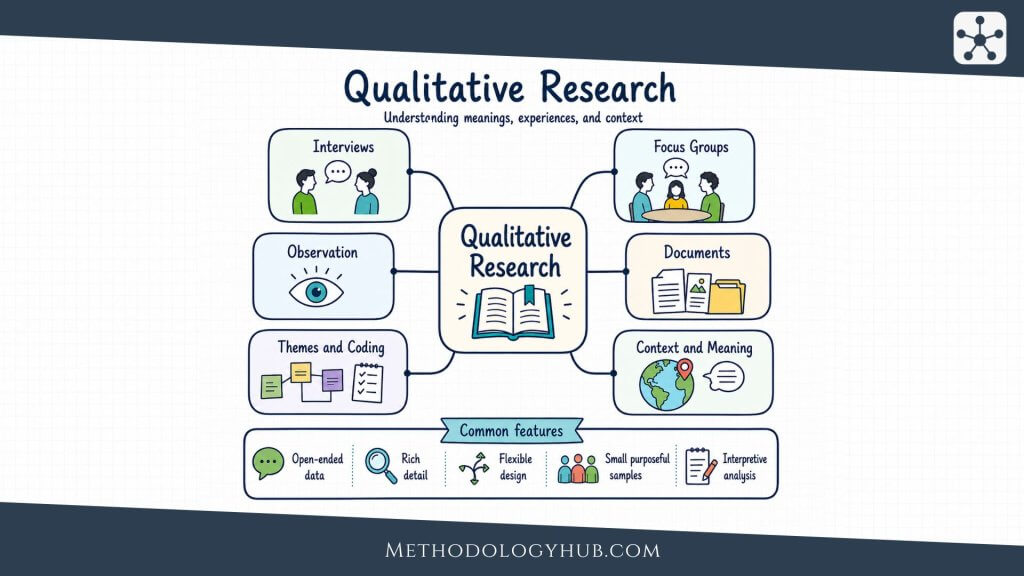
Qualitative research is a type of research used to study meanings, experiences, practices, interactions, texts, and social contexts. Instead of starting with numbers as the main form of evidence, it works closely with words, observations, documents, images, and human accounts. Researchers use qualitative research when they want to understand how people interpret a situation, how a process unfolds, or how a case can be understood in its own setting.
This article explains qualitative research in a beginner-friendly way. It covers when to use it, how to write a qualitative research question, which methods and approaches are common, how sampling works, how qualitative data are analysed, and how qualitative and quantitative research differ.
What Is Qualitative Research?
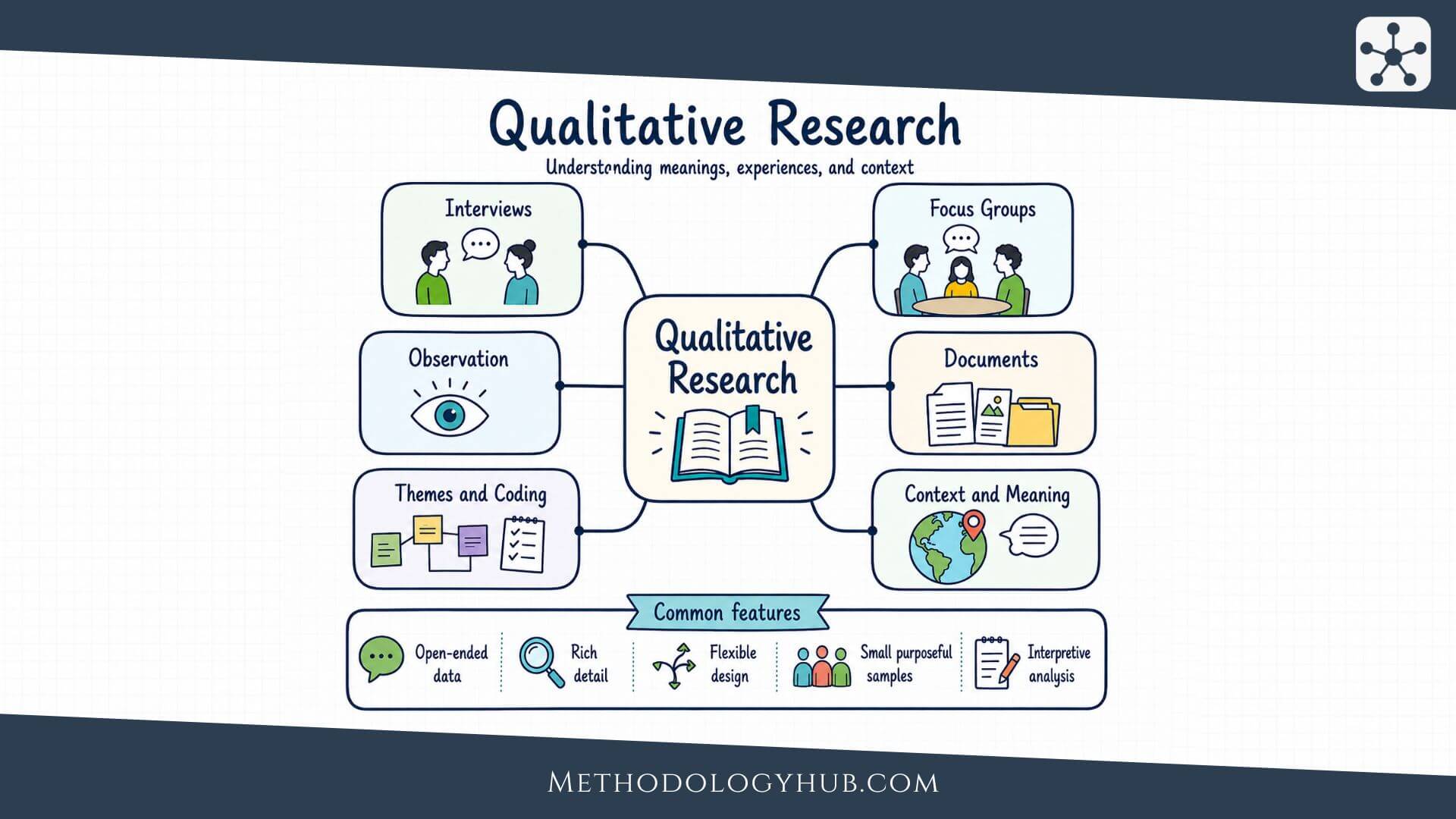
Qualitative research is a way of studying people, settings, texts, and practices through detailed, interpretive evidence. It is often used when the researcher wants to understand experience rather than measure it only as a score. A qualitative study may ask how students experience feedback, how nurses make decisions during handover, how families explain school choice, or how a policy document constructs a problem.
The evidence in qualitative research can come from interviews, focus groups, observations, documents, open-ended survey responses, images, audio recordings, videos, field notes, or online materials. These materials are usually analysed by reading, coding, comparing, interpreting, and connecting patterns back to the research question. The result is not usually a percentage or a test statistic. It is a reasoned explanation of meanings, themes, categories, narratives, practices, or processes.
A simple contrast helps. A quantitative study might ask how many first-year students use a writing centre and whether use is associated with grades. A qualitative study might ask how first-year students decide whether the writing centre feels useful, intimidating, or irrelevant. Both questions can be part of serious research, but they ask for different kinds of evidence.
Most qualitative studies also move back and forth between data and interpretation. A researcher may begin with a focused question, conduct early interviews, notice that participants use an unexpected word, and then adjust later questions so that the word can be explored more carefully. This does not mean the study has no structure. It means the structure allows learning during the research process. The final report should still show how the question, data, analysis, and claims fit together.
This iterative character is one reason qualitative research is useful when concepts are not yet stable. Before a researcher can measure “belonging,” “confidence,” “trust,” or “participation,” it can help to understand how people actually talk about those experiences in a setting. Qualitative evidence can reveal the words, boundaries, and situations that later make measurement more meaningful.
Quality and Trustworthiness in Qualitative Research
Quality in qualitative research depends on more than collecting interesting quotes. Readers need to see how the researcher moved from raw material to findings. That includes how participants or documents were chosen, how data were collected, how coding was carried out, how interpretations were checked, and how the final claims are connected to the evidence.
Trustworthiness is often discussed through four ideas: credibility, dependability, confirmability, and transferability. These terms become easier to understand inside the work of a study. Credibility asks whether the interpretation fits the evidence. Dependability asks whether the research process is described clearly enough to follow. Confirmability asks whether the findings are grounded in the data rather than only in the researcher’s preference. Transferability asks whether readers are given enough detail to judge whether the findings may be useful in another setting.
Good qualitative writing also explains the researcher’s role. In an interview study, the way questions are asked can shape what people say. In observation, the researcher decides where to stand, what to note, and what to treat as relevant. In document analysis, the researcher decides which texts belong in the dataset. These decisions do not make the study weak. They make it necessary to report the path clearly.
Researchers often support trustworthiness through careful documentation. They may keep analytic memos, record changes to the codebook, compare interpretations within a research team, return to earlier transcripts after themes develop, or use several data sources to examine the same process from different angles. These steps are useful only when they are connected to the question. A study does not become stronger by adding procedures mechanically. It becomes stronger when readers can see why the procedures helped the interpretation.
Another useful feature is thick description. This means giving enough detail about the setting, participants, material, and context so that readers can understand how the finding was produced. A short quote can illustrate a theme, but the surrounding description tells readers who was speaking, what situation was being discussed, and how the excerpt fits the wider pattern.
When to Use Qualitative Research
Qualitative research is useful when a topic cannot be understood well through counts or scores alone. It is often chosen when the study needs depth, context, language, personal experience, group interaction, or a close reading of documents. It is also useful at the early stage of a project, when the researcher is still learning which concepts, categories, or questions should guide later work.
This makes qualitative research especially common in exploratory research, where the aim is to open up a topic rather than test a fixed claim. It can also support descriptive research when the study needs to describe a setting, process, or set of experiences in detail. In some studies, qualitative research can contribute to explanatory research by showing how a process works and why participants interpret events in a certain way.
Qualitative research is a good fit when the researcher asks questions such as:
- How do participants understand an experience?
- What meanings do people attach to a practice, event, or decision?
- How does a process unfold in a real setting?
- How do people talk about a problem, identity, institution, or policy?
- What themes appear across interviews, observations, or documents?
- How does one case work in detail?
It is less suitable when the main goal is to estimate a population percentage, compare average scores across a large sample, or test a relationship between measured variables. Those questions usually point toward quantitative research, or toward mixed methods research when both numerical patterns and detailed explanations are needed.
| Research situation | Qualitative fit | Reason |
|---|---|---|
| A new topic has little prior research | Strong | Interviews or observations can reveal concepts that are not yet clear. |
| A study asks how people experience a process | Strong | Participants can describe meanings, choices, and changes over time. |
| A project needs a national estimate | Limited | A probability survey is usually better for population-level estimation. |
| A survey result needs explanation | Strong in mixed methods | Follow-up interviews can explain patterns found in numerical data. |
The choice should follow the research question. A study on student attendance could be qualitative, quantitative, or mixed methods depending on the question. Counting absences is one task. Understanding how students explain absence is another. A careful research design keeps those tasks separate, then connects them only when the study has planned to do so.
Qualitative research can enter a project at different points. At the beginning, it may help the researcher understand a field before designing a survey or experiment. During an intervention, it may show how participants actually experience the programme rather than only whether an outcome changed. After a quantitative result, it may help explain why a pattern appeared, why it differed between groups, or why an expected effect did not appear. The timing should be planned rather than added as an afterthought.
It is also a good choice when the researcher needs to keep context visible. A numerical score can show that two groups differ, but it may hide the classroom routines, family expectations, institutional rules, or personal histories behind that difference. Qualitative research slows the analysis down enough to examine those layers without turning them immediately into variables.
Qualitative Research Process
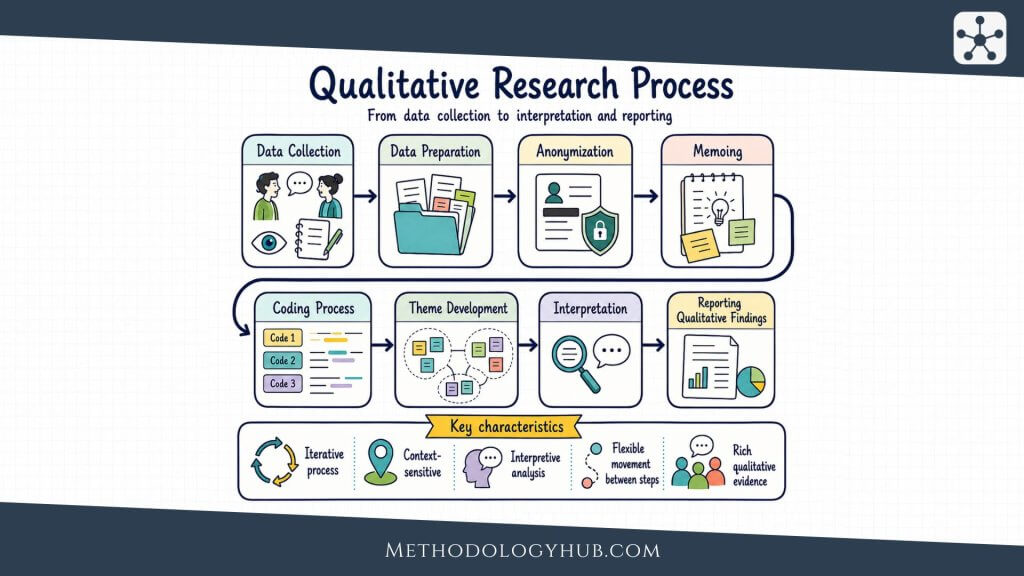
The qualitative research process is the path a researcher follows from collecting rich, open-ended material to developing an interpretation that can be reported clearly. The process often looks tidy when shown in a diagram, but in practice it is not a rigid line. Researchers move back and forth between steps, return to earlier notes, refine codes, adjust themes, and sometimes collect additional material after early analysis shows that something is missing.
The image above shows the process as a structured flow with eight main stages: data collection, data preparation, anonymization, memoing, coding, theme development, interpretation, and reporting qualitative findings. These steps help organize the work, but they should not be treated as a mechanical checklist. In qualitative research, the researcher is constantly reading, comparing, questioning, and refining the evidence.
Data Collection in Qualitative Research
Qualitative research usually begins with data collection, although early thinking about analysis often starts before the first interview, observation, or document review. The researcher collects material that can reveal experiences, meanings, practices, interactions, or contexts. This material may come from interviews, focus groups, field notes, classroom observations, policy documents, diaries, photographs, online discussions, open-ended survey responses, or other forms of research data.
The important point is not simply that the data are non-numerical. Qualitative data need enough depth to support interpretation. A brief comment such as “I liked the course” may be useful in a broad survey, but it gives little material for qualitative analysis unless it is placed beside fuller responses, follow-up questions, observations, or contextual information. Strong qualitative data usually allow the researcher to ask: what is being described, how is it being understood, and what setting shaped this account?
Data Preparation
After collection, the researcher prepares the data for analysis. This stage can include organizing files, checking audio quality, arranging field notes by date, collecting documents into folders, labeling sources consistently, and creating a clear record of what was gathered. Preparation sounds simple, but it prevents confusion later. A study with ten interviews, several observation sessions, and a set of institutional documents can quickly become difficult to manage if files are named inconsistently or context notes are missing.
Data preparation also involves deciding what counts as part of the dataset. For example, an interview transcript may be accompanied by interviewer notes, participant background information, consent records, and later reflections. Not all of this material is analysed in the same way, but it should be organized so the researcher can trace how the evidence was produced.
Practical note: A well-organized qualitative dataset should let the researcher move from a finding back to the exact interview, field note, document, or observation that supports it.
Anonymization
Anonymization protects participants and settings by removing or changing identifying details. This may involve replacing names with pseudonyms, removing contact details, masking school names, changing job titles, or generalizing locations. In some studies, anonymization is straightforward. In others, it requires careful judgement because a person may be identifiable through a combination of details even if their name is removed.
For example, “a deputy headteacher in the only rural secondary school in the district” may identify someone even without a name. A researcher may need to describe the role more generally, such as “a senior school leader.” The goal is to preserve enough detail for interpretation while reducing the risk that participants or institutions can be recognized unnecessarily.
Memoing
Memoing is the practice of writing analytic notes while the study develops. A memo may record an early idea, a surprising pattern, a possible connection between cases, a question about a code, or a doubt about an interpretation. Memos are not polished findings. They are working notes that help the researcher think with the data rather than only store it.
Memoing is especially useful because qualitative analysis often develops gradually. A researcher may notice that several participants describe “support” in very different ways. One participant may mean emotional encouragement, another may mean clear instructions, and another may mean access to time or resources. A memo can capture that early distinction before it becomes a formal theme.
Coding Process
The coding process begins when the researcher labels meaningful parts of the data. A code may be attached to a sentence, paragraph, turn in conversation, field note, document passage, or visual element. Codes can describe actions, feelings, barriers, explanations, relationships, or repeated ideas. For example, in a study of student feedback, codes might include “unclear instructions,” “peer support,” “fear of judgment,” “revision strategy,” or “teacher availability.”
Coding is not the same as highlighting interesting quotations. It is a way of organizing the data so that patterns can be compared across the dataset. A code should help the researcher return to related material and ask what is similar, what is different, and what the pattern suggests. Some studies begin with open coding, where codes are developed close to the data. Others use a more structured coding framework based on theory, previous research, or the research question.
Theme Development
Theme development moves the analysis beyond individual codes. A theme is not just a topic that appears often. It is a meaningful pattern that helps answer the research question. Several codes may come together because they point to a larger idea. For example, codes such as “unclear expectations,” “hidden assessment rules,” and “guessing what teachers want” might form a theme about uncertainty in academic communication.
Developing themes usually involves comparison. The researcher checks whether a possible theme appears across several participants, cases, documents, or moments. They also look for exceptions. A theme becomes stronger when the researcher can explain its boundaries: what belongs in it, what does not, and how it connects to the wider analysis.
Interpretation
Interpretation is where the researcher explains what the patterns mean in relation to the study’s purpose. The analysis should not stop at naming themes. It should show how the evidence answers the question, how participants made sense of their situation, how a process unfolded, or how context shaped what happened.
This stage often requires returning to the data several times. A researcher may compare themes with memos, revisit field notes, check whether an interpretation fits all cases, and consider whether another explanation is more convincing. Interpretation should stay close enough to the evidence that readers can follow it, but it should also go beyond description. It turns organized data into an argument.
Reporting Qualitative Findings
The final stage is reporting qualitative findings in a clear and transparent way. A strong report explains how the data were collected, how the sample or cases were selected, how the material was prepared and anonymized, how coding was carried out, and how themes or interpretations were developed. Readers should be able to see the route from raw evidence to final claim.
Reporting also involves choosing evidence carefully. Quotations, field note excerpts, or document examples should not be added only because they sound interesting. They should support a specific analytic point. A good qualitative report usually combines explanation with selected evidence, showing both the pattern and the detail behind it.
Although reporting often appears at the end, writing may begin much earlier. Researchers may write memos, draft theme descriptions, create analytic tables, or sketch early findings while analysis is still underway. This is one reason qualitative research is often described as iterative. The process may be presented in stages, but the thinking develops through repeated movement between evidence, notes, codes, themes, and interpretation.
Qualitative Research Question
A qualitative research question usually asks how, what, in what ways, or how participants make sense of something. It should be open enough to let unexpected ideas appear, but focused enough to guide data collection. A question that is too broad can produce scattered data. A question that is too narrow can turn an interview or observation into a checklist.
A useful qualitative question connects three parts: the topic, the group or material being studied, and the kind of understanding the researcher wants. For example, instead of asking, “What do students think about feedback?” a study might ask, “How do first-year university students interpret written feedback on their first major assignment?” The second version gives a clearer group, setting, and focus.
Plain test: if the answer would fit mainly into yes, no, or one number, the question is probably not yet written as a qualitative question.
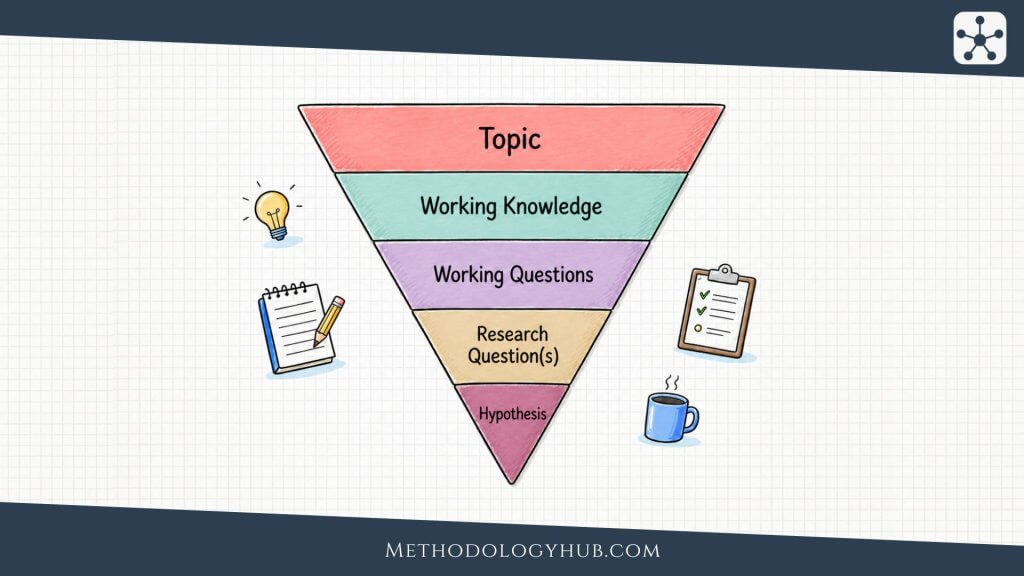
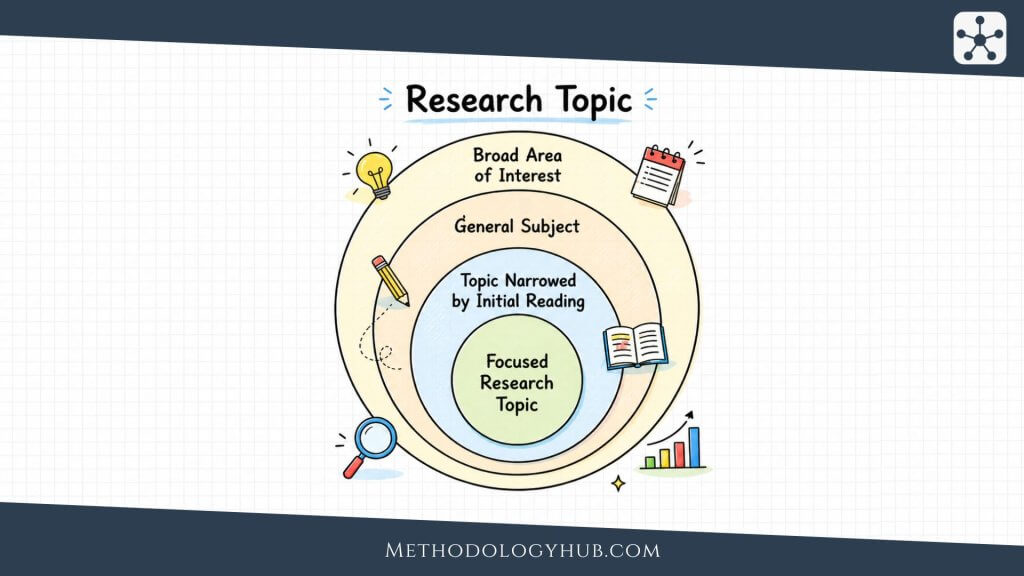
Qualitative questions often develop from a general research topic. A student might begin with the topic of classroom participation. After reading and thinking about access to data, the question could become: “How do quiet students describe their participation in small-group science lessons?” This is still open, but it is no longer vague.
A qualitative question does not usually begin as a fixed research hypothesis. Some qualitative projects may use propositions, sensitising concepts, or theory-guided expectations, but the question normally leaves space for participants, documents, or observations to complicate the starting idea. That openness should not be confused with a lack of direction. The question still needs boundaries so the researcher knows what kind of data to collect.
| Less suitable wording | More suitable qualitative wording |
|---|---|
| Does feedback improve learning? | How do students describe using teacher feedback when revising their work? |
| Are patients satisfied with appointment reminders? | How do patients explain their responses to appointment reminders? |
| Is group work effective? | In what ways do pupils negotiate roles during group work? |
Some qualitative studies begin with one central question and several subquestions. The central question gives direction. The subquestions help the researcher plan interviews, observations, or document analysis. They should support the main question rather than become a separate set of unrelated mini-studies.
A useful way to test a draft question is to imagine the data it would require. If the question asks how students interpret feedback, interviews, learning diaries, or annotated assignments might fit. If the question asks how teachers give feedback in class, observation or recorded classroom talk may fit better. The wording of the question should therefore point toward a possible method without locking the researcher into a narrow script too early.
Qualitative Research Methods
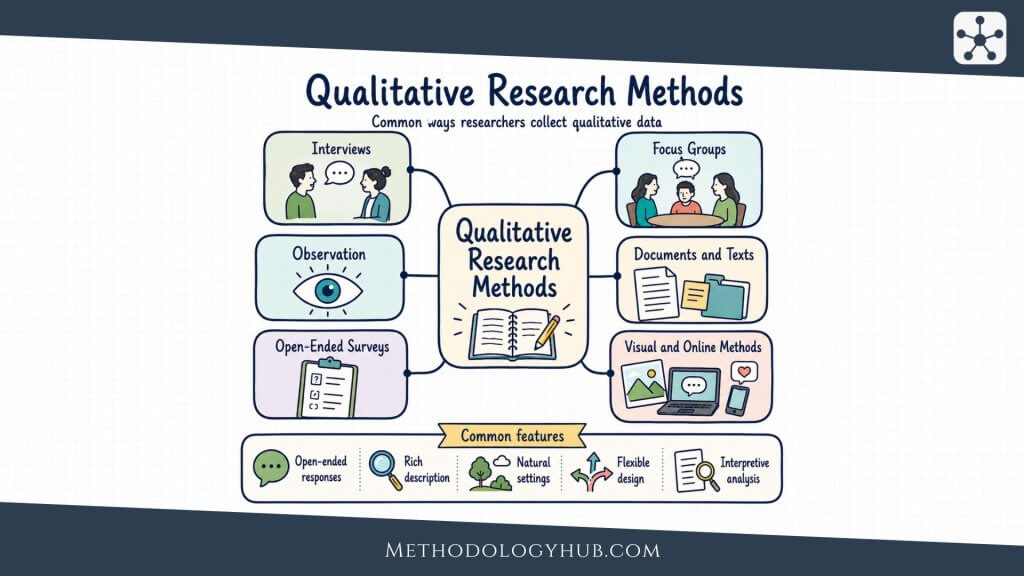
Qualitative research methods are the practical ways researchers collect or generate qualitative data. A method is not the whole methodology. Interviews, focus groups, observations, documents, open-ended surveys, and visual or online materials can all be used inside different qualitative approaches. The choice depends on what kind of evidence can answer the question.
Qualitative Interviews
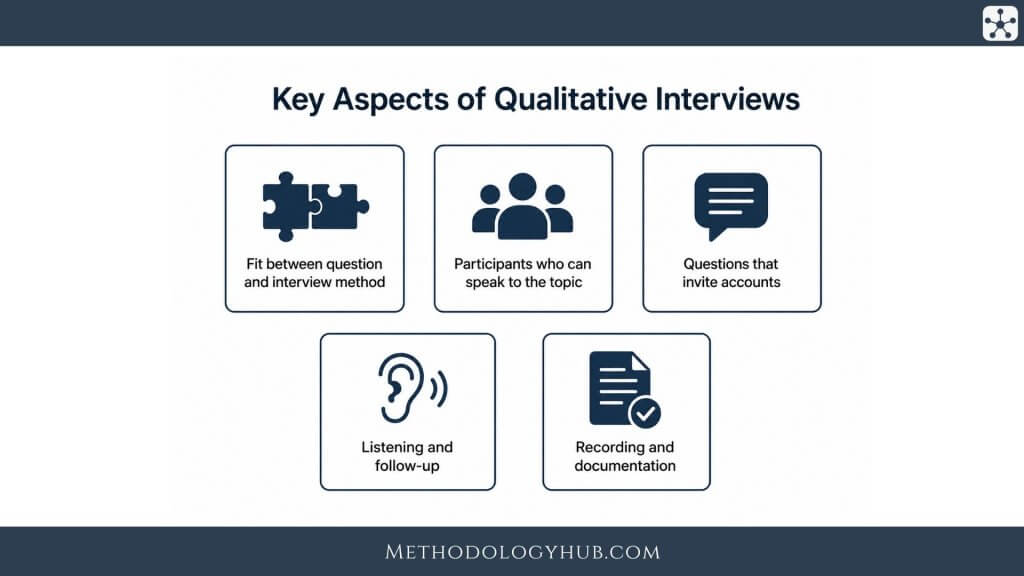
Interviews are one of the most common qualitative research methods. Qualitative interviews allow participants to describe experiences, decisions, feelings, routines, and interpretations in their own words. Some interviews are highly structured, but qualitative interviews are often semi-structured. The researcher prepares guiding questions, then follows useful leads as the conversation develops.
Interviews are a good fit when the topic involves personal experience or a process that cannot be observed easily. A researcher studying how trainee teachers respond to classroom feedback may learn more from interviews than from a short survey, because the interview allows participants to explain hesitation, confidence, confusion, or change over time.
A strong interview study usually depends on more than good questions. The interview guide should begin with accessible questions, move toward the central topic, and leave room for follow-up prompts. Questions such as “Can you tell me what happened next?” or “What did that mean for you at the time?” often produce richer data than questions that ask participants to agree with the researcher’s wording.
Interviews also need careful recording and transcription decisions. A study focused on broad experiences may not need every pause marked in detail. A study focused on interaction, hesitation, or wording may need a more detailed transcript. The level of transcription should match the analysis plan, because the transcript becomes the material the researcher will later read, code, and quote.
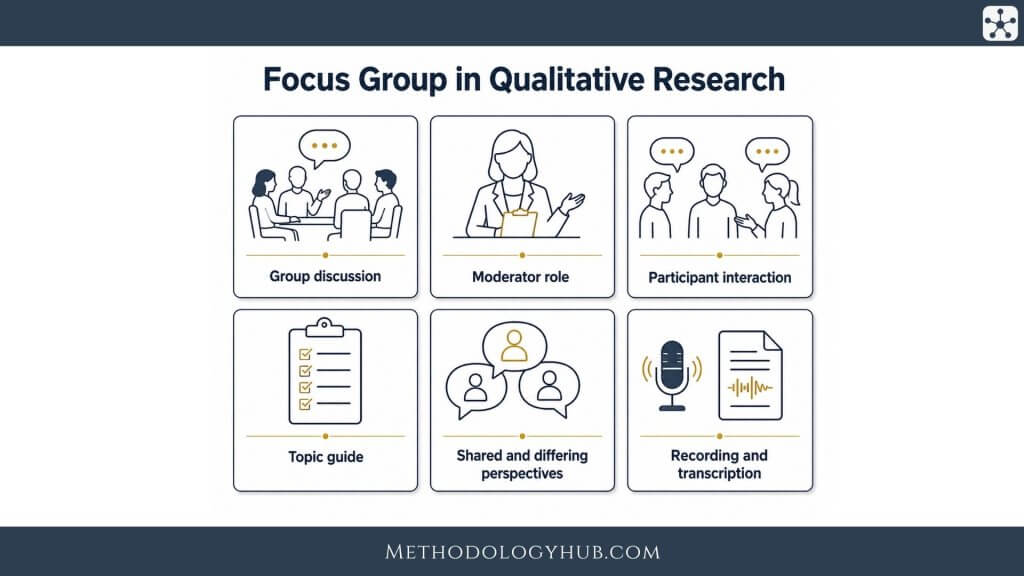
Focus Groups
Focus groups bring several participants into a guided group discussion. They are useful when the researcher wants to study shared views, differences between participants, or the way people respond to one another’s ideas. The interaction is part of the data.
A focus group can work well when participants are comfortable speaking together and the topic benefits from discussion. For example, pupils might compare how they use digital homework tools, or community members might discuss how they understand a local service. The researcher still needs to guide the conversation carefully so that one or two voices do not take over the whole discussion.
The composition of a focus group changes the data. Participants who share a role or experience may speak more freely because they recognise each other’s examples. A mixed group may reveal disagreement, but it can also make some participants cautious. The researcher should explain why the group was formed in a particular way and how the discussion was moderated.
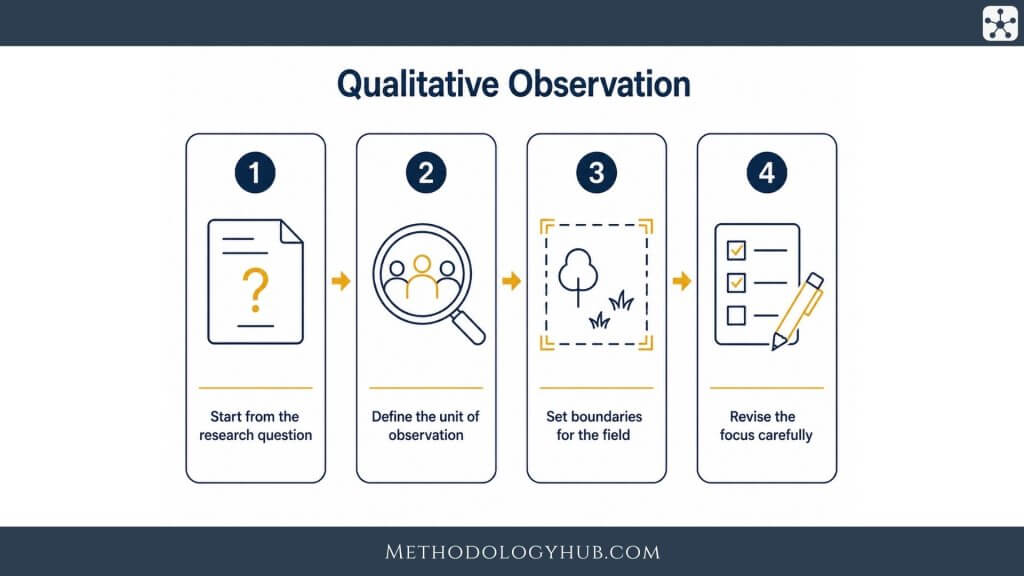
Observation
Qualitative Observation allows the researcher to study what people do in a setting, rather than relying only on what they later say they do. It can be used in classrooms, clinics, meetings, public spaces, laboratories, libraries, online sessions, or other settings where interaction and routine are part of the question.
Observation can be more or less participatory. In some studies, the researcher watches without taking part. In others, the researcher is also involved in the setting. Field notes usually record actions, speech, setting details, timing, and early reflections. Strong observation notes separate what was seen from the researcher’s first interpretation of it.
Observation is especially helpful when routine behaviour has become so familiar that participants may not mention it in an interview. A teacher may say that group work is student-led, while observation shows that the teacher quietly redirects the groups every few minutes. The contrast between what people say and what happens in practice can become a useful part of the analysis.
Researchers also need to decide when and where observation will happen. Observing only the first day of a programme may show different behaviour from observing after routines have settled. Observing one meeting may miss preparation before the meeting and informal discussion after it. The observation plan should therefore fit the process being studied.
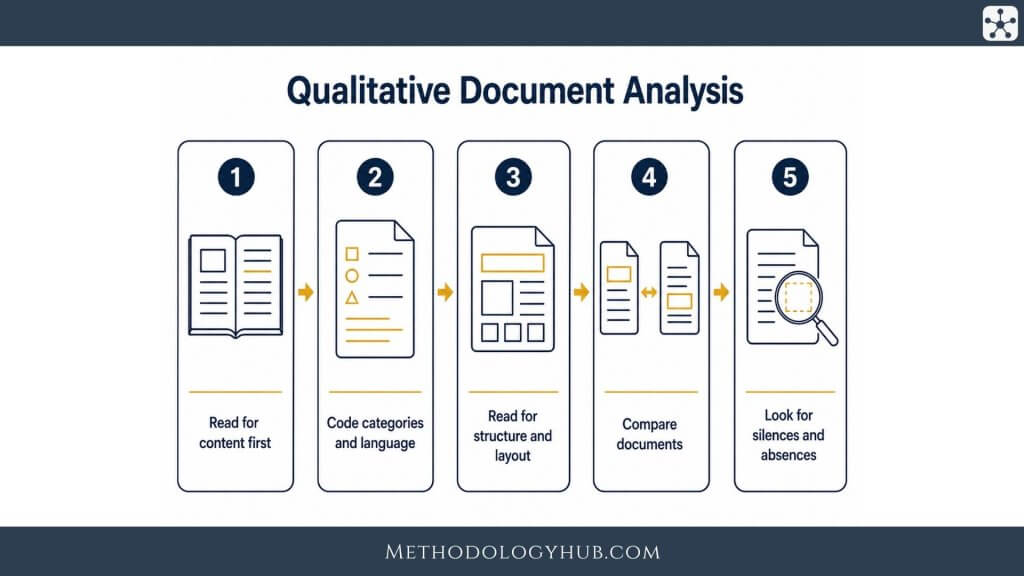
Documents and texts
Qualitative document analysis is useful when the research question concerns language, representation, rules, institutional records, policy, curriculum, public communication, diaries, letters, reports, or media material. The researcher may study how a school policy describes behaviour, how textbooks present a topic, or how meeting minutes record decisions.
Document-based qualitative research should explain which texts were included and why. A folder of documents is not automatically a dataset. The selection should fit the question, the time period, and the setting. Analysis may focus on themes, categories, arguments, word choices, silences, or changes across versions.
Documents should also be read as products of a situation. A policy document, a lesson plan, a diary entry, and a public report do not speak in the same way. Each has an audience, purpose, format, and set of constraints. A careful analysis asks not only what the document says, but also what kind of document it is and what it was designed to do.
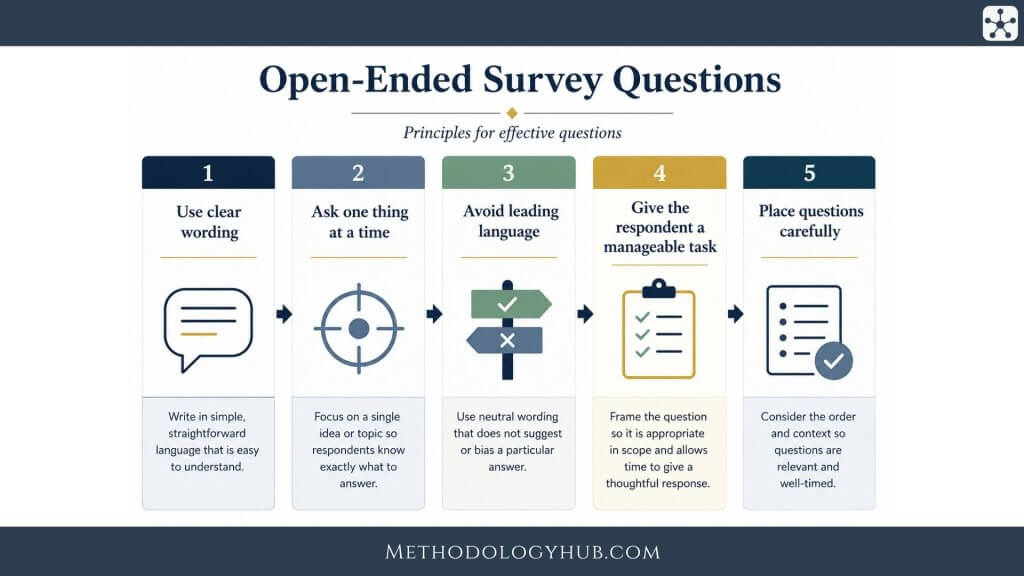
Open-Ended Surveys
Open-ended survey questions ask participants to write responses in their own words. They can be useful when the researcher wants brief qualitative data from a larger group than would be possible with interviews. They can also help a survey include voices that closed response options might miss.
The limitation is depth. A written response in a survey is usually shorter than an interview answer, and the researcher cannot ask follow-up questions. Open-ended surveys work best when the question is focused and when brief responses are enough for the purpose of the study.
Open-ended questions should be written with the same care as interview prompts. A broad prompt such as “Any comments?” often produces scattered answers. A focused prompt such as “Describe one situation in which the feedback helped or did not help you revise” gives participants a clearer task while still allowing their own words to shape the response.
Visual Methods
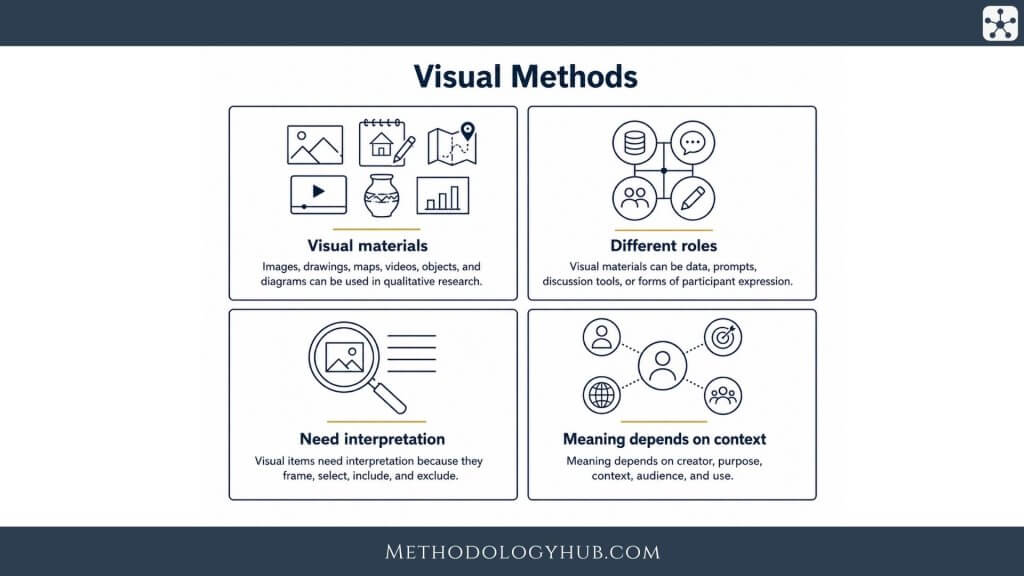
Visual methods use images, drawings, photographs, maps, diagrams, videos, or other visual materials as data or prompts. A participant might take photographs of spaces where they study, draw a map of a daily routine, or discuss images connected to an experience. The visual material can help participants express ideas that are difficult to put into words directly.
Visual materials often need extra context in the analysis. A photograph may show a study space, but the participant’s explanation may reveal why that space feels private, stressful, safe, or distracting. The method should keep those surrounding details visible where they affect interpretation.
Qualitative Research Approaches
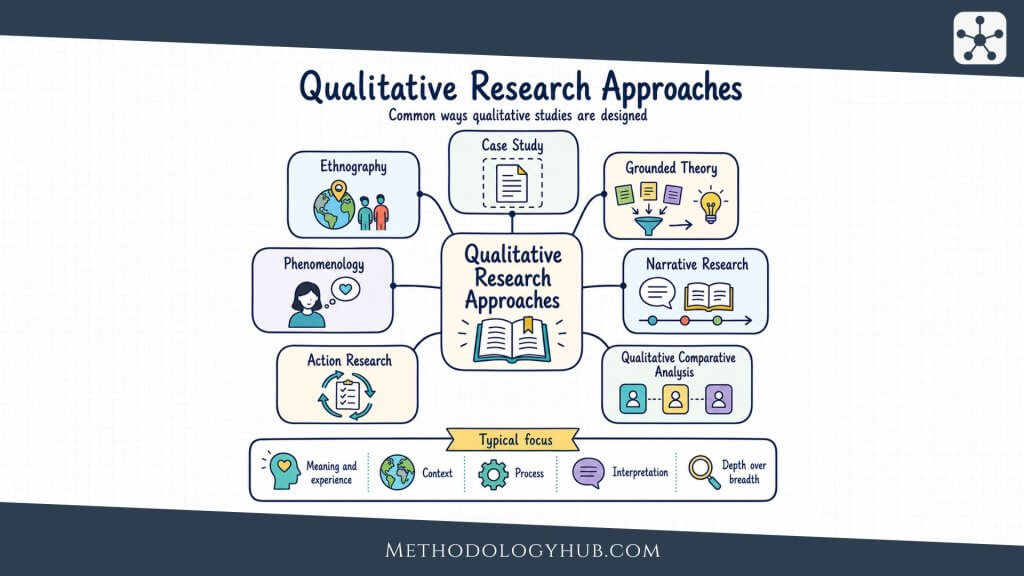
Qualitative research approaches are larger design traditions. They shape the purpose of the study, the kind of data collected, and the logic of analysis. Two projects may both use interviews, but one may be a case study and another may be phenomenology. The interview method looks similar at first, but the study aims are different.
Case Study
Case study research examines one case or a small number of cases in depth. The case might be a school, classroom, hospital ward, community project, policy, person, event, or organisation. The aim is to understand how the case works in context.
Case studies often use several sources of data, such as interviews, observation, documents, and records. This helps the researcher build a fuller account of the case. The case boundaries should be clear: what is included, what is outside the case, and why this case was chosen.
A case study can focus on one unusual case, one typical case, or several cases that can be compared. In a single-case study, depth is usually the strength. In a multiple-case study, the researcher can examine what is shared across cases and what changes from one setting to another. Either way, the case should be treated as more than a location where data were collected. It is the object of study.
Ethnography
Ethnography studies culture, practice, and everyday life through extended engagement with a setting or group. The researcher usually spends time observing, taking field notes, speaking with participants, and learning the routines and meanings that shape the setting.
An ethnographic study might examine how a classroom community handles peer support, how staff in a clinic coordinate informal work, or how members of an online learning group develop shared norms. The strength of ethnography comes from time, attention, and context.
Grounded Theory
Grounded theory is used to build a theory or explanatory model from data. The researcher collects and analyses data in close connection, often adjusting later data collection as early categories begin to develop. Comparison is central: incident is compared with incident, code with code, and case with case.
This approach is useful when existing theory does not explain a process well. For example, a researcher might study how new nurses learn to ask for help during their first months of practice. The final result may be a set of categories showing stages, conditions, decisions, and consequences in that process.
Grounded theory often uses analytic memo writing throughout the project. Memos allow the researcher to record early hunches, compare cases, question categories, and decide what data should be collected next. This is different from waiting until the end and then sorting all data at once. The analysis grows through repeated comparison.
Phenomenology
Phenomenology focuses on lived experience. It asks how participants experience a phenomenon and how that experience appears to them. The topic is usually something people have lived through directly, such as transition to university, chronic pain, bereavement, professional burnout, or learning a new language.
Because phenomenology focuses so closely on experience, the researcher usually has to be careful with abstract labels. A participant’s account should not be rushed into a general category before the researcher has examined the words, images, contrasts, and examples through which the experience is described. The depth comes from staying with the description long enough to see its shape.
Phenomenological research usually relies on detailed accounts, often through interviews. The analysis looks for the structure and texture of experience, not just a list of topics. The researcher pays close attention to how participants describe time, body, emotion, relationship, place, and meaning.
Narrative Research
Narrative research studies stories. It examines how people organise events into accounts, how they position themselves and others, and how stories connect personal experience with social expectations. The data may come from interviews, diaries, letters, autobiographies, oral histories, or digital storytelling.
A narrative study does not treat a story only as a container of facts. It also asks how the story is told. Sequence, turning points, repeated phrases, missing parts, and the role of the listener can all become part of the analysis.
Action Research
Action research studies a practice while also trying to improve it. It is common in classrooms, professional learning, health services, and community settings. A teacher might introduce a new discussion routine, observe how pupils respond, revise the routine, and study the next cycle.
The cycle usually moves through planning, action, observation, reflection, and revision. Action research can use qualitative data such as field notes, interviews, reflective journals, student work, and meeting records. Its value lies in disciplined learning from practice, not in a one-time description of change.
Qualitative Comparative Analysis
Qualitative comparative analysis, often shortened to QCA, compares cases through set logic. It examines which combinations of conditions are linked to an outcome. The approach can work with a small or medium number of cases and is often used when simple one-factor explanation is not enough.
QCA is related to comparative research, but it has its own logic. A researcher may compare schools, programmes, or communities and ask which combinations of conditions appear when a certain outcome is present. It sits near the boundary between qualitative and more formal comparative analysis.
QCA is often placed near the border between qualitative and quantitative thinking. It does not reduce cases to one average effect, but it does use formal comparison to examine combinations. For example, a study might compare schools where a programme succeeded and ask which combinations of leadership support, teacher training, parental involvement, and available time appear together in successful cases.
Sampling in Qualitative Research
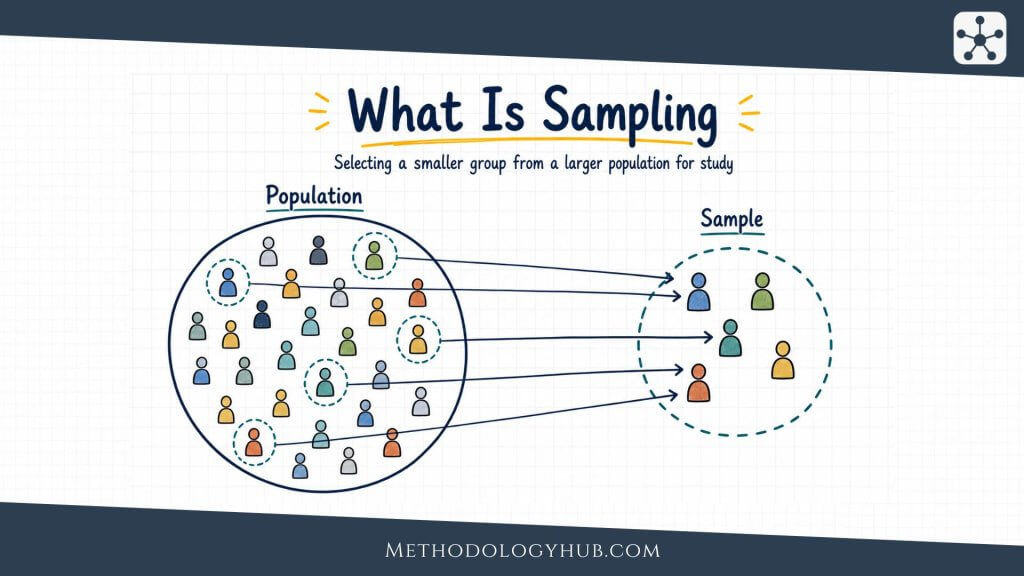
Sampling in qualitative research is usually about relevance and depth rather than statistical representation. The researcher chooses participants, cases, documents, events, or settings because they can help answer the research question. A small sample can be appropriate when it provides detailed, information-rich data.
This does not mean that sampling can be casual. The researcher should explain who or what was included, how access was gained, which criteria guided selection, and what boundaries the sample creates for interpretation. Readers should be able to see why these participants, cases, or documents were suitable for the study.
One early decision is the unit of analysis. In some qualitative studies, the unit is a person. In others, it is a classroom, a meeting, a document, an event, an online thread, a family, or an organisation. The unit of recruitment and the unit of analysis are not always the same. A researcher may recruit teachers but analyse lessons, or collect documents from schools but analyse policy statements. Stating the unit clearly prevents confusion later.
Inclusion criteria also need to be visible. If a study concerns first-year students, the researcher should say what counts as first year in that institution. If a document study concerns official policies, the researcher should say whether drafts, guidance notes, emails, and public summaries were included. These boundaries help readers understand what the findings are based on.
Common Qualitative Sampling Methods
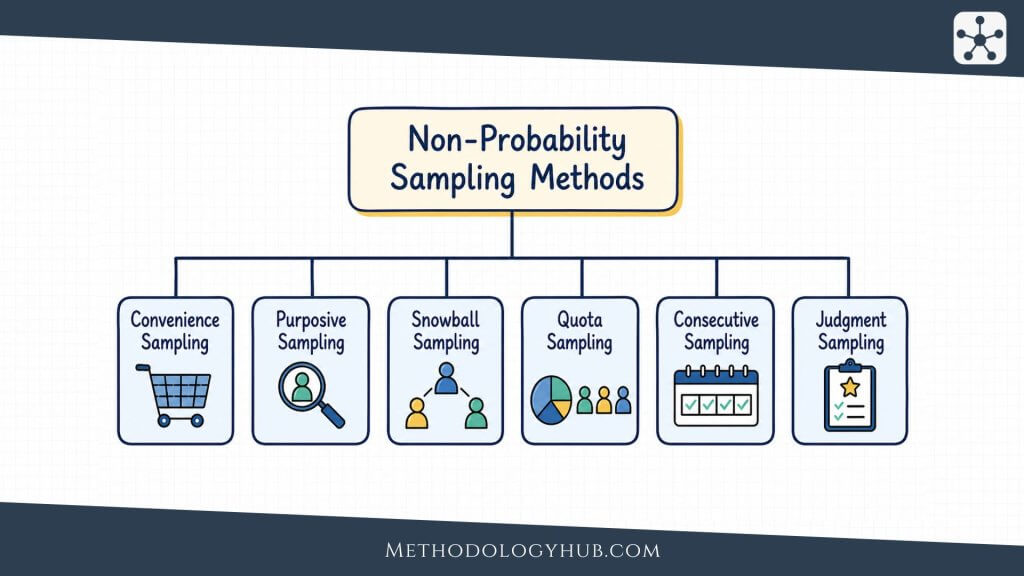
Several sampling methods appear often in qualitative research. Purposive sampling selects cases because they meet criteria connected to the research question. Maximum variation sampling seeks difference across relevant characteristics. Homogeneous sampling focuses on a more similar group so that one shared experience can be studied closely. Snowball sampling uses participant referrals to reach people who may be difficult to contact directly. Theoretical sampling, common in grounded theory, lets emerging analysis guide later sampling.
These strategies are not merely labels. The method section should say what the strategy did in this study. For example, maximum variation sampling is clearer when the researcher states which forms of variation were sought, such as year level, school type, role, or length of experience.
Sampling may also change during a project. Early interviews may show that one group of participants describes the process very differently from another, so the researcher may seek more participants from that group. In grounded theory, this is part of the design. In other approaches, it should still be reported as a deliberate adjustment rather than hidden as if the sample had been fixed from the beginning.
Sample Size in Qualitative Research
Sample size in qualitative research depends on the question, method, approach, data quality, and expected variation. An interview study with a narrow focus may need fewer participants than a multi-site case study. A document analysis may include dozens of texts if each is short, while an ethnographic project may focus on one setting for a long period.
Large numbers do not automatically improve qualitative research. If interviews are too many for careful analysis, the study can become thin. At the same time, a very small sample needs a clear reason. The researcher should explain why the sample was enough for the kind of interpretation being made.
If you want to estimate an appropriate sample size for your study, try our free, privacy-friendly sample size calculator. It helps you calculate the number of participants needed based on your study design and statistical requirements. No registration is required, and your data stays private, making it a quick and convenient way to plan your research before collecting data.
Data Saturation
Data saturation is often used to describe the point at which additional data no longer add much to the analysis. In practice, it means the researcher is hearing or seeing patterns that are already well developed, and new material is not changing the main categories or themes.
Saturation should not be treated as a magic number. It depends on the diversity of the sample, the complexity of the topic, the depth of data, and the analysis method. A study with a narrow group and focused question may reach saturation sooner than a study with varied participants and broad questions.
Not every qualitative approach uses saturation in the same way. A narrative study may focus on the depth of a small number of life stories rather than trying to reach repeated themes across many participants. A case study may stop when the case has been documented well enough for the research question. For this reason, it is better to explain the stopping logic than to state saturation as a formula.
Qualitative Data Analysis
Qualitative data analysis turns transcripts, notes, documents, images, or online materials into findings. The work is not simply reading through material and choosing a few interesting examples. It involves organising the data, coding it, comparing parts, writing notes, developing categories or themes, and returning to the research question.
The analysis often begins during data collection. A researcher may notice that interviewees keep returning to a certain problem, or that observation notes show a repeated routine. Early observations can guide later questions, but the final analysis should still be systematic enough for readers to follow.
A common workflow begins with familiarisation. The researcher reads transcripts, reviews field notes, listens again to recordings, or looks through documents before formal coding begins. This stage can feel slow, but it prevents the analysis from becoming a mechanical search for phrases. Early notes about tone, surprise, contradiction, and possible connections often become useful later.
After familiarisation, the researcher usually moves between smaller and larger units of meaning. A small excerpt may receive a code. Several codes may become a category. Several categories may support a theme, explanation, typology, or model. The movement is rarely perfectly linear. Researchers often return to earlier material after later patterns become clearer.
Qualitative Coding
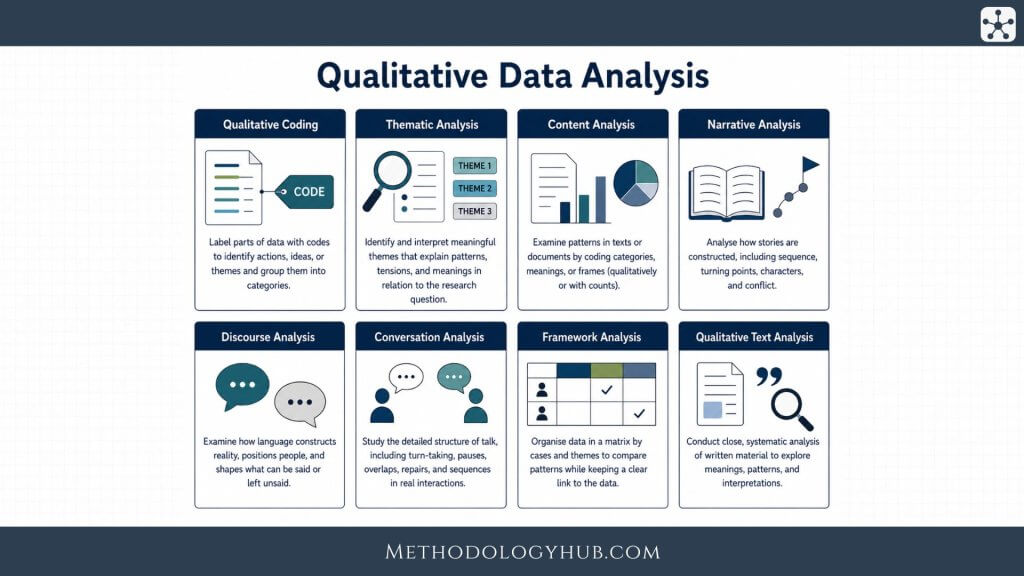
Coding means labelling parts of data so they can be compared and interpreted. A code may describe an action, feeling, idea, event, topic, or process. In an interview about academic feedback, codes might include “unclear comments,” “asking a friend,” “fear of bothering teacher,” or “using examples to revise.”
Codes can be developed from the data, from existing theory, or from both. Many studies begin with open coding, then group related codes into wider categories. Coding is not the final answer. It is a tool for seeing patterns more clearly.
A codebook can help when a study includes many documents, many interviews, or several researchers. It may include the code name, a short description, inclusion rules, exclusion rules, and example excerpts. The codebook should be flexible enough to improve during analysis, but stable enough that coding does not mean something different every time it is applied.
Thematic Analysis
Thematic analysis identifies, develops, and interprets themes across a dataset. A theme is more than a topic that appears often. It is a meaningful pattern that helps answer the research question. For example, “feedback confusion” is a topic, while “students treat unclear feedback as a sign that revision is risky” is closer to an analytic theme.
Thematic analysis is flexible and widely used in student projects, health research, education research, and social research. Its flexibility means the researcher should explain how themes were developed, refined, named, and connected to evidence.
Good thematic analysis usually moves beyond topic labels. If several participants mention “support,” the theme should not simply be called “support” unless the analysis explains what kind of support, how it works, who provides it, and what tension surrounds it. A stronger theme might show that participants only recognised support when it was offered without forcing them to ask publicly.
Content Analysis
Content analysis studies patterns in communication, documents, or texts. It can be qualitative, quantitative, or both. In qualitative content analysis, the researcher may examine categories, meanings, frames, or repeated ways of describing a topic. In more quantitative versions, the researcher may count coded categories.
A study of school newsletters might analyse how often families are addressed as partners, recipients, or problems to be managed. A study of policy documents might compare how different documents define inclusion. The coding rules should be clear enough that readers understand how text was sorted and interpreted.
When content analysis uses counts, the counts should be interpreted with caution. A category that appears often is not always the most important category, and a rare phrase can still carry analytic weight if it frames the document in a powerful way. The numbers can support the reading, but they should not replace the close analysis of language and context.
Narrative Analysis
Narrative analysis studies how stories are built. It looks at sequence, turning points, characters, conflict, resolution, and the position of the speaker. The same event can be told as success, failure, recovery, injustice, or learning, depending on how the story is organised.
This kind of analysis is useful when the research question concerns identity, life course, transition, memory, or professional development. It keeps attention on the story form as well as the topics mentioned inside the story.
Discourse Analysis
Discourse analysis studies language in use. It asks how language constructs versions of reality, positions people, makes some actions seem natural, and makes other actions harder to say. The data may be interviews, speeches, classroom talk, policy documents, media texts, or online discussions.
For example, a discourse analysis of school behaviour policies might ask how pupils are described, what responsibilities are assigned to teachers and families, and which explanations are treated as acceptable. The analysis stays close to wording and context.
Conversation Analysis
Conversation analysis examines the detailed structure of talk. It pays attention to turn-taking, pauses, overlaps, repairs, questions, answers, and sequences of interaction. The data are usually recordings and detailed transcripts.
This approach is useful when the research question concerns how people do things through talk, such as asking for help, giving advice, resisting a suggestion, or making a decision in a meeting. Small details can carry a lot of analytic weight.
Framework Analysis
Framework analysis uses a structured matrix to organise qualitative data by cases and themes. It is often used in applied research where the study has clear questions and needs a transparent link between data and findings. The matrix helps researchers compare cases without losing sight of each participant or document.
This approach can be useful in evaluation research, health research, education research, and policy studies. It is especially helpful when a team is analysing data together and needs a shared structure.
The matrix in framework analysis can also make comparison more transparent. A reader can see how one theme appears across several cases, or how one case contains several themes. This structure is useful when the final report needs to move between individual cases and cross-case patterns without losing either level.
Qualitative Text Analysis
Qualitative text analysis is a broad label for close, systematic analysis of written material. It may include documents, reports, open-ended responses, transcripts, websites, letters, textbooks, or archival material. The analysis can focus on themes, categories, arguments, metaphors, or changes over time.
The researcher should define the text collection carefully. For example, a study of textbooks should say which textbooks, editions, subjects, grades, and pages were included. Without those boundaries, the analysis becomes difficult to judge.
AI-Assisted Qualitative Analysis
AI-assisted qualitative analysis uses digital tools to support parts of the analysis process, such as transcription, first-pass organisation, search, code suggestions, clustering, or memo prompts. These tools can help manage large datasets, but they do not replace interpretation. The researcher remains responsible for deciding what counts as evidence and how findings are justified.
A cautious workflow treats AI output as draft material to inspect, revise, and document. For example, a tool may suggest possible codes for interview excerpts, but the researcher should check whether those codes fit the research question, the transcript context, and the wider analysis. Qualitative research depends on careful reading, not fast sorting alone.
AI support also changes the audit trail. If a tool grouped excerpts, translated responses, or suggested code names, the researcher should record what was done, which material was involved, and how the output was checked. This allows the report to distinguish between software assistance and analytic judgement.
Qualitative Research Examples
Examples make qualitative research easier to understand because the method becomes tied to a real question. The examples below are academic rather than commercial. They show how a question, data source, and analysis can fit together.
The examples are not templates to copy exactly. Their purpose is to show design logic. A qualitative example should make it clear why the data source fits the question, what the researcher would compare or interpret, and what kind of finding could reasonably come from the study. This is more useful than simply naming a method.
Interview Study Example
A researcher wants to understand how first-generation university students experience academic office hours. The study uses semi-structured interviews with students from different year levels. Questions ask how students learned about office hours, what made them decide to attend or avoid them, and how they interpreted the meeting afterwards.
The analysis might use thematic analysis. Possible themes could concern uncertainty about rules, fear of seeming unprepared, helpful moments of clarification, or the role of peers in encouraging attendance. The findings would explain how students make sense of office hours, not estimate how many students attend them.
A deeper interview study would also pay attention to differences between students. First-generation students, international students, and students in different disciplines may describe academic support in different ways. The researcher does not need a statistically representative sample to examine those contrasts, but the sample should include enough variation for the comparison being made.
Focus Group Study Example
A school wants to understand how pupils talk about group work in science lessons. The researcher conducts focus groups with pupils from several classes. The group setting allows pupils to agree, disagree, correct one another, and compare experiences.
The analysis might examine repeated discussion patterns, such as how pupils describe fairness, role assignment, quiet members, or teacher support. Because the interaction is part of the data, the researcher can study individual views and the way pupils negotiate meanings together.
The final report would not treat every comment as an independent interview response. It would examine how the discussion developed: which ideas received agreement, which comments produced hesitation, and which examples made other participants change or refine their views. That interaction is the special contribution of the focus group.
Case Study Example
A researcher studies one school that has introduced a new mentoring programme for new teachers. The case includes interviews with mentors and mentees, observation of mentoring meetings, programme documents, and reflective notes from participants.
The analysis builds a detailed account of how the programme works in that school. It may show how time, trust, leadership support, and informal conversations shape mentoring. The study does not claim that every school will experience the programme in the same way, but it can offer a careful explanation of one case.
If the case study is written well, readers should understand the local conditions that shaped the programme. The finding may travel as an idea, not as a direct prediction. Another school can ask whether it has similar conditions, different constraints, or a different mentoring culture before applying the insight.
Thematic Analysis Example
A health education researcher collects open-ended survey responses from students about stress during examination periods. The responses are short, but there are many of them. The researcher codes the responses and develops themes that capture repeated patterns.
One theme might describe stress as a time-management problem. Another might describe stress as fear of disappointing family. A third might describe stress as physical exhaustion. The analysis would connect these themes to the research question and provide selected excerpts to show how the themes were developed.
A stronger version would also examine how the themes relate to one another. For some students, time pressure may lead to physical exhaustion. For others, family expectations may change how time pressure is experienced. The analysis becomes deeper when themes are connected rather than presented as isolated headings.
Content Analysis Example
A researcher studies how environmental responsibility is presented in middle-school science textbooks. The dataset includes chapters from textbooks used in a defined curriculum year. The researcher develops categories for individual action, collective action, scientific explanation, uncertainty, and responsibility.
The content analysis can show which categories appear, how they are described, and what kind of student role the textbooks imply. If counts are used, they should support the interpretation rather than replace close reading.
The researcher might also compare chapters, grade levels, or textbook editions. A newer edition may include more references to collective action, while an older edition may frame responsibility mostly as individual behaviour. The value of the example comes from connecting the coding categories to the way textbooks shape possible understandings of the topic.
Qualitative vs Quantitative Research
Qualitative and quantitative research differ mainly in the kind of question they ask and the kind of evidence they use. Qualitative research studies meaning, experience, context, and process. Quantitative research uses numbers to measure variables, compare groups, estimate patterns, or test relationships. Both can be rigorous when the design fits the question.
The difference is not that one is subjective and the other is objective. Both involve decisions. A quantitative researcher decides how to define variables, which measurement scale to use, and which statistical methods are suitable. A qualitative researcher decides how to select participants or texts, how to code data, and how to justify interpretation.
| Aspect | Qualitative research | Quantitative research |
|---|---|---|
| Main focus | Meaning, experience, context, process | Measurement, comparison, association, estimation |
| Typical data | Words, observations, documents, images, transcripts | Scores, counts, categories, measurements, scales |
| Sample logic | Information-rich cases, relevance, variation | Often larger samples, sometimes probability sampling |
| Analysis | Coding, themes, interpretation, comparison | Statistical analysis, modelling, tests, estimates |
| Typical output | Themes, categories, narratives, explanations | Means, percentages, coefficients, p-values, intervals |
Many research projects benefit from reading the two approaches together. A survey may show that many students avoid office hours. Interviews may then explain that students do not understand what office hours are for. A qualitative study may reveal categories that later become survey items. This is where mixed methods research becomes useful, provided that the two parts are planned to speak to each other.
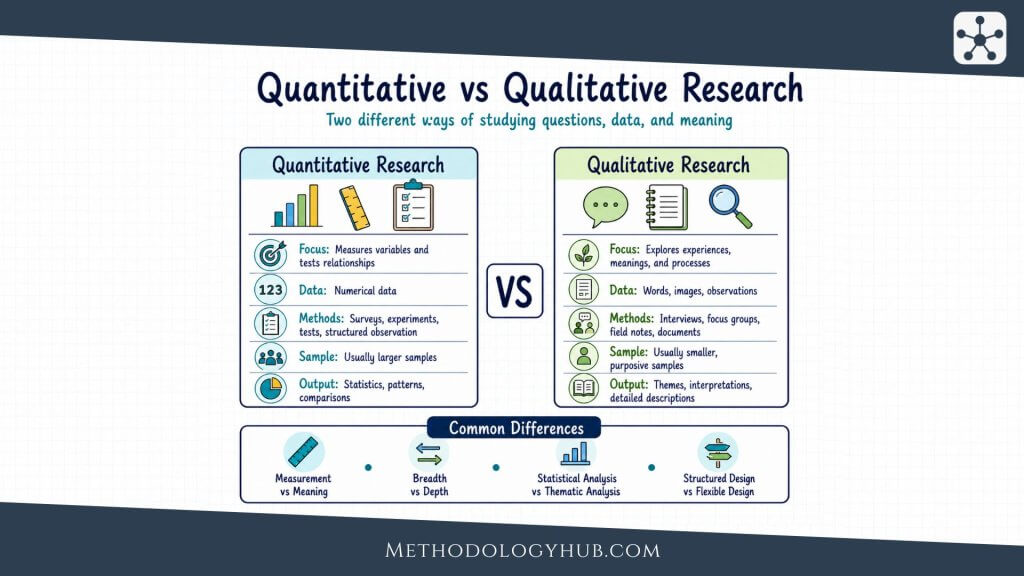
The two approaches also support different kinds of generalisation. Quantitative research often aims to estimate how common a pattern is in a defined population. Qualitative research more often supports analytic transfer: it gives a detailed explanation that readers can compare with another setting. A small interview study should therefore avoid sounding like a national survey, while a large survey should avoid pretending it has explained every personal meaning behind the numbers.
In practice, the decision is often less about choosing a side and more about matching evidence to claim. If the claim concerns frequency, size, or strength of association, numerical data are usually needed. If the claim concerns meaning, process, language, or situated practice, qualitative data are usually needed. When both claims are being made, the design should show how the two forms of evidence will be connected.
AI in Qualitative Research
AI is increasingly used around qualitative research, especially in transcription, data organisation, searching, code suggestions, translation support, and memo drafting. These uses can save time, but they also change the workflow. The researcher needs to know which parts of the analysis were supported by a tool and which parts were decided through human interpretation.
AI tools can be helpful for practical tasks. They may clean transcripts, group similar excerpts, suggest possible labels, summarise long documents for orientation, or help a researcher find all passages that mention a term. These tasks can make a large dataset easier to navigate.
The limit is interpretation. Qualitative research depends on context, tone, sequence, social setting, and the relationship between parts of the data. AI may miss sarcasm, local meaning, silence, hesitation, or the reason a phrase carries weight in one setting but not another. It may also produce neat categories before the researcher has spent enough time with the material.
Recommendation: use AI to assist organisation when it helps, but do not let the tool decide what the study means.
A transparent report should describe AI use in plain language. If a tool was used for transcription, say so. If it suggested draft codes, explain how the researcher checked and revised them. If it was used only for organising files or searching transcripts, that is different from using it to develop themes. Readers should not have to guess where software support ended and interpretation began.
AI can also be useful before analysis, for example when preparing interview guides, testing whether questions are clear, or creating a first outline for a codebook. These uses still need researcher judgement. A suggested interview question may sound polished but lead participants too strongly. A draft code may look tidy but ignore the participant’s own language. Careful review keeps the method tied to the data.
One practical approach is to separate assistance from decision making. AI may help locate passages, draft alternative labels, or summarise a long document for orientation. The researcher then reads the original material, checks whether the suggestion fits, revises the label, and records the decision. This keeps the analysis from becoming a set of tool-generated categories detached from the evidence.
Researchers should also be careful with sensitive or restricted data. Interview transcripts, field notes, and private documents may contain identifiable details. Before using any external tool, the researcher should check institutional rules, consent conditions, and data protection requirements. This point belongs in the practical workflow, because the way data are handled affects what can responsibly be done with them.
Conclusion
Qualitative research is used when a study needs to understand meaning, experience, practice, interaction, context, or texts. It is not a weaker version of quantitative research. It answers a different kind of question and uses a different path from data to conclusion.
A strong qualitative study begins with a focused research question. The question guides the choice of method, whether that method is interviews, focus groups, observation, documents, open-ended surveys, visual materials, or online data. The wider approach may be case study, ethnography, grounded theory, phenomenology, narrative research, action research, or qualitative comparative analysis.
Sampling and analysis need the same care. Participants, cases, or documents should be selected for a clear reason. The analysis should show how codes, categories, themes, narratives, or interpretations were developed. Readers should be able to follow the connection between the evidence and the finding.
Qualitative research can also work beside quantitative research. Numerical data can show patterns, while qualitative data can explain how those patterns are experienced and interpreted. When the design is clear, both approaches can contribute to the research process in different but connected ways.