Comparative research is a research design in which researchers study two or more cases, groups, contexts, periods, policies, texts, or datasets side by side. The purpose is not simply to describe each case separately. The purpose is to understand how they are similar, how they differ, and what those similarities or differences suggest about the research question.
This article explains what comparative research is, which objectives it can support, how comparative designs are structured, which methods researchers use, how it differs from related designs, and how to perform a comparative study.
What Is Comparative Research?
Comparative research is a research design that studies two or more units in relation to one another. Those units may be people, groups, organisations, classrooms, schools, countries, legal systems, policies, texts, historical periods, medical records, ecosystems, or any other cases that can be compared in a meaningful way.
The comparison should be planned. A researcher does not simply place two examples next to each other and call the study comparative. The cases need to be selected for a reason, the comparison needs clear criteria, and the interpretation needs to return to the research question. Without that structure, the study can become a loose description of separate cases rather than a comparative design.
Comparative research definition
Comparative research means examining two or more cases, groups, settings, or datasets through shared criteria in order to identify similarities, differences, patterns, or possible explanations. The comparison may be qualitative, quantitative, or mixed. It may focus on a small number of cases in depth, a larger set of cases with numerical indicators, or a combination of both.
For example, a researcher may compare reading achievement in two school systems. The study might ask whether different curriculum structures are associated with different outcomes. The cases are the school systems. The comparison criteria might include curriculum time, teacher training, assessment practices, and student performance. The value of the design comes from the relationship between those pieces, not from describing each system in isolation.
What makes a study comparative
A study becomes comparative when the cases are analysed through the same lens. That lens may be a set of variables, a shared interview guide, a coding framework, a historical question, a measurement instrument, or a theoretical concept. The researcher asks similar questions of each case so that the cases can be read together.
This does not mean every case must be identical in size, detail, or data source. In real research, cases often differ in access, documentation, language, setting, and measurement. The task is to make the comparison fair enough for the study’s purpose. If a researcher compares two school policies, for instance, the data for each policy should allow the same kind of judgement. If one case has detailed classroom observations and the other has only a short public document, the comparison may become uneven.
Cases, variables, and context
Three ideas often sit at the centre of comparative research: cases, variables, and context. A case is the unit being compared. A variable is a feature that can differ across cases, such as age, policy type, teaching method, income level, test score, or participation rate. Context refers to the surrounding conditions that help explain why a case looks the way it does.
These ideas should be introduced together rather than treated as separate vocabulary. Imagine a study comparing two hospitals. The hospitals are cases. Waiting time, staffing level, readmission rate, and patient satisfaction may be variables. Local population needs, funding structure, and referral patterns form part of the context. The researcher compares the hospitals by looking at how these features appear in each setting and how they may be connected.
Comparative research can stay close to description, but it can also support explanation. A descriptive comparison might show that one group reports higher library use than another. An explanatory comparison asks what could account for that pattern, such as access, course requirements, prior training, or opening hours. The design becomes stronger when the researcher is clear about which kind of claim is being made.
Objectives of Comparative Research
The objectives of comparative research depend on the type of question being asked. Some studies compare cases to describe difference. Others compare cases to classify patterns, examine explanations, evaluate change, or test whether an idea travels across settings. The same basic act of comparison can therefore support several different research goals.
A useful way to begin is to ask what the comparison should do. Should it show how two groups differ. Should it explain why one policy produced a different result from another. Should it check whether a theory developed in one setting can be applied elsewhere. Each objective creates a different design problem.
Identifying similarities and differences
The most direct objective is to identify similarities and differences across cases. A researcher may compare two curricula, three neighbourhoods, four national policies, or several interview groups. The result may be a structured account of what is shared and what varies.
This kind of comparison is often used in descriptive research. The researcher may not be trying to prove a cause. Instead, the aim is to make the pattern visible. For example, a study might compare how different schools organise homework support, showing that some use peer tutoring, some use teacher-led sessions, and others rely on online resources.
Classifying cases into types
Comparative research can also classify cases into types. Once cases are compared across several criteria, researchers may notice recurring combinations. These combinations can become categories, typologies, or profiles.
For instance, a study of youth participation programmes might compare funding source, participant age, staff training, decision-making structure, and frequency of meetings. The comparison may reveal three programme types: school-led programmes, community-led programmes, and hybrid programmes. The typology is not a decoration. It helps readers see how the cases are organised and how later interpretation will proceed.
Examining possible explanations
Many comparative studies are used for explanation. Here the researcher compares cases because the cases differ in an outcome, a condition, or both. The comparison then helps examine which factors may be linked to the difference.
Suppose two similar schools introduce different reading support models. One school shows stronger improvement than the other. A comparative study might examine teacher training, student attendance, instructional time, assessment feedback, and parental involvement. The comparison cannot automatically prove causation, but it can narrow the field of possible explanations and guide later research.
Testing whether concepts travel across settings
Another objective is to ask whether a concept, measure, or theory works in more than one setting. This is common in cross-cultural, cross-national, and comparative institutional research. A concept such as teacher autonomy, civic participation, family support, or patient satisfaction may not have exactly the same meaning everywhere.
Comparative research therefore often checks equivalence. Are the cases being compared in a fair way. Does the same survey item mean the same thing in different languages. Does one legal category match another legal category in a different system. Does a policy label hide different practices underneath. These questions are part of the design, not a later detail.
Planning note: A comparison is easier to interpret when the objective is stated early. The same cases can be compared for description, classification, explanation, or theory testing, but each purpose needs a different structure.
Studying change across time
Comparative research can include time as part of the comparison. A researcher may compare the same institution before and after a reform, compare different historical periods, or compare several groups across repeated time points. In this sense, comparative research can connect with cross-sectional research or longitudinal research.
A cross-sectional comparison looks at cases at one point in time. A longitudinal comparison follows cases across time. Both can be comparative. The difference lies in how time enters the design.
Core Aspects of Comparative Research
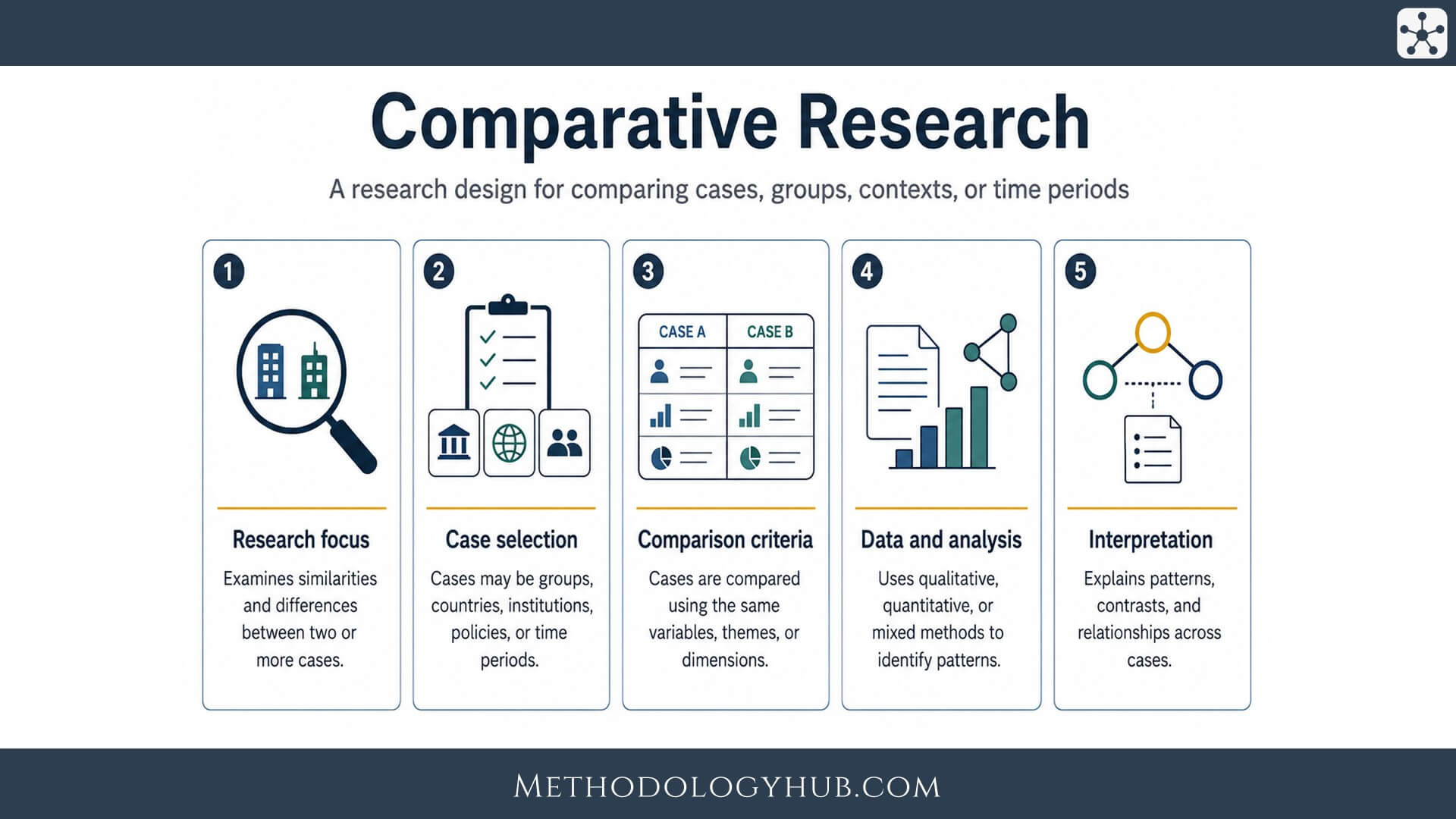
Comparative research depends on several design choices that should be made visible to the reader. These choices include what counts as a case, how cases are selected, which criteria are used for comparison, how data are made comparable, and what kind of interpretation the study can support.
These aspects are closely connected. A study cannot choose cases well without knowing the research question. It cannot define comparison criteria well without knowing the concepts or variables being studied. It cannot interpret results well without knowing the limits of the data. The design works as a chain.
Case selection
Case selection is one of the most important decisions in comparative research. Cases should not be chosen only because they are familiar or easy to reach. They should help answer the question. In some studies, the researcher selects cases that are very similar except for one major difference. In others, the researcher selects cases that are very different but show a similar outcome.
A small comparative study may use two or three carefully chosen cases. A larger study may include dozens of countries, schools, organisations, texts, or records. In both situations, the reader needs to know why these cases were included and what they allow the researcher to see.
Comparability
Comparability means that cases can be compared in a reasonable and transparent way. This does not mean they must be identical. It means the comparison criteria should make sense across all cases. A researcher can compare two universities, but the criteria may need adjustment if one is a large public institution and the other is a small specialised college.
Comparability also applies to data. If survey data are used, the questions should measure the same idea across groups. If interview data are used, the interview guide should be similar enough to support comparison. If documents are used, the same coding logic should be applied to each document set.
Level of analysis
The level of analysis is the level at which the comparison is made. A study may compare individuals, classrooms, schools, districts, countries, laws, or historical periods. Confusion begins when one level is used for evidence and another level is used for interpretation without explanation.
For example, a researcher may collect interviews from teachers but make claims about school systems. That can be reasonable, but the bridge between teacher-level data and system-level interpretation needs to be explained. The same issue appears in quantitative work when individual-level survey responses are used to compare institutions or regions.
Variables and comparison criteria
In quantitative comparative studies, researchers often compare variables across cases. In qualitative studies, they may compare themes, processes, practices, meanings, or categories. The underlying question is similar: what features are being compared.
Clear criteria prevent the comparison from drifting. A study comparing teacher training in three countries might use criteria such as entry requirements, programme length, supervised practice, assessment, and continuing professional development. The cases may still be rich and complex, but the comparison has a structure.
| Aspect | Question to ask | Example |
|---|---|---|
| Cases | What units are being compared? | Three schools, two policies, five countries, or four historical periods. |
| Criteria | Which features are compared across cases? | Access, outcomes, rules, resources, practices, or participant views. |
| Data | Are the data comparable enough? | The same survey items, coding guide, time period, or document type. |
| Interpretation | What kind of claim can the design support? | Description, explanation, classification, or theory refinement. |
Context and interpretation
Context gives comparative research much of its explanatory power. A difference between cases rarely appears in isolation. It may be linked to history, policy, resources, culture, geography, institutional rules, or measurement practices. Ignoring context can make a comparison look cleaner than it really is.
At the same time, too much context can make comparison difficult. If every case is treated as entirely unique, the researcher may struggle to draw any shared conclusion. Comparative research therefore requires balance. It needs enough structure to compare cases and enough context to avoid flattening them.
Comparative Research Design
A comparative research design explains how the comparison will be organised. It identifies the cases, the selection logic, the criteria for comparison, the data sources, and the planned analysis. In this way, the design connects the research process to the final interpretation.
Comparative designs vary widely. Some compare a small number of cases in depth. Others compare many cases statistically. Some focus on one point in time, while others follow change across years or decades. The best design depends on the question, not on a fixed template.
Most similar systems design
A most similar systems design compares cases that are alike in many ways but differ in an outcome or condition of interest. The logic is simple: if cases are similar on many background features, the differences that remain may help explain the outcome.
For example, a researcher may compare two schools in the same district with similar student populations and funding levels, but different attendance outcomes. Because the schools share many background conditions, the researcher can look more closely at differences in leadership practices, timetable structure, family communication, or student support.
Most different systems design
A most different systems design works in the opposite direction. It compares cases that differ in many background features but share an outcome. The question becomes: what do these different cases have in common that might help explain the shared result.
For instance, several universities in different countries may all have high completion rates in a particular programme. The researcher may compare them to see whether they share a common feature, such as structured mentoring, early assessment feedback, or strong placement support. The cases look different at first, but the shared outcome directs attention to possible common conditions.
Paired comparison
Paired comparison focuses on two cases selected because their relationship is analytically useful. The cases may be similar, contrasting, sequential, or connected by history, policy, geography, or institutional design. Two cases are not automatically easier than many cases. A paired comparison still needs clear selection logic.
Paired designs are common when a researcher wants depth and contrast at the same time. A study may compare two cities with different housing policies, two classrooms using different feedback approaches, or two legal systems that address the same issue through different rules.
Comparative case study design
A comparative case study design combines close case analysis with cross-case comparison. Each case is studied in detail, then cases are compared across shared questions or themes. This design is often used when the researcher wants to understand process, meaning, context, or institutional detail.
For example, a researcher may study three teacher-training programmes. Each programme can be analysed as a case, with attention to curriculum, placement structure, assessment, and participant experience. The cross-case comparison then asks what patterns appear across the programmes and what differences seem linked to the local setting.
Cross-sectional and longitudinal comparative designs
A cross-sectional comparative design compares cases at one defined time point or within one short period. A longitudinal comparative design compares cases across time. Both are useful, but they answer different questions.
A cross-sectional study might compare student satisfaction across departments in one academic year. A longitudinal study might compare how satisfaction changes across several years after a new advising system is introduced. When time is part of the question, the design should show how the time points were selected and how change will be interpreted.
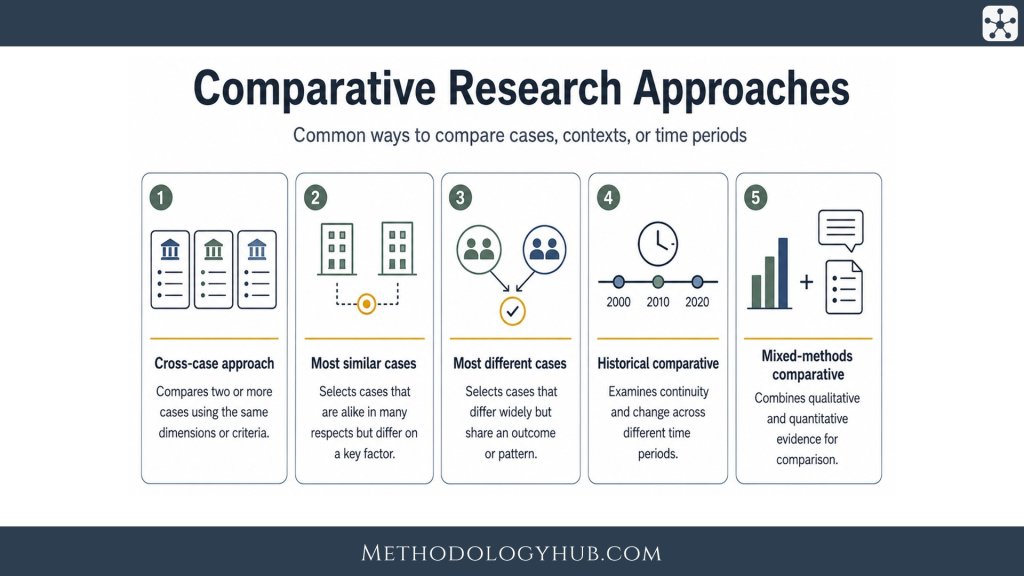
Comparative Research Approaches
Comparative research can be approached through qualitative, quantitative, or mixed methods. The approach depends on the kind of data being used and the kind of claim the researcher wants to make. A comparison of interview narratives will not be organised in the same way as a comparison of national survey indicators, even when both studies are comparative.
It is useful to separate the comparative design from the methodology. Comparative research is about the structure of comparison. Qualitative research, quantitative research, and mixed methods research describe the kind of data and analysis used inside that structure.
Qualitative comparative research
Qualitative comparative research compares cases through non-numerical data such as interviews, documents, observations, fieldnotes, policy texts, images, or open-ended responses. It is often used when the researcher wants to understand meaning, process, experience, institutional practice, or historical development.
For example, a qualitative comparative study might examine how teachers in three schools describe inclusive classroom practice. The researcher may use similar interview questions in each school, code the interviews with a shared framework, and then compare patterns across cases. The comparison does not depend on large numbers. It depends on careful case understanding and transparent cross-case analysis.
Quantitative comparative research
Quantitative comparative research uses numerical data to compare cases, groups, or categories. It may compare averages, proportions, rates, distributions, trends, or statistical relationships. This approach is common in surveys, administrative data analysis, education assessment, epidemiology, economics, and population research.
A researcher might compare average science scores across school types, vaccination rates across regions, or employment outcomes across training programmes. The analysis may use descriptive statistics, confidence intervals, regression models, or other statistical methods. The comparison should still be tied to design choices, such as sampling, measurement, and equivalence.
Mixed methods comparative research
Mixed methods comparative research combines qualitative and quantitative evidence in one comparative design. This can be useful when numbers show the pattern but qualitative evidence helps explain how the pattern appears in practice.
For example, a study may compare student retention across four colleges using enrolment data, then use interviews to understand advising practices in each college. The quantitative part shows where retention differs. The qualitative part helps interpret the institutional routines behind those differences.
Configurational comparative research
Configurational comparative research looks at combinations of conditions rather than single factors one at a time. Qualitative Comparative Analysis, often shortened to QCA, is one well-known approach. It asks how different combinations of conditions are linked to an outcome across cases.
This approach is useful when several routes may lead to the same result. For instance, student success may be linked to different combinations of mentoring, financial support, course flexibility, and prior preparation. One case may succeed through one combination, another through a different combination. Configurational comparison helps the researcher study these patterns without forcing every case into one linear explanation.
Comparative Research Methods
Comparative research methods are the practical ways researchers collect and analyse evidence for comparison. The method should fit the cases, the data, and the claim. A cross-national survey, a comparative interview study, a document analysis, and a statistical comparison can all be comparative, but they require different procedures.
The term method should not be reduced to the name of a tool. It includes how data are collected, how cases are prepared for comparison, how categories are defined, and how findings are interpreted. In comparative research, method and comparability are closely linked.
Comparative document analysis
Comparative document analysis examines written or visual materials across cases. Documents may include policies, laws, curriculum guides, meeting minutes, textbooks, reports, letters, archival records, media texts, or institutional guidelines.
The researcher usually builds a coding framework and applies it across all documents. For example, a study may compare school discipline policies by coding how each policy defines misconduct, which responses are allowed, how appeals work, and whether restorative practices are included. The method becomes comparative because the same questions are asked of each document set.
Comparative interviews
Comparative interview research uses interviews across more than one group or setting. The interviews may be structured, semi-structured, or open-ended, but they need enough shared focus to support comparison.
A study might interview teachers in schools with different assessment systems. The researcher may ask all participants about feedback practices, grading workload, student response, and professional judgement. Later, the analysis can compare how teachers in each setting describe the same areas of work.
Comparative surveys
Comparative surveys collect structured responses from different groups, institutions, regions, or countries. They are often used when researchers want to compare distributions, averages, or relationships across groups.
Survey comparison requires careful measurement. The same question should carry the same meaning across groups as far as possible. Translation, cultural interpretation, response scales, sampling, and mode of administration can all affect comparability. A difference in results may reflect a real difference between groups, but it may also reflect how the question was understood.
Secondary data comparison
Many comparative studies use existing datasets. These may include census data, school records, health registers, labour statistics, public archives, assessment databases, or published indicators. Secondary data can make large comparisons possible, especially when collecting new data would be too costly.
The main task is to check whether the data were produced in comparable ways. If countries define unemployment, disability, household income, or school completion differently, the numbers may not line up as neatly as they appear. The researcher should examine definitions before treating indicators as directly comparable.
Comparative statistical analysis
Comparative statistical analysis uses numerical techniques to compare groups or cases. It may involve means, proportions, cross-tabulations, confidence intervals, t-tests, ANOVA, regression, multilevel models, or other forms of statistical analysis.
The method depends on the question. A study comparing two group means may use a t-test. A study comparing outcomes across several groups may use ANOVA or regression. A study comparing individuals nested inside schools or countries may need multilevel analysis. The statistical technique should follow the structure of the data, not the other way around.
Useful check: Before analysis, ask whether each case has evidence for the same comparison criteria. If not, the study may need a narrower question or a clearer explanation of unequal data.
Comparative historical analysis
Comparative historical analysis compares processes across time and place. It is often used to study institutional change, social movements, reforms, revolutions, legal development, education systems, or public policy. The evidence may come from archives, documents, historical datasets, interviews, and secondary literature.
This method is especially useful when timing and sequence are part of the explanation. A reform may look similar in two countries but unfold differently because one case had earlier institutional preparation and the other did not. Comparative historical analysis allows the researcher to compare pathways, not only outcomes.
Comparative Research vs Case Study Research
Comparative research and case study research often overlap, but they are not the same. Case study research focuses on understanding a case in depth. Comparative research focuses on understanding cases in relation to one another.
A single case study may examine one school, one hospital, one policy, one organisation, or one historical event. A comparative study examines two or more cases through shared criteria. A comparative case study sits between the two: it studies each case in depth and then compares across cases.
Main difference between the designs
The main difference is the centre of attention. In case study research, the case itself receives sustained attention. The researcher asks how the case works, how its parts fit together, and how its context shapes what is observed. In comparative research, the relationship between cases is central. The researcher asks how cases resemble or differ from one another and what that pattern suggests.
For example, a case study may examine how one school introduced project-based learning. A comparative study may examine how three schools introduced project-based learning under different leadership structures. The first design gives a close account of one setting. The second uses cross-case comparison to interpret variation across settings.
| Aspect | Case study research | Comparative research |
|---|---|---|
| Focus | Understanding one case or a bounded set of cases in depth. | Understanding similarities, differences, or patterns across cases. |
| Typical question | How does this case work? | How do these cases compare? |
| Data use | Often rich, detailed, and context-heavy. | Organised so the same criteria can be examined across cases. |
| Result | A detailed account of the case and its context. | A cross-case pattern, contrast, typology, or explanation. |
When the two designs work together
The two designs often work together well. A researcher may first analyse each case in depth, then compare cases. This avoids a shallow comparison that jumps too quickly to categories. It also avoids a purely separate set of case descriptions with no cross-case conclusion.
The balance depends on the project. A dissertation may devote substantial space to each case before the comparison. A shorter article may present case detail more selectively and spend more space on the cross-case pattern. In either form, the reader should be able to see both the case evidence and the comparative logic.
How to Perform Comparative Research
Performing comparative research means building a clear route from question to cases, from cases to data, and from data to interpretation. The process does not have to be complicated, but it should be explicit. Readers should be able to see how the comparison was made.
The steps below describe a general process. A small student project may use the same logic with fewer cases and simpler data. A large research project may add sampling plans, statistical modelling, translation procedures, or several rounds of coding. The core task remains the same: compare cases through a defensible structure.
Step 1: Define the research question
Start by writing a question that requires comparison. A question such as “How do two schools organise feedback for first-year students?” clearly points to a comparative design. A question such as “What is feedback?” does not yet require comparison.
The question should also make the units of comparison visible. If the study compares classrooms, say classrooms. If it compares countries, say countries. If it compares documents, policies, or time periods, name them clearly. This helps align the question with the rest of the design.
Step 2: Select the cases
Choose cases because they help answer the question. They may be similar cases with a meaningful difference, different cases with a shared outcome, typical cases, contrasting cases, extreme cases, or cases selected from a larger population. The selection logic should be stated.
For a student project, case selection may be partly practical. That is acceptable if it is reported honestly. A comparison of two textbooks, two school policies, or two local organisations can still be useful, but the conclusion should fit the selection.
Step 3: Define comparison criteria
Decide what will be compared across cases. Criteria may come from theory, prior research, policy categories, interview themes, observed practices, or measurable variables. The criteria should be specific enough to guide data collection and analysis.
For example, a study comparing homework policies might use criteria such as purpose of homework, expected time, feedback procedure, family involvement, digital access, and support for students who struggle. These criteria turn a broad topic into a workable comparison.
Step 4: Choose data sources
Select data sources that can answer the same comparison questions for each case. These may include interviews, surveys, documents, observations, datasets, test results, archival records, or a combination. If the data sources differ across cases, explain how the difference affects interpretation.
In many studies, empirical research data are central because the researcher collects or analyses observations. In other studies, theoretical research plays a larger role, especially when concepts, models, or arguments are compared.
Step 5: Prepare the data for comparison
Data preparation is where many comparative studies become stronger or weaker. The researcher may need to clean a dataset, translate interview excerpts, code documents, align time periods, standardise categories, or check whether measures mean the same thing across cases.
For quantitative data, preparation may include checking missing values, variable definitions, units of measurement, and sample structure. For qualitative data, it may include building a coding guide, writing case summaries, and checking whether the same themes are traceable across all cases.
Step 6: Analyse within cases and across cases
Good comparative analysis often moves in two directions. First, the researcher analyses each case on its own terms. Then, the researcher compares across cases. This prevents the study from losing context too early.
Within-case analysis asks what is happening inside each case. Cross-case analysis asks how cases relate to one another. The final interpretation should show both. A reader should not see only separate case stories, but also should not see a comparison that ignores the character of each case.
Step 7: Interpret the findings in relation to the design
The interpretation should match the design. A small qualitative comparison may support careful theoretical insight, but not a broad population estimate. A large survey comparison may support statistical inference, but only if sampling, measurement, and data quality allow it. An explanatory research claim needs stronger support than a descriptive comparison.
This is also where the researcher should connect findings back to the original question. If the study began with a question about policy differences, the conclusion should not drift into unsupported claims about all institutions. The comparison should stay within the reach of the evidence.
Step 8: Report the comparison clearly
A clear report explains the cases, selection logic, comparison criteria, data sources, analysis steps, and limits of interpretation. Tables can help, especially when the study compares several cases across several criteria. Prose is still needed to explain what the pattern means.
The reporting should show enough detail for readers to understand the route from evidence to conclusion. A short statement such as “the cases were compared” is not enough. The reader should know what was compared, how it was compared, and why that comparison was appropriate.
Examples of Comparative Research
Examples of comparative research are easiest to understand when the cases and criteria are visible. The examples below show how the same design logic can appear across different academic fields. They are simplified, but they show how a comparison can be structured.
Example in education research
An education researcher compares two first-year writing programmes at different colleges. The cases are the programmes. The criteria include class size, feedback method, writing assignments, tutor support, and student completion rates. The researcher uses programme documents, student surveys, and interviews with instructors.
The comparison may show that both programmes teach similar writing skills, but they organise support differently. One relies on weekly peer workshops. The other uses individual writing conferences. The findings may suggest how support structures shape student experience, while still recognising that the two colleges have different student populations.
Example in health research
A health researcher compares follow-up care in three clinics treating the same chronic condition. The criteria include appointment scheduling, patient education, record keeping, referral pathways, and readmission rates. The study uses clinic records and interviews with nurses and patients.
The comparison may show that the clinic with the most consistent follow-up reminders has fewer missed appointments. That pattern does not prove a cause by itself, but it points to a possible explanation that could be examined in a later evaluation research project.
Example in social science research
A social scientist compares youth participation in two municipalities. Both municipalities have youth councils, but they differ in how young people are selected, how often meetings occur, and whether proposals reach elected officials. The researcher analyses meeting records, interviews participants, and compares local rules.
The study may show that participation looks similar on paper but works differently in practice. One council may have more formal access to decision makers, while the other may give participants more freedom to set the agenda. The comparison helps separate surface similarity from practical difference.
Limitations of Comparative Research
Comparative research also has limitations. These limitations do not make the design weak by default. They show where the researcher needs care. The most frequent difficulties involve case selection, comparability, uneven data, too many possible explanations, and overgeneralisation.
A good comparative study does not hide these limits. It explains how they were handled and how they affect interpretation. This is especially important for students, because comparison can look straightforward at first but becomes more demanding once cases are examined closely.
Cases may not be fully comparable
Cases are often compared because they share some feature, but they may differ in other ways that affect interpretation. Two schools may use the same programme name but implement it differently. Two countries may report the same indicator using different definitions. Two historical periods may use similar language but operate under different institutions.
The researcher should ask whether the comparison is fair enough for the question. Sometimes the answer is to narrow the criteria. Sometimes it is to explain the differences more openly. Sometimes the cases should be changed.
Data may be uneven across cases
Comparative studies often struggle with uneven data. One case may have rich documents, while another has limited records. One group may respond strongly to a survey, while another has a low response rate. One country may collect an indicator annually, while another collects it irregularly.
Uneven data do not always prevent comparison, but they affect confidence in the findings. The researcher should avoid treating all cases as equally documented when they are not.
Too many explanations may be possible
Comparative research often deals with complex settings. Many factors may differ across cases at the same time. This can make explanation difficult, especially when the number of cases is small. If two schools differ in leadership, resources, student background, timetable, and teacher experience, it is hard to know which difference is most closely linked to the outcome.
Researchers can respond by using theory, narrowing the question, choosing cases carefully, adding more cases, or combining methods. The goal is not to remove all complexity. The goal is to make the reasoning traceable.
Findings can be overgeneralised
A comparison of two or three cases can produce useful insight, but it should not be presented as if it represents all cases everywhere. A small comparative study may suggest a pattern, refine a concept, or develop an explanation. It does not automatically estimate a population.
For broader claims, researchers need a design that supports broader inference, such as a larger sample, clearer sampling strategy, or appropriate statistical analysis. This is where comparative research may connect with survey research, probability sampling, or other designs.
Conclusion
Comparative research is a flexible research design for studying cases, groups, settings, periods, documents, or datasets in relation to one another. Its strength lies in structured comparison. Instead of treating each case as a separate description, the researcher asks shared questions across cases and interprets the pattern that appears.
The design can be qualitative, quantitative, or mixed. It can compare two cases in depth, many cases statistically, or several cases through a combination of data sources. It can describe differences, classify cases, examine possible explanations, refine concepts, or study change over time.
The central challenge is to keep the comparison fair and transparent. Cases should be selected deliberately. Criteria should be clear. Data should be checked for comparability. Interpretation should match the evidence. When these parts are handled carefully, comparative research can help students and researchers understand how patterns vary across contexts and what those patterns may suggest.
FAQs on Comparative Research
What is comparative research?
Comparative research is a research design that examines two or more cases, groups, settings, periods, documents, or datasets through shared criteria. It is used to identify similarities, differences, patterns, or possible explanations across cases.
What is an example of comparative research?
An example is a study comparing two school programmes by examining their curriculum, teaching methods, feedback procedures, student support, and completion rates. The programmes are the cases, and the shared criteria make the comparison possible.
What are the main types of comparative research?
The main types include qualitative comparative research, quantitative comparative research, mixed methods comparative research, comparative case study research, cross-sectional comparative research, longitudinal comparative research, and configurational approaches such as Qualitative Comparative Analysis.
How do you perform comparative research?
Start with a research question that requires comparison, select cases deliberately, define shared comparison criteria, choose suitable data sources, prepare the data so the cases can be compared, analyse within each case, compare across cases, and report the selection logic and limits clearly.