Longitudinal research is a research design in which the same people, cases, records, groups, or settings are studied more than once across a defined period of time. Instead of taking one snapshot, the researcher follows a process as it develops. This makes longitudinal research especially useful when the research question is about change, stability, sequence, development, decline, recovery, learning, behaviour, or transition.
This article explains what longitudinal research is, what it tries to do, how it differs from cross-sectional research, which longitudinal research designs and methods are common, and how researchers can plan a longitudinal study in a clear and realistic way.
What Is Longitudinal Research?
Longitudinal research is a type of research design that collects data from the same units at two or more points in time. The units may be people, classrooms, families, organisations, patients, countries, documents, records, neighbourhoods, or any other subject that can be observed repeatedly. The design is used when time is part of the question rather than just a background detail.
A simple example is a study that measures students’ reading confidence at the start of the school year, in the middle of the year, and at the end of the year. The researcher is not only asking how confident students are at one point. The study asks how confidence changes, whether some students change more than others, and whether earlier conditions help explain later outcomes.
Longitudinal research definition
Longitudinal research means collecting data from the same units repeatedly across time in order to study change, continuity, direction, or sequence. The same unit is followed so that earlier and later information can be connected within the same case.
This connection is the main difference between a longitudinal design and a series of unrelated one-time studies. If a researcher surveys one group of students in January and a completely different group in June, the two surveys may show a difference between time points. They do not show how the same students changed. A longitudinal study keeps that link between time points visible.
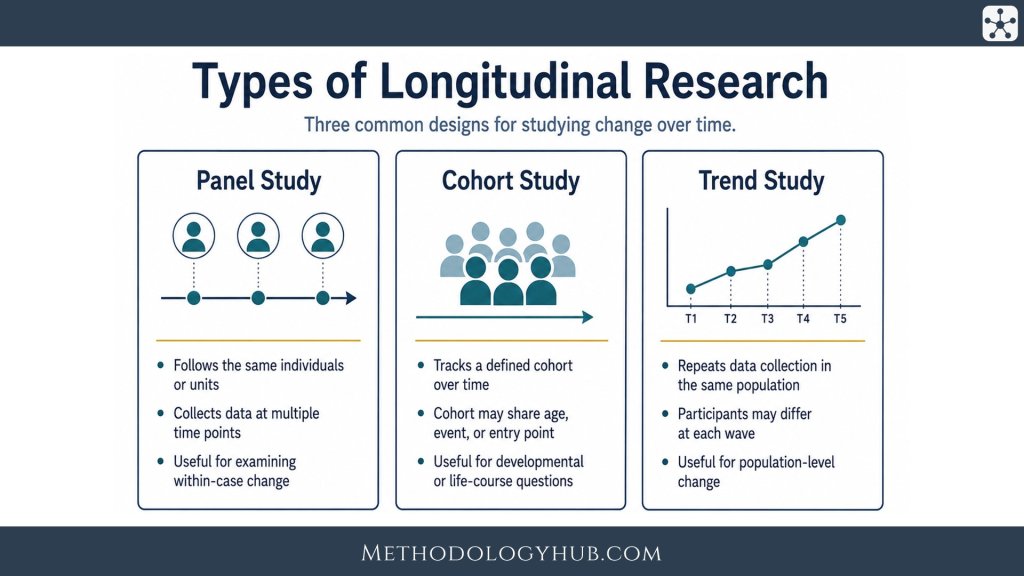
Time as part of the design
In longitudinal research, time has to be planned. The researcher decides how many observations will be collected, how far apart they will be, and which moments are most suitable for the phenomenon being studied. A study of daily mood may need frequent diary entries. A study of career development may need yearly interviews. A study of child growth may use measurement points that match developmental stages.
The timing should follow the research topic and the expected pace of change. Some processes move quickly. Others unfold slowly. A design that is too short may miss the change completely. A design with too few observations may detect that something changed, but may not show when or how the change happened.
Longitudinal data
Longitudinal research produces longitudinal data. These data contain repeated information from the same units. In a quantitative study, this may mean repeated test scores, health measures, survey responses, income records, attendance counts, or scale scores. In a qualitative study, it may mean repeated interviews, fieldnotes, diaries, classroom observations, or documents collected from the same setting over time.
The repeated structure affects the way the data are interpreted. A score recorded in the third wave of a study is not just another number. It belongs to a case with a previous history in the dataset. A later interview is not just a separate conversation. It can be read beside earlier interviews to see what stayed the same, what changed, and what the participant now understands differently.
Objectives of Longitudinal Research
The main objectives of longitudinal research are tied to time. Researchers use this design when one observation is not enough to answer the question. A one-time study can describe the current situation. A longitudinal study can show whether that situation is stable, improving, declining, repeating, or moving in different directions for different groups.
These objectives appear in many fields. Education researchers may follow pupils through a school year. Health researchers may study recovery after treatment. Sociologists may examine transitions from school to work. Psychologists may study changes in motivation, stress, identity, or family relationships. In each case, the design gives the researcher a way to place later data beside earlier data.
Studying change over time
The most direct objective is to study change. Change may be measured as a difference between two points, such as before and after an intervention. It may also be studied as a pattern across several waves, such as gradual growth, sudden decline, temporary improvement, or repeated fluctuation.
For example, a researcher might measure anxiety symptoms before the start of a university semester, during examinations, and after examinations. The study could show whether anxiety rises only during the examination period or remains higher afterward. A one-time survey would not show that movement.
Studying stability and continuity
Longitudinal research is not only about change. It can also study stability. Some patterns remain steady across time, and that steadiness may be part of the finding. A student’s sense of belonging, a household’s income level, a patient’s functional status, or a classroom routine may show very little movement during the study period.
This is useful because stability is often invisible in a one-time study. If a researcher observes that a group has low trust in an institution at one point, the result may look like a temporary reaction. If the same low trust appears over several waves, the interpretation changes. The finding now points to a more persistent pattern in the data.
Studying sequence and direction
Another objective is to examine sequence. Researchers often want to know whether one event, condition, or measurement tends to come before another. Longitudinal data can help because earlier observations are separated from later observations.
Suppose a study examines sleep, concentration, and academic performance. A cross-sectional study can show that these variables are related at one time. A longitudinal study can ask whether earlier sleep patterns are associated with later concentration, and whether later concentration is associated with later performance. The design does not prove cause by itself, but it gives a clearer time order than a single snapshot.
Planning note: If the question uses words such as change, growth, decline, transition, recovery, duration, or sequence, a longitudinal design may fit better than a one-time design.
Comparing trajectories
Many longitudinal studies compare trajectories. A trajectory is the path a measure or experience follows across time. Two people may start at the same point and move differently. Two groups may have similar averages at the beginning of a study but separate later. A policy may affect one region sooner than another. A treatment may help some patients quickly and others slowly.
Trajectory thinking keeps the researcher from reducing time to a simple before-and-after contrast. It also shows that average change can hide different patterns. In a class of students, the average reading score may increase across a semester. Inside that average, some students may improve quickly, some may improve slowly, and some may not improve at all.
Key Aspects of Longitudinal Research
Longitudinal research needs more planning than many one-time designs because the study has to survive across time. The researcher must define who or what will be followed, decide what will be measured or explored repeatedly, protect consistency across waves, and prepare for missing data. These decisions shape the quality of the final interpretation.
The design should be described in enough detail that readers can see how the study moved from one wave to the next. Vague wording such as “participants were followed over time” is usually not enough. A clear description names the units, time points, measures, data collection methods, retention plan, and analytic approach.
Same units across time
The repeated link to the same unit is central. If the study follows people, the researcher needs a way to match each person’s baseline data with later data. If the study follows schools, clinics, documents, or households, the same logic applies. The later observation must be connected to the earlier one.
This does not mean every unit must appear at every wave. In real studies, some participants leave, some records are incomplete, and some settings change. The point is that the design is built around repeated observation of the same units, even if the final dataset contains gaps.
Measurement across waves
Longitudinal research usually depends on consistent measurement. If a researcher measures student engagement with one scale at the first wave and a different scale at the second wave, the change may reflect the instrument rather than the students. The same issue appears in interviews, observations, and administrative records. A question, category, or procedure that changes between waves can change the meaning of the data.
Consistency does not mean the design can never adapt. A qualitative researcher may add follow-up questions when new themes appear. A health study may add a measure when a new clinical question emerges. The researcher should explain these changes so that readers can judge what was comparable and what was added later.
Attrition and missing data
Attrition means the loss of participants, cases, records, or observations across waves. It is common in longitudinal research. People move, lose interest, become unreachable, withdraw, or miss a data collection point. Organisations merge or close. Records may be unavailable for some periods.
Attrition becomes a problem when the units that leave are different from those that remain in ways related to the study. For example, a study of academic support may lose students who are struggling most, leaving a final sample that appears more successful than the original group. This is why researchers often report the number of units at each wave and compare those who stayed with those who left when possible.
Time intervals and study duration
The spacing of time points affects what the study can show. Two observations can show a difference between the beginning and the end. Three or more observations can begin to show the shape of change. Frequent observations can show short-term fluctuations, while longer intervals may be more suitable for slow processes.
There is no universal interval that works for all studies. The interval should fit the process. Weekly measurement may be appropriate for mood, symptoms, study habits, or diary-based research. Yearly measurement may be more suitable for educational transitions, employment, ageing, or institutional change.
Analysis that respects repeated data
Longitudinal data usually cannot be analysed as if every observation came from a different unit. Repeated measures from the same person or case are related. A student’s score in June is likely related to that same student’s score in January. A patient’s later health measure is linked to their earlier health measure.
In quantitative research, this affects the choice of statistical methods. Researchers may use change scores, repeated-measures analysis, growth models, mixed models, survival analysis, or other approaches depending on the question and data structure. In qualitative research, analysis may compare each case across time before comparing patterns between cases.
Longitudinal vs Cross-Sectional Research
Longitudinal research is often compared with cross-sectional research because both designs are common in academic work. The difference is not the topic, the field, or the type of data. The difference is the role of time. Cross-sectional research studies a population, sample, or set of cases at one point in time. Longitudinal research studies the same units repeatedly.
A cross-sectional survey can estimate how many students currently report high academic stress. A longitudinal survey can examine how stress changes from the start to the end of the semester. Both designs can be useful. They simply answer different questions.
| Aspect | Longitudinal research | Cross-sectional research |
|---|---|---|
| Time frame | Two or more observations across time. | One observation period or one time point. |
| Main focus | Change, stability, sequence, trajectories, duration. | Current status, prevalence, differences, associations. |
| Units observed | Usually the same units are followed repeatedly. | Units are observed once. |
| Typical strength | Shows within-case movement and time order. | Often faster, cheaper, and easier to complete. |
| Typical limitation | Needs more time, retention planning, and design-aware analysis. | Cannot directly show individual change across time. |
When the comparison affects interpretation
The distinction affects the kind of claim a study can make. A cross-sectional study may find that older students report more academic confidence than younger students. That does not show that individual students become more confident as they age. The difference could reflect cohort differences, programme differences, selection effects, or other factors. A longitudinal study that follows the same students can examine whether their confidence changes within the same people.
This does not make longitudinal research automatically stronger in every situation. If the question is about the current distribution of a variable in a population, cross-sectional research may fit very well. If the question is about change within cases or sequence across time, longitudinal research is usually a better fit.
Connection with other research designs
Longitudinal research can appear inside several broader research designs. It can be part of descriptive research when the purpose is to describe change over time. It can be part of explanatory research when the purpose is to examine possible reasons for later outcomes. It can also support case study research, survey research, or correlational research.
The same idea applies to experimental research and quasi-experimental research. A study may measure participants before and after an intervention, or across several follow-up points. The design is experimental or quasi-experimental because of the intervention structure, and longitudinal because outcomes are measured across time.
Longitudinal Research Designs
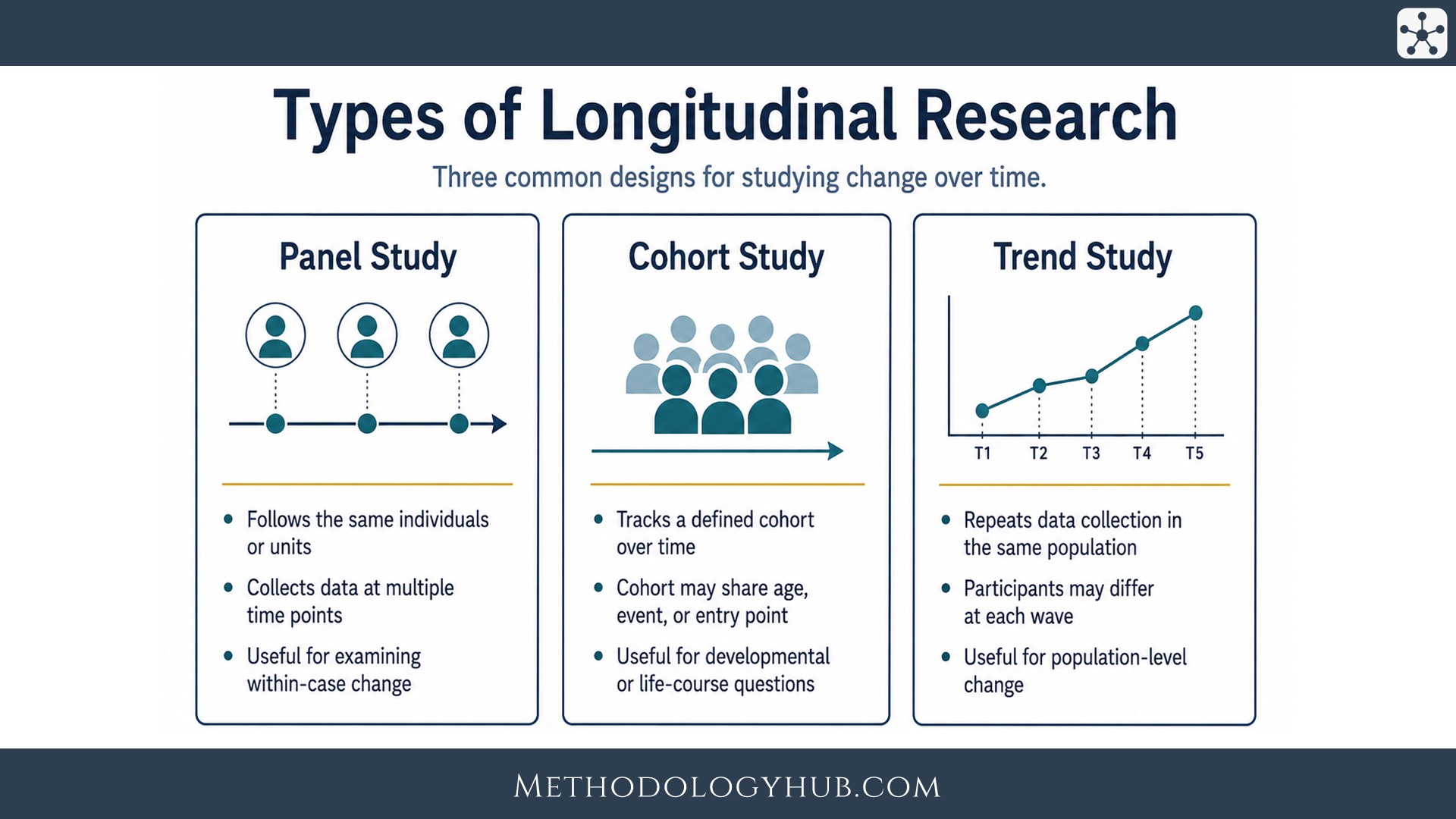
Longitudinal research designs differ in what they follow, when they begin, how often they collect data, and how the sample is maintained. The right design depends on the phenomenon, the available time, the data source, and the kind of comparison the researcher wants to make.
Some designs begin now and follow participants into the future. Others use existing records to reconstruct what happened in the past. Some return to the same participants at each wave, while others repeatedly observe the same setting or population structure. The labels below are useful because they help the researcher explain the design without hiding the practical choices behind one broad term.
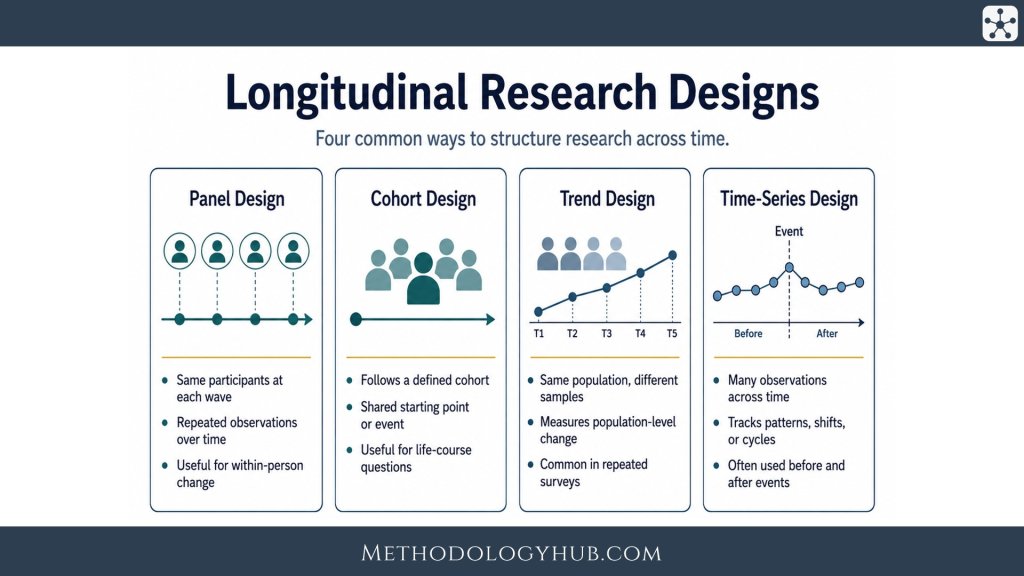
Panel design
A panel design follows the same sample across several waves. The sample may consist of individuals, households, organisations, classrooms, or other units. Panel studies are often used in social science, education, health, and public opinion research because they can show within-case change.
For example, a panel survey may ask the same group of young adults about education, work, housing, and wellbeing every year for five years. The repeated structure allows the researcher to compare each person’s later answers with their own earlier answers.
Cohort design
A cohort design follows a group that shares a starting condition or experience. The cohort may be people born in the same year, students who entered school in the same year, patients diagnosed during the same period, or workers hired at the same time.
Cohort designs are useful when the starting point is meaningful. A study of children born in the same year can examine development across childhood. A study of patients diagnosed in the same year can follow treatment, recovery, recurrence, or long-term outcomes.
Prospective design
A prospective longitudinal design begins before the later outcomes have occurred. The researcher collects baseline data, then follows units forward. This design is useful when the researcher wants to measure predictors before outcomes are known.
For instance, a health study may record physical activity, diet, sleep, and stress at baseline, then follow participants for several years to study later health outcomes. Because the earlier data were collected before the later outcomes, the time order is clearer than in a one-time design.
Retrospective design
A retrospective longitudinal design uses existing data to look back across time. The researcher may use medical records, school records, employment histories, archives, administrative databases, or previously collected survey data. The data already exist, but the analysis treats them as a time-ordered record.
This design can be efficient when long-term records are available. It also depends heavily on the quality of those records. If earlier measurements were inconsistent, missing, or collected for a different purpose, the researcher needs to be cautious in interpretation.
Repeated measures design
A repeated measures design collects the same or similar measurements from the same participants under several time points or conditions. It is common in psychology, education, health, and laboratory-based research. The design may be used to compare scores before and after a programme, across several sessions, or during different stages of a task.
Repeated measures designs can be part of experimental, quasi-experimental, or non-experimental research. The repeated measurement is the longitudinal part. The presence or absence of manipulation determines whether the wider study is experimental.
Intensive longitudinal design
Intensive longitudinal designs collect many observations from each unit over a relatively short or medium period. Examples include daily diaries, experience sampling, mobile surveys, wearable sensors, learning logs, and repeated symptom reports. These designs are useful when the process changes quickly or fluctuates within people.
A study of student concentration might ask participants to report their concentration several times per day for two weeks. This would show short-term variation that a monthly survey would miss. The design also creates a large amount of data, so planning the analysis early is important.
| Design | How it works | Good fit |
|---|---|---|
| Panel design | Follows the same sample across waves. | Within-case change and repeated survey data. |
| Cohort design | Follows a group with a shared starting point. | Development, ageing, diagnosis, school entry, transitions. |
| Prospective design | Collects data now and follows units forward. | Studying predictors before later outcomes occur. |
| Retrospective design | Uses existing time-ordered records. | Long histories already stored in records or archives. |
| Intensive longitudinal design | Collects many observations from each unit. | Daily, weekly, or moment-to-moment processes. |
Longitudinal Research Methods
Longitudinal research is a design, not one single data collection method. Researchers can collect longitudinal data through surveys, interviews, observations, tests, records, diaries, sensors, or mixed data sources. The method should fit both the research question and the expected pattern of change.
A strong longitudinal study usually chooses methods that participants can complete across waves and that researchers can repeat with enough consistency. A method that works once may become difficult when repeated many times. Lengthy questionnaires, long interviews, demanding tests, or complicated tracking procedures can increase missing data if the study runs for a long period.
Longitudinal surveys
Longitudinal surveys ask the same participants or units questions across two or more waves. They are common when researchers want comparable answers over time. A survey may repeat the same questions at each wave, add new questions in later waves, or rotate modules depending on the design.
Surveys are useful for measuring attitudes, behaviours, experiences, symptoms, educational progress, employment status, or household conditions. They also make it possible to connect longitudinal research with quantitative research and statistical analysis.
Longitudinal interviews
Longitudinal interviews collect qualitative data from participants more than once. The researcher may return to the same person after a few weeks, months, or years to ask how their situation, interpretation, or experience has changed. This method is useful when the study aims to understand lived experience, meaning, decision-making, or transition.
For example, a researcher may interview new teachers at the start of their first year, near the middle of the year, and after the year ends. The later interviews can return to earlier topics and ask how the participant now understands events that were still unfolding during the first interview.
Records and administrative data
Many longitudinal studies use existing records. These may include school records, hospital records, employment histories, social service data, test results, financial records, court records, environmental readings, or digital platform logs. Records can be useful because they may cover long periods that would be expensive to follow from the beginning.
Record-based longitudinal research depends on data quality. The researcher needs to know when and how the records were created, whether definitions changed, whether missing values are common, and whether the records cover the population or only the cases that entered a system.
Observation and repeated assessments
Observation can also be longitudinal. A researcher may observe the same classroom across a semester, the same organisation during a change process, or the same community project across several stages. Repeated observation can show routines, interactions, and adaptations that participants may not fully describe in an interview or survey.
Repeated assessments are common in education, health, psychology, and laboratory research. These may include tests, clinical measures, task performance, behavioural coding, physiological measures, or rating scales. The researcher should consider whether repeated testing itself changes the result. Participants may learn from earlier tests or become tired of repeated tasks.
Diaries, logs, and experience sampling
Diaries and logs allow participants to record information close to the time it occurs. In experience sampling, participants may respond to prompts during the day. These methods can reduce reliance on memory and show short-term patterns.
They are useful for studying mood, pain, sleep, studying, social interaction, screen use, classroom engagement, or daily work routines. The burden on participants can be high, so the number of prompts, length of each entry, and total study duration should be realistic.
Longitudinal Research Approaches
Longitudinal research can be quantitative, qualitative, or mixed methods. The approach depends on the kind of evidence the study needs. A study can measure change numerically, interpret change through participant accounts, or combine both in one design.
This distinction is important because time can be treated differently across approaches. In a quantitative study, time may appear as waves, dates, intervals, slopes, or event histories. In a qualitative study, time may appear through stories, turning points, memories, routines, and changing meanings. In a mixed methods study, the researcher has to decide how these forms of time will speak to each other.
Quantitative longitudinal research
Quantitative longitudinal research uses numerical data collected across time. It may examine means, proportions, growth rates, trajectories, transitions, or relationships between earlier and later variables. Examples include repeated test scores, health measures, survey scales, employment records, or attendance counts.
The analysis may involve descriptive summaries at each wave, change scores, repeated-measures tests, regression models, growth models, mixed models, or event history methods. The choice depends on the research hypothesis, number of waves, measurement level, missing data pattern, and sample structure.
Qualitative longitudinal research
Qualitative research can be longitudinal when data are collected from the same participants, cases, or settings across time. The aim is usually to understand how experiences, meanings, decisions, relationships, or identities develop. The researcher may use repeated interviews, fieldwork, diaries, case histories, or documents.
Qualitative longitudinal analysis often moves in two directions. First, the researcher follows each case across time. Then the researcher compares cases to see whether similar patterns appear across participants or settings. This keeps the time story of each case from being lost too early in broad themes.
Mixed methods longitudinal research
Mixed methods research combines quantitative and qualitative evidence in one study. In a longitudinal design, this can be especially useful because numbers may show the pattern of change, while qualitative data may help explain how participants experienced that change.
For example, a study of student transition to university might collect survey scores on belonging at several waves and interview a smaller group of students after each wave. The survey can show whether belonging rises, falls, or remains steady. The interviews can show how students explain those shifts in relation to classes, friendships, family, work, and campus life.
Design question: Decide early whether time will be measured mainly as numbers, explored through experience, or studied through a combination of both.
Empirical and applied uses
Most longitudinal research is a form of empirical research because it uses observed data from the world. It may also be applied research when it addresses a practical problem such as learning progress, service use, health recovery, programme outcomes, or policy effects.
Longitudinal designs can also support basic research when the aim is to build knowledge about development, behaviour, social change, or theory. The design does not decide the purpose by itself. The purpose comes from the question the study asks and the way the findings will be used.
How to Perform Longitudinal Research
Performing longitudinal research begins with a clear research question and ends with an interpretation that respects time. The steps below describe a general process. A small student project may use a short two-wave design. A large research programme may need several years, multiple teams, advanced statistical modelling, and a detailed retention plan. The same basic logic still applies.
Step 1: Define the research question
Start by writing a question that clearly needs time. A question such as “What is the average study time of first-year students?” may be answered with a cross-sectional design. A question such as “How does study time change during the first semester?” points toward a longitudinal design.
The question should also name the unit of analysis, the outcome or experience of interest, and the period being studied. A focused question helps the researcher avoid collecting repeated data simply because repeated data seem more impressive.
Step 2: Choose the units and sample
Decide who or what will be followed. The unit may be a person, class, school, patient, record, family, organisation, or place. Then choose a sample that fits the claim the study wants to make. Some longitudinal studies use probability sampling, especially when the aim is population inference. Others use purposive or case-based selection, especially when depth is more important than population estimation.
The sampling plan should connect to the wider research process. Researchers should explain how units were selected, who was eligible, how many entered the study, and how many remained at each wave.
Step 3: Decide the number and timing of waves
The number of waves should fit the expected pattern of change. Two waves can show a difference between two points. Three or more waves allow the researcher to examine the shape of change more clearly. Many waves can show fluctuation, timing, and short-term processes.
The timing should be meaningful. A study of a school intervention may collect data before the intervention, immediately after it, and several months later. A study of recovery may use follow-ups that match clinical expectations. A study of daily behaviour may need much shorter intervals.
Step 4: Select measures and data collection methods
Choose measures and methods that can be repeated. If the study uses a scale, the scale should be appropriate at each wave. If the study uses interviews, the guide should allow comparison across waves while leaving room for participants to discuss new experiences. If the study uses records, the researcher should check how those records are produced and whether definitions remain stable across time.
This step also includes planning data management. Longitudinal data require reliable case identifiers, clear wave labels, secure storage, and careful documentation. Without this organisation, later analysis becomes difficult even when data collection itself was successful.
Step 5: Plan for retention and missing data
Retention should be planned before the first wave. Researchers may keep contact information updated, send reminders, schedule data collection at suitable times, reduce participant burden, and make participation easy to continue. In school, clinic, or organisational research, this may also mean maintaining cooperation with gatekeepers across the study period.
Missing data should be expected rather than treated as a surprise. The researcher should record why data are missing when possible and report the pattern. In quantitative research, the statistical analysis may need methods that handle incomplete repeated data. In qualitative research, missing waves can still be interpreted carefully if the case history is described clearly.
Step 6: Analyse change and interpret time
Analysis should match the research question. A two-wave study may compare baseline and follow-up. A multi-wave study may model trajectories. A qualitative study may build case summaries across time before comparing themes. A mixed methods study may connect numerical change with interview accounts.
The interpretation should avoid treating time as decoration. Longitudinal research is strongest when the final discussion explains what the time structure added. Did the study show gradual change, sudden change, stable differences, delayed effects, temporary shifts, or different trajectories among groups?
Examples of Longitudinal Research
Examples make longitudinal research easier to understand because the design is defined by how time is built into the study. The following examples are simplified, but they show how the same basic logic can appear in different fields.
Education example
An education researcher wants to study how reading confidence develops during the first year of secondary school. The researcher surveys the same students in September, January, and June. The survey measures reading confidence, reading habits, teacher support, and self-reported difficulty.
This is longitudinal research because the same students are followed across the school year. The researcher can examine average change, differences between students, and whether early confidence is associated with later reading habits. The study could also include interviews with a smaller group of students to understand how they describe their progress.
Health example
A health researcher follows patients after a rehabilitation programme. Data are collected at discharge, three months later, and twelve months later. The study measures mobility, pain, daily activity, and use of follow-up services.
The design can show whether early improvement continues, fades, or differs between patients. If the study only measured patients at twelve months, it would miss the path between discharge and later outcome.
Psychology example
A psychology researcher studies stress and sleep during an examination period. Participants complete a short daily diary for four weeks. Each day, they report sleep duration, perceived stress, study time, and concentration.
This intensive longitudinal design can show daily variation. It can also examine whether stress on one day is associated with sleep that night or concentration the next day. The design is short in calendar time, but it is longitudinal because each participant provides repeated observations.
Social science example
A social science researcher studies the transition from school to work. A cohort of final-year students is interviewed before graduation, six months after graduation, and two years later. The interviews explore expectations, job search experiences, family support, further study, and employment decisions.
The design allows the researcher to compare what participants expected with what later happened. It also shows how people revise their plans as opportunities, constraints, and responsibilities change.
Record-based example
A researcher uses five years of school attendance records to study absence patterns. The same students are tracked across terms. The study examines whether early absence predicts later absence and whether changes occur after a new attendance policy is introduced.
This is retrospective longitudinal research because the data already exist. The researcher still needs to check whether attendance was recorded consistently across the five years and whether students who moved schools are missing from the dataset.
Conclusion
Longitudinal research is used when a study needs to understand what happens across time. It follows the same units repeatedly so that earlier and later data can be connected. This gives researchers a way to examine change, stability, sequence, trajectories, and the timing of events.
The design can be quantitative, qualitative, or mixed methods. It can use surveys, interviews, records, observations, diaries, tests, or digital data. It can also be combined with many other types of research, including descriptive, explanatory, experimental, quasi-experimental, survey, correlational, case study, applied, and empirical research.
A good longitudinal study does more than collect data more than once. It explains why time is needed, which units are followed, when observations occur, how measurement is kept comparable, how missing data are handled, and how the analysis uses the repeated structure of the data. When those pieces fit together, longitudinal research gives a clearer view of processes that cannot be understood from a single snapshot.
FAQs on Longitudinal Research
What is longitudinal research?
Longitudinal research is a research design that collects data from the same people, cases, records, groups, or settings at two or more points in time. It is used to study change, stability, sequence, development, or trajectories across time.
What is an example of longitudinal research?
An example is a study that measures the same students’ reading confidence at the start, middle, and end of a school year. Because the same students are followed across time, the researcher can examine how confidence changes within the same group.
What is the difference between longitudinal and cross-sectional research?
Longitudinal research follows the same units across two or more time points. Cross-sectional research observes units once, usually to describe a current situation, prevalence, difference, or association. Longitudinal research is better suited to studying change and time order.
What are the main types of longitudinal research designs?
Common longitudinal research designs include panel designs, cohort designs, prospective designs, retrospective designs, repeated measures designs, and intensive longitudinal designs. They differ in what they follow, when data collection begins, and how often observations are collected.
Is longitudinal research qualitative or quantitative?
Longitudinal research can be qualitative, quantitative, or mixed methods. Quantitative studies use repeated numerical data, qualitative studies use repeated interviews, observations, diaries, or documents, and mixed methods studies combine both forms of evidence across time.