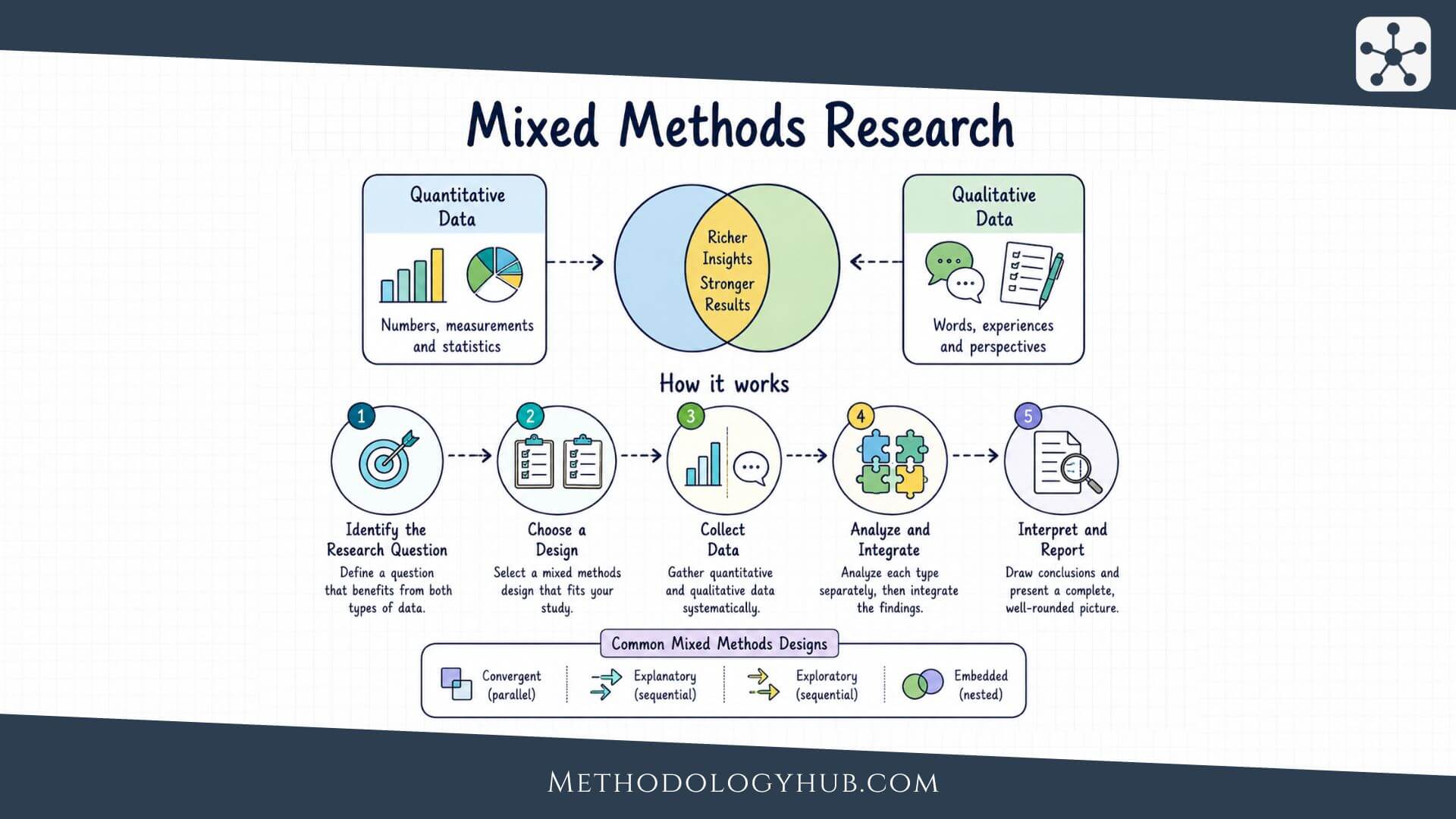
Mixed methods research is a research approach that combines quantitative and qualitative evidence within one study or a connected set of study phases. It is used when numbers can show a pattern, but words, observations, documents, or cases are needed to understand that pattern more fully. A mixed methods study may begin with a survey and continue with interviews, or it may begin with exploratory interviews and then build a questionnaire for a larger group.
The central idea is not to collect two kinds of data simply because more data seems better. Mixed methods research works best when the two parts are planned together, connected at clear points, and interpreted as one study.
What Is Mixed Methods Research?
Mixed methods research is a methodology in which a researcher collects, analyses, and integrates both quantitative and qualitative data to answer one research question or a connected set of questions. The quantitative side may use scores, counts, scales, tests, or records. The qualitative side may use interviews, observations, documents, open-ended responses, images, or field notes.
The word “integrates” is the part that separates mixed methods research from a study that merely places a survey and a few quotations side by side. Integration means that the two forms of evidence are connected during the design, sampling, data collection, analysis, interpretation, or reporting. The connection may be simple, such as using interview results to explain survey findings. It may also be more complex, such as building a new instrument from qualitative themes and then testing it with a larger sample.
Mixed methods research definition
Mixed methods research can be defined as a planned approach that combines quantitative and qualitative methods in order to produce a fuller answer than either approach could produce alone. The study may give equal weight to both strands, or one strand may support the other. What makes the design mixed is the deliberate relationship between them.
A researcher studying academic feedback, for example, might first survey 600 students about how often they use teacher comments when revising essays. The numerical results can show broad patterns. The researcher might then interview 25 students to understand how they interpret the comments, which feedback they ignore, and which comments lead to revision. The final answer is stronger when the interviews are used to interpret the survey pattern rather than being treated as a separate mini-study.
How quantitative and qualitative parts work together
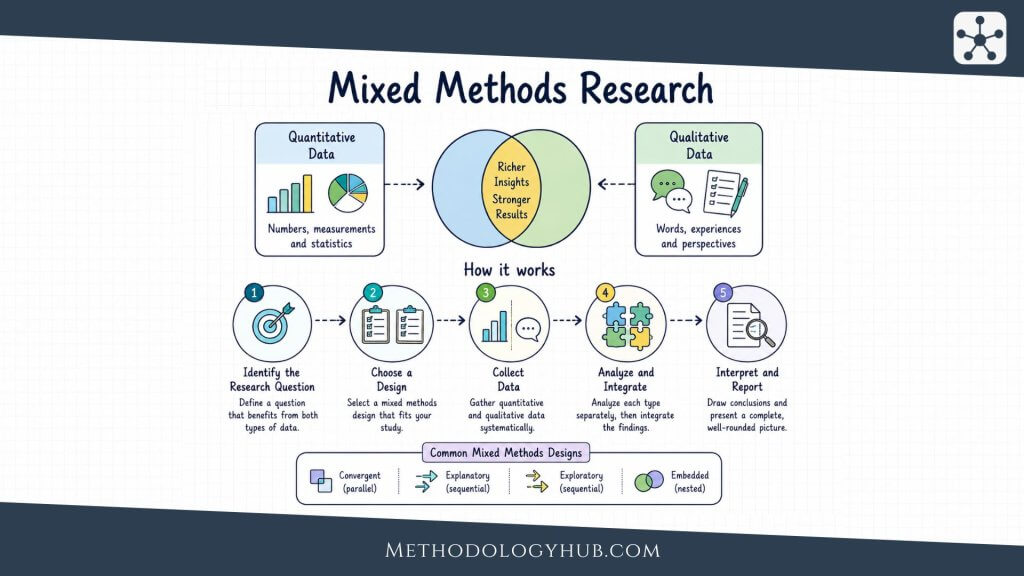
In a mixed methods design, the quantitative and qualitative parts are often called strands. A strand is one side of the study: one kind of data, one analytic route, and one contribution to the answer. The quantitative strand may estimate how often something happens, compare groups, or test a relationship between variables. The qualitative strand may describe how people experience a process, how a setting works, or how participants explain a result.
The two strands can meet at different moments. Sometimes the researcher connects them before data collection by using one sample to select another. Sometimes they meet during analysis, for example when themes from interviews are compared with survey scores. Sometimes the connection appears mainly during interpretation, where the researcher explains how the two findings fit together.
What mixed methods research can show
Mixed methods research can show the size of a pattern and the meaning behind it. It can show whether a programme is associated with improved scores and also how participants experienced the programme. It can show that two groups differ and also describe the conditions that may explain the difference. It can help refine a measure before a larger quantitative study, or it can use qualitative evidence to understand why a statistical result looked unexpected.
This does not mean that mixed methods research automatically gives a better answer than a well-designed single-method study. A mixed study still depends on careful sampling, suitable data collection, clear analysis, and honest interpretation. The design should be chosen because the research question needs both forms of evidence.
Objectives of Mixed Methods Research
The objectives of mixed methods research depend on the role each strand plays in the study. Some mixed studies use qualitative findings to prepare a later quantitative phase. Others use qualitative work after a survey or experiment to interpret a result. Some collect both forms of data during the same period and compare the findings at the end.
These objectives should be stated early in the research process. If the purpose of mixing is unclear, the design can become crowded. A researcher may collect interviews, scores, questionnaires, and field notes, but still fail to explain how the evidence fits together. A clear objective keeps the study readable.
To explain quantitative results
One common objective is explanation. A researcher may find a numerical pattern first and then use qualitative evidence to understand it. For instance, a survey may show that first-year students report lower confidence in academic writing than final-year students. Interviews can then explore what first-year students find difficult, how they understand assessment criteria, and what kind of support they actually use.
Here, the qualitative phase is not an optional add-on. It gives the researcher a way to read the numerical result with more care. The study can move from “there is a difference” to a more detailed account of how that difference is experienced and what may be producing it.
To develop a tool or measure
Another objective is development. A researcher may begin with interviews, focus groups, observations, or document analysis, then use the findings to design a questionnaire, coding scheme, test, or scale. This is useful when existing instruments do not fit the setting or when the language of participants is needed before closed questions can be written.
Imagine a researcher developing a survey on students’ use of digital study tools. Early interviews might reveal that students do not think in simple categories such as “online” and “offline” learning. They may describe switching between lecture recordings, shared notes, messages from classmates, and printed summaries. A better survey can be written after those practices have been understood.
To compare different forms of evidence
Mixed methods research can also compare findings from different sources. A school evaluation may compare attendance records, test scores, teacher interviews, and student focus groups. Agreement between strands can increase confidence in the interpretation. Difference between strands can also be useful, because it may point to hidden variation or a limitation in one kind of evidence.
For example, a programme may improve average scores while interviews reveal that only some students found it accessible. That combination does not cancel either finding. It asks the researcher to interpret both: the programme may have measurable effects while still leaving barriers for particular groups.
Recommendation: The objective of mixing should be written in plain language. Are you explaining a result, building an instrument, comparing evidence, or extending the scope of the study?
To extend the scope of a study
Some questions need breadth and depth. A quantitative phase may show how widespread a pattern is across a large group. A qualitative phase may give a closer view of selected cases, decisions, documents, or experiences. This combination can be useful in education, health, social research, psychology, and public policy, where human behaviour is often measurable in one way and understandable in another.
The aim is not to cover every possible angle. It is to use each strand for a specific task. A broad survey can map a field. A smaller interview study can follow selected parts of that map. Together, the study can be more balanced than a survey without context or interviews without a sense of wider distribution.
Key Aspects of Mixed Methods Research
The key aspects of mixed methods research are easiest to understand as design decisions. A researcher decides what the study asks, which strand comes first, how much weight each strand receives, where the strands connect, and how the final interpretation will be written. These decisions should be visible to the reader.
A mixed methods article can become confusing when it reports the quantitative and qualitative sections as if they belong to two different projects. The reader should not have to guess why the interviews were conducted after the survey, why certain participants were selected, or how the two analyses shaped the final answer.
Research question
The research question sets the design in motion. Some questions are mainly quantitative. Some are mainly qualitative. A mixed methods question needs both. It may ask about the extent of a pattern and the experience behind it, or about whether an intervention works and how participants respond to it.
For example, the question “How many students use peer feedback?” is mainly quantitative. The question “How do students experience peer feedback?” is mainly qualitative. A mixed question might ask, “How widely do students use peer feedback, and how do different patterns of use shape their revision decisions?” That question already points toward both measurement and interpretation.
Timing
Timing describes when the strands happen. In a sequential design, one strand comes before the other. The first strand may shape sampling, instruments, or questions for the second strand. In a concurrent design, both strands are collected during the same general period, then compared or combined during analysis and interpretation.
Timing affects the logic of the study. If interviews are used to explain survey findings, the survey usually comes first. If interviews are used to build a questionnaire, the qualitative phase usually comes first. If the aim is to compare two forms of evidence about the same situation, both strands may be collected side by side.
Priority
Priority describes the weight given to each strand. Some mixed methods studies are equally balanced. Others are mainly quantitative with a smaller qualitative component, or mainly qualitative with a smaller quantitative component. Priority should match the question and the claim.
In an experiment with a process evaluation, the quantitative outcome may receive more weight because the study asks whether scores changed. Interviews may still play an important role by explaining implementation, participant response, or variation across settings. In a qualitative case study, a short questionnaire may help describe participants, but the main interpretation may come from interviews and documents.
Integration
Integration is the point where mixed methods research becomes more than parallel data collection. It can happen through sampling, when the results of one strand decide who is invited into the next strand. It can happen through instruments, when qualitative themes become survey items. It can happen through analysis, when numerical categories are compared with interview themes. It can also happen in the final interpretation, where the researcher writes one answer from both forms of evidence.
Integration should be planned before the study begins. If the researcher waits until the end, the two strands may not fit together. For instance, a survey may ask about general satisfaction while interviews ask about detailed learning strategies. Both are useful topics, but they may be too far apart to support a joined interpretation.
| Aspect | Main question | Example decision |
|---|---|---|
| Timing | Do the strands happen in sequence or at the same time? | Survey first, interviews second |
| Priority | Is one strand dominant, or are both balanced? | Quantitative outcome with supporting interviews |
| Integration | Where do the strands connect? | Interview sample chosen from survey response groups |
| Final interpretation | What is learned from reading both strands together? | Survey pattern explained through participant accounts |
Final interpretation
The final interpretation should make the combined contribution clear. The researcher may report where the strands agree, where they differ, and what each strand adds to the other. When the strands differ, the answer should not be rushed. Difference can occur because the methods capture different parts of the situation, because participants respond differently in different formats, or because one strand has limits that the other helps reveal.
A useful final interpretation sounds less like two summaries placed together and more like a guided reading of the whole study. It returns to the research question and explains how the combined evidence answers it.
Mixed Methods vs Quantitative and Qualitative Research
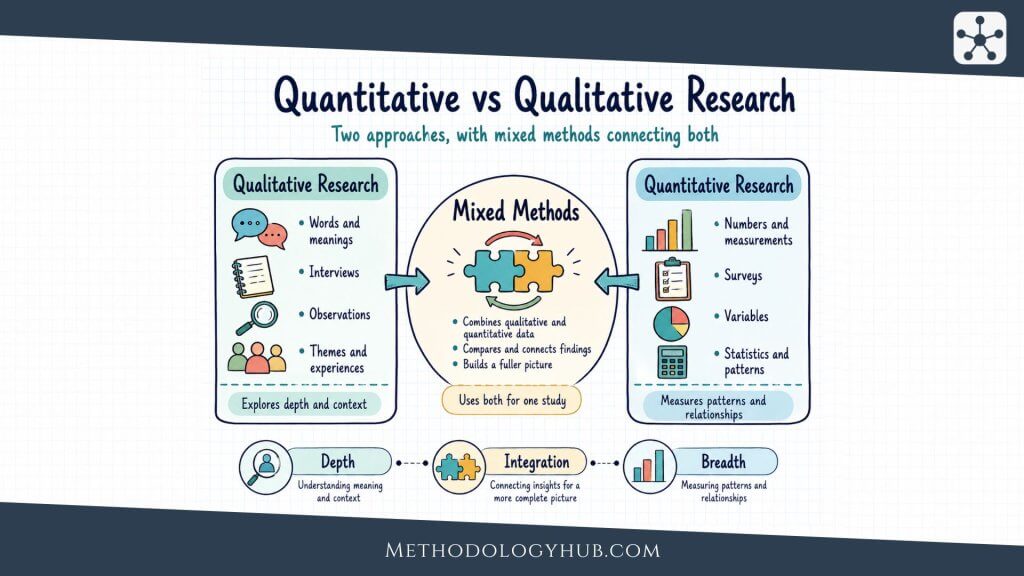
Mixed methods research is often compared with quantitative research and qualitative research because it draws from both. The comparison is useful, but it should not be treated as a ranking. Each methodology answers a different kind of question.
A quantitative design is suitable when the study needs measurement, comparison, estimation, or testing. A qualitative design is suitable when the study needs close interpretation of meaning, process, practice, or context. A mixed methods design is suitable when the research question needs both forms of evidence and when the researcher can integrate them in a meaningful way.
Mixed methods vs quantitative research
Quantitative research usually begins by defining variables and deciding how they will be measured. It can estimate how common something is, compare groups, test a research hypothesis, or model relationships. The result is often expressed through counts, percentages, means, correlations, regression coefficients, or other statistical methods.
Mixed methods research can include all of that, but it adds a qualitative strand to answer questions that numbers alone do not answer well. A survey may show that students with part-time jobs have lower attendance. Interviews may help explain scheduling pressure, travel time, family responsibilities, or perceptions of lectures. The quantitative part shows the pattern. The qualitative part helps interpret how that pattern is produced in daily life.
Mixed methods vs qualitative research
Qualitative research works closely with words, actions, documents, cases, and settings. It can explain how people interpret a situation or how a process develops over time. It does not need numerical measurement to be systematic. Its strength comes from careful selection, rich data, transparent analysis, and a clear connection between evidence and interpretation.
Mixed methods research can include qualitative depth while also adding numerical breadth. For example, interviews may identify several ways students use feedback. A later survey can examine how common those patterns are across a larger group. In this case, the qualitative strand helps name the patterns, while the quantitative strand estimates their distribution.
When mixed methods is the better fit
Mixed methods research is a better fit when the main question has two connected parts: one that needs measurement and one that needs interpretation. It is also useful when one method needs help from the other. Interviews may help build a survey. A survey may help select cases for interviews. A statistical result may need follow-up explanation.
The decision should be practical and intellectual. If the research question can be answered clearly with one method, a single-method design may be cleaner. If the question loses too much when either numbers or context are removed, a mixed design may be more suitable.
| Approach | Typical focus | Typical evidence |
|---|---|---|
| Quantitative research | Measurement, comparison, estimation, testing | Scores, counts, scales, records, coded variables |
| Qualitative research | Meaning, experience, context, practice, process | Interviews, observations, field notes, documents, cases |
| Mixed methods research | A joined question needing both measurement and interpretation | A planned combination of numerical and non-numerical data |
Methodological Approaches in Mixed Methods Research
Methodological approaches in mixed methods research are usually described by the timing and relationship between the strands. The names vary across textbooks, but several designs appear often: convergent design, explanatory sequential design, exploratory sequential design, embedded design, and multiphase design.
These names are useful because they show the basic structure of the study. They should not be used as decorative labels. A reader should be able to see the design in the actual methods section: what was collected, when it was collected, how the strands were analysed, and where the findings were integrated.
Convergent design
In a convergent design, quantitative and qualitative data are collected during the same broad period and then brought together. The researcher may compare results, merge them in a table, or use one strand to interpret the other. This design is useful when the study needs two views of the same topic at the same time.
For example, a researcher may survey students about feedback usefulness while also collecting open-ended comments about feedback experiences. The survey can show the distribution of responses. The open-ended data can show how students explain those responses. The results can then be compared: do students who rate feedback highly describe different practices from students who rate it poorly?
Explanatory sequential design
In an explanatory sequential design, the quantitative phase comes first, and the qualitative phase follows. The second phase is used to explain, refine, or interpret the first. This design is especially useful when the quantitative results raise questions that cannot be answered from the dataset alone.
A study may find that a new reading programme improved average test scores, but that gains were uneven across classes. Follow-up interviews with teachers and students can explore how the programme was used, which parts were difficult, and why some classrooms showed stronger improvement than others. The later qualitative work is guided by the earlier numerical results.
Exploratory sequential design
In an exploratory sequential design, the qualitative phase comes first, and the quantitative phase follows. This design is useful when the researcher needs to understand a topic before measuring it more widely. Early interviews, observations, or documents can help identify categories, language, behaviours, or possible variables.
For example, a researcher studying school belonging may begin with interviews to learn how students describe belonging in their own words. Those findings can then be used to develop survey items. The later survey can examine how common different forms of belonging are across grade levels or school types.
Embedded design
In an embedded design, one strand is placed inside a larger design that is mainly quantitative or mainly qualitative. The smaller strand supports the main one. This approach often appears in experimental research, quasi-experimental research, and evaluation studies.
For instance, a quasi-experimental study may compare exam results before and after an instructional change. A small interview component can be embedded to understand how teachers implemented the change and how students responded. The main outcome may still be numerical, but the embedded qualitative strand helps explain the pathway between the intervention and the result.
Multiphase design
A multiphase design uses several connected phases across a longer project. It may begin with exploration, continue with instrument development, move into a large survey, and end with interviews or case studies. This design is common when the project is broad, staged, or tied to programme development.
The main requirement is coherence. Each phase should have a purpose, and each phase should feed into the next in a visible way. Without that connection, a multiphase project can turn into a collection of related studies rather than one mixed methods design.
Mixed Methods Research Methods
Mixed methods research methods are the concrete tools used inside the wider design. These may include surveys, interviews, experiments, observations, document analysis, tests, administrative records, field notes, or coding schemes. The method is the tool. The mixed methods design is the plan that explains how the tools work together.
This distinction helps avoid confusion. A survey is not mixed methods by itself. Interviews are not mixed methods by themselves. A study becomes mixed methods when these tools are combined in a planned design and used to answer a joined question.
Surveys and interviews
The combination of surveys and interviews is one of the most familiar forms of mixed methods research. A survey can reach a wider group and collect comparable responses. Interviews can explore how participants understood the survey topic and why they responded as they did.
This pairing can work in both directions. Interviews may come first to build a survey. A survey may come first to identify patterns and select interview participants. For example, a researcher might interview students with high, medium, and low survey scores to understand the differences behind those score groups.
Experiments and qualitative follow-up
Mixed methods research can also appear inside experimental or intervention studies. An experiment may test whether an instructional approach affects achievement. Qualitative follow-up can examine how the approach was implemented, whether participants used it as intended, and how the setting shaped the outcome.
This is useful because an outcome score rarely explains itself. A treatment may appear ineffective because it was poorly implemented, because participants misunderstood it, or because the measurement missed a relevant change. Qualitative evidence can help interpret the result without replacing the statistical analysis.
Document analysis and statistical analysis
Some mixed studies combine document analysis with numerical analysis. A researcher may analyse policy documents qualitatively to identify themes, then code those themes across a larger set of documents and count how often they appear. Another study may combine school records with curriculum documents to examine both outcomes and institutional practices.
The connection between document analysis and statistical analysis should be clear. If text is transformed into categories or counts, the researcher should explain the coding rules. If documents are used to interpret numerical results, the researcher should explain which documents were selected and why.
Observations and rating scales
Observations can be used qualitatively, quantitatively, or both. A classroom study may include field notes that describe interaction patterns, while also using a structured observation schedule that records how often certain behaviours occur. The same setting can therefore produce narrative and numerical evidence.
This combination can be useful when researchers need to understand both frequency and context. A rating scale may show that group discussion occurred often. Field notes can show whether the discussion was shared among students or dominated by one participant. The interpretation comes from reading the count and the observation together.
Joint displays
A joint display is a table, matrix, or figure that places qualitative and quantitative findings together so the reader can see how they relate. It might show survey results in one column and interview themes in another. It might compare cases by score group and include short summaries of participant explanations.
Joint displays are helpful when they support interpretation rather than decoration. A good display shows where findings agree, where they differ, and what is added by the combination. It can make integration visible in a way that long paragraphs sometimes do not.
How to Perform Mixed Methods Research
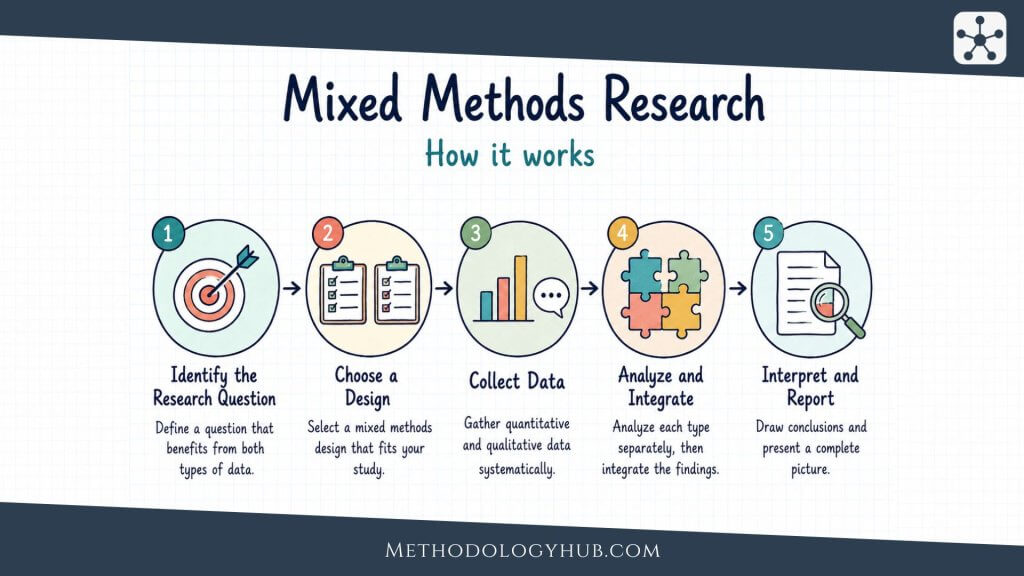
Performing mixed methods research begins with a question that genuinely needs more than one kind of evidence. The researcher then chooses a design, plans each strand, decides where integration will occur, collects and analyses the data, and writes a joined interpretation.
The steps below are written as a practical sequence. Real projects may move back and forth between them, especially during exploratory work. Still, the sequence helps students and beginning researchers see what needs to be planned before data collection starts.
Step 1: Write a mixed methods research question
Start with a question that cannot be answered well by numbers alone or by qualitative evidence alone. The question should make the relationship between the strands visible. It may ask about a measurable pattern and the experiences behind it, or about a process and its distribution across a group.
A weak starting point would be: “What do students think about online feedback?” A stronger mixed question would be: “How often do students use online feedback when revising assignments, and how do they describe the role of that feedback in their revision decisions?” The second question points toward both a survey and interviews.
Step 2: Choose the design
Choose a design that fits the order and purpose of the strands. If the study needs qualitative findings to build a survey, use an exploratory sequential design. If the study needs interviews to explain a survey result, use an explanatory sequential design. If the study needs two forms of evidence collected during the same period, use a convergent design.
The design should be named, but the name is less important than the explanation. Readers need to know what was done first, what followed, and how one strand shaped the other.
Step 3: Plan sampling for each strand
Sampling in mixed methods research may differ across strands. A survey may need a larger sample selected for breadth. Interviews may use a smaller purposive sample selected for depth, contrast, or relevance to the results. The two sampling plans should still be connected to the same research question.
In a sequential design, results from the first strand may guide the second sample. A researcher might survey 400 students and then interview students from different score groups. In that case, the second sample is not chosen only for convenience. It is chosen because it helps interpret the first result.
Step 4: Collect quantitative and qualitative data
Data collection should follow the timing of the design. In a concurrent design, the two strands may be collected during the same period. In a sequential design, the first strand should be analysed enough to guide the second. The researcher should document what was collected, from whom, when, and under what conditions.
Mixed methods research often uses more than one data collection route, so organisation is important. Survey files, interview transcripts, observation notes, and documents should be stored and labelled clearly. This helps later analysis and makes the method easier to report.
Step 5: Analyse each strand
Each strand needs an analysis that fits its own data. Quantitative data may be analysed with descriptive statistics, group comparisons, correlations, regression, or other statistical procedures. Qualitative data may be analysed through coding, thematic analysis, narrative analysis, document analysis, or case comparison.
The researcher should not weaken one strand because the study is mixed. A poor survey cannot be rescued by interviews. Thin interviews cannot be rescued by a large dataset. Each part should be strong enough to contribute something useful to the final interpretation.
Step 6: Integrate the findings
Integration may involve connecting, merging, embedding, or comparing findings. In a sequential design, integration often begins when the first strand shapes the second. In a convergent design, integration often happens when the two sets of results are brought together after separate analyses.
The researcher should look for agreement, difference, expansion, and explanation. Agreement occurs when both strands point in the same direction. Difference occurs when the strands appear to conflict. Expansion occurs when one strand adds a part of the answer the other could not provide. Explanation occurs when one strand helps interpret the other.
Step 7: Write the final interpretation
The final report should show the mixed logic clearly. The methods section should describe the design, timing, priority, sampling, data collection, analysis, and integration. The results section may present strands separately first, then bring them together. The discussion should return to the main question and explain the joined answer.
Good reporting also makes limits visible. A mixed methods study may have a small qualitative sample, a low survey response rate, uneven integration, or a narrow setting. These limits do not automatically weaken the study, but they should shape how far the conclusion is taken.
Examples of Mixed Methods Research
Examples of mixed methods research are easier to understand when the two strands are visible. Each example below has a quantitative part, a qualitative part, and a reason for combining them. The examples are simplified, but they show how the logic works in academic research.
Example in education
A researcher wants to study whether a new peer-review routine improves student writing. The quantitative strand compares writing scores before and after the routine. The qualitative strand uses student interviews and samples of peer comments to understand how students used the routine during revision.
The mixed methods interpretation can show whether writing scores changed and how students experienced the peer-review process. If scores improved but interviews show that only some students understood the task, the result becomes more precise. The study can discuss both the measurable outcome and the conditions that shaped it.
Example in health research
A health researcher studies appointment attendance in a community clinic. The quantitative strand analyses attendance records to identify patterns by age group, distance, appointment type, and time of day. The qualitative strand uses interviews with patients to understand travel barriers, communication problems, and experiences with the booking system.
The records may show which groups miss appointments more often. The interviews can explain why the pattern appears. Together, the findings can support a more careful interpretation than either records or interviews alone.
Example in psychology
A psychology researcher studies academic stress among university students. The quantitative strand uses a stress scale and measures sleep quality, study time, and exam performance. The qualitative strand uses diary entries or interviews to understand how students describe stress during the exam period.
The mixed design can connect scale scores with lived experience. Students with similar scores may describe different sources of pressure. Students with different scores may share similar coping routines. This gives the researcher a closer view of how numerical patterns relate to daily experience.
Example in evaluation research
In evaluation research, mixed methods designs are often used to judge both outcomes and implementation. A university may evaluate a mentoring programme by comparing retention rates, grade averages, and survey responses. It may also interview mentors and mentees to understand how meetings were organised, which support was useful, and where participation dropped.
This design helps separate the effect of the programme from the way it was delivered. A programme may have weak results because the idea was poor, but it may also have weak results because students did not receive the planned support. Mixed methods research can make that distinction more visible.
Choosing a Mixed Methods Research Design
Choosing a mixed methods research design means matching the design to the question, the available data, the setting, and the intended conclusion. The decision should not begin with the design label. It should begin with what the study needs to know.
A design label is useful only when it clarifies the logic of the project. “Explanatory sequential” tells the reader that a quantitative phase came first and a qualitative phase followed to explain it. “Exploratory sequential” tells the reader that qualitative work came first and shaped later quantitative work. “Convergent” tells the reader that the strands were collected in the same period and then compared or merged.
Match the design to the question
If the question begins with a broad need to understand a topic, an exploratory sequential design may fit. If the question begins with a pattern, test result, or survey finding that needs interpretation, an explanatory sequential design may fit. If the question asks for two forms of evidence about the same situation, a convergent design may fit.
This choice should be made before the data are collected. If the design is chosen after the study is already finished, the report may force a label onto a project that was not actually planned as mixed methods research.
Check whether integration is realistic
Some projects look attractive on paper but are too wide for the available time, access, or skill set. A student project with a short deadline may not be able to run a full survey and a long interview study. A researcher with no access to a sampling frame may not be able to make the quantitative strand support population-level claims.
Integration also takes time. The researcher has to compare, merge, or connect findings carefully. If integration is unrealistic, a focused qualitative or quantitative design may produce a clearer study than a poorly connected mixed one.
Simple test: If you remove either strand and the research question still works, the study may not need a mixed methods design.
Connect the design to the intended claim
The final claim should follow from the design. A convergent design can compare two kinds of evidence from the same period. An explanatory sequential design can explain a prior quantitative result. An exploratory sequential design can show how qualitative work informed later measurement. Each design supports a different kind of conclusion.
The claim should also respect the sample. A small interview sample can add depth, but it should not be treated as if it represents a full population. A large survey can show distribution, but it may not explain how participants understood the question. Mixed methods research is strongest when each strand is interpreted according to what it can actually support.
Conclusion
Mixed methods research is useful when a study needs both numerical patterns and detailed interpretation. It can connect a survey with interviews, an experiment with field notes, records with participant accounts, or document analysis with statistical summaries. The strength of the approach comes from the connection between strands, not from the simple amount of data collected.
A well-designed mixed methods study explains its question, design, timing, priority, sampling, analysis, and integration. It also makes clear what each strand contributes. The quantitative part may show how often, how much, or how strongly something appears. The qualitative part may show how participants experience, explain, or respond to the same situation. The final interpretation should show what is learned by reading both together.
For students and beginning researchers, the safest starting point is the research question. When the question calls for measurement and meaning, breadth and depth, or outcome and process, mixed methods research may be a suitable design. When the question can be answered cleanly with one kind of evidence, a single-method study may be more focused.
FAQs on Mixed Methods Research
What is mixed methods research?
Mixed methods research is a research approach that combines quantitative and qualitative evidence in one planned design. It is used when a research question needs both numerical patterns and detailed interpretation.
What is an example of mixed methods research?
An example of mixed methods research is a study that surveys students about how often they use teacher feedback and then interviews selected students to understand how they use that feedback when revising their work.
What are the main types of mixed methods research designs?
The main types of mixed methods research designs include convergent design, explanatory sequential design, exploratory sequential design, embedded design, and multiphase design. They differ mainly in timing, priority, and integration.
What is convergent mixed methods research?
Convergent mixed methods research collects qualitative and quantitative data during the same general period and then brings the findings together. The researcher may compare, merge, or jointly interpret the two strands.
What is explanatory sequential mixed methods research?
Explanatory sequential mixed methods research begins with quantitative data and then uses qualitative data to explain or interpret the results. It is useful when a survey, test, or statistical result needs closer explanation.