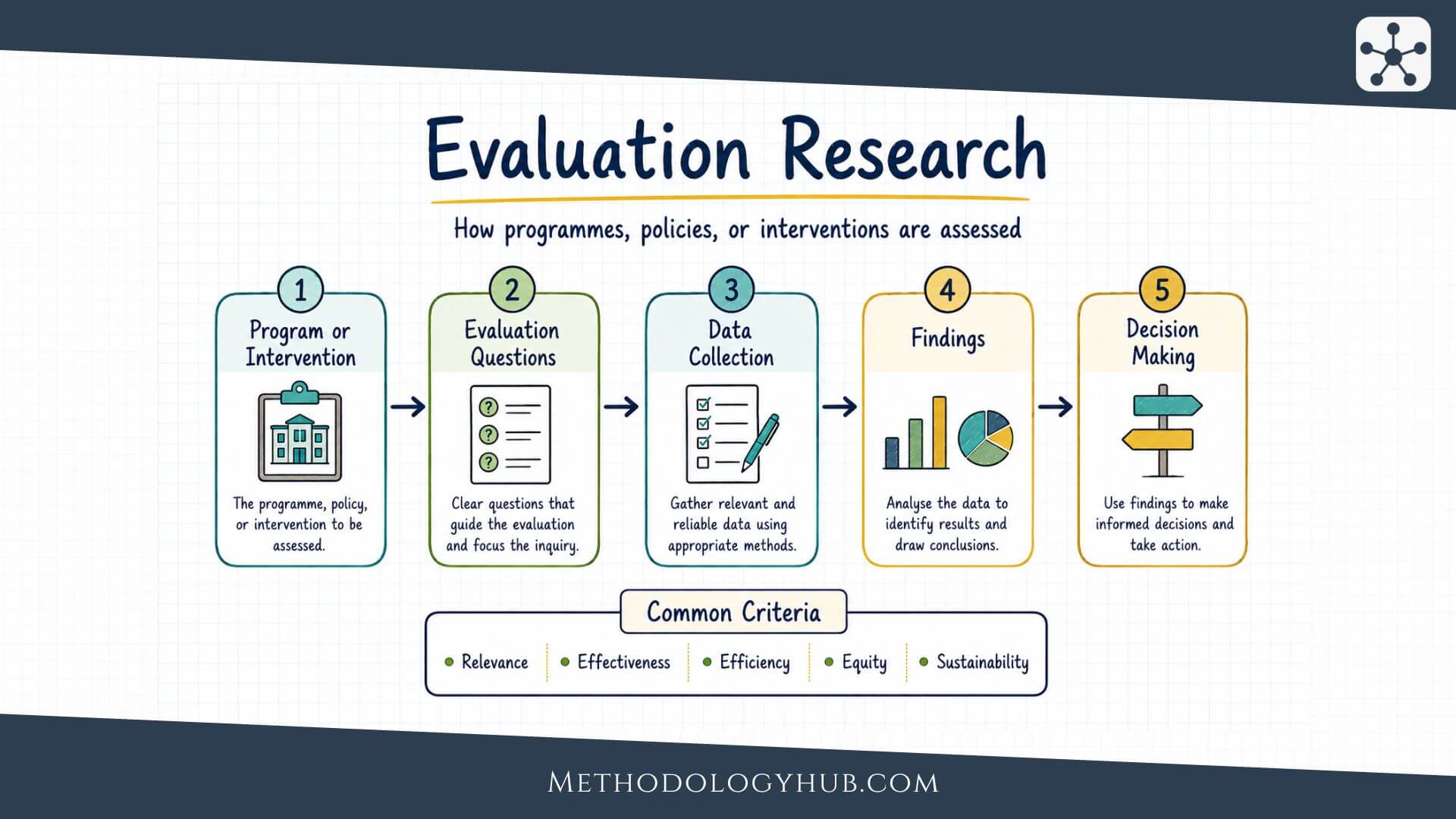
Evaluation research is a type of research used to judge the quality, implementation, results, or usefulness of a programme, policy, intervention, course, service, or project. It does not simply ask whether something is liked. It asks what was planned, what actually happened, what evidence can be used to judge it, and what conclusion the evidence can reasonably support.
This article explains what evaluation research is, which objectives it usually has, which aspects shape a good evaluation, how it differs from basic, applied, and action research, how to perform evaluation research step by step, and what evaluation research can look like in real studies.
What Is Evaluation Research?
Evaluation research is systematic research that examines whether a programme, policy, intervention, service, or practice is working as intended. The object being evaluated is often called the evaluand. In plain language, that means the thing the study is judging. It may be a reading programme in a school, a mentoring scheme at a university, a public health campaign, a social service, a training course, or a local environmental project.
The word evaluation can sound informal because people evaluate things every day. They decide whether a lesson was useful, whether a service was clear, or whether a policy seems fair. Evaluation research is different because it uses a planned research design. It defines the evaluation questions, identifies suitable evidence, collects or analyses research data, and explains how the judgement was reached.
Evaluation research definition
Evaluation research means using systematic methods to assess the design, delivery, effects, or value of a programme, policy, intervention, service, or practice. It usually connects evidence to criteria. The criteria might concern effectiveness, implementation quality, reach, fairness, cost, participant experience, or fit with stated goals.
A simple example is a school evaluating a new tutoring programme. The evaluation may ask whether the tutoring reached the pupils it was designed for, whether sessions were delivered as planned, whether reading scores changed, how pupils experienced the support, and whether the programme should be revised or continued. A single satisfaction form would not answer all of these questions. A stronger evaluation would combine records, observations, interviews, test scores, and comparison data where appropriate.
Evaluation research as a type of research
Evaluation research is usually classified by purpose. In the types of research framework, it sits beside basic research, applied research, and action research. The purpose is not mainly to build a theory from the beginning, although theory may guide the work. It does more than solve a problem directly. Its main purpose is to assess something that already exists or is being introduced.
This does not make evaluation research less academic. A good evaluation still needs a clear research question, careful sampling, suitable measures, transparent analysis, and cautious interpretation. The difference is that the study is anchored in an evaluative judgement. The researcher describes the programme and then asks what can be concluded about its design, delivery, outcomes, or use.
Evaluation, monitoring, and informal feedback
Evaluation research is often confused with monitoring and informal feedback. Monitoring tracks what is happening while a programme runs. It may record how many people attended, how many sessions were delivered, or how many forms were completed. Those details are useful, but they do not by themselves explain whether the programme was well designed or effective.
Informal feedback is also narrower. Participants may say that a course was interesting or that a service was easy to use. Those responses can become part of the evaluation, but they are not the whole study. Evaluation research places that feedback beside other evidence, such as outcomes, records, observations, comparison groups, or qualitative accounts of how the programme was experienced in practice.
The strength of evaluation research is that it connects several pieces of evidence into one careful judgement. It may show that a programme was well received but reached only a small part of the intended group. It may show that outcomes improved, but mainly among participants who attended regularly. It may show that the idea was sound, but the implementation was uneven. These mixed conclusions are common, and they are often more useful than a simple yes-or-no verdict.
Objectives of Evaluation Research
The objectives of evaluation research depend on the stage of the programme and the decision the study is meant to support. Some evaluations are planned before a programme begins. Others happen while it is being delivered. Some are carried out after enough time has passed to examine outcomes. The same evaluation may include several objectives, but each one should be written clearly enough to guide the design.
A useful evaluation does not begin with a vague question such as whether the programme is good. It asks what good would mean in this setting. For one programme, success may mean improved reading scores. For another, it may mean better access for underserved groups, more consistent service delivery, fewer missed appointments, stronger participant understanding, or a more coherent match between goals and activities.
Assessing implementation
One common objective is to assess implementation. This means asking whether the programme was delivered as planned. A tutoring programme, for example, may have promised two sessions per week, trained tutors, small groups, and regular progress checks. An implementation evaluation would ask whether those parts actually happened.
This objective is especially important when outcome results are unclear. If scores do not improve, the programme idea may not be the only explanation. Perhaps the programme was not delivered consistently. Perhaps participants did not attend often enough. Perhaps staff received too little preparation. Without implementation evidence, the researcher may judge the programme too quickly.
Examining outcomes
Another objective is to examine outcomes. Outcome evaluation asks whether relevant changes occurred after the programme or intervention. The outcome may be a score, a rate, a behaviour, a skill, an attitude, a service use pattern, or a documented condition. In quantitative work, outcomes are often measured through numerical indicators. In qualitative research, outcomes may be understood through participant accounts, field notes, or documents.
Outcome questions are strongest when they are linked to the programme’s logic. If a mentoring scheme aims to improve first-year student adjustment, the evaluation should not rely only on attendance counts. It may need evidence about belonging, help-seeking, academic confidence, retention, or other outcomes that follow from the programme theory.
Understanding reach and participation
Evaluation research often asks who was reached. A programme can be carefully designed and still fail to reach the group it was intended to support. A university writing workshop, for example, might attract confident students who already seek academic support, while students with the greatest difficulty may not attend. In that case, the evaluation needs to look beyond the workshop content and examine recruitment, access, timing, communication, and participation patterns.
Reach can be studied with enrolment records, attendance logs, demographic summaries, interviews, or short surveys. The main task is to compare the intended participants with the participants who actually used the programme. This objective often connects evaluation research with descriptive research, because the evaluator first needs a clear picture of who participated and who did not.
Comparing alternatives
Some evaluations compare two or more approaches. A school may compare a peer tutoring model with teacher-led small group instruction. A public health department may compare two ways of communicating screening information. A community organisation may compare in-person sessions with blended support. The evaluation question asks whether each approach improved an outcome and which approach produced a stronger or more suitable result under the conditions of the study.
Comparison can be experimental, quasi-experimental, comparative, or mixed methods. In an experimental research design, participants may be randomly assigned to conditions. In quasi-experimental research, existing groups or natural implementation differences may be compared. In comparative research, the evaluator may examine different cases, sites, or programme versions to understand how conditions shape results.
| Objective | Main question | Possible evidence |
|---|---|---|
| Implementation | Was the programme delivered as planned? | Logs, observations, staff records, document review |
| Outcomes | What changed after the programme? | Scores, rates, surveys, records, interviews |
| Reach | Who used the programme, and who was missed? | Participant records, attendance, population data |
| Comparison | Which option produced the better fit or result? | Comparison groups, cases, sites, before-and-after data |
Supporting decisions about revision or continuation
Evaluation research often ends with a decision-facing conclusion. The evidence may suggest that a programme should continue, be revised, be expanded, be paused, or be studied further before a firm judgement is made. This decision-facing character is one reason evaluation research needs clear criteria from the beginning. Without criteria, the final conclusion can become too dependent on the loudest result or the strongest opinion.
Still, the evaluator should avoid turning the report into a simple instruction. Research evidence usually has limits. A careful evaluation explains what the evidence supports, where uncertainty remains, and which conditions shaped the findings. That leaves room for responsible decision making without overstating what the study can show.
Key Aspects of Evaluation Research
The key aspects of evaluation research are easiest to understand as parts of one design. A researcher begins with the thing being evaluated, clarifies the purpose of the evaluation, decides which criteria will be used, writes evaluation questions, chooses evidence, and then connects the findings back to the original judgement. If one part is missing, the evaluation can become hard to interpret.
For example, a programme may have several goals at once. A public health campaign may aim to increase knowledge, change behaviour, reduce barriers to services, and reach people who are usually missed by standard communication. Each goal may need different evidence. A single survey item cannot carry the whole evaluation.
The evaluand
The evaluand is the programme, policy, service, intervention, course, or practice being evaluated. Naming it clearly sounds simple, but it often prevents confusion later. A study may evaluate a whole programme, one part of a programme, one site, one year of implementation, or one revised version. The boundary needs to be visible.
Suppose a university evaluates a first-year mentoring scheme. Is the study evaluating the idea of mentoring, the training given to mentors, the matching process, the weekly meetings, the effects on students, or the full scheme as delivered in one academic year? These are related, but they are not identical. A clear evaluand keeps the evaluation from drifting.
Evaluation criteria
Evaluation criteria are the standards or dimensions used to judge the evaluand. They translate a broad question into more concrete terms. If a programme is judged as effective, effective in relation to what? If a service is judged as accessible, accessible for whom? If a policy is judged as well implemented, what evidence would show that?
Common criteria include effectiveness, reach, relevance, efficiency, acceptability, sustainability, quality of implementation, participant experience, and fit with stated goals. The criteria should be chosen before the final interpretation, not selected afterward to make the programme look better or worse.
Plain reading: the evaluand is what is being judged. The criteria explain what kind of judgement the evaluation will make.
Evaluation questions
Evaluation questions connect the criteria to the research design. A question such as “Did the programme work?” is usually too broad. It may need to become several questions: Was the programme delivered as planned? Who participated? What changed after participation? How did participants experience the programme? Which conditions helped or limited implementation?
These questions guide the choice of methods. A question about frequency may need quantitative research. A question about experience may need interviews, observations, or document analysis. A question that needs both outcome measurement and explanation may call for mixed methods research.
Programme theory or logic model
Many evaluations use a programme theory or logic model. This is a simple explanation of how the programme is expected to produce results. It links resources, activities, outputs, short-term outcomes, and longer-term outcomes. The model does not have to be complicated. Its purpose is to make the assumed chain of change visible.
In a reading intervention, the logic may be that trained tutors provide structured practice, pupils receive more individual feedback, reading fluency improves, comprehension improves, and confidence grows. If the evaluation later finds no improvement in comprehension, the logic model helps the researcher ask where the chain may have broken. Perhaps pupils attended too few sessions. Perhaps fluency improved but comprehension tasks were not addressed. Perhaps the outcome was measured too early.
Indicators and data sources
Indicators are observable signs used to study the evaluation questions. They may be test scores, attendance rates, completion records, observation notes, interview themes, service use records, or document codes. A good indicator is not chosen because it is easy to collect alone. It should represent the concept being evaluated.
This is where evaluation research overlaps with variables in research and measurement. If the outcome is student engagement, the evaluator has to decide whether engagement will be represented through attendance, participation, submitted work, self-reports, teacher ratings, or several sources together. The choice affects the conclusion.
Design, analysis, and interpretation
Evaluation research can use many designs. Some evaluations are cross-sectional research, collecting evidence at one point in time. Others are longitudinal research, following outcomes across months or years. Some are case study research, especially when the evaluator needs to understand one programme in depth. Others use survey research, records, interviews, experiments, or quasi-experiments.
The analysis should match the evidence. Numerical outcomes may require descriptive statistics, comparison of means, regression, or other statistical methods. Qualitative data may require coding, theme development, comparison across participants, or interpretation of documents and observations. The final judgement should not be stronger than the design allows.
Types of Evaluation Research
Evaluation research can be grouped in several ways. The most common distinction is between formative and summative evaluation. Another useful distinction is between process, outcome, and impact evaluation. These types often overlap in real projects. A single evaluation may study implementation while the programme is still developing and later examine outcomes after the programme has been delivered for a longer period.
The type should follow the evaluation question. If the question asks whether a programme is being delivered as intended, a process evaluation is needed. If the question asks whether participants changed, an outcome evaluation is needed. If the question asks whether changes can be attributed to the programme rather than to other conditions, the design needs stronger comparison or causal reasoning.
Formative evaluation research
Formative evaluation research is conducted while a programme is being planned, piloted, or improved. It provides evidence that can guide changes before the programme is judged in a final way. A formative evaluation of a new science curriculum, for example, might examine whether teachers understand the materials, whether pupils can follow the activities, and which lessons need revision.
The tone of formative evaluation is developmental. It does not ask only whether the programme succeeded. It asks what should be adjusted. The evidence may come from classroom observations, teacher interviews, student work, pilot test results, or implementation notes.
Summative evaluation research
Summative evaluation research is conducted after a programme has been implemented for long enough to judge its results. It may examine whether goals were achieved, whether outcomes improved, whether the programme should continue, or whether resources should be directed elsewhere. A summative evaluation of a mentoring programme may compare retention rates, student confidence, academic progress, and participant experiences after one or more years of delivery.
Summative evaluation usually needs a more stable version of the programme. If the programme changes every few weeks, a final judgement may be difficult. The evaluator should therefore describe the period being evaluated and any important changes that occurred during that period.
Process evaluation research
Process evaluation research studies how a programme is delivered. It looks at activities, timing, staff roles, participant flow, materials, communication, and the conditions under which implementation happened. This type is especially useful when outcomes are hard to interpret without knowing what participants actually received.
For example, a community health programme may report low attendance. A process evaluation could show whether the problem was location, scheduling, referral, language, trust, transport, or mismatch between the programme and participant needs. This kind of evidence helps explain the path between design and result.
Outcome evaluation research
Outcome evaluation research studies changes connected to the programme’s goals. Outcomes may be short-term or long-term. A short-term outcome might be increased knowledge after a workshop. A longer-term outcome might be a change in behaviour, attendance, health status, achievement, or service use.
The main challenge is to choose outcomes that fit the programme theory and the available timeframe. If a short training course is evaluated one week after delivery, it may be reasonable to measure knowledge and confidence. It may be too early to judge long-term behaviour. Good outcome evaluation keeps the timing of measurement in proportion.
Impact evaluation research
Impact evaluation research asks whether observed changes can be linked to the programme in a stronger way. It usually needs comparison. The evaluator may use random assignment, matched comparison groups, interrupted time series, difference-in-differences, regression, or other designs that help separate programme effects from wider changes.
Impact evaluation is often demanding because real programmes are introduced in complex settings. Groups may differ before the programme begins. Participants may choose whether to take part. Other changes may happen at the same time. A careful impact evaluation explains how the design handles these rival explanations.
Cost and economic evaluation
Some evaluations include costs. They may ask how much the programme cost to deliver, whether the cost was reasonable in relation to outcomes, or how different options compare. Cost evidence should be interpreted carefully. A programme that is cheaper is not automatically better, and a programme with stronger outcomes may still be difficult to sustain if the required resources are not available.
Cost evaluation is common in health, education, and public services, but it should still be connected to the main evaluation questions. Costs mean little without knowing what was delivered, who benefited, and what outcomes were achieved.
These types are not separate boxes that a study must choose from only once. A strong evaluation may begin with formative work, include process evidence during delivery, and later add outcome or impact analysis. The design should make that sequence clear instead of using one label for everything.
Evaluation vs Action Research
Evaluation research and action research both study real practices, programmes, or interventions. They are often used in schools, universities, health services, community organisations, and other applied settings where research is expected to connect with practical work. The difference is in the main purpose of the study.
Evaluation research is mainly used to judge something that already exists or is being implemented. It asks whether a programme, policy, service, intervention, or practice was delivered as planned, whether it reached the intended people, what results it produced, and how those results should be interpreted. The evaluator is trying to build an evidence-based judgement.
Action research is more directly tied to improvement by the practitioner. A teacher, nurse, social worker, school leader, or other practitioner studies their own practice while changing it. The process usually moves through cycles of planning, acting, observing, reflecting, and revising. The researcher is not only judging a programme from the outside. They are usually part of the setting and use research to guide the next action.
Main difference between evaluation research and action research
The main difference is that evaluation research asks how well something worked, while action research asks what happens when a practitioner changes a practice and studies that change. This difference affects the design. Evaluation research usually begins by defining the evaluand, the criteria, the evaluation questions, and the evidence needed for judgement. Action research usually begins with a practice-based problem and develops through repeated cycles of action and reflection.
Plain distinction: evaluation research judges a programme or intervention against evidence and criteria. Action research studies practice while the practitioner changes and improves it.
There can still be overlap. An action research project may include evaluation questions, especially when the practitioner wants to know whether a change produced better results. An evaluation study may include formative feedback that helps a programme improve while it is still running. The label should follow the main purpose. If the study is organised around judging a defined programme, it is closer to evaluation research. If it is organised around practitioner-led cycles of change, it is closer to action research.
| Aspect | Evaluation research | Action research |
|---|---|---|
| Main purpose | Judge a programme, policy, service, intervention, or practice. | Improve practice through cycles of action and reflection. |
| Typical question | How well did this programme work, for whom, and under what conditions? | What happens when I change this practice, and what should I adjust next? |
| Researcher role | The evaluator may be internal or external to the programme. | The researcher is often a practitioner inside the setting. |
| Usual structure | Define the evaluand, set criteria, collect evidence, and interpret results. | Plan, act, observe, reflect, revise, and begin another cycle if needed. |
Example of the difference
Imagine a school introduces a new after-school reading programme. An evaluation research study might examine whether the programme reached the pupils it was designed for, whether attendance was stable, whether reading scores changed, and how teachers and pupils experienced the programme. The final report would use those findings to judge the programme and support a decision about continuation, revision, or expansion.
An action research study would look different. A teacher might notice that pupils are not using reading journals effectively, introduce a new feedback routine, observe how pupils respond, collect short reflections and samples of work, then adjust the routine in the next cycle. The focus is not the whole programme as an evaluand. The focus is the teacher’s own practice and how it can be improved through systematic inquiry.
How to Perform Evaluation Research
Evaluation research begins before data collection. The evaluator has to understand the programme, clarify the purpose of the evaluation, decide what will count as evidence, and choose a design that fits the question. Jumping straight to a survey or interview guide can produce data, but not necessarily data that answer the evaluation questions.
The steps below are a practical sequence. Real projects may move back and forth between them, especially when a programme is still developing, but the logic usually remains the same.
Step 1: Define the evaluand and its boundaries
Start by naming exactly what is being evaluated. Describe the programme, policy, intervention, service, or practice. Include the setting, time period, participants, activities, and version being studied. A clear boundary prevents the evaluation from making claims about parts of the programme that were never examined.
For example, an evaluation might focus on the first year of a mentoring scheme in one faculty, not on mentoring in the whole university. That boundary should appear in the research plan and later in the report.
Step 2: Clarify the purpose of the evaluation
The purpose may be formative, summative, process-focused, outcome-focused, or impact-focused. It may also combine several purposes. Clarifying the purpose helps the evaluator decide whether the study should support improvement, final judgement, comparison, explanation, or future planning.
This step is closely connected to the wider research process. A broad research topic becomes a focused evaluation only when the object, purpose, questions, and evidence are aligned.
Step 3: Build a programme theory or logic model
Write down how the programme is expected to work. What resources does it use? What activities are delivered? What immediate outputs should appear? What short-term and longer-term outcomes are expected? Which assumptions connect these steps?
This model helps the evaluator choose fair questions. If a programme was designed to improve knowledge first and behaviour later, the evaluation should not judge long-term behaviour before participants have had enough time to use what they learned.
Step 4: Write evaluation questions
Good evaluation questions are clear, answerable, and tied to criteria. They may ask about implementation, reach, outcomes, experiences, costs, comparison, or explanation. A strong set of questions usually includes a mix of practical and researchable wording.
Step 5: Choose the evaluation design
The design should fit the questions. A process evaluation may use observations, logs, documents, interviews, and attendance records. An outcome evaluation may use before-and-after measures. An impact evaluation may need a comparison group, time series, random assignment, matching, or statistical controls. A small local evaluation may use a non-experimental research design if causal claims are not the main goal.
The evaluator should also decide whether the study is empirical research, based on observed or collected evidence, or whether it mainly uses existing theory, documents, and argument in a more theoretical research form. Most evaluation research is empirical, but theory often helps define criteria and interpret results.
Step 6: Select data sources and indicators
Choose data sources that can answer each question. These may include surveys, interviews, administrative records, observations, test scores, service logs, documents, or field notes. Each source should have a clear reason for being included. If a question asks about participant experience, attendance records alone will not be enough. If a question asks about measurable outcomes, interviews alone may leave part of the question unanswered.
When numerical indicators are used, the evaluator should describe how they were measured and analysed. This may involve statistical analysis, especially when the study compares groups, examines change over time, or estimates the uncertainty around a result.
Step 7: Collect and analyse the evidence
Data collection should follow the plan, but the evaluator should also document changes that happen in the field. Programmes are rarely still. Staff may change, attendance may fluctuate, resources may arrive late, or participants may use the programme in unexpected ways. These details are not distractions. They may explain the findings.
During analysis, keep descriptive and evaluative claims separate. First show what was found. Then explain how those findings relate to the criteria. For example, report the attendance pattern before judging reach. Report the test score change before judging effectiveness. Report interview themes before judging acceptability.
Step 8: Write a balanced conclusion
The conclusion should return to the evaluation questions. It should state what the evidence supports, what remains uncertain, and which conditions shaped the result. A strong evaluation conclusion may be mixed: the programme was delivered well in some sites, reached some groups better than others, produced short-term gains, and needs stronger follow-up before long-term outcomes can be judged.
This kind of conclusion is not weak. It is often the most honest reading of the evidence. Evaluation research is strongest when it explains degrees, conditions, and limits rather than forcing every result into a simple success or failure label.
Examples of Evaluation Research
Examples of evaluation research are common in education, health, social services, public administration, community work, and environmental programmes. The examples below are simplified, but they show how evaluation questions, evidence, and interpretation fit together.
Example from education
A school introduces a small-group reading programme for pupils who are below grade-level expectations. The evaluation asks whether the programme was delivered as planned, whether the intended pupils attended, whether reading fluency and comprehension improved, and how teachers described the fit between the programme and classroom instruction.
The evidence may include attendance records, tutor logs, pre-test and post-test reading scores, teacher interviews, and samples of pupil work. If reading scores improve but attendance is uneven, the evaluation may conclude that the programme shows promise for pupils who receive enough sessions, while also identifying attendance as a condition that limits the overall result.
Example from public health
A local health department runs a campaign to increase screening uptake in a defined population. The evaluation may ask whether the campaign reached the intended group, whether knowledge changed, whether appointments increased, and which communication channels participants remembered.
Data may come from clinic records, short surveys, community partner reports, and interviews. A purely numerical result might show that appointments increased. Qualitative evidence may add that participants trusted messages more when they came through local organisations. Together, the evidence gives a fuller judgement than either source alone.
Example from social services
A social service agency introduces a new intake process to reduce waiting time for families seeking support. The evaluation may examine average waiting time before and after the change, staff workload, family experience, and whether the process works equally well for families with different language needs.
This example shows why evaluation research often needs more than one criterion. A faster intake process may look successful if waiting time is the only outcome. If interviews show that some families find the new forms confusing, the evaluation has to balance speed with accessibility and service quality.
Example from environmental education
A community organisation offers workshops on local water conservation. The evaluation may ask whether participants gained knowledge, whether they changed household practices, and whether the workshop activities were suitable for different age groups. The design might include pre-workshop and post-workshop questions, follow-up interviews, and observation notes from facilitators.
If knowledge improves immediately but behaviour change is modest after three months, the evaluation can examine the reasons. Participants may understand the issue but face practical barriers, such as rented housing, shared meters, or lack of access to equipment. The result would be more useful than a simple statement that the workshop worked or failed.
Example from higher education
A university evaluates a peer mentoring scheme for first-year students. The questions may concern participation, student belonging, help-seeking, retention, and mentor preparation. A mixed methods design could combine survey data, retention records, mentor reflection notes, and student interviews.
The evaluation may find that students who attended regularly reported stronger belonging, but that commuting students attended less often because sessions were scheduled late in the day. This does not dismiss the programme. It points to a design issue that can be revised before the next cycle.
Example from policy implementation
A municipality introduces a policy to improve access to after-school activities. The evaluation may examine whether schools and community centres implemented the policy in similar ways, whether participation increased among low-income families, and whether transport or scheduling affected participation.
The study could use administrative records, site visits, interviews, and comparison across neighbourhoods. Because policy implementation often differs by site, the evaluation should describe these differences rather than treating the policy as if it were delivered identically everywhere.
Strengths and Limitations of Evaluation Research
Evaluation research is useful because it keeps judgement tied to evidence. It can show whether a programme was implemented as planned, whether participants were reached, whether outcomes changed, and how the programme was experienced. It can also reveal that a programme’s result depends on conditions that were not obvious at the beginning.
At the same time, evaluation research has limits. Programmes operate in real settings, and real settings are rarely controlled perfectly. Participants may choose whether to take part. Staff may adapt activities. Records may be incomplete. Outcomes may take longer to appear than the evaluation period allows. These limits do not make evaluation research impossible, but they should be reported clearly.
Strengths of evaluation research
One strength is practical clarity. Evaluation research can turn a broad judgement into researchable questions. Instead of saying that a programme seems useful, the evaluator can ask whether it reached the intended group, whether it was delivered as planned, whether relevant outcomes changed, and how participants understood the experience.
A second strength is its ability to combine methods. Evaluation research can use surveys, interviews, observations, records, documents, experiments, quasi-experiments, and case studies. This flexibility helps when the evaluand is complex and one kind of evidence would be too narrow.
A third strength is transparency. A well-written evaluation report shows how the judgement was made. Readers can see the criteria, evidence, analysis, and limits. Even when readers disagree with the final judgement, they can trace the reasoning.
Limitations of evaluation research
One limitation is attribution. If outcomes improve after a programme, the evaluator still has to ask whether the programme produced the change or whether other conditions contributed. Without comparison data, repeated measurement, or a strong design, the conclusion should be cautious.
Another limitation is measurement. Programmes often pursue outcomes that are difficult to measure, such as confidence, trust, belonging, learning culture, or service quality. The evaluator may need several indicators, and each one will capture only part of the concept.
A further limitation is timing. Some programmes produce early outputs quickly but need longer to affect outcomes. If the evaluation period is too short, the study may judge the programme before it has had a reasonable chance to produce the expected change. If the period is too long, other influences may become harder to separate from the programme.
Balanced interpretation: evaluation research can support a careful judgement, but the judgement should always reflect the design, data quality, timeframe, and setting.
How to read evaluation findings
Evaluation findings should be read in layers. First, look at what was actually evaluated. Then look at the criteria. Next, examine the evidence and the design. After that, read the conclusion. A claim about effectiveness means more when the reader knows who participated, what comparison was used, how outcomes were measured, and whether implementation was consistent.
This layered reading is especially important for students. A report may use technical language, but the central question is still simple: does the evidence support the judgement being made? When the answer is only partly yes, the report should say so.
Conclusion
Evaluation research is a systematic way to judge a programme, policy, service, intervention, or practice. It asks what was planned, what happened, what changed, who was reached, how participants experienced the work, and how the evidence should be interpreted against clear criteria.
The strongest evaluations do not treat success as a simple label. They show how implementation, context, participation, outcomes, and timing fit together. A programme may be well designed but poorly delivered. It may improve one outcome but leave another unchanged. It may work well for one group and less well for another. Evaluation research gives researchers and readers a disciplined way to make these distinctions.
For beginners, the main point is to keep the design connected to the judgement. Define the evaluand. Choose criteria. Write evaluation questions. Select data sources that can answer those questions. Analyse the evidence carefully. Then make a conclusion that stays within what the design can support.
FAQs on Evaluation Research
What is evaluation research?
Evaluation research is systematic research used to assess a programme, policy, service, intervention, or practice. It judges the evaluand against criteria such as implementation quality, reach, outcomes, effectiveness, participant experience, or cost.
What is the main purpose of evaluation research?
The main purpose of evaluation research is to make an evidence-based judgement about a defined programme, policy, service, intervention, or practice. The judgement may support improvement, continuation, revision, comparison, or further study.
What are the main types of evaluation research?
Common types of evaluation research include formative evaluation, summative evaluation, process evaluation, outcome evaluation, impact evaluation, and cost evaluation. These types can be combined when a study needs to examine delivery, outcomes, and interpretation together.
What is the difference between evaluation research and applied research?
Applied research addresses a practical problem, while evaluation research judges a specific programme, policy, service, intervention, or practice. Evaluation research can be applied, but it is defined by its evaluative purpose and its use of criteria.
How do you perform evaluation research?
To perform evaluation research, define the evaluand, clarify the evaluation purpose, build a programme theory, write evaluation questions, choose criteria, select a suitable design, collect and analyse evidence, and write a conclusion that stays within what the data can support.