A research topic is the specific area a study is built around. It is the subject you choose before you write a research question, design a method, collect evidence, or begin drafting a paper. A topic gives the project a place to stand. It tells you what you are studying, what you are not studying, and where your reading should begin.
This article explains what a research topic is, how to choose a research topic, how to narrow a broad idea into a workable study, and how to test whether the topic can support a paper, thesis, dissertation, proposal, literature review, or lab report.
What is a research topic?
A research topic is the focused subject area of a study. It is broader than a research question, but narrower than a general subject. It is a fundamental element of the research process and gives the project a boundary before the researcher decides exactly what to ask, which evidence to use, and how the study will be carried out.
For example, “education” is a subject. “Online learning” is still too broad for most projects. “Recorded lectures and exam preparation among first-year biology students” is closer to a research topic. It identifies a setting, a group, and a part of learning that could be studied.
A research topic is not supposed to answer the study by itself. It does not need to contain the final argument. Its job is to give the project a manageable area of inquiry. Once that area is clear, the researcher can turn it into a research problem, research question, aim, objective, or hypothesis.
Research topic definition
A research topic is a specific issue, case, relationship, text, event, group, process, or problem selected for systematic investigation. It tells the reader the area in which the study is located and gives the researcher a practical starting point for reading and planning.
A topic usually answers the question, “What is this study about?” It does not yet answer, “What exactly will this study find out?” That second task belongs to the research question.
A useful topic often names at least one of the following:
- a group, population, or setting
- a case, place, document set, or time period
- a variable, relationship, process, or pattern
- a problem, uncertainty, debate, or gap
- a body of evidence that can realistically be examined
The topic should be clear enough that someone else can understand the direction of the project. If you need five minutes to explain what the topic really means, the wording is probably still too vague.
Research topic vs subject
A subject is a large academic area. A topic is a smaller part of that area. Biology, history, psychology, law, public health, literature, education, and sociology are subjects. They are too large to guide one study on their own.
A topic cuts into the subject. In public health, a topic might be appointment reminders and missed clinic visits. In history, it might be newspaper coverage of women’s employment after the First World War. In biology, it might be the effect of light exposure on seed germination under controlled conditions.
The subject tells the reader which field you are in. The topic tells the reader which part of that field you are going to study.
Research topic vs research question
A research topic names the area. A research question asks something specific about that area. The topic is the starting focus. The question is the task the study must answer.
- Research topic: sleep duration and concentration among university students
- Research question: How is average weekday sleep duration associated with self-reported concentration among first-year university students?
The topic points toward the area. The question gives the project its exact direction. A student can read around a topic for a while, but the final project needs a question so that evidence and analysis have a clear purpose.
Research topic vs research title
A research title is the name of the paper, proposal, thesis, or dissertation. It is usually written after the topic has become clear. The title may include the topic, but it also needs to be readable and precise.
For example, the topic might be “feedback timing and revision quality in first-year writing courses.” A title could be “Feedback Timing and Revision Quality in First-Year Undergraduate Writing Courses.” The title looks like the topic, but it is now shaped for readers.
Do not start by trying to invent the perfect title. Start by finding the topic. The title can be improved later.
Broad and narrow research topics
A broad topic gives you a direction, but it is usually too open for a finished study. A narrow topic gives you a clearer path, but it should not become so small that there is nothing to analyse.
- Too broad: climate change and cities
- More workable: heat-risk planning in public spaces in mid-sized German cities since 2018
- Too narrow: one paragraph in one heat-risk leaflet from one city
The workable version has limits. It names an issue, setting, place type, and period. It leaves enough room for comparison and evidence, but it no longer asks the researcher to cover everything about cities and climate.
How to choose a research topic
To choose a research topic, begin with the assignment or field, list possible areas of interest, read enough to understand what has already been studied, identify a problem or gap, and narrow the topic until it can be answered with available evidence. The first version does not need to be perfect. Good topics often improve through several rounds of reading and revision.
The mistake is treating topic selection as a single decision. In practice, it is a short process. You move from interest to reading, from reading to possible problems, from possible problems to evidence, and from evidence to a workable topic.
Step 1: understand the task before choosing
Before choosing a topic, read the assignment, proposal guidelines, thesis handbook, journal instructions, or supervisor notes. A topic that is good for one project may be wrong for another. A five-page paper, a master’s thesis, a dissertation, a lab report, and a systematic review require different levels of scope.
Check the required length, type of sources, discipline, method expectations, deadline, and level of originality. Some assignments allow any topic within a course. Others require a particular period, text, population, dataset, field site, experiment, or source type.
Useful early questions include:
- What kind of project am I writing?
- How much time do I have?
- What sources or data am I expected to use?
- Does the topic need to fit a course, supervisor, laboratory, archive, or dataset?
- What would make the topic too large for this project?
Step 2: start with a broad area of interest
Most research topics begin as broad areas. That is normal. You might begin with student stress, renewable energy, voting behaviour, childhood nutrition, housing policy, reading habits, public transport, antibiotic resistance, language learning, or medieval trade.
At this stage, write down several possibilities. Do not judge them too quickly. The point is to create a working list. Some ideas will turn out to be too broad. Some will have too little evidence. Some will become better after you find a smaller angle.
Interest helps because research takes time. If the topic is dull to you from the beginning, the project will be harder to sustain. Interest alone is not enough, but it gives you a reason to keep reading when the project becomes difficult.
Step 3: do preliminary reading
Preliminary reading helps you avoid choosing a topic based only on a first impression. You do not need to complete the full literature review yet. You need enough reading to learn the main terms, common findings, repeated problems, and available sources.
Read recent journal articles, review papers, textbooks, handbooks, official datasets, archive guides, or reports from reliable institutions. As you read, look for patterns. Which concepts appear often? Which cases are studied again and again? Which findings conflict? Which methods are common? Which limitations do authors mention?
Good preliminary notes do not need to be long. For each source, record the full reference, the main point, the method or evidence used, and one sentence on how it affects your topic. This keeps your reading useful instead of turning it into a pile of quotations.
Step 4: identify the problem inside the topic
A topic becomes stronger when it contains a problem. The problem can be practical, empirical, theoretical, historical, methodological, or interpretive. It is the reason the topic deserves study.
For example, “library use” is only an area. A problem might be that evening library use increased after opening hours changed, but no one knows which students used the extra time or how it affected study habits. That problem can lead to a topic such as “extended library opening hours and evening study space use during examination periods.”
The problem does not have to be dramatic. It can be a small uncertainty, a gap in evidence, a disputed interpretation, a poorly measured relationship, or a case that has not been examined carefully.
Step 5: narrow the topic with boundaries
Boundaries turn a broad area into a research topic. You can narrow by place, period, group, source type, variable, outcome, case, text, policy, treatment, or method.
For example, “student motivation” can be narrowed many ways:
- motivation in first-year statistics courses
- motivation and weekly feedback in online exercises
- motivation among students returning after academic probation
- motivation in recorded lecture use during exam preparation
- motivation and attendance in laboratory-based science courses
Each version points toward a different study. Narrowing does more than make the topic smaller. It makes the topic more researchable.
Step 6: check the available evidence
A topic can sound good and still fail if the evidence is not available. Before committing, check whether you can access the sources, data, participants, measurements, records, texts, or documents the study would need.
Ask yourself what would count as evidence. If the topic is about student performance, can you access grades or only self-reports? If it is about court decisions, are the cases public? If it is about historical newspapers, are the archives searchable? If it is about a laboratory process, do you have the equipment and time to measure it?
Evidence checks protect you from spending weeks on a topic that cannot be studied under the conditions you have.
Step 7: write a working topic statement
A working topic statement is a short sentence that names the area of study before the final research question is written. It helps you explain the project to yourself, your supervisor, or your instructor.
A useful working statement might look like this:
- This study examines the relationship between weekly sleep duration and self-reported concentration among first-year university students.
- This paper studies how three British newspapers discussed women’s employment between 1919 and 1929.
- This project focuses on heat-risk planning in public space documents from mid-sized German cities since 2018.
These statements are not final titles. They are working tools. Once the topic is stable, you can turn it into a question, aim, or title.
Criteria of a good research topic
A good research topic is focused, researchable, feasible, clear, connected to existing scholarship, and open to analysis. These criteria are not a checklist you use only at the end. They help you improve the topic while you are still shaping it.
Weak topics usually fail for ordinary reasons. They are too broad, too vague, too personal, too dependent on unavailable data, or too close to an answer the researcher already wants to prove. The fix is usually not to make the wording more complicated. The fix is to make the topic more precise.
Focused
A focused topic has a clear centre. It does not try to cover a whole field, a whole country, a whole century, or every possible cause of a problem. It chooses one main angle and leaves the rest for background or future work.
- Too broad: technology and education
- Focused: weekly online quizzes and preparation habits among first-year chemistry students
The focused version does less, but it can actually be studied. A smaller topic often produces a stronger project because the researcher can read, collect evidence, and write with more control.
Researchable
A researchable topic can be investigated with evidence. That evidence may come from experiments, surveys, observations, interviews, documents, archives, images, texts, databases, records, measurements, or published studies.
A topic such as “good teaching” is not researchable until “good” is defined. A stronger topic might be “written feedback and revision quality in first-year history essays.” That version names evidence that could be examined: feedback, drafts, revisions, and assessment criteria.
Feasible
A feasible topic fits the time, access, skills, and resources available. A topic may be interesting and still be a poor choice for your project. If it requires a national dataset you cannot obtain, laboratory equipment you cannot use, or archive access you cannot get, the topic needs to change.
Feasibility is not about choosing a weak topic. It is about choosing a topic that can be completed well. A modest project with good evidence is better than a large project built on guesses.
Clear
A clear topic uses direct language. It avoids empty words such as “impact”, “influence”, “quality”, “success”, or “awareness” unless the study explains what those words mean.
- Vague: the impact of exercise on health
- Clearer: weekly aerobic exercise and self-reported sleep quality among adults aged 60 to 75
The clearer version names the activity, outcome, and group. It does not solve every design problem, but it gives the project a shape.
Connected to existing scholarship
A topic should connect to work that already exists. That does not mean repeating the same study. It means the topic has a place in a field. The researcher should be able to explain how the topic grows out of previous research, a gap, a disagreement, a new case, a new source, or a better way of using evidence.
If you cannot find any serious sources on the area, the topic may be too new, too obscure, or worded in a way that does not match the field. Try different search terms before abandoning it. Sometimes the literature exists under another name.
Open to analysis
A good topic should lead to more than a list of facts. It should allow the researcher to describe, compare, explain, test, interpret, or evaluate something.
“The date of the Treaty of Versailles” is a factual item, not a research topic. “British newspaper discussion of the Treaty of Versailles in the first month after signing” is a research topic because it gives room for source selection, comparison, and analysis.
Types of research topics
Research topics can be shaped in different ways. Some topics describe a pattern. Some compare cases. Some examine relationships. Some ask how a process works. Some evaluate a policy, treatment, source, or intervention. Knowing the type of topic helps you choose a suitable research question and method.
The categories below are not strict boxes. A single topic can combine more than one type. They are useful because they show what the topic is asking the study to do.
Descriptive research topics
A descriptive topic focuses on what exists, how often something occurs, what features appear, or how something changes over time. It is useful when the first task is to map a pattern clearly.
- assessment feedback in first-year biology laboratory reports
- references to heat risk in municipal planning documents since 2018
- patterns of evening library use during examination periods
Descriptive topics can be strong when they are carefully bounded and connected to a reason for study. They are weak only when they collect facts without a clear purpose.
Comparative research topics
A comparative topic studies differences between groups, cases, periods, texts, policies, places, or conditions. The comparison should have a reason. It should help the reader see something that would not be visible from one case alone.
- feedback practices in first-year biology and chemistry laboratory courses
- public transport strike coverage in Berlin and Vienna newspapers from 2019 to 2024
- citation practices in undergraduate essays and master’s dissertations in the same department
Good comparative topics define the basis of comparison before the study begins. Without that basis, the comparison can become a loose description of two unrelated things.
Relational research topics
A relational topic examines whether two or more factors are associated. These topics often use surveys, structured observations, measurements, existing datasets, or administrative records.
- weekday sleep duration and exam performance among first-year psychology students
- household income and access to preventive dental care in urban districts
- workplace noise exposure and reported sleep disturbance among factory workers
Relational topics need clear variables. If the variables are not defined, the study cannot decide what to measure or compare.
Explanatory research topics
An explanatory topic focuses on how or why something happens. These topics are often more demanding because explanation requires stronger evidence than description.
- assessment timing and students’ revision strategies in introductory statistics courses
- differences in flood-prevention policy adoption between neighbouring municipalities
- public health message wording and readers’ understanding of vaccination guidance
Explanatory topics should be tested carefully. If the available evidence can only show that two things happened together, the study should avoid claiming that one caused the other.
Evaluative research topics
An evaluative topic examines how well something works against stated criteria. This can involve a programme, policy, intervention, teaching method, clinical procedure, archive system, assessment tool, or public service.
- peer feedback and the structure of undergraduate research proposal drafts
- SMS appointment reminders and missed clinic visits in a university health centre
- heritage policy criteria and protection of buildings at risk of demolition
Evaluative topics need criteria. Without criteria, words such as “effective” and “successful” stay too vague.
Interpretive research topics
An interpretive topic examines meaning, representation, argument, framing, classification, or interpretation. These topics are common in history, literature, law, media studies, philosophy, education, and parts of social research.
- fragmented narration and traumatic memory in two selected post-war novels
- responsibility for urban housing shortages in parliamentary debates from 1970 to 1985
- uncertainty in museum labels for disputed archaeological objects
Interpretive topics still need evidence. The evidence may be textual, visual, archival, legal, or observational, but it should be selected and analysed in a controlled way.
Review-based research topics
A review-based topic studies existing research rather than collecting new primary data. It may ask how a concept has been defined, which methods have been used, where findings agree, or which gaps remain.
- measurement of academic stress in studies of undergraduate students
- definitions of digital literacy in higher education research since 2015
- evidence on appointment reminder systems in outpatient care
Review-based topics need a clear search strategy and inclusion rules. Without those rules, the review can become a loose summary of whatever sources were easiest to find.
Research topic examples
Examples show how broad ideas become research topics. The better versions below are not the only possible choices. They show how a topic becomes stronger when it names a group, place, period, source, relationship, or problem.
Example 1: education
Broad idea: feedback and student learning
Weak topic: feedback in education
Better research topic: written feedback timing and revision quality in first-year undergraduate history essays
The better topic names the feedback type, the outcome, the student group, and the assignment. It gives the project a direction without trying to cover all feedback in all education.
Example 2: public health
Broad idea: missed medical appointments
Weak topic: reminder messages and healthcare
Better research topic: SMS appointment reminders and missed visits among patients aged 18 to 30 at a university health clinic
This topic defines the reminder type, outcome, age group, and setting. It points toward clinic records, message timing, and missed appointment rates.
Example 3: environmental planning
Broad idea: cities and climate change
Weak topic: climate change policies in cities
Better research topic: heat-risk mitigation in public space planning documents from mid-sized German cities since 2018
The better topic is still substantial, but it has boundaries. It names the issue, source type, city type, country, and time period.
Example 4: literature
Broad idea: memory in novels
Weak topic: memory in post-war literature
Better research topic: fragmented narration and traumatic memory in two selected post-war novels
This version narrows the material and the literary feature. It avoids promising to cover a whole literary tradition.
Example 5: psychology
Broad idea: sleep and grades
Weak topic: sleep and academic success
Better research topic: weekday sleep duration and exam performance among first-year psychology students
The better topic defines the predictor, outcome, and group. It can later become a research question about association, prediction, or difference.
Example 6: history
Broad idea: newspapers and public opinion
Weak topic: newspapers in the 1920s
Better research topic: newspaper framing of women’s employment in Britain between 1919 and 1929
The topic avoids claiming it can measure public opinion unless the evidence supports that. It chooses a source type, issue, place, and period.
Example 7: law
Broad idea: data protection
Weak topic: data protection law and privacy
Better research topic: German administrative court interpretations of consent requirements in university data-sharing cases since 2018
The stronger topic defines jurisdiction, institution type, legal issue, and period. It points toward case law and legal analysis.
Example 8: biology
Broad idea: plant growth
Weak topic: light and plant growth
Better research topic: light exposure duration and seed germination rate in controlled laboratory conditions
This version names the condition and the outcome. It can be developed into an experiment with controlled variables.
Example 9: sociology
Broad idea: commuting and wellbeing
Weak topic: commuting problems
Better research topic: commute duration and self-reported workday stress among full-time employees in metropolitan areas
The better topic defines a relationship, group, and setting. It still needs measurement decisions, but the project now has a workable shape.
Example 10: academic writing
Broad idea: writing support
Weak topic: writing centres and students
Better research topic: writing centre consultations and organisation of first-year students’ research proposal drafts
This topic names the support activity, the student group, and the text feature to be examined.
Research topic for different academic works
The same topic can be used differently depending on the academic work. A short paper, thesis, dissertation, proposal, literature review, and lab report do not need the same scope. The topic should fit the size and purpose of the project.
A common problem is using a dissertation-sized topic for a course paper, or using a small course-paper topic for a thesis. The topic has to match the space available for reading, method, analysis, and discussion.
Research topic in a research paper
In a research paper, the topic should be narrow enough for one sustained argument. A paper does not have room to explain every part of a broad field. It needs a topic that can be introduced, supported with sources, analysed, and concluded within the required length.
For example, “social media and politics” is too broad for most papers. “Short-form video use among first-time voters during the 2025 German federal election campaign” is more manageable.
Research topic in a thesis
A thesis topic must support a longer piece of work. It should be narrow enough to finish, but rich enough to justify chapters or sections. A thesis topic often needs subtopics that divide the work into parts.
For example, a thesis topic on affordable housing policy might include policy instruments, eligibility rules, rental outcomes, and selected city cases. Those parts still need to serve one main topic.
Research topic in a dissertation
A dissertation topic usually needs a stronger link to scholarly contribution. It should connect to a gap, disagreement, theory, method, source base, or evidence problem in the field. The topic should be large enough for original work, but not so large that the dissertation becomes unfocused.
A dissertation topic often changes during the first stages of reading. That is normal. The final topic should reflect what the literature, evidence, and method can support.
Research topic in a proposal
In a proposal, the topic has to show focus before the research is complete. The reader needs to see what will be studied, why the topic is worth studying, and how the researcher will approach it.
A proposal topic should make the path from topic to question to method easy to follow. If the topic is unclear, the proposal will feel uncertain even if the background section is long.
Research topic in a literature review
A literature review topic defines which body of scholarship will be searched and analysed. It may focus on a concept, method, population, intervention, historical debate, or pattern of findings.
For example, “student stress” is too broad for many reviews. “Measurement of academic stress among undergraduate nursing students since 2015” is clearer. It tells the reader what literature belongs inside the review.
Research topic in a lab report
In a lab report, the topic is often tied to an experiment, measurement, or hypothesis. It should name the process or relationship being tested.
For example, “temperature and enzyme activity” is a topic. It could become a lab report on how temperature affects the rate of enzyme activity under controlled pH conditions. The topic helps the introduction, method, results, and discussion stay connected.
How to refine a research topic
Refining a research topic means making it clearer, narrower, more answerable, and better connected to evidence. This stage often takes longer than students expect. A topic usually improves because the researcher reads, tests, rewrites, and removes parts that do not fit.
The aim is not to make the topic sound more formal. The aim is to make it easier to research.
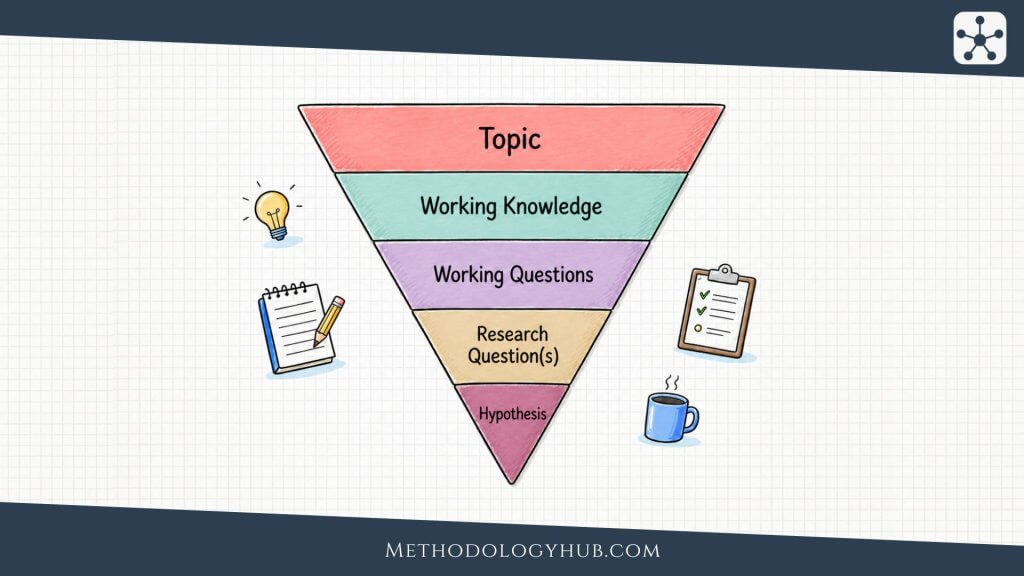
Use the broad-to-narrow path
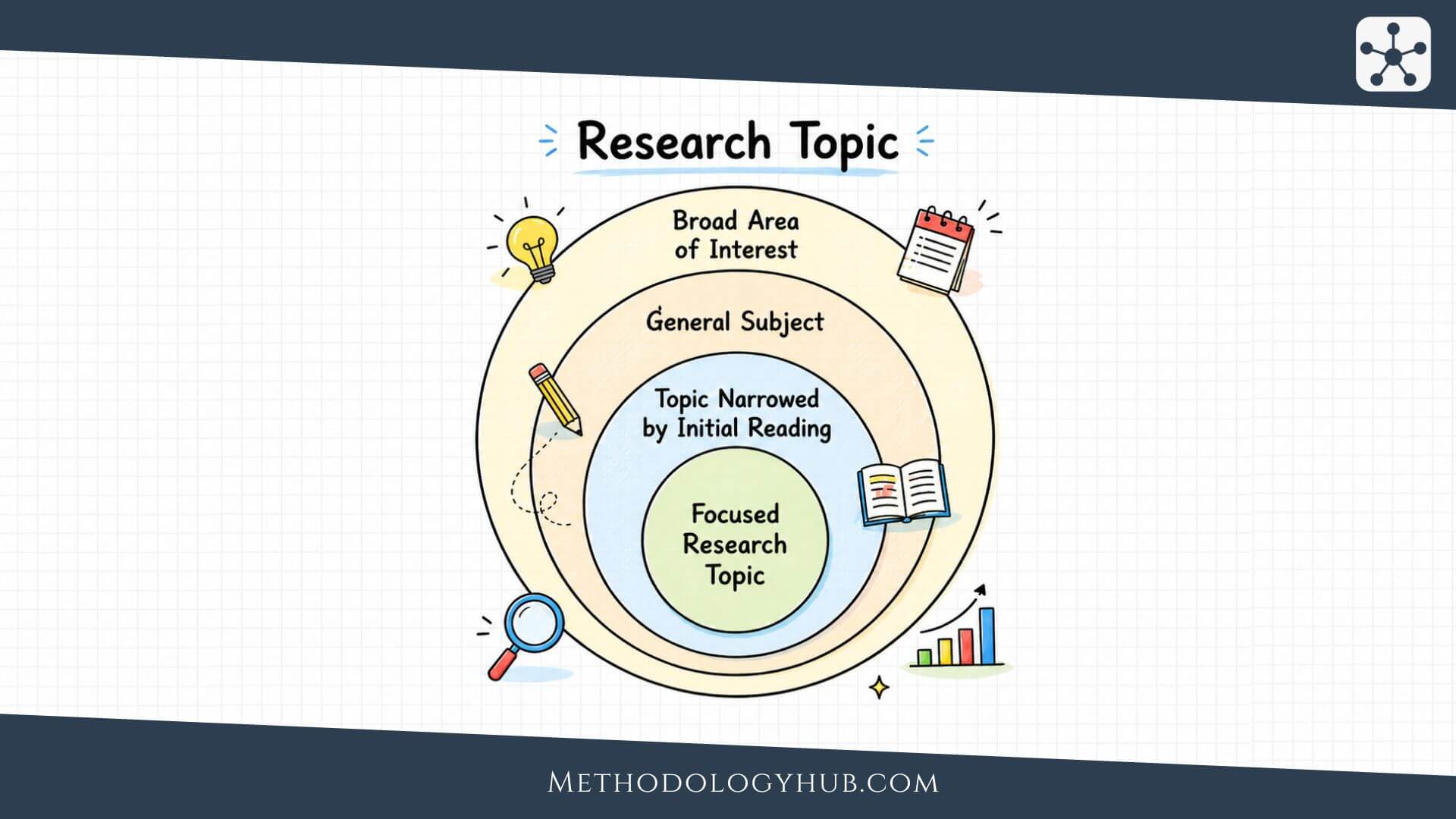
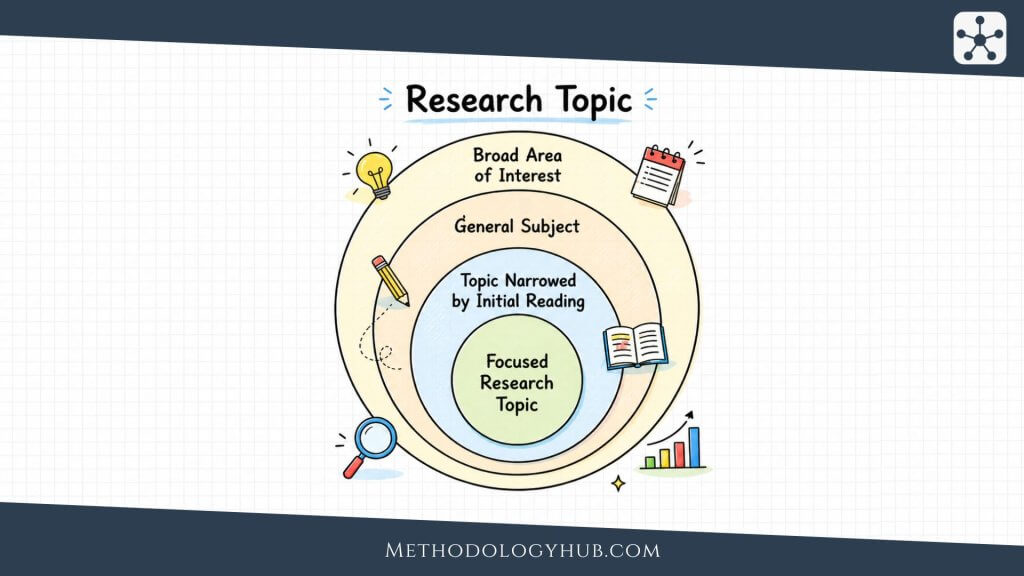
Start with the broad area, then narrow it step by step. Do not jump from a subject to a final topic in one move.
- Subject: education
- Broad area: online learning
- Narrower area: recorded lectures in first-year courses
- Problem: students use recordings differently during exam preparation
- Research topic: recorded lecture use and exam preparation habits among first-year biology students
Each step removes some possibilities and keeps others. By the end, the topic is still connected to the subject, but it is no longer too large.
Use who, what, where, when, and how
The five basic questions are simple, but they work. They force the topic to name its boundaries.
- Who: which group, population, author, institution, or case?
- What: which concept, problem, outcome, or material?
- Where: which place, setting, archive, platform, laboratory, or institution?
- When: which period, cohort, year, event, or stage?
- How: which process, method, source type, or relationship?
You do not always need every answer in the topic wording. You need enough of them to keep the project from drifting.
Replace vague words
Many early topics contain vague nouns. Words such as “impact”, “success”, “quality”, “engagement”, “awareness”, “wellbeing”, and “performance” can be useful, but only when the researcher defines them.
For example, “student engagement” might mean attendance, reading completion, class discussion, platform logins, time on task, or self-reported interest. These are different things. A good topic should say which one the study can actually examine.
Check the source base
After narrowing the topic, check the source base again. A topic can become too narrow if there are not enough sources or data to support it. It can also stay too broad if the source list becomes unmanageable.
Try a small test search. Search two or three databases, one library catalogue, or one archive guide. Save the search terms that work. Notice which terms return irrelevant results. This gives you a practical sense of whether the topic can support the project.
Build a topic map
A topic map is a simple page with the topic in the centre and related branches around it. The branches might include population, setting, variables, sources, theory, period, method, and possible research questions.
The point is not to make a decorative diagram. The point is to see which parts belong together. If one branch keeps growing while the others stay empty, the topic may need to shift toward that stronger area.
Turn the topic into a question
The final test is whether the research topic can become a research question. If it cannot, it may still be only a subject area.
- Topic: peer feedback and undergraduate research proposals
- Question: How does peer feedback affect the organisation of undergraduate research proposal drafts?
The question does not have to be final at once. It simply shows whether the topic can guide a study.
Checklist for choosing a research topic
Before you commit to a research topic, test it. A topic can sound good in conversation but become difficult when you try to connect it to sources, data, methods, and a final answer. A short checklist can prevent many problems.
Topic clarity
- Can the topic be explained in one or two sentences?
- Does it name the main area of study?
- Does it avoid vague words that still need definition?
- Can another person understand the topic without a long explanation?
Scope
- Is the topic narrow enough for the project length?
- Is it broad enough to support analysis?
- Have you set limits around group, place, period, source, material, or outcome?
- Have you removed parts that belong in a later project?
Evidence
- Can you name the sources or data needed?
- Can you access them in time?
- Are there enough scholarly sources to understand the field?
- Would the evidence actually help answer the question that will come from the topic?
Academic fit
- Does the topic fit the course, field, supervisor, journal, or assignment?
- Does it connect to existing scholarship?
- Can it lead to a research question, aim, or hypothesis?
- Does it allow description, comparison, explanation, evaluation, interpretation, or testing?
Conclusion
A research topic is the first clear shape of a study. It is not the full research question, and it is not the method. It is the focused area that tells the researcher what the project will investigate, which sources or data may be needed, and what kind of academic discussion the work belongs to.
Choosing a research topic usually starts with a broad interest. That broad interest then has to be tested against the literature, the available evidence, the project length, and the requirements of the field. A topic such as “student learning” is too wide on its own. A topic such as “weekly online quizzes and preparation habits among first-year chemistry students” is much closer to something that can become a real study.
The best research topics are not chosen only because they sound impressive. They are chosen because they can be worked on carefully. A useful topic gives the researcher enough room for analysis, but not so much room that the project becomes scattered. It has boundaries. It can lead to a research question. It can be connected to existing scholarship. It can be answered with evidence the researcher can actually reach.
A topic also changes as the project develops. Early reading may show that the first version is too broad, too narrow, already answered, poorly defined, or difficult to support with evidence. That is not a failure. It is part of turning a general interest into a study that can be planned, written, and defended.
Before moving forward, the researcher should be able to explain the research topic in simple language, name the main boundary of the project, identify possible sources or data, and show how the topic could become a focused research question. If those pieces are in place, the topic is ready to become the foundation of the next stage of research.
Research topic FAQ
What is a research topic?
A research topic is the focused subject area that a study investigates. It gives the project an initial direction and helps the researcher decide what to read, what evidence to look for, and what research question can be developed.
How do you choose a research topic?
To choose a research topic, start with a broad area of interest, do background reading, look for a specific problem or gap, check whether evidence is available, and narrow the topic until it fits the project length, field, and method.
What makes a good research topic?
A good research topic is clear, focused, researchable, feasible, and connected to existing scholarship. It should be narrow enough to guide the project, but broad enough to support analysis, explanation, comparison, evaluation, or interpretation.
What is the difference between a research topic and a research question?
A research topic names the area of study. A research question asks something specific about that area. For example, “sleep and students” is a topic, while “How is weekday sleep duration associated with exam performance among first-year students?” is a research question.
How narrow should a research topic be?
A research topic should be narrow enough to study within the available time, sources, data, and project length. It should usually include boundaries such as a group, place, time period, case, source type, variable, or problem.
Can a research topic change during the project?
Yes, a research topic can change during the project. Early reading may show that the topic is too broad, too narrow, already well studied, or hard to support with evidence. Revising the topic is normal when the new version is clearer and more researchable.
Where can I find research topic ideas?
Research topic ideas can come from course readings, recent journal articles, literature reviews, previous assignments, public datasets, archive catalogues, policy documents, laboratory problems, field observations, and gaps or limitations mentioned in existing studies.