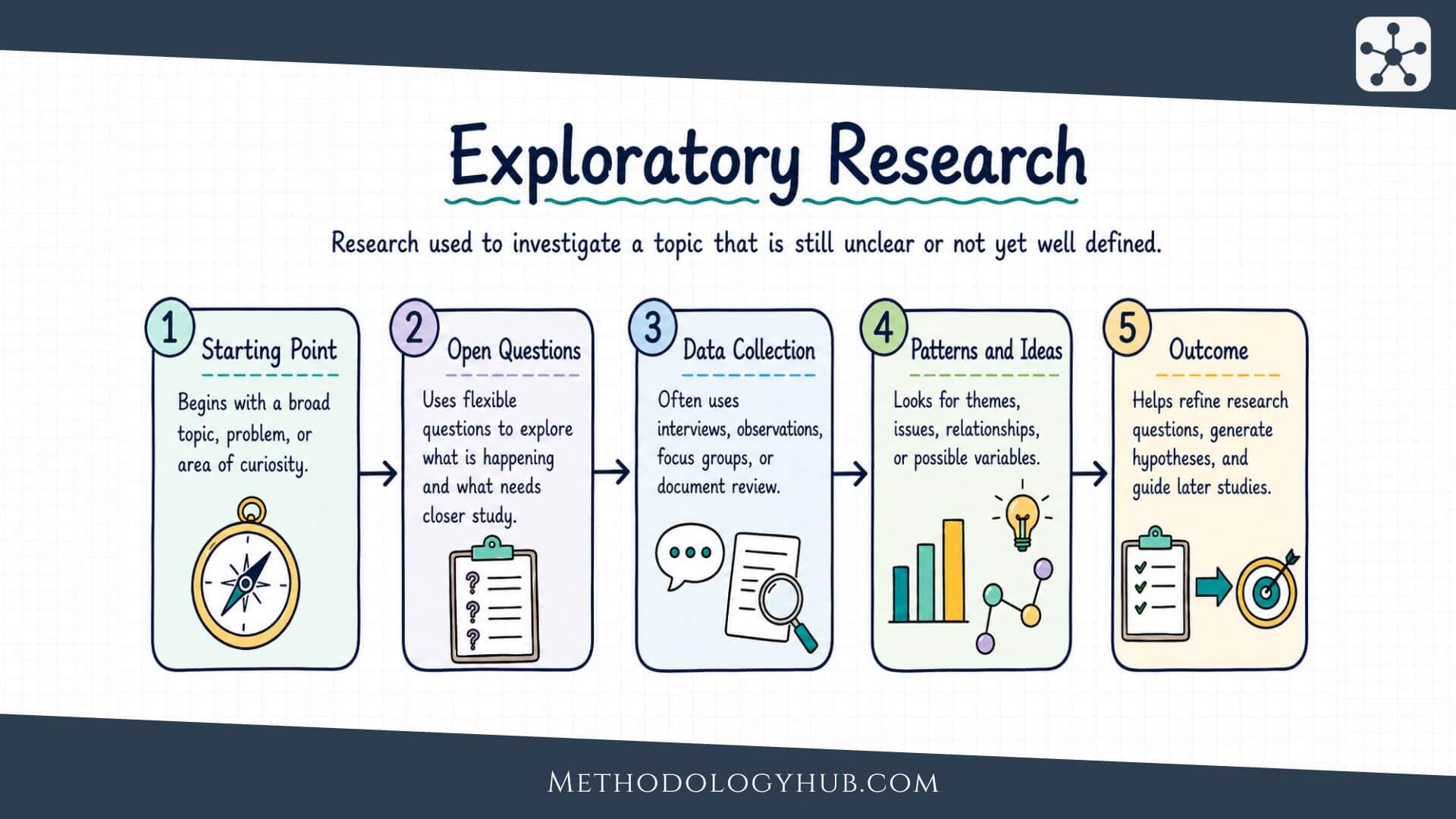
Exploratory research is a type of research used when a topic, problem, group, setting, or relationship is not yet understood well enough for a fixed study design. It helps the researcher become familiar with the situation, notice useful patterns, refine early ideas, and prepare clearer research questions for later work.
This article explains what exploratory research is, what it is used for, how it differs from descriptive and explanatory research, which methods are common, and how to perform an exploratory study in a clear and academically defensible way.
What Is Exploratory Research?
Exploratory research is a research approach used at an early stage of inquiry. The researcher begins with an area of interest, a practical puzzle, an unfamiliar setting, or an unclear problem, but does not yet have enough information to design a narrow study. Instead of starting with a fixed explanation, exploratory research opens the topic carefully and asks what needs to be understood first.
For example, a school may notice that students in a new transition programme are using support services in unexpected ways. At the beginning, the staff may not know whether the issue is communication, timetable pressure, peer influence, confidence, transport, family responsibilities, or something else. An exploratory study could use interviews, short surveys, observations, and document review to build a more precise picture before a larger study is planned.
Exploratory research definition
Exploratory research means studying a topic in a flexible and open way when the existing knowledge is limited, fragmented, or not specific enough for a more structured design. It is often used to clarify a problem, identify possible variables, understand language used by participants, develop concepts, and prepare later descriptive, explanatory, or evaluative research.
The word exploratory does not mean careless or vague. A good exploratory study still has a purpose, a transparent method, and a clear record of how decisions were made. What changes is the amount of flexibility allowed. The researcher may refine the focus as new information appears, add a follow-up interview question, compare early cases with later cases, or adjust sampling so the study can understand the situation more fully.
Where exploratory research fits in types of research
In the wider system of types of research, exploratory research is usually classified by objective. It is placed beside descriptive research and explanatory research because these three labels describe what the study is trying to do. Exploratory research opens and clarifies. Descriptive research records and summarises. Explanatory research examines reasons, mechanisms, causes, or relationships.
This classification can overlap with other research types. An exploratory study may be qualitative, quantitative, or mixed methods. It may use a case study, a pilot survey, interviews, focus groups, observations, a scoping review, or secondary data. It may also prepare the ground for applied research, evaluation research, or later statistical analysis.
Typical questions in exploratory research
Exploratory research questions tend to be open. They often ask what is happening, which features seem relevant, how people describe an experience, which categories appear in the data, or where a later study should focus. These questions can become more precise as the study develops.
A student beginning a study on classroom participation might first ask how students describe participation in different lesson formats. After several interviews, the question may become sharper: How do students distinguish between visible participation, such as speaking aloud, and quieter forms of participation, such as note-taking, peer support, or online response tools. That shift does not weaken the study. It shows how exploratory work can move from a broad topic to a better framed research question.
Objectives of Exploratory Research
The objectives of exploratory research are connected to discovery, clarification, and preparation. A researcher uses it when moving too quickly into measurement or hypothesis testing would create weak results because the topic has not yet been framed well enough.
This does not mean exploratory research is only a preliminary exercise. Some exploratory studies stand as full research projects, especially when they document a little-studied setting, develop a conceptual account, or show how a group understands an experience. Still, exploratory research often helps create better conditions for the next stage of the research process.
Clarify the research problem
Many studies begin with a problem that sounds clear from a distance but becomes complicated when examined closely. A college may say that students are not using feedback. A hospital unit may say that staff are avoiding a reporting system. A local archive may say that community records are missing from public use. These statements point to a concern, but they do not yet explain the form of the problem.
Exploratory research can help separate the different layers. Perhaps students read feedback but do not understand how to use it. Perhaps staff avoid the reporting system because the categories do not match their daily work. Perhaps the archive is used by some community members but not by teachers, researchers, or younger residents. The research problem becomes more specific after the researcher listens, observes, compares, and revises early assumptions.
Identify concepts and variables
Exploratory work often helps researchers identify the concepts, categories, or variables that should appear in a later study. At the beginning, the researcher may know the broad topic but not the terms that best describe it. Participants may use language that differs from the language found in previous literature. A school may speak of engagement, while students describe belonging, pressure, fear of being wrong, or habits built in earlier classrooms.
In quantitative work, exploratory research can point toward variables that should later be measured. In qualitative work, it can help develop categories, themes, sensitising concepts, or a conceptual framework. In both cases, the aim is not to force the topic into a ready-made structure too soon. The aim is to let early evidence show which distinctions are useful.
Develop research questions and working hypotheses
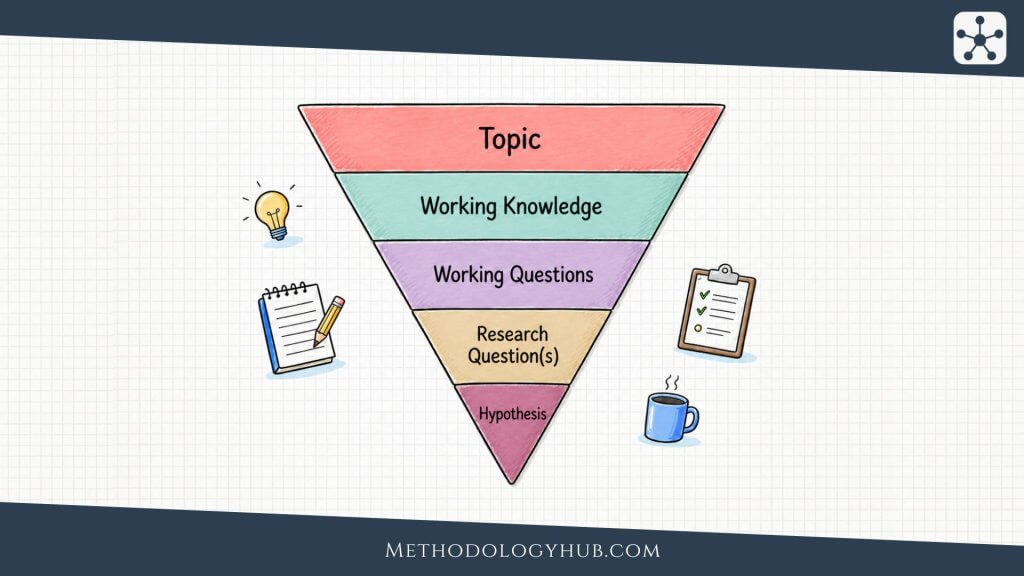
Exploratory research is strongly connected to the development of research questions. A broad topic such as peer learning, teacher workload, neighbourhood memory, museum access, or health communication needs a narrower question before it can become a manageable study. Exploratory research helps the researcher see what can actually be asked, observed, and analysed.
It can also support the development of a research hypothesis, although the wording should be careful. A fixed hypothesis normally belongs to a later explanatory or confirmatory study. In exploratory research, the researcher may instead use tentative expectations, working hypotheses, or guiding propositions. These are useful when they organise the inquiry without pretending that the study began with a fully tested claim.
Useful wording: In exploratory research, it is often safer to write that early findings suggest, indicate, or point toward a possible explanation, rather than saying that they prove or confirm a hypothesis.
Prepare later descriptive or explanatory research
Exploratory research can make later research more precise. After an exploratory interview study, a researcher may know which survey items to include, which terms to define, which groups to compare, or which timeframe to study. After a pilot observation, a researcher may understand how to record events consistently. After a scoping review, a researcher may see which part of the literature is crowded and which part still needs direct empirical work.
This preparation is especially useful when a later study will use quantitative research, because measurement requires clarity. It is difficult to measure a concept well if the researcher has not yet understood how it appears in context, how participants describe it, or which dimensions belong to it.
Key Aspects of Exploratory Research
The key aspects of exploratory research are flexibility, openness, close attention to context, and a willingness to revise early ideas. These features make exploratory research useful, but they also require discipline. A flexible design still needs a clear record of what was done and why.
Flexible design
Exploratory research usually has a flexible design. The researcher may begin with a plan for interviews, observations, or document review, but the plan can be adjusted when early findings show that a different angle is needed. For instance, an interview guide may be revised after the first few participants introduce a term that was missing from the original questions.
Flexibility should be deliberate. The researcher should explain which parts of the design changed, what evidence led to the change, and how the change affected the interpretation. Without that record, flexibility can look like improvisation. With that record, it becomes part of the method.
Open-ended data
Exploratory research often uses open-ended data because closed response options may be too narrow at the start. Interviews, focus groups, field notes, diaries, written reflections, classroom artefacts, institutional documents, and open survey questions can all give participants or cases room to show what the researcher did not anticipate.
Open-ended data do not remove structure. A semi-structured interview, for example, still has planned topics. The difference is that the participant can explain experiences in their own words, and the researcher can ask follow-up questions when something unexpected appears.
Small or purposefully selected samples
Many exploratory studies use small or purposefully selected samples. The goal is not always to estimate a population percentage. It may be to understand variation, identify possible categories, compare contrasting cases, or learn from people who have direct experience of the phenomenon. In that situation, a sampling method based on relevance can be more useful than a broad but shallow sample.
This is common in qualitative exploratory research. A researcher may speak with first-year teachers, students returning after a break, nurses involved in a new training model, or residents living near a changed public space. The sample should still be explained: who was included, who was not included, how participants or cases were reached, and what kind of claim the sample can support.
Iterative analysis
Exploratory research is often iterative. Data collection and analysis may partly overlap. Early analysis can shape later data collection, and later data can change how early material is interpreted. This is different from a design where every variable, item, and comparison is fixed before data collection begins.
For example, a researcher studying how students choose optional courses may begin by coding interviews for practical reasons, academic interest, peer influence, and teacher advice. Later interviews may show that timetable conflicts and fear of future workload need separate attention. The coding structure can then be revised, as long as the researcher records that revision.
Context-sensitive interpretation
Exploratory research often depends on context. A pattern found in one classroom, clinic, neighbourhood, archive, or online learning platform may not transfer neatly to another. The researcher should therefore describe the setting and explain how the setting shaped the data.
This does not make exploratory findings weak. It makes them situated. A careful exploratory study can show how a problem appears in a specific place, which features may be transferable, and which parts require later study in other settings.
| Aspect | What it looks like in exploratory research | What the researcher should report |
|---|---|---|
| Flexibility | The focus can be refined as evidence appears. | Which changes were made and why. |
| Open data | Participants, documents, or observations can introduce unplanned information. | How data were collected and analysed. |
| Purposeful sampling | Cases are selected because they can illuminate the topic. | Who was included and what claim the sample supports. |
| Iteration | Analysis can shape later data collection. | How early and later interpretations were connected. |
Methods Used in Exploratory Research
Exploratory research does not belong to one single method. The method should fit the stage of knowledge, the type of question, the available data, and the kind of evidence the researcher needs. Some studies use one method, while others combine several methods to compare what different sources reveal.
Literature-based exploration
A researcher may begin by reviewing existing literature, not to summarise everything that has ever been written, but to map what is already known and where the uncertainty lies. A scoping review, narrative review, or structured literature search can help identify concepts, theories, populations, gaps in measurement, and disagreements across studies.
This type of exploration is useful when a student is still choosing a research topic or when a field uses several terms for similar ideas. For example, studies on student participation may use terms such as engagement, involvement, voice, attendance, interaction, belonging, or classroom talk. Literature-based exploration can show which term fits the planned study best.
Interviews
Interviews are one of the most common methods in exploratory research. They allow participants to explain experiences, meanings, choices, and problems in detail. Semi-structured interviews are especially useful because they combine planned questions with space for follow-up.
An exploratory interview study might ask teachers how they understand artificial intelligence tools in writing classes, how they notice student use, what support they need, and which classroom practices seem to be changing. The answers may reveal categories the researcher would not have included in a closed survey at the beginning.
Focus groups
Focus groups collect data through guided group discussion. They are useful when the researcher wants to see how people compare experiences, respond to each other, use shared language, or disagree about a topic. In schools, universities, community research, and health communication, focus groups can reveal social meanings that may be harder to see in one-to-one interviews.
They should be used with care. Some topics are too personal for group discussion, and some participants may speak less freely in front of peers. When focus groups fit the topic, they can provide rich exploratory data about norms, expectations, and group-level language.
Observation
Observation helps the researcher study behaviour, interaction, spaces, routines, or events as they occur. It can be especially useful when people find it difficult to describe their own practices or when the setting itself is part of the research problem.
For example, a researcher studying use of a school library may observe where students sit, how they move through the space, which materials they handle, how staff support them, and when the space becomes crowded or quiet. These observations may later shape interview questions or a more structured survey.
Case studies
A case study can be exploratory when the researcher studies one case, or a small number of cases, to understand a phenomenon in context. The case might be a classroom, policy, programme, organisation, neighbourhood, archive, historical event, or community initiative. Case study research often combines interviews, observations, documents, and existing records.
Exploratory case studies are useful when the boundaries of the phenomenon are still unclear. The researcher can ask what seems to be happening inside the case, how different actors understand it, and which features could be studied later across more cases.
Pilot studies and pilot surveys
A pilot study is a small-scale version of a research activity used to test or refine a procedure. In exploratory research, a pilot can help the researcher see whether questions are understandable, whether recruitment is realistic, whether a measurement tool reflects participants’ experiences, or whether data collection produces the kind of information needed.
A pilot survey can also be exploratory if the researcher uses it to identify patterns, check response categories, or test whether items make sense before a larger survey research project. The pilot should not be reported as if it had the strength of a large probability sample unless the design supports that claim.
Secondary data exploration
Researchers may also explore existing research data, administrative records, open datasets, archives, school records, policy documents, or published reports. This can help identify patterns that deserve closer attention. A student might explore attendance records before deciding which year group to interview. A public health researcher might review service-use data before designing focus groups.
Secondary data can be helpful, but the researcher should remember that the data were originally collected for a particular purpose. Categories, missing values, definitions, and measurement choices can limit what the exploration can show.
Exploratory vs Descriptive and Explanatory Research
Exploratory, descriptive, and explanatory research are often compared because they all describe the objective of a study. They are not competing labels for the same thing. They answer different kinds of questions and often appear at different points in a research programme.
Exploratory research
Exploratory research is used when the researcher does not yet know enough to define the problem, variables, categories, or possible relationships with confidence. It is useful for opening a topic, developing early concepts, and deciding which direction later work should take.
An exploratory study on students’ experiences of remote assessment might begin with open interviews because the researcher does not yet know whether the main concern is technology, stress, academic honesty, feedback, home environment, time management, or course design.
Descriptive research
Descriptive research is used when the researcher wants to describe characteristics, frequencies, distributions, behaviours, or conditions. The topic is usually clearer than in exploratory research, so the researcher can decide what should be measured or recorded.
After the exploratory study on remote assessment, a descriptive study might survey a large group of students to estimate how many report technical problems, how often they use particular study strategies, or which assessment formats they have experienced.
Explanatory research
Explanatory research is used when the researcher wants to examine why or how something occurs. It often studies relationships between variables, mechanisms, processes, or causes. The design usually needs clearer expectations than exploratory research.
In the remote assessment example, explanatory research might test whether feedback timing is associated with student confidence, or whether assessment format affects reported stress after controlling for course level and previous experience. Depending on the question, this may involve statistical analysis, comparison, modelling, or theory-based qualitative explanation.
| Type | Main objective | Typical question | Typical output |
|---|---|---|---|
| Exploratory research | Clarify and open up a topic | What is going on here? | Concepts, categories, questions, early propositions |
| Descriptive research | Describe characteristics or patterns | What exists, how often, or in what form? | Profiles, summaries, frequencies, descriptions |
| Explanatory research | Examine reasons, mechanisms, or relationships | Why or how does this occur? | Explanations, models, tested relationships, causal arguments |
How the three can connect
A research programme may move through all three objectives. First, exploratory research may identify the relevant dimensions of a topic. Next, descriptive research may measure how common those dimensions are in a wider group. Later, explanatory research may examine why the pattern occurs or how different variables are related.
The sequence is not automatic. Some studies begin with theory and move directly into explanatory work. Other studies remain exploratory because the field is new, the setting is changing, or the researcher is interested in meaning and experience rather than measurement. The useful question is not which label sounds stronger, but which objective fits the current stage of knowledge.
Exploratory Research and Methodology
Exploratory research can be qualitative, quantitative, or mixed methods. The choice depends on the research question and on what kind of information is needed at the early stage. It is a mistake to treat exploratory research as automatically qualitative, although qualitative designs are very common because they work well with open questions and unfamiliar settings.
Qualitative exploratory research
Qualitative exploratory research is used when the researcher wants to understand meaning, experience, practice, language, context, or process. Interviews, focus groups, observation, field notes, documents, and visual materials are common sources of data. The analysis may use thematic analysis, qualitative content analysis, grounded theory, narrative analysis, discourse analysis, or another approach that fits the question.
For example, a researcher may study how new university students understand academic reading. Instead of assuming that the problem is simply reading speed or vocabulary, the study may ask how students choose what to read first, how they decide whether a text is difficult, what they do when they do not understand, and how teachers’ instructions shape their reading practices.
Quantitative exploratory research
Quantitative exploratory research uses numerical data, but it does not always begin with a fixed hypothesis. It may explore patterns in existing data, examine distributions, compare early groups, test whether survey items cluster together, or identify possible relationships for later study. Exploratory data analysis, pilot surveys, and preliminary measurement studies can all belong here.
For instance, a researcher with school attendance data may first examine patterns by year group, season, weekday, or distance from school. The goal at this stage is not to prove a causal claim. It is to see which patterns are present and which follow-up questions are worth asking. Later work may use statistical methods to test more specific expectations.
Mixed methods exploratory research
Mixed methods research can be especially useful when a topic needs both depth and breadth. A researcher might first conduct interviews to identify categories, then build a survey from those categories. This is often called an exploratory sequential design because the qualitative phase helps shape the later quantitative phase.
The direction can also work differently. A researcher might begin by exploring an existing dataset, then conduct interviews to understand the patterns in more depth. What makes the study exploratory is the role of the early stage: it helps define the problem, focus the later method, and guide interpretation.
Design note: Exploratory research is defined by its objective. Qualitative, quantitative, and mixed methods describe how the study collects and analyses evidence.
Exploratory research and research design
Exploratory research can appear within several research designs. It may use non-experimental research when variables are observed rather than manipulated. It may use cross-sectional research when data are collected at one point in time, or longitudinal research when change over time is part of the question.
It can also precede experimental research or quasi-experimental research. Before testing an intervention, a researcher may need to explore how the intervention is understood, whether the setting can support it, which outcome should be measured, and which participants are most affected.
How to Perform Exploratory Research
Exploratory research works best when the researcher keeps a clear line between openness and disorder. The study can adapt as it develops, but the reader should still be able to follow the logic of each step. The following procedure gives a practical structure that can be adapted to different academic projects.
Step 1: Define the broad research area
Start by naming the general area and the reason it needs exploration. The area may come from a gap in the literature, a practical observation, a classroom problem, an unfamiliar population, a new technology, a policy change, or an unexpected pattern in existing data.
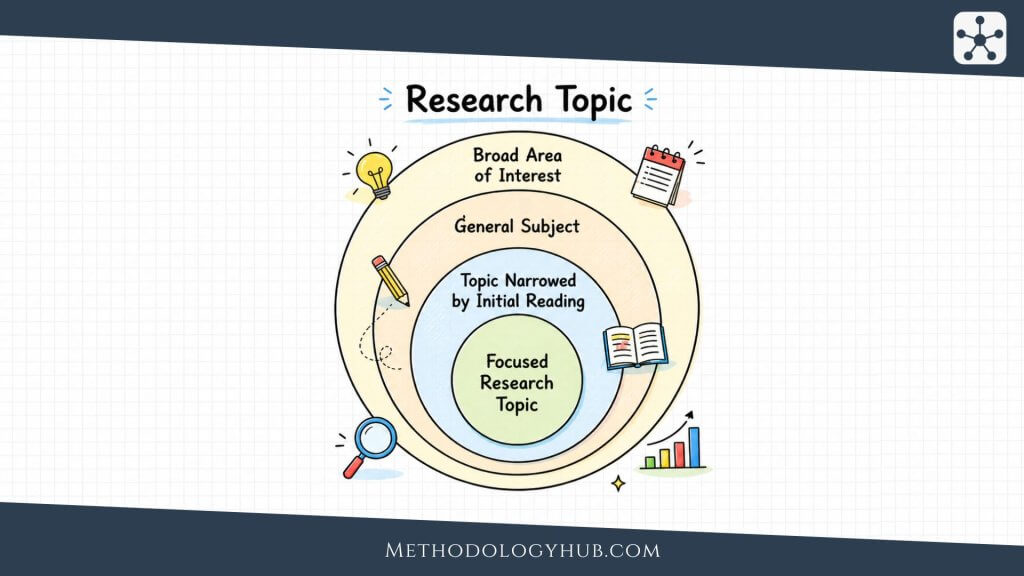
At this stage, the topic can be broad, but it should not be endless. “Student learning” is too wide. “How first-year students adjust to feedback in large introductory courses” gives the study a clearer starting point while still leaving room for exploration.
Step 2: Review what is already known
A short but careful literature review helps prevent the study from treating a well-known topic as if it were new. It also helps the researcher identify useful concepts, possible methods, and unresolved questions. The review does not have to close the topic too early. It gives the researcher enough orientation to ask better opening questions.
During this step, note the words used in previous studies, the groups that have been studied, the methods that have been used, and the areas that remain unclear. These notes will help justify the exploratory design.
Step 3: Form open research questions
Exploratory questions should be open enough to allow new information to appear, but clear enough to guide data collection. A question such as “What affects learning?” is too vague. A better exploratory question might ask, “How do first-year students describe the role of written feedback in revising their assignments?”
More than one question can be used, but the questions should work together. One question might ask about experiences, another about language, and another about situations in which the experience changes. The goal is a coherent inquiry, not a loose collection of interesting questions.
Step 4: Choose an exploratory design and sample
Next, decide which method can answer the opening questions. Interviews may fit personal experience. Observation may fit routines and interaction. A case study may fit a setting with clear boundaries. A pilot survey may fit early measurement. Secondary data may fit a first look at patterns already recorded.
The sample should match the exploratory purpose. In many studies, that means selecting participants, cases, documents, or records that can reveal variation. For example, a study of feedback use may include students from different course formats, achievement levels, or study backgrounds, if those differences are relevant to the question.
Step 5: Collect data with room for follow-up
Exploratory data collection should be organised but not overly rigid. Interview guides, observation templates, document review sheets, and survey drafts can all help. At the same time, the researcher should leave room to follow unexpected information when it is relevant.
Field notes are useful here. They can record why a follow-up question was added, why a new document was reviewed, or why a later participant group was included. These notes help the final report show how the study developed.
Step 6: Analyse patterns and refine concepts
Analysis in exploratory research often begins with broad reading, coding, counting, mapping, or comparison. The researcher looks for repeated ideas, surprising differences, unclear categories, and possible relationships. In qualitative work, this may involve coding transcripts or field notes. In quantitative work, it may involve graphs, cross-tabulations, simple summaries, or early scale checks.
The analysis should not turn every interesting detail into a final claim. Some findings will be central, some will be tentative, and some will simply guide later research. A clear report tells the reader which is which.
Step 7: Use the findings to plan the next stage
The final stage is to explain what the exploratory research has made clearer. This may include a refined research question, a set of concepts, a proposed framework, a list of variables, a revised survey instrument, or a plan for later descriptive or explanatory research.
For example, an exploratory study of feedback use may show that students distinguish between feedback they can act on immediately and feedback they only understand after seeing examples. A later descriptive study could measure how common these experiences are, while an explanatory study could examine whether feedback format is associated with revision quality.
Reporting exploratory research
When reporting exploratory research, explain the starting point, the design, the sample, the data sources, the analysis, and the way the focus developed. Readers should understand why the study was exploratory and how the findings should be interpreted.
The language should be careful. Exploratory findings can be persuasive, but they usually support cautious claims. Words such as suggests, indicates, reveals, identifies, proposes, and raises can be more accurate than proves or confirms. The study can still be useful without overstating what the design can show.
Examples of Exploratory Research
Examples of exploratory research are easiest to understand when the topic is still partly unknown. In each example below, the researcher begins with a real question, but the purpose is not yet to test a fixed explanation. The study first needs to find the relevant dimensions of the problem.
Example from education
A researcher wants to understand how secondary school students use teacher feedback when preparing for final exams. Previous studies discuss feedback in general terms, but the local school context has recently changed because students now receive feedback through an online platform as well as in class.
An exploratory design could include interviews with students, interviews with teachers, and a review of anonymised feedback examples. The study may identify different forms of feedback use: correcting errors, planning revision, comparing with peers, asking follow-up questions, or ignoring comments that feel too general. These categories could later shape a wider survey or an intervention study.
Example from public health
A health researcher notices that a community clinic has low attendance at a new screening service. The clinic records show who attended, but they do not explain why others stayed away. An exploratory study could use focus groups and short interviews to understand how people describe the service, what they know about the condition, and which practical barriers affect attendance.
The findings may show that the main issue is not only awareness. It may include appointment timing, fear of results, unclear letters, mistrust of medical language, transport, or family responsibilities. A later study could then test a revised communication strategy or compare attendance before and after a service change.
Example from sociology
A sociology student wants to study how young adults describe friendship after moving away from their hometown. The topic is broad, and existing research uses different terms such as social support, belonging, loneliness, mobility, and transition. An exploratory interview study could ask participants to describe how friendships are maintained, weakened, replaced, or redefined after moving.
The study may reveal that participants distinguish between everyday contact, emergency support, shared history, and identity. These concepts could form the basis for a later comparative study between students, apprentices, and young workers.
Example from environmental research
A researcher wants to understand how residents use a newly restored urban river path. Visitor counts can show when the path is used, but they do not explain what the space means to residents or why some groups avoid it. An exploratory study could combine observation, walking interviews, and a review of planning documents.
The findings may show differences between exercise use, quiet use, social use, and avoidance at certain times. The researcher may also notice that lighting, seating, sound, and perceived safety shape use more than distance alone. These early findings could guide later descriptive mapping or comparative research across several public spaces.
Example from academic writing research
A researcher wants to study how first-year students understand analytical writing. Instead of assuming that students simply need more grammar instruction, the researcher conducts exploratory interviews and collects short writing reflections. The study asks how students distinguish description from analysis, how they use sources, and what they find difficult when explaining evidence.
The exploratory findings may show that students can define analysis in abstract terms but struggle to recognise it in their own paragraphs. A later teaching study could then examine whether annotated examples improve students’ ability to revise analytical paragraphs.
Advantages and Limitations of Exploratory Research
Exploratory research has clear strengths, but it also has limits. It is strongest when the researcher needs to understand a topic before narrowing it. It is weaker when the study is expected to provide final population estimates, firm causal claims, or precise tests of fixed hypotheses.
Advantages of exploratory research
Exploratory research helps researchers avoid designing a study around the wrong assumptions. It can reveal participant language, hidden categories, practical barriers, and contextual details that would be missed by a narrow design. It can also make later research tools more accurate because they are built from a better understanding of the field.
It is also useful for students. A student who begins with a broad interest can use exploratory work to move from a general topic to a workable question. This can improve the fit between the research question, data collection, and analysis.
Limitations of exploratory research
The limits of exploratory research come from the same features that make it useful. A flexible design may not support strong generalisation. A small purposive sample may reveal rich detail, but it may not show how common a pattern is in the wider population. Open-ended analysis may identify possible explanations, but it may not test them in the way an explanatory design would.
These limits should be stated directly. A report can say that the findings identify possible categories, raise questions for later research, or provide a context-specific account. It should not claim more than the design can support.
When exploratory research is a good fit
Exploratory research is a good fit when the topic is new, the literature is thin, the setting has changed, the concepts are unclear, participant language is unknown, a measurement tool needs development, or a later study needs preparation. It is also useful when the researcher suspects that existing categories do not fit the local context.
It is usually a poor fit when the task is to estimate a precise population value, compare large groups with a fixed measurement tool, test a causal claim, or evaluate an intervention with predetermined outcomes. Those goals usually call for descriptive, explanatory, experimental, quasi-experimental, or evaluation designs.
Conclusion
Exploratory research is used when the researcher needs to understand a topic before designing a narrower study. It can clarify a problem, identify concepts, develop research questions, shape variables, test early tools, and prepare later descriptive or explanatory research. Its strength lies in careful openness: the design gives enough structure to guide inquiry, but enough flexibility to notice what was not expected at the start.
A strong exploratory study does not hide its uncertainty. It explains it. The report should show why exploration was needed, how data were collected, how early ideas were refined, and what kind of claim the findings can support. When written this way, exploratory research becomes a disciplined first step in academic inquiry, not a loose substitute for a clearer design.
FAQs on Exploratory Research
What is exploratory research?
Exploratory research is a type of research used when a topic, problem, group, setting, or relationship is not yet clearly understood. It helps the researcher clarify the problem, identify concepts, develop research questions, and prepare later descriptive or explanatory research.
What is the main purpose of exploratory research?
The main purpose of exploratory research is to gain orientation in an unclear or little-studied area. It is used to refine a broad topic, identify possible variables or categories, understand participant language, and shape a more focused research design.
What are examples of exploratory research methods?
Examples of exploratory research methods include literature-based exploration, semi-structured interviews, focus groups, observation, exploratory case studies, pilot studies, pilot surveys, document review, and early analysis of existing data.
What is the difference between exploratory and descriptive research?
Exploratory research is used to clarify an unclear topic or problem. Descriptive research is used to describe characteristics, frequencies, patterns, or conditions after the topic has become clearer. Exploratory research often prepares the concepts or questions that descriptive research later measures.
Is exploratory research qualitative or quantitative?
Exploratory research can be qualitative, quantitative, or mixed methods. Qualitative exploratory research is common because open-ended methods fit unclear topics well, but quantitative exploration can also be used to examine early numerical patterns or test a draft measurement tool.