A research hypothesis turns a research question into a prediction that can be checked against evidence. It is a testable statement about what a study expects to find and a fundamental element of the research process. Instead of only asking whether two things are connected, the hypothesis says what kind of connection the researcher expects to see.
This article explains what a research hypothesis is, how to write one, how it differs from a research question, and how to check whether a hypothesis can guide a real study.
What Is a Research Hypothesis?
A research hypothesis is a clear and testable prediction about the expected answer to a research question. It usually states a relationship, difference, effect, or pattern that the study will examine. The hypothesis is not a final answer. It is a statement that the research design must be able to support, reject, or revise.
In simple terms, a research question asks what the study wants to find out. A research hypothesis gives a possible answer before the evidence is collected or analysed. That answer should not be a guess pulled from nowhere. It should come from previous research, theory, observation, pilot work, or a clear reason in the field.
For example, a research question might ask, “What is the relationship between weekday sleep duration and exam performance among first-year university students?” A research hypothesis could state, “First-year university students who report longer weekday sleep duration will have higher exam scores.” The hypothesis names the expected direction of the relationship and gives the study something specific to test.
Research hypothesis definition
A research hypothesis is a tentative, evidence-informed statement that predicts a relationship between variables, a difference between groups, or an expected pattern in research material. It is written before the main analysis and is judged by evidence rather than preference.
The word “tentative” is important. A hypothesis is not something the researcher is trying to protect. It is something the researcher is willing to test. If the evidence does not fit the hypothesis, the study has still produced useful knowledge. The result may show that the expectation was wrong, incomplete, too broad, or dependent on conditions the researcher did not first notice.
A research hypothesis usually helps define:
- what the study expects to find
- which variables, groups, cases, or conditions will be compared
- what kind of evidence will be needed
- which analysis will be suitable
- how the results should be interpreted
A weak hypothesis leaves these points unclear. A strong one makes the project easier to design because it tells the researcher what must be observed, measured, compared, or tested.
Research hypothesis vs research question
A research question asks for an answer. A research hypothesis predicts one possible answer. The two work together, but they are not the same sentence with different punctuation.
- Research question: How does weekly feedback affect revision quality in first-year undergraduate history essays?
- Research hypothesis: First-year undergraduate history students who receive weekly feedback will produce revisions with clearer structure and stronger evidence use than students who receive feedback only at the end of the module.
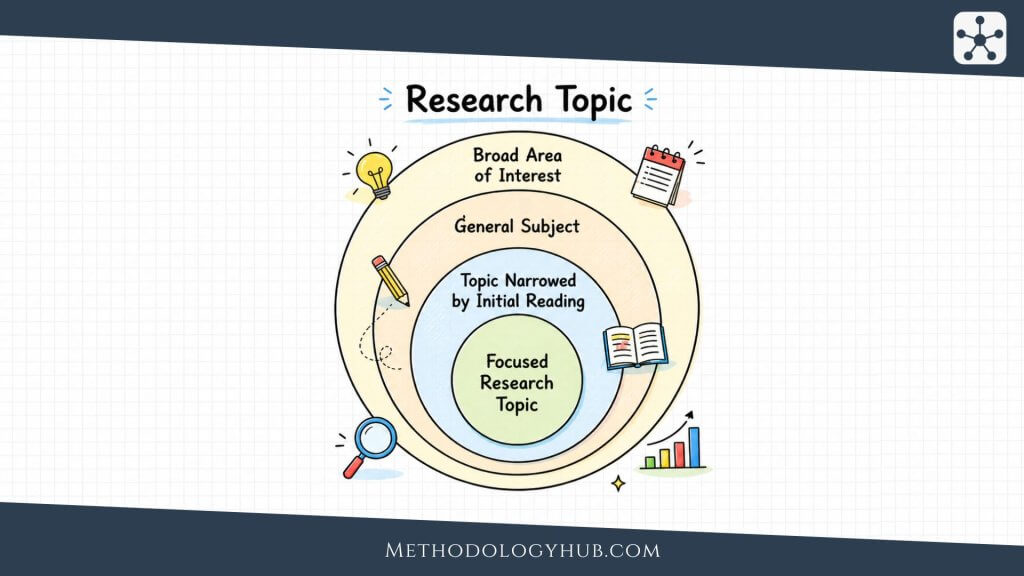
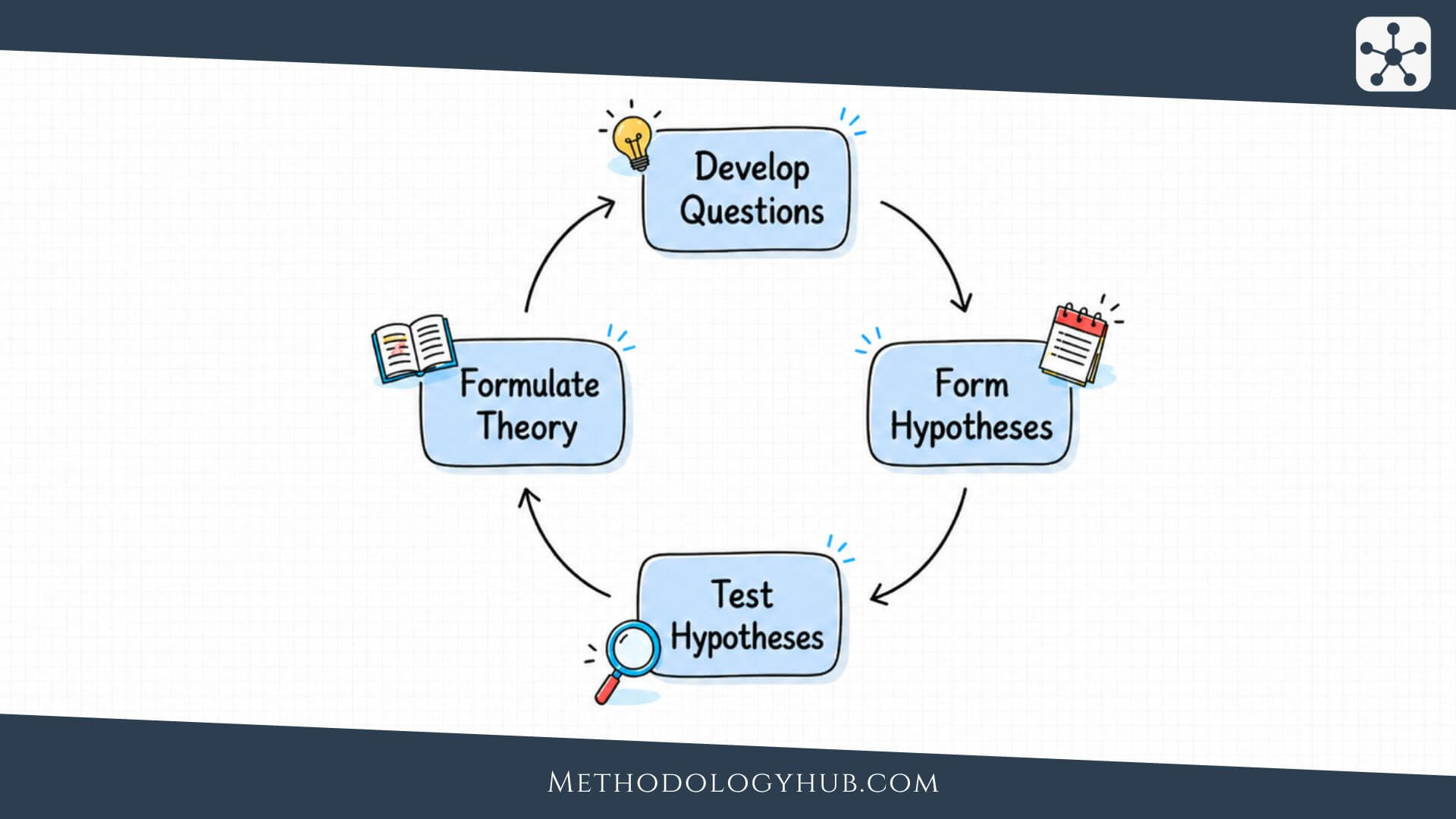
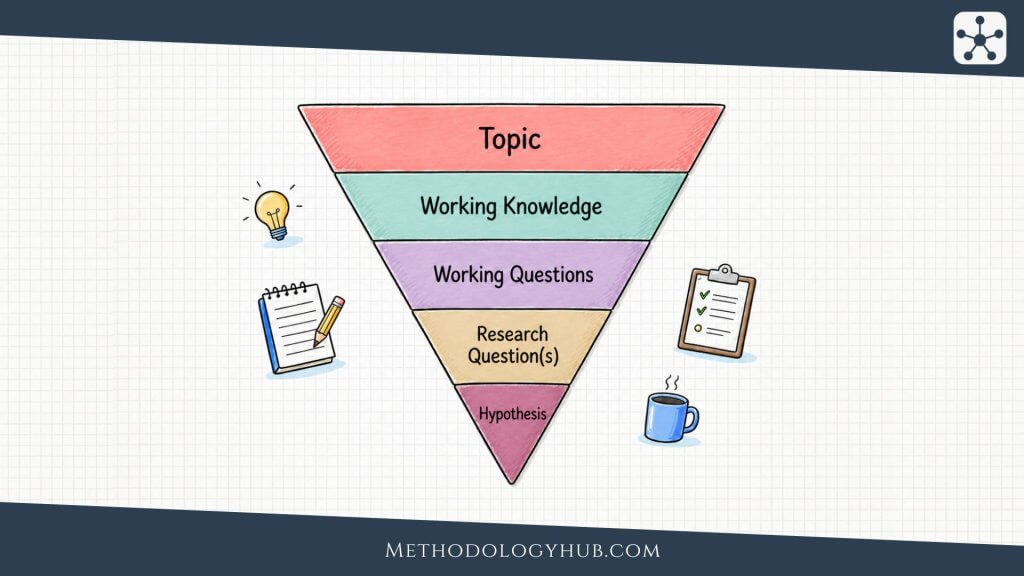
The question opens the investigation. The hypothesis gives a testable expectation. In many studies, the research question comes first. The hypothesis is then written after the researcher has narrowed the research topic, read the literature, and decided what kind of answer can reasonably be tested.
Some projects use only research questions. This is common when the aim is to describe a new area, map a pattern, interpret documents, build a classification, or explore a problem before making a prediction. A hypothesis is most useful when the study has a clear expectation that can be compared with evidence.
Research hypothesis vs research problem
A research problem is the issue that gives the study a reason to exist. A research hypothesis is the expected answer that the study will test.
For example, the problem might be that many first-year students submit laboratory reports with weak discussion sections. A research question could ask how structured pre-lab planning affects the quality of those discussion sections. A research hypothesis could state that students who complete a structured pre-lab planning sheet will write discussion sections with more accurate links between results and theory.
The problem explains the need for the study. The question defines what will be investigated. The hypothesis predicts what the evidence may show.
Research hypothesis vs prediction
The words hypothesis and prediction are sometimes used as if they are identical. They are close, but not always the same. A prediction can be a specific expected result. A hypothesis is usually a broader testable statement about a relationship, difference, effect, or mechanism.
In an experiment, a hypothesis might state that increasing water temperature will increase the reaction rate of an enzyme until the enzyme begins to denature. A prediction might then state that the reaction rate will be higher at 35 degrees Celsius than at 20 degrees Celsius under the same pH conditions.
The hypothesis gives the logic. The prediction gives a more specific expected observation.
When a study needs a research hypothesis
A study usually needs a research hypothesis when it tests a relationship, compares groups, examines an intervention, evaluates an effect, or uses statistical testing. The hypothesis gives the design a clear target.
A study may not need a formal hypothesis when it is mainly descriptive, historical, conceptual, exploratory, or interpretive. In those cases, a focused research question may be enough. Forcing a hypothesis into a project that is not built to test one can make the writing look artificial and can confuse the method.
The useful test is simple: can the study collect or examine evidence that would count for or against the statement? If yes, a hypothesis may help. If not, the project may need a research question instead.
How to Write a Research Hypothesis
To write a research hypothesis, begin with a focused research question, identify the main variables or conditions, decide what relationship you expect, and write the expectation in a form that can be tested. The first version will often be rough. That is normal. A good hypothesis usually becomes clearer as the research design becomes clearer.
The aim is not to make the sentence sound complicated. The aim is to make it useful. A useful hypothesis tells the reader what the researcher expects and what evidence could challenge that expectation.
Step 1: Start with a focused research question
A hypothesis without a clear research question often becomes vague. The research question sets the boundaries. It tells you the group, setting, relationship, period, material, or outcome that the hypothesis should address.
Compare these two starting points:
- Broad topic: sleep and academic performance
- Focused research question: What is the relationship between average weekday sleep duration and exam performance among first-year psychology students?
The broad topic is too open. The focused question is ready for a hypothesis because it names the main population and the relationship being studied.
Step 2: Identify the variables, groups, or conditions
Many research hypotheses involve variables. A variable is a feature that can vary across people, cases, times, places, texts, objects, or conditions. In a simple study, one variable may be the possible cause, predictor, intervention, or condition. Another variable may be the outcome.
For example:
- Independent variable: amount of weekly feedback
- Dependent variable: quality of essay revision
Not every project uses the exact language of independent and dependent variables. Some studies compare groups, periods, legal cases, policies, treatments, or materials. The same principle still applies. You need to know what is being compared and what kind of result is expected.
Step 3: Decide what relationship you expect
The hypothesis should say more than “there is a connection.” It should state what kind of connection is expected whenever the design allows it.
Useful relationship words include:
- increase: one variable is expected to rise as another rises
- decrease: one variable is expected to fall as another rises
- differ: one group, case, period, or condition is expected to differ from another
- predict: one factor is expected to help explain variation in an outcome
- affect: a condition or intervention is expected to change an outcome
Choose the word that fits the design. Do not write “affect” if the study can only show association. Do not write “predict” if the design does not estimate prediction. The verb should match what the evidence can support.
Step 4: Make the statement testable
A testable hypothesis can be checked against evidence. The evidence might come from an experiment, a survey, a dataset, a set of documents, repeated observations, measurements, records, or another organised source.
For example, “students who study more will do better” is too loose. Better would be, “Students who report at least ten hours of weekly independent study will receive higher final exam scores than students who report fewer than five hours.” That version defines the groups and the outcome.
A testable hypothesis does not need to be perfect, but it must be clear enough for the researcher to decide what data are needed.
Step 5: Set limits around the hypothesis
Most weak hypotheses are too wide. They try to apply to all people, all places, all schools, all societies, or all historical periods. A useful research hypothesis has boundaries.
Limits may involve:
- population or group
- place or institution
- time period
- type of material
- measured outcome
- comparison group
- experimental condition
For example, “exercise improves health” is too wide. “Adults aged 60 to 75 who complete a twelve-week supervised aerobic exercise programme will report better sleep quality than adults in the comparison group” is narrower and easier to test.
Step 6: Use direct language
A hypothesis does not need decorative wording. It should be direct enough that another researcher can understand what is being tested.
Use plain sentence patterns:
- Students who receive X will have higher Y than students who receive Z.
- Higher levels of X will be associated with lower levels of Y.
- Group A will differ from Group B on outcome Y.
- Condition X will produce a greater change in Y than condition Z.
These patterns are not exciting, but they do the job. A hypothesis is a working tool, not a slogan.
Step 7: Check the method before you keep the wording
After writing the hypothesis, ask whether the planned method can actually test it. If the hypothesis predicts a causal effect, the study needs a design that can support causal reasoning. If the hypothesis predicts a difference between groups, the groups must be defined. If the hypothesis predicts an association, the variables must be observable or measurable.
If the method and hypothesis do not match, change one of them. A well-written sentence cannot fix a study design that does not collect the needed evidence.
Characteristics of a Good Research Hypothesis
A good research hypothesis is clear, specific, testable, limited, linked to existing knowledge, and open to being challenged by evidence. These qualities are not ornaments. They make the hypothesis useful for designing the study and interpreting the results.
Most weak hypotheses fail for ordinary reasons. They are too broad. They use words that cannot be observed. They predict something the method cannot test. Or they sound certain before the study has begun.
Clear
A clear hypothesis can be understood on the first or second reading. It should not hide the main relationship behind long phrases or abstract nouns.
- Unclear: Academic support has a positive impact on student development.
- Clearer: First-year students who attend three writing centre consultations will produce research proposal drafts with fewer structural problems than students who attend none.
The clearer version names the group, support, comparison, and expected outcome.
Specific
A specific hypothesis gives enough detail to guide the research design. It avoids large topic words unless they are tied to something observable.
For example, “technology improves learning” is not specific. Which technology? Which learners? Which kind of learning? Which setting? A stronger version would state, “Students using weekly online practice quizzes will score higher on the final statistics test than students using the same reading materials without quizzes.”
Specific does not mean overloaded. A hypothesis should include enough detail to guide the study, but not so much that one sentence carries the whole literature review.
Testable
A testable hypothesis can be compared with evidence. A statement such as “good teaching creates better citizens” may sound interesting, but it is too vague for one study unless the terms are defined carefully.
A testable version might be, “Students in sections using weekly source-evaluation exercises will identify unsupported claims in historical texts more accurately than students in sections without the exercises.” This version can be examined with a defined task and comparison.
Linked to existing knowledge
A research hypothesis should have a reason behind it. That reason may come from a theory, a previous study, a repeated observation, a documented problem, or a contradiction in the literature.
This does not mean the hypothesis must repeat what previous studies already found. It can test a relationship in a new setting, examine a different group, compare methods, or question an assumption. But the reader should be able to see why the expectation was made.
Limited in scope
A good hypothesis fits the size of the study. A student project, journal article, laboratory report, thesis, and funded multi-year study have different limits. A hypothesis that requires national data, repeated experiments, and long-term follow-up will not fit a short course paper.
Scope is controlled by deciding who, where, when, and what will be studied. The narrower version may feel less dramatic, but it is usually stronger because it can actually be tested.
Open to being wrong
A hypothesis should not be written as if the answer is already settled. It should be possible for the evidence to challenge it. If no possible finding could count against the statement, the statement is not doing real research work.
For example, “students fail because they are not motivated” is not a good hypothesis. It assumes the explanation. A better version would identify observable indicators and allow other explanations: “Lower completion of weekly practice tasks will be associated with lower final test scores, after accounting for attendance.”
Types of Research Hypotheses
Research hypotheses can be grouped in several ways. The most useful types are simple, complex, directional, non-directional, null, alternative, associative, and causal hypotheses. These categories overlap. A hypothesis can be simple and directional, or complex and non-directional.
Knowing the type helps you choose the right wording and method. It also keeps you from writing a hypothesis that sounds testable but does not match the study.
Simple hypothesis
A simple hypothesis predicts a relationship between one independent variable and one dependent variable, or between one main condition and one outcome.
- Students who complete weekly practice quizzes will score higher on the final test than students who do not complete weekly quizzes.
- Higher daily step count will be associated with lower self-reported fatigue among office workers.
Simple does not mean weak. Many strong studies begin with a simple hypothesis because the relationship is easy to define and test.
Complex hypothesis
A complex hypothesis involves more than two variables, more than one condition, or more than one outcome. It may predict that two factors work together, that one factor changes the effect of another, or that an intervention affects several outcomes.
- Students who receive weekly feedback and attend peer review sessions will show greater improvement in essay structure and source integration than students who receive feedback only.
- Sleep duration and study consistency will jointly predict exam performance among first-year students.
Complex hypotheses need careful design. If the study cannot separate the variables or outcomes, the hypothesis may need to be simplified.
Directional hypothesis
A directional hypothesis predicts the direction of the relationship or difference. It states that one value will be higher, lower, stronger, weaker, faster, slower, more frequent, or less frequent than another.
- Students who receive worked examples before practice tasks will complete the tasks more accurately than students who receive practice tasks first.
- Higher average noise exposure will be associated with lower reported sleep quality among factory workers.
Use a directional hypothesis when previous research or a strong theoretical reason supports the expected direction.
Non-directional hypothesis
A non-directional hypothesis predicts that a relationship or difference exists, but it does not say which direction the result will take.
- There will be a difference in test performance between students who receive digital feedback and students who receive handwritten feedback.
- There will be an association between commute duration and workday stress among full-time employees.
This type is useful when the literature suggests a difference or relationship, but the direction is uncertain.
Null hypothesis
A null hypothesis states that there is no relationship, no difference, or no effect. In statistical testing, it often provides the statement tested against the observed data.
- There is no difference in final test scores between students who complete weekly quizzes and students who do not.
- There is no association between weekday sleep duration and exam performance among first-year psychology students.
The null hypothesis is not a personal belief that nothing will happen. It is a formal statement used in many statistical designs.
Alternative hypothesis
An alternative hypothesis states that a relationship, difference, or effect exists. It is often paired with the null hypothesis.
- Students who complete weekly quizzes will have different final test scores from students who do not complete weekly quizzes.
- Weekday sleep duration will be associated with exam performance among first-year psychology students.
The alternative hypothesis may be directional or non-directional, depending on the study and the evidence behind the expected result.
Associative hypothesis
An associative hypothesis predicts that two variables move together, but it does not claim that one causes the other. This is common in survey research, observational studies, and studies using existing datasets.
- Higher attendance will be associated with higher course grades among first-year economics students.
- Longer commute duration will be associated with higher reported workday stress.
Association is not the same as cause. If the design cannot rule out other explanations, keep the wording associative.
Causal hypothesis
A causal hypothesis predicts that one factor produces a change in another. This type needs a stronger design because causal claims are harder to support.
- A twelve-week supervised exercise programme will reduce resting blood pressure among adults with elevated baseline readings compared with a control condition.
- Providing source-evaluation training before a writing assignment will reduce the number of unsupported claims in student essays.
Use causal wording only when the study design can support it. Experiments, controlled interventions, natural experiments, and strong longitudinal designs are better suited for causal hypotheses than simple one-time observations.
Research Hypothesis Examples
Examples help show the difference between a topic, a weak hypothesis, and a hypothesis that can guide a study. The stronger examples below are not meant to be copied word for word. They show how a broad idea can become a testable statement.
Example 1: Education
Topic: feedback and essay writing
Weak hypothesis: Feedback helps students write better essays.
Stronger research hypothesis: First-year history students who receive weekly written feedback will improve their essay structure scores more than students who receive only final-draft feedback.
The weak version is too broad. The stronger version names the group, feedback condition, comparison, and outcome.
Example 2: Public health
Topic: appointment reminders
Weak hypothesis: Reminder messages reduce missed appointments.
Stronger research hypothesis: Patients aged 18 to 30 who receive SMS reminders 24 hours before scheduled appointments will have lower missed-appointment rates than patients who receive no reminder.
The stronger version defines the reminder, time point, population, comparison group, and measured result.
Example 3: Psychology
Topic: sleep and exam performance
Weak hypothesis: Sleep affects grades.
Stronger research hypothesis: First-year psychology students who report at least seven hours of weekday sleep will have higher exam scores than students who report fewer than six hours.
The stronger version does not try to explain every part of academic performance. It tests one defined relationship.
Example 4: Environmental science
Topic: urban heat and tree cover
Weak hypothesis: Trees improve urban climate.
Stronger research hypothesis: Residential streets with more than 30 percent tree canopy cover will have lower average afternoon surface temperatures in July than residential streets with less than 10 percent canopy cover.
This version gives measurable conditions and a specific outcome.
Example 5: Economics
Topic: transport costs and job access
Weak hypothesis: Transport costs affect employment.
Stronger research hypothesis: In metropolitan districts with similar unemployment rates, lower monthly public transport costs will be associated with higher job application rates among unemployed adults.
The stronger version is still ambitious, but it defines a relationship and suggests what kind of data would be needed.
Example 6: Biology
Topic: temperature and enzyme activity
Weak hypothesis: Temperature changes enzymes.
Stronger research hypothesis: Enzyme activity will increase between 20 and 35 degrees Celsius under controlled pH conditions, then decrease at 50 degrees Celsius.
This hypothesis gives a direction and a boundary. It also points directly to an experimental design.
Example 7: Political science
Topic: voter information and turnout
Weak hypothesis: Better information increases voting.
Stronger research hypothesis: First-time voters who receive a non-partisan information letter explaining polling location and voting hours will report higher turnout than first-time voters who do not receive the letter.
The stronger version names the group, intervention, and outcome. It also avoids making a general claim about all voters.
Example 8: History
Topic: newspapers and labour debates
Weak hypothesis: Newspapers influenced workers in the 1920s.
Stronger research hypothesis: National newspapers in Britain between 1919 and 1926 used more negative language when describing strike leaders than when describing government negotiators.
This hypothesis does not claim to measure influence unless the evidence can support that. It predicts a pattern in a defined set of texts.
Research Hypothesis in Different Academic Works
A research hypothesis can appear in many kinds of academic work, but its role changes with the type and scale of the project. A lab report, thesis, dissertation, research proposal, journal article, and literature review do not use hypotheses in exactly the same way.
The basic principle stays the same: the hypothesis should match the question, evidence, method, and size of the work.
Research hypothesis in a lab report
In a lab report, the hypothesis usually predicts the outcome of an experiment. It should identify the independent variable, dependent variable, and expected direction.
For example: “Increasing the concentration of substrate will increase enzyme reaction rate until the enzyme becomes saturated.” This sentence tells the reader what the experiment changes, what it measures, and what pattern is expected.
A lab report hypothesis should be short and precise. The discussion section can later explain whether the result supported the hypothesis and what limits affected the interpretation.
Research hypothesis in a thesis
In a thesis, the hypothesis often supports a larger argument. It may be placed after the research question, after the literature review, or in the methodology chapter, depending on the discipline and programme requirements.
A thesis may use one main hypothesis and several sub-hypotheses. The main hypothesis states the central expectation. The sub-hypotheses break that expectation into smaller parts that can be tested in separate sections.
- Main hypothesis: Students who receive structured weekly feedback will improve more in academic writing than students who receive end-of-module feedback only.
- Sub-hypothesis 1: The structured-feedback group will show greater improvement in paragraph organisation.
- Sub-hypothesis 2: The structured-feedback group will show greater improvement in source integration.
The sub-hypotheses should not introduce separate projects. They should help answer the main research question.
Research hypothesis in a dissertation
In a dissertation, the hypothesis usually needs a stronger connection to the literature. The project is larger, so the hypothesis should not look like a quick classroom prediction. It should respond to a real debate, unresolved finding, theoretical expectation, or gap in existing evidence.
A dissertation can also test several related hypotheses. This is common when the project uses a model, compares several groups, or examines multiple outcomes. The important point is that each hypothesis must have a clear role in the full design.
Research hypothesis in a research proposal
In a research proposal, the hypothesis has to show that the planned study is focused and testable before the research is carried out. Reviewers want to see that the expectation is not too broad, not already settled, and not impossible to examine.
Proposal readers often ask:
- Does the hypothesis follow from the research question?
- Is the expected relationship clear?
- Can the planned evidence test the hypothesis?
- Is the scope realistic?
- Does the analysis plan fit the hypothesis?
A proposal can have a strong topic and still fail if the hypothesis is unclear. The reader needs to see the path from question to hypothesis to method.
Research hypothesis in a journal article
In a journal article, the hypothesis should usually be direct and closely tied to the article’s contribution. Space is limited, so the hypothesis cannot carry too many conditions at once.
Some articles list hypotheses as H1, H2, and H3. Others write them in prose. Either approach can work. The important point is that the reader should be able to see what was expected before the results are presented.
Research hypothesis in a literature review
A literature review does not always need a research hypothesis. Many reviews are guided by research questions instead. A hypothesis may be useful when the review tests an expectation about patterns in previous findings.
For example, a review might hypothesise that studies using longer follow-up periods report smaller intervention effects than studies using short follow-up periods. That kind of hypothesis can be tested by comparing features across the included studies.
If the review only maps what has been written, a question may be enough. If the review predicts a pattern across studies, a hypothesis can help.
How to Imnprove a Research Hypothesis
A research hypothesis often improves through revision. The first version may show the general expectation, but it may not yet be narrow enough, testable enough, or clear enough for the final study.
Refinement means making the hypothesis do more work with fewer vague words. It also means removing claims that the evidence cannot support.
Move from topic to question to hypothesis
Do not jump straight from a topic to a hypothesis. The research question should come in between. This keeps the hypothesis from becoming a loose claim about a broad subject.
- Topic: academic writing support
- Research question: How do writing centre consultations affect the organisation of first-year students’ research proposal drafts?
- Research hypothesis: First-year students who attend three writing centre consultations will show greater improvement in proposal organisation scores than students who do not attend consultations.
This path makes the hypothesis easier to test because each step narrows the project.
Replace vague words with observable terms
Many first drafts use words that sound reasonable but are difficult to test. Instead of “better learning”, name the outcome. Instead of “student engagement”, say whether the study uses attendance, participation, task completion, time on platform, or another indicator.
For example, “students will be more engaged” could become “students will complete a higher proportion of weekly practice tasks.” The second version is less grand, but it can be examined.
Decide whether the hypothesis should be directional
If prior research gives a strong reason to expect a direction, write a directional hypothesis. If the evidence suggests a difference but not the direction, use a non-directional hypothesis.
Do not force a direction only because it sounds stronger. A directional hypothesis should have support behind it.
Check the comparison
A hypothesis often becomes clearer when the comparison is explicit. Ask what the main group, condition, time period, or material is being compared with.
- compared with students who do not receive feedback
- compared with the previous policy period
- compared with streets with lower canopy cover
- compared with baseline measurements
Without a comparison, the hypothesis may be hard to test.
Check the scale of the project
A hypothesis for a short essay should be narrower than a hypothesis for a dissertation. A classroom lab report should not contain a hypothesis that would require months of testing. A journal article should not include so many hypotheses that none can be explained properly.
Fit the hypothesis to the time, data, tools, and length of the project.
Write the null and alternative when needed
When a study uses statistical testing, it often needs a null hypothesis and an alternative hypothesis.
- Null hypothesis: There is no difference in final test scores between students who complete weekly quizzes and students who do not.
- Alternative hypothesis: There is a difference in final test scores between students who complete weekly quizzes and students who do not.
If the study expects a direction, the alternative hypothesis can be directional: “Students who complete weekly quizzes will have higher final test scores than students who do not.”
Read the hypothesis against the results section before collecting data
A useful final check is to imagine the results section. What table, comparison, figure, extract, measurement, or analysis would answer the hypothesis? If you cannot imagine what the result would look like, the hypothesis is probably still too vague.
This does not mean predicting the result with certainty. It means knowing what kind of evidence the study is supposed to produce.
Conclusion
A research hypothesis gives a study a testable expectation. It is the point where the research question becomes a statement that evidence can support, reject, or complicate. A good hypothesis does not need inflated language. It needs clear variables, a defined relationship, and a method that can examine it.
The strongest hypotheses usually come after careful narrowing. Start with a topic. Turn the topic into a research question. Read enough to see what previous work suggests. Then write a hypothesis that fits the evidence you can collect or examine.
A research hypothesis should be useful to the whole project. It should help shape the method, guide the analysis, and give the discussion section something precise to return to.
- Begin with a focused research question.
- Identify the variables, groups, cases, or conditions.
- State the expected relationship in clear language.
- Make sure the hypothesis can be tested with evidence.
- Revise the wording until the hypothesis fits the method.
FAQs on Research Hypotheses
What is a research hypothesis?
A research hypothesis is a testable statement about what a study expects to find. It usually predicts a relationship, difference, effect, or pattern that can be checked against evidence.
How do you write a research hypothesis?
To write a research hypothesis, start with a focused research question, identify the main variables or conditions, decide the expected relationship, set limits around the study, and write the expectation in direct, testable language.
What is the difference between a research question and a research hypothesis?
A research question asks what the study wants to find out. A research hypothesis predicts one possible answer that the study will test. The question usually comes first, and the hypothesis follows after the topic has been narrowed.
What makes a good research hypothesis?
A good research hypothesis is clear, specific, testable, limited in scope, linked to existing knowledge, and open to being challenged by evidence. It should also match the method used in the study.
What are the main types of research hypotheses?
Common types include simple, complex, directional, non-directional, null, alternative, associative, and causal hypotheses. The right type depends on the research question and the design of the study.
Does every study need a research hypothesis?
No. A research hypothesis is useful when a study tests a relationship, difference, effect, or expected pattern. Some descriptive, historical, conceptual, exploratory, or interpretive studies may work better with research questions only.