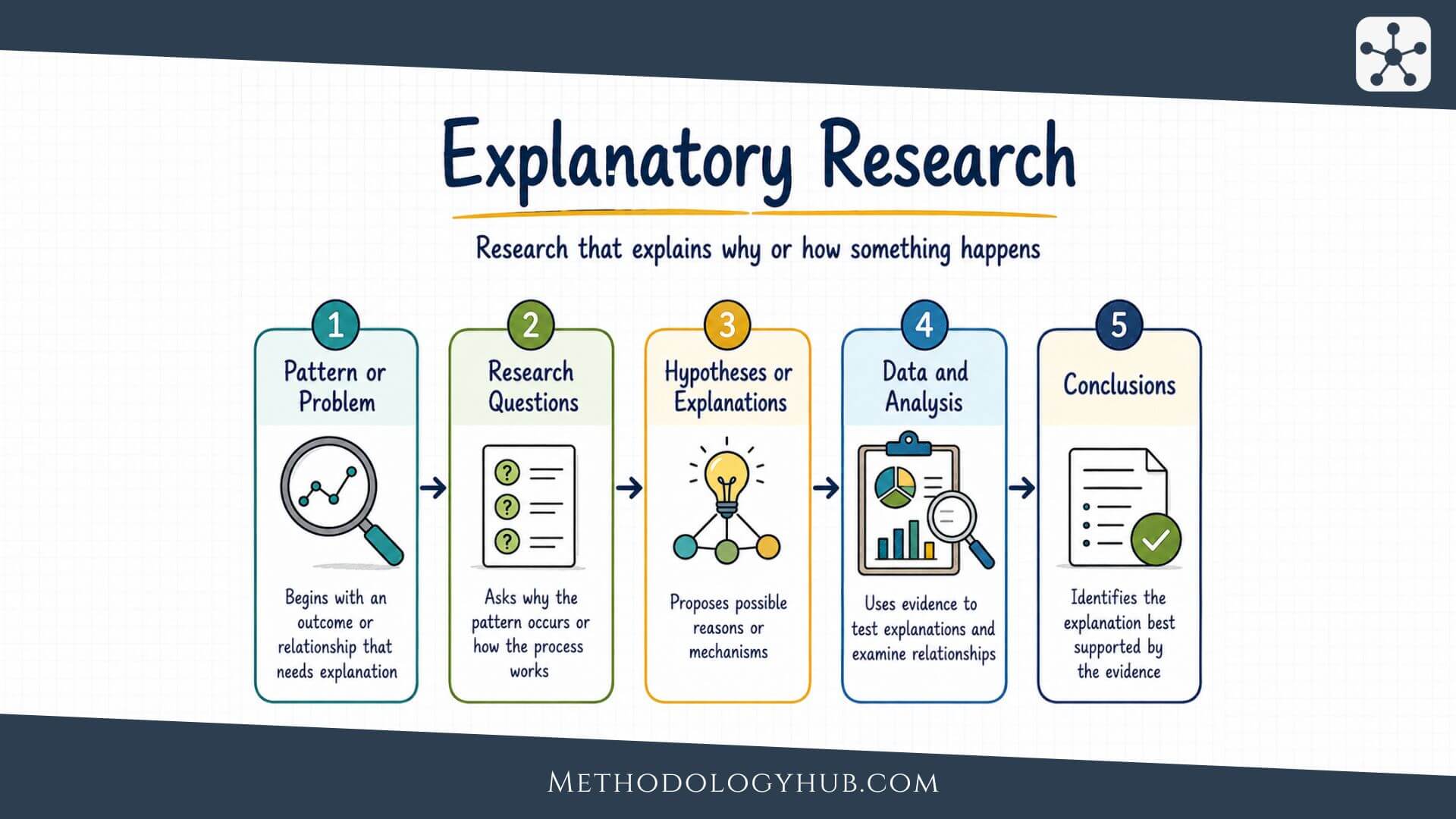
Explanatory research is research that studies why or how something happens. It goes beyond describing a pattern and tries to explain the relationship, process, or cause behind it. A descriptive study may show that students who attend revision sessions often get higher exam scores. An explanatory study asks whether the sessions help, whether already motivated students are more likely to attend, or whether another factor explains the difference.
This article explains what explanatory research is, what its objectives are, which aspects shape the design, how it differs from exploratory and descriptive research, how to perform it, and what explanatory research can look like in academic studies.
What Is Explanatory Research?
Explanatory research is a type of research used to explain why a pattern, outcome, relationship, or event occurs. It is usually used when researchers already know that something exists, but still need to understand the reason behind it. The focus is not only on what is happening, but on what may be producing the observed result.
For example, a school may know from attendance records that some pupils miss more classes than others. A descriptive study can show how often absence occurs and which groups are most affected. Explanatory research takes the next step. It may examine whether transport distance, school climate, family responsibilities, health, prior achievement, or several factors together help explain the difference in attendance.
Explanatory research definition
Explanatory research is research that investigates why or how a relationship, difference, process, or outcome occurs. It often examines the connection between one or more possible explanatory factors and an outcome. In quantitative research, this usually means studying relationships between variables. In qualitative research, it may mean explaining how people make decisions, respond to conditions, or move through a process.
The word explanatory does not mean that a study has to prove a cause beyond doubt. Many studies cannot do that. It means that the design is built around explanation. The researcher is trying to account for a pattern rather than only record it. The strength of the explanation depends on the research process, the quality of the evidence, and the fit between the question, data, and analysis.
When explanatory research is used
Explanatory research is often used after earlier research has already identified a pattern. A field may first use exploratory studies to understand a new topic, then descriptive studies to map it more clearly, and then explanatory studies to test possible reasons for the pattern. The order is not automatic, but it is common in many areas of research.
In practice, explanatory research is suitable when the study asks questions such as:
- Why do some learners improve faster than others after the same teaching method?
- How does sleep quality relate to concentration during exams?
- Does access to green space help explain differences in reported stress?
- Which factors account for variation in recovery after a medical intervention?
- How do teachers adapt feedback when classroom conditions change?
These questions do not only ask for a description. They ask for a reasoned connection between conditions and outcomes. That connection may be tested statistically, traced through a qualitative process, compared across cases, or studied through a mixed methods design.
What explanatory research can show
An explanatory study can show that one explanation fits the evidence better than another. It can also show that a simple explanation is too weak. For instance, a study may begin with the idea that students miss online classes because they lack motivation. After collecting data, the researcher may find that unstable internet access, caring duties, and assessment pressure explain more of the pattern than motivation alone.
This is one reason explanatory research often pays close attention to alternative explanations. A relationship between two variables may look clear at first but change when another variable is included. A process may seem straightforward until interviews reveal that participants moved through it in different ways. The aim is to make the explanation stronger, narrower, and more honest about what the evidence supports.
Objectives of Explanatory Research
The objectives of explanatory research are connected by one central task: to make a relationship or process understandable. A researcher may want to identify possible causes, test a research hypothesis, compare competing explanations, or clarify the steps that connect one condition to an outcome.
These objectives often appear together. A study of reading progress, for example, may test whether extra practice predicts improvement, examine whether the effect differs by prior reading level, and interview teachers to understand how the practice sessions were actually used. The study is still one project, but it has several explanatory tasks.
Identifying possible causes or explanatory factors
One objective of explanatory research is to identify factors that may account for an outcome. These factors are sometimes causes, but the word cause should be used carefully. A study may find that prior achievement, attendance, and study time are associated with exam performance. Whether those factors can be treated as causes depends on the design.
In an experimental research design, the researcher may manipulate an intervention and compare outcomes across groups. In a quasi-experimental research design, the researcher may compare groups that already exist. In a non-experimental survey, the researcher may examine statistical relationships without changing the conditions. These designs can all be explanatory, but they support different levels of causal interpretation.
Testing hypotheses
Another objective is to test a proposed explanation. A hypothesis gives the study a clear direction. It turns a broad idea, such as “feedback helps learning”, into a statement that can be studied with evidence. A more precise hypothesis might say that students receiving written feedback with revision guidance will improve more between draft and final submission than students receiving only a score.
Hypothesis testing is common in quantitative explanatory research. The researcher identifies variables, collects research data, and uses suitable statistical analysis to examine whether the evidence supports the proposed relationship. The result should still be read with the design in mind. A significant association is not the same as proof that one factor caused the other.
Plain reading: a hypothesis gives explanatory research something specific to examine. It does not replace careful design, measurement, or interpretation.
Comparing explanations
Explanatory research rarely works well when it considers only one possible reason. Many outcomes can be explained in more than one way. Higher student achievement may be linked to teaching quality, prior knowledge, family support, study time, school resources, or peer influence. A researcher has to decide which explanations are plausible enough to examine.
Comparing explanations can happen through statistical controls, comparison groups, longitudinal data, case comparison, or qualitative analysis. The researcher may ask whether a relationship remains after accounting for other variables, whether the same process appears in several settings, or whether a proposed explanation fails in cases where it should have worked.
Clarifying mechanisms and processes
Some explanatory studies are less interested in a single cause and more interested in the process that connects conditions to outcomes. In education, a researcher may ask how peer discussion improves writing. The answer may involve planning, confidence, exposure to alternative phrasing, and revision habits. In health research, a study may ask how social support affects recovery. The explanation may include emotional support, practical help, medication adherence, and reduced stress.
Mechanisms are easier to understand when they are written as a chain rather than as isolated terms. A condition creates an opportunity or pressure. People respond to it in a particular setting. Their response affects a later outcome. Explanatory research tries to make that chain visible enough that readers can judge whether it fits the evidence.
Refining theory
Explanatory research can also refine theory. A theory may suggest that feedback improves learning because it tells students what to change. A study may find that this is only partly true. Feedback improves learning when students have time to revise, understand the comments, and see the task as changeable. The theory then becomes more precise.
This objective is especially important in basic research, where the first aim is to improve understanding. It also appears in applied research, where theory helps explain why a practical intervention worked in one setting but not another.
Key Aspects of Explanatory Research
The key aspects of explanatory research are easiest to understand as parts of one design decision. The researcher begins with a question about why or how something occurs, then chooses evidence that can test or develop an explanation. The design should make the proposed relationship visible without pretending that every uncertainty has disappeared.
Research question
The research question gives explanatory research its direction. A question such as “How many students use the writing centre?” is descriptive. A question such as “Does writing centre use help explain improvement in essay scores after controlling for prior achievement?” is explanatory. The second question points to a possible relationship and asks whether that relationship helps account for an outcome.
Good explanatory questions are usually focused. They name the outcome, the possible explanatory factor, and often the setting or population. A question that is too broad, such as “Why do students succeed?”, is difficult to answer in one study. A narrower version might ask how attendance, prior grades, and revision time explain differences in first-year biology exam scores at one university.
Variables, concepts, and measurement
In quantitative explanatory research, concepts need to be translated into variables. A researcher may turn “student engagement” into attendance, participation score, time spent on a learning platform, or a scale score from a questionnaire. Each choice changes the meaning of the study. Engagement measured as attendance is not the same as engagement measured as effort or interest.
This is where explanatory research can become weak if measurement is too thin. If the study claims to explain learning confidence but only measures the number of logins, readers may question whether the variable captures the concept. Measurement does not need to be perfect, but it should be good enough for the claim being made.
Design and comparison
Explanation usually depends on comparison. The researcher may compare groups, time points, cases, classrooms, neighbourhoods, documents, or experiences. Without comparison, it is difficult to know whether the proposed explanation is doing any work.
In an experiment, comparison may involve a treatment group and a control group. In a longitudinal study, it may involve the same participants over time. In a case study, it may involve comparing several episodes or participants inside one setting. In qualitative research, comparison may involve cases where the outcome appeared and cases where it did not.
Time order
Time order is important because explanations often imply sequence. If a study argues that a factor influenced an outcome, the factor usually has to appear before the outcome or at least be logically prior to it. A cross-sectional survey can examine relationships at one point in time, but it often has limited ability to show which came first.
Longitudinal research can strengthen explanatory work because it follows change across two or more time points. For example, measuring study habits before an exam and scores after the exam gives a clearer sequence than asking about both after results are known. The design still needs care, but the temporal structure is stronger.
Alternative explanations and controls
Alternative explanations are central to explanatory research. A study that links tutoring to higher scores should consider whether students who choose tutoring already differ from those who do not. They may have different motivation, prior grades, schedules, or support at home. If these differences are ignored, the explanation may be too simple.
Controls can help, but they are not magic. Statistical controls only work for variables that are measured well and included for a reason. Qualitative controls work differently. A researcher may compare cases, look for negative cases, or trace whether a proposed process appears in the evidence. In both approaches, the point is the same: the explanation should face plausible alternatives.
Interpretation and scope
Explanatory research should say how far the explanation can travel. A finding from one school, clinic, community, or dataset may be useful, but it may not apply everywhere. The scope of the explanation depends on the sample, setting, timeframe, measures, and design.
For example, a study may explain why a reading intervention worked for pupils with mild reading delays in one district. That explanation may not apply to older students, different languages, or pupils with different support needs. Clear scope does not weaken the study. It makes the conclusion more accurate.
Explanatory vs Exploratory and Descriptive Research
Explanatory research is often compared with exploratory and descriptive research because all three are based on research objective. They answer different kinds of questions. Exploratory research opens up a topic. Descriptive research maps what is there. Explanatory research studies why or how a pattern occurs.
These types are not enemies. They often support one another. A topic that is poorly understood may need exploratory work first. Once researchers know what to look at, descriptive studies can measure or document the pattern. When the pattern is clear enough, explanatory research can test possible reasons.
Explanatory vs exploratory research
Exploratory research is used when a topic is new, unclear, or not yet well organised. It helps researchers identify possible concepts, questions, participants, variables, or methods. Explanatory research usually needs a more focused starting point. It asks why a known or suspected pattern appears.
For example, a researcher may first use interviews to explore how students describe academic pressure. The interviews may reveal sleep, workload, family expectations, and assessment timing as important issues. A later explanatory study may test whether sleep quality helps explain differences in concentration during exam periods.
Explanatory vs descriptive research
Descriptive research focuses on accurate description. It may describe how many participants show a certain characteristic, what patterns appear in documents, or how a group experiences a setting. Explanatory research asks what accounts for those patterns.
A descriptive study may show that reported stress is higher among first-year students than among final-year students. An explanatory study may examine whether differences in social support, assessment load, financial pressure, or campus belonging help explain that gap. The descriptive result gives the explanatory study something to work from.
Explanatory vs causal research
Explanatory research and causal research are closely related, but they are not always identical. Causal research is usually concerned with cause-and-effect relationships. Explanatory research is broader. It can include causal testing, but it can also explain meanings, decisions, pathways, and mechanisms in situations where direct causal proof is difficult.
In a tightly controlled experiment, explanatory research may make a stronger causal claim. In an interview study, it may explain how participants understood and responded to a change. In a correlational study, it may examine whether variables are linked in a way that supports a proposed explanation, while still avoiding overclaiming causation.
| Research objective | Main question | Typical result |
|---|---|---|
| Exploratory research | What should be studied more clearly? | Initial concepts, themes, questions, or possible variables. |
| Descriptive research | What exists, how often, and in what form? | A clear account of characteristics, frequencies, patterns, or experiences. |
| Explanatory research | Why or how does the pattern occur? | A tested or developed explanation of a relationship, process, or outcome. |
Designs and Methods Used in Explanatory Research
Explanatory research can use several designs. The best choice depends on the research question, the kind of explanation needed, the available data, and the strength of claim the researcher wants to make. The same topic may be studied experimentally, statistically, qualitatively, or with a combination of methods.
Experimental and quasi-experimental designs
Experimental designs are often used when researchers want stronger evidence about cause and effect. The researcher introduces or manipulates a condition, such as a teaching method, intervention, or task format, and then compares outcomes. Random assignment helps make groups more comparable at the start of the study.
Quasi-experimental designs are used when random assignment is not possible or not practical. A researcher may compare existing classes, schools, clinics, or communities. These designs can still be explanatory, but the researcher has to be careful about pre-existing differences between groups.
Correlational and regression-based designs
Correlational research examines whether variables are related. In explanatory work, correlation is often a starting point rather than a final answer. A researcher may find that study time and exam score are related, but the relationship still needs careful interpretation.
Regression-based designs allow researchers to examine several predictors at once. A study may estimate whether study time predicts exam score after accounting for prior achievement and attendance. This can strengthen an explanatory argument, but it still depends on measurement quality, design, and whether important variables were omitted.
Longitudinal and comparative designs
Longitudinal designs help researchers study change, sequence, and development. They are useful when the explanation depends on what happens over time. A study of students’ confidence across a school year, for example, can examine whether earlier feedback experiences help explain later changes in confidence.
Comparative research can also be explanatory. A researcher may compare schools with different attendance patterns, communities with different health outcomes, or cases where an intervention worked with cases where it did not. The comparison helps the researcher identify which conditions may account for the difference.
Design note: explanatory research becomes stronger when the design can show sequence, comparison, and alternative explanations clearly.
Qualitative explanatory designs
Qualitative explanatory research often studies processes, meanings, decisions, and mechanisms in context. It may use interviews, observations, documents, focus groups, or case material. The explanation is built through careful analysis of how events, interpretations, and actions are connected.
For example, a qualitative study may explain why some teachers adopt a new assessment policy while others resist it. The explanation may involve workload, trust in leadership, prior experience, classroom autonomy, and how teachers understand the purpose of the policy. The study may not calculate an effect size, but it can still offer a rich explanation of the process.
Mixed methods designs
Mixed methods research combines quantitative and qualitative evidence in one planned design. This can be useful in explanatory research because numerical results and qualitative accounts answer different parts of the explanation.
A researcher may first find a statistical relationship between feedback frequency and writing improvement. Interviews can then help explain how students used the feedback, which comments they understood, and why some students ignored it. The mixed design links pattern and process instead of treating them as separate pieces.
How to Perform Explanatory Research
Performing explanatory research means building a study that can support a reasoned explanation. The process begins with a focused question and ends with an interpretation that connects the evidence back to that question. The steps below are written in a practical order, although real research often involves revision along the way.
Step 1: Start with a clear explanatory question
The first step is to write a question that asks why or how. The question should name the outcome and the possible explanation clearly enough that a design can be built around it. “Why are students stressed?” is too broad for most projects. “How do assessment deadlines and sleep quality explain reported stress among first-year students during the examination period?” is easier to design.
The question should also fit the stage of knowledge in the field. If the topic is still unclear, the project may need exploratory work first. If the pattern has not been described accurately, descriptive work may be needed before an explanatory design can be justified.
Step 2: Review what is already known
A good explanation does not begin from nowhere. The researcher should review existing theory, earlier studies, and relevant definitions. This helps identify which explanations have already been tested, which variables or concepts are often used, and where uncertainty remains.
The review should not become a list of disconnected summaries. It should lead toward the explanatory question. For example, if earlier studies connect sleep, workload, and stress, the review can show why those factors are plausible and how the present study will examine them in a specific setting.
Step 3: Identify variables, concepts, or cases
The next step is to decide what evidence can answer the question. In a quantitative study, this may mean identifying the outcome variable, explanatory variables, possible control variables, and the population. In a qualitative study, it may mean identifying cases, participants, documents, events, or situations that can reveal the process being explained.
This decision should be visible in the methods section. Readers need to know what was included, what was left out, and why the chosen evidence fits the explanation being studied.
Step 4: Choose a suitable design
The design should match the kind of explanation being sought. If the researcher wants to test whether an intervention changes an outcome, an experimental or quasi-experimental design may fit. If the researcher wants to examine associations in an existing dataset, a regression-based design may fit. If the researcher wants to explain decision-making in context, a qualitative case study may fit.
The design should also match the claim. A cross-sectional survey can support an explanatory argument about association, but it often cannot establish time order strongly. A small qualitative study can explain a process in depth, but it should not be written as if it estimates how common that process is in a whole population.
Step 5: Collect data with the explanation in mind
Data collection should follow from the design. A survey should measure the variables needed for the explanation. Interviews should ask about the process, conditions, choices, and experiences relevant to the question. Observations should focus on behaviours or interactions that can show how the process unfolds.
The researcher should also collect enough contextual information to interpret the result. A school intervention study may need information about class size, prior achievement, teacher experience, and how consistently the intervention was used. Without that context, the final explanation may be too thin.
Step 6: Analyse relationships, processes, or mechanisms
The analysis depends on the methodology. Quantitative explanatory research may use statistical methods such as regression, analysis of variance, mediation analysis, or matched comparisons. The analysis should report the size, direction, and uncertainty of the relationship, not only whether a result was statistically significant.
Qualitative explanatory research may use thematic analysis, process tracing, cross-case comparison, or theory-guided coding. The analysis should show how the explanation was built from the evidence. It should include enough detail for readers to see why the interpretation follows from the data.
Step 7: Interpret the explanation carefully
The final step is to return to the research question. The conclusion should explain what the study found, how strong the explanation is, and which alternatives remain possible. A cautious interpretation is not a weak interpretation. It is often the clearest way to show what the evidence can support.
The researcher should avoid turning every association into a cause. A study may show that social support is related to lower stress, but the design may not prove that support caused the lower stress. A better conclusion would describe the relationship, explain why it fits the proposed account, and state what further evidence would be needed for a stronger causal claim.
Examples of Explanatory Research
Examples of explanatory research show how the same objective can appear in different fields. The exact methods may change, but the logic is similar. The researcher starts with a pattern or outcome and studies what may explain it.
Example in education
A researcher notices that students who submit draft essays early tend to receive higher final marks. A descriptive study could report the size of the difference. An explanatory study would ask why the difference appears. The researcher might examine whether early submission gives students more time to use feedback, whether stronger students submit earlier, or whether teacher response time affects revision quality.
The study could use student records, draft submission dates, feedback comments, prior grades, and final essay marks. Interviews with students could add another layer by showing how they used feedback. The explanation might then show that early submission helps only when feedback is specific and students have enough time to revise.
Example in public health
A public health researcher may find that vaccination uptake differs across neighbourhoods. A descriptive study can show the rates by area. An explanatory study may examine whether distance to clinics, appointment availability, trust in health information, language access, or previous healthcare experiences help explain the difference.
This project might combine administrative records, survey data, interviews, and geographic information. The final explanation may show that distance alone does not account for uptake. Appointment times, local communication, and previous contact with health services may also shape the pattern.
Example in psychology
A psychology study may ask why some students report lower test anxiety after practice exams. One explanation is that practice exams improve knowledge. Another is that they reduce uncertainty about the test format. A third is that they increase confidence through repeated exposure.
An explanatory design could measure knowledge, perceived uncertainty, confidence, and anxiety before and after practice exams. The analysis could then examine which pathway fits the data best. The result may show that reduced uncertainty explains more of the anxiety change than knowledge improvement alone.
Example pattern: explanatory research often begins with a known difference, then studies which factor, process, or pathway accounts for that difference.
Example in environmental research
An environmental researcher may observe that two lakes with similar rainfall have different algae levels. A descriptive study can document the difference. An explanatory study may examine nutrient runoff, water temperature, land use, depth, circulation, and nearby agricultural activity.
The design may use field measurements over time, land-use maps, laboratory analysis of water samples, and comparison across several lakes. The explanation may show that the difference is not due to rainfall, but to nutrient concentration and water circulation patterns.
Example in social research
A social researcher may study why some first-generation university students use academic support services while others do not. A survey can examine whether awareness, timetable fit, previous school experience, confidence, and perceived stigma are related to service use. Interviews can explain how students decide whether support feels helpful, risky, or unnecessary.
The final explanation may show that awareness is only the first step. Students may know that support exists but avoid it if they believe using it will make them look unprepared. This kind of explanation connects measurable factors with the meanings students attach to them.
Conclusion
Explanatory research helps researchers move from observing a pattern to understanding why or how it may occur. It can test hypotheses, compare explanations, identify mechanisms, and refine theory. Its strength does not come from using one fixed method. It comes from aligning the research question, design, data, analysis, and interpretation.
A strong explanatory study is careful about what it can claim. It considers alternative explanations, respects the limits of the design, and explains the scope of the findings. This makes explanatory research useful for students, teachers, researchers, and professionals who need to understand more than what was observed.
FAQs on Explanatory Research
What is explanatory research?
Explanatory research is research that studies why or how a pattern, relationship, process, or outcome occurs. It goes beyond description by testing or developing an explanation for what has been observed.
What is the main objective of explanatory research?
The main objective of explanatory research is to explain a relationship, difference, process, or outcome. This may involve identifying possible causes, testing hypotheses, comparing explanations, or clarifying mechanisms.
What is the difference between exploratory and explanatory research?
Exploratory research is used when a topic is still unclear and the researcher needs to identify concepts, questions, or possible directions. Explanatory research is used when the researcher wants to understand why or how a known or suspected pattern occurs.
What is the difference between descriptive and explanatory research?
Descriptive research describes what exists, how often something occurs, or what characteristics appear in a group or setting. Explanatory research studies the reasons behind a pattern, relationship, process, or outcome.