Basic research is research carried out to develop knowledge, explain concepts, test theory, or understand how something works at a deeper level. Its first aim is not to solve one immediate practical problem, although later studies may use its findings in schools, clinics, laboratories, public institutions, or other settings.
This article explains what basic research is, what its objectives are, how it differs from applied research, how researchers perform it, and what basic research can look like in different academic fields. The focus is beginner-friendly: enough detail to support students and teachers, but without treating research design as a set of rigid labels.
What Is Basic Research?
Basic research is a type of research conducted to extend knowledge rather than to produce an immediate practical solution. It often asks how a process works, how a concept should be understood, whether a theory can explain a pattern, or what relationship exists between ideas, variables, events, or mechanisms.
A basic research project may begin with a puzzle that does not yet have a direct use. A psychologist may study how attention changes when people switch between tasks. A linguist may examine how children learn the structure of sentences. A biologist may investigate how cells respond to a signal. A sociologist may study how trust develops in small groups. In each case, the first goal is understanding. The finding may later support practical work, but the original study is judged mainly by what it adds to knowledge.
Basic research definition
Basic research means systematic inquiry aimed at increasing knowledge about principles, concepts, theories, or mechanisms. It is sometimes called fundamental research because it works close to the foundations of a field. The word fundamental does not mean simple. It means the study tries to clarify something that later thinking, measurement, or explanation may depend on.
This definition becomes easier to understand when it is placed beside a concrete example. Suppose a researcher studies how memory is affected by sleep. If the study asks how different sleep stages relate to memory consolidation, without testing a specific classroom or clinical intervention, it is basic research. The project may later help educators or clinicians, but its immediate contribution is a better explanation of memory.
Basic research as a purpose-based type of research
In many research methods courses, basic research is classified by purpose. This means it is grouped according to what the study is trying to contribute. The wider purpose-based family also includes applied research, action research, and evaluation research. These labels do not describe the same part of a study as methods such as surveys, interviews, experiments, or statistical tests. They describe the purpose behind the study.
A single project can therefore be basic research and also have another label. It may be quantitative research if it measures variables numerically. It may be qualitative research if it studies meaning, language, experience, or interpretation. It may be theoretical research if it develops a model through concepts and argument rather than through newly collected observations. The purpose is only one layer of the design.
What basic research tries to add
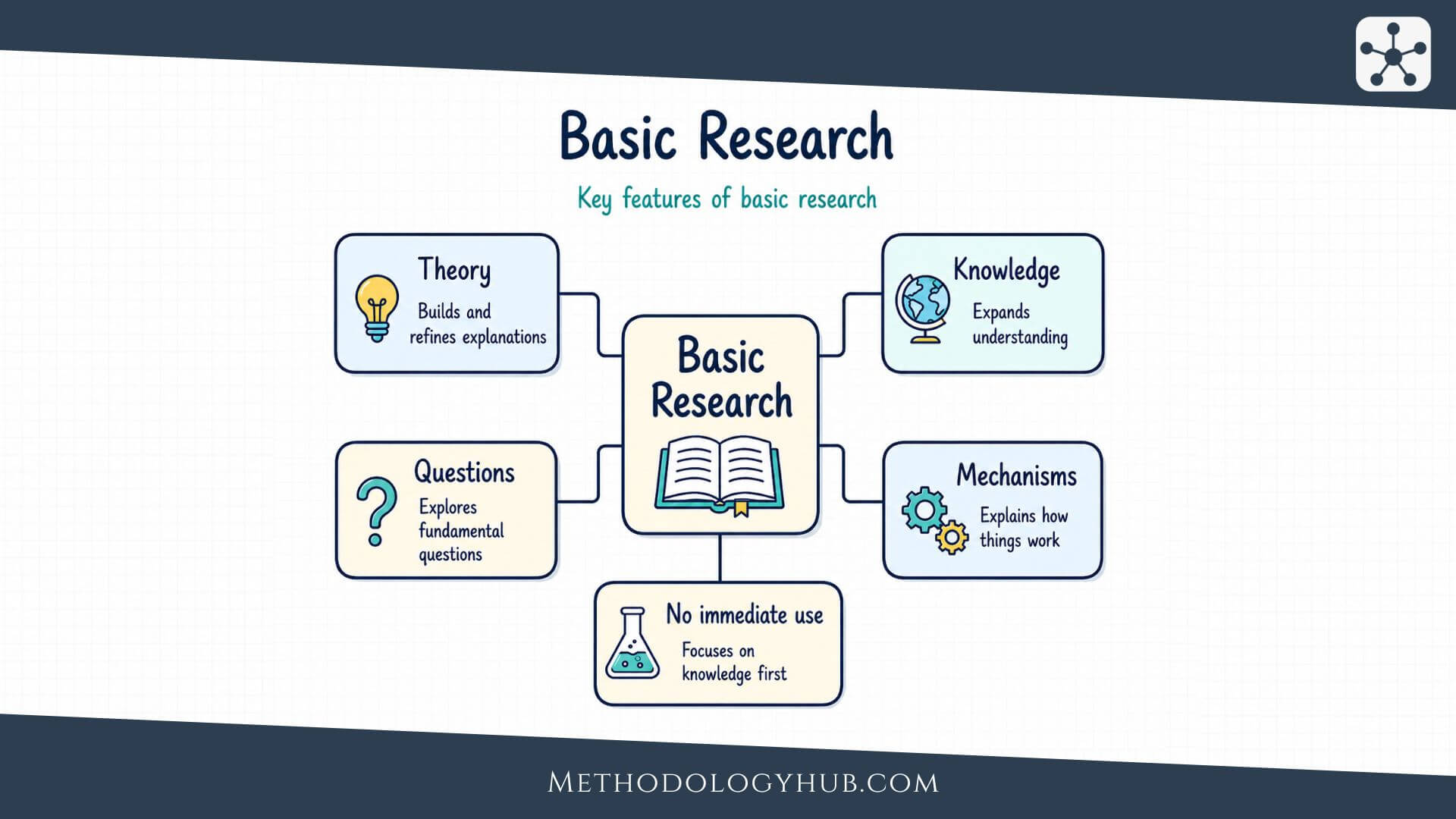
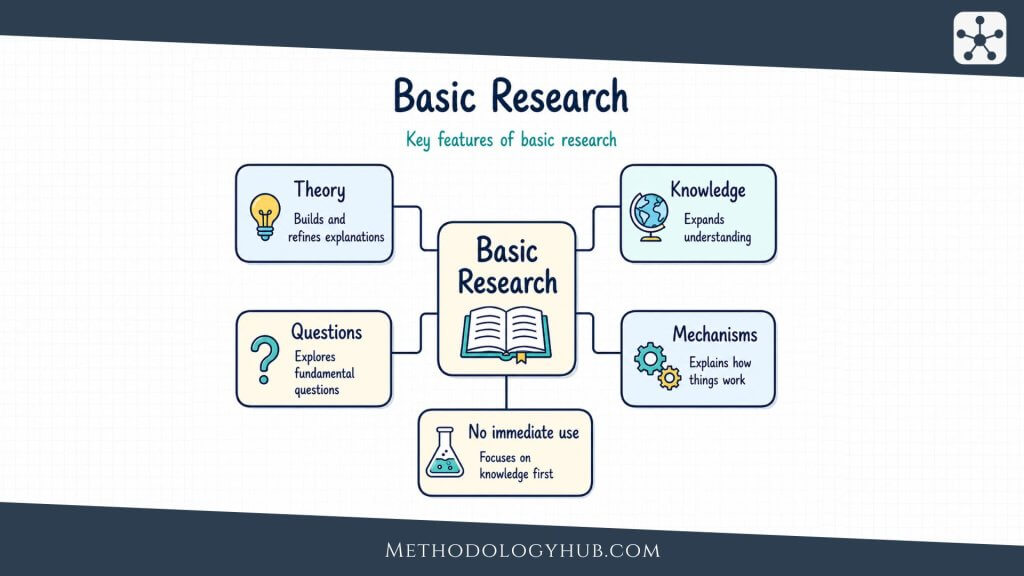
Basic research usually adds one of three things. It may sharpen a concept, such as motivation, identity, attention, resilience, or social trust. It may test or improve a theory, such as a theory of learning, memory, language change, or group behaviour. It may explain a mechanism, such as how a biological process, cognitive process, physical process, or social process operates.
Because of this, the result is often written in careful language. A basic research study may not say, “This programme should now be used in every school.” It may say that a model explains one part of learning better than another model, or that a relationship appears under some conditions but not under others. That kind of conclusion may look modest, but it gives later researchers a stronger base for asking more focused questions.
Objectives of Basic Research
The objectives of basic research are tied to understanding. A researcher may want to clarify what a concept means, explain how a process unfolds, test whether a theory fits the evidence, or identify relationships that were not previously known. These objectives are often less immediate than those in applied studies, but they still need clear planning.
Basic research is sometimes described too loosely as research done “for knowledge alone.” That phrase can be useful, but it can also hide the actual work. Strong basic research does not simply collect interesting facts. It connects a topic to a problem in knowledge. Something is unclear, inconsistent, underexplained, poorly measured, or theoretically incomplete. The study is designed to reduce that uncertainty.
Developing concepts
Many basic studies begin because a concept is used often but understood unevenly. In education, a researcher may notice that students, teachers, and articles use the word engagement in different ways. Some mean attendance, some mean participation, some mean interest, and some mean persistence. A basic research project could examine how the concept is structured and which dimensions should be separated before measurement begins.
This type of work is especially useful before a researcher writes a research question or develops an instrument. If a concept is unclear, the data collected about it may also be unclear. Basic research helps by giving later studies cleaner language and stronger categories.
Building and testing theory
Theories organise explanations. They suggest which ideas belong together, which relationships should be expected, and which patterns would be surprising. Basic research can build theory by proposing a new explanation, or it can test theory by asking whether the explanation fits observations, texts, measurements, or cases.
For example, a researcher may test whether a theory of motivation explains how students choose difficult tasks. Another researcher may compare two theories of language learning using classroom recordings. A third may use mathematical modelling to examine whether a theory produces stable predictions. The study may not tell a school what policy to adopt tomorrow. It can still improve the field’s explanation of learning.
Explaining mechanisms and relationships
Basic research often looks beneath an observed pattern. A descriptive study might show that two variables are associated. A basic research project may ask what process could explain that association. Does one variable influence another? Is a third factor involved? Does the relationship appear only in certain settings or time periods?
This is where basic research can connect with explanatory research. The purpose is still knowledge-building, but the objective is explanation. A study of memory, for instance, may not stop at reporting that sleep and recall are related. It may ask which stage of sleep seems connected to the change and which theory best accounts for the result.
Plain reading: basic research is strongest when it names the knowledge problem clearly. The project should show what is not yet understood and how the study will make that part clearer.
Preparing ground for later studies
Basic research can also prepare later work. A study may identify variables that should be measured, propose categories for future observation, test a laboratory procedure, or clarify the assumptions behind a model. In this sense, basic research often sits early in a chain of studies, but it may also appear later when a field discovers that its existing explanations are too thin.
This connection is visible in many fields. Before an intervention can be tested, researchers may need to understand the process the intervention targets. Before a questionnaire can be trusted, researchers may need to know what dimensions the concept contains. Before a large survey research project is useful, basic work may be needed to define the categories used in the survey.
Key Aspects of Basic Research
The key aspects of basic research are easier to understand when the study is viewed as one connected design. The researcher starts with a gap in understanding, turns that gap into a question, chooses a way to gather or examine evidence, and then explains what the findings add to the field. The study may be abstract, but the design should still be precise.
Basic research does not mean unstructured research. A project can be highly theoretical and still have clear concepts, evidence, reasoning, and limits. It can also be empirical and still remain basic if the main contribution is explanation rather than immediate use.
The research question is conceptual or explanatory
A basic research question usually asks about meaning, structure, relationship, process, mechanism, or theory. It may ask how a concept should be defined, how two variables relate, whether a model fits observed data, or what process explains a pattern.
For example, a basic research question in education might ask how learners mentally organise examples when forming a new concept. A question in biology might ask how a cell pathway responds to a change in environmental conditions. A question in sociology might ask how group norms form when people have little previous contact. These questions could later support applied projects, but they first seek an explanation.
The study often works closely with theory
Theory is not decoration in basic research. It shapes the question, the concepts, the comparison, and the interpretation. Sometimes the theory is already established and the researcher tests it in a new way. Sometimes the theory is incomplete and the researcher tries to refine it. Sometimes two theories give different expectations, and the study compares how well each one fits the evidence.
Theories can be connected to many forms of evidence. A basic study may use empirical research when it collects observations or measurements. It may use theoretical argument when it examines assumptions, concepts, or models. It may combine both. What makes it basic is the kind of contribution the study claims.
Basic research can use many designs
There is no single basic research method. A researcher may use an experimental research design to test a causal mechanism under controlled conditions. Another may use case study research to understand a rare process in depth. Another may use correlational research to examine how variables move together, or comparative research to see how a concept appears across settings.
The timeframe can also vary. A cross-sectional research design may capture a process at one point in time. A longitudinal research design may follow change across several points. Both can be basic if the study’s first purpose is to understand the phenomenon rather than to evaluate a programme or fix a local problem.
Evidence and interpretation must stay aligned
Basic research often produces cautious conclusions because the design places limits on what can be claimed. A laboratory experiment may support a statement about a mechanism under controlled conditions, but it may not show how the mechanism appears in every real-world setting. A qualitative interview study may deepen understanding of a process, but it may not estimate how often that process appears in a population.
This is why the research data, method, and conclusion need to match. If the study measures variables in research, the researcher should explain how the variables represent the concepts. If the study uses textual or interview evidence, the researcher should show how interpretation was developed. If the study uses statistical analysis, the statistical claim should return to the original theoretical question.
This check keeps the design from becoming abstract in the wrong way. Even when a study is theoretical, the reader should still see the path from question to evidence and from evidence to interpretation.
Basic vs Applied Research
Basic and applied research are both systematic forms of inquiry, but they begin from different purposes. Basic research asks for deeper understanding. Applied research asks how research can address a defined practical problem. The distinction is useful, but it should not be treated as a wall between two separate worlds.
In many fields, the two connect over time. A basic study may explain a process, and an applied study may later test how that knowledge can be used in a school, clinic, court, museum, library, or public service setting. At the same time, applied problems can raise new basic questions when practical work reveals that a concept or mechanism is not well understood.
Main difference between basic and applied research
The main difference is the first intention of the study. Basic research is designed around knowledge development. Applied research is designed around a practical problem. A basic study of reading may examine how working memory and vocabulary interact during comprehension. An applied study may test whether a specific reading support programme improves comprehension scores in a particular group of learners.
Both studies can be rigorous. Both can use careful measurement, transparent sampling, and strong analysis. The difference is not that one is academic and the other is less academic. The difference is the question the study is organised to answer.
| Aspect | Basic research | Applied research |
|---|---|---|
| Main purpose | Develop knowledge, concepts, theory, or explanation. | Address a specific practical problem. |
| Starting point | A gap in understanding or explanation. | A practical issue in a setting or population. |
| Typical question | How does this process work? | Which approach helps with this problem? |
| First audience | Researchers, students, theorists, and readers building knowledge in the field. | Researchers and practitioners working with a defined problem. |
| Result | A clearer concept, theory, mechanism, or explanation. | Evidence for a decision, intervention, policy, programme, or practice. |
How basic and applied research connect
The connection between basic and applied research is often gradual. A basic study may explain how people remember information. Later, an applied study may use that knowledge to design a learning activity. Another study may then evaluate whether that activity works in a particular classroom. The chain is not always straight, and not every basic finding becomes an application, but the relationship is still real.
The reverse can also happen. A practical problem may reveal that the underlying theory is weak. For example, an education programme may work for one group but not another. That applied finding can send researchers back to basic questions about attention, language, motivation, prior knowledge, or context.
Basic research and use-inspired research
Some studies sit between the two categories. They are driven by a deep knowledge question while also being aware of a possible long-term use. A researcher may study a biological mechanism because it is scientifically interesting and because it could eventually inform medical research. Another may study language development because the theory is incomplete and because the findings may later support children with reading difficulties.
In such cases, the label depends on how the study is framed. If the design is organised mainly around understanding the mechanism, it is closer to basic research. If it is organised mainly around solving a defined practical problem, it is closer to applied research. Clear writing should explain the purpose rather than relying on the label alone.
How to Perform Basic Research
Performing basic research means turning a knowledge problem into a study that can be examined with appropriate evidence and reasoning. The process is not always linear. Researchers often move back and forth between literature, concepts, theory, design, and interpretation. Still, a clear sequence helps students plan the work.
The steps below are written for academic projects, including coursework, thesis planning, and early research proposals. A large funded project may include more formal stages, but the underlying logic is similar.
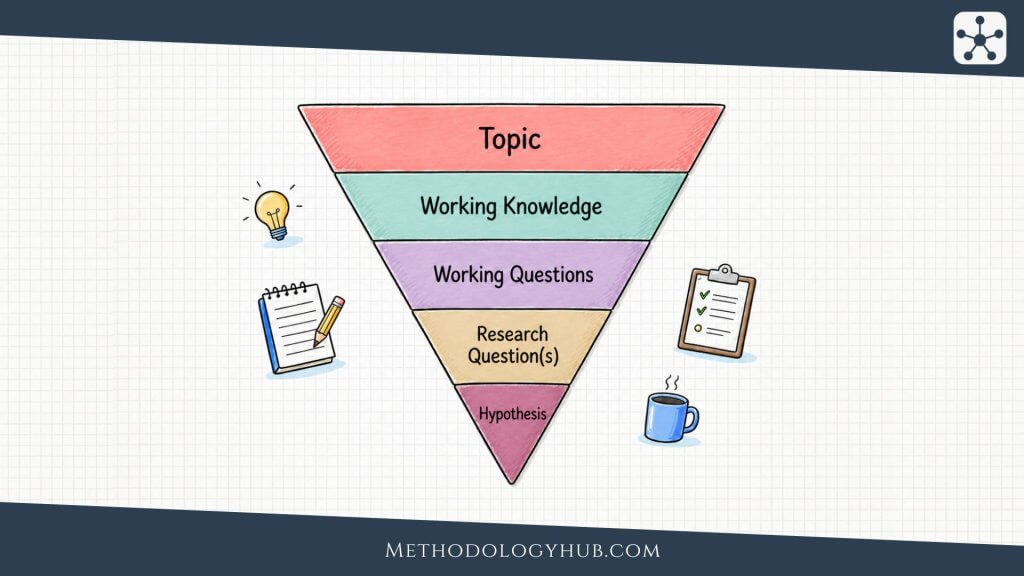
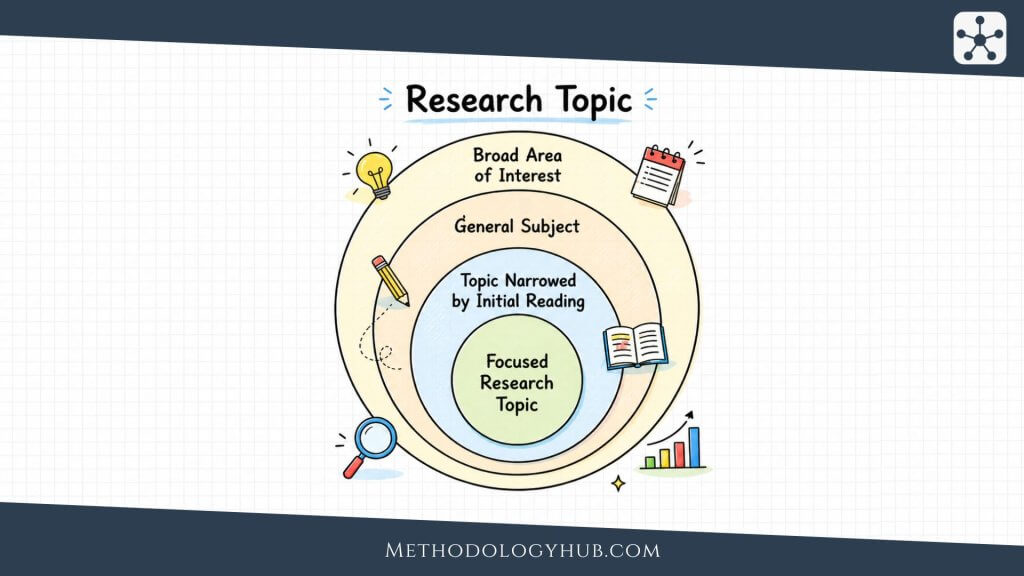
Step 1: Choose and narrow the research topic
A basic research project begins with a research topic, but the topic must be narrowed before it can become a study. “Learning” is too broad. “How students form misconceptions in introductory physics” is closer to a researchable area. “How first-year students revise an incorrect physics concept after contrasting examples” is narrower still.
Narrowing does not make the study less ambitious. It makes the study possible. Basic research often needs precision because small differences in concepts can change the whole interpretation. The researcher should ask which part of the topic is unclear and what kind of explanation would count as progress.
Step 2: Review the literature around the knowledge gap
The literature review should do more than collect previous studies. It should show where understanding is incomplete. Perhaps previous studies disagree. Perhaps a theory explains one setting but not another. Perhaps a concept is measured in several inconsistent ways. Perhaps an older model has not been tested with newer data.
This stage helps the researcher avoid repeating what is already known. It also helps the researcher decide whether the study should be exploratory research, descriptive research, explanatory research, or some combination. The objective should match the current state of the field.
Step 3: Write the research question and, when suitable, a hypothesis
The question should express the knowledge gap directly. A basic research question may ask how a process works, how a concept is structured, how two variables relate, or whether a theory explains evidence. If the study is quantitative or theory-testing, the researcher may also write a research hypothesis.
For example, a question might ask: How do learners revise an incorrect concept after receiving two contrasting examples? A related hypothesis might predict that learners who compare examples will show stronger conceptual change than learners who study each example separately. The question gives the study direction. The hypothesis gives a testable expectation.
Step 4: Select a design and method
The design should follow the question. If the question asks about causal mechanisms under controlled conditions, an experiment may fit. If it asks about concept formation in a real classroom, observation, interviews, or a small case study may fit better. If it asks about relationships between measured variables, a correlational or statistical design may be suitable. If it asks about assumptions inside a theory, theoretical analysis may be the right path.
Some basic research uses one method. Other projects use mixed methods research, especially when the researcher needs both numerical pattern and interpretive depth. A study of scientific reasoning, for example, might combine test scores with written explanations from students. The method should not be chosen because it sounds advanced. It should fit the question.
Step 5: Collect or construct the evidence
In empirical basic research, evidence may come from experiments, observations, interviews, texts, records, simulations, or measurements. In theoretical basic research, evidence may come from arguments, models, definitions, examples, and logical comparison. In both cases, the researcher should show how the evidence connects to the concept or theory being studied.
Sampling also needs attention. A basic research study does not always need a large representative sample, especially if the aim is conceptual depth or theory development. Still, the sample, cases, texts, or observations must make sense for the question. A study cannot support a broad explanation if the evidence is too narrow for that claim.
Step 6: Analyse the data or argument
Analysis in basic research should return to the knowledge problem. If the study uses statistical methods, the researcher may compare groups, estimate relationships, or test model predictions. If the study uses qualitative material, the researcher may analyse patterns, meanings, categories, or processes. If the study is theoretical, the researcher may compare assumptions and show which explanation is more coherent.
The analysis should not stop at description unless description is the objective. A basic research project usually needs to explain what the findings mean for the concept, theory, or mechanism. The reader should be able to see how the study moves the field from a less clear position to a clearer one.
Step 7: Report the contribution carefully
The final report should state the contribution in plain terms. Did the study refine a concept? Did it support one theory more than another? Did it identify a mechanism? Did it show that a relationship depends on context? Did it suggest a new way to measure a variable?
Careful reporting also means naming limits. A study may explain one process in one setting, with one group, under one set of assumptions. That does not make the study weak. It makes the contribution visible and honest. Later research can then test whether the explanation travels to other settings, populations, or methods.
Examples of Basic Research
Examples of basic research can come from almost any academic field. The form of the study changes, but the purpose remains similar: to develop knowledge, concepts, theory, or explanation. The examples below are written as research situations rather than as slogans, because the purpose becomes clearer when the question, evidence, and contribution are seen together.
Example from education
An education researcher studies how students revise misconceptions in science. The researcher is not testing a school policy or comparing two full curriculum programmes. Instead, the study examines how learners respond when they see examples that conflict with their first belief. Data may include written explanations, response times, and pre-test and post-test answers.
The basic contribution would be a clearer explanation of conceptual change. The study may show, for example, that students do not simply replace one idea with another. They may hold both ideas at once for a period, using the new explanation only in certain question types. That finding can later inform classroom practice, but the study itself is mainly about understanding learning.
Example from psychology
A psychology researcher studies how attention changes when people switch between tasks. Participants may complete a controlled experiment in which they respond to visual cues. The researcher measures response time, accuracy, and the conditions under which performance changes.
The project is basic research if the aim is to explain attention and task switching rather than to design a specific workplace training programme. The finding might refine a theory of cognitive control by showing which conditions make switching easier or harder. Later applied studies may use that knowledge, but the first contribution is theoretical.
Example from biology
A biology researcher investigates how a cell signalling pathway responds when a particular protein is blocked. The study may use laboratory experiments, imaging, and molecular measurements. The question is not yet whether a treatment should be used in patients. The first question is how the pathway behaves.
This kind of basic research can be highly technical, but the logic is simple. A mechanism is not fully understood, so the study examines its parts and relationships. If the mechanism becomes clearer, later research may ask whether it can be connected to diagnosis, prevention, or treatment. Those later studies may be applied, translational, or clinical, depending on their purpose.
Example from sociology
A sociologist studies how trust develops in newly formed groups. The researcher may observe group discussions, analyse interaction patterns, and interview participants about how they decide whether another person is reliable. The aim is not to evaluate a specific organisation. The aim is to understand a social process.
The basic contribution might be a refined model of trust formation. The study may show that trust develops through repeated small confirmations rather than through one large event. It may also show that different kinds of trust appear at different stages of group interaction. Such findings can later support applied work in education, community research, or organisational settings, but the first output is conceptual and explanatory.
Example from language research
A language researcher studies how bilingual children choose grammatical structures when speaking in different contexts. The researcher may record speech, code sentence patterns, and compare those patterns across age groups or language environments. The study is basic if it asks how language development works rather than how to design one teaching programme.
The result may refine a theory of language acquisition. It may show that children do not simply transfer structures from one language to another in a fixed way. Instead, the pattern may depend on the topic, speaker, setting, and amount of exposure. The value of the study lies in the clearer explanation.
Example from mathematics or physics
Basic research can also be abstract. A mathematician may develop a proof that extends a theorem. A physicist may test predictions from a model of particle behaviour. These studies may not involve participants, interviews, or survey data. They still follow systematic reasoning and aim to deepen knowledge.
In these fields, basic research often works with formal models, equations, simulations, or carefully controlled observations. The contribution may be a new proof, a refined model, a better explanation of a physical process, or evidence that a prediction holds under specific conditions.
Basic Research in a Research Plan
In a research plan, basic research should not be presented as a vague interest in knowledge. It should be written as a clear design. The reader should see the topic, the gap, the question, the concepts, the method, the evidence, and the expected contribution. This is especially useful in student proposals, where the label basic research can otherwise remain too general.
Writing the purpose statement
The purpose statement should tell the reader what the study seeks to understand. A weak version would say, “This study is about motivation.” A stronger version would say, “This study examines how students describe the shift from external pressure to self-directed study in the first semester of university.” The second version gives the concept, process, setting, and direction.
The statement does not need to promise a practical solution. It should promise a researchable contribution to understanding. If a practical connection exists, it can be mentioned later, but it should not replace the knowledge aim.
Linking the question to data and analysis
The question should point naturally toward data and analysis. A question about meaning may need interviews, documents, observations, or qualitative analysis. A question about relationships between variables may need measurement and statistical methods. A question about change may need repeated observations rather than a single snapshot.
This alignment protects the study from overclaiming. For example, if the researcher collects interview data from a small purposive sample, the study may provide depth about how participants understand a process. It should not be written as if it estimates how common that process is in a full population. If the researcher uses a large survey, the study may estimate patterns more clearly, but it may need additional evidence before explaining meaning in depth.
Positioning the study among other research types
A methods section can describe basic research alongside other labels. A study may be basic by purpose, explanatory by objective, quantitative by methodology, non-experimental by design, and cross-sectional by timeframe. Another may be basic by purpose, exploratory by objective, qualitative by methodology, and case-study based by design.
This layered wording helps readers understand the study without treating one label as the whole design. It also makes the project easier to compare with non-experimental research, quasi-experimental research, and other designs that answer different methodological questions.
Describing the expected contribution
The expected contribution should be specific. Instead of saying that the study will add to knowledge, the proposal should say what kind of knowledge it may add. It may refine a concept, compare explanations, identify a mechanism, clarify a relationship, improve a model, or generate a framework for later research.
This wording also makes the conclusion easier to write. At the end of the study, the researcher can return to the same contribution and state what the evidence showed. The report then has a clear line from purpose to question, from question to method, and from method to interpretation.
Conclusion
Basic research is the part of research that works closest to understanding. It asks how concepts are structured, how theories can be improved, how relationships appear, and how mechanisms operate. It may not begin with an immediate practical problem, but it can still shape later applied, action, evaluation, experimental, theoretical, and empirical studies.
The clearest way to recognise basic research is to look at the first purpose of the study. If the study is organised mainly to build knowledge, clarify explanation, refine theory, or understand a process, it is basic research. The method may be quantitative, qualitative, mixed, theoretical, experimental, or observational. The purpose is what gives the label its meaning.
For students, the safest approach is to write the study in layers. State that the project is basic by purpose, then explain its objective, methodology, design, data, and timeframe. This keeps the article, proposal, or thesis from sounding like a list of labels and helps the reader see how the whole design fits together.
FAQs on Basic Research
What is basic research?
Basic research is systematic inquiry carried out to develop knowledge, concepts, theories, or explanations. It is mainly concerned with understanding how something works rather than solving one immediate practical problem.
What is the main objective of basic research?
The main objective of basic research is to improve understanding. A study may refine a concept, test a theory, explain a mechanism, identify a relationship, or prepare stronger foundations for later research.
What is the difference between basic and applied research?
Basic research aims to build knowledge and explanation. Applied research uses research methods to address a specific practical problem. The two can connect over time, but they begin from different purposes.
Can basic research use experiments?
Yes. Basic research can use experimental designs when the researcher wants to study a mechanism, relationship, or theory under controlled conditions. It can also use surveys, interviews, observations, case studies, statistical analysis, simulations, or theoretical reasoning.