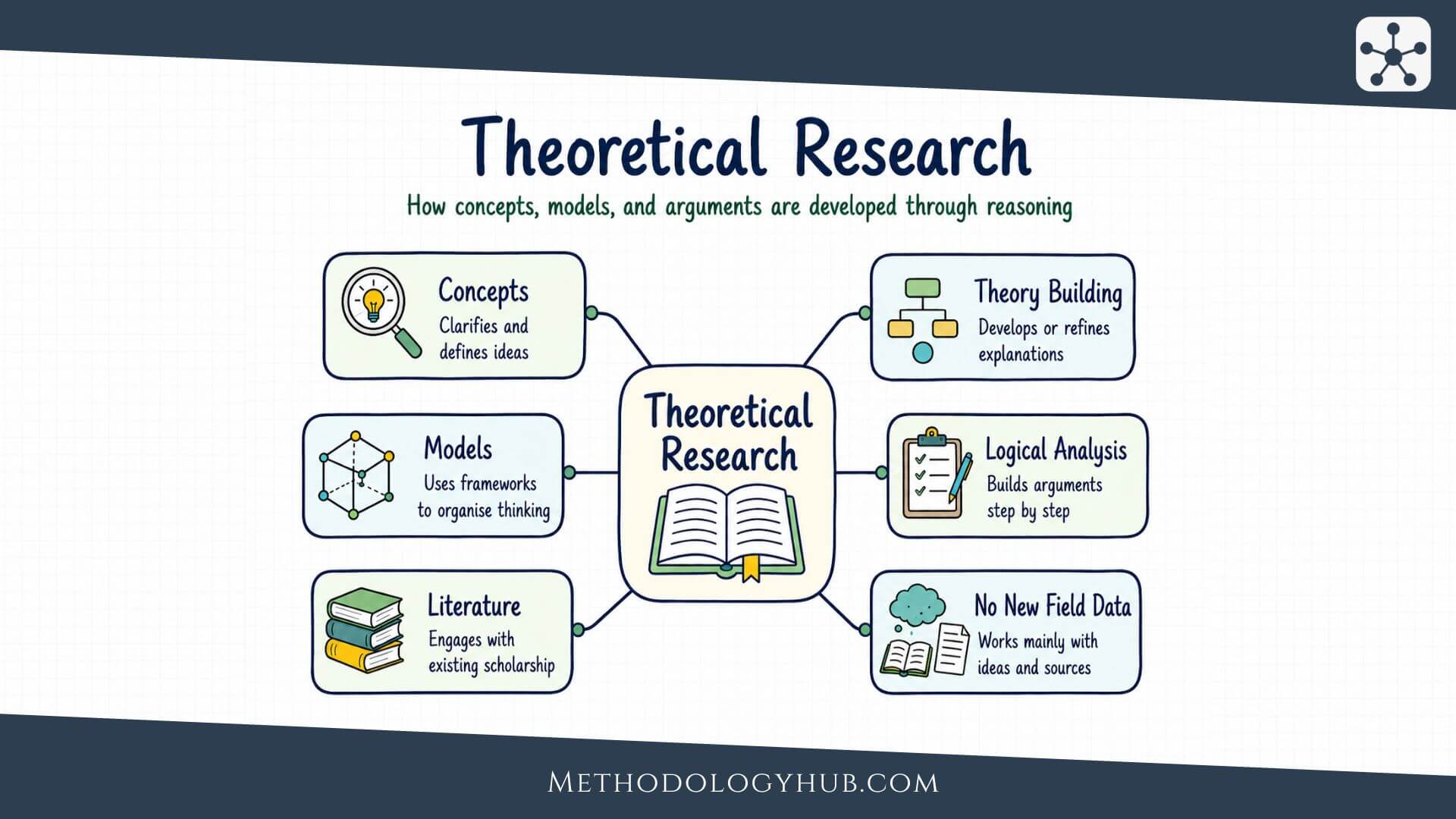
Theoretical research is a type of research that develops knowledge through concepts, models, arguments, and existing literature rather than through the collection of new observational or experimental data. It is used when a researcher wants to clarify an idea, build a theory, compare explanations, refine assumptions, or create a framework that later studies can use.
This article explains what theoretical research is, how it differs from empirical research, which objectives it serves, which methods are often used, and how a theoretical study can be planned. The focus is on research logic rather than technical language, because theoretical work should be understandable even when it deals with complex ideas.
What Is Theoretical Research?
Theoretical research is research that works mainly with ideas. Instead of beginning with a survey, interview, laboratory experiment, or field observation, the researcher begins with concepts, assumptions, theories, models, texts, or earlier findings. The aim is to reason carefully about how those ideas fit together and what they allow us to understand.
This does not mean theoretical research is detached from reality. A theory of learning, for example, may help explain why feedback affects revision. A theory of social trust may help researchers understand cooperation in schools, communities, or public institutions. A mathematical model of population change may help researchers think about processes that are difficult to observe directly. The difference is that the new contribution comes mainly from reasoning, not from newly collected data.
Theoretical research definition
Theoretical research is a type of research that develops, analyses, compares, or refines theories and concepts through systematic reasoning. It may draw on existing studies, but it does not usually produce its main findings by collecting new research data. Its strength depends on the clarity of the argument, the fit between concepts, and the way the researcher handles assumptions and previous literature.
A theoretical study may ask whether a concept is being used too broadly, whether two explanations can be combined, whether a model has hidden assumptions, or whether a field needs a new framework. These questions are research questions even when they are not answered with a dataset. They still require a method of reading, comparison, reasoning, and justification.
How theoretical research works in academic study
In academic work, theoretical research often sits between existing knowledge and future investigation. It may take findings from several empirical studies and ask what they suggest together. It may examine a concept that appears in many articles but is defined differently each time. It may also build a model that turns a broad idea into a more precise structure.
For example, imagine a researcher studying academic motivation. Empirical studies may already show links between feedback, confidence, classroom climate, and persistence. A theoretical study could examine how these ideas relate to each other. It might argue that feedback affects motivation only when students interpret it as usable and fair. That argument could then guide a later empirical research project.
What theoretical research produces
The product of theoretical research is not a table of new survey results or a transcript of interviews. It is usually a clearer concept, a revised theory, a new framework, a set of propositions, a model, a typology, or a more precise way of interpreting earlier findings. A theoretical article may end by suggesting hypotheses, research designs, or concepts for later studies.
This kind of output can be practical for researchers because it gives direction. If a concept is unclear, data collection may become confused. If a theory contains assumptions that are never stated, results may be interpreted too quickly. A theoretical study slows down that process and asks whether the ideas behind the research are strong enough to carry the interpretation.
Objectives of Theoretical Research
The objectives of theoretical research depend on the state of knowledge in a field. Sometimes the field has many findings but no clear explanation. Sometimes researchers use the same term in different ways. Sometimes a theory works in one setting but becomes unclear when it is applied elsewhere. Theoretical research helps by organising these problems into a sharper argument.
Unlike a study that asks how many people gave a certain answer or whether two variables are associated, theoretical research often asks what a concept means, how an explanation is built, and what assumptions must be accepted for a claim to make sense. These questions can look abstract at first, but they shape how later studies are designed.
Clarifying concepts
One common objective is concept clarification. Many research terms are familiar but still difficult to use precisely. Words such as resilience, engagement, identity, wellbeing, motivation, literacy, trust, or inclusion can carry different meanings across studies. A theoretical paper may examine those meanings and propose a clearer definition.
This work is useful before choosing variables in research or designing an instrument. If a researcher wants to measure engagement, for example, it is not enough to say that engagement is important. The researcher must decide whether engagement means attendance, attention, emotional interest, participation, effort, or a combination of these. Theoretical research can make that decision more careful.
Building or extending theory
Another objective is theory building. A theory explains how concepts relate to each other. It may describe a process, a mechanism, a set of conditions, or a pattern of relationships. Theoretical research can build a new theory when existing explanations are scattered, or it can extend an existing theory to a new context.
For example, a theory of classroom feedback may begin with the idea that feedback improves learning by showing students what to change. A theoretical researcher might extend that theory by adding interpretation: students respond not only to the content of feedback, but also to whether they trust the source, understand the criteria, and believe revision is possible. The theory becomes more detailed because the reasoning has been expanded.
Comparing explanations
Theoretical research can also compare explanations. Two theories may describe the same situation in different ways. One may explain academic persistence through individual motivation. Another may explain it through institutional support, expectations, and access to resources. A theoretical study can place these explanations beside each other and ask where they agree, where they differ, and whether they can be combined.
The point is not always to choose one winner. Sometimes the strongest result is a clearer map of the disagreement. A researcher may show that two theories use the same words but mean different things, or that they explain different parts of the same process. This kind of comparison helps readers see what each explanation can and cannot do.
Plain reading: theoretical research often improves a field by making its ideas cleaner, its assumptions clearer, and its explanations easier to examine.
Developing propositions and hypotheses
A theoretical study may not test a hypothesis itself, but it can prepare the ground for one. After comparing concepts and building an argument, the researcher may propose statements that can later be examined with empirical data. These statements may describe expected relationships, conditions, processes, or differences between cases.
For instance, a theoretical study on student feedback might propose that feedback is more likely to support revision when students see it as specific, understandable, and connected to assessment criteria. A later empirical study could turn that proposition into a research hypothesis, collect data, and test whether the pattern appears in a particular setting.
Organising existing findings
Some theoretical research begins with a large body of empirical results. Instead of collecting more data, the researcher asks how existing findings can be understood together. This may involve grouping studies by their assumptions, identifying different uses of a concept, or showing that several findings point toward a shared explanation.
This objective is different from simply summarising articles one by one. Theoretical work should add a structure. It should show how the pieces relate, where the gaps in reasoning appear, and what kind of conceptual model could help future studies move forward.
Key Aspects of Theoretical Research
Theoretical research is easier to understand when its parts are seen as one chain of reasoning. The researcher begins with a problem in ideas: a concept is unclear, a theory is incomplete, several explanations conflict, or existing findings are hard to connect. The study then works through literature, assumptions, definitions, and argument until a clearer position is reached.
This process should not feel like opinion writing. A good theoretical study is disciplined. It explains why the problem is worth studying, which concepts are being used, which sources are being read, and how the argument moves from one step to the next. The reader should be able to follow the reasoning even if they do not agree with every conclusion.
Concepts and definitions
Concepts are the building blocks of theoretical research. A concept names an idea that the researcher wants to examine, such as social capital, cognitive load, academic confidence, identity formation, or institutional trust. The problem is that concepts can become too broad if they are used without clear boundaries.
A theoretical study should explain how a concept is defined and how that definition differs from nearby ideas. If a paper discusses academic confidence, for example, it may need to separate confidence from self-esteem, prior achievement, motivation, and classroom belonging. These ideas may be connected, but they should not be treated as if they are identical.
Assumptions
Every theory contains assumptions. Some are obvious, but many are hidden. A theory may assume that people act rationally, that behaviour is shaped mainly by context, that language shapes experience, or that systems tend toward balance. These assumptions affect what the theory can explain.
Theoretical research becomes stronger when assumptions are stated rather than left in the background. A reader can then ask whether those assumptions are reasonable for the topic. A theory that works for adult learners in a university may not work in the same way for younger pupils in a school. The assumption about learners, setting, and agency needs to be visible.
Literature as material for reasoning
In theoretical research, literature is not only background. It is often the main material of the study. The researcher reads earlier theories, concepts, models, and findings to identify patterns in reasoning. This can include classic texts, recent articles, empirical studies, methodological discussions, and conceptual papers.
The literature should be selected deliberately. A theoretical paper does not need to cite every text that uses a term, but it should show why the chosen texts are relevant. If the study compares two theories, the reader should know why those theories were chosen and how they are being compared. If the study builds a framework, the reader should see which ideas were included and which were left outside the scope.
Argument and coherence
The central method of theoretical research is argument. An argument connects claims in a way that can be followed and examined. It may begin by showing that a concept is used inconsistently, then propose a clearer definition, then show how that definition changes the interpretation of earlier findings.
Coherence means that the parts of the argument fit together. The definition should match the model. The model should match the assumptions. The conclusion should not claim more than the reasoning supports. This is similar to alignment in empirical research, where the question, design, data, and analysis need to point in the same direction.
| Aspect | What the researcher does | What the reader should see |
|---|---|---|
| Concepts | Defines and separates central ideas | Clear meanings and boundaries |
| Assumptions | States what the argument depends on | A basis that can be questioned |
| Literature | Uses earlier work as material for analysis | Relevant sources and selection logic |
| Argument | Connects claims step by step | A conclusion that follows from the reasoning |
| Scope | Shows where the theory applies | A realistic range for interpretation |
Scope and boundaries
Theoretical research should say how far its argument is meant to travel. A framework built for classroom learning may not explain workplace training, family learning, or informal peer learning without adjustment. A model developed for small groups may not work at the level of institutions or national systems.
Boundaries do not weaken theoretical work. They make it easier to use. When a researcher says which setting, population, discipline, period, or level of analysis is being addressed, readers can judge whether the theory fits their own question.
Theoretical vs Empirical Research
Theoretical research is often compared with empirical research because both are major sources of academic knowledge. The difference lies in the source of the main contribution. Empirical research builds its answer from observed, measured, collected, or documented evidence. Theoretical research builds its answer from reasoning about concepts, theories, models, and previous work.
The two are not enemies. Many strong research fields move between them. Theory guides what researchers observe, measure, and compare. Empirical findings can support a theory, challenge it, narrow it, or show that it needs revision. The distinction is useful because it helps readers understand how a study reaches its conclusion.
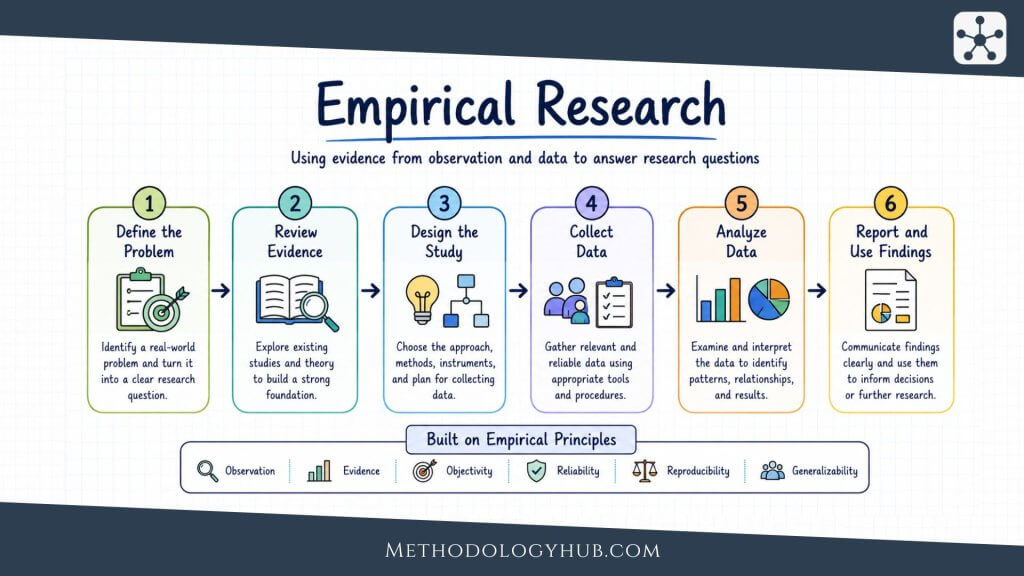
How the source of knowledge differs
In empirical research, the reader expects to see a method for collecting or selecting evidence. This could include participants, documents, measurements, observations, test scores, interviews, or records. The study explains how the evidence was gathered and analysed.
In theoretical research, the reader expects a method for handling ideas. The study explains which literature is used, which concepts are central, how theories are compared, and how the argument is developed. The evidence is not a new dataset, but the reasoning still needs a clear path.
How theoretical and empirical work connect
A theoretical article may create the concepts that an empirical project later measures. An empirical project may produce findings that force researchers to change a theory. A field becomes stronger when these movements are explicit. If researchers collect data without theory, the results may become hard to interpret. If researchers build theory without checking whether it can guide observation, the argument may become too detached from research practice.
For example, a theoretical framework about academic belonging might propose that belonging depends on recognition, participation, and trust. A later qualitative research project could interview students about these experiences. A quantitative research project could develop a scale and examine relationships with attendance or achievement. A mixed methods research project could combine both approaches.
| Aspect | Theoretical research | Empirical research |
|---|---|---|
| Main material | Concepts, theories, models, literature | Observed, measured, collected, or documented data |
| Main question | How should ideas be defined, connected, or revised? | What does the evidence show in a setting, sample, case, or dataset? |
| Common output | Framework, typology, model, proposition, critique | Findings, estimates, themes, comparisons, test results |
| Quality depends on | Clarity, coherence, assumptions, source selection | Design, sampling, measurement, analysis, interpretation |
Theoretical research and basic research
Theoretical research is also connected to basic research. Basic research aims to expand knowledge, and theoretical research often does this by improving concepts and explanations. Still, the two terms are not identical. A basic study can be empirical if it collects new data to understand a process. A theoretical study can be basic when it develops knowledge without an immediate practical application.
The labels describe different parts of a study. Basic research describes the purpose. Theoretical research describes the source of knowledge and reasoning. A project can be both, but the terms should not be used as if they mean exactly the same thing.
Theoretical Research Methods
Theoretical research methods are ways of working with ideas in a systematic manner. They do not all look the same. Some theoretical studies analyse a concept. Some build a model. Some compare theories. Others use formal reasoning, thought experiments, or literature-based synthesis. The right method depends on the research question.
Because theoretical work does not usually have participants, instruments, or field procedures, students sometimes assume that it has no method. That is a misunderstanding. The method is found in how the researcher selects sources, defines terms, compares ideas, develops claims, and checks whether the argument is coherent.
Conceptual analysis
Conceptual analysis examines the meaning and use of a concept. The researcher may trace how a term appears in different studies, identify overlapping meanings, separate related concepts, and propose a more precise definition. This method is useful when a field uses an important word without enough agreement about what it means.
A conceptual analysis of academic engagement, for example, might compare definitions from education, psychology, and sociology. It could show that some authors focus on behaviour, others on emotion, and others on cognitive effort. The final contribution might be a three-part definition that helps later researchers design better measures.
Theory building
Theory building develops an explanation by connecting concepts. The researcher may begin with a problem that existing theories do not fully explain. They then propose relationships between concepts and describe the conditions under which those relationships are expected to appear.
This method works best when the researcher is clear about the level of analysis. A theory may explain individual decisions, classroom interaction, group behaviour, institutional rules, or social change. Problems appear when a theory developed for one level is used at another level without explanation.
Model development
Model development creates a simplified representation of a process, relationship, or system. A model may be verbal, visual, mathematical, computational, or diagrammatic. The purpose is to make the structure of the argument easier to examine.
A model of reading development, for instance, may connect vocabulary, background knowledge, decoding, motivation, and text difficulty. The model does not include every detail of a classroom. Instead, it shows which parts of the process are central to the explanation and how they are expected to interact.
Formal or mathematical modelling
Some theoretical research uses formal or mathematical modelling. This approach is common in fields such as economics, biology, computer science, physics, statistics, and parts of psychology. The researcher expresses assumptions in formal terms and then studies what follows from them.
A formal model can be useful when a process is complex, when direct observation is difficult, or when the researcher wants to examine possible outcomes under different assumptions. The model does not need to be realistic in every detail. Its value depends on whether the simplification helps answer the question and whether the assumptions are stated plainly.
Literature-based synthesis
Literature-based synthesis uses existing studies to build a conceptual or theoretical argument. It may draw on empirical findings, theoretical papers, and methodological discussions. The goal is not only to report what each source says, but to create a structure that makes the field easier to understand.
This approach can be close to review writing, but it is not the same as listing article summaries. A theoretical synthesis should have an argument. It may show that a field has three competing definitions, that findings make better sense under one framework than another, or that a new typology is needed.
Critical comparison
Critical comparison examines two or more theories, concepts, or frameworks. The researcher may compare their assumptions, scope, explanatory strength, limitations, and implications for future study. This method is useful when a field contains several explanations that are often used separately.
A critical comparison should be fair. It should not turn one theory into a weak version of itself just to make another look stronger. The researcher should show each position clearly, then explain the criteria used for comparison.
Thought experiments and analytical examples
Thought experiments use imagined cases to examine the logic of an idea. They are common in philosophy, but they also appear in other fields when researchers need to test whether a concept or theory behaves consistently. An analytical example can serve a similar role by showing how a theory would interpret a carefully described situation.
These examples should not replace evidence when evidence is needed. Their role is to reveal the structure of an argument. If a theory gives an odd result in a simple imagined case, that may show that the theory needs a clearer boundary or a revised assumption.
Methodological Approaches in Theoretical Research
Theoretical research can be approached in several ways. The approach affects how the researcher reads the literature, handles concepts, and presents the final argument. A philosophy paper, a mathematical model, a conceptual framework in education, and a theory-building article in sociology may all be theoretical, but their methods of reasoning are not identical.
It helps to choose the approach before writing the full article. The researcher should know whether the study is mainly clarifying a concept, integrating several ideas, criticising a theory, building a model, or preparing propositions for later empirical work. That choice gives the paper a clearer rhythm.
Deductive approach
A deductive approach begins with a theory or general principle and examines what follows from it. The researcher may ask: if this theory is accepted, what should we expect in a particular case? Which assumptions are required? What consequences follow for research design?
This approach is common when a researcher wants to extend a theory. For example, a theory of self-regulated learning may be applied to online study. The theoretical question becomes whether the original assumptions still hold when teacher contact, peer interaction, and time management change.
Inductive approach
An inductive theoretical approach begins with patterns in existing studies, cases, or concepts and moves toward a broader explanation. The researcher may notice that several empirical studies report similar findings but explain them differently. The theoretical work then builds a more general framework that can account for those patterns.
This approach is not the same as collecting new data. The material already exists in published work or documented cases. The new contribution comes from the way the researcher organises and interprets those materials.
Abductive approach
An abductive approach moves between puzzling observations and possible explanations. It is often used when existing theories do not fully account for a pattern. The researcher asks which explanation would make the pattern more understandable, then develops that explanation carefully.
For instance, several studies may show that students ignore feedback even when the feedback is detailed. A theoretical researcher might propose that the missing piece is not information, but trust, timing, or perceived control. The resulting explanation can then guide a new empirical design.
Integrative approach
An integrative approach brings ideas from different theories or fields into one framework. This can be useful when one field has a strong concept that another field has not used, or when a problem crosses disciplinary boundaries. The challenge is to combine ideas without flattening their differences.
For example, a study of reading development may draw from cognitive psychology, linguistics, and education. An integrative theoretical approach would explain how those ideas can work together and where their assumptions need adjustment.
Planning note: A theoretical paper becomes easier to write when the researcher knows whether the movement is deductive, inductive, abductive, integrative, or comparative.
Comparative approach
A comparative approach places theories, models, or concepts next to each other. The researcher defines comparison criteria and then examines how each theory handles the same problem. The criteria might include conceptual clarity, explanatory range, fit with existing findings, internal coherence, or usefulness for future study.
This approach is suitable when several theories are used in a field but their differences are not always made explicit. A comparative article can help readers choose a framework for their own research process.
How to Perform Theoretical Research
Performing theoretical research is not a matter of reading widely and then writing an opinion. It is a planned process. The researcher needs a clear problem, a focused question, a reason for selecting certain literature, a careful handling of concepts, and an argument that develops step by step.
The procedure below is written for students and early researchers, but the same logic applies to advanced theoretical work. The details may become more specialised, yet the basic movement remains similar: define the problem, build the conceptual ground, reason carefully, and show what the argument contributes.
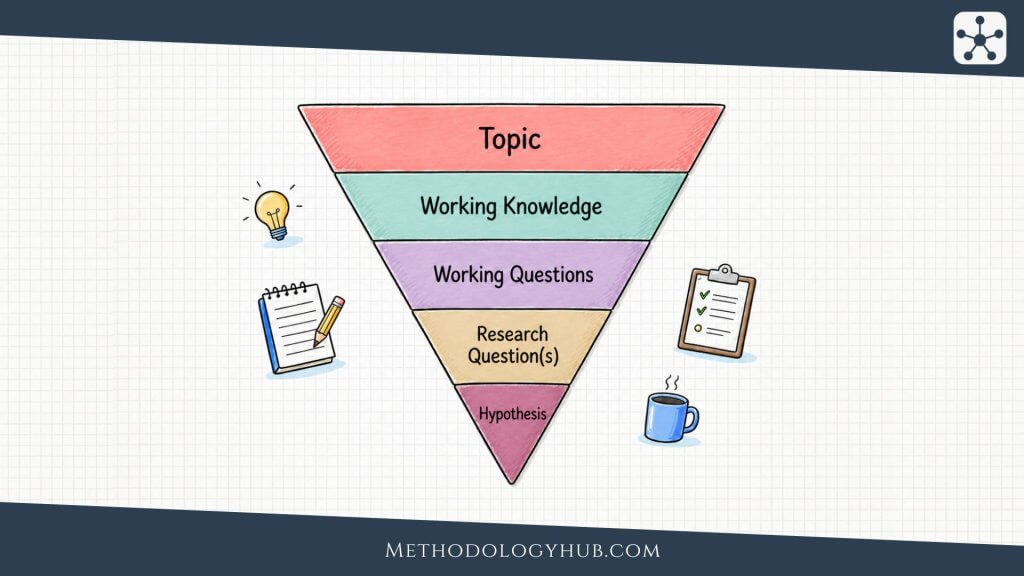
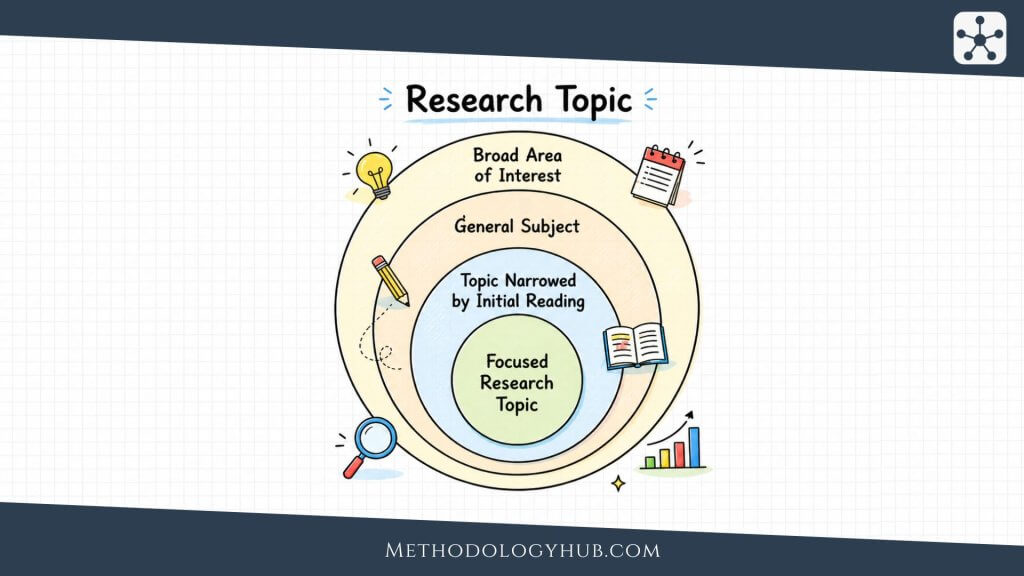
Step 1: Choose a research topic with a conceptual problem
A theoretical study begins with a research topic, but the topic should contain a problem in ideas. “Student motivation” is too broad by itself. A more theoretical problem might be that motivation is defined differently across studies, or that existing models do not explain why motivated students sometimes avoid revision.
The topic should invite reasoning. If the question can only be answered by collecting new data, the project may be empirical rather than theoretical. If the question asks how concepts are defined, how theories fit together, or how assumptions shape interpretation, theoretical research may be suitable.
Step 2: Write a theoretical research question
A theoretical research question should name the conceptual task. It may ask how a concept should be defined, how two theories differ, what assumptions a model requires, or how existing findings can be organised into a framework.
Examples include: How can academic belonging be defined for first-year university students? How do two theories of feedback differ in their assumptions about learner agency? What conceptual framework can connect digital access, participation, and learning support? These questions do not ask for a new dataset first. They ask for conceptual work.
Step 3: Select and map the literature
The literature gives theoretical research its material. The researcher should identify foundational texts, recent articles, competing theories, and empirical findings that have influenced the problem. The selection should be broad enough to represent the debate, but focused enough to support a clear argument.
A useful first map might group sources by theory, concept, discipline, method, or period. This helps the researcher avoid writing a long sequence of article summaries. The map should show how the sources relate to each other and where the conceptual tension appears.
Step 4: Define the central concepts
Once the literature is mapped, the researcher defines the central concepts. This may involve choosing one definition, revising an existing definition, or proposing a new one. The definition should be justified, not simply announced.
A good definition does two things. It says what the concept includes, and it shows what the concept does not include. If the paper defines academic belonging, for example, it may need to separate belonging from friendship, satisfaction, participation, and institutional identity.
Step 5: State assumptions and boundaries
The researcher should then state the assumptions behind the argument. These may concern human behaviour, social context, learning, language, measurement, or the level of analysis. The boundaries should also be clear. A theory may apply to formal education but not to informal learning, or to adolescents but not to adult learners.
This step protects the paper from overstatement. Theoretical research is strongest when it tells readers where the argument is meant to apply and where more work is needed before applying it elsewhere.
Step 6: Build the argument or model
The central part of the study is the argument. This may take the form of a conceptual framework, a model, a typology, a set of propositions, or a critique of existing theory. The structure should be easy to follow. Each claim should prepare the next one.
If a model is included, it should be explained in prose. A diagram can help readers, but it should not carry the argument alone. The researcher should describe what each part means, why the parts are connected, and what the model leaves outside.
Step 7: Check coherence and alternatives
The researcher should test the argument against alternative interpretations. Are there other theories that explain the same issue? Does the argument depend on an assumption that some readers may reject? Does the conclusion follow from the definitions? Does the model become too broad?
This step gives theoretical research its discipline. The goal is not to defend an idea at all costs. The goal is to produce an argument that can be examined, questioned, and used by other researchers.
Step 8: Show how the theory can guide later research
The final step connects the theoretical contribution to later work. This may include propositions, hypotheses, measurement suggestions, study designs, or questions for future empirical work. The researcher should avoid making empirical claims that have not been tested, but they can explain how the theory could be examined.
For example, a theoretical model of feedback interpretation might suggest interview questions, survey items, or comparison groups for a later study. In that way, theoretical research becomes part of a wider research sequence rather than a closed piece of writing.
Examples of Theoretical Research
Examples can make theoretical research easier to recognise. The examples below do not describe full studies, but they show the kinds of questions and outputs that fit theoretical work. In each case, the main contribution would come from reasoning about ideas rather than collecting new data.
Example in education
A researcher may notice that studies of student feedback use the term “useful feedback” in different ways. Some studies treat usefulness as detail, others as timing, others as emotional support, and others as alignment with assessment criteria. A theoretical study could compare these meanings and propose a framework with three parts: clarity, timing, and perceived possibility of action.
The article would not need to survey students itself. Its contribution would be the framework. Later researchers could use that framework to design interviews, code feedback comments, or build a survey instrument.
Example in psychology
A theoretical study in psychology might examine the relationship between self-efficacy, confidence, and motivation. These concepts are often connected, but they are not identical. The paper could argue that self-efficacy refers to belief about performing a specific task, while confidence is often broader and motivation concerns direction, energy, and persistence.
The result could be a clearer model of how the concepts relate. That model could help researchers avoid measuring one concept while claiming to study another.
Example in sociology
A sociological theoretical study might compare two explanations of social trust. One theory may focus on individual experience, while another may focus on institutions and social conditions. The paper could examine how each theory explains trust in schools, neighbourhoods, or public services.
The contribution might be a combined framework showing that trust depends on both personal interaction and institutional predictability. Such a framework could then guide case study research, survey research, or comparative research.
Example in biology
In biology, theoretical research may build a model of how a process could work under different assumptions. A researcher might model how a population changes when survival, reproduction, competition, and environmental variation are represented in different ways. The model can show which assumptions produce which outcomes.
The study may later be connected to field observations or experiments, but the theoretical contribution lies in showing the structure of the possible explanation.
Example in research methodology
A theoretical study in methodology might examine how researchers use the term “research design” across textbooks and journal articles. Some may use it to mean the full logic of a study, while others use it more narrowly to refer to experimental, survey, or case study structures.
The study could propose a clearer typology that separates purpose, objective, methodology, design, source of knowledge, and timeframe. This kind of work can help students understand how research labels fit together in a types of research framework.
When to Use Theoretical Research
Theoretical research is suitable when the main difficulty is conceptual rather than logistical. If researchers already have many studies but no clear explanation, collecting more data may not solve the problem. If a concept is used inconsistently, a new survey may repeat the confusion. If a theory is applied beyond its original setting, the assumptions may need to be examined before the next empirical project begins.
This does not mean theoretical research is only for advanced scholars. Students can also use theoretical work when they need to compare concepts, develop a framework for a thesis, or explain the theory behind a study. The scale can be smaller, but the logic remains the same.
Use it when the concept is unclear
Theoretical research fits well when a term is used often but defined loosely. A student writing about digital literacy, for instance, may discover that some authors focus on technical skills, others on critical reading, and others on participation in online communities. A theoretical approach can separate these meanings before the student chooses a research design.
Use it when theories need comparison
Theoretical research also fits when a topic has several competing explanations. A study of school attendance may be explained through motivation, family circumstances, school climate, health, or institutional policy. A theoretical paper can compare these explanations and decide which one fits the planned research question best.
Use it before designing empirical research
Theoretical work is often useful early in a project. Before collecting data, a researcher needs to know which concepts are central, how they relate, and what kind of claim the study hopes to support. A theoretical framework can guide sampling, measurement, interview questions, document selection, and statistical analysis when numbers are involved.
Use it when existing findings need interpretation
Sometimes a field has many findings but little agreement about what they mean. A theoretical study can group the findings, identify shared assumptions, and propose a clearer explanation. This can prepare later systematic reviews, meta-analyses, qualitative syntheses, or new empirical studies.
Conclusion
Theoretical research develops knowledge by working carefully with ideas. It defines concepts, examines assumptions, compares explanations, builds models, and creates frameworks that help later studies ask better questions. It does not usually collect new data, but it still needs a clear method and a disciplined argument.
Theoretical and empirical research are best understood as connected parts of academic inquiry. Theory can guide what researchers observe, how they measure concepts, and how they interpret results. Empirical findings can then test, challenge, or refine the theory. A field grows more clearly when both forms of work are described honestly.
For students, the most useful starting point is the research question. If the question asks what people do, say, experience, or score, an empirical design may be needed. If the question asks what a concept means, how explanations differ, or what model can organise existing knowledge, theoretical research may be the better fit.
FAQs on Theoretical Research
What is theoretical research?
Theoretical research is research that develops knowledge through concepts, theories, models, arguments, and existing literature rather than through the collection of new observational or experimental data.
What is the difference between theoretical and empirical research?
Theoretical research builds its answer through reasoning about ideas, concepts, and models. Empirical research builds its answer through observed, measured, collected, or documented evidence.
What are examples of theoretical research?
Examples of theoretical research include clarifying a concept, comparing two theories, building a conceptual framework, developing a mathematical model, creating a typology, or proposing hypotheses for later empirical research.
What methods are used in theoretical research?
Theoretical research methods include conceptual analysis, theory building, model development, formal modelling, literature-based synthesis, critical comparison, thought experiments, and analytical examples.
How do you write a theoretical research question?
A theoretical research question should name the conceptual task. It may ask how a concept should be defined, how theories differ, what assumptions a model requires, or how existing findings can be organised into a framework.