A research question is the question a study is built to answer. It turns a broad topic into a focused task. Instead of saying that you want to study climate policy, student motivation, migration, voting behaviour, laboratory safety, or medieval trade, the research question says exactly what you want to find out about that topic.
This article explains what a research question is, how to write a research question, and how to test whether the question can actually guide a research project.
What Is a Research Question?
A research question is a focused question that defines what a study is trying to answer. It tells the reader what the project is about, what kind of evidence will be needed, and what the researcher will try to explain, compare, measure, interpret, or evaluate.
In simple terms, a research question is the bridge between an interesting research topic and an actual research project. A topic can be wide and open. A research question has to be narrower. It has to point toward a possible answer.
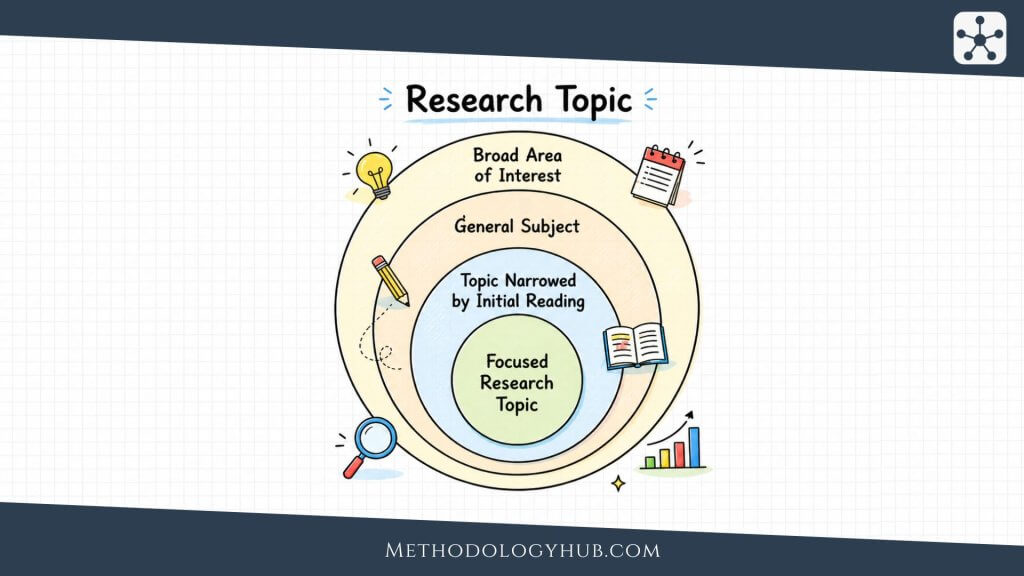
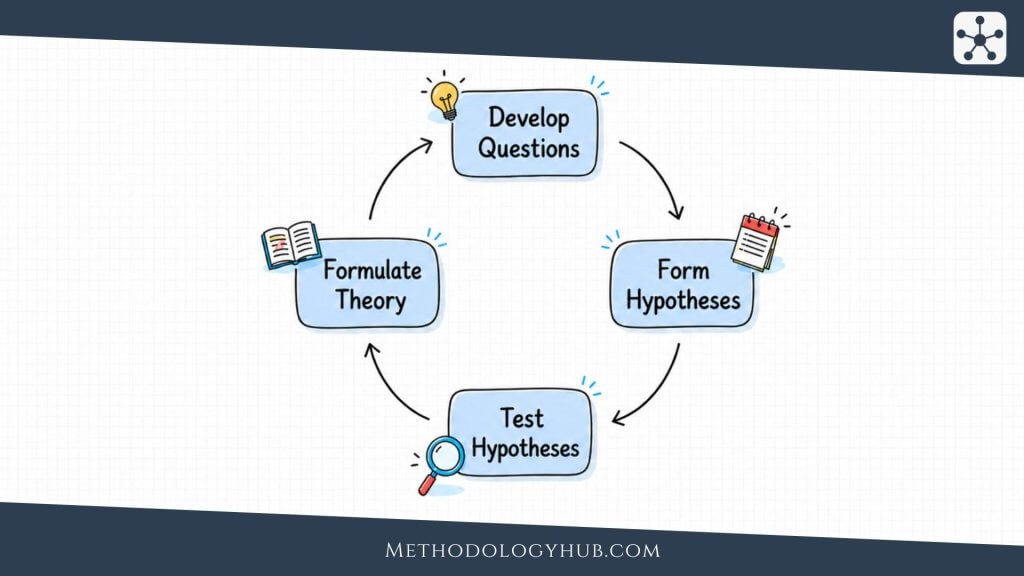
The research question also sits inside the wider research process. A project usually begins with a broad interest, moves toward a clearer topic, defines objectives, and then uses the research question to decide what kind of evidence, method, and final answer the study needs.
Research question definition
A research question is a clearly written question that identifies the main issue a researcher wants to investigate. It should be focused enough to guide the research design, but open enough to require analysis rather than a one-word answer.
For example, “education” is a topic. “Online learning” is still a topic. “How does weekly feedback affect first-year university students’ completion of online statistics exercises?” is a research question. It names a group, a setting, a possible relationship, and a form of evidence that could be collected.
A research question usually helps define:
- what the study will include
- what the study will leave out
- what evidence or data will be needed
- which method is likely to fit the project
- how the final answer should be judged
That last point matters. A research question is not only a sentence at the beginning of a paper. It becomes a test of the whole project. If the method cannot answer the question, the study is not aligned. If the findings do not return to the question, the paper feels unfinished. If the question is too broad, the entire project can become hard to manage.
Research question vs topic
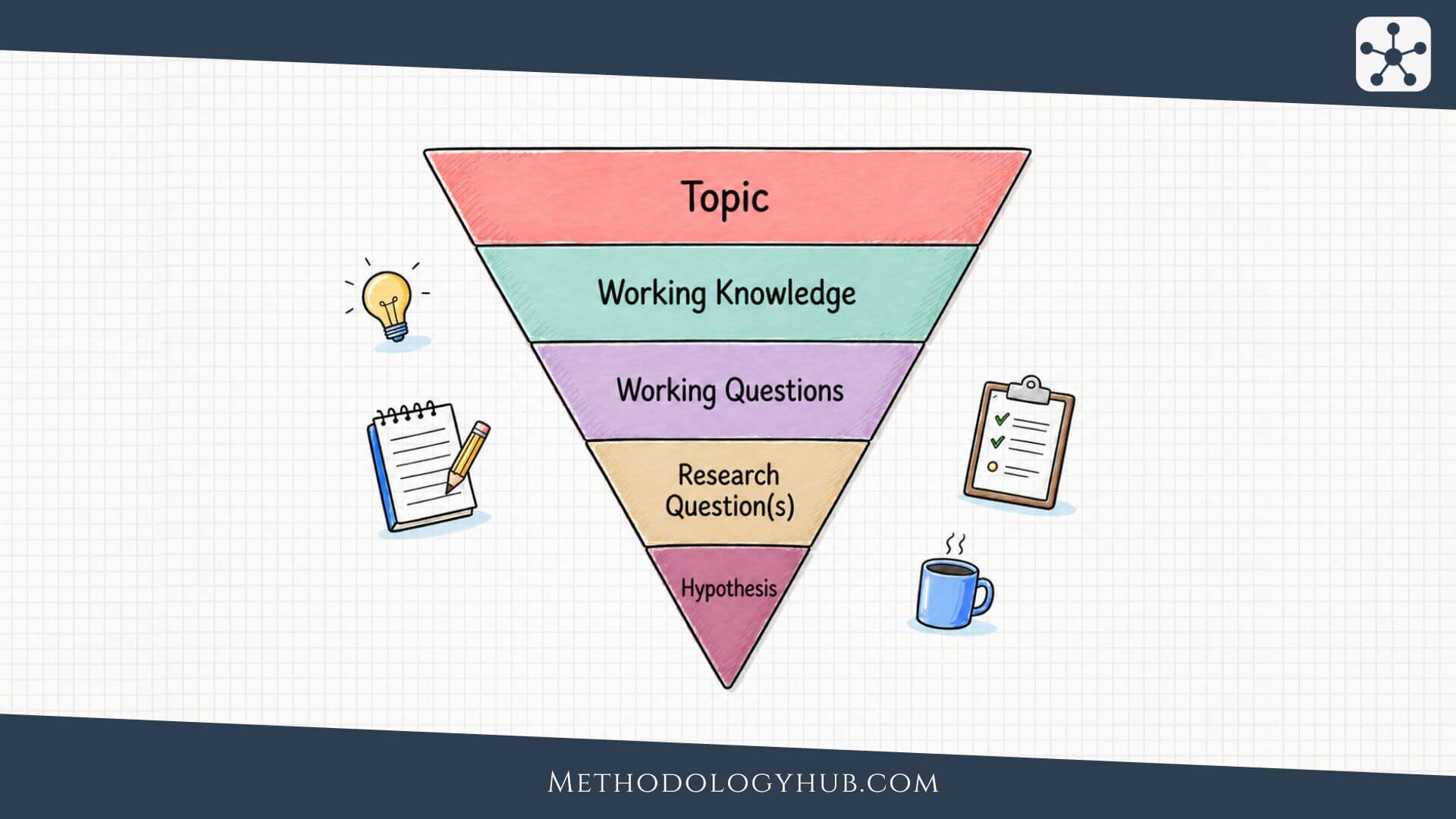
A topic names the subject area. A research question asks something about that subject area. This difference sounds small, but it changes the whole project.
A research topic is the starting area of interest, but it is not yet specific enough to guide a study on its own. To write a research question, you need to turn that topic into a focused problem, relationship, comparison, or pattern that can actually be investigated.
For example:
- Research topic: renewable energy in rural communities
- Research question: How do local planning rules affect the adoption of small-scale solar energy in rural communities?
The topic tells us what the area is. The question tells us what to investigate. A student who only has a topic may read endlessly without knowing what matters. A student with a research question can make decisions: which sources to read, which concepts to define, which data to collect, and which arguments are relevant.
Research question vs research problem
A research problem is the issue that makes the study worth doing. The research question turns that issue into something answerable.
For example, the problem might be that students in a particular course have high dropout rates, but the reasons are unclear. A research question could ask, “Which course design factors are associated with first-year students’ withdrawal from introductory statistics modules?”
The problem gives the study its reason. The question gives it direction.
Research question vs hypothesis
A research hypothesis is a tentative answer or prediction. A research question asks what the study wants to find out. In many quantitative studies, the question and hypothesis work together.
- Research question: What is the relationship between sleep duration and exam performance among first-year university students?
- Research hypothesis: Students who report longer average sleep duration will have higher exam scores.
A research hypothesis is usually written after the research question has become clear. The question asks what will be investigated, while the hypothesis gives a testable expectation about what the answer may be.
Not every study needs a hypothesis. Some studies begin with a question because the researcher is describing a pattern, mapping a debate, comparing cases, or examining a problem before predicting an outcome. The important point is that the research question should come before the method is locked in. The question tells you what kind of study is needed.
How to Write a Research Question
To write a research question, start with a broad topic, do enough preliminary reading to see where the real issue is, narrow the topic to a specific problem, and then turn that problem into an answerable question. The first version does not need to be perfect. Most good research questions are rewritten several times.
The mistake is expecting the final wording to appear immediately. A research question usually develops through trial and correction. You write one version, test it against the literature and your available method, then make it sharper.
Step 1: Start with a topic you can actually work on
The first step is to choose a topic area. At this stage, it can be broad. You might be interested in public health communication, historical memory, teacher feedback, renewable energy, voting behaviour, workplace safety, or language learning. A broad topic gives you a starting point for reading.
Still, the topic has to be realistic. If you have six weeks and no access to specialist data, you should not choose a topic that would require a national dataset, laboratory testing, or years of fieldwork. A good research question begins with interest, but it also needs access.
Useful early questions include:
- What topic do I keep returning to?
- What problem inside this topic seems unresolved?
- What kind of evidence could I realistically access?
- What does my course, programme, supervisor, or journal expect?
Step 2: Do preliminary reading before you decide
Preliminary reading keeps the research question from being based only on a first impression. You do not need to read everything at this stage. You need enough reading to understand the area and see what has already been studied.
Look for repeated terms, recurring disagreements, unexplained findings, limits of previous studies, and differences between contexts. Sometimes the question comes from a gap. Sometimes it comes from a contradiction. Sometimes it comes from applying an existing idea to a new case.
For example, you may begin with “student motivation”. After reading, you may notice that many studies discuss motivation in general, but fewer separate the effect of feedback timing from feedback content. That difference can become the beginning of a research question.
Step 3: Define the problem behind the question
A research question should not float by itself. It should respond to a problem. The problem can be practical, theoretical, empirical, methodological, or interpretive.
- Practical problem: something is not working well in a real setting.
- Theoretical problem: existing concepts do not fully explain the case.
- Empirical problem: evidence is incomplete, inconsistent, or too limited.
- Methodological problem: previous studies may have used a weak or narrow approach.
- Interpretive problem: a text, event, policy, or pattern can be understood in more than one way.
Once you know the problem, the question becomes easier to write. You are no longer asking something only because it sounds interesting. You are asking because there is a reason to investigate it.
The research question is also closely connected to the research objectives. The question states what the study wants to find out, while the objectives break that question into the smaller tasks the project has to complete, such as comparing cases, measuring a relationship, analysing sources, or explaining a pattern.
Step 4: Narrow the question by setting limits
A research question needs limits. These limits may involve population, place, time period, material, variables, concepts, or cases.
Compare these two versions:
- Too broad: How does social media affect politics?
- More focused: How did first-time voters in Germany use short-form video platforms to evaluate party messages during the 2025 federal election campaign?
The second question is still open, but it has boundaries. It names a group, a place, a type of platform, an activity, and a time period. Those limits make the study easier to plan.
Step 5: Write the question in direct language
A research question does not need to sound impressive. It needs to be clear. Avoid decorative wording, inflated claims, and vague academic phrases. The reader should understand what is being asked without needing to untangle the sentence.
In many cases, start with one of these words:
- What: useful for description, identification, and mapping patterns
- How: useful for processes, mechanisms, relationships, and interpretation
- Why: useful for explanation, but often difficult unless the design can support causal reasoning
- To what extent: useful when you want to assess degree, strength, or scope
- Which: useful when comparing factors, cases, or explanations
Questions that begin with “does”, “is”, or “are” can work, but they often produce yes-or-no answers. If the answer could be “yes” or “no” and nothing else, the question may need rewriting.
Step 6: Test the question before you commit
Before you settle on the final wording, test the question. Ask whether it can be answered with the evidence and time available. Ask whether it is too broad, too narrow, too obvious, or too loaded. Ask whether the method you plan to use can actually answer it.
A useful test is to imagine the final answer. Not the exact answer, but the kind of answer. Would the study produce a comparison, an explanation, a measurement, an interpretation, or an evaluation? If you cannot imagine what form the answer would take, the question is probably still unclear.
Criteria of a Good Research Question
A good research question is focused, researchable, feasible, specific, complex enough for analysis, and relevant to a real academic problem. These criteria are not separate boxes to tick at the end. They are tools for improving the question while you write it.
Most weak research questions fail for ordinary reasons. They ask too much. They ask something no available evidence can answer. They assume the answer in advance. Or they use words that sound academic but hide what the project is really doing.
Focused
A focused research question asks one main thing. It may include several parts, but those parts should belong together. If the question tries to compare three populations, explain four causes, and evaluate two policies at the same time, it will probably become unmanageable.
Instead of asking, “How do poverty, family structure, school funding, teacher training, and digital access affect student achievement across Europe?”, a more focused version might ask, “How is household internet access associated with homework completion among lower-secondary students in rural schools?”
The narrower version does less, but it can actually be studied.
Researchable
A researchable question can be answered with evidence. The evidence might come from experiments, surveys, interviews, documents, archives, observations, existing datasets, texts, measurements, or other sources. The point is that the question cannot depend only on personal belief.
“Is modern architecture good?” is not a strong research question because “good” is too vague and the evidence is unclear. A researchable version could ask, “How did post-war housing policies shape the design of public apartment blocks in Vienna between 1945 and 1970?”
That version points toward documents, policies, buildings, time period, and analysis.
Feasible
A feasible question can be answered within the limits of the project. Time, access, ethics, language ability, technical skill, funding, and data availability all matter.
A question can be interesting and still be a poor choice for your project. If it requires confidential records you cannot access, a sample you cannot recruit, or measurements you cannot make, it needs to be changed. Feasibility is not about lowering ambition. It is about designing a study that can be completed well.
Specific
A specific question gives the reader enough detail to understand the study’s direction. It should avoid empty words such as “impact”, “influence”, or “effect” unless those words are tied to something measurable or explainable.
For example, “What is the impact of exercise on health?” is too general. “How is weekly aerobic exercise associated with self-reported sleep quality among adults aged 60 to 75?” is more specific. It names the activity, outcome, and group.
Complex enough for analysis
A research question should not be so simple that it can be answered with a dictionary definition or a single statistic. It should require interpretation, comparison, explanation, testing, or evaluation.
“When was the Treaty of Versailles signed?” is a factual question. It may appear in research, but it is not enough to guide a research project. “How did British newspapers frame the Treaty of Versailles in the first month after its signing?” is a research question because it requires evidence selection and analysis.
Relevant
A relevant research question connects to a real discussion in the field. That does not mean every student project must change the world. It means the question should have a reason. It should help clarify a debate, examine an under-studied case, test a relationship, review evidence, solve a practical problem, or interpret material in a careful way.
A useful way to test relevance is to ask, “Who would care about the answer, and why?” The answer might be scholars, teachers, clinicians, historians, policymakers, laboratory managers, archivists, or future researchers. If no one would need the answer, the question may be interesting only to you.
Types of Research Questions
Research questions can do different kinds of work. Some describe what is happening. Some compare cases or groups. Some test relationships. Some explain why something occurs. Some evaluate whether an intervention, policy, method, or interpretation works.
Knowing the type of question helps you choose a suitable method. It also helps you avoid a common mismatch: writing an explanatory question but using only descriptive evidence, or writing a comparison question without defining what will be compared.
Descriptive research questions
A descriptive research question asks what something is like, how often it occurs, what features it has, or how it changes over time. It is useful when the first task is to map a pattern clearly.
Examples include:
- What types of assessment feedback do first-year biology students receive in laboratory reports?
- How have references to climate adaptation changed in municipal planning documents since 2015?
- What reading strategies do advanced second-language learners report using when preparing academic essays?
Descriptive questions are not weak by default. They are weak only when they stay too general or collect facts without a clear purpose.
Comparative research questions
A comparative research question asks how two or more cases, groups, periods, texts, policies, or settings differ. The comparison must be meaningful. Do not compare simply because two things exist. Compare because the difference can teach the reader something.
Examples include:
- How do feedback practices differ between first-year laboratory courses in biology and chemistry?
- How did newspaper coverage of public transport strikes differ in Berlin and Vienna between 2019 and 2024?
- Which differences appear in citation practices between undergraduate essays and master’s dissertations in the same department?
Relational research questions
A relational research question asks whether and how two or more factors are associated. These questions are common in studies that use surveys, datasets, measurements, or structured observations.
Examples include:
- What is the relationship between weekly study time and exam performance among first-year economics students?
- How is household income associated with access to preventive dental care among adults in urban districts?
- To what extent is workplace noise exposure associated with reported sleep disturbance among factory workers?
Relational questions should define the variables clearly. If the variables are vague, the question will be hard to answer.
Explanatory research questions
An explanatory research question asks why or how something happens. These questions usually require a stronger design because explanation is harder than description. If you ask “why”, you need evidence that can support an explanation rather than only show a pattern.
Examples include:
- How do changes in assessment timing affect students’ revision strategies in introductory statistics courses?
- Why did two neighbouring municipalities adopt different flood-prevention policies after the same regional risk assessment?
- How does the wording of public health guidance affect readers’ understanding of vaccination recommendations?
Evaluative research questions
An evaluative research question asks whether something works, how well it works, for whom it works, or under what conditions it works. These questions are common in education, medicine, policy, public administration, and applied research.
Examples include:
- How effective is peer feedback in improving the structure of undergraduate research proposals?
- To what extent did a new appointment reminder system reduce missed clinic visits in a university health centre?
- Which criteria best predict whether a local heritage policy protects buildings at risk of demolition?
Evaluative questions need clear criteria. Without criteria, “works” becomes too vague.
Interpretive research questions
An interpretive research question asks how meaning is created, presented, understood, or contested. These questions often appear in history, literature, law, media studies, philosophy, anthropology, and parts of education and social science.
Examples include:
- How does a selected group of post-war novels represent homecoming after military service?
- How did parliamentary debates frame responsibility for urban housing shortages between 1970 and 1985?
- How do museum labels present uncertainty when describing disputed archaeological objects?
Interpretive questions still need evidence. The evidence may be textual, visual, archival, legal, or observational, but it must be selected and analysed in a controlled way.
Research Question Examples
Examples are useful because they show the difference between a topic, a weak question, and a research question that can guide a project. The stronger examples below are not perfect for every assignment. They show the kind of narrowing that usually improves a question.
Example 1: Education
Topic: feedback and student learning
Weak question: Does feedback help students?
Stronger research question: How does the timing of written feedback affect revision quality in first-year undergraduate history essays?
The weak question is too broad and produces a simple yes-or-no answer. The stronger version names the type of feedback, the outcome, the student group, and the writing task. It also points toward a possible method: comparing revisions, feedback timing, and essay quality.
Example 2: Public health
Topic: appointment reminders
Weak question: Are reminder messages useful?
Stronger research question: To what extent did SMS appointment reminders reduce missed appointments among patients aged 18 to 30 at a university health clinic?
The stronger version defines the reminder type, outcome, age group, and setting. It can be answered with clinic records before and after the reminder system, although the exact design would need to control for other changes.
Example 3: Environmental policy
Topic: local climate adaptation
Weak question: What should cities do about climate change?
Stronger research question: How have mid-sized German cities incorporated heat-risk mitigation into public space planning since 2018?
The weak version is too large and too advisory. The stronger version asks about a specific policy area, type of city, planning context, and period. It could be answered through policy documents, planning reports, and selected case comparisons.
Example 4: Literature
Topic: memory in post-war fiction
Weak question: How is memory important in post-war novels?
Stronger research question: How do two selected post-war novels use fragmented narration to represent traumatic memory?
The stronger version limits the material and identifies the literary feature to be analysed. It avoids trying to cover a whole tradition in one paper.
Example 5: Sociology
Topic: commuting and wellbeing
Weak question: Does commuting make people unhappy?
Stronger research question: How is commute duration associated with self-reported workday stress among full-time employees in metropolitan areas?
This version defines a possible relationship and population. It still needs decisions about measurement, sampling, and controls, but it is much closer to a researchable question.
Example 6: History
Topic: newspapers and public opinion
Weak question: Did newspapers influence people in the 1920s?
Stronger research question: How did three major newspapers frame debates about women’s employment in Britain between 1919 and 1929?
The stronger version avoids claiming it can measure influence unless the evidence can support that. It asks about framing, which can be studied through newspaper archives.
Example 7: Psychology
Topic: sleep and academic performance
Weak question: Is sleep important for students?
Stronger research question: What is the relationship between average weekday sleep duration and exam performance among first-year psychology students?
The stronger question defines the predictor, outcome, and group. It may still need to account for study time, prior grades, and health factors, but the basic shape is clear.
Example 8: Law and policy
Topic: data protection
Weak question: Is data protection law effective?
Stronger research question: How have German administrative courts interpreted consent requirements in university data-sharing cases since 2018?
The stronger question defines jurisdiction, institution type, legal issue, and period. It points toward a document-based legal analysis rather than a broad opinion about effectiveness.
Common Mistakes When Writing a Research Question
Most research question problems are fixable. A weak first version does not mean the project is bad. It usually means the question has not yet been narrowed, tested, or connected to evidence.
The aim is not to make the question sound more complicated. It is to make it more useful.
Mistake 1: The question is too broad
A broad question usually contains a large topic word with no boundary. Words such as “society”, “education”, “technology”, “health”, “culture”, “media”, and “politics” are often warning signs when they appear without a specific group, place, period, or problem.
- Too broad: How does technology affect education?
- Better: How do weekly online quizzes affect preparation habits among first-year chemistry students?
Mistake 2: The question is too narrow
A question can also become too narrow. If the answer is a single date, name, number, or definition, it is probably not enough for a research project.
- Too narrow: How many students used the library in March 2025?
- Better: How did extended library opening hours affect evening study space use during the 2025 examination period?
Mistake 3: The question has a built-in answer
A loaded question assumes what it should be investigating. It pushes the reader toward the answer before evidence has been considered.
- Loaded: Why did the new grading policy unfairly reduce student motivation?
- Better: How did students describe the effect of the new grading policy on their motivation and study planning?
The second version still allows criticism of the policy, but it does not assume the conclusion from the start.
Mistake 4: The wording is vague
Some questions use important-sounding words without defining what will actually be studied. Words such as “impact”, “success”, “quality”, “identity”, “awareness”, and “engagement” can be useful, but only when they are tied to observable evidence.
- Vague: What is the impact of academic writing support?
- Better: How does participation in three writing centre consultations affect the structure of students’ research proposal drafts?
Mistake 5: The method cannot answer the question
A question about cause needs evidence that can support causal reasoning. A question about lived experience cannot be answered only by counting website visits. A question about historical framing cannot be answered only by a present-day survey.
Method mismatch is one of the most common research design problems. To avoid it, write the question and then ask, “What evidence would count as an answer?” If the evidence you can collect does not match the question, revise one of them.
Mistake 6: The question tries to answer too many things
Many early questions are overloaded. They contain several questions joined together.
- Overloaded: How do students use AI tools, how do teachers respond, and what policies should universities adopt?
- Better: How do first-year students describe their use of AI tools when planning academic essays?
The other parts might become subquestions, later studies, or background discussion. They should not all sit inside the main research question unless the project is large enough to handle them.
Research Question for Different Academic Works
The research question appears in many kinds of academic work, but it does not have exactly the same job in every project. A thesis, dissertation, research proposal, journal article, literature review, and lab report all use questions differently.
The basic principle stays the same: the question should guide the work. What changes is the scale of the project and the amount of detail needed around the question.
Research question in a thesis
In a thesis, the research question usually has to support a sustained argument over many pages. It must be narrow enough to finish, but rich enough to justify several chapters or sections.
A thesis question often needs subquestions. The main question gives the project its direction. The subquestions divide the work into smaller parts.
For example:
- Main research question: How did municipal housing policy shape access to affordable rental housing in Vienna between 2000 and 2020?
- Subquestion 1: Which policy instruments were used during this period?
- Subquestion 2: How did eligibility rules change?
- Subquestion 3: What evidence is available on changes in access for different income groups?
The subquestions are not random additions. They break the main question into parts that can be researched and written as sections.
Research question in a dissertation
In a dissertation, the research question usually needs a stronger link to a scholarly debate. The project is larger, and the expectation of original contribution is higher. That means the question must be positioned carefully inside existing research.
A dissertation question often grows out of a tension in the literature: a theory that does not explain a case well, a method that misses part of the problem, or a finding that has not been tested in another setting. The question should make clear what the dissertation is adding, even if the full contribution is developed later.
Research question in a research proposal
In a research proposal, the question has to convince the reader that the project is worth doing and possible to do. It must be clear before the study has been completed.
Proposal readers often judge the question by asking:
- Is the question specific enough?
- Does it respond to a real problem or gap?
- Can the proposed method answer it?
- Is the scope realistic?
- Does the project have enough academic value?
A proposal can fail even when the topic is interesting if the question is unclear. The reader needs to see the path from question to method to expected contribution.
Research question in a journal article
In a journal article, the research question is usually narrower than in a thesis or dissertation. The article has limited space, so the question should be precise. It should also connect quickly to the article’s contribution.
Some journal articles state the question directly. Others present it as an aim, objective, or hypothesis. Either way, the reader should not have to guess what the article is trying to answer.
Research question in a literature review
A literature review also needs a research question, especially if it is a systematic review, scoping review, or structured review. Without a question, the review can become a summary of sources rather than a study of the literature.
A literature review question might ask:
- What methods have been used to study a specific problem?
- What patterns appear across existing findings?
- How has a concept been defined in a field?
- Where do findings agree, conflict, or remain incomplete?
The question controls the search strategy, inclusion criteria, and structure of the review.
Research question in a lab report
In a lab report, the research question may be connected to an experiment, measurement, or hypothesis. It should identify what the experiment tests or investigates. Even when the lab report follows a fixed structure, the question still helps the introduction, method, results, and discussion stay connected.
For example, a lab report might ask, “How does temperature affect the rate of enzyme activity under controlled pH conditions?” That question defines the independent variable, dependent variable, and control condition. It also tells the reader what the results section should report.
How to Refine a Research Question
Writing a research question is rarely finished in one attempt. The first version often shows the direction, but not the final shape. Refinement is the process of making the question clearer, narrower, more answerable, and better aligned with the method.
A useful way to revise a research question is to work on one problem at a time. Do not try to fix everything in one sentence at once. First check the scope. Then check the wording. Then check the evidence. Then check the method.
Move from broad to specific
Many research questions begin as broad questions because the researcher is still discovering the topic. That is fine. The task is to keep narrowing until the question can guide a real study.
Here is one possible path:
- Broad topic: academic writing support
- Narrower topic: writing centre consultations for first-year students
- Problem: students attend consultations, but it is unclear which parts of their drafts improve afterward
- Research question: How do writing centre consultations affect the organisation of first-year students’ research proposal drafts?
The final version is still not the only possible question. It is one workable version that names a setting, population, intervention, and outcome.
Replace vague nouns with observable terms
Vague nouns make a question sound larger than it is. When you see words such as “success”, “quality”, “engagement”, “awareness”, or “effectiveness”, ask how they will be recognised in the study.
For example, “student engagement” might mean attendance, participation in discussion, completion of reading tasks, time spent on a learning platform, or self-reported interest. These are not the same thing. The question should say which one matters.
Check the scale of the answer
A research question should produce an answer that fits the assignment. A five-page essay, bachelor’s thesis, master’s dissertation, doctoral dissertation, and journal article do not have the same scale.
If the project is short, the question needs a tight focus. If the project is long, the question can be larger, but it still needs boundaries. A long project does not excuse a vague question. It only gives the researcher more room to answer a difficult one.
Align the question with the evidence
Once you have a draft question, list the evidence you would need to answer it. If the list is unrealistic, revise the question.
Ask yourself:
- Do I need people, documents, measurements, texts, images, records, or existing datasets?
- Can I access that evidence legally and ethically?
- Will the evidence actually answer the question?
- What would count as a convincing answer?
Use subquestions carefully
Subquestions can help organise a larger project, but they should not become a hiding place for an unfocused main question. Each subquestion should support the main question.
A good set of subquestions usually moves in a logical order:
- first, define or describe the case
- then, examine the main relationship, process, or comparison
- then, interpret what the findings mean for the main question
If your subquestions point in different directions, the main question may need rewriting.
Conclusion
A research question is one of the first serious decisions in a research project. It turns interest into direction. It tells you what to read, what evidence to collect, what method to use, and what the final answer should return to.
The best way to write a research question is to move slowly from topic to problem to focused question. Start broad if you need to. Read enough to understand the area. Find the issue that makes the project worth doing. Then narrow the question until it becomes answerable.
A strong research question does not need decorative wording. It needs a clear task. It should ask something that matters, fit the evidence available, and guide the project from the first paragraph to the final discussion.
- Choose a topic you can realistically study.
- Define the problem before writing the final question.
- Use clear limits around group, place, period, case, concept, or relationship.
- Check that your method can answer the question.
- Revise the wording until the question is direct and researchable.
FAQs on Research Questions
What is a research question?
A research question is the focused question a study is designed to answer. It defines what the researcher wants to investigate and helps guide the literature review, method, data collection, analysis, and conclusion.
How do you write a research question?
To write a research question, start with a broad topic, do preliminary reading, identify a specific problem, narrow the scope, and turn the focus into a clear question. Then test whether the question is researchable, feasible, specific, and aligned with your method.
What makes a good research question?
A good research question is focused, researchable, feasible, specific, analytical, and relevant. It should ask one main thing, point toward evidence, fit the limits of the project, and require more than a simple yes-or-no answer.
What is the difference between a research question and a hypothesis?
A research question asks what the study wants to find out. A hypothesis gives a tentative answer or prediction that can be tested. Many quantitative studies use both, while other research designs may use a research question without a formal hypothesis.
Can a research project have more than one research question?
Yes, a project can have a main research question and several subquestions. The main question gives the overall direction, while the subquestions divide the project into smaller parts. The subquestions should support the main question rather than introduce separate projects.
Should a research question be broad or narrow?
A research question should be narrow enough to answer within the limits of the project, but not so narrow that it produces only a simple fact. The right scope depends on the assignment, available evidence, method, and time frame.