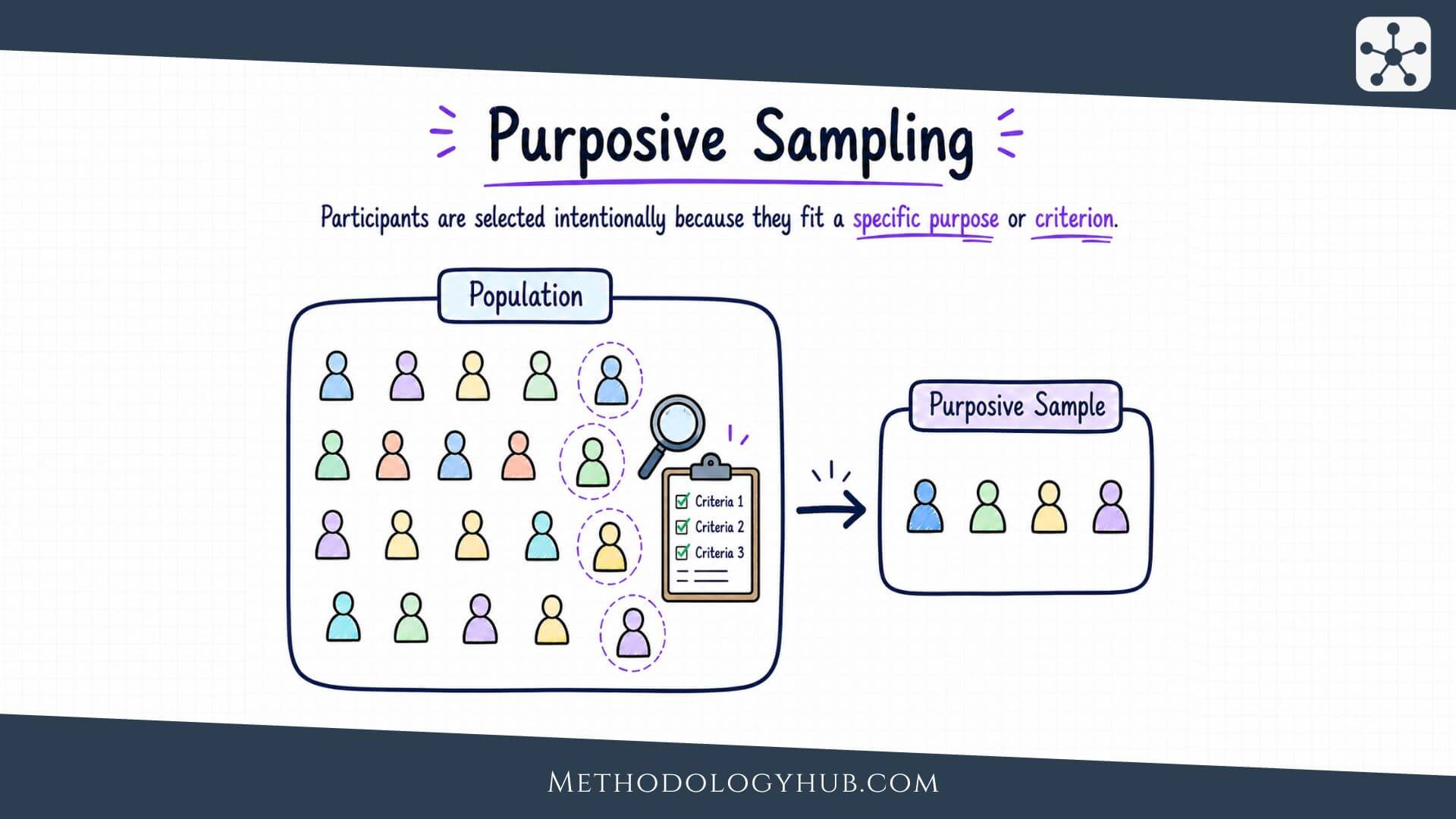
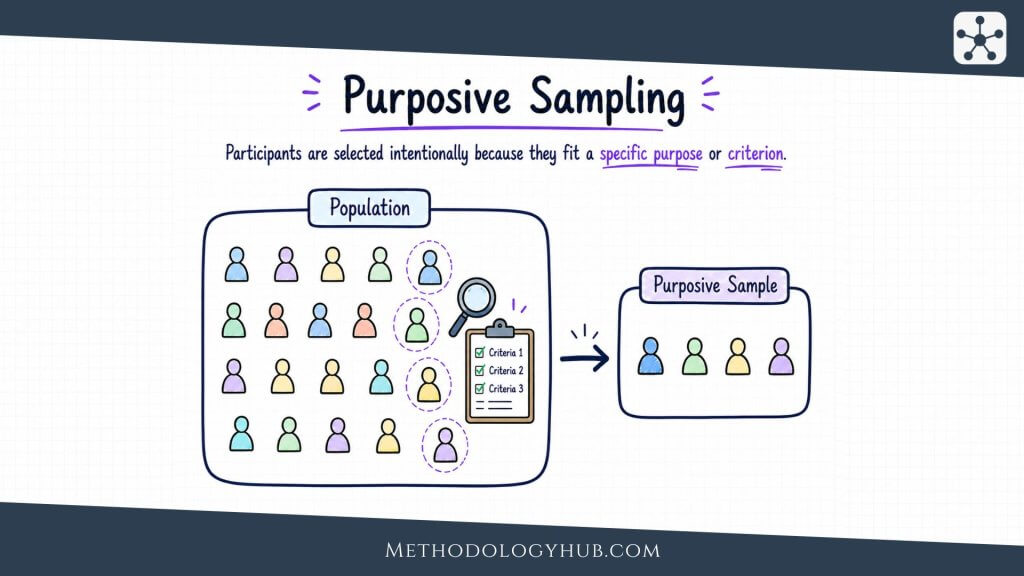
Purposive sampling is a non-probability sampling method in which researchers select people, cases, documents, events, sites, or records because they fit the purpose of the study. Instead of asking chance to decide who enters the sample, the researcher uses clear criteria to find units that can speak directly to the research question.
This article explains what purposive sampling is, how it works in research, which main types are used, when it is suitable, how to carry it out, and how to interpret its advantages and limitations without treating it like a random sample.
What Is Purposive Sampling?
Purposive sampling is a sampling method where the researcher selects cases because they are especially relevant to the study aim. The sample is not built by random selection. It is built through judgement, criteria, and a clear link between the research question and the people or cases selected.
Imagine a researcher studying how first-year university students adjust to academic reading. A random sample of all students at the university might include many students who are not in their first year. A convenience sample from one lecture may be easy to collect, but it may include only one programme or one type of student. A purposive sample would begin differently. The researcher would define who can give useful evidence for this question, such as first-year students from several programmes who have completed their first semester, and then recruit participants who match those criteria.
Purposive sampling definition
Purposive sampling means selecting units for a study because they meet planned criteria connected to the research purpose. Those units may be participants, documents, schools, clinics, classrooms, interview transcripts, policy texts, field sites, or any other source of research data.
The method is often used in qualitative research, where the goal is usually not to estimate a population percentage. The goal is to understand a process, experience, setting, viewpoint, or pattern in enough depth. That does not mean purposive sampling is careless or informal. A strong purposive sample has a reasoned selection logic, not a vague preference for whoever seems interesting.
Population, sample, and selection criteria
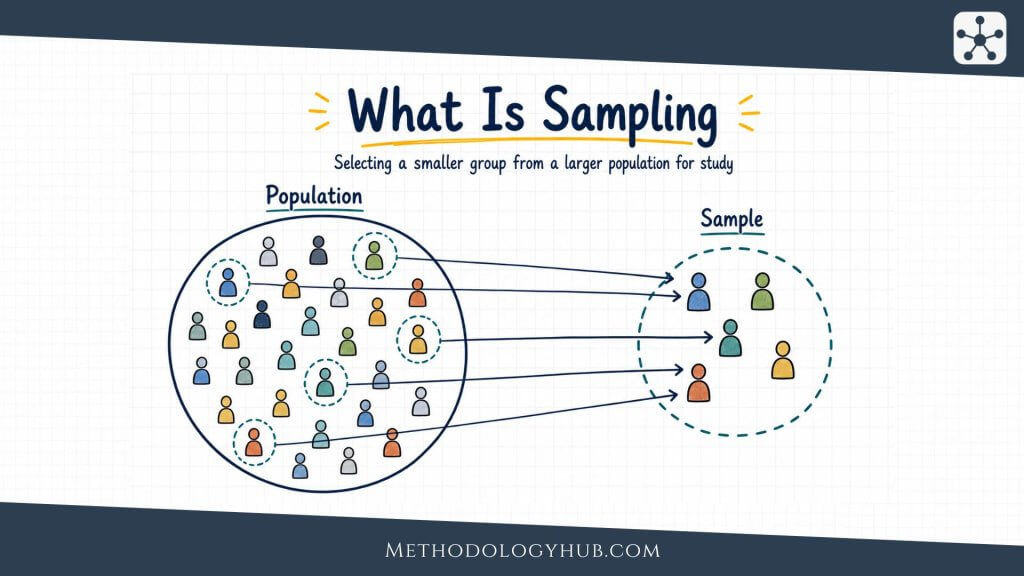
Purposive sampling still begins with a population, although the population may be described more narrowly than in a large survey. The population is the wider group the study is about. The sample is the smaller set that is actually studied. Selection criteria sit between the two. They define which people or cases can enter the sample and why they fit the study.
For example, a study of support needs among newly qualified teachers might define the population as teachers in their first two years of practice in public secondary schools. The sample could then be selected to include teachers from different subject areas, school sizes, and levels of mentoring support. The criteria do not appear after recruitment as a way to tidy the sample. They guide recruitment from the beginning.
Purposive sampling and non-probability sampling
Purposive sampling belongs to the wider family of non-probability sampling. In non-probability sampling, members of the population do not all have a known chance of selection. This separates it from random sampling, where selection is based on probability.
This difference affects the kind of claim the study can make. A purposive interview study may give a careful account of how selected participants describe an experience. It should not usually claim to estimate how common that experience is in the whole population. If a study needs population percentages, standard errors, or confidence intervals, a probability design is usually a better starting point, provided it can be carried out properly.
Purposive sampling is not random sampling
The difference between purposive and random sampling is not about quality. It is about purpose. Random sampling is designed to reduce the researcher’s control over selection and to support population-level inference. Purposive sampling is designed to increase the fit between the sample and the research question.
A researcher studying a rare teaching approach may not want a random sample of all teachers, because most would have no direct experience of the approach. The researcher may instead need teachers who have used it, school leaders who supported it, and students who experienced it in class. That sample is not random, but it may be exactly the right sample for an interview study about how the approach was experienced.
Purposive Sampling in Research
Researchers use purposive sampling when the sample needs to contain people or cases with direct knowledge of the topic. The method is common in interview studies, focus groups, case studies, ethnography, document analysis, evaluation research, and mixed-methods projects where one part of the study needs a focused qualitative sample.
The strength of purposive sampling is the match between the sample and the question. A study about how nurses experience night shifts needs nurses who have worked night shifts. A study about rural school transport needs pupils, parents, teachers, or administrators who know that setting. A study of published guidance documents needs documents that belong to the field and time period being studied. The sample is selected because it can carry the inquiry forward.
Finding information-rich cases
Purposive sampling is often used to find information-rich cases. These are cases that can provide detailed evidence about the topic. They are not always unusual or dramatic. Sometimes an ordinary case is information-rich because it shows how a process normally works. Sometimes an unusual case is information-rich because it exposes limits, pressures, or exceptions that are hard to see elsewhere.
For a beginner, the phrase information-rich should be read carefully. It does not mean selecting people who will give the answer the researcher expects. It means selecting people or cases that are likely to provide enough relevant detail to answer the research question well.
Connecting the sample to the research question
Purposive sampling works best when the research question is already clear enough to guide selection. If the question asks about the transition from school to university, the sample should include people who have recently made that transition. If the question asks about how teachers adapt lessons for multilingual classrooms, the sample should include teachers who work in such classrooms.
The link between question and sample should be visible to the reader. A methods section that says only “participants were purposively sampled” is too thin. It tells the reader the label, but not the reasoning. A stronger description names the criteria, recruitment route, sample composition, and any changes made during the study.
Planning note: A purposive sample is easier to defend when the reader can see how each selection criterion follows from the research question.
Working with depth instead of population estimates
Many purposive samples are small compared with survey samples. That is not a flaw by itself. In qualitative research, a smaller sample can allow longer interviews, richer field notes, closer document analysis, and a more careful reading of differences between cases.
The trade-off is that the findings are interpreted differently. A purposive sample may help explain how a process works, how people describe an experience, or how meanings vary across cases. It usually cannot say how many people in the wider population hold a view or have an experience. That is where the language of the report needs care.
Making selection transparent
Because purposive sampling relies on judgement, transparency is especially useful. Readers need to know what the researcher looked for, how participants or cases were located, who was included, who was not included, and how the final sample took shape.
This is also where purposive sampling differs from casual recruitment. A casual sample may happen because a researcher asks whoever is nearby. A purposive sample is planned. Even when recruitment changes during fieldwork, the changes should be explained in relation to the study aim and emerging data.
Main Types of Purposive Sampling
Purposive sampling is not one single procedure. It is a family of related strategies. Each strategy gives the researcher a different way to decide which cases are suitable. The choice depends on what the study is trying to learn, how much variation is needed, and what kind of evidence the selected cases can provide.
Some studies use one strategy throughout. Others combine strategies. A researcher might begin with criterion sampling to find eligible participants, then use maximum variation sampling to make sure the final group includes different ages, roles, or settings. The names are less useful than the reasoning behind them, but the names help researchers report the design clearly.
Criterion sampling
Criterion sampling selects cases that meet a specific condition. The criterion may be an experience, role, event, diagnosis, time period, document type, or setting. A study of students who changed degree programmes during their first year would include only students who made that change. A document study of policy responses during a certain period would include documents that meet the date and content criteria.
This type is often the simplest to understand because the selection rule is direct. The researcher asks: who or what must be included for the question to be answered? The answer becomes the criterion.
Maximum variation sampling
Maximum variation sampling deliberately includes different kinds of cases within the study boundary. The researcher is not trying to make the sample statistically representative. The aim is to see how the topic appears across a range of relevant situations.
For example, a study of school library use might include pupils from different year levels, schools with different library resources, and students who use the library often as well as those who rarely use it. The variation helps the researcher compare experiences and notice what seems shared across cases and what changes with context.
Homogeneous sampling
Homogeneous sampling selects cases that share a particular feature. This approach is useful when the researcher wants to examine one group in detail without too much variation across the sample. A study might focus only on final-year nursing students in one placement type, or only on parents of children starting school for the first time.
The benefit is focus. Because participants share a central feature, the researcher can look closely at differences within that group. The limitation is also clear: the findings should be read as evidence from that selected group, not as a broad account of all possible groups.
Typical case sampling
Typical case sampling selects cases that appear ordinary for the setting being studied. The researcher is not searching for extremes. The aim is to describe how a process or experience looks under fairly usual conditions.
This can be helpful in evaluation research. If a district wants to understand how a new reading programme is being used, the researcher may choose schools that have adopted it in a typical way rather than schools with unusually high resources or unusually severe implementation problems. The word typical should be used with care. The researcher needs a basis for saying why a case appears typical.
Extreme or deviant case sampling
Extreme or deviant case sampling selects cases that are unusual in a way that can teach the researcher something. These may be unusually successful cases, unusually difficult cases, rare experiences, very high scores, very low scores, or events that differ sharply from the usual pattern.
A researcher studying attendance support might examine a school that improved attendance quickly and another where attendance remained low despite similar support. The comparison can reveal conditions that are less visible in average cases. The selected cases are not meant to stand for everyone. They are selected because their unusual position can sharpen understanding.
Critical case sampling
Critical case sampling selects a case because it can test or clarify an idea in a focused way. A critical case is chosen because the researcher thinks it has a special position in relation to the question. If something appears in that case, it may be likely to appear elsewhere. If it does not appear there, the researcher may need to reconsider the assumption.
For example, if a digital homework platform is expected to work especially well in a school with strong internet access, trained teachers, and regular student support, that school might be a critical case. If the platform struggles even there, the researcher has reason to examine the assumptions behind the programme.
Expert sampling
Expert sampling selects people because they hold specialised knowledge about the topic. These participants may be researchers, practitioners, teachers, clinicians, administrators, community leaders, archivists, or other people with close experience in a field.
Expert samples are useful when the research question asks about professional judgement, policy interpretation, practice routines, or specialist knowledge. The researcher should still define expertise clearly. A job title alone may not be enough. Experience, role, training, publication, practice history, or direct involvement may all be part of the selection criteria.
Theoretical sampling
Theoretical sampling is often associated with grounded theory. It develops during the study as the researcher collects and analyses data. Early findings guide later sampling. The researcher looks for cases that can refine categories, test emerging ideas, or fill gaps in the developing explanation.
This makes theoretical sampling different from a fixed sample chosen entirely before data collection. It still needs documentation. The researcher should explain how analysis shaped later recruitment and why new cases were added.
| Type | How selection works | Good fit |
|---|---|---|
| Criterion sampling | Includes cases that meet a defined condition. | Studies with clear eligibility criteria. |
| Maximum variation sampling | Includes different cases within the study boundary. | Studies comparing perspectives across settings or groups. |
| Homogeneous sampling | Selects cases that share a central feature. | Focused studies of one group or experience. |
| Typical case sampling | Selects cases that appear ordinary for the setting. | Studies describing usual practice or experience. |
| Extreme case sampling | Selects unusual cases that reveal sharp contrasts. | Studies of exceptions, high performers, or difficult cases. |
When to Use Purposive Sampling?
Purposive sampling is most suitable when the study needs people or cases with particular experience, knowledge, characteristics, or relevance. It is often a good fit when a random sample would include many people who cannot answer the question in depth.
The method is common in qualitative and mixed-methods research. It also appears in some quantitative work, especially when a study needs a specific subgroup or when the researcher is testing ideas in a focused setting. Still, the interpretation must match the design. A purposive sample can be thoughtful and useful without being statistically representative.
Use it when direct experience is needed
Some research questions can only be answered by people who have gone through a particular experience. A study of first-generation students applying to postgraduate programmes needs participants who are first-generation students and have faced that process. A study of patients using a new clinic pathway needs patients who used that pathway. A study of teachers adapting to a new assessment policy needs teachers who worked under that policy.
In these cases, purposive sampling prevents the sample from being filled with people who are easy to find but poorly matched to the question. The method brings the sample closer to the experience being studied.
Use it when comparison needs planned variation
Purposive sampling is also useful when a researcher wants to compare different perspectives. The sample can be planned to include variation across roles, settings, ages, programme types, school levels, regions, or levels of experience.
For example, a study of classroom feedback might include teachers from early career and experienced groups, students from different year levels, and schools with different assessment routines. The aim is not to mirror the population numerically. It is to make sure the study does not hear from only one narrow group.
Use it when the population is hard to list
Random sampling usually needs a usable sampling frame. Many research settings do not have one. People with rare experiences, informal roles, undocumented histories, or membership in small networks may not appear on a complete list. In those situations, purposive sampling can give the researcher a practical and transparent route into the field.
This does not remove the need for care. The recruitment route can still shape the sample. If all participants come through one organisation, one teacher, one clinic, or one online group, the final sample may reflect that route. The researcher should report the route clearly and describe the sample boundary.
Use it when qualitative analysis needs enough depth
Qualitative analysis often depends on detailed data. Long interviews, observations, open-ended responses, and document analysis all take time to collect and analyse. Purposive sampling helps the researcher spend that time on cases that can provide relevant detail.
Sample size is then judged differently from a survey. The researcher asks whether the sample gives enough evidence for the study aim, whether relevant variation has been included, and whether further data collection is still producing new insight. These decisions should be documented rather than hidden behind a fixed number.
Use another method when population estimates are the main aim
If the main aim is to estimate a population mean, percentage, or distribution, purposive sampling is usually not enough. A survey estimating the proportion of pupils who receive tutoring, for example, would normally need a probability design if the result is meant to describe a wider population.
That does not make purposive sampling weaker in every situation. It means it answers a different kind of question. The sampling method should match the claim. A purposive sample can support careful qualitative interpretation. A probability sample can support many forms of inferential statistics when the design and assumptions are suitable.
How to Use Purposive Sampling
Using purposive sampling well begins before recruitment. The researcher needs to know what kind of evidence is needed, who or what can provide it, which differences should be included, and how the selection process will be reported. A clear sampling plan helps the study avoid vague statements such as “participants were chosen because they were relevant.”
The steps below describe a general process. A small interview study may move through them quickly. A larger qualitative project may revisit the steps several times as analysis develops. The same logic still applies: define the purpose, set criteria, choose a strategy, recruit transparently, and keep the final claim aligned with the sample.
Step 1: Define the research question and target group
The research question should guide the sample. A question about how students choose optional science courses needs a different sample from a question about how teachers advise those students. The researcher should decide whether the unit of analysis is a person, group, organisation, document, event, lesson, clinic, or other case.
The target group should be described clearly. “Teachers” is usually too broad. “Secondary school science teachers who taught Year 10 classes during the 2025 school year” is much clearer. This level of detail helps readers understand the boundaries of the study.
Step 2: Write inclusion and exclusion criteria
Inclusion criteria state who or what can enter the study. Exclusion criteria state who or what will not be included, even if the case is close to the topic. These criteria should follow from the research question and practical design.
For example, a study of students’ first semester transition might include full-time students in their first semester and exclude students who transferred from another university after several years of study. A study of clinic records might include records from a defined period and exclude records with missing information needed for the analysis.
Step 3: Choose the purposive sampling strategy
Once the criteria are clear, the researcher chooses the strategy. Criterion sampling may be enough when every participant simply needs to meet a condition. Maximum variation sampling may be better when the study needs different perspectives. Homogeneous sampling may fit when the researcher wants a close look at one group.
The strategy should be named in the methods section, but naming it is not enough. The researcher should explain how the strategy shaped recruitment. A reader should be able to see how the final sample follows from the stated plan.
Example: A study may use criterion sampling to include only first-generation students, then maximum variation sampling to include different subject areas and year levels.
Step 4: Identify access routes
Access routes are the practical ways the researcher reaches potential participants or cases. They may include schools, clinics, professional networks, archives, course lists, public documents, community groups, gatekeepers, or online recruitment notices.
The route can influence who enters the study. If recruitment depends on one school leader, students who feel less comfortable speaking may be missed. If recruitment uses one online forum, people outside that forum are absent. These limits do not automatically invalidate the study, but they should be visible when the findings are interpreted.
Step 5: Recruit and review the sample composition
During recruitment, the researcher should track who has been invited, who has responded, who is included, and which criteria they meet. This helps the researcher see whether the sample is becoming too narrow.
For example, a study aiming for variation across school types may notice that early respondents all come from larger urban schools. The researcher can then continue recruitment in smaller rural schools, if that variation belongs to the research question. This is not changing the rules for convenience. It is keeping the sample connected to the plan.
Step 6: Decide when the sample is sufficient
Purposive sampling does not always use a fixed sample size in the same way as a survey. In qualitative research, researchers often think about data adequacy, meaning whether the collected data are enough to answer the question with care.
Some studies use saturation language, especially when new interviews are no longer adding much to the analysis. Others use information power, richness, or coverage of planned variation. The exact language depends on the methodology. In the methods section, the researcher should explain how the final sample size was judged and how that judgement was linked to the design.
Step 7: Report the sampling procedure clearly
A good report gives the reader enough detail to understand how the sample was built. It should name the sampling strategy, explain the criteria, describe recruitment routes, give the final sample composition, and note changes during recruitment.
This is especially helpful when the study includes more than one group. A project may include students, teachers, and administrators. Each group may have different criteria and recruitment routes. Reporting them separately prevents the sample from becoming a blur.
Advantages of Purposive Sampling
Purposive sampling has several advantages when the research question calls for depth, relevance, or access to a specific group. It lets the researcher select cases that are likely to provide meaningful data for the study aim. It can also make a small project more focused because data collection is not spent on cases that fall outside the question.
These advantages should be read in relation to the design. Purposive sampling is not a shortcut for every study. Its strengths appear when the researcher uses it deliberately and reports the selection process clearly.
It fits focused research questions
Purposive sampling is well suited to focused questions. If the study asks about a specific experience, role, or setting, the method helps the researcher select people or cases that match that focus.
This fit can make interviews, observations, or document analysis more productive. Participants are more likely to have direct experience of the topic. Documents are more likely to contain relevant evidence. Sites are more likely to show the process under study.
It helps locate detailed evidence
Because the sample is chosen for relevance, purposive sampling can help researchers collect detailed evidence. In an interview study, this may mean participants can describe events, decisions, barriers, routines, or interpretations in depth. In a document study, it may mean selecting texts that are central to the policy or practice being analysed.
The method is especially useful when the researcher cannot afford to collect large amounts of data that are only loosely connected to the question. A smaller, carefully selected sample can be more useful than a larger but unfocused one.
It allows planned comparison
Purposive sampling can be designed to include different perspectives. A researcher may include people from different roles, locations, experience levels, or case types. This helps the analysis move beyond one narrow viewpoint.
For example, a study of school counselling may include students, counsellors, teachers, and parents. Each group can show a different part of the process. The researcher should not merge those perspectives too quickly. The strength of the sample is partly in the comparison.
It can adapt during qualitative fieldwork
Some qualitative designs allow sampling to change as the study develops. Early interviews may show that a missing group should be included, or that one planned category is less relevant than expected. Purposive sampling can respond to that learning, as long as the changes are documented.
This flexibility is not the same as drifting without a plan. The researcher still needs a reason for each adjustment. The best adjustments come from the data and the research question, not from convenience alone.
Limitations of Purposive Sampling
Purposive sampling is useful, but it has limits. The method depends on selection decisions made by the researcher, and those decisions can shape the findings. A strong study does not hide this. It explains the logic of selection and keeps interpretation within the boundaries of the sample.
The main limits are not reasons to avoid the method in every case. They are reminders to avoid overclaiming. A purposive sample can be carefully chosen and still remain a non-probability sample.
It does not support statistical generalisation
Because purposive sampling does not give every member of the population a known chance of selection, it usually cannot support statistical generalisation. A researcher should not use a purposive sample of 30 students to estimate the percentage of all students who feel prepared for university writing.
The findings may still be useful. They may show how students describe preparation, what barriers they mention, and how experiences differ across selected cases. The claim is about interpretation and depth, not population frequency.
Researcher judgement shapes the sample
Purposive sampling depends on judgement. That judgement can be thoughtful, informed, and well documented. It can also become too narrow if the researcher chooses only familiar cases, confirms an expected view, or relies too heavily on one access route.
The best protection is transparency. The researcher should explain the criteria, recruitment route, and final sample. Where possible, they should also consider whether relevant voices or cases are missing.
Access can narrow the final sample
A purposive sampling plan may look broad at the start, but access can narrow it. Some people may decline to participate. Some organisations may not allow recruitment. Some documents may not be available. The final sample may therefore differ from the planned sample.
This is common in fieldwork. The issue is how the researcher handles it. A report should describe the final sample honestly rather than writing as if every planned category was fully reached.
The method can be confused with convenience sampling
Purposive sampling is sometimes treated as a polished name for convenience sampling. The two methods can overlap in practice, especially when access is limited, but they are not the same. Convenience sampling selects cases because they are easy to reach. Purposive sampling selects cases because they meet a reasoned purpose.
A study can be both partly convenient and purposive if the researcher uses available access routes to find cases that meet clear criteria. The report should be honest about both sides. It should not call a sample purposive if the only real reason for selection was ease of access.
It needs careful reporting
Purposive sampling can become weak when reporting is vague. A single sentence rarely gives enough information. Readers need to know why those participants, cases, documents, or sites were chosen and how they relate to the study aim.
Careful reporting also helps with later interpretation. When the sample boundary is clear, readers can see where the findings may transfer to similar contexts and where they should be read more cautiously.
Purposive Sampling Example
An example can make purposive sampling easier to follow. Suppose a researcher wants to study how secondary school teachers support pupils who return to school after a long health-related absence. The study is qualitative, and the researcher plans to conduct semi-structured interviews.
A random sample of teachers would not fit well because many selected teachers may have no experience with this situation. A convenience sample from one school would also be narrow. The researcher therefore uses purposive sampling to select teachers who have supported at least one returning pupil during the past two school years.
Defining the sample
The target group is secondary school teachers with recent experience supporting returning pupils. The inclusion criteria are clear: the teacher must work in a secondary school, must have supported at least one pupil returning after a long health-related absence, and must be able to discuss that support process in an interview.
The researcher may then add planned variation. The final sample could include teachers from different subject areas, schools with different levels of pastoral support, and teachers with different years of experience. This keeps the sample focused while still allowing comparison.
Recruitment and data collection
The researcher might contact several schools, explain the study to school leaders, and ask them to circulate an invitation to eligible teachers. This route has a gatekeeper, so it should be reported. Teachers who volunteer are then screened against the inclusion criteria.
During interviews, the researcher notices that most early participants are experienced teachers. If early-career teachers are relevant to the question, recruitment can continue with attention to that group. The researcher is not trying to balance the sample statistically. The aim is to avoid hearing only one part of the experience.
Example wording: Participants were selected purposively because they had recent experience supporting pupils returning after a long health-related absence.
Interpreting the findings
The final report might describe how teachers understood their role, what support they found helpful, where coordination became difficult, and how pupils’ needs changed over time. These findings can be useful for schools facing similar situations.
The report should not claim that a certain percentage of all teachers use a particular support strategy unless the study design allows that claim. Instead, it can show patterns in the selected accounts and explain how the sample was built.
Purposive Sampling and Data Analysis
Purposive sampling does not end when participants are recruited. The sampling plan shapes how the data are read. If the study selected different groups, the analysis should pay attention to those groups. If the study selected typical and extreme cases, the analysis should explain what that contrast showed.
This connection between sampling and analysis is easy to overlook. A sample can be carefully designed, but if the analysis treats all cases as one flat set, the reason for selecting them may disappear. The categories used in sampling should not control every finding, but they should remain visible during interpretation.
Analysing within and across cases
In many purposive samples, researchers analyse both within cases and across cases. Within-case analysis looks closely at one participant, document, site, or event. Cross-case analysis then compares patterns across several cases.
For example, in a study of teachers supporting returning pupils, the researcher may first write a short case summary for each teacher. The analysis can then compare how support looks across subjects, school settings, and levels of experience. This keeps the sample design connected to the findings.
Using sample variation in interpretation
If a study uses maximum variation sampling, the analysis should not simply report one average story. It should examine how experiences differ across the planned dimensions. Differences may be just as useful as shared patterns.
For example, new teachers and experienced teachers may describe similar goals but different levels of confidence. Schools with formal support teams may describe different coordination routines from schools where one teacher carries most of the work. These differences are part of what the purposive sample was designed to show.
Reporting limits without weakening the study
Some writers avoid discussing sample limits because they fear it will make the study look weak. In fact, clear limits usually make the report stronger. Readers can trust the interpretation more when they can see where the evidence comes from.
A careful sentence might say that the findings come from teachers who volunteered after school-based invitations, so the sample may include teachers who were especially willing to discuss support practices. This does not erase the value of the interviews. It helps readers place the findings in context.
Conclusion
Purposive sampling gives researchers a structured way to select cases that fit a study’s purpose. It is especially useful when the research question depends on direct experience, specialised knowledge, a defined condition, or planned variation across relevant cases.
The method is most common in qualitative research, but its logic can appear wherever a study needs a focused sample rather than a randomly selected one. Its strength is the close connection between sample and question. Its limit is that it usually does not support statistical generalisation to a whole population.
Good purposive sampling therefore depends on clear criteria, transparent recruitment, a named selection strategy, and interpretation that matches the design. When those parts are kept together, the sample is not just a group of available participants. It becomes a visible part of how the study builds evidence.
FAQs on Purposive Sampling
What is purposive sampling?
Purposive sampling is a non-probability sampling method in which researchers select participants, cases, documents, sites, or events because they meet criteria linked to the research purpose.
What is an example of purposive sampling?
An example is a researcher studying first-generation university students and recruiting only students who are the first in their family to attend university. The participants are selected because they have direct experience of the topic.
What are the main types of purposive sampling?
Common types include criterion sampling, maximum variation sampling, homogeneous sampling, typical case sampling, extreme or deviant case sampling, critical case sampling, expert sampling, and theoretical sampling.
When should purposive sampling be used?
Purposive sampling should be used when the study needs cases with particular experience, knowledge, characteristics, or relevance. It is especially common in qualitative research and focused case-based studies.
Is purposive sampling qualitative or quantitative?
Purposive sampling is most common in qualitative research, but it can also appear in mixed-methods and some quantitative studies when the researcher needs a focused, selected sample.
What is the difference between purposive sampling and convenience sampling?
Purposive sampling selects cases because they meet planned criteria connected to the research question. Convenience sampling selects cases mainly because they are easy to reach.
What is the difference between purposive sampling and random sampling?
Purposive sampling uses researcher judgement and selection criteria. Random sampling uses chance so that units have a known probability of selection. The two methods support different kinds of research claims.
What is a limitation of purposive sampling?
A main limitation is that purposive sampling usually does not support statistical generalisation to a whole population. The findings should be interpreted in relation to the selected cases and the study purpose.