Case study research is a research design that studies one case, or a small number of cases, in depth and in context. The case may be a person, classroom, school, organisation, programme, event, community, policy, project, document set, or process. Instead of separating the case from its setting, the researcher treats the setting as part of what needs to be understood.
This article explains what case study research is, what it is used for, how it differs from related research designs, which methods are often used, and how to plan a case study from the first research question to the final analysis. It is written for students and researchers who need a clear introduction without losing the methodological detail that makes a case study credible.
What Is Case Study Research?
Case study research is an in-depth study of a bounded case in its real setting. The word bounded is important because a case study is not simply a topic with a small sample. The researcher has to say where the case begins, where it ends, and why that case can answer the question. A case may be bounded by time, place, role, organisation, programme, event, or membership.
For example, a study of “student motivation” is too broad to be a case by itself. A study of one first-year writing course during one semester can be a case. A study of three rural schools introducing a new literacy programme can also be a case study, because each school can be examined as a bounded setting and then compared with the others.
Case study research definition
Case study research is a research design in which the researcher investigates a case or a small set of cases using detailed evidence from more than one source. The goal is to understand the case as a whole, including the people, conditions, events, decisions, documents, practices, and relationships that shape what happens inside it.
This makes case study research different from a method such as interviewing or observation. Interviews may be part of the design, but they are not the design by themselves. A case study may use interviews, field notes, records, test scores, documents, images, survey responses, or statistics. What makes the design a case study is the decision to organise the evidence around a bounded case.
The role of context in case study research
Context is not background decoration in a case study. It is part of the evidence. A school policy, a hospital routine, a classroom culture, a local history, or an organisational structure may explain why a process unfolded as it did. In another design, the researcher may try to remove these conditions or control for them. In a case study, the researcher usually studies how those conditions are connected to the case.
Imagine a researcher studying why one mentoring programme works well in a university department but not in another. A simple outcome comparison may show a difference. A case study can go further by examining recruitment, staff workload, student expectations, meeting routines, institutional support, and the history of each department. The case is not only the programme on paper. It is the programme as it is lived and organised in a particular setting.
What a case study can show
A case study can show how a process works, how people interpret an experience, how a policy is implemented, how a decision develops, or how several conditions combine inside one setting. It can also help researchers refine a concept, compare explanations, or prepare for a larger study.
The strength of the design is depth. The researcher can stay close to the sequence of events, the language used by participants, the documents that shaped decisions, and the practical conditions that influenced behaviour. The limitation is that a case study usually does not estimate population averages in the way a large survey research design might. Its conclusions are usually analytical, contextual, and theory-linked rather than statistical in the narrow sense.
Objectives of Case Study Research
The objectives of case study research depend on the question being asked. Some case studies are exploratory, because they open up a topic that is not yet well understood. Some are descriptive, because they give a careful account of a setting, event, or process. Others are explanatory, because they try to show how or why something happened in the case.
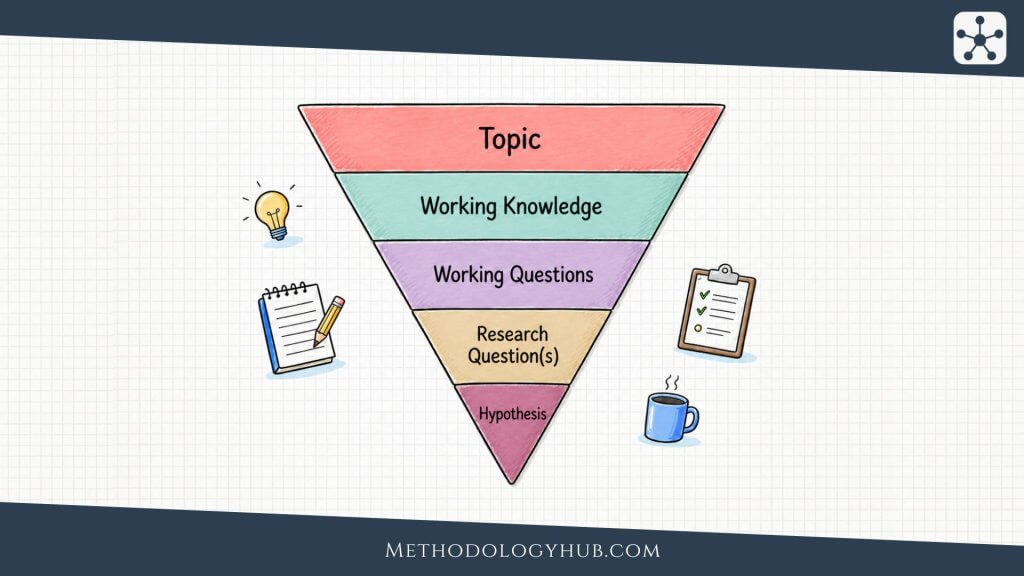
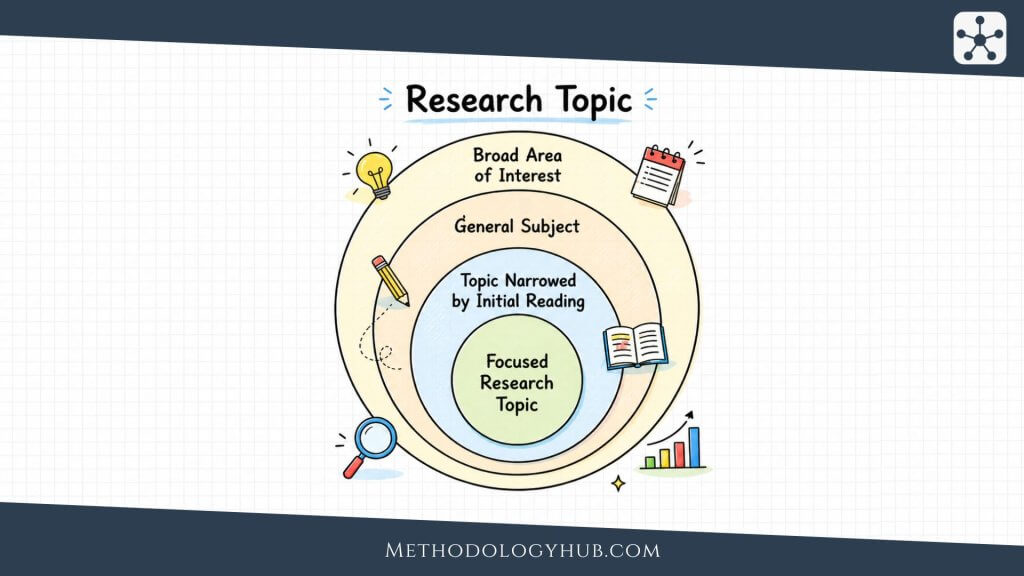
This means case study research can connect to several categories in a wider research process. A researcher may begin with a broad research topic, narrow it into a case, and then decide whether the aim is to explore, describe, explain, evaluate, or compare.
Exploratory case study research
An exploratory case study is useful when the researcher needs to learn what is happening before asking a more precise question. This is common when a new policy has just been introduced, when a technology is used in an unexpected way, or when a group has received little previous study.
For example, a researcher may study how one school adapts to a new assessment system during its first year. At the beginning, the researcher may not know which staff routines, student reactions, or administrative pressures will become important. The case study allows the researcher to follow those developments and use them to refine later questions.
Descriptive case study research
A descriptive case study gives a structured account of a case. It may describe how a community programme operates, how a classroom routine is organised, how a clinical team makes decisions, or how a research group manages data. The aim is not only to tell a story. It is to describe the case with enough detail and structure that readers can understand its parts and boundaries.
This kind of case study often works well when a field needs a clear picture before explanation is possible. A descriptive account of a programme may show who participates, what activities occur, how decisions are made, which documents guide practice, and where tensions appear. Later studies can then ask more focused explanatory questions.
Explanatory case study research
An explanatory case study asks how or why an outcome, event, or process occurred. It is often linked with explanatory research because the researcher is not satisfied with reporting that something happened. They want to examine the sequence, mechanisms, conditions, and decisions that made the outcome possible.
For instance, if a tutoring programme improved attendance in one school, an explanatory case study might examine how students were recruited, how tutors built relationships, how attendance was tracked, and how families responded. The final explanation may be more careful than a simple statement that tutoring “caused” attendance to rise. It may show that tutoring worked under certain conditions and through certain routines.
Plain distinction: exploratory case studies open up a case, descriptive case studies map it carefully, and explanatory case studies examine how or why a pattern occurred.
Evaluation-oriented case study research
Case study research can also support evaluation research. Instead of asking only whether a programme reached a target, the researcher can study how the programme was delivered, how participants experienced it, and why results differed across settings.
This is especially useful for complex interventions. A public health campaign, teacher development programme, or community service may not work in the same way everywhere. A case study can show how the intervention interacted with staff capacity, participant needs, local resources, and everyday practice. The findings may then guide decisions about adaptation, continuation, or further study.
Key Aspects of Case Study Research
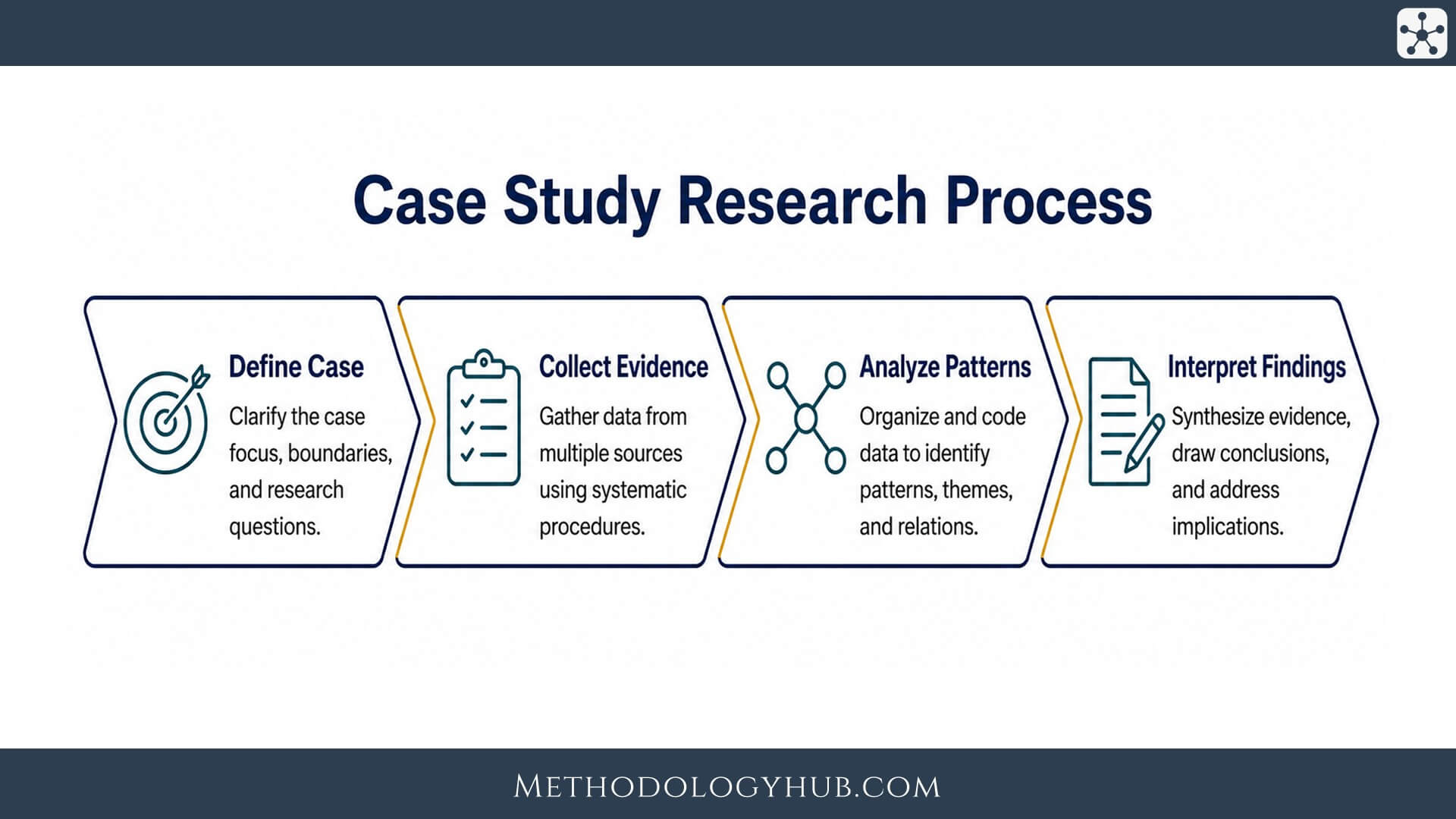
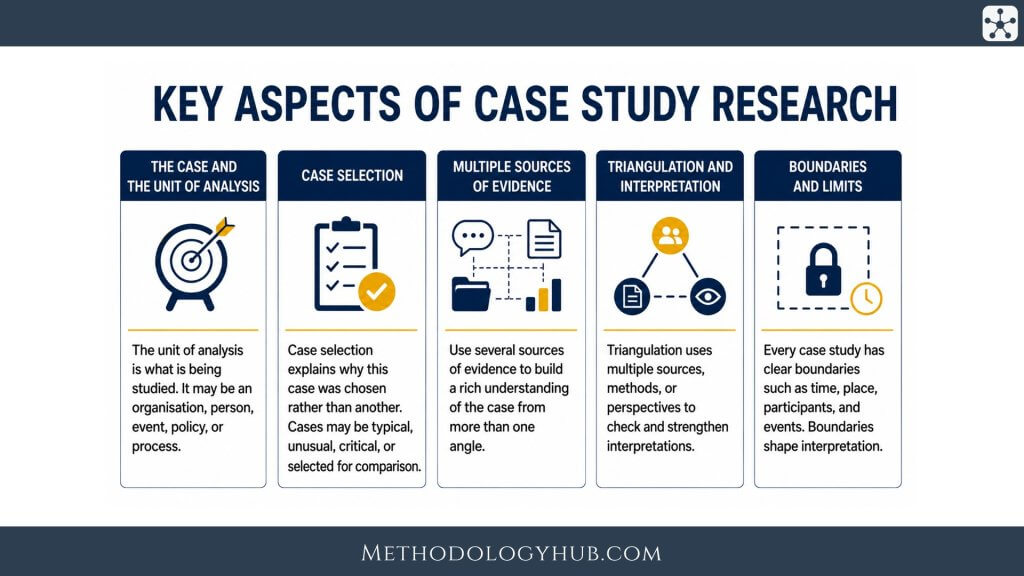
The main parts of case study research are easier to understand when they are seen as one design chain. The researcher begins with a question, defines the case, explains why the case was selected, gathers evidence from suitable sources, analyses the case in relation to the question, and reports how the interpretation was built.
Each part has to fit the others. A case cannot be chosen only because it is easy to reach. The evidence cannot be chosen only because it is convenient. A case study becomes stronger when the reader can see why this case, these data, and this analysis belong together.
The case and the unit of analysis
The unit of analysis is the main thing being studied. In some projects, the unit is one organisation. In others, it may be a student, a classroom, a clinic, a policy event, a project team, or a digital platform. A study may also contain embedded units. For example, a case study of one school may analyse teachers, lessons, policy documents, and student records inside that school.
Confusion often begins when the case and the data source are treated as the same thing. A teacher interview is not the case if the actual case is the school reform programme. A set of meeting minutes is not the case if the case is the decision-making process in one department. The researcher should name the case first, then show which evidence helps examine it.
Case selection
Case selection explains why the researcher chose this case rather than another one. The case may be typical, unusual, critical, successful, troubled, changing quickly, or especially clear for studying a process. In a multiple-case design, cases may be selected because they are similar in one respect but different in another, allowing comparison.
Selection should follow the question. A researcher interested in how a policy is implemented may choose a case where the policy is active and observable. A researcher interested in breakdown may choose a case where implementation stalled. A researcher interested in variation may choose several cases with different conditions.
Multiple sources of evidence
Case study research often uses several sources of evidence. This may include interviews, observation, documents, administrative records, artefacts, survey data, field notes, photographs, test scores, or meeting records. The point is not to collect everything available. The point is to collect evidence that helps answer the question from more than one angle.
Using several sources can help the researcher compare what people say, what documents record, and what happens in practice. For example, a policy document may describe a mentoring programme as weekly and structured, while observation notes may show that meetings are irregular and informal. That difference is not a problem to hide. It may be part of the finding.
Triangulation and interpretation
Triangulation means using more than one source, perspective, method, or moment of data collection to examine the case. It does not mean forcing every source to say the same thing. Sometimes the most useful part of triangulation is the difference between sources.
If participants describe a process as simple but documents show several hidden approval steps, the researcher has learned something about how the process is perceived and how it is formally organised. If observation shows that a classroom routine works differently from the written lesson plan, that difference can deepen the interpretation. A strong case study explains how these pieces of evidence were compared and what the comparison showed.
Boundaries and limits
Every case study needs boundaries. Without boundaries, the project can grow until the researcher is studying everything around the case. Boundaries may be set by time, place, participant group, document type, event sequence, or stage of a programme. These decisions should be visible in the method section.
Boundaries also shape interpretation. A case study of the first six months of a school reform cannot claim to explain its long-term effects. A case study of one hospital ward cannot describe all hospitals. This does not make the study weak. It simply tells readers how far the evidence can reasonably travel.
Types of Case Studies
Case study research can take several forms, depending on what the researcher wants to understand about the case. Some case studies describe a situation in detail. Others compare cases, explain a process, test an interpretation, or use one case to illuminate a wider issue. The type of case study should follow from the research question, the available evidence, and the kind of conclusion the study can reasonably support.
These types are not always completely separate. A single project may be mainly descriptive but also include explanatory elements. A comparative case study may also be instrumental if the cases are used to understand a broader concept. The labels are most useful when they clarify the purpose of the design rather than turning the study into a rigid category exercise.
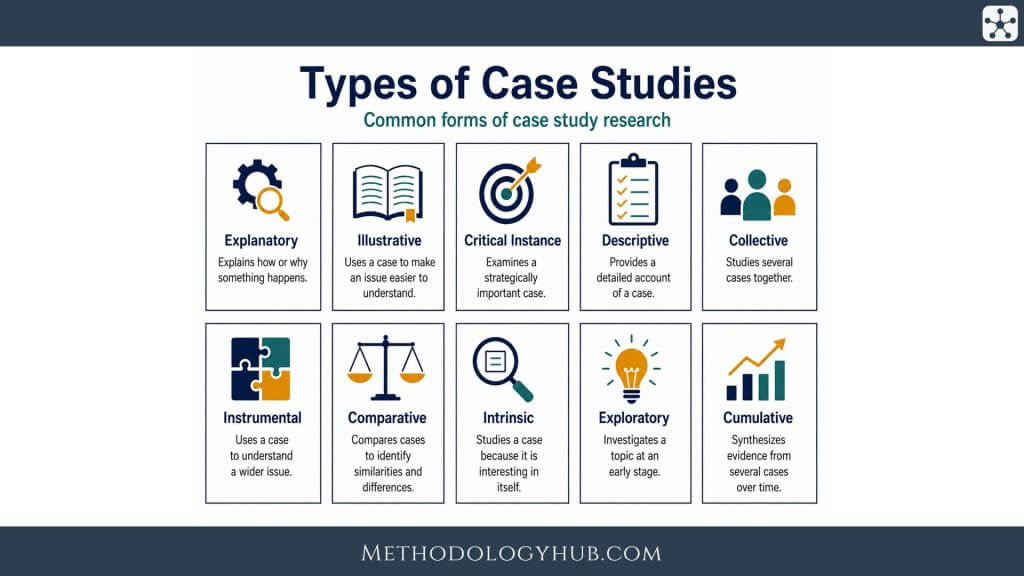
Explanatory Case Study
An explanatory case study investigates how or why something happened. It is often used when the researcher wants to understand a process, outcome, decision, change, or relationship in its real-world setting. Instead of only showing that an event occurred, the study traces the conditions and actions that helped produce it.
For example, a researcher may study why one school successfully adopted a new assessment policy while another struggled with the same policy. The explanation might involve leadership, teacher training, time pressure, local culture, or previous experience with reform. In this type of case study, evidence is usually organised around a possible explanation, and the researcher examines whether that explanation fits the documents, interviews, observations, and other research data.
Illustrative Case Study
An illustrative case study uses a case to make an unfamiliar issue easier to understand. The case acts as a concrete example of a process, practice, policy, or concept that may otherwise feel abstract. This type is common in teaching, professional reports, and introductory research because it helps readers see how a general idea appears in a real setting.
The goal is not usually to test a theory in a strict way. The goal is to show the shape of the phenomenon through a clear example. For instance, an illustrative case study might show how a classroom uses formative feedback during a writing unit, or how a clinic organises patient follow-up after discharge. The case should be specific enough to be useful, but the researcher should avoid treating one example as proof that the same pattern appears everywhere.
Critical Instance Case Study
A critical instance case study focuses on a case that is especially important for examining a claim, assumption, or situation. The case may be unusual, intense, high-risk, decisive, or strategically chosen because it can reveal something that ordinary cases may not show as clearly.
For example, a researcher might study a school that achieved strong results under difficult conditions, or a public programme that failed even though it appeared well-funded and well-designed. The value of the case comes from its ability to test or sharpen an interpretation. A critical instance case study therefore needs a strong reason for selecting the case. The reader should understand why this case, rather than another, can provide insight into the research problem.
Descriptive Case Study
A descriptive case study gives a detailed account of a case within its boundaries and context. It may describe a programme, community, classroom, organisation, event, decision-making process, or set of practices. The focus is on careful description rather than direct causal explanation.
Descriptive case studies are useful when the subject is complex and not yet well documented. A researcher may describe how a school counselling service works, how a local archive is organised, or how students use peer support in a course. The quality of the study depends on clear boundaries: what is included, what is excluded, what period is studied, and which sources of evidence are used. Good description is not casual storytelling. It is systematic, selective, and connected to a clear research purpose.
Collective Case Study
A collective case study examines several cases together in order to understand a broader issue. The researcher is not interested only in each case by itself, but also in what can be learned by looking across the cases. This type is often used when one case would be too narrow to show variation.
For example, a researcher might study several schools that introduced the same reading intervention, several hospitals using the same patient record system, or several community organisations responding to the same local problem. Each case is analysed on its own first, then compared with the others. The strength of a collective case study lies in its ability to show patterns, differences, and conditions across cases without losing the depth of individual case analysis.
Instrumental Case Study
An instrumental case study uses a case to understand something beyond the case itself. The case is important because it helps the researcher examine a concept, process, theory, or problem. The case is therefore a means of investigation, not only the final subject of interest.
For instance, a researcher may study one university department to understand how academic staff adapt to curriculum change. The department is the case, but the wider interest is adaptation to change. This type of case study is common in qualitative research, although it can also include numerical evidence. The researcher should make the wider issue clear so readers can see why the selected case is useful.
Comparative Case Study
A comparative case study examines two or more cases in relation to one another. The purpose is to understand similarities, differences, or patterns across cases. Comparison may be used to study different institutions, groups, countries, classrooms, programmes, policies, or time periods.
The cases should be selected for a reason. They may be similar in most respects but different in one important condition, or they may be different settings that face a similar problem. A comparative case study is strongest when the comparison is planned from the beginning. The researcher should decide what will be compared, which evidence will be collected in each case, and how the comparison will be interpreted.
Intrinsic Case Study
An intrinsic case study is conducted because the case itself is of direct interest. The researcher wants to understand this particular case in depth, not mainly because it represents other cases or tests a wider theory. The case may be unique, historically important, locally meaningful, or simply worth studying on its own terms.
For example, a researcher may study one school with a distinctive history, one community project, one classroom culture, or one organisation undergoing a rare transition. The aim is to understand the case as fully as possible within the limits of the study. An intrinsic case study can still connect to wider literature, but it does not need to claim that the case stands for a whole population.
Exploratory Case Study
An exploratory case study is used when the researcher is entering a topic that is not yet clearly understood. It helps identify possible questions, concepts, variables, sources of evidence, or directions for later research. This type is useful at the early stage of a project, especially when the researcher does not yet know which parts of the case will be most important.
For example, a researcher may explore how students experience a new online learning system before designing a larger survey. Interviews, observations, documents, and usage records may reveal concerns that were not visible at the start. The exploratory case study can then help refine the research process and support a more focused later design.
Cumulative Case Study
A cumulative case study brings together evidence from several cases studied over time. Instead of starting from one new case only, the researcher compares and synthesises findings from earlier cases to build a broader understanding. This type can be useful when a field already has several case reports, but the findings need to be organised more clearly.
For example, a researcher may examine published case studies of teacher mentoring programmes, community health initiatives, or digital learning projects. The goal is to see what the cases suggest together: which patterns repeat, which conditions differ, and which conclusions remain uncertain. A cumulative case study depends on careful selection and comparison, because weak or incompatible case evidence can lead to a shallow synthesis.
Case Study Research Methods
Case study research methods are the tools used to gather and analyse evidence about the case. A case study can be built from one method, but many use several. The choice depends on the question, the case boundary, the access available, and the kind of evidence needed.
Because case studies often examine complex real settings, the researcher should explain not only which methods were used, but also how they connect to the case. A list of interviews and documents is less useful than a clear explanation of how each source helps answer the question.
Interviews
Interviews are common in case study research because they let the researcher ask participants how they experienced, interpreted, or acted within the case. An interview may focus on decisions, routines, relationships, conflicts, expectations, or changes over time. Semi-structured interviews are often useful because they give the researcher a guide while still allowing participants to explain what the researcher did not anticipate.
In a case study of a new school timetable, interviews might include teachers, students, administrators, and parents. Each group may see a different part of the case. Teachers may discuss planning time, students may describe fatigue, administrators may describe scheduling limits, and parents may describe changes at home. Together, these accounts give a fuller picture than one group alone.
Observation and field notes
Observation allows the researcher to see practices as they occur. It is especially useful when the study concerns interaction, routines, physical setting, or informal behaviour. Field notes can record what happened, who was present, how space was used, which documents or tools appeared, and how participants responded to events.
Observation can also reveal differences between formal descriptions and everyday practice. A clinic protocol may state that patients receive the same explanation at intake, but observation may show that the explanation changes depending on staff workload or patient questions. In a case study, that difference can become part of the analysis.
Documents and records
Documents help researchers understand the formal and historical side of a case. They may include policy texts, meeting minutes, lesson plans, reports, emails, manuals, assessment rubrics, public statements, archival materials, or case files. Records may include attendance data, service use, grades, waiting times, referrals, or administrative logs.
Documents should not be treated as neutral mirrors. They are produced for particular purposes and audiences. A school improvement plan, for example, may show official goals, but it may not show how teachers negotiated those goals in practice. The researcher can compare documents with interviews and observation to see how formal accounts and lived practice connect.
Survey and quantitative evidence
Some case studies include numerical evidence. A researcher may use short surveys, test scores, attendance patterns, service statistics, network measures, or counts of events. This does not make the study any less of a case study. It simply means the case is being examined with both qualitative and quantitative evidence.
Quantitative evidence can help describe patterns inside the case. For example, a case study of a mentoring scheme may include student survey responses, appointment records, and retention data. The researcher may then connect these patterns with interview accounts and programme documents. When statistical testing is used, the analysis should still fit the case design and should be reported with care through suitable statistical methods or statistical analysis.
| Method | What it can add to a case study | Example evidence |
|---|---|---|
| Interviews | Participant accounts, meanings, decisions, and experiences | Teacher, student, patient, staff, or manager interviews |
| Observation | Practice, interaction, setting, routine, and sequence | Classroom notes, meeting notes, clinic observations |
| Documents | Formal rules, plans, records, histories, and written accounts | Policies, reports, minutes, manuals, emails |
| Quantitative data | Patterns, counts, trends, and measured differences inside the case | Attendance, test scores, waiting times, survey responses |
The methods should work together rather than sit beside one another as separate fragments. The researcher should explain how interview themes were compared with documents, how observations informed later interviews, or how numerical patterns were interpreted alongside participant accounts. This connection is often where the case study becomes most useful.
Methodological Approaches
Case study research is often associated with qualitative research, but it is not limited to qualitative data. A case study can be qualitative, quantitative, or mixed methods. It can focus on one case or several cases. It can be exploratory, descriptive, explanatory, comparative, or evaluation-oriented.
The methodological approach should be chosen after the researcher knows what the case is and what the study is trying to learn from it. A case study of one student’s learning experience will look different from a case study of several hospitals implementing the same referral system.
Qualitative case study research
Qualitative case study research studies the meanings, actions, relationships, documents, and conditions inside a case. It usually works with interviews, observation, field notes, documents, and open-ended records. The analysis may produce themes, categories, narrative accounts, timelines, or explanations of a process.
This approach fits questions about experience, interpretation, practice, and context. A researcher may ask how teachers adapt a new curriculum, how students experience a transition year, or how a community organisation responds to policy change. The strength of qualitative case study research lies in the close reading of evidence and the careful description of context.
Quantitative case study research
Quantitative case study research uses numerical evidence within a bounded case. The researcher may analyse records, scores, frequencies, response patterns, or changes over time. This approach can be useful when the case has measurable features and when the researcher wants to describe or examine patterns inside it.
For example, a researcher studying one school intervention may analyse attendance, grades, survey scores, and participation logs from that school. The design remains a case study if the analysis is organised around that bounded case and interpreted in relation to its setting. The researcher should avoid presenting the numbers as if they came from a representative population sample unless the sampling design supports that claim.
Mixed methods case study research
A mixed methods case study combines qualitative and quantitative evidence in a planned design. This can be useful when the researcher needs both measured patterns and detailed explanation. A survey may show that participants report uneven access to support, while interviews and documents may explain how access is shaped by schedules, eligibility rules, or staff roles.
Integration is the central task. The researcher should explain when the qualitative and quantitative strands were collected, how one strand informed the other, and how the final interpretation was built from both. Without that connection, the study becomes two small projects placed side by side.
Single-case and multiple-case designs
A single-case design studies one case in depth. This can be suitable when the case is unusual, typical, revealing, critical, longitudinal, or especially rich for the research question. A single-case study may follow one classroom, one organisation, one patient pathway, one policy decision, or one historical event.
A multiple-case design studies two or more cases. The researcher may compare similar cases, contrasting cases, or cases that show different outcomes. Multiple-case designs can make patterns easier to compare, but they also require more planning. Each case needs enough depth to be meaningful, and the cross-case analysis should not flatten the differences that made the cases worth studying.
Case study research and empirical evidence
Most case studies are forms of empirical research because they use observed, collected, or recorded evidence. They may also be connected to theoretical research when the case is used to refine a concept, challenge an assumption, or develop an explanation that can guide later studies.
The relationship between evidence and theory should be handled carefully. A case study may begin with a theory and examine how well it fits the case. It may begin with the case and build a more grounded explanation from the evidence. It may also move back and forth between theory and data as the analysis develops.
Case Study Research vs. Other Designs
Case study research is often compared with experimental, survey, correlational, and comparative designs. These designs can overlap in practice, but they answer different kinds of questions. The distinction is not about which design is better. It is about what each design is built to show.
A study can even combine designs. A researcher might use a case study inside an applied research project, compare several cases in comparative research, or include case studies after a survey to explain patterns. The label should match the main design logic.
Case study research vs. experimental research
Experimental research usually manipulates an intervention or condition and compares groups under controlled rules. Case study research usually examines a case in its real setting without trying to control all conditions. An experiment asks what effect follows when a condition is changed under a defined design. A case study asks how a case works in context, often with attention to sequence, meaning, and setting.
The difference affects causal claims. Experiments can be strong for estimating effects when random assignment and control are feasible. Case studies can be strong for examining mechanisms, implementation, and conditions. A case study may show why an intervention worked in one setting, why it failed in another, or which local processes shaped the outcome.
Case study research vs. quasi-experimental research
Quasi-experimental research studies effects when random assignment is not used or not possible. It may compare existing groups, time periods, or naturally occurring exposure conditions. Case study research may include comparisons, but its main logic is usually depth within a bounded case or across several cases.
A quasi-experimental study of a reading programme might compare test scores before and after implementation across schools. A case study of the same programme might examine how teachers used the materials, how students responded, what support was available, and why the programme changed during implementation. These two designs can complement each other when the research question needs both effect estimation and contextual explanation.
Case study research vs. survey research
Survey research collects responses from many participants, often to describe attitudes, behaviours, experiences, or characteristics across a larger group. Case study research usually studies fewer cases in greater depth. A survey can show how common a pattern is. A case study can show how that pattern is produced, interpreted, or organised inside a setting.
For example, a survey may find that many students report difficulty accessing academic support. A case study can examine one support centre in detail to see how booking systems, opening hours, staff roles, communication, and student confidence shape access. The survey gives breadth. The case study gives depth.
Case study research vs. correlational research
Correlational research examines relationships between variables without manipulating them. It may ask whether study time is associated with exam score, whether stress is related to sleep, or whether service use is related to satisfaction. Case study research may include variables, but it usually treats them as part of a wider case rather than as isolated measures.
A correlational study may show that two variables are related. A case study can examine the process behind that relationship in one setting. For example, if attendance and achievement are correlated, a case study can investigate routines, transport, family responsibilities, teacher support, and peer relationships that shape attendance.
| Design | Main focus | Typical strength |
|---|---|---|
| Case study research | A bounded case in context | Depth, process, context, explanation |
| Experimental research | Manipulated condition and comparison | Effect estimation under controlled rules |
| Survey research | Responses across many people or units | Breadth, frequency, population description |
| Correlational research | Relationships between variables | Association, prediction, pattern detection |
Case study research is also related to non-experimental research, because many case studies observe and analyse without manipulating conditions. It can be cross-sectional research when the case is examined during one defined period, or longitudinal research when the case is followed across time.
How to Perform Case Study Research
Performing case study research requires more than choosing an interesting example. The researcher needs to turn a topic into a case, connect the case to a question, collect suitable research data, and show how the analysis was developed. The steps below give a practical sequence for planning and reporting a case study.
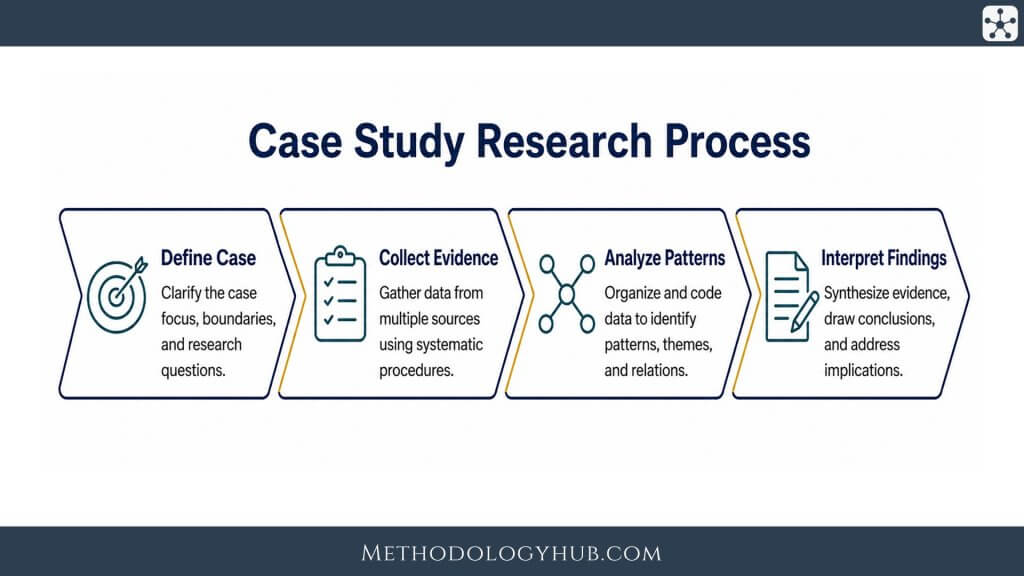
Step 1: Start with a focused research question
The research question should tell the researcher what kind of case is needed. Questions that begin with how, why, in what way, or under what conditions often fit case study research well. A question such as “How did one school adapt its feedback policy during the first year of implementation?” points toward a bounded case, a timeframe, and a process.
A question that asks for a population percentage, such as “What percentage of students prefer written feedback?”, may fit survey research better. A question that asks whether one intervention causes higher scores may require an experimental or quasi-experimental design. The design should follow the question rather than the other way around.
Step 2: Define the case and its boundaries
The researcher should define the case in plain terms. Is it one school, one policy, one class, one organisation, one project, one patient pathway, or one decision process? The boundaries should also be stated. This includes the time period, setting, participants or units, and evidence types included in the study.
Boundary decisions prevent the project from drifting. A case study of one programme during its pilot year should not quietly become a study of every related policy in the organisation. A clear boundary also helps readers understand what the study can and cannot claim.
Step 3: Select the case or cases
Case selection should be justified. The researcher may choose a case because it is typical, unusual, accessible in depth, information-rich, theoretically interesting, or useful for comparison. In a multiple-case study, each case should have a reason for inclusion.
For example, a researcher comparing three schools may select one where the programme was implemented smoothly, one where it changed during implementation, and one where it stalled. This selection creates a basis for comparison. The researcher can then ask which conditions and decisions were present in each case.
Step 4: Plan the evidence sources
The researcher should decide which evidence sources are needed and how they will be gathered. Interviews may show participant experience. Observation may show routines. Documents may show formal rules. Records may show patterns. Survey responses may show how common certain perceptions are inside the case.
The plan should also include inclusion criteria. Who will be interviewed? Which documents will be included? Which time period will be analysed? Which observations will be recorded? These choices are part of the design and should not be left vague.
Step 5: Collect and organise the data
Case study data can quickly become large and varied. A researcher may have transcripts, field notes, documents, spreadsheets, diagrams, photographs, and memos. Organisation is therefore part of method quality. Files should be named consistently, dates should be recorded, and evidence should be linked to the case boundary.
Many case study researchers create a case record or case database. This does not need to be complicated. It may be a structured folder system, a spreadsheet that tracks sources, or qualitative analysis software with clear labels. The goal is to make the route from evidence to interpretation traceable.
Step 6: Analyse within the case
Within-case analysis means studying each case on its own terms before rushing to compare or generalise. The researcher may create a timeline, code interview transcripts, compare documents, map events, examine quantitative patterns, or write a case narrative.
This stage helps the researcher understand what happened in the case and how the evidence fits together. A timeline may show that a policy change came after staff shortages, not before. A document comparison may show that programme goals shifted during implementation. Interview themes may show that participants interpreted the same event in different ways.
Step 7: Compare, interpret, and report
If the design includes several cases, cross-case analysis follows. The researcher compares patterns across cases while keeping each case intact enough for the differences to make sense. The report should explain what was similar, what differed, and how those findings answer the research question.
The final report should also show how the conclusion was reached. Readers should see the case boundary, selection logic, data sources, analysis steps, and evidence behind the interpretation. A case study report does not need to include every detail collected, but it should include enough evidence for readers to follow the argument.
Strengths and Limitations
Case study research is useful when a researcher wants to study a case in depth rather than separate it from the setting in which it exists. The case may be a classroom, school, clinic, community, organisation, policy, event, programme, project, family, person, or decision process. What makes the design distinctive is not only the small number of cases. It is the attention given to context, boundaries, evidence, and interpretation.
The strengths and limitations of case study research are closely connected. The same features that make the design rich can also make it difficult to summarise. The same attention to context that gives the study depth can limit how far the findings can be generalised. For this reason, case study research works best when the researcher is clear about what the design can show, what it cannot show, and how the evidence will be used.
Strengths of Case Study Research
One of the main strengths of case study research is depth. A case study can examine a situation from several angles and over a meaningful period of time. Instead of reducing the case to one score or one short observation, the researcher can combine interviews, observations, documents, records, field notes, and other forms of research data. This makes the design especially useful when the topic is complex and the researcher needs to understand how different parts of the case connect.
Depth is not the same as collecting everything available. A strong case study still needs a focused research question and clear boundaries. The strength comes from being able to study the case with enough detail to show relationships between people, actions, documents, decisions, and conditions. For example, a case study of a school improvement programme may examine leadership decisions, teacher interviews, lesson observations, student work, policy documents, and assessment records. Each source gives a partial view. Together, they create a fuller account of the case.
Another strength is the ability to study real-world context. Many research designs try to control or remove contextual variation so that a narrow relationship can be tested. Case study research often does the opposite. It treats the setting as part of the explanation. In a study of a community health programme, the local history, staffing pattern, funding arrangement, participant trust, and service routine may all shape how the programme works. A case study can keep those conditions visible instead of treating them as background noise.
Case study research is also flexible in its use of evidence. It can be used in qualitative research, quantitative research, or mixed methods research. A qualitative case study may focus on interviews and observations. A quantitative case study may include performance records, attendance data, or survey results. A mixed methods case study may use numerical patterns to describe what happened and qualitative evidence to explain how participants experienced the process.
A further strength is the possibility of studying processes as they unfold. Some research questions cannot be answered well with a single measurement. A researcher may want to know how a policy was introduced, how a group responded to change, how a conflict developed, or how an intervention was adapted during implementation. Case study research can follow these sequences and show turning points, delays, disagreements, and adjustments.
This process view is especially helpful in applied fields such as education, health, social work, public administration, and community research. A final outcome may show whether something improved, but the case study can show how the improvement developed. It can also show why a programme that looked strong on paper did not work as expected in practice.
Case study research can also support theory development. A carefully studied case may refine an existing concept, suggest a new explanation, or show that a theory needs adjustment in a particular setting. This is especially useful in early-stage research, where the field may not yet have stable variables or established measures. In that situation, a case study can help identify which concepts deserve closer study in later descriptive research, explanatory research, survey research, or comparative work.
Limitations of Case Study Research
The first limitation is generalisation. Case study research usually examines one case or a small number of cases. This means the findings should not be presented as if they automatically describe a full population. A detailed study of one school, one clinic, or one organisation can produce valuable understanding, but it cannot by itself estimate how common a pattern is across all schools, clinics, or organisations.
This does not make case study research weak. It means the claims must be framed carefully. Instead of claiming statistical generalisation, many case studies support analytical generalisation. The researcher connects the case findings to concepts, theory, or similar settings, while explaining the conditions under which the interpretation may apply. If broader population claims are needed, a different design may be required, such as survey research or a larger comparative study.
A second limitation is case selection. Because case study research often depends on a small number of cases, the selection decision carries a lot of weight. A case chosen only because it is easy to access may not be suitable for the question. A case chosen because it is unusual may be useful, but the researcher must explain what makes it useful. Without a clear selection logic, readers may not know whether the case was typical, extreme, critical, convenient, or selected for another reason.
This limitation connects closely to sampling methods. Case studies do not always use sampling in the same way as large surveys, but they still require deliberate choices about who or what is included. The researcher may need to choose participants, documents, events, time periods, departments, classrooms, meetings, or observations within the case. These smaller choices affect the evidence and should be reported clearly.
A third limitation is the risk of uneven evidence. Case studies often use multiple data sources, but not all sources are equally strong. Some documents may be incomplete. Some interviewees may remember events differently. Some observations may capture only part of the process. A researcher who relies too heavily on one type of evidence may produce an interpretation that looks detailed but is actually narrow.
For this reason, case study research benefits from triangulation. Triangulation means comparing evidence from different sources, methods, times, or perspectives. If interview accounts, documents, and observations point in the same direction, the interpretation becomes more convincing. If they differ, the disagreement may become part of the finding. The researcher should not force all evidence into one smooth story when the case itself is more complicated.
Another limitation is the time required. A good case study can be demanding. The researcher may need to gain access, build trust, collect several forms of evidence, organise large amounts of material, and write a clear account without losing the complexity of the case. This can make case study research slower than designs that use a shorter instrument or a single dataset.
Analysis can also be challenging. Case study evidence may include transcripts, field notes, tables, documents, photographs, timelines, and records. The researcher needs a transparent plan for organising and analysing this material. In some studies, qualitative coding is central. In others, timelines, matrices, cross-case comparison, or descriptive statistics may be used. If numerical evidence is included, the researcher may also need appropriate statistical analysis, although many case studies rely more on interpretation than formal statistical testing.
A final limitation is researcher interpretation. Because case study research often involves close engagement with the case, the researcher plays a visible role in selecting evidence, interpreting meaning, and deciding what belongs in the final report. This does not make the design less rigorous, but it does mean the report should show how conclusions were reached. Readers need enough information about the case boundaries, sources, procedures, and analysis to judge whether the interpretation is well supported.
The best way to handle these limitations is not to hide them. A strong case study states its boundaries, explains its case selection, reports its evidence carefully, and frames its claims at the right level. When this is done well, case study research can offer a detailed and credible account of cases that would be difficult to understand through distant measurement alone.
Examples of Case Study Research
Examples can make the design easier to recognise. The cases below are not full studies, but they show how a topic becomes a bounded case and how methods can be matched to the question.
Example 1: A classroom feedback routine
A researcher wants to understand how a new feedback routine changes writing lessons in one secondary school class. The case is one class during one semester. Evidence may include lesson observations, teacher interviews, student focus groups, samples of written feedback, and student revision records.
The study would not claim to represent all writing classes. Instead, it would show how this routine worked in one bounded setting. It might reveal that the routine changed student revision habits only when feedback time was built into the lesson, or that students understood comments differently from the way the teacher intended.
Example 2: A university mentoring programme
A university introduces a mentoring programme for first-year students. A case study could examine one department where the programme had high participation. The researcher might use programme documents, appointment records, interviews with mentors and students, and short survey responses from participants.
The analysis could show how mentor training, timetable fit, staff communication, and student trust shaped participation. If the researcher wanted comparison, they could study another department where participation was lower and examine how local conditions differed.
Example 3: A public service implementation process
A local agency introduces a new referral system. A case study may follow the first year of implementation. Evidence could include policy documents, staff meetings, referral records, interviews with frontline workers, and observation of intake procedures.
This example fits case study research because the researcher is interested in how the system operated in context. The analysis may show that the formal referral pathway looked simple on paper but became more complex when staff had to deal with missing information, unclear eligibility rules, or uneven communication between teams.
Example 4: A multiple-case comparison of schools
A researcher studies how three schools respond to the same attendance policy. Each school is a case. The researcher may collect attendance records, policy documents, staff interviews, parent communication materials, and field notes from attendance meetings.
The cross-case analysis could compare how leadership routines, family contact practices, transport access, and staff roles shaped the policy in each school. This is different from simply ranking the schools by attendance rates. The case study asks how the policy became a different practical process in each setting.
FAQs on Case Study Research
What is case study research?
Case study research is a research design that studies one bounded case or a small number of cases in depth and in context. The case may be a person, group, organisation, programme, event, setting, policy, or process.
What is the purpose of case study research?
The purpose of case study research is to understand a case in detail. It can be used to explore a new topic, describe a setting or process, explain how or why something happened, compare cases, or evaluate a programme in context.
What are examples of case study research?
Examples include a study of one classroom using a new feedback routine, one hospital ward introducing a referral system, one community programme during its pilot year, or several schools implementing the same policy in different ways.
Is case study research qualitative or quantitative?
Case study research can be qualitative, quantitative, or mixed methods. Many case studies use qualitative evidence such as interviews, observation, and documents, but some also include numerical records, surveys, counts, or test scores.
What is the difference between case study research and survey research?
Survey research usually collects responses from many people or units to describe patterns across a wider group. Case study research studies one case or a small number of cases in greater depth, with attention to context, sequence, and evidence from several sources.