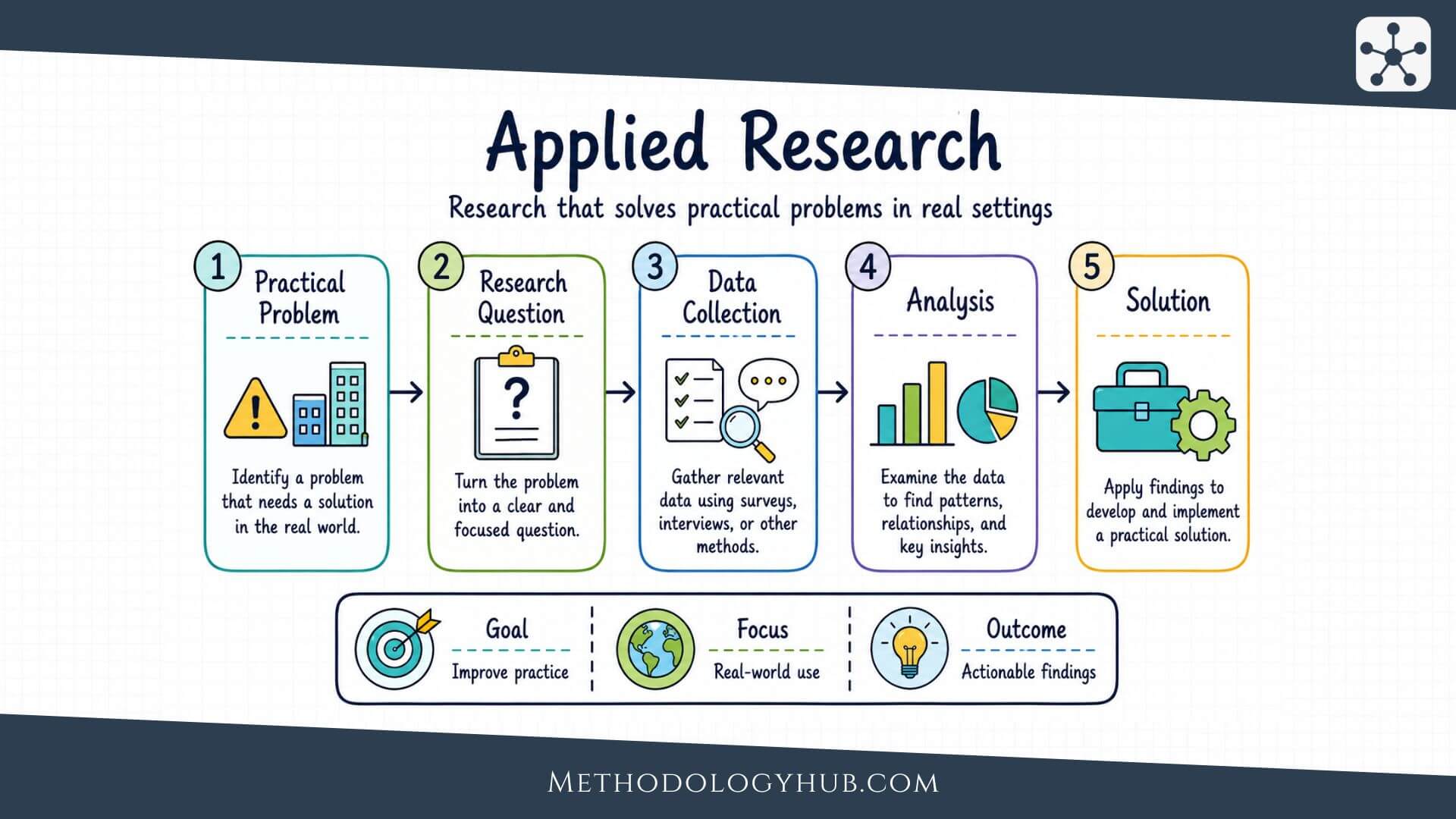
Applied research is research designed to answer a practical question, improve a real situation, or help solve a defined problem. It uses systematic methods, just like other forms of academic research, but its starting point is usually a problem found in practice: a teaching method that needs testing, a health intervention that needs evidence, a public programme that needs refinement, or an environmental issue that needs a workable response.
This article explains what applied research is, what its objectives are, how it differs from basic research, which aspects shape a strong applied study, how to perform applied research step by step, and what applied research can look like in different academic fields.
What Is Applied Research?
Applied research is a type of research conducted to address a specific practical problem. The problem may come from a classroom, clinic, community organisation, public service, workplace, laboratory, archive, or natural environment. What makes the study applied is not the method by itself. It is the way the research question is tied to a practical situation where the findings are expected to guide a decision, improve a process, test a solution, or clarify what should be done next.
For example, a researcher may study whether a short tutoring programme improves reading fluency among pupils who are below grade level. The study goes beyond reading development as a general concept. It tries to answer a concrete question about a specific intervention, population, setting, and outcome. The same applied logic appears when a health researcher compares appointment reminder systems, when an environmental scientist tests ways to reduce water contamination, or when a public administration researcher studies whether a new intake procedure reduces waiting time.
Applied research definition
Applied research means using systematic inquiry to produce knowledge that can be used in relation to a practical problem. The study still needs a clear research question, a suitable design, transparent data collection, and careful interpretation. It is not the same as casual trial and error, even though it often begins from a problem that practitioners, policymakers, teachers, clinicians, engineers, or community workers can recognise.
A useful way to read the term is to focus on the connection between knowledge and use. Applied research asks what evidence can help people understand a real problem more clearly or choose between possible responses. Sometimes the study tests a proposed solution. Sometimes it diagnoses the problem before any solution is chosen. Sometimes it compares several options and shows which one fits the setting best.
Applied research in academic research
Applied research belongs inside academic research because it follows the same expectations of clarity, evidence, and reasoning. A study does not become weak simply because it has a practical goal. The strength of the study depends on how well the problem is defined, how suitable the design is, how reliable the data are, and how carefully the conclusion stays within the evidence.
Applied research can be quantitative research, qualitative research, or mixed methods research. A quantitative study may measure whether an intervention changes test scores. A qualitative study may examine how nurses experience a new handover system. A mixed methods study may combine outcome measures with interviews so that the researcher can see both what changed and how participants made sense of the change.
What applied research can show
Applied research can show whether a proposed change is associated with better outcomes, which needs are present in a group, how a service is used, why an intervention is difficult to implement, or which conditions affect whether a solution works. The answer may be numerical, interpretive, comparative, or descriptive, depending on the design.
At the same time, applied research should not promise more than the design can support. A small interview study can give deep insight into experience, but it should not be written as if it estimated a whole population. A one-group before-and-after study can describe change over time, but it needs caution before claiming that the intervention caused the change. A strong applied study makes this connection clear: it explains what the evidence supports and which parts still need further study.
Objectives of Applied Research
The objectives of applied research are shaped by the problem the study is trying to address. In some projects, the objective is to test whether a solution works. In others, the first task is slower and more diagnostic: to understand the problem, describe its scale, identify the people affected by it, or examine why a current practice is not producing the expected result.
This is why applied research is not always experimental. A researcher cannot test a solution properly if the problem has been poorly defined. A school may want to improve attendance, but the useful research question depends on what the attendance problem actually looks like. Is it concentrated in one year level. Is it linked to transport. Is it connected to illness, workload, school climate, or family responsibilities. Different findings would lead to different responses.
Diagnosing a practical problem
One objective of applied research is to describe and understand a practical problem before choosing an intervention. This kind of study may use surveys, interviews, administrative records, observations, or document analysis. The purpose is not simply to collect background information. It is to turn a broad concern into a sharper research problem.
For example, a university may notice that many first-year students stop attending laboratory sessions. An applied study could examine attendance records, interview students, and compare timetabling patterns across departments. The findings may show that the issue is not lack of interest, but timetable overload or confusion about assessment. In that situation, an intervention aimed only at motivation would miss the real problem.
Testing a solution or intervention
Another common objective is to test whether a proposed solution produces the intended result. This type of applied research often uses experimental research, quasi-experimental research, or a carefully designed comparison. The researcher may compare groups, measure outcomes before and after an intervention, or examine whether changes differ across sites.
Suppose a clinic introduces a text-message reminder system to reduce missed appointments. An applied study may compare missed appointment rates before and after the reminder system, or compare clinics that use the system with similar clinics that do not. The research question is practical, but the design still has to handle alternative explanations. A drop in missed appointments could be caused by the reminder system, but it could also be influenced by seasonal demand, staffing changes, or differences between clinics.
Plain distinction: diagnosing a problem asks what is happening and why. Testing a solution asks whether a planned response changes the outcome in the intended direction.
Improving practice or procedure
Applied research often aims to improve a practice rather than judge a single intervention as simply successful or unsuccessful. This is common in education, health services, social work, libraries, environmental management, and public administration. The study may show which parts of a process work, which parts create difficulty, and how users or participants respond.
This objective connects applied research to action research, especially when practitioners study their own setting while introducing changes. Still, applied research is broader than action research. An applied study may be conducted by an outside researcher, may use a single data collection period, or may compare several institutions rather than working through repeated cycles of planning and reflection.
Supporting evidence-based decisions
Applied research can also support decisions about programmes, policies, services, or resource use. A public library may study whether extended evening hours reach students who cannot visit during the day. A local health service may examine whether community translation support improves access to appointments. A conservation team may test whether a restoration technique improves plant survival across several sites.
In these cases, the objective goes beyond producing an academic article. The study is expected to inform a choice. That does not mean the researcher simply tells decision makers what they want to hear. The value of applied research comes from disciplined evidence, including findings that show a preferred solution is too limited, too costly, poorly targeted, or only useful under certain conditions.
Key Aspects of Applied Research
The key aspects of applied research are easier to understand if they are read as one connected design rather than as separate checklist items. A practical problem has to be turned into a research question. That question has to be studied in a real setting. The researcher then needs suitable evidence, a clear analysis plan, and an interpretation that explains how far the findings can travel beyond the study context.
Consider a project on feedback in school writing lessons. A teacher or researcher may suspect that pupils receive feedback too late to use it. Applied research would not stop at that complaint. It would define the setting, identify the learners and feedback process, decide what counts as useful evidence, and ask a question such as: how does the timing of written feedback affect revision quality in Year 9 essays. The research problem becomes smaller and more answerable.
Practical problem and research question
Applied research starts with a practical problem, but the problem has to be translated into a researchable question. A broad concern such as low achievement, poor uptake, high dropout, service delay, or weak participation is usually too wide. The question should name the population, setting, outcome, process, or experience being studied.
This step often connects to the research topic. The topic gives the general area. The question turns that area into a study. A topic such as student wellbeing can become an applied research question about whether peer mentoring reduces reported isolation among first-year students during the first semester.
Context and setting
The setting carries more weight in applied research than in many purely conceptual studies. A programme that works in a small school may not work the same way in a large university. A health reminder system may work in a clinic where patients have stable phone access, but less well in a community where contact information changes often. These details are not distractions. They help readers understand the conditions under which the findings are useful.
A strong applied study therefore reports the setting clearly: who was involved, where the study took place, what the existing practice was, which limits shaped implementation, and what counted as success or improvement. Context does not make the study less academic. It makes the practical claim easier to judge.
Data and measurement
Applied research depends on suitable research data. The data may be numerical scores, attendance records, observations, interviews, documents, performance measures, environmental samples, or service records. The form of the data should follow the question rather than the other way around.
If the study asks whether a tutoring programme improves reading fluency, the researcher needs a measure of reading fluency that is appropriate for the learners and the timeframe. If the study asks how patients experience a new appointment system, interviews or open survey responses may give better evidence than a single satisfaction score. If the study asks whether a water treatment method reduces contamination, the data need to come from a sampling and measurement procedure that can detect the relevant change.
Variables, outcomes, and comparison
Many applied studies use variables because they examine change, difference, or association. A variable may be an outcome such as test score, waiting time, infection rate, attendance, reported stress, or plant survival. Another variable may describe exposure to an intervention, group membership, time period, location, or background characteristic.
Applied research becomes stronger when the comparison is planned carefully. A before-and-after comparison may be useful, but it can be weakened if many other things changed at the same time. A comparison group can help, but only if the groups are similar enough for the interpretation. In some settings, random assignment is possible. In others, researchers use quasi-experimental, longitudinal, case study, survey, or mixed methods designs to build the best possible answer within real constraints.
Interpretation and transfer
The interpretation of applied research should connect the findings back to the practical problem. The researcher should explain what the results suggest for the setting, which conditions shaped the result, and how cautious readers should be when applying the finding elsewhere.
This is different from claiming that one study gives a universal solution. Applied findings often travel through similarity of context. A literacy intervention tested in one group of pupils may be informative for similar pupils in similar schools, but the conclusion should not ignore age, language background, teacher training, timetable, materials, or baseline reading level. Careful interpretation protects the practical use of the study because it tells readers where the evidence is strongest.
Basic vs Applied Research
Basic vs applied research is a distinction based on purpose. Basic research aims to develop knowledge, theory, concepts, or explanation. Applied research aims to use research evidence in relation to a practical problem. The two are often presented as opposites, but in real academic work they are closely connected.
A study of how working memory supports reading comprehension may be basic research if the goal is to improve theory about cognition. A study testing whether a working-memory-informed classroom strategy helps struggling readers may be applied research. The second project may depend on the first. At the same time, the applied project may reveal new questions for basic research, especially if the strategy works for some learners but not for others.
Difference in purpose
The simplest difference is the first intention of the study. Basic research asks questions such as how a process works, how a concept should be defined, or whether a theory explains an observed pattern. Applied research asks how evidence can help address a practical problem, choose between actions, improve a procedure, or test a response.
This difference does not make one type more academic than the other. A basic study can be poorly designed, and an applied study can be rigorous. The point is to identify what the study is trying to contribute. Basic research usually contributes to understanding. Applied research usually contributes to informed action in a specific problem area.
Difference in research question
Basic research questions often focus on explanation, theory, mechanism, or conceptual clarity. Applied research questions usually include a practical setting, outcome, group, intervention, service, process, or decision. The wording often reveals the difference.
A basic question might ask: how does feedback timing influence memory consolidation during learning. An applied question might ask: does same-day feedback improve revision quality in ninth-grade writing assignments compared with feedback returned one week later. Both questions are connected, but they operate at different levels of use.
| Aspect | Basic research | Applied research |
|---|---|---|
| Main purpose | Develop understanding, concepts, or theory. | Address a practical problem or inform a decision. |
| Starting point | A gap in knowledge or explanation. | A practical problem, need, or decision. |
| Typical output | Theory, model, concept, explanation, or new knowledge. | Evidence for action, improvement, intervention, policy, or procedure. |
| Use of findings | May be useful later or indirectly. | Usually intended for use in a defined problem area. |
How basic and applied research connect
The connection between basic and applied research is often more interesting than the contrast. Basic research can give applied researchers better theories, measures, and explanations. Applied research can show whether those theories hold when people, institutions, and environments are less controlled than in a laboratory or model.
For example, basic research on memory may shape the design of spaced learning activities. Applied education research may then test those activities in actual classrooms. If the intervention produces uneven results, that finding can push basic researchers to examine attention, motivation, feedback, or prior knowledge more closely. The movement is not one-way. Knowledge and use can revise one another.
When the boundary is not clean
Some studies sit between basic and applied research. A project may test a theory while also addressing a practical problem. Another project may begin from a real setting but produce a conceptual model that other researchers use later. This overlap is common in education, medicine, psychology, environmental science, engineering, and social research.
Because of this overlap, the label should not be used mechanically. The better question is: what is the study mainly trying to contribute. If the central contribution is a clearer theory or explanation, it leans toward basic research. If the central contribution is evidence for a practical decision or response, it leans toward applied research. Many studies do both, but one purpose usually guides the design more strongly.
How to Perform Applied Research
To perform applied research, begin with the practical problem and gradually turn it into a study that can produce trustworthy evidence. The process should feel practical, but not rushed. A researcher who moves straight from problem to solution may miss the reason the problem exists, the conditions that shape it, or the evidence needed to judge whether a response worked.
The steps below describe a general path. Different fields will adapt the details. A clinical study, classroom study, environmental field study, and public service study will not use the same instruments or procedures. They can still follow the same design logic: define the problem, ask a clear question, choose a suitable method, collect relevant data, analyse the evidence, and interpret the results in context.
Step 1: Define the practical problem
The first step is to describe the problem as precisely as possible. A vague problem such as poor performance, low participation, unsafe conditions, slow service, or weak communication is only a starting point. The researcher needs to ask who is affected, where the problem appears, how it is noticed, how long it has been present, and what evidence already exists.
In an education study, the problem might shift from “students do not revise well” to “students in one year level rarely use teacher comments when rewriting argumentative essays.” That narrower problem is easier to study. It points toward a population, setting, task, behaviour, and possible evidence.
Step 2: Review existing knowledge
Applied research should not begin as if nothing is known. A short but careful review helps the researcher see how the problem has been studied before, which concepts are useful, which methods have been tried, and where the current setting may differ from earlier studies. This review may include academic literature, local reports, policy documents, records, or previous evaluations.
The purpose is not to fill the introduction with references. It is to avoid repeating weak designs and to build a better question. A researcher studying appointment reminders, for instance, should know whether similar reminders have been tested in comparable clinics, what outcomes were measured, and which barriers affected implementation.
Step 3: Write the research question
The research question should connect the practical problem to evidence. It should be narrow enough to guide design decisions and open enough to allow honest findings. In quantitative applied research, the question may ask whether one variable changes, differs, or predicts another. In qualitative applied research, it may ask how participants experience a process or why a procedure works differently across settings.
Some applied studies also use a research hypothesis. A hypothesis may predict that a new feedback routine improves revision quality, that a reminder system reduces missed appointments, or that students with access to a support service have higher completion rates. A hypothesis should be stated before the analysis and should follow from the research question and previous evidence.
Step 4: Choose the research design
The design should match the question. If the study asks whether an intervention changes an outcome, an experimental or quasi-experimental design may fit. If the study asks how a service is experienced, interviews, observations, or open-ended survey responses may be suitable. If the study asks how a problem appears across a population, survey research may be appropriate. If the study examines one bounded setting in detail, case study research may fit.
Applied studies also differ by timeframe. A cross-sectional research design can describe a situation at one point in time. A longitudinal research design can study change across weeks, months, or years. The right choice depends on what the problem requires. If the research question concerns improvement or sustainability, a single snapshot may be too thin.
Step 5: Plan sampling and data collection
The researcher then decides who or what will be included. Participants, records, classrooms, clinics, documents, sites, or observations should be selected in a way that fits the claim. A study intended to estimate a population pattern may need a probability-based sample. A study of a specialised experience may need purposive selection. A study comparing groups must make the comparison transparent.
Data collection should be practical enough to complete, but careful enough to support the analysis. In an applied study, practical constraints are normal: school timetables, clinic systems, access to records, seasonal field conditions, staff availability, and participant burden can shape the design. These constraints should be reported rather than hidden.
Step 6: Analyse the data
The analysis should answer the research question rather than simply produce many outputs. Quantitative applied studies may use descriptive statistics, group comparisons, regression models, or other statistical methods. When the study tests differences or relationships, statistical analysis should be chosen according to the variables, design, sample size, and assumptions.
Qualitative applied studies may use thematic analysis, framework analysis, document analysis, or other interpretive procedures. The analysis should show how evidence was organised and how conclusions were reached. In mixed methods work, the researcher should explain how the numerical and qualitative findings speak to one another. For example, outcome data may show that a programme improved attendance, while interviews explain why students found the programme usable.
Step 7: Interpret the findings for the problem
The final step is to return to the practical problem without overreaching. The researcher should state what the findings suggest, what they do not show, and how the setting shaped the result. A useful applied conclusion often includes conditions: this response worked for this group, in this setting, over this period, using these resources, and with these limitations.
That kind of interpretation may look cautious, but it is more useful than a broad claim that ignores context. Applied research is often read by people who want to decide what to do. They need to know the result and the conditions under which the result was produced.
Examples of Applied Research
Examples of applied research are easiest to recognise when the research question points to a practical setting and a possible use of the findings. The examples below are simplified, but they show how the same applied logic can appear across different fields. Each one begins with a real problem, then uses research methods to produce evidence that can guide a decision or improve practice.
Applied research examples should not be read as templates where only the topic changes. A good design depends on the field, population, setting, available data, and type of claim. Still, the examples show the kinds of questions applied researchers often ask.
Applied research in education
An education researcher may study whether a structured peer feedback routine improves the quality of student revisions in secondary school writing. The practical problem is that students receive comments but do not use them well. The study might compare classes using the routine with classes using the existing feedback approach, then analyse revision quality, student reflections, and teacher observations.
This example could use a quasi-experimental design if classes are compared without random assignment. It could also use mixed methods if scores are combined with interviews or classroom observation. The applied contribution would not be a general theory of writing development. It would be evidence about a feedback routine in a defined teaching situation.
Applied research in health
A health researcher may examine whether a nurse-led follow-up call reduces hospital readmission among patients with a chronic condition. The study could compare patients who receive the call with a similar group who receive usual discharge information. The outcome might be readmission within 30 days, but the researcher may also collect patient feedback to understand whether the calls were understandable and usable.
This example shows why applied research often needs more than one kind of evidence. A programme may reduce readmission but place too much workload on staff. Or it may be easy to run but fail to reach patients with unstable housing or limited phone access. The practical conclusion depends on both outcome and implementation.
Applied research in environmental science
An environmental scientist may test whether a local wetland restoration technique improves water quality and plant survival. The study could compare restored sites with similar unrestored sites, take repeated measurements across a season, and record changes in nutrient levels, plant growth, and site conditions.
Here, the applied problem is environmental management. The design might be comparative and longitudinal because the researcher needs to observe change over time. The findings could guide local restoration planning, but the report should explain climate, soil, water flow, species, and maintenance conditions so that other readers can judge whether the results fit their own sites.
Applied research in public administration
A public administration researcher may study whether a simplified application form reduces errors in social service applications. The study could examine application records before and after the form is changed, compare error rates, and interview staff about the kinds of mistakes that remain.
The finding may show that the form reduces missing information but does not reduce misunderstanding about eligibility. That result would still be useful. It would suggest that the form helps with one part of the problem, while guidance or support may be needed for another part. Applied research does not need to produce a perfect solution to produce useful evidence.
Applied research in social research
A social researcher may investigate how young adults use community study spaces when they do not have quiet conditions at home. The study could use observations, interviews, short surveys, and attendance records. The findings might help a school, library, or youth service decide opening times, staffing, room layout, or support services.
This kind of applied research may be mainly qualitative or mixed methods. The practical result may not be a single intervention effect. It may be a clearer understanding of access, barriers, routines, and user needs. That can be enough to guide a better design for the service.
| Field | Practical problem | Possible applied research question |
|---|---|---|
| Education | Students do not use written feedback effectively. | Does a peer feedback routine improve revision quality in writing assignments? |
| Health | Patients miss follow-up appointments. | Does a reminder call reduce missed follow-up appointments among eligible patients? |
| Environment | A restoration technique has uncertain field results. | How does the technique affect water quality and plant survival across one growing season? |
| Public service | Application forms are often submitted with errors. | Does a simplified form reduce error rates in submitted applications? |
Strengths and Limits of Applied Research
Applied research has strengths because it connects systematic inquiry with real problems. It can help people move beyond opinion, habit, or assumption. A teacher may believe that faster feedback helps students, a clinic may believe that reminders reduce missed appointments, or a community service may believe that a new intake procedure is easier for users. Applied research tests, describes, or examines such claims with evidence.
Its limits come from the same practical conditions that make it useful. Applied studies often take place in settings that cannot be fully controlled. Participants may differ across groups. Programmes may be implemented unevenly. Records may be incomplete. A policy or procedure may change during the study. These are not reasons to avoid applied research. They are reasons to design and report it carefully.
Strength: close connection to real problems
The main strength of applied research is that it stays close to problems people actually face. Instead of asking only whether something is theoretically possible, it asks how a process works with real people, existing resources, institutional routines, and practical constraints. This makes the findings easier to use when the study is well designed.
For students, this feature also makes applied research easier to understand. The question usually has a visible situation behind it. A study of attendance, feedback, appointment access, water quality, or service use can be connected to a setting that readers can picture.
Strength: useful comparison between options
Applied research can compare options before a decision is made. A school may compare two forms of reading support. A hospital may compare two patient information formats. A local authority may compare two ways of organising appointments. The comparison may involve outcomes, cost, workload, user experience, or fit with existing routines.
This does not mean applied research always gives a single simple answer. Sometimes it shows trade-offs. One option may produce better outcomes but require more staff time. Another may be easier to run but less effective for the group with the greatest need. A good applied study makes those trade-offs visible.
Limit: context can narrow interpretation
Applied findings are often shaped by context. A procedure may work because a particular team has experience, because participants are highly motivated, because the setting has strong resources, or because the timeframe is short. If those conditions change, the result may change too.
This is why applied research should describe its setting and conditions carefully. The goal is not to make the study sound smaller. It is to help readers judge whether the finding can inform their own setting. A finding that is carefully bounded may be more useful than a broad claim that hides the limits of the evidence.
Limit: implementation can affect the result
In applied research, a solution may fail because the idea is weak, but it may also fail because it was not implemented as planned. A reading programme may be taught inconsistently. A reminder system may not reach patients with outdated contact details. A form may be redesigned, but staff may not receive enough training to explain it.
For this reason, applied researchers often collect process evidence as well as outcome evidence. Outcome data may show whether change occurred. Process data help explain how the change was introduced and why the result appeared. Without that second layer, it can be difficult to know whether to revise the solution, the delivery, or the original problem definition.
FAQs on Applied Research
What is applied research?
Applied research is research designed to address a practical problem, improve a real situation, test a solution, or support a decision. It uses systematic methods, but its starting point is a problem found in practice.
What is the main purpose of applied research?
The main purpose of applied research is to produce evidence that can help address a defined practical problem. It may diagnose the problem, test an intervention, improve a procedure, compare options, or support a decision.
What is the difference between basic and applied research?
Basic research mainly develops knowledge, concepts, theories, or explanations. Applied research mainly uses research evidence to address a practical problem. The two types often connect because basic research can guide applied studies, and applied studies can raise new theoretical questions.
What are examples of applied research?
Examples of applied research include testing whether a tutoring programme improves reading fluency, studying whether reminder calls reduce missed appointments, examining whether a wetland restoration method improves water quality, or evaluating whether a simplified application form reduces errors.