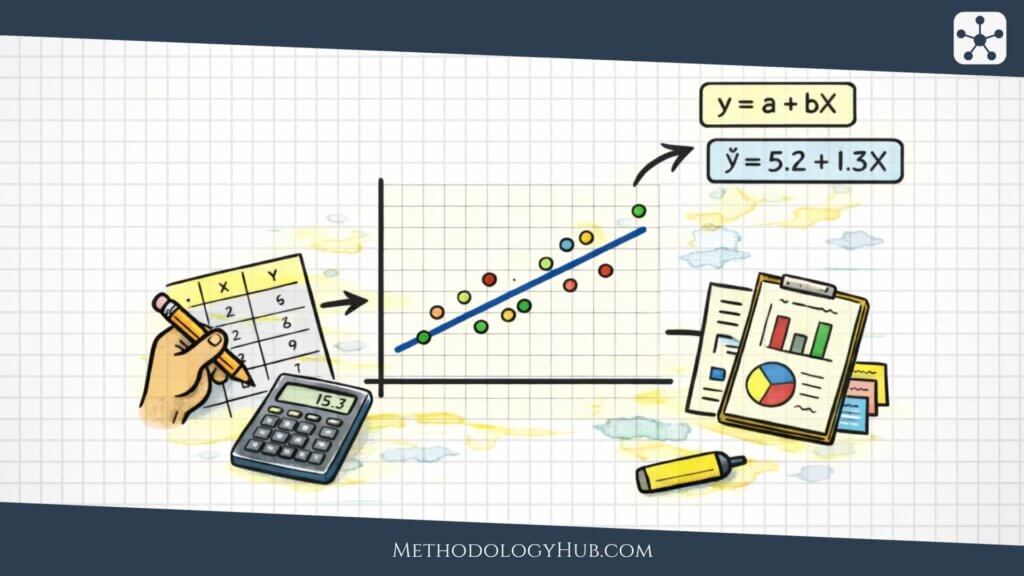
The research process is the route from a first idea to a finished piece of research. It is where a broad interest becomes a question, where that question is matched with evidence, and where the researcher works out what can honestly be said at the end. A useful process does not make research automatic.
This article walks through the research process in a practical way. It explains what each stage is for and how they connect, so the process feels less like a list of terms and more like the work a researcher actually does.
What is the research process?
The research process is the organised path used to answer a research question. It usually starts with a research topic or problem, then moves through reading, question development, design, data collection, analysis, interpretation, and reporting. The exact shape changes from one discipline to another, but the same basic issue remains: the researcher has to make a series of choices and show how those choices led to the final answer.
Those choices are the real work of research. A researcher has to decide what evidence would be convincing, where that evidence can be found, how it should be collected, and how far the results can be taken. When those decisions are left vague, the study becomes hard to trust. When they are explained clearly, readers can follow the route from question to conclusion.
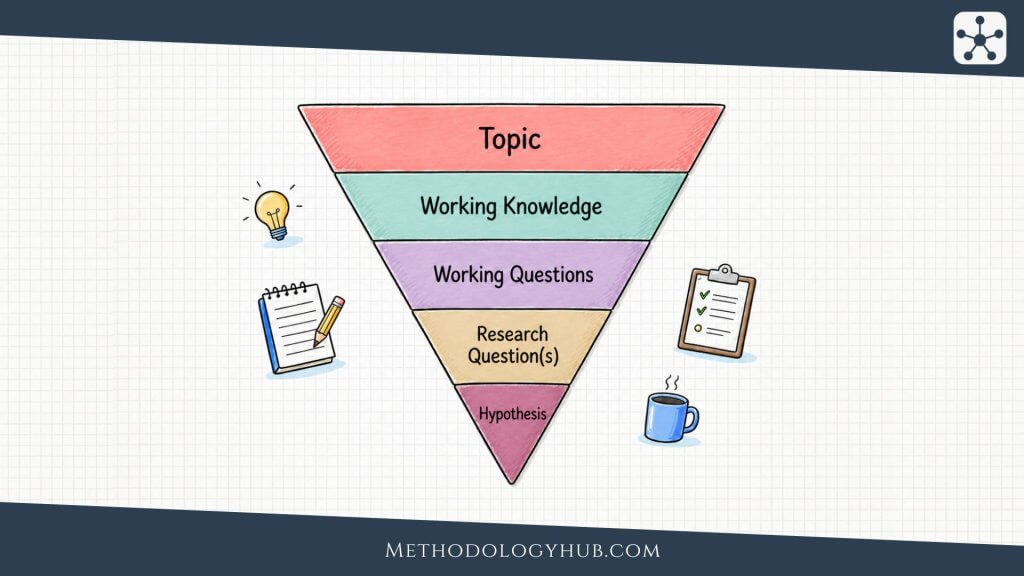
Research process definition
A simple definition is this: the research process is the planned movement from a research problem to an evidence-based conclusion. It includes choosing a topic, reading what is already known, writing a research question, choosing a design, selecting methods, collecting and analysing data, interpreting the findings, and reporting the study clearly.
That definition matters because research is not the same as gathering information. A person can read many sources, collect many facts, and still not have a study. Research needs a question, a method, and a reasoned answer. Without that structure, the project often becomes a file of useful notes rather than an investigation.
In practice, the research process helps researchers do the following:
- move from a broad topic to a specific question
- understand what is already known about the topic
- choose a suitable design and method
- collect evidence in a consistent way
- analyse findings without jumping too quickly to conclusions
- report the study so that readers can follow the reasoning
What the research process does
The research process gives shape to work that can easily become messy. At the start, a researcher may only have a general interest, such as student sleep, public health communication, climate adaptation, reading habits, soil quality, memory, or urban transport. That interest is a beginning, not a study. It becomes research when the researcher narrows it, asks something specific, and works out what kind of evidence could answer it.
The process also helps prevent common mistakes. Researchers can become attached to a method too early, collect data before the question is clear, or read results as if they say more than they really do. Moving through the stages carefully slows that down. Each decision has to be tied back to the purpose of the study.
Research process and research methodology
The research process and research methodology are related, but they are not the same thing. The research process is the whole route of the study, from the first research topic to the final report. Research methodology is the explanation of how the study is designed and carried out. It usually covers the design, methods, sampling, data collection, analysis, and ethical handling of the work.
One way to separate them is to think of the research process as the full journey and the methodology as the route through the middle of that journey. A methodology section normally does not describe every early idea or every abandoned draft. It explains the planned choices that make the study credible: what was studied, who or what was included, how evidence was gathered, and how it was analysed.
This distinction is useful because students often treat methodology as a list of tools. It should do more than name a survey, interview, experiment, observation, document study, or statistical model. The reader needs to understand why that method fits the question and how it was actually used.
Basic research and applied research
The same process can be used in basic research and applied research, although the purpose of the work differs. Basic research usually tries to improve understanding of a concept, mechanism, relationship, or theory. Applied research is aimed at a practical problem, decision, programme, intervention, or setting.
For example, a basic research project might ask how working memory changes under different task conditions. An applied project might ask whether a particular teaching method improves recall among first-year students. Both still need a topic, a review of previous work, a research question, a design, methods, data, analysis, and a conclusion. What changes is the purpose of the question and how the findings are likely to be used.
The main steps of the research process
The research process is often shown as a set of steps because that makes the work easier to plan. Instead of treating research as one large task, the researcher can break it into smaller decisions: choose a topic, read around it, turn it into a question, design the study, collect evidence, analyse the evidence, interpret the findings, and report the work.
In real projects, though, the steps do not always happen in a neat line. Reading may reveal that the first question was too broad. A pilot test may show that a survey item is confusing. Early analysis may expose missing data or a variable that has to be recoded. Research moves forward, but it often loops back when the work shows what needs to be changed.
The 10 research process steps
A practical version of the research process includes ten main steps:
- Choose a research topic: identify a broad area and narrow it into something manageable.
- Conduct background research: learn the basic terms, debates, and available sources.
- Develop a research question: turn the topic into a focused question that can be answered.
- Review the literature: examine previous studies and organise what is already known.
- Choose a research design: decide what kind of study will answer the question.
- Select research methods: choose how evidence will be collected or generated.
- Collect data: gather the information needed for analysis.
- Analyse data: organise, examine, calculate, compare, or interpret the evidence.
- Interpret findings: explain what the results show in relation to the question.
- Write and present the research: report the study clearly, including limits and implications.
These ten steps can be adapted for different fields. Some projects begin with a research hypothesis, while others begin with a case, a problem, a set of documents, or an existing dataset. Some require ethics approval before any contact with participants. Others use public records or published material. The details change, but the logic stays much the same: ask a question, make a plan, gather evidence, analyse it, and explain what the evidence supports.
How the steps connect
The stages depend on one another. A clear topic makes early reading easier. Early reading helps sharpen the question. The question guides the literature review. The literature review shapes the design. The design affects the method. The method determines what kind of data can be collected. The data then limits what kind of analysis and conclusion are possible.
Problems usually appear when one part of the process is out of line with the others. A study may claim to examine student wellbeing but use a questionnaire that only measures grades. Another may ask about change over time but collect data only once. Another may describe a broad population but use a sample that cannot represent it. These are not small formatting problems. They decide whether the study can answer its own question.
The process is planned, but not frozen
Planning does not mean the study is frozen from the beginning. Research often improves because the researcher notices problems early and fixes them. A topic may turn out to be too wide. A question may need clearer wording. A source base may be thin. A questionnaire, coding frame, or measurement tool may not work as expected. These moments are part of learning what the study can realistically do.
The point is to make changes deliberately. When the question changes, the design may also need to change. When the sample changes, the conclusion may need a narrower scope. When the analysis changes, the reason should be recorded. A flexible process can still be careful, as long as the researcher keeps track of the decisions and explains them.
Step 1: choosing a research topic
The first step in the research process is choosing a topic. A topic is the general area the study will deal with. It is not yet the research question, and it is not the method. It is the starting point that gives the project a direction.
This step can seem easy, but many research problems begin here. A research topic may be too broad, too vague, too personal, too familiar, too hard to access, or too dependent on evidence the researcher cannot obtain. The early task is therefore not simply to choose something interesting. It is to choose something that can be turned into research.
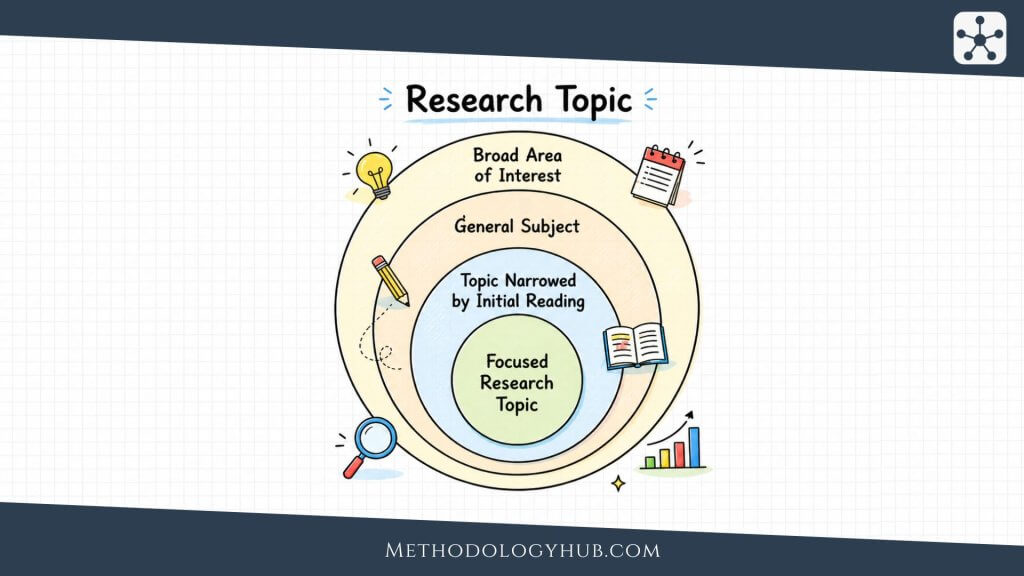
Start with a broad area
Many studies begin with a broad area of interest. A student may be interested in exam stress, reading comprehension, hospital discharge, renewable energy, online learning, urban transport, memory, language acquisition, or childhood nutrition. At this stage, the topic is usually too wide. That is normal. The first version only needs to point the researcher in a useful direction.
The topic then has to be narrowed. Online learning, for example, could become attendance in online university seminars, feedback in remote courses, student engagement with recorded lectures, or assessment design in online programmes. Each narrower version gives the researcher a more realistic path for reading, questioning, and collecting evidence.
Narrow the topic into something researchable
A researchable topic is one that can be studied with the time, sources, data, and methods available. It should be specific enough to guide the work, but not so narrow that there is nothing to examine. A useful topic often names a group, setting, text, case, relationship, event, problem, intervention, or outcome.
For example, “sleep and students” is too broad for most projects. “Sleep duration and self-reported concentration among first-year university students” is much more workable. It suggests a population, possible variables, and a likely form of data collection. It still needs to become a research question, but it is already closer to a study.
Before settling on a topic, ask:
- Can the topic be studied with the time and resources available?
- Is there enough existing literature to understand the field?
- Can data or evidence be accessed legally and ethically?
- Is the topic specific enough to avoid drifting in several directions?
- Can the topic lead to a question rather than only a description?
Check the evidence before committing
A topic can sound promising and still fail if the evidence is not available. This happens when students choose a current problem but cannot obtain reliable data, or when they choose a group they cannot reach. It can also happen when the topic depends on private records, restricted archives, specialist equipment, or permissions that are unlikely to be granted.
A quick evidence check can save a lot of time. Search library databases, recent journals, public datasets, institutional reports, archive catalogues, and reference lists. The aim is not to complete the literature review yet. The aim is to find out whether the topic can support a real project. If every useful source is inaccessible, or if the available material is too weak, the topic may need to change.
Avoid starting with a fixed answer
Another common mistake is choosing a topic because the researcher already knows what they want to prove. That makes the project biased from the start. Research can begin with expectations, but it should not begin with a conclusion that the evidence is expected to defend.
For example, “proving that homework improves learning” is not a good starting point. A better version would examine the relationship between homework type and learning outcomes in a defined setting. The second version allows the evidence to matter. The first version asks the study to protect an answer that has already been chosen.
Step 2: conducting background research
Background research is the early reading and checking that helps the researcher understand the topic before writing the final research question. It is lighter and more exploratory than a full literature review. Its job is to help the researcher learn the language of the topic, see what has already been studied, and notice which sources or data may be available.
This stage is especially useful when the researcher knows the broad area but not the angle. Background reading can show which terms are used in the field, which findings keep appearing, where researchers disagree, and which questions have already been answered many times.
What background research includes
Background research can include textbooks, review articles, recent journal articles, research reports, handbooks, datasets, policy documents, clinical guidelines, archive catalogues, or discipline-specific databases. The best starting points depend on the field. A psychology student may begin with review articles and measurement tools. A history student may begin with archive guides and secondary scholarship. A public health student may begin with epidemiological data and systematic reviews.
The first job is to build a working map of the topic. The researcher should learn the main terms, the methods commonly used, the populations or cases that appear often, and the findings that have already been reported. This saves time later because the research question is less likely to repeat something obvious or miss a debate that readers would expect to see.
Read to understand the field, not to collect quotations
Early reading becomes unhelpful when the researcher copies pages of notes without knowing why they matter. A better approach is to read with questions in mind. What does this source define? What does it measure? What problem does it raise? What method does it use? What does it leave uncertain?
Good background notes are usually short and useful. They do not need to record every line of every source. They should help the researcher decide what the project could ask, what kind of evidence might be available, and which direction is realistic.
Useful background notes often include:
- main concepts and definitions
- common research designs in the topic area
- frequently studied populations or settings
- repeated findings across several sources
- limitations or gaps mentioned by authors
- possible datasets, instruments, archives, or participant groups
Use background research to refine the topic
Background research should leave the topic sharper than it was at the start. If the researcher begins with “student stress,” early reading may show separate routes through assessment load, financial pressure, sleep, social support, international student adjustment, or clinical training. Each route would lead to a different study.
The researcher then has to choose. A single study cannot cover every interesting angle. Narrowing the topic is not a loss of depth. It is the step that makes the study possible. The clearer the focus becomes, the easier it is to choose sources, write a question, and select a method.
Keep track of sources from the start
Even early sources should be recorded properly. Students often lose time because they find useful material, write scattered notes, and later cannot remember where an idea came from. A simple reference manager, spreadsheet, or structured note file can prevent that problem.
At this stage, each source note should include the full reference, a link or DOI where available, the main idea, and a short comment on possible use. This habit also protects the writing later. When notes separate the author’s wording from the researcher’s own comments, paraphrasing and citation become much cleaner.
Step 3: developing a research question
The research question is the question the study is trying to answer. It takes a broad topic and turns it into something the researcher can actually investigate. Without a clear research question, a project can easily become a collection of information rather than a focused study with a clear purpose.
A good research question gives the study direction from the beginning. It helps the researcher decide what matters, what does not belong in the study, and what kind of evidence is needed to answer the question properly. It also helps the reader understand what the study is about before they get to the method, analysis, or results.
Research topic vs research question
A research topic names the general area the researcher is interested in. A research question asks something specific about that area. For example, “remote learning” is only a topic. It tells us the general subject, but not what the study will actually examine. A question such as “How does recorded lecture use relate to exam performance among first-year biology students?” is much more useful because it identifies a relationship, a group of people, and the kind of evidence the researcher might need.
Research questions can be written in different ways depending on the purpose of the study. Some questions describe a pattern, while others compare groups, test relationships, examine possible causes, evaluate an intervention, or interpret texts, records, and events. The important point is that the question should match what the researcher wants to find out and what the study can realistically answer.
Features of a good research question
A good research question is clear, focused, researchable, and connected to the field. It should not be so broad that the project becomes impossible, or so narrow that the answer is obvious. It should also use language that fits the concepts found in the literature.
A useful research question usually has these features:
- Clear wording: the reader can understand what is being asked.
- Defined scope: the population, context, time period, text, dataset, or case is limited.
- Researchable evidence: the question can be answered using sources, data, or observations.
- Analytical potential: the answer requires more than a simple yes or no.
- Disciplinary fit: the question uses concepts and methods recognised in the field.
Research objectives
Research objectives take the main research question and break it into smaller, more practical tasks. The research question explains what the study wants to find out, while the objectives explain what the researcher will actually do in order to answer it. This is especially useful in proposals, theses, and dissertations because it shows how the project will move from a broad aim to specific evidence.
For example, a study about sleep duration and concentration might include objectives such as describing the average sleep duration in the sample, measuring students’ self-reported concentration, and examining whether sleep duration and concentration are associated. These objectives are not separate studies. They are smaller parts of the same investigation, and together they help build the answer to the main research question.
Types of research questions
Different types of research questions lead to different types of studies. A descriptive question asks what is happening, what exists, or what characteristics are present. A comparative question asks how two or more groups, cases, places, or time periods differ. An explanatory question asks how or why something happens, often by looking at relationships, causes, or mechanisms. An evaluative question asks how well a programme, policy, intervention, or practice works in relation to a particular aim.
For example:
- Descriptive: What are the most common study habits reported by first-year students?
- Comparative: How do commuting and non-commuting students differ in library use?
- Explanatory: How is sleep duration associated with self-reported concentration?
- Evaluative: To what extent did a peer mentoring programme improve student retention?
These question types are not rigid categories that every project must fit into perfectly. They are useful starting points for shaping the study and deciding what kind of evidence will be needed. The final research question should reflect the purpose of the project, the limits of the study, and the evidence the researcher can realistically collect.
Research question and hypothesis
Some studies also include a research hypothesis. A hypothesis is a testable expectation about what the research may find. It is especially common in experimental and statistical studies, where the researcher is examining a possible relationship between variables or testing whether an intervention has an effect.
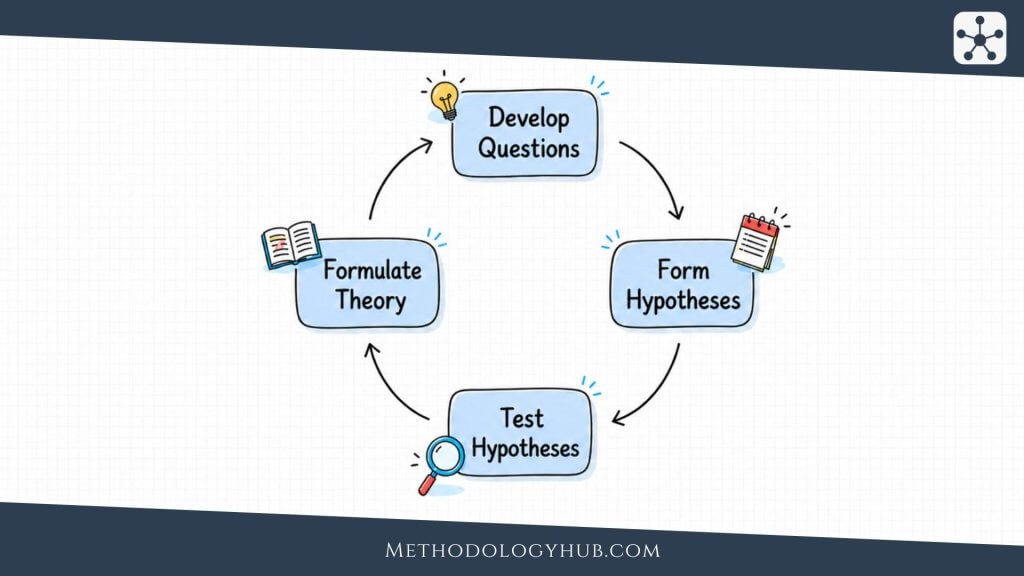
The research question asks what the study wants to find out, while the hypothesis predicts a possible answer. For example, a research question might ask whether sleep duration is associated with concentration. A hypothesis might predict that students who report longer sleep duration will also report better concentration. The analysis then examines whether the data support that expectation.
Not every study needs a hypothesis. Some studies are designed to describe a situation, compare groups, explore experiences, or interpret texts and events without beginning from a specific prediction. What matters is fit. The research question, hypothesis, design, method, and analysis should all work together rather than feeling like separate parts of the project.
Step 4: reviewing the literature
The literature review is the stage where the researcher studies previous work more systematically. It shows what is already known, how the topic has been studied, where researchers disagree, and where the new study fits.
A literature review is not a source-by-source summary. It is an organised account of existing knowledge. The researcher has to compare studies, group them into themes, look at methods, notice limits, and explain how the current project grows out of the field.
What a literature review does
A good literature review helps the researcher avoid repeating work unnecessarily. It also helps refine the question and design. If earlier studies used weak measures, small samples, unclear definitions, or limited settings, those problems can guide the new study. If several studies reach different conclusions, the researcher may need to ask why.
The literature review usually supports the study in four ways:
- it defines the main concepts used in the study
- it shows what previous research has found
- it identifies debates, gaps, or limits in existing work
- it justifies the focus and design of the new study
Finding relevant literature
Good literature searching is deliberate. The researcher should not depend on the first results from a general web search. Academic databases, library catalogues, journal platforms, citation indexes, and reference lists are usually better places to start.
The search should use related terms rather than one phrase. A study on student sleep might search for sleep duration, sleep quality, academic performance, concentration, university students, first-year students, and wellbeing. The terms should change as the researcher learns how the field names the topic.
It also helps to record the search process. For larger projects, write down which databases were searched, which terms were used, when the search was run, and which inclusion rules were applied. This prevents repeated searching and makes the review easier to explain.
Reading sources critically
Critical reading means asking how a source reached its claims. It is not enough to know what a study concluded. The researcher should ask what data were used, how the sample was chosen, how variables were measured, how the analysis was done, and whether the conclusion follows from the evidence.
When reading a study, ask:
- What question or aim does the study address?
- What design and method does it use?
- Who or what was studied?
- What evidence was collected?
- What were the main findings?
- What limits did the authors report?
- How does this source affect the current project?
Organising the literature review
The structure of the literature review should follow the logic of the topic. Some reviews are organised by theme. Some are organised by method. Some move from broad background to a narrower gap. Some compare competing explanations. The best structure is the one that helps the reader understand why the new question makes sense.
For example, a review on sleep and student concentration might begin with how sleep is defined, then discuss student sleep patterns, then review studies on sleep and cognitive performance, then examine measurement problems, and finally explain the gap the current study addresses. That structure gives the reader a path through the material rather than a pile of references.
Academic integrity while using sources
A literature review also depends on academic integrity. Sources should be represented accurately, cited consistently, and kept separate from the researcher’s own interpretation. This applies to direct quotations, paraphrases, tables, figures, data, and ideas taken from other researchers.
Good source notes make this easier. They should show where an idea came from, what the source actually says, and how the researcher plans to use it. Careless notes can lead to copied wording, forgotten sources, and unsupported claims, long before the final reference list is checked.
Step 5: choosing a research design
Research design is the overall plan for answering the research question. It explains what kind of study is being conducted and how the main parts fit together. Design comes before detailed data collection because the researcher needs to know what kind of evidence is needed before deciding exactly how to gather it.
A design is more than a label. Calling a study “qualitative,” “quantitative,” “cross-sectional,” or “experimental” does not explain it by itself. The design should show how the question, evidence, sample, method, and analysis will work together.
What research design includes
A research design usually includes the purpose of the study, the type of evidence needed, the population or materials studied, the time frame, the method of data collection, and the approach to analysis. It may also include ethical procedures, sampling methods, measurement tools, and plans for handling incomplete data.
In a thesis or research proposal, the design should answer practical questions such as:
- Will the study measure variables, interpret documents, observe behaviour, test an intervention, or compare cases?
- Will data be collected once or over time?
- Will the researcher use primary data, secondary data, or both?
- Who or what will be included in the study?
- How will the analysis answer the research question?
Reliability, validity, and bias in the design
A design also has to deal with reliability, validity, and bias. Reliability is about consistency. If a measure, coding procedure, or instrument is used again under similar conditions, it should give reasonably stable results. Validity is about fit. The study should measure or examine what it claims to measure or examine.
Bias is systematic distortion. It can enter through sampling, wording, measurement, missing data, researcher expectations, participant behaviour, or selective reporting. Bias cannot always be removed completely, but the design should anticipate it and reduce it where possible.
Common research design purposes
Different designs do different jobs. Some are descriptive and show what exists, how often something occurs, or how it is distributed. Some are comparative and examine differences between groups, periods, settings, or cases. Some are explanatory and look at relationships or possible causes. Some are evaluative and assess whether an intervention, programme, or policy achieved its aims.
The design should follow the question. If the question asks about differences between two groups, a comparative design may fit. If it asks whether an intervention changed an outcome, an experimental or quasi-experimental design may be suitable. If it asks how a process developed over time, a longitudinal or document-based design may make more sense.
Cross-sectional and longitudinal designs
A cross-sectional design collects data at one point in time. It is useful for describing a situation, comparing groups, or examining relationships as they appear during a particular period. Many surveys use this design because it is efficient and manageable.
A longitudinal design collects data at more than one point in time. It is useful when the question concerns change, development, sequence, or duration. Longitudinal designs usually require more planning because the researcher has to track cases, handle missing data, and account for drop-out over time.
Experimental and non-experimental designs
An experimental design involves manipulating an intervention or condition and observing its effects. In many experiments, participants or units are assigned to different conditions. When the design is well controlled, it can provide stronger evidence about cause and effect than a design based only on observation.
Non-experimental designs do not manipulate conditions. They observe, measure, compare, interpret, or analyse existing variation. These designs are common when manipulation would be unethical, impossible, or unsuitable for the question. Much research in education, health, social science, history, and environmental studies works this way.
Choosing the right design
The right design is the one that can answer the question with the available resources and ethical conditions. A design may look impressive on paper and still be unrealistic. If the researcher cannot access the population, collect enough data, obtain approval, or analyse the evidence properly, the design needs to be revised.
It is better to complete a modest design well than to attempt an ambitious design badly. Good research is not measured by how complicated the design sounds. It is measured by whether the design fits the question and produces evidence the reader can evaluate.
Step 6: selecting research methods
Research methods are the practical tools used to collect or generate evidence. A method might involve a survey, experiment, observation, interview, document analysis, content analysis, statistical model, measurement instrument, archive search, or secondary data analysis. The method should be chosen after the question and design are clear.
A common mistake is choosing a method because it feels familiar. The better question is: what evidence does this study need? If the study asks about measurable relationships, the method should produce data that can be analysed statistically. If it asks how a policy changed over time, documents, records, or longitudinal data may be more suitable.
Methods based on measurement
Some methods collect numerical data. They are often used to measure frequency, difference, association, change, or effect. Examples include structured surveys, experiments, standardised tests, physiological measures, administrative datasets, and statistical records.
Measurement-based methods require careful work with variables. The researcher has to define what is being measured, how it is being measured, and whether the measure fits the research question. A poor measure can weaken the study even when the sample is large.
Methods based on words, documents, and observation
Other methods work mainly with language, documents, images, behaviour, or records. These include interviews, field notes, open-ended questionnaire responses, policy documents, historical archives, classroom observations, meeting minutes, media texts, and institutional records.
These methods are useful when the study needs detail, meaning, context, or process. They still require a clear plan. The researcher should explain how participants or sources were selected, how the material was recorded, how it was organised, and how interpretations were checked.
Primary and secondary research methods
Primary research collects new data for the study. This may involve running a survey, conducting interviews, observing a setting, taking measurements, or carrying out an experiment. Primary research gives the researcher more control over data collection, but it also requires more planning, ethical review, and practical work.
Secondary research uses data or sources that already exist. This may include published datasets, census data, approved patient records, policy documents, historical archives, journal articles, or institutional reports. Secondary research can be efficient, but the researcher must understand how the original data were produced and what limits they have.
Mixed method designs
Some studies combine more than one kind of method. A project might use a survey to identify a pattern and interviews to understand the experiences behind that pattern. Another might combine statistical records with document analysis. The value of a mixed method design comes from giving each kind of evidence a clear role.
Combining methods should not be done just to make the study look larger. Each method should have a job. If the researcher cannot explain why both methods are needed, the project may become heavier without becoming better.
Choosing instruments and materials
Methods often require specific instruments or materials. A survey needs questions. An experiment needs tasks and conditions. An observation needs a recording protocol. A document study needs selection criteria. A statistical study needs variables and a dataset.
These materials should be tested before full data collection begins. A pilot study, trial coding exercise, draft questionnaire, or small technical check can reveal problems early. A question may be unclear, an instruction may be too long, a variable may not capture the intended concept, or a recording sheet may miss something the study needs.
Step 7: sampling and data collection
Data collection is the stage where the researcher gathers the evidence needed for analysis. Depending on the study, data may come from people, documents, laboratory measurements, digital records, public datasets, observations, archives, images, or texts.
This stage is practical, but it is not mechanical. The quality of the data depends on earlier decisions about the question, design, method, sample, instrument, and procedure. If those decisions are unclear, data collection may produce material that is hard to analyse or impossible to use.
What counts as data?
Data is any recorded evidence used to answer the research question. In one study, data may mean numbers in a spreadsheet. In another, it may mean interview transcripts, field notes, images, documents, laboratory readings, survey responses, coded text, or archived records.
The word data should not be limited to numbers. What counts as data depends on the question and method. A historian may treat letters as data. A linguist may treat spoken sentences as data. A public health researcher may use hospital admission records. A biologist may use measurements from field samples. The shared requirement is that the evidence is collected and handled systematically.
Types of data
Before data collection begins, the researcher should know what kind of data the study will produce or use. Different data types require different ways of recording, cleaning, analysing, and presenting evidence.
- Categorical data: data sorted into groups or labels, such as subject area, treatment group, diagnosis, or response category.
- Numerical data: data recorded as numbers, such as age, score, income, temperature, time, or frequency.
- Discrete data: numerical data counted in separate values, such as number of visits, errors, children, books, or completed tasks.
- Continuous data: numerical data measured on a scale, such as height, weight, duration, distance, or concentration level.
- Objective data: data recorded through observation, measurement, records, or instruments rather than personal judgement alone.
- Subjective data: data based on perceptions, experiences, ratings, opinions, or self-reports.
These categories can overlap. A self-reported concentration score, for example, is numerical because it uses numbers, but it is also subjective because it is based on the participant’s own judgement. Naming the data type helps the researcher choose a suitable analysis and avoid treating one kind of evidence as if it were another.
Sampling
Sampling is the process of deciding who or what will be included in the study. A sample may include people, schools, hospitals, documents, cases, time periods, articles, images, or observations. The sample determines the evidence on which the study is built.
In some designs, the researcher uses probability sampling, where members of a population have a known chance of selection. This is common when the study aims to estimate characteristics of a wider population. In other designs, the researcher uses purposive or criterion-based sampling, where cases are selected because they meet specific conditions. The choice depends on the aim of the study.
The sample should be described clearly. The reader should know who or what was included, how selection happened, how many units were studied, and what inclusion or exclusion criteria were used.
Data collection procedures
Procedures are the exact steps used to collect data. They include when data were collected, where collection happened, who collected the data, what instructions were given, what instruments were used, and how responses, measurements, or observations were recorded.
Clear procedures reduce inconsistency. If two researchers collect data in different ways without documenting the difference, the findings become harder to interpret. In a survey, one group may receive a different introduction from another. In an observation, two observers may code behaviour differently. In a laboratory study, a small procedural difference may affect the result.
Data quality
Data quality refers to whether the collected evidence is suitable for analysis. Poor data quality can come from unclear questions, missing responses, inconsistent measurements, transcription errors, weak sampling, unreliable instruments, or poor storage.
Researchers should plan data quality checks before collection begins. This may include piloting instruments, training data collectors, checking equipment, setting file naming rules, using validation checks in spreadsheets, or reviewing a small sample of entries for errors.
Keeping a research log
A research log records decisions and events during the study. It can include changes to instruments, recruitment problems, missing data issues, unexpected events, coding decisions, and analysis notes. The log is useful later because the method section has to describe what actually happened, not what the researcher hoped would happen.
The log does not need to be complicated. It only needs to preserve decisions that would otherwise be forgotten. A short dated note can save hours later when the researcher tries to remember why a procedure changed or why some data were excluded.
Step 8: analysing data
Data analysis is the stage where the researcher examines the evidence and turns it into findings. Analysis is not the same as interpretation. Analysis shows what is present in the data. Interpretation explains what those findings mean in relation to the research question and the literature.
Good analysis starts with preparation. Data often need to be cleaned, organised, coded, checked, or formatted before any real analysis begins. Skipping this work can leave errors in the results.
Preparing data for analysis
Data preparation depends on the method. Survey data may need checking for missing values, duplicate responses, invalid entries, and coding errors. Interview transcripts may need anonymising and formatting. Documents may need cataloguing. Observation notes may need consistent labels. Experimental data may need calibration checks or exclusion rules.
Preparation should be recorded. If cases are removed, variables recoded, transcripts anonymised, or categories changed, the researcher should keep a note of those decisions. This improves transparency and prevents confusion when returning to the data later.
Analysing numerical data
Numerical analysis can involve statistical analysis, comparisons, correlation analysis, regression analysis, tests of difference, visualisation, or other statistical procedures. The choice depends on the research question, the design, the level of measurement, and the quality of the data.
Descriptive statistics summarise data. They may include frequencies, percentages, means, medians, ranges, and standard deviations. Inferential statistics go further by testing whether an observed pattern is likely to reflect more than random variation, depending on the design and the assumptions behind the test.
The researcher should not choose statistical tests by looking for whichever result seems strongest. Analysis should be connected to the research question and, where possible, planned before outcomes are examined. That reduces selective reporting and helps keep the conclusion honest.
Independent and dependent variables
When a study examines a relationship, comparison, or possible effect, the researcher often needs to define the independent variable and the dependent variable. The independent variable is the condition, predictor, exposure, or grouping factor used to explain or compare. The dependent variable is the outcome being measured or examined.
In the sleep and concentration example, sleep duration could be treated as the independent variable and concentration score as the dependent variable. The wording depends on the design. In an experiment, the independent variable may be controlled by the researcher. In a non-experimental study, it may simply be observed or measured.
Analysing texts, documents, and observations
When data consist of documents, transcripts, images, notes, or other non-numerical material, analysis usually involves sorting, comparing, coding, categorising, and interpreting patterns. The researcher may examine repeated concepts, changes over time, differences between cases, argument structure, institutional language, or the relationship between texts and context.
This kind of analysis still needs a clear procedure. The researcher should explain how material was selected, how it was read, how categories were developed, and how interpretations were checked. The aim is not to pretend that interpretation is mechanical. The aim is to show how the researcher worked with the evidence.
Avoiding overanalysis and underanalysis
Overanalysis happens when the researcher uses techniques the data cannot support or draws conclusions that go far beyond the evidence. Underanalysis happens when the researcher only describes the data and does not answer the question. Both problems weaken the study.
A useful test is to ask whether each analysis step has a purpose. Does it help answer the research question? Does it clarify a pattern, relationship, difference, or interpretation? If not, it may be unnecessary. At the same time, if the analysis only reports raw responses or basic counts without explaining their relevance, it may need more work.
Linking analysis back to the design
Analysis should match the design chosen earlier. An experimental design may require comparison between conditions. A longitudinal design may require examination of change over time. A document study may require comparison across sources or periods. A survey study may require analysis of variables that were planned before data collection.
When analysis does not match the design, the study feels disconnected. This is why analysis should be considered before data collection begins. The researcher should already know what the data must allow them to do.
Step 9: interpreting the findings
Interpretation explains what the findings mean. It connects the analysis back to the research question, the literature review, and the limits of the study. Good interpretation is careful. It does not turn small findings into large claims.
The researcher should begin with the research question. What answer does the evidence support? Which findings are clearest? Which findings are uncertain? Which findings differ from previous research? Which findings need caution because of sample size, design, measurement, or missing data?
Results vs interpretation
Results are what the analysis found. Interpretation is what those results mean. In a research report, the results section usually presents findings with limited explanation. The discussion section then explains those findings in relation to the question, literature, and study limits.
For example, a result may state that students who reported shorter sleep duration also reported lower concentration scores. Interpretation would ask what that association might mean, whether it fits previous studies, whether the design allows causal claims, and what other explanations may exist.
Compare findings with previous research
Interpretation should return to the literature review. If the findings are similar to previous studies, explain the connection. If they differ, consider why. The difference may come from sample, context, measurement, time period, method, or analysis. It may also suggest that the topic is more complicated than earlier work showed.
The goal is not to force every finding into agreement with previous research. The goal is to place the findings in context. A study becomes more useful when readers can see how it relates to what was already known.
Report limits clearly
Every study has limits. A small sample may limit generalisation. A cross-sectional design may limit claims about change. Self-report data may be affected by memory or social desirability. Secondary data may lack variables the researcher would have preferred. Document sources may reflect institutional priorities rather than everyday practice.
Limits should not be treated as failure. They are part of honest reporting. The reader needs to know what the study can and cannot show. Clear limits usually make the study more credible because they show that the researcher understands the evidence.
Avoid unsupported claims
Unsupported claims usually appear when the researcher wants the findings to be stronger than they are. A small survey cannot speak for every student. A correlation cannot prove cause by itself. A document analysis cannot automatically describe what people experienced. A short observation cannot represent every setting.
Careful wording helps. Instead of saying “this proves,” use wording that fits the evidence, such as “the findings suggest,” “the data indicate,” “within this sample,” or “in this context.” This does not weaken the study. It makes the conclusion more accurate.
Step 10: writing and presenting the research
The final stage of the research process is reporting the study. Academic writing is not just a final polish. It is where the researcher shows what was asked, how the study was done, what was found, and what can be concluded.
A research report should make the process visible. Readers should not have to guess how the question was developed, how data were collected, or how analysis was carried out. The report should give enough detail for readers to understand and evaluate the study.
Common structure of a research report
Many research reports, theses, dissertations, and journal articles follow a familiar structure. The details vary by discipline, but the basic order often includes introduction, literature review, method, results, discussion, conclusion, and references.
A typical structure includes:
- Introduction: presents the topic, problem, aim, and research question.
- Literature review: explains relevant previous research and the place of the current study.
- Method: describes design, sample, materials, procedure, data collection, and analysis.
- Results: presents the findings clearly.
- Discussion: interprets the findings in relation to the question and literature.
- Conclusion: gives the final answer, limits, and possible directions for further work.
- References: records the sources used in the study.
Writing the introduction
The introduction should help the reader understand what the study is about and why it matters. It usually begins with the topic or problem, then narrows toward the specific aim, research question, or hypothesis. A good introduction does not simply announce a subject. It explains the issue, shows why the issue is worth studying, and prepares the reader for the rest of the report.
The introduction should also make the scope of the study clear. For example, a report about student wellbeing should not leave the reader wondering whether the study is about mental health, workload, social support, academic pressure, or all of these at once. The introduction should define the focus early enough that the reader can see what the project is trying to do.
In many reports, the introduction also includes a brief statement of the research aim and research question. This gives the reader a clear point of reference before the literature review, method, and results appear. By the end of the introduction, the reader should know the topic, the problem, the purpose of the study, and the direction the report will take.
Writing the literature review
The literature review explains how the current study fits into existing research. It should not be a list of everything the researcher has read. Its purpose is to show what is already known, where researchers agree or disagree, what gaps or limitations remain, and how the current study responds to that background.
A strong literature review is organised around ideas, debates, themes, methods, or findings rather than around one source after another. For example, instead of writing one paragraph on each article, the researcher might group studies by how they define the problem, what populations they examine, what methods they use, or what conclusions they reach. This helps the reader understand the research area rather than just the reading list.
The literature review should lead naturally toward the research question. If the review discusses previous studies but never explains why the new study is needed, it becomes disconnected from the rest of the report. The reader should be able to see how the literature supports the aim of the project and why the chosen question is worth asking.
Writing the method section
The method section is where many research reports become too vague. A good method section should be specific enough for the reader to understand what was done. It should explain the design, participants or materials, sampling, instruments, procedures, ethical handling, and analysis approach.
A weak method section says that a survey was conducted. A better one explains who received the survey, how many people responded, what the questions measured, how consent was handled, when data were collected, how missing data were treated, and how responses were analysed.
The method section should also match the research question. If the study asks about a relationship between variables, the method should explain how those variables were measured and how the relationship was analysed. If the study interprets interviews, texts, or documents, the method should explain how the material was selected, coded, compared, and interpreted. The reader should be able to see why the chosen method was suitable for the question.
Presenting the results
The results section presents what the study found. Its main job is to report the findings clearly before moving into broader interpretation. Numerical results may need tables, figures, descriptive statistics, statistical tests, or model outputs. Textual or document-based findings may need themes, excerpts, categories, comparisons, or summaries of patterns. The form should fit the evidence.
Tables and figures should not repeat the exact same information as the prose. They should make complex findings easier to see. Each table or figure should have a clear title, consistent labels, and enough explanation for the reader to understand what it shows.
The results section should usually follow the order of the research question, objectives, or hypotheses. This keeps the findings organised and prevents the section from becoming a loose collection of numbers, quotes, or observations. The reader should be able to move through the results and understand how each finding relates to the purpose of the study.
Writing the discussion
The discussion section explains what the results mean. This is where the researcher connects the findings back to the research question, the literature review, and the wider problem introduced at the start of the report. The discussion should not simply repeat the results in different words. It should interpret them.
A useful discussion often begins by returning to the main question and explaining the answer suggested by the findings. It can then compare the findings with previous research, explain where the study supports or challenges existing work, and consider why certain results may have appeared. If the findings were unexpected, the discussion should not hide that. It should explain possible reasons and show how the results can be understood.
The discussion should also be careful about claims. A study can only support conclusions that fit its design, data, and analysis. For example, a small interview study may offer detailed insight into participants’ experiences, but it should not claim to measure how common those experiences are in the wider population. A survey may show an association between two variables, but it should not automatically claim that one caused the other unless the design supports that claim.
Writing the conclusion
The conclusion gives the final answer to the research question and brings the report together. It should remind the reader what the study set out to do, what it found, and why the findings matter. A conclusion should not introduce a completely new argument or a new set of evidence. Its role is to close the study clearly.
A good conclusion usually includes the main answer, the contribution of the study, the most important limitations, and possible directions for future research or practice. The limitations should be honest but not apologetic. Every study has limits. What matters is explaining how those limits affect the strength, scope, or transferability of the findings.
The conclusion should leave the reader with a clear sense of what has been learned. It does not need to exaggerate the importance of the study. It only needs to state the final message in a precise and useful way.
Writing the references
The references section records the sources used in the report. It allows readers to check where ideas, evidence, theories, definitions, and previous findings came from. It also shows that the researcher has worked with existing scholarship rather than presenting the study as if it appeared from nowhere.
References should follow the required citation style, such as APA, MLA, Chicago, Harvard, or a specific journal style. The exact format depends on the discipline or publication, but consistency matters in every case. Author names, publication years, titles, journal names, publishers, page ranges, and links or DOIs should be checked carefully.
The references section should include only the sources actually cited in the report. It should not become a general bibliography unless the assignment or publication specifically asks for one. The reader should be able to match every in-text citation to a full reference, and every full reference should point back to something cited in the report.
Editing the final report
Research writing needs revision. The first draft may contain a good study but a weak explanation of it. Revision should check structure, paragraph order, source use, method detail, results presentation, and interpretation before final proofreading.
One useful method is to read the report section by section and ask whether each section is doing its job. Does the introduction lead to the question? Does the literature review prepare the design? Does the method give enough detail? Do the results answer the question? Does the discussion stay close to the evidence?
Proofreading comes last. At that point, check spelling, grammar, citation style, table numbering, figure labels, reference list accuracy, headings, and formatting. These details affect how trustworthy the work feels to the reader.
Peer review and final checking
In academic publishing, many studies also go through peer review. Peer review means that other researchers evaluate the work before publication. They may comment on the research question, literature, method, analysis, interpretation, or clarity of reporting.
Peer review is not the same as proofreading. A peer reviewer is not looking only for spelling mistakes. They are asking whether the study is clear, credible, and supported by evidence. Even when a project is not being submitted to a journal, feedback from supervisors, instructors, or colleagues can play a similar role during revision.
Research process example
A concrete example makes the research process easier to follow. The example below uses a student project, but the same logic applies to larger academic studies.
Starting research topic
The researcher begins with a broad interest in sleep and academic work. At first, the research topic is too large. It could include sleep duration, sleep quality, bedtime routines, screen use, stress, grades, concentration, memory, or wellbeing. The researcher has to choose a narrower route.
After some background reading, the researcher decides that concentration is a manageable outcome for a small university project. The topic becomes sleep duration and self-reported concentration among first-year university students.
Research question
The researcher writes the question as: “How is self-reported sleep duration associated with self-reported concentration among first-year university students?”
This question works better than the broad topic because it names the variables, the population, and the relationship being examined. It also avoids claiming cause before the study begins. The wording points toward a cross-sectional survey, which fits a small project with limited time.
Literature review
The researcher reviews studies on student sleep, concentration, academic performance, and self-report measurement. The review shows that sleep is often associated with cognitive functioning, but that measurement differs across studies. Some use sleep diaries, some use questionnaires, and some use wearable devices.
Because the project is small, the researcher chooses a questionnaire. The literature review still matters because it helps define sleep duration and concentration clearly enough for the survey items.
Design and method
The study uses a cross-sectional survey. The sample is first-year students at one university. The survey asks about average sleep duration on weeknights, perceived concentration during study sessions, course of study, age, and employment hours. The method is limited, but it fits the question and the time available.
The researcher pilots the survey with five students. Two questions are unclear, so they are rewritten. The pilot also shows that the survey takes about six minutes, which helps the researcher explain the time commitment during recruitment.
Data collection and analysis
The researcher collects responses through an approved university survey link. Responses are screened for missing values and duplicate submissions. Sleep duration is grouped into categories, and concentration scores are summarised.
The analysis compares concentration scores across sleep duration categories and examines whether there is an association. The researcher does not claim that sleep duration causes concentration differences because this design cannot prove cause.
Interpretation and reporting
The findings show that students reporting shorter sleep duration also tend to report lower concentration. The discussion compares this pattern with previous research, notes the limits of self-report data, and explains that the study was conducted at one university only.
The conclusion answers the question carefully: within this sample, shorter self-reported sleep duration was associated with lower self-reported concentration. The researcher suggests that future studies could use longitudinal data or objective sleep measures.
Conclusion
The research process is the practical structure that turns a broad interest into a finished study. It begins with a topic, but the topic has to become a question. That question then has to guide the literature review, design, method, data collection, analysis, interpretation, and final report.
Good research depends on fit. The question should fit the topic. The design should fit the question. The method should fit the design. The data should fit the analysis. The conclusion should fit the evidence. When those parts work together, the study is easier to understand and easier to evaluate.
The research process also makes the limits of a study clearer. No project can answer everything. A well-reported project does not pretend otherwise. It explains what was done, what was found, what can be concluded, and where caution is needed.
Research process FAQ
What is the research process?
The research process is the planned route from a topic or problem to an evidence-based conclusion. It usually includes choosing a topic, reviewing literature, writing a research question, choosing a design, collecting data, analysing findings, interpreting results, and reporting the study.
What are the main steps in the research process?
The main steps are choosing a topic, conducting background research, developing a research question, reviewing the literature, choosing a design, selecting methods, collecting data, analysing data, interpreting findings, and writing the final report.
What is the first step in the research process?
The first step is choosing a research topic. The topic should then be narrowed into a focused area that can be studied with the available sources, data, time, and methods.
How is a research question different from a research topic?
A research topic names the general area of study. A research question asks something specific about that area. The question guides the design, method, data collection, analysis, and conclusion.
How can I make my research process stronger?
You can make the research process stronger by narrowing the topic early, writing a clear research question, matching the method to the question, planning analysis before data collection, keeping a decision log, and reporting limitations honestly.