Experimental research is a research design in which the researcher deliberately changes one or more conditions and observes the effect on an outcome. It is used when a study needs more than description or association. Instead of only asking whether two variables appear together, experimental research asks whether a controlled change in one variable produces a change in another.
This article explains what experimental research is, how it works, which objectives it serves, how experimental designs are structured, how they compare with related research designs, and how a researcher can plan an experiment.
What Is Experimental Research?
Experimental research is a research design used to examine causal relationships. The researcher introduces a treatment, intervention, condition, or stimulus, then measures whether an outcome changes in response. This controlled change is what separates an experiment from many other forms of empirical research.
A simple education example can make the idea easier to follow. Suppose a researcher wants to know whether short retrieval quizzes improve later test scores. One group of students receives weekly retrieval quizzes, while another group studies the same material without those quizzes. If the groups are assigned carefully and the outcome is measured in the same way, the design can help the researcher judge whether the quizzes caused a difference in performance.
Experimental research definition
Experimental research means studying the effect of a deliberately manipulated independent variable on a dependent variable under planned conditions. The independent variable is the condition the researcher changes. The dependent variable is the outcome that is measured. Other conditions are held steady, balanced, or recorded so that the effect of the independent variable can be interpreted more clearly.
This definition sounds technical at first, but the logic is direct. A researcher changes something on purpose, observes what happens afterward, and designs the study so that competing explanations are reduced as much as possible. The experiment does not remove uncertainty from research, but it gives the researcher a stronger basis for causal interpretation than a design based only on observation.
Experimental research as a research design
Experimental research belongs to the design layer of a study. It describes how the study is structured, not only what kind of data are collected. Many experiments use numerical scores and therefore sit comfortably inside quantitative research. Still, an experiment can also include observations, written responses, interviews, or open-ended explanations when the researcher wants to understand how participants experienced the treatment.
The design label is useful because it tells readers what kind of conclusion the study is trying to support. A descriptive survey can show how many students prefer one study method. A correlational research design can show whether students who quiz themselves tend to score higher. An experiment goes further by assigning or exposing participants to different study conditions and then measuring the result.
What experimental research can show
Experimental research can support a causal claim when the design is strong enough. The researcher needs to show that the treatment came before the outcome, that the treatment and outcome are connected, and that alternative explanations have been reduced through control, random assignment, comparison groups, or careful measurement.
Even then, the claim should be written with care. A well-designed experiment can show that a treatment caused an effect in the study conditions. The researcher still has to ask how far the finding travels to other participants, settings, times, or versions of the treatment. For example, a laboratory memory experiment may show a clear learning effect under controlled conditions, while a classroom field experiment may show whether that effect appears in everyday teaching conditions.
Objectives of Experimental Research
The objectives of experimental research are tied to explanation. A researcher usually turns to an experiment when the study needs to test whether a condition has an effect, compare alternative treatments, examine mechanisms, or estimate how strong an effect is under defined conditions. The design is especially useful when a research hypothesis states that one variable is expected to influence another.
These objectives can appear in basic, applied, action, or evaluation studies. A laboratory experiment in psychology may be part of basic research if it tests a theory of attention. A classroom experiment may be part of applied research if it tests a teaching strategy. The same design logic can serve different research purposes.
Testing causal relationships
The first objective is to test whether a change in one variable produces a change in another. This is the classic causal aim of experimental research. A researcher may ask whether feedback timing affects revision quality, whether a reminder system increases attendance, or whether a soil treatment changes plant growth.
The causal claim depends on the structure of the study. If participants are randomly assigned to conditions, the groups should be similar at the start except for chance differences. If the treatment is then introduced to one group and not another, a later outcome difference becomes easier to connect to the treatment.
Comparing treatments or conditions
Many experiments compare two or more treatments. A study might compare three study methods, two therapy formats, four temperature conditions, or several versions of a learning task. The goal is not only to show that something works, but to compare what happens under different planned conditions.
Comparison can be simple or layered. A two-group experiment may compare treatment and control. A factorial experiment may test two independent variables at once, such as feedback type and practice schedule. This allows the researcher to ask whether each variable has a separate effect and whether the combination creates a different pattern.
Estimating effect size and direction
Experimental research also helps estimate how large an effect is and in which direction it moves. A result may show that an intervention improved scores, reduced errors, increased speed, or changed a measured response. The size of that change affects how the result is interpreted.
This is where statistical analysis becomes useful. A p-value can help evaluate whether the observed result is difficult to explain under a null hypothesis, but it does not show the size of the effect by itself. Means, proportions, confidence intervals, and effect sizes give the reader a fuller view of the result.
Plain reading: experimental research is not only about finding a difference. It is about linking that difference to a planned change in the study conditions.
Testing mechanisms and explanations
Some experiments go beyond asking whether a treatment works. They ask how or under which conditions the effect appears. A researcher may test whether a study technique improves scores because it increases active recall, or whether a classroom strategy works better for beginners than for advanced learners.
These questions require more careful design. The researcher may add mediating variables, moderating variables, repeated measurements, or extra comparison groups. The experiment then becomes a way to test an explanation, not only a way to compare final outcomes.
Core Aspects of Experimental Research
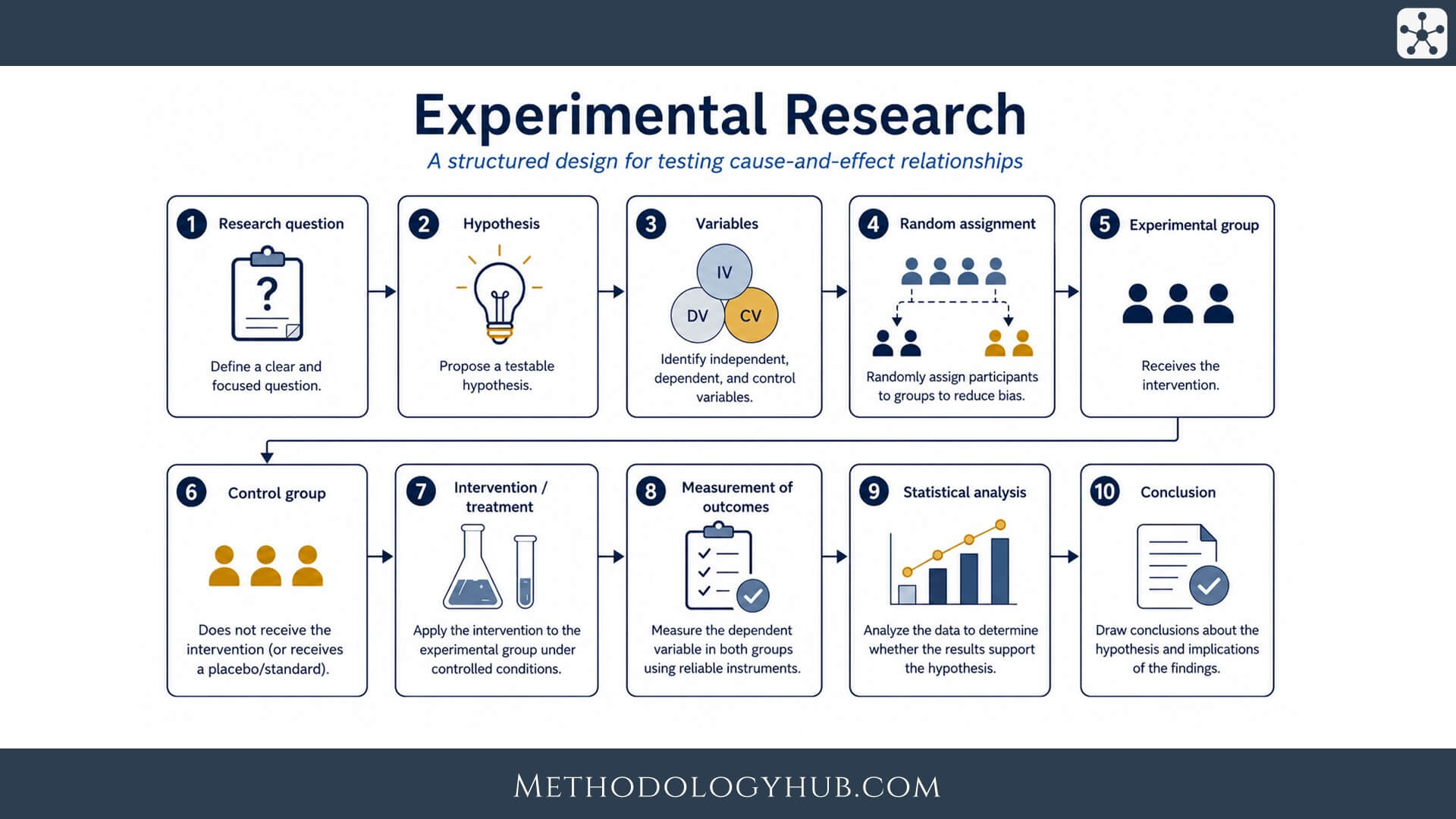
The main aspects of experimental research are easiest to understand as parts of one design. A researcher begins with a question, identifies the variables, creates a treatment or condition, decides how groups or observations will be compared, and then measures the outcome with enough consistency for interpretation.
These pieces should fit together. If the research question asks about the effect of a new reading activity, the independent variable should be the activity or its features. The dependent variable should capture the reading outcome. The comparison condition should show what would happen without the activity or with another activity. The analysis should match the design and the type of research data.
Independent and dependent variables
Experimental research depends on clear variables. The independent variable is the condition the researcher manipulates, such as teaching method, feedback timing, lighting level, dosage, practice schedule, or task instruction. The dependent variable is the outcome, such as a score, reaction time, error count, attitude rating, biological measure, or observed behaviour.
These variables need operational definitions. Instead of saying that an experiment tests “motivation”, the researcher should explain how motivation will be represented in the study. It may be measured through a validated scale, persistence on a task, attendance, or another observable indicator. The interpretation depends on that measurement decision.
Manipulation and treatment conditions
The manipulation is the planned change introduced by the researcher. In a school experiment, the manipulation might be a new feedback method. In a laboratory experiment, it might be the order of information, the difficulty of a task, or the presence of a stimulus. In an agriculture experiment, it might be fertilizer type or watering schedule.
A treatment condition is one version of that manipulation. A study may have one treatment condition and one control condition, or several treatment conditions. The main point is that each condition should be described clearly enough for another researcher to understand what participants received, saw, heard, did, or experienced.
Control and comparison
Control in experimental research means reducing alternative explanations. A control group may receive no treatment, an existing treatment, a placebo condition, or a different version of the treatment. Control can also come from keeping procedures consistent, using the same measurement instrument, balancing participant characteristics, or holding timing constant.
Comparison is what gives the outcome meaning. If one class receives a new practice routine and scores 82 on the final test, that number alone tells little. The result becomes interpretable when it is compared with a group that did not receive the routine, with a group that received another routine, or with the same students before the intervention.
Random assignment
Random assignment means that participants, cases, classrooms, plots, or other units are assigned to experimental conditions by chance. It is different from survey research sampling. Sampling concerns who enters the study. Assignment concerns which condition those units receive after they have entered.
Random assignment helps balance known and unknown characteristics across groups. It does not guarantee perfect balance in every study, especially with small samples, but it reduces systematic selection into conditions. This is one reason randomized experiments are often treated as strong designs for causal inference.
Measurement and analysis
The outcome measure should match the research question. If the study asks whether a writing intervention improves argument structure, the outcome should measure writing quality in a way that captures argument structure, not only word count. If the study asks whether a memory task improves recall, the recall measure should align with the material that was studied.
Analysis should follow the design. A two-group post-test experiment may use a test for mean differences. A pretest-posttest design may compare change scores or use a model that accounts for baseline measurement. A factorial design may test main effects and interaction effects. The choice of statistical methods should be made because the method answers the study question, not because a test name is familiar.
| Aspect | Question it answers | Example |
|---|---|---|
| Independent variable | What is changed or assigned? | Feedback type |
| Dependent variable | What outcome is measured? | Revision score |
| Control condition | What comparison gives the result meaning? | Usual written feedback |
| Random assignment | How are units placed into conditions? | Students assigned by random number |
| Outcome analysis | How is the effect estimated? | Mean difference with confidence interval |
Experimental Research Designs
An experimental research design is the structure a researcher uses to test whether a change in one variable produces a change in another variable. The design decides who receives the intervention, who does not, when measurements are taken, how comparison groups are formed, and how much control the researcher has over outside influences. In this sense, the design is the architecture of the study. It gives the experiment its logic before any data are collected.
In experimental research, the researcher does more than observe what already exists. A condition is introduced, varied, or controlled so that its possible effect can be examined. This condition is usually the independent variable. The result being measured is the dependent variable. For example, a researcher may test whether a new feedback strategy improves writing scores. The feedback strategy is the independent variable, and the writing score is the dependent variable.
The design becomes experimental when the researcher can create a clear comparison. One group may receive the intervention, while another group receives no intervention, a standard condition, or a placebo condition. The purpose of that comparison is to make the interpretation more precise. If both groups are similar at the start, and only one group receives the intervention, then later differences are easier to connect to the intervention itself.
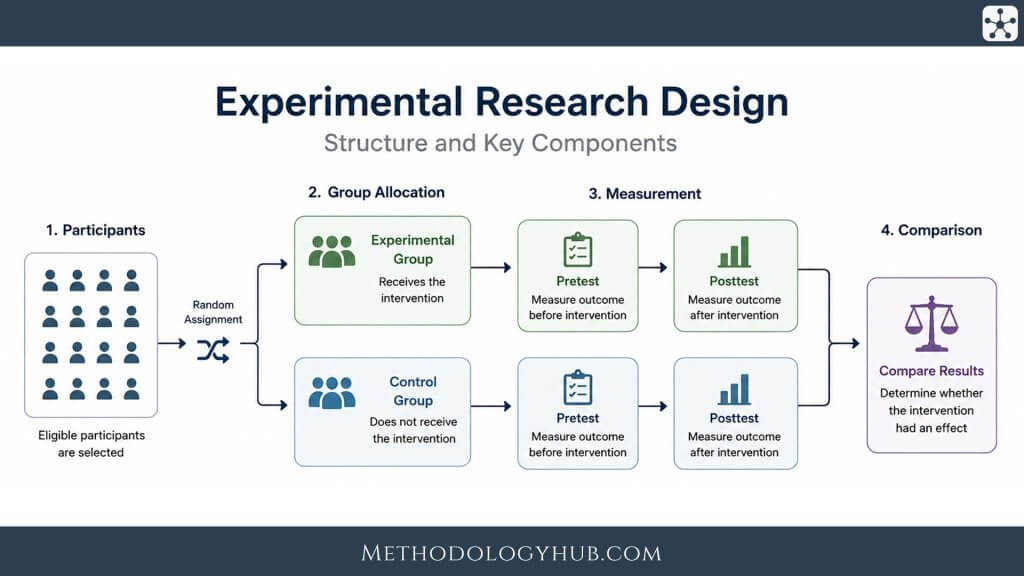
How design gives structure to an experiment
A design does not begin with a statistical test. It begins with the research question. If the question asks whether one condition causes a change in an outcome, the researcher must build a design that can support that kind of answer. A weak design may collect numbers, compare groups, and report a p-value, but still fail to support a causal interpretation if the groups were not comparable or if outside variables were uncontrolled.
For this reason, experimental design usually pays attention to several connected decisions. The researcher needs to decide what intervention will be introduced, who will participate, how participants will be assigned to conditions, what will be measured, when measurement will happen, and how the results will be compared. These decisions should fit together. A careful design makes the path from question to conclusion visible.
Core parts of an experimental design
The first core part is manipulation. The researcher deliberately changes or introduces the independent variable. In a classroom study, this may be a new teaching method. In a psychology study, it may be a stimulus, task instruction, or feedback condition. In a laboratory study, it may be a temperature, dosage, material, or treatment condition. Manipulation separates experimental research from studies that only observe existing variation.
The second core part is control. Control means that the researcher tries to keep other relevant conditions stable, balanced, or accounted for. Control can happen through random assignment, standardised procedures, careful measurement, eligibility criteria, or statistical adjustment. The goal is not to remove the real world completely. The goal is to reduce competing explanations enough for the comparison to be meaningful.
The third core part is comparison. A single group measured once after an intervention gives little basis for interpretation. The result may look positive, but the researcher cannot easily know whether the same change would have happened without the intervention. A comparison group gives the researcher a reference point. It makes the outcome easier to interpret because the intervention group can be compared with another condition.
The fourth core part is measurement. The dependent variable must be measured in a way that fits the concept being studied. A study about learning should use a measurement that reflects learning, not only attendance or satisfaction. A study about anxiety should use an instrument that can reasonably capture anxiety, not a vague single item. Strong measurement makes the design more credible because the outcome reflects the intended construct.
Pretest and posttest structure
Many experimental designs use a pretest and posttest structure. The pretest measures participants before the intervention. The posttest measures them after the intervention. This arrangement helps the researcher see whether change occurred across time and whether that change differs between groups.
For example, two groups of students may take the same writing assessment before instruction begins. One group then receives a new feedback approach, while the other group receives the usual feedback. At the end of the unit, both groups take another writing assessment. If the intervention group improves more than the comparison group, the researcher has stronger evidence than if only one final score had been collected.
Pretests are useful because groups are rarely perfectly identical at the beginning. Even with random assignment, one group may start slightly higher than another by chance. A pretest makes those starting differences visible. It can also help the researcher examine change rather than only final performance.
Random assignment and group equivalence
Random assignment is one of the strongest design features in experimental research. It means participants are assigned to conditions by chance rather than by choice, convenience, teacher decision, clinic schedule, or participant preference. When random assignment is implemented well, it helps distribute known and unknown differences across groups.
This does not guarantee that groups will be perfectly equal. Small samples can still produce accidental imbalance. However, random assignment gives the design a stronger basis than assignment based on existing groups or personal choice. It reduces the chance that one group differs from the other before the intervention even begins.
When random assignment is not possible, the study may still use an experimental logic, but the design becomes weaker for causal claims. The researcher may use matched groups, pretest scores, statistical controls, or comparison sites, but these features do not fully replace random assignment. They can improve the design, yet the interpretation should remain more cautious.
Design, method, and analysis are not the same
It is useful to separate design from method and analysis. The design is the structure of the study. The method describes how evidence is collected. The analysis describes how the evidence is examined. In one experiment, the design may involve random assignment to two groups. The method may involve a standardised test, observation checklist, or survey. The analysis may involve a t-test, ANOVA, regression model, or another statistical analysis procedure.
These parts should support one another, but they should not be treated as the same thing. A study does not become experimental only because it uses numbers. It becomes experimental because the researcher manipulates a condition, controls the comparison as much as possible, and measures the outcome in a structured way. A design can therefore be experimental even when the outcome includes observation ratings, behavioural counts, or qualitative follow-up data, as long as the main comparison follows an experimental structure.
Types of Experimental Research
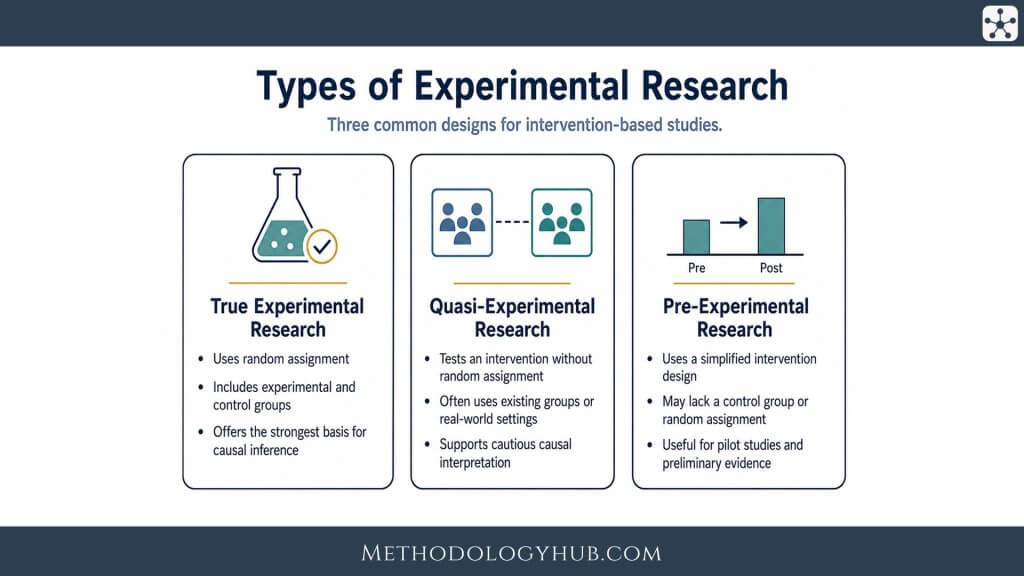
Experimental research is often discussed as if it were one fixed design, but in practice it includes several forms. The main difference between them is the amount of control the researcher has over assignment, comparison, and measurement. Some experiments use random assignment and strong control over the research setting. Others test an intervention in real schools, clinics, organisations, or communities where random assignment is not possible. A third group uses simpler designs that can be useful for early testing but cannot support strong causal claims on their own.
The three main types of experimental research are true experimental research, quasi-experimental research, and pre-experimental research. They all involve some form of intervention or treatment, but they differ in how confidently the researcher can connect the intervention to the observed outcome.
True Experimental Research
True experimental research is the strongest form of experimental design because it includes three central features: manipulation, control, and random assignment. The researcher deliberately changes the independent variable, compares outcomes between groups, and assigns participants to groups through a random process. This random assignment is what separates true experimental research from many other intervention-based designs.
For example, a researcher may want to test whether a new study-skills programme improves exam performance. Eligible students are randomly assigned to either an experimental group that receives the programme or a control group that continues with the usual support. After the programme, both groups take the same exam or complete the same outcome measure. If the groups were similar at the start and only the intervention differed, the researcher has a stronger basis for interpreting the difference as an effect of the programme.
True experimental research is common in laboratory settings, clinical trials, educational interventions, psychology experiments, and controlled behavioural studies. It is especially useful when the researcher can define the treatment clearly, measure the outcome reliably, and keep other conditions as similar as possible between groups.
The main strength of true experimental research is internal validity. Because random assignment helps balance known and unknown participant differences across groups, it reduces the risk that the result is caused by pre-existing differences. This does not mean every true experiment is automatically strong. Poor measurement, weak implementation, participant dropout, or unclear procedures can still weaken the study. The design gives the researcher a strong starting point, but the quality of the study still depends on how well each part is carried out.
Quasi-Experimental Research
Quasi-experimental research also studies the effect of an intervention, but it does not use random assignment. Instead, the researcher works with groups that already exist or are formed by practical conditions. This type of design is common in real-world settings where random assignment would be difficult, inappropriate, or impossible.
A school district, for instance, may introduce a new mathematics programme in one school while another similar school continues with the usual curriculum. A researcher can compare student outcomes before and after the change, or compare the intervention school with the comparison school. Because the students were not randomly assigned, the researcher has to think carefully about other differences between the schools, such as teacher experience, prior achievement, class size, or available resources.
Quasi-experimental research is often used in education, public health, social policy, programme evaluation, and organisational research. These are fields where researchers frequently study interventions as they occur in real settings. The design may not provide the same level of control as a true experiment, but it can produce useful evidence when the comparison is well planned and the limitations are reported clearly.
Several designs fall under quasi-experimental research. A non-equivalent groups design compares groups that did not result from random assignment. An interrupted time series design measures an outcome repeatedly before and after an intervention. A matched comparison design pairs cases or groups that are similar on important characteristics. Each approach tries to make the comparison more credible, even though random assignment is absent.
| Feature | True experimental research | Quasi-experimental research |
|---|---|---|
| Assignment to groups | Random assignment is used | Groups are not randomly assigned |
| Control over conditions | Usually stronger | Often shaped by real-world limits |
| Causal interpretation | Stronger when the design is well implemented | More cautious because group differences may remain |
The strength of quasi-experimental research depends on the quality of the comparison. A weak comparison group can make the study difficult to interpret. A carefully chosen comparison group, repeated measurement, baseline data, or statistical adjustment can make the design more convincing. The researcher should show why the groups or time periods are comparable enough for the question being asked.
Pre-Experimental Research
Pre-experimental research is the simplest form of experimental research. It involves an intervention, but it lacks one or more features needed for stronger causal inference. Many pre-experimental designs have no random assignment, no control group, or no pre-test. Because of this, they are usually used for early exploration, classroom projects, pilot studies, or preliminary evaluation rather than firm causal testing.
A common example is the one-shot case study. A group receives an intervention, and the researcher measures the outcome afterward. For example, a teacher introduces a new revision activity and then records students’ quiz scores at the end of the week. The problem is that there is no baseline and no comparison group. If scores are high, the researcher cannot tell whether the activity caused the result, whether the students were already prepared, or whether the quiz was easier than usual.
Another common form is the one-group pre-test post-test design. Here, the researcher measures the group before the intervention, applies the intervention, and measures the group again afterward. This is stronger than measuring only after the intervention because the researcher can observe change over time. Still, the design has limits. Students may improve because of practice, maturation, outside instruction, repeated exposure to the test, or other events that occurred during the study period.
A third form is the static-group comparison design, where one group receives the intervention and another group does not, but the groups are not randomly assigned and may not be measured before the intervention. This design gives some basis for comparison, but it remains vulnerable to pre-existing group differences.
Plain reading: pre-experimental research can show that an outcome followed an intervention, but it usually cannot show clearly that the intervention caused the outcome.
Pre-experimental research is not useless. It can help a researcher test whether an intervention is practical, whether participants understand the procedure, whether an instrument works, or whether a fuller study is worth planning. Its value depends on using the design for the right purpose. It becomes problematic only when the findings are written as if they came from a stronger experiment.
Choosing Between the Types
The choice between true experimental, quasi-experimental, and pre-experimental research depends on the research question, setting, access, and level of control. If random assignment is possible and the study aims to test cause and effect clearly, a true experiment is usually the strongest option. If the researcher must work with existing groups or policy changes, a quasi-experimental design may fit better. If the goal is early testing or a small pilot, a pre-experimental design may be enough, as long as the conclusions stay modest.
A useful way to choose is to start with the claim the study wants to make. Strong causal claims need stronger design features: random assignment, comparison groups, baseline measurement, reliable outcomes, and consistent implementation. More tentative claims can use simpler designs, but the language of the conclusion should match the evidence.
When to Perform Non-Experimental Research
Non-experimental research is suitable when the researcher needs to study variables as they naturally occur rather than manipulate them. It is often used when an experiment is not possible, not appropriate for the question, or not necessary for the kind of conclusion the study aims to produce. Instead of assigning people to conditions, the researcher observes, measures, describes, compares, or analyses existing patterns.
This distinction is important because not every research question asks for a causal test. Some questions ask what exists, how common something is, how people experience a situation, how two variables are associated, or how a process develops over time. In those cases, an experimental design may be too narrow. It may even distort the topic by forcing a controlled comparison where natural context is central to the study.
For example, a researcher who wants to know how students describe anxiety before oral presentations may not need to manipulate anything. Interviews, open-ended survey responses, or classroom observations may fit better. A researcher who wants to estimate how many students use tutoring services may need a descriptive survey. A researcher who wants to examine whether sleep duration is associated with exam performance may use a correlational design. These studies can be rigorous without being experimental.
When manipulation is not possible
Non-experimental research is often used when the independent variable cannot be manipulated. Many variables are characteristics, histories, conditions, or experiences that already exist. Age, language background, prior achievement, family structure, diagnosis history, school type, income level, and past exposure to a programme cannot usually be assigned by the researcher.
If a researcher wants to compare students who attended different school systems before entering university, the researcher cannot randomly assign their past schooling. The only realistic option is to observe existing groups and interpret the comparison carefully. The same applies to studies of naturally occurring events, such as migration experiences, earlier illness, previous training, or long-term educational pathways.
Plain distinction: use experimental research when the researcher can introduce and control a condition. Use non-experimental research when the study examines conditions, experiences, or characteristics that already exist.
When the aim is description rather than causation
Non-experimental research is also suitable when the study aims to describe a population, setting, practice, pattern, or experience. A descriptive question does not require an intervention. It requires careful boundaries, appropriate data, and a clear account of what is being observed.
For example, a study may ask how teachers give written feedback on student essays. The researcher may collect examples of feedback, code the comments, and describe the patterns that appear. Another study may examine how often first-year students use library resources during the first semester. A third study may describe the range of support services available in public universities. None of these studies requires random assignment or a treatment condition.
Trying to turn every descriptive question into an experiment can weaken the study. If the main aim is to record what happens in real settings, the researcher should not add an artificial intervention simply to make the design look stronger. A good descriptive study can provide the careful groundwork needed before any later experiment is planned.
When the aim is association
Many studies ask whether variables are related, not whether one variable has been proven to cause another. These questions often call for correlational research or another non-experimental design. A researcher may ask whether study time is associated with exam score, whether reading confidence is related to writing performance, or whether teacher feedback frequency is linked with student revision behaviour.
These questions can be valuable, especially when a field needs early evidence about possible relationships. However, the interpretation must stay aligned with the design. If participants are not randomly assigned and variables are not manipulated, the study should not claim direct causation. A correlation can suggest a relationship, support prediction, or guide later investigation, but other explanations may remain possible.
For instance, if students who attend tutoring sessions have higher grades, tutoring may help. It is also possible that motivated students are more likely to attend tutoring and more likely to study consistently. A non-experimental study can examine the relationship, and statistical controls may improve the analysis, but the design still differs from a controlled experiment.
When natural context is central
Non-experimental research is often the better choice when the natural setting is part of what the researcher wants to understand. Classroom routines, family conversations, workplace practices, peer interactions, community activities, and institutional processes can change when they are placed under artificial experimental conditions.
A researcher studying how students collaborate during group projects may need to observe real group work rather than assign students to highly controlled laboratory tasks. A researcher studying how teachers interpret a new curriculum may need interviews and document analysis rather than an intervention. A researcher studying how patients describe their experiences of a health service may need qualitative evidence gathered in context.
In these cases, control is not the only goal. Richness, setting, sequence, meaning, and participant perspective may be central to the research question. Non-experimental designs can preserve these features more naturally than experiments.
When an experiment should come later
Non-experimental research can also prepare the ground for a later experiment. Before testing an intervention, the researcher may need to understand the problem, define the variables, identify the population, examine existing practices, or develop a measurement tool. Exploratory interviews, descriptive surveys, document analysis, and observational studies can all help make a future experiment more focused.
For example, a researcher may want to test a new study-skills programme. Before designing the experiment, they may first conduct interviews to understand students’ study routines, analyse existing course outcomes, or run a survey on learning difficulties. This early non-experimental work can help the researcher design a better intervention and select more suitable outcome measures.
Non-experimental research therefore should not be treated as a weaker version of experimental research in every situation. It serves a different purpose. It is strongest when the question is about description, association, meaning, natural processes, existing differences, or early-stage investigation.
Choosing between experimental and non-experimental research
The choice should follow the research question. If the question asks whether an intervention causes a change, and the researcher can control assignment and measurement, experimental research may fit. If the question asks what exists, how people experience something, how variables are associated, or how a setting works naturally, non-experimental research may be more suitable.
| Research situation | Better fit |
|---|---|
| The researcher can manipulate a treatment and compare groups. | Experimental research |
| The variable already exists and cannot be assigned. | Non-experimental research |
| The aim is description, exploration, or natural context. | Non-experimental research |
Strengths and Limitations of Experimental Research
Experimental research is one of the strongest approaches for testing cause-and-effect relationships, but it is not suitable for every question. Its value comes from structure. The researcher manipulates an independent variable, controls the comparison as much as possible, and measures the dependent variable in a planned way. When these parts are well designed, the study can provide clear evidence about whether an intervention, treatment, or condition produced a change.
At the same time, experimental research has limits. Control can make interpretation stronger, but it can also make the setting less natural. Random assignment can improve group comparability, but it is not always possible. A precise outcome measure can support clear analysis, but it may capture only part of the experience being studied. A balanced view of experimental research should therefore consider both its strengths and its limitations.
Strength: Stronger support for causal claims
The main strength of experimental research is its ability to support causal interpretation. Because the researcher introduces or manipulates the independent variable, the study can examine whether that change is followed by a change in the dependent variable. When this is combined with a control group and random assignment, the design becomes especially strong.
For example, if students are randomly assigned to two feedback conditions, and one group improves more than the other, the researcher has a clearer basis for interpreting the feedback condition as a possible cause. The comparison is stronger than simply observing that students who received feedback performed better, because the researcher controlled how the groups were formed and what condition each group received.
Strength: Clear comparison between groups
Experimental research usually includes comparison. This is a major advantage because it gives the result a reference point. A score, behaviour, or outcome can be difficult to interpret on its own. It becomes more meaningful when compared with another group, another condition, or a baseline measurement.
A control group helps answer a simple but central question: what might have happened without the intervention? If both groups experience the same schedule, setting, measurement procedure, and time period, but only one group receives the intervention, later differences are easier to interpret. This does not remove every possible explanation, but it makes the study more disciplined.
Strength: Control over variables and procedures
Control is another strength. Experimental studies often use standardised instructions, consistent timing, defined eligibility criteria, and careful measurement. These features reduce the chance that results are shaped by accidental differences in procedure. If one class receives a 40-minute intervention and another receives a 10-minute explanation, the comparison becomes unclear. A controlled procedure helps prevent that kind of confusion.
Control variables also support interpretation. The researcher may hold some conditions constant, balance them across groups, or record them for analysis. In a laboratory study, this may involve controlling temperature, timing, equipment, or stimulus presentation. In an education study, it may involve using the same assessment, similar lesson duration, and comparable classroom conditions.
Strength: Replication and transparency
Experimental research can often be described in a way that allows replication. A strong report explains the participants, assignment procedure, intervention, control condition, measurement tools, timing, and analysis. This level of detail helps other researchers repeat the study, adapt it, or test whether the findings hold in another setting.
Replication is especially useful in fields where one study is not enough to settle a question. If several experiments with similar designs produce similar results, confidence in the finding increases. If later experiments produce different results, researchers can examine whether the difference comes from the sample, setting, intervention, measurement, or analysis.
Limitation: Artificial settings can reduce naturalness
One limitation of experimental research is that strong control can make the setting less natural. Laboratory tasks, short interventions, scripted instructions, and simplified conditions can help isolate a cause, but they may not fully reflect how the same process works in everyday life.
For example, a study of memory may use a controlled list of words on a screen. That design helps the researcher control exposure time, word length, and testing conditions. However, remembering a list of words is different from remembering information during a stressful exam or a classroom discussion. The controlled study may answer one question well, but it may not cover every real-world situation connected to memory.
Limitation: Random assignment is not always possible
Another limitation is that random assignment cannot always be used. Schools may not allow students to be assigned to classes randomly. Clinics may need to follow existing treatment protocols. Public programmes may already be assigned by policy, location, or eligibility rules. In these situations, researchers may need quasi-experimental or non-experimental designs instead.
Without random assignment, the interpretation becomes more cautious. Groups may differ before the intervention begins. One group may have higher motivation, more resources, different background characteristics, or better starting scores. Pretests, matching, and statistical controls can help, but they do not fully replace random assignment.
Limitation: Some variables cannot be manipulated
Experimental research is not suitable when the central variable cannot be manipulated. A researcher cannot assign participants to different childhood histories, language backgrounds, income levels, family structures, or past educational experiences. These variables can be studied, but usually through non-experimental designs.
This limit does not make the topic less researchable. It simply means the design must fit the variable. A researcher may compare existing groups, analyse records, conduct interviews, use longitudinal data, or build a statistical model. These approaches can produce strong evidence for description, association, or explanation, but they follow a different logic from experimental manipulation.
Limitation: Narrow measurement can simplify complex outcomes
Experimental research often depends on clear outcome measurement. This is useful, but it can also narrow the study. A reading intervention may improve test scores, but the test may not capture confidence, reading enjoyment, classroom participation, or long-term habits. A health intervention may change one clinical measure while leaving patient experience unclear.
This problem can be reduced by choosing outcome measures carefully. Some studies use several dependent variables, combine quantitative and qualitative evidence, or include follow-up measurements. Still, the researcher should be honest about what the outcome measure can and cannot show.
Balancing strengths and limitations
| Strength | Related limitation |
|---|---|
| Strong control improves causal interpretation. | Too much control can make the setting less natural. |
| Random assignment improves group comparability. | Random assignment may not be feasible in real settings. |
| Clear measurement supports direct analysis. | One measure may capture only part of a complex outcome. |
The strongest use of experimental research appears when the question, design, measurement, and interpretation fit together. The researcher should not choose an experiment only because it sounds more rigorous. Experimental research is most suitable when the study can manipulate a condition, create a fair comparison, control major competing explanations, and measure the outcome in a credible way.
Experimental vs. Quasi-Experimental vs Non-Experimental Research
Experimental research is often compared with quasi-experimental research and non-experimental research. The comparison is useful because these designs can look similar at first. They may all involve groups, outcomes, measurements, and statistical analysis. The difference lies in how the conditions arise and how much support the design gives to causal interpretation.
In a true experiment, the researcher manipulates the independent variable and uses random assignment to place units into conditions. In a quasi-experiment, the researcher may study a treatment or intervention, but random assignment is missing. In non-experimental research, the researcher observes variables as they exist rather than assigning treatment conditions.
Experimental research vs. quasi-experimental research
Quasi-experimental research is used when a treatment is studied but random assignment is not available. For example, one school may adopt a new mathematics programme while another school continues with the usual programme. The researcher can compare outcomes, but the schools may have differed before the programme began.
This does not make quasi-experimental research useless. It can be useful when random assignment is not possible in practice. The researcher may use matching, pretest scores, statistical controls, interrupted time series, or comparison groups to reduce rival explanations. The result is usually interpreted more cautiously than a randomized experiment.
Experimental research vs. non-experimental research
Non-experimental research does not manipulate the independent variable. A researcher may measure study habits and exam scores, compare existing groups, analyse records, observe behaviour, or conduct a survey. These designs can be excellent for description, exploration, prediction, and association, but they do not create the same causal structure as an experiment.
For example, a survey may show that students who study with practice questions score higher than students who do not. That association may be real, but it could be explained by motivation, prior knowledge, time availability, or other differences. An experiment would assign students to study conditions so that the effect of practice questions can be tested more directly.
Experimental research vs. correlational research
Correlational research examines whether variables are related. It can show whether higher values on one variable tend to appear with higher or lower values on another. This is useful for identifying patterns, building prediction models, and preparing later studies.
The difference is that correlation does not require manipulation. A correlation between sleep and test performance does not show whether changing sleep would change performance, because many other factors may be involved. Experimental research can test a causal version of the question by changing or assigning a sleep-related condition under controlled procedures, when such a design is suitable.
| Design | Manipulation | Random assignment | Usual claim |
|---|---|---|---|
| Experimental research | Yes | Yes, in true experiments | Causal effect under study conditions |
| Quasi-experimental research | Often yes | No | Causal interpretation with stronger caution |
| Non-experimental research | No | No | Description, association, prediction, or comparison |
| Correlational research | No | No | Strength and direction of association |
These designs should not be treated as a simple ranking for every situation. A randomized experiment may be unsuitable for some questions. A non-experimental design may be exactly right for mapping a population, describing a setting, or studying a variable that cannot be assigned. The design should follow the question and the kind of claim the study can reasonably support.
How to Perform Experimental Research
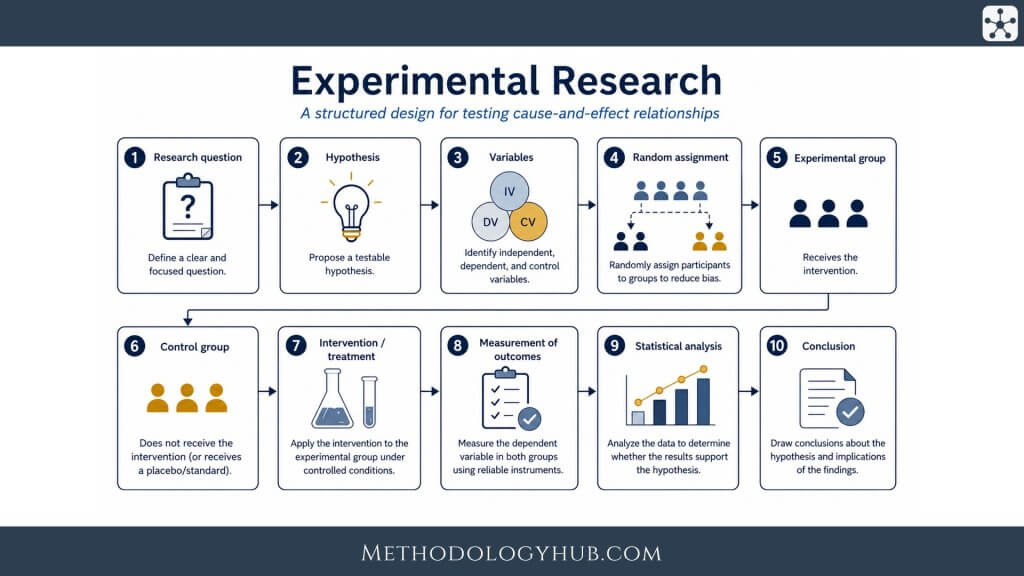
Performing experimental research begins long before the treatment is introduced. The researcher needs a clear question, a testable hypothesis, defined variables, a workable design, suitable participants or units, a measurement plan, and an analysis plan. These decisions belong inside the wider research process.
A good experiment is not built by adding random assignment at the end. The design should be planned from the beginning so that the treatment, comparison condition, measurement schedule, and analysis all answer the same question.
Step 1: Define the research question
The research question should name the relationship being tested. A vague question such as “Does technology help learning?” is too broad for an experiment. A clearer question would ask whether weekly online retrieval quizzes improve final exam performance among first-year biology students compared with rereading review notes.
This narrower version tells the researcher what the treatment is, what the comparison might be, who the study concerns, and what outcome should be measured. It also prevents the experiment from drifting into a general evaluation of a topic rather than a test of a defined condition.
Step 2: Write the hypothesis
The hypothesis translates the question into an expected relationship. In experimental research, the hypothesis usually states that the treatment condition will produce a different outcome from the control or comparison condition. It may also state the expected direction, such as higher scores, faster responses, fewer errors, or greater retention.
The hypothesis should be written before the final analysis. This keeps the interpretation tied to the planned test rather than to whichever pattern looks most interesting after the data are collected.
Step 3: Define the variables and conditions
The researcher then defines the independent variable, dependent variable, and any control variables. The independent variable must be translated into actual conditions. For example, “feedback” may become immediate written comments, delayed written comments, audio comments, or no comments. The dependent variable may become a score from a rubric, a test result, or a measured change from baseline.
Control variables should be selected because they could affect the outcome. In an education experiment, prior achievement may need attention. In a plant growth experiment, light, soil, and watering may need to be held constant or recorded. In a psychology experiment, task order and instructions may need careful standardization.
Step 4: Choose the experimental design
The design should match the question and the setting. If participants can experience only one condition, a between-subjects design may fit. If the same participants can complete several conditions without strong carryover, a within-subjects design may be efficient. If the researcher wants to examine two independent variables together, a factorial design may be better.
At this stage, the researcher also decides whether the experiment will be conducted in a laboratory, field setting, online environment, classroom, clinic, or other site. The setting affects control, recruitment, measurement, and interpretation.
Step 5: Select participants or units
The sample should fit the population named in the question. Participants may be students, patients, teachers, households, documents, plants, animals, classes, clinics, or repeated observations. The researcher should explain who or what was eligible and how the sample was reached.
Sampling and assignment should not be confused. A study may recruit a convenience sample and then randomly assign participants to conditions. Another study may use a probability sample but still fail to assign treatments randomly. Both parts should be reported separately.
Step 6: Assign conditions and collect data
Once the design is ready, units are assigned to conditions according to the plan. If random assignment is used, the method should be described. The researcher then applies the treatment, keeps procedures consistent, records deviations, and collects outcome data according to the measurement schedule.
Good experimental reporting makes the procedure traceable. Readers should be able to see what happened first, what each group received, when the outcome was measured, and how missing or incomplete data were handled.
Step 7: Analyse and interpret the results
The analysis should answer the experimental question directly. A simple two-group design may compare means or proportions. A repeated-measures design may use paired comparisons or models for repeated observations. A factorial design may examine main effects and interactions.
The final interpretation should return to the question. The researcher should describe the direction of the result, the size of the effect, the uncertainty around the estimate, and the study conditions under which the result was observed. A strong report also separates the result from wider claims that the design cannot support.
Examples of Experimental Research
Examples of experimental research appear across many fields. The setting changes, but the basic structure remains recognizable: a treatment or condition is introduced, a comparison is created, and an outcome is measured. The examples below use academic and applied research contexts rather than commercial situations.
Experimental research in education
An education researcher may test whether spaced practice improves vocabulary retention. Students are randomly assigned to one of two study schedules. One group studies the same word list in a single session. The other group studies the list across several shorter sessions. After one week, both groups complete the same vocabulary test.
The independent variable is study schedule. The dependent variable is vocabulary test score. If the groups were assigned randomly and the instruction was otherwise similar, the researcher can interpret a score difference as evidence about the effect of spacing under the study conditions.
Experimental research in psychology
A psychology experiment may test whether background noise affects working memory performance. Participants complete a memory task under quiet conditions or under a controlled noise condition. The task instructions, timing, and scoring are kept the same across conditions.
This design lets the researcher examine whether the noise condition changes performance. A within-subjects version might have the same participants complete both conditions in counterbalanced order. A between-subjects version might assign participants to only one condition.
Experimental research in health sciences
A health sciences experiment may test whether a guided exercise programme improves mobility scores after rehabilitation. Participants are assigned to receive the guided programme or the usual rehabilitation routine. Mobility is measured at baseline and after a fixed period.
The pretest helps show where participants started. The comparison group helps separate the programme effect from improvement that may occur over time. The researcher may analyse post-treatment scores while accounting for baseline mobility.
Experimental research in agriculture and environmental science
An agriculture experiment may compare the effect of three fertilizer types on plant growth. Plots are assigned to fertilizer conditions, and other factors such as watering schedule, seed variety, and sunlight exposure are controlled or recorded. Plant height, biomass, or yield may be measured after a set growth period.
Environmental experiments can use similar logic. A researcher may test how different temperature conditions affect seed germination, or how water quality treatments affect algae growth. The design needs enough replication so that the result is not based on one unusual plot, container, or observation.
Example pattern: identify the treatment, identify the comparison, measure the outcome, and then ask whether the design supports a causal reading.
Experimental research in social and behavioural studies
A social science researcher may test whether the wording of an information sheet changes comprehension. Participants are randomly assigned to read either a standard version or a simplified version. They then answer the same comprehension questions.
The study does not need to be large to show experimental logic. What it needs is a planned manipulation, a consistent outcome measure, and a comparison that helps isolate the effect of wording. If the simplified version leads to higher comprehension scores, the researcher can discuss that effect within the limits of the sample and setting.
Methodological Approaches in Experimental Research
Experimental research is often associated with quantitative methods, but the methodological approach can be broader. The core of the design is manipulation and comparison. Around that core, researchers may use numerical measurement, qualitative observation, mixed methods, repeated measurement, or longitudinal follow-up.
The approach should be chosen according to the question. A study that asks whether a treatment changes test scores needs a suitable numerical outcome. A study that also asks how participants responded to the treatment may add interviews or open-ended responses. The experiment tests the effect, while the additional evidence helps explain the experience or process around that effect.
Quantitative experimental research
Most experimental research is quantitative because effects are often estimated through numerical outcomes. Researchers may compare means, proportions, rates, times, counts, or scale scores. This allows the study to report the size and uncertainty of the treatment effect.
Quantitative experimental research often uses statistical analysis to examine whether the observed difference is compatible with random variation under a null hypothesis. The analysis should include descriptive results as well as statistical tests, so readers can see the observed pattern before interpreting the test result.
Mixed methods experimental research
Mixed methods research can be combined with experimental design when the question needs both effect evidence and explanatory detail. For example, a researcher may run a classroom experiment to test a new feedback routine and then interview students to understand how they used the feedback.
The two parts should be connected. Interviews should not be added only as decoration after a numerical result. They should help interpret implementation, participant response, unexpected patterns, or differences between groups. A well-integrated mixed methods experiment explains what was learned from reading the numerical and qualitative evidence together.
Cross-sectional and longitudinal experiments
Some experiments measure outcomes at one point after treatment. These designs can be efficient when the expected effect appears quickly. Other experiments use repeated measurements or follow participants over time. These connect experimental design with longitudinal research.
A longitudinal experiment can show whether an effect lasts, fades, grows, or changes shape. For example, a study technique may improve scores immediately after practice but show a different pattern after one month. The timeframe should follow the theory behind the expected effect.
Experimental research within a wider study
An experiment can also be one part of a larger project. An exploratory research phase may help design the treatment. A small pilot experiment may test whether the procedure works. A later evaluation may examine the treatment in a wider setting. In this sense, experimental research can sit inside a broader research programme.
This layered view helps students avoid treating research types as isolated boxes. A project can be applied in purpose, explanatory in objective, quantitative in methodology, empirical in source of knowledge, experimental in design, and longitudinal in timeframe. Each label describes a different part of the study.
FAQs on Experimental Research
What is experimental research?
Experimental research is a research design in which the researcher changes or assigns a condition and measures its effect on an outcome. It is used to test causal relationships between an independent variable and a dependent variable.
What is the main purpose of experimental research?
The main purpose of experimental research is to test whether a planned change in one variable causes a change in another variable. It can also compare treatments, estimate effect size, and examine how an effect appears under defined conditions.
What are the main features of experimental research?
The main features of experimental research are manipulation of an independent variable, measurement of a dependent variable, comparison between conditions, control of alternative explanations, and, in true experiments, random assignment to conditions.
What is the difference between experimental and quasi-experimental research?
Experimental research uses manipulation and random assignment in its strongest form. Quasi-experimental research studies a treatment or intervention but does not randomly assign participants or units to conditions, so causal interpretation is usually more cautious.