Action research is a type of research in which people study a real practice while they are also trying to improve it. It is often used by teachers, health workers, community researchers, librarians, social workers, and other practitioners who want to understand a problem in their own setting, try a planned change, collect evidence, and reflect on what happened.
This article explains what action research is, what its main objectives are, which aspects shape a good action research project, how it compares with basic and applied research, how to perform action research step by step, and how action research can look in schools, clinics, universities, and community settings.
What Is Action Research?
Action research is a research approach in which inquiry and practical change are developed together. The researcher does not only observe a situation from outside. Instead, the researcher studies a real setting, introduces or supports an action, gathers evidence about the process, and uses reflection to decide what should happen next.
A simple classroom example shows the idea. A teacher notices that students rarely revise their written work after receiving comments. Instead of only complaining about the problem, the teacher turns it into a small research project. The teacher asks a focused question, tries a new peer-feedback routine, collects samples of drafts and revisions, notes how students respond, and then adjusts the routine for the next writing task. The action and the research develop side by side.
Action research definition
Action research means studying a practice through a planned cycle of action, observation, reflection, and revision. The goal is not only to describe what is happening, but to use evidence to guide improvement in the setting being studied. The setting may be a classroom, clinic, community programme, university course, public service, professional team, or other place where people can act on the findings.
This makes action research different from a study that only records a problem. A researcher may begin with a concern, but the concern is then shaped into a research question, connected to evidence, and examined through a cycle. The written report should show not only the final result, but also how the action was planned, what was observed, and how reflection changed the next step.
The action research cycle
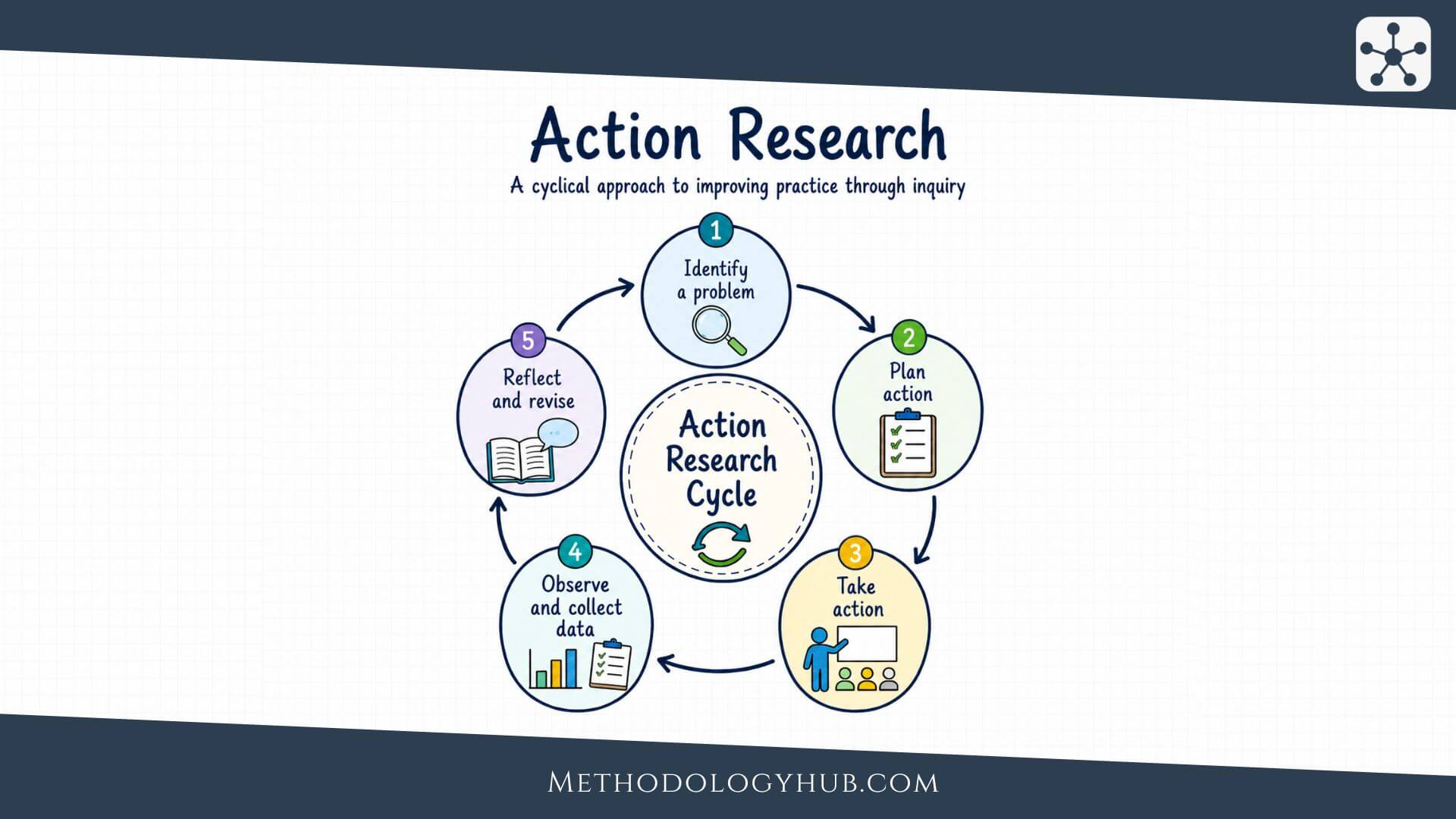
The cycle is one of the easiest ways to recognise action research. Many versions exist, but most include planning, acting, observing, and reflecting. The researcher identifies a practice issue, plans a change, carries it out, collects research data, studies the evidence, and then decides whether to continue, revise, or try another action.
The cycle does not have to be large. A teacher may complete two short cycles across one semester. A health team may follow several cycles while improving a patient information routine. A community group may work through a longer cycle that includes meetings, interviews, local data, and changes to a service. What connects these examples is the same logic: act carefully, observe honestly, reflect on evidence, and revise the practice.
Who conducts action research?
Action research is often conducted by practitioners. A teacher may study a teaching routine. A nurse may study a handover process. A librarian may study how students use a research workshop. A youth worker may study how participants respond to a community activity. In many projects, the person asking the question is also one of the people who can change the practice.
Action research can also be collaborative. A university researcher may work with teachers, a clinic may work with patients and staff, or a community group may work with local participants. These projects need clear roles. Readers should be able to see who designed the action, who collected evidence, who interpreted the data, and whose experience shaped the reflection.
Objectives of Action Research
The objectives of action research are connected to practice. A project usually begins because someone in a real setting sees a difficulty, gap, question, or routine that needs closer study. The aim is not to produce a distant description. The aim is to learn from a practical situation in a systematic way and use that learning to guide action.
This does not mean action research is informal. A good project still needs a clear research topic, a focused question, a planned intervention or change, suitable evidence, and careful interpretation. The difference lies in the close relationship between inquiry and improvement.
Improving a local practice
The most direct objective is to improve a practice in a specific setting. A teacher may want to improve feedback, a clinic may want to improve appointment follow-up, or a community centre may want to improve participation in a youth programme. The study asks what happens when a planned change is introduced and how that change can be refined.
The word local is important. Action research is usually not designed to make broad claims about every school, clinic, or community. Its first responsibility is to the setting where the action takes place. Still, a carefully described local project can help other readers think about similar conditions in their own setting.
Developing evidence for decision making
Another objective is to replace guesswork with evidence. Practitioners often have good experience-based impressions, but impressions can be incomplete. Action research gives them a way to collect notes, work samples, survey responses, interviews, attendance records, observation data, or other evidence that can be reviewed more carefully.
The evidence does not have to be complex. A classroom action research project might use student drafts, short reflection notes, and a simple rubric. A health project might use staff observations, patient feedback, and waiting-time records. The key is that the evidence should match the question and should be collected in a way that can be explained to readers.
Supporting practitioner reflection
Action research also supports reflection. The practitioner does not only ask whether the action worked. They ask what changed, for whom it changed, under which conditions, and what the next cycle should do differently. Reflection is therefore not a private afterthought. It becomes part of the research record.
This is one reason action research often uses journals, field notes, meeting notes, and reflective memos. These records help show how the researcher interpreted events as the project unfolded. They also make the study more transparent because readers can see how decisions were made between cycles.
Plain reading: action research does not treat reflection as decoration. Reflection is part of the method because it connects evidence from one cycle to the decision made in the next cycle.
Connecting participants and practice
Many action research projects involve participants in more than data collection. Students may comment on a classroom routine. Patients may explain how they experience a discharge process. Community members may help define the problem and interpret results. The level of participation varies, but action research often gives more attention to the knowledge of people inside the setting.
This participant connection can make the project more grounded. It also makes reporting more demanding. The researcher should explain how participants were involved, what role their input played, and how disagreements or unexpected responses were handled in the reflection process.
Key Aspects of Action Research
The key aspects of action research are easiest to understand when they are read as one connected design. A practitioner identifies a practical problem, turns it into a researchable question, plans an action, collects evidence while the action is carried out, and then uses reflection to revise the practice. Each aspect supports the next one.
Because action research happens in real settings, it often looks less controlled than an experiment. That does not make it weaker by default. It means the project needs a clear account of context, roles, evidence, and interpretation so that readers understand how the study was conducted.
A practical starting point
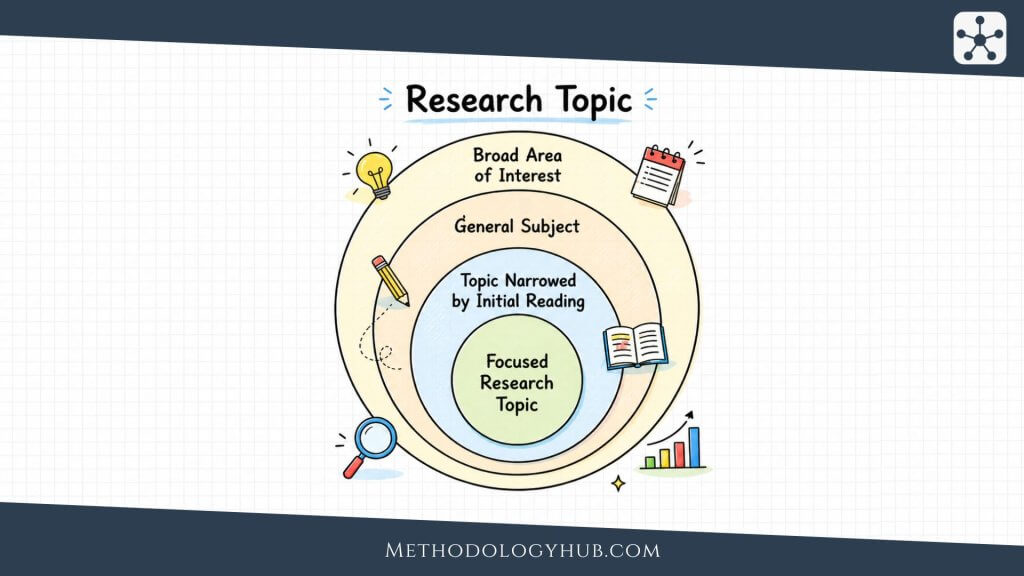
Action research usually starts with a concern from practice. The concern should be specific enough to study. A broad statement such as “students are not engaged” is too loose. A more useful starting point would be: “students in one class rarely use teacher comments when revising their essays.” This version points toward observable work, a setting, and a possible action.
The starting point should also be realistic. The researcher needs enough access to try an action and collect data. A teacher can usually study a classroom routine more easily than a district-wide policy. A clinic team can study a discharge checklist more easily than the whole health system. The scale should match the researcher’s role and the time available.
A focused research question
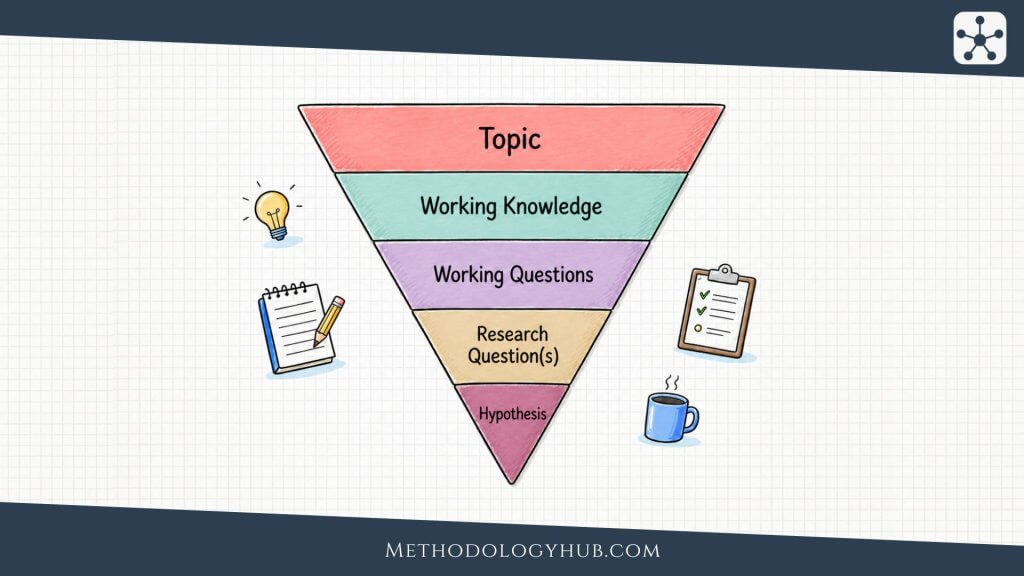
The research question gives the project direction. In action research, the question often asks how a planned change affects a practice, experience, process, or outcome in a particular setting. For example: “How does structured peer feedback affect the quality of revisions in Year 8 writing?” or “How do patients describe a revised discharge information sheet after two weeks of use?”
Some projects also include a research hypothesis, especially when the researcher expects a measurable change. A teacher might hypothesise that a revision checklist will increase the number of specific changes students make between drafts. In many qualitative action research projects, however, the question is more open and does not need a formal hypothesis.
Action, observation, and reflection
The action is the planned change introduced in the setting. It might be a new discussion structure, a revised worksheet, a patient reminder routine, a mentoring session, a reading guide, or a different way of organising feedback. The action should be described clearly enough that readers can understand what changed from usual practice.
Observation then records what happens. This may include numerical records, written work, interviews, short questionnaires, field notes, or documents. The researcher should choose data that can answer the question rather than collecting everything available. A small project with well-chosen data is usually easier to interpret than a large pile of weakly connected evidence.
Researcher role and context
The researcher’s role should be visible. In action research, the researcher may be a teacher, facilitator, supervisor, nurse, librarian, or community worker. This closeness can be a strength because the researcher understands the setting. It also means the report should explain how the researcher recorded observations, invited participant feedback, and handled their own assumptions.
Context also needs attention. A change that works in a small seminar may not work in a large lecture. A patient information routine may work differently in a busy urban clinic than in a small rural clinic. Context helps readers judge the transferability of the study. It shows where the findings came from and what conditions shaped them.
Evidence and analysis
Action research can use qualitative research, quantitative research, or mixed methods research. Interviews, observations, field notes, documents, scores, rubrics, attendance records, and short surveys can all be suitable if they match the question. The method should follow the evidence needed, not the other way around.
Analysis should be practical but still systematic. A teacher may compare drafts before and after a feedback routine. A clinic team may summarise waiting-time records and review patient comments. A community researcher may code meeting notes and compare themes across two cycles. If numerical data are used, simple descriptive statistics may be enough, although some projects may also use statistical analysis or other statistical methods.
Action Research vs Evaluation Research
Action research and evaluation research are both practical forms of research. They are usually carried out in real settings rather than in highly controlled laboratory conditions, and both can help people make better decisions about practice, programmes, services, or interventions. The difference is in the role of the researcher and the main purpose of the study.
Action research is used when a practitioner wants to study and improve their own practice through a cycle of planning, action, observation, and reflection. Evaluation research is used when a researcher or organisation wants to judge the quality, implementation, effect, or value of a programme, policy, course, service, or intervention. One is mainly about improving practice from within. The other is mainly about judging something that has been designed, implemented, or funded.
The main difference
The easiest way to separate the two is to look at the question being asked. In action research, the question often sounds like: “How can I improve this practice in this setting?” A teacher may ask how feedback can be changed to support revision. A nurse may ask how a handover routine can be improved. A community worker may ask how participation in a local project can be strengthened.
In evaluation research, the question usually sounds more like: “How well is this programme working?” or “Should this intervention be continued, changed, expanded, or stopped?” A school district may evaluate a reading programme. A university may evaluate a mentoring scheme. A public agency may evaluate whether a service reaches the group it was designed to support.
Comparison table
| Aspect | Action research | Evaluation research |
|---|---|---|
| Main purpose | To improve a practice while studying the change. | To judge the quality, value, implementation, or effect of something. |
| Typical focus | Classroom practice, professional routines, local work processes, or community practice. | Programmes, policies, services, courses, interventions, or projects. |
| Researcher role | Often an insider who is also part of the practice being studied. | May be an internal evaluator, external evaluator, researcher, or evaluation team. |
| Usual structure | Cyclical: plan, act, observe, reflect, and revise. | Criterion-based: define what is evaluated, collect evidence, compare findings with criteria, and report conclusions. |
| Typical outcome | A better-informed change in local practice and a record of what was learned from the cycles. | A judgement about performance, implementation, outcomes, reach, or value. |
| Example question | How can I improve peer feedback during writing lessons? | Did the writing support programme improve students’ revision quality? |
How the two can overlap
The boundary is not always rigid. A school, clinic, or community organisation may use action research to improve a practice and also collect evidence that looks evaluative. For example, a teacher may introduce a new feedback routine, reflect on each lesson, revise the routine, and compare student drafts before and after the change. The study is still action research if the main structure is the improvement cycle and the teacher’s reflective role is central.
The same topic could also become evaluation research if the main purpose changes. Suppose a school has already introduced a writing support programme across several classes and now wants to know whether the programme should continue next year. The study may compare participation records, writing scores, student feedback, teacher reports, and implementation notes. Here the focus is less on the teacher’s own cycles of improvement and more on judging the programme as a whole.
Planning note: If the central activity is changing your own practice while studying the change, the design is usually action research. If the central activity is judging a programme or intervention against criteria, it is usually evaluation research.
Example in an education setting
Imagine a teacher who notices that students rarely use written feedback when revising essays. In an action research study, the teacher might plan a new feedback routine, use it for three weeks, collect student reflections and revised drafts, adjust the routine, and repeat the process. The evidence is connected to improvement in that classroom. The teacher is not only observing from outside the situation. They are part of the practice being studied.
In evaluation research, the same school might examine a year-long writing intervention used across several classes. The study may ask whether the intervention was implemented as planned, whether students attended the sessions, whether writing scores changed, and whether teachers found the programme usable. The conclusion may support a decision about revising, expanding, or discontinuing the intervention.
Choosing between action research and evaluation research
The choice depends on what the study is supposed to do. If the researcher is a practitioner trying to learn from a local change while adapting the practice along the way, action research is usually the better fit. It gives space for reflection, revision, and close attention to the setting.
If the study needs to judge the performance of an existing programme, course, policy, or service, evaluation research is usually more suitable. It can use qualitative, quantitative, or mixed methods research, depending on the evaluation question. The design may include interviews, observations, documents, survey responses, participation records, outcome measures, or other forms of research data.
A useful decision point is the expected final product. Action research normally ends with a practical learning account: what was changed, what happened, what was noticed, and how the next cycle was shaped. Evaluation research normally ends with an evaluative conclusion: how well something worked, for whom, under what conditions, and according to which criteria.
Types of Action Research
Action research appears in several forms. The differences usually concern who leads the inquiry, how participants are involved, and how broad the intended change is. Some projects are small and practitioner-led. Others are collaborative or participatory, with several people helping to define the problem and interpret the evidence.
These types are not always separated cleanly in real projects. A teacher-led classroom study may become collaborative when colleagues join the next cycle. A community project may begin with one facilitator but become participatory when local members help decide what evidence should be collected.
Individual practitioner action research
Individual practitioner action research is conducted by one person in their own practice. A teacher may study questioning strategies. A librarian may study how students use a database workshop. A counsellor may study a new intake form. The project is usually small, but it can still be rigorous when the question, action, data, and reflection are reported clearly.
This type is common in professional development and teacher research because it lets practitioners study questions that are close to their daily work. Its scale is also manageable. The researcher can try a change, collect evidence from the setting, and make revisions without needing a large research team.
Collaborative action research
Collaborative action research involves more than one practitioner or a partnership between practitioners and researchers. A group of teachers may study a new assessment routine across several classes. A university researcher may work with school staff to design and study a learning intervention. A clinic team may examine a handover process together.
The value of collaboration is that several people can bring different perspectives to the same practice. It can also make the findings stronger because evidence and interpretation are discussed rather than held by one person. The report should explain how decisions were shared and how the group handled differences in interpretation.
Participatory action research
Participatory action research gives participants a stronger role in shaping the inquiry. Instead of being treated only as respondents, participants may help define the problem, design the action, interpret findings, and decide next steps. This approach is common in community research, youth research, health projects, and other settings where the experience of participants is central.
For example, a community education project might invite learners to identify barriers to attendance, discuss possible changes, collect feedback from peers, and help interpret the results. The research is still systematic, but the knowledge of participants is part of the design rather than only a source of data.
Classroom and educational action research
Classroom action research is one of the best-known forms. Teachers use it to study learning, feedback, participation, assessment, classroom discussion, reading routines, writing development, or student support. The design often fits naturally into a school term because teachers can try one change, observe the response, and refine the next lesson sequence.
Educational action research can also happen outside a single classroom. It may involve departments, schools, universities, adult education programmes, or professional learning groups. The scale changes, but the cycle remains familiar: identify a problem in practice, act, observe, reflect, and revise.
How to Perform Action Research
To perform action research, begin with a practical issue that can be changed, then turn it into a focused question, plan an action, collect suitable evidence, study the evidence, and use reflection to decide the next cycle. The process is flexible, but it should not be vague. Each step should leave a clear trace in the final report.
The steps below describe a common way to organise an action research project. They can be adapted for classrooms, clinics, libraries, community programmes, or university courses.
Step 1: Identify a practice issue
Start with something that happens in the setting and can be studied through evidence. The issue should be concrete enough to observe. “Learners need more support” is broad. “Learners rarely use examples when revising their lab reports” is more useful because it points to a specific practice and a possible source of evidence.
At this stage, it helps to write a short description of the setting, the people involved, and the routine that seems to need change. This description can later become part of the methods section because it explains where the inquiry began.
Step 2: Write the action research question
The question should connect the action, the setting, and the evidence. For example: “How does a weekly revision checklist affect the quality of lab report revisions in one first-year course?” This question is specific enough to guide data collection, but still open enough to allow unexpected findings.
A strong question usually avoids promising too much. It does not claim that one small project will solve every version of the problem. It asks what happens in this setting when this action is tried, and what can be learned from the evidence.
Step 3: Review relevant knowledge
Action research is local, but it should not ignore existing knowledge. A short review can help the researcher understand similar studies, concepts, methods, and possible forms of evidence. For a classroom project, this might include work on feedback, peer review, formative assessment, or student revision. For a health project, it might include studies on communication, patient education, or service routines.
The review does not need to become a long theory chapter in every small project. Its job is to inform the action and help the researcher avoid designing the project from personal impression alone.
Step 4: Plan the action and data collection
The action should be described before it begins. What will change? Who will be involved? How long will the cycle last? What will remain the same? These details protect the study from becoming a vague story about improvement.
Data collection should then follow the question. If the question concerns student revision, evidence may include drafts, rubrics, feedback notes, and student reflections. If the question concerns clinic communication, evidence may include observation notes, patient comments, staff logs, and time records. The researcher should also decide how the data will be organised before the action begins.
Step 5: Carry out the action
During the action phase, the researcher introduces the planned change and records what happens. It is important to keep notes while the process is still fresh. Small details often become useful later: a task took longer than expected, participants used a tool in an unexpected way, or a planned activity worked for one group but not another.
The researcher should avoid changing the action constantly without recording those changes. If a change is necessary, it should be noted. Action research can adapt, but adaptation needs documentation so the final report shows how the cycle unfolded.
Step 6: Analyse the evidence
Analysis depends on the data. Student work may be compared using a rubric. Interview notes may be coded for repeated themes. Survey responses may be summarised with percentages. Attendance or completion records may be compared before and after the action. In a mixed methods research project, numerical patterns and participant comments may be read together.
The analysis should return to the question. It should show what changed, what did not change, what was unclear, and what seems to explain the result. A useful analysis does not force every piece of evidence into a positive story. Unexpected results often give the next cycle its direction.
Step 7: Reflect and revise
Reflection is where action research turns evidence into the next decision. The researcher asks what the evidence suggests, what should be kept, what should be changed, and what needs closer study. This can lead to a second cycle with a revised action, a better instrument, a narrower question, or a different form of participant feedback.
The reflection should be written down. A clear reflective record helps readers understand why the next cycle looks the way it does. It also prevents the report from presenting the final decision as if it appeared automatically.
Step 8: Report the action research project
The report should describe the setting, question, action, participants or cases, evidence, analysis, reflection, and revisions. It should also explain the boundaries of the study. A classroom action research project may be useful for other teachers, but it should not be reported as if it proves that the same action will work everywhere.
A strong report usually includes enough detail for readers to understand the practice situation. It does not need to overstate the result. Its value comes from showing how systematic inquiry helped the researcher learn from action in a real setting.
Examples of Action Research
Examples of action research are easiest to understand when the action, evidence, and reflection are visible. The examples below are not templates to copy exactly. They show how the same cycle can be adapted to different academic and professional settings.
Action research in a classroom
A teacher notices that students often submit first drafts that contain general claims but little evidence. The teacher asks: “How does a source-use checklist affect the evidence students include in their essay revisions?” The action is a short checklist used during peer review. The evidence includes first drafts, revised drafts, peer comments, and student reflections.
After the first cycle, the teacher finds that students added more quotations but did not always explain them. In the second cycle, the checklist is revised to include a prompt for explaining each piece of evidence. The final report describes both the improvement and the part of the routine that needed revision.
Action research in a health setting
A clinic team notices that patients often leave appointments unsure about follow-up steps. The team asks: “How do patients respond to a revised discharge summary written in plain language?” The action is a one-page summary tested over four weeks. Evidence includes patient comments, staff notes, and records of follow-up phone calls.
The first cycle shows that patients like the shorter format but still miss information about medication timing. The team revises the summary by adding a small timing table. The second cycle then studies whether patients describe the follow-up instructions more clearly. The project stays close to practice while still using a systematic record of evidence.
Action research in a university course
A lecturer teaching a first-year methods course sees that students can define terms but struggle to connect them to examples. The action research question asks: “How does weekly example writing affect students’ ability to apply research design terms?” The action is a five-minute example-writing task at the end of each week.
The evidence includes student examples, short quizzes, and reflective notes. After one cycle, the lecturer notices that students write better examples when the prompt names a setting, such as a school or clinic. The second cycle uses more specific prompts. The report shows how a small teaching routine was refined through evidence.
Action research in a community programme
A community education programme wants to improve attendance in a weekly adult learning group. Instead of assuming the cause, the facilitator begins with participant feedback and attendance records. The action is a revised meeting structure that includes a shorter opening activity, clearer session goals, and a participant-led planning board.
Evidence comes from attendance records, short interviews, and facilitator notes. The reflection shows that attendance improved for some participants but not for those with transport difficulties. The next cycle therefore focuses on timing and access rather than session structure alone.
| Setting | Possible action | Possible evidence |
|---|---|---|
| School classroom | Introduce a revision checklist for essays. | Drafts, rubrics, peer comments, student reflections. |
| Clinic | Revise follow-up instructions for patients. | Patient comments, staff notes, follow-up records. |
| University course | Add weekly example-writing tasks. | Student examples, quiz answers, teaching notes. |
| Community programme | Change the meeting structure after participant feedback. | Attendance records, interviews, facilitator notes. |
These examples also show the difference between action research and a simple project report. A project report might say that a new routine was introduced. An action research report explains the question, action, evidence, analysis, reflection, and revision.
Strengths and Limitations of Action Research
Action research has several strengths. It connects inquiry to practice, gives practitioners a structured way to study their own work, and can produce findings that are immediately useful in the setting being studied. It also makes room for participant experience, especially in collaborative and participatory projects.
At the same time, action research has limits. Because it is usually local and context-specific, its findings should be interpreted with care. The researcher is often close to the practice, which can improve understanding but also requires honest documentation of role, assumptions, and evidence.
Strengths of action research
One strength is relevance to practice. The project begins with a real issue that someone in the setting has reason to examine. This can make the findings more usable for participants than findings from a distant study that does not account for local routines.
Another strength is flexibility. The researcher can learn from the first cycle and revise the second. This is helpful in complex settings where a fixed plan may not fit what actually happens. Action research also supports professional learning because practitioners become researchers of their own work rather than only users of external findings.
Limitations of action research
The main limitation is generalisation. A project in one classroom, clinic, or community programme may not apply directly to another. Readers need details about context so they can judge whether the findings are relevant to their own setting.
Another limitation is role-related bias. Because the researcher may also be the practitioner, they may expect the action to work or may notice some evidence more than other evidence. This does not make action research unusable. It means the researcher should record procedures clearly, include more than one form of evidence when possible, and invite feedback from others when interpretation is uncertain.
Interpreting action research findings
Action research findings should be read as situated evidence. They show what happened in a particular setting, during a particular cycle, with particular participants and conditions. The goal is not to pretend that local evidence is universal. The goal is to report the project well enough that others can learn from the case.
This is why action research often works well with case study research, descriptive research, or exploratory research aims. The design may describe a setting, explore a process, and document improvement across cycles without claiming more than the evidence can support.
Conclusion
Action research is a practice-based form of inquiry. It is used when a researcher or practitioner wants to study a real setting while also improving it through planned action. The cycle of planning, acting, observing, reflecting, and revising gives the approach its structure.
A good action research project does not rely on good intentions alone. It needs a focused question, a clear action, suitable data, careful analysis, and honest reflection. It should also explain the researcher’s role and the context in which the action took place.
Action research is especially useful when the person close to a problem can also help change the practice. A teacher can study feedback in a classroom. A health team can study a patient communication routine. A community group can study participation in a local programme. In each case, the strength of the study comes from connecting action with evidence.
FAQs on Action Research
What is action research?
Action research is a type of research in which a practice is studied while a planned change is being introduced. It usually follows cycles of planning, acting, observing, reflecting, and revising.
What is the main purpose of action research?
The main purpose of action research is to improve a practice in a real setting while using systematic evidence to understand what happens. It connects practical change with research-based reflection.
What are the steps in action research?
Common steps in action research are identifying a practice issue, writing a research question, reviewing relevant knowledge, planning an action, collecting data, analysing evidence, reflecting on results, revising the action, and reporting the project.
What is an example of action research?
An example is a teacher introducing a peer-feedback routine, collecting student drafts and reflections, analysing how revisions changed, and then adjusting the routine for the next writing task.
How is action research different from applied research?
Applied research addresses a practical problem with systematic evidence. Action research also addresses practice, but it usually studies a change while it is being carried out and revised by practitioners or participants in the setting.