Descriptive research is a type of research used to describe a population, situation, behaviour, experience, or set of characteristics as accurately as possible. It helps researchers answer questions such as what exists, who is involved, how often something occurs, where a pattern appears, and how a group or setting can be described from available evidence.
This article explains what descriptive research is, what its objectives are, which features shape a strong descriptive study, how it differs from exploratory and explanatory research, and how researchers can perform it in a clear and beginner-friendly way.
What Is Descriptive Research?
Descriptive research is research that documents and describes the features of a defined subject without trying to manipulate it. The subject may be a group of students, a set of classrooms, a hospital service, a collection of documents, a social behaviour, a natural environment, or a body of published studies. The researcher observes, measures, records, or summarises what is there.
The simplest way to recognise descriptive research is to look at the question it asks. A descriptive study usually begins with questions such as: What are the characteristics of this group? How common is this behaviour? Which categories appear in these records? What experiences do participants report? How has this pattern changed across a defined period?
Descriptive research definition
Descriptive research means systematically collecting and analysing evidence in order to describe a population, case, setting, event, behaviour, or phenomenon. It can use numerical data, qualitative data, or both. What makes the study descriptive is not the data format alone, but the claim the study tries to support.
For example, a researcher may survey 600 secondary school students to describe how often they use digital study tools. Another researcher may observe classroom interaction to describe the types of questions teachers ask during lessons. A third may analyse published articles to describe which research designs are most common in a field. These projects use different data sources, but they share the same descriptive purpose.
What descriptive research can show
Descriptive research can show patterns, distributions, categories, frequencies, averages, ranges, and participant perspectives. In quantitative studies, it often reports values such as percentages, means, medians, standard deviations, or counts. In qualitative studies, it may report categories, themes, examples, and detailed descriptions of a setting or experience.
A descriptive study may also compare groups, periods, locations, or document types. A school researcher might compare how feedback practices differ between year levels. A public health researcher might describe vaccination rates across districts. A language researcher might describe the kinds of errors learners make at different stages. These comparisons can be useful, but they should be interpreted as description unless the design supports an explanatory claim.
What descriptive research does not try to prove
Descriptive research is usually not designed to prove cause and effect. It may show that two variables appear together, or that one group differs from another, but that is not the same as showing that one factor caused the other. A study may find that students who use the library more often report higher academic confidence. That is a descriptive or correlational pattern. It does not prove that library use caused the confidence difference.
This does not make descriptive research weak. It simply means the interpretation must stay aligned with the design. Many fields need careful description before they can move toward stronger explanations. If researchers do not know what is happening, how often it happens, who is affected, or where the pattern appears, later explanatory work may be built on a poor map of the topic.
Objectives of Descriptive Research
The objectives of descriptive research depend on what the study needs to make visible. Sometimes the researcher wants a clear profile of a population. Sometimes the aim is to document a practice that has been discussed loosely but not studied carefully. In other cases, the study creates a baseline that later research can compare with new data.
These objectives often appear together. A single descriptive study may estimate the frequency of a behaviour, describe differences between subgroups, and organise observations into useful categories. The important point is that the objective should be stated plainly before the design is chosen.
Describe characteristics of a group or setting
One objective is to describe the characteristics of a defined group, setting, or collection. A study of first-year university students may describe age, study programme, housing situation, hours of employment, study habits, and academic support use. A study of school libraries may describe opening hours, staffing, digital resources, seating capacity, and student access.
Good description depends on boundaries. The researcher should state who or what is included, which period is covered, and which characteristics are being described. Without these boundaries, a descriptive study can become too broad to interpret.
Estimate frequency, proportion, or distribution
Many descriptive studies estimate how common something is. A researcher may report the proportion of teachers who use peer feedback, the average number of patients seen in a clinic each day, or the distribution of response categories in a student survey. This type of objective often uses statistical analysis, but the analysis may remain descriptive if it only summarises the observed data.
Frequency and distribution are useful because they bring scale into the discussion. Instead of saying that a practice exists, the study can show whether it appears rarely, commonly, or mainly in certain groups. That is often the difference between an impression and a research-based description.
Map variation across groups, places, or time
Descriptive research can also map variation. A researcher may describe differences in homework load across grade levels, access to health services across districts, or published methods across journals. A study may use a cross-sectional research design to describe one point in time, or a longitudinal research design to describe change across several points.
Variation should not be treated as an explanation too quickly. If one district has lower service access than another, the descriptive finding identifies the difference. It does not automatically explain the reasons behind it. A later explanatory research design may be needed to test possible causes.
Plain planning question: before collecting data, ask whether the study is trying to describe characteristics, estimate frequency, compare groups descriptively, or document change over time.
Create categories, classifications, or profiles
Some descriptive studies organise a complex topic into categories. A researcher may classify types of feedback comments, patterns in interview responses, formats of online learning materials, or kinds of errors in laboratory reports. In this situation, the study may count existing categories, but it may also build the category system from the data.
This objective appears often in qualitative descriptive studies and content analyses. The researcher needs to show how categories were developed, how evidence was assigned to them, and how the final description represents the material. A category system should make the topic clearer rather than simply giving the reader a long list of labels.
Provide a baseline for later research
Descriptive research can create a baseline. A school may describe current attendance patterns before introducing a new support programme. A public health team may describe current service use before a policy change. A field of study may describe the methods currently used in published articles before discussing future research directions.
A baseline is more than a starting number. It is a documented description of the situation at a defined time, created with a method that later researchers can understand. If the same variables, categories, or procedures are used again, change can be studied more clearly.
Key Aspects of Descriptive Research
Descriptive research becomes stronger when its main parts fit together. The research question, population, variables, data collection method, and analysis plan should all point toward the same descriptive objective. If the question asks for a population estimate, the sample and measurement plan need to support that estimate. If the question asks for a detailed description of an experience, the data collection method needs to capture enough detail.
It is useful to think of descriptive research as a chain. The researcher first decides what should be described. Then they decide who or what can provide evidence. After that, they define the information to collect, collect it consistently, and present the results in a form that readers can judge.
Research question
The research question sets the descriptive frame. A broad question such as “How do students learn?” is too large for one descriptive study. A narrower question such as “What study strategies do first-year biology students report using during exam preparation?” gives the researcher a clearer population, behaviour, and context.
Descriptive questions often use words such as what, which, how many, how often, how much, where, and when. They can also ask how participants describe an experience, as long as the study stays focused on description rather than deep theory building.
Population, sample, and unit of analysis
The population is the wider group or collection the study is about. The sample is the smaller set actually observed. The unit of analysis is the thing being described, such as a person, school, lesson, article, record, event, or location. These three parts should not be left vague.
For example, a study may recruit 30 schools but describe student-level outcomes inside those schools. Another may collect 500 social service records but describe households rather than individual clients. These choices are reasonable when they are explained. They become confusing when the reader cannot tell what level the description belongs to.
Variables, indicators, and categories
In quantitative descriptive research, the researcher usually defines variables before collecting data. A variable may be age, attendance rate, reading score, device access, number of appointments, or response category. Each variable needs a clear definition so that measurement is consistent.
In qualitative descriptive research, the researcher may work with categories, topics, events, descriptions, or participant accounts. These may be partly planned before data collection and partly refined during analysis. Either way, the reader should be able to see how the description was produced from the evidence.
Data collection method
The data collection method should match the kind of description needed. A survey may work well when many people can answer the same structured questions. Observation may work better when the researcher needs to describe behaviour as it occurs. Document analysis may fit when the evidence is already present in reports, policies, student work, clinical records, or published articles.
The method also shapes what can be claimed. A short questionnaire may describe broad patterns across many people, but it may miss the detail of how participants understand their experiences. Interviews may provide richer accounts, but they usually describe a smaller group. Neither option is automatically better. The fit depends on the question.
Analysis and reporting
Descriptive analysis often begins by organising the data. Quantitative data may be summarised with counts, percentages, averages, medians, ranges, charts, and tables. Qualitative data may be summarised through categories, thematic descriptions, short examples, and comparisons across cases. In a mixed methods research study, both forms may be combined.
Reporting should make the description readable without hiding the method. Readers need enough detail to understand how the evidence was gathered, which cases were included, and how the summary was produced. A table of descriptive statistics may be helpful, but it should be supported by plain explanation. A set of qualitative categories may be useful, but it should be connected to examples from the data.
| Aspect | Question it answers | Example in a descriptive study |
|---|---|---|
| Research question | What should be described? | What reading strategies do pupils report using at home? |
| Population and sample | Who or what provides evidence? | Year 8 pupils from public schools in one district. |
| Variables or categories | Which features will be recorded? | Reading time, reading format, support from family, and reported difficulties. |
| Analysis | How will the description be summarised? | Percentages, medians, subgroup tables, and short descriptions of open responses. |
Descriptive Research Designs and Methods
Descriptive research can be carried out through several designs and methods. Some are mainly quantitative. Others are mainly qualitative. Many studies combine both. The design should follow the question, not the other way around.
Because descriptive research often studies situations as they naturally occur, it is commonly linked to non-experimental research. The researcher records, measures, or interprets evidence without assigning people to treatment conditions or manipulating the setting.
Survey research
Survey research is one of the most common ways to conduct descriptive research. It uses questionnaires or structured interviews to collect comparable information from a group of participants. A descriptive survey may ask about study habits, health behaviours, teacher practices, access to technology, or attitudes toward a school policy.
Surveys work well when the researcher needs a broad view across many people. The questions should be clear, the response options should match the concept, and the sample should fit the intended claim. If the survey is meant to describe a population, the selection process becomes especially important.
Observational description
Observation is useful when behaviour, interaction, or setting features need to be described directly. A researcher may observe how pupils work during group tasks, how patients move through a clinic reception process, or how visitors use a museum exhibit. The researcher may use a structured checklist, field notes, audio or video records, or a combination of these.
Observation can capture details that participants may forget or describe inaccurately. At the same time, it requires clear recording rules. If several observers are involved, they need shared definitions so that one observer’s “teacher prompt” is not another observer’s “student correction.”
Case study description
Case study research can be descriptive when it gives a detailed account of a bounded case. The case may be one school, one programme, one classroom, one patient pathway, one community, or one event. The study may use interviews, records, observations, and documents to build a rich description.
A descriptive case study is useful when the case itself needs to be understood carefully before broader comparison is possible. It should still have boundaries. A case study of a school reading programme, for example, should make clear which year groups, documents, activities, and time period are included.
Plain distinction: a survey can describe many people with the same questions, while a case study can describe one bounded case in greater depth.
Document and content analysis
Descriptive research can also use documents, records, images, published articles, policy texts, student assignments, or other materials that already exist. A researcher may describe the topics covered in science textbooks, the methods used in journal articles, or the types of feedback written on student essays.
This approach usually requires a coding scheme. The researcher decides what features will be recorded and how each document will be classified. If the study counts categories, coding consistency becomes important. If the study uses qualitative description, the researcher still needs to show how the categories or summaries were built from the material.
Cross-sectional and longitudinal descriptive designs
A cross-sectional descriptive study collects data at one point or during a short defined period. It can describe the current state of a population or setting. A longitudinal descriptive study collects data at more than one point and can describe change over time.
For example, a cross-sectional study may describe how many students currently use a tutoring centre. A longitudinal study may describe how tutoring use changes across the academic year. The second design can show change, but it still does not prove the cause of that change unless additional explanatory features are built into the design.
Qualitative, quantitative, and mixed descriptions
Quantitative research is useful when the description depends on numbers, such as frequency, percentage, average, score, or rate. Qualitative research is useful when the description depends on words, meanings, experiences, documents, observations, or context. Mixed descriptions use both forms when one alone would give an incomplete picture.
A study of student feedback, for instance, may count how often each type of comment appears and also describe the language teachers use in those comments. The count gives scale. The qualitative description gives texture. Together, they make the pattern easier to understand.
Descriptive vs Exploratory vs Explanatory Research
Descriptive research is often compared with exploratory research and explanatory research because all three are commonly classified by research objective. They are connected, but they do not do the same work.
Exploratory research is usually used when the topic is unclear or underdeveloped. Descriptive research is used when the researcher can define what should be described. Explanatory research is used when the researcher wants to test why a pattern occurs or how variables are related through a proposed mechanism.
Descriptive vs exploratory research
Exploratory research often comes before descriptive research. It helps the researcher understand the topic, identify possible variables, refine language, or develop better questions. It may use open interviews, pilot observations, informal document review, or early fieldwork to learn what deserves closer attention.
Descriptive research usually has a more settled focus. The researcher already knows enough to define the population, variables, categories, or setting to be described. For example, an exploratory interview study may first reveal that students talk about academic pressure in terms of time, family expectations, and assessment load. A later descriptive survey may then measure how common each of those pressures is in a wider student population.
Descriptive vs explanatory research
Explanatory research asks why or how. It may test whether one variable predicts another, whether an intervention changes an outcome, or whether a theoretical mechanism explains a pattern. Descriptive research, by contrast, can show the pattern clearly without claiming to explain it fully.
A descriptive study may report that absenteeism is higher in one grade level than another. An explanatory study would ask what accounts for that difference. It might examine transport access, health, school climate, family responsibilities, or prior achievement. That change in question usually requires a different design and a different analysis plan.
Descriptive vs correlational research
Correlational research examines relationships between variables. It often overlaps with descriptive research because a correlation can describe how two measured variables move together. A study may describe the association between reading time and vocabulary score, or between age and technology use.
The overlap can create confusion. A correlational result is not automatically explanatory. A correlation can be reported descriptively, especially when the study does not control other variables or test a causal model. When researchers want to explain the relationship, they usually need stronger design features, theory, and analysis.
| Research objective | Main question | Typical result |
|---|---|---|
| Exploratory research | What should be asked or examined? | Early categories, refined questions, possible variables, or pilot insights. |
| Descriptive research | What exists, how often, where, when, or in what form? | Frequencies, profiles, categories, summaries, maps, or detailed descriptions. |
| Explanatory research | Why or how does the pattern occur? | Evidence about relationships, mechanisms, causes, or alternative explanations. |
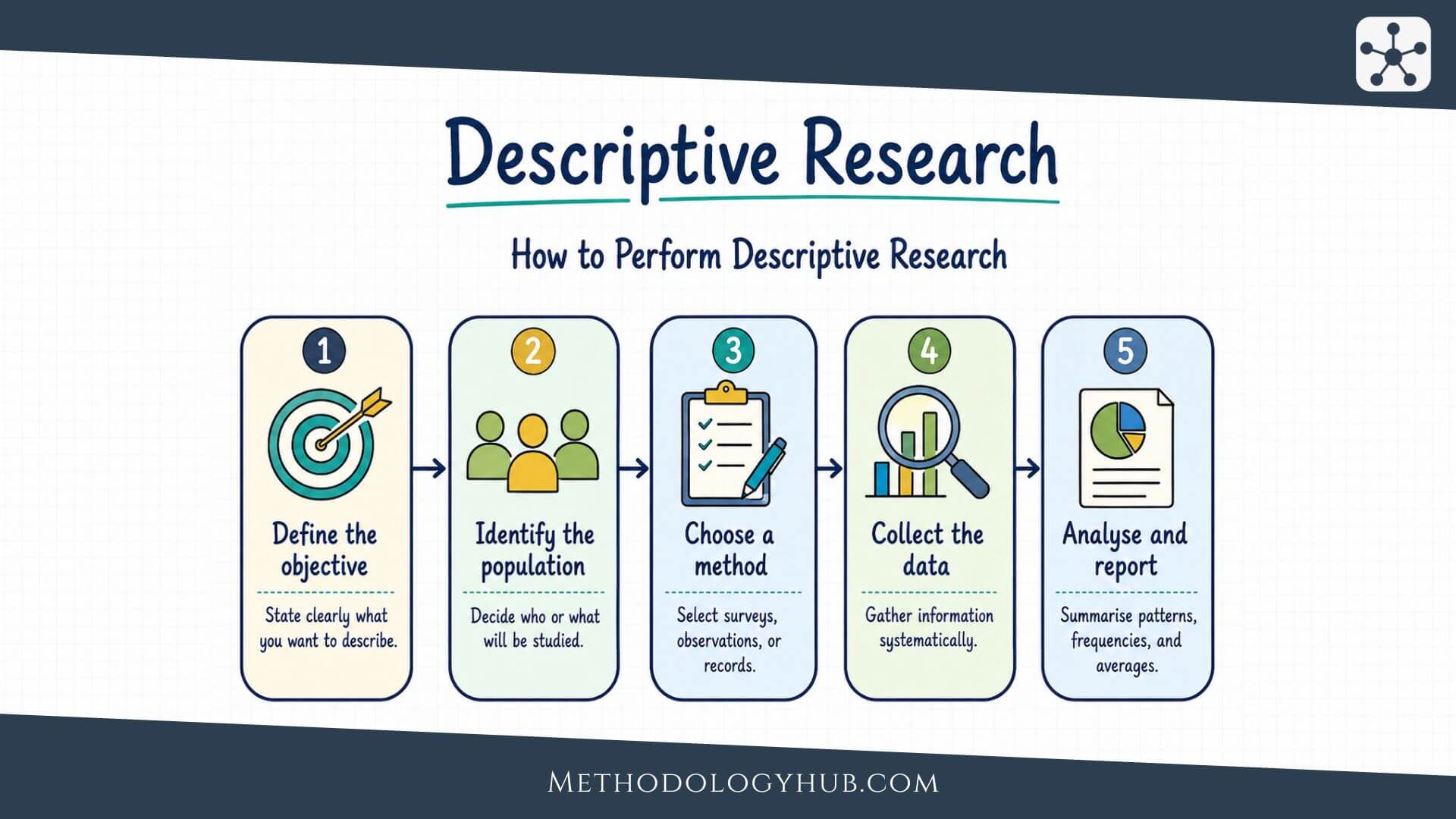
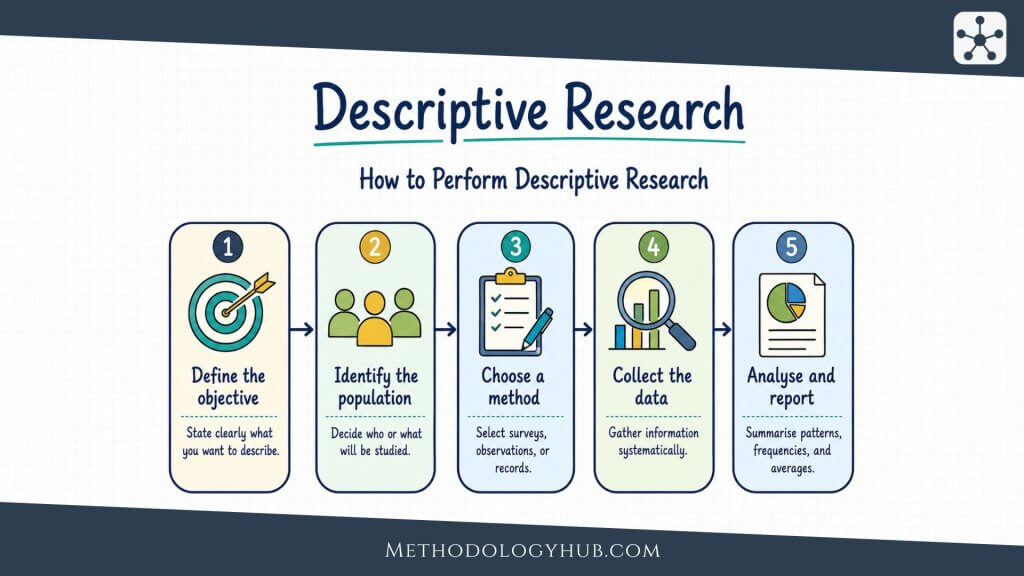
How to Perform Descriptive Research
Descriptive research is easiest to perform when the steps are treated as connected decisions. A clear question leads to a defined population. The population shapes the sample. The sample shapes data collection. The data collection method shapes analysis. If one part is vague, the next part becomes harder to justify.
The steps below work for many descriptive studies, but they should be adapted to the field, topic, and available evidence.
Step 1: Choose and narrow the research topic
A descriptive study begins with a research topic that can be observed or documented. A topic such as “student learning” is too wide. A narrower topic such as “study strategies used by first-year biology students during exam preparation” gives the study a clearer descriptive focus.
The topic should be specific enough that the researcher can decide what evidence is relevant. If almost anything could count as data, the topic is probably still too broad.
Step 2: Write a descriptive research question
The research question should state what will be described and in whom, where, or during which period. A question such as “What types of written feedback do teachers provide on Year 10 history essays?” is easier to design than “How do teachers give feedback?” because it defines the feedback form, subject, and student group more clearly.
Some descriptive studies later lead to a research hypothesis, especially if the researcher moves toward comparison or explanation. A purely descriptive study, however, does not always need a hypothesis. It may need clear research questions instead.
Step 3: Define the population and sample
The researcher then defines the population or collection. This may be people, records, documents, schools, classrooms, articles, locations, or events. The sample should be selected in a way that fits the intended description. A study claiming to describe all first-year students at a university needs a stronger selection plan than a study describing one seminar group.
Inclusion criteria should be stated before data collection when possible. For example, a records study may include only complete patient records from a specific clinic between January and June. A document study may include only articles from selected journals during a defined publication period.
Step 4: Define variables, categories, or indicators
Next, the researcher decides what information will be collected. In a survey, this may include variables such as age, year level, study time, library use, and confidence score. In an observation study, it may include categories such as teacher question, student response, peer discussion, or off-task behaviour.
This step turns the research question into a practical data plan. It also protects the study from drifting. When definitions are unclear, different participants, observers, or coders may interpret the same item differently.
Step 5: Choose a data collection method
The method should fit the kind of evidence needed. Surveys are useful for standardised information from many participants. Observation is useful for behaviour and setting features. Interviews can support qualitative description of experiences. Document or record analysis is useful when the evidence already exists in written, visual, or administrative form.
The researcher should also decide how data will be recorded. Survey responses may be entered into a dataset. Observations may use a coding sheet. Interviews may be recorded and summarised. Documents may be coded in a spreadsheet or qualitative analysis tool. The recording procedure affects the quality of the final description.
Step 6: Collect the research data consistently
During data collection, consistency is more important than speed. The same rule should be used for each participant, record, or observation unless the design says otherwise. If questions are changed halfway through a survey, or if observers use different definitions, the description becomes harder to trust.
Researchers should keep notes on response rates, missing data, excluded cases, coding decisions, and practical field conditions. These details help readers understand the shape of the final dataset and the limits of the description.
Step 7: Analyse the data descriptively
Descriptive analysis depends on the data. Numerical data can be summarised with counts, percentages, averages, medians, ranges, standard deviations, tables, or charts. Qualitative data can be summarised through categories, descriptions, short examples, and patterns across cases.
More advanced statistical methods may be used when the study estimates population values, compares subgroups, or reports uncertainty. The researcher should still explain whether the analysis is descriptive, inferential, correlational, or explanatory.
Step 8: Report the results with clear boundaries
The report should return to the descriptive question. It should explain what was observed, how the description was produced, and which limits should be kept in mind. A clear descriptive report does not need to sound dramatic. It needs to be precise, readable, and honest about what the data can show.
When the results suggest possible explanations, the researcher can discuss them carefully as interpretations or future questions. The wording should not turn a descriptive pattern into proof of cause. A good report leaves the reader with a clear picture, not a claim that stretches beyond the design.
Examples of Descriptive Research
Examples of descriptive research appear across education, health, social science, environmental studies, language research, and document-based research. The examples below show how the same descriptive logic can be used with different types of evidence.
Example 1: Study habits among university students
A researcher wants to describe how first-year university students prepare for exams. The study uses a questionnaire asking about weekly study hours, preferred study locations, use of lecture notes, group study, digital tools, and perceived difficulty. The results show the distribution of study strategies and how they differ by programme or year level.
This is descriptive research because the main goal is to show what students report doing. The study may suggest possible connections between study habits and confidence, but it would not prove that one habit causes better academic outcomes unless the design were changed.
Example 2: Feedback comments in school essays
A researcher collects a sample of marked history essays and describes the written feedback teachers provide. The study develops categories such as praise, correction, question, explanation, task instruction, and suggestion for revision. It then reports how often each category appears and gives short examples from the comments.
This example shows how descriptive research can use documents rather than participants. It also shows how counting and qualitative description can work together. The count shows the pattern. The examples show what the pattern looks like in actual feedback.
Example 3: Patient waiting times in a clinic
A health services researcher describes patient waiting times in a clinic over three months. The study records appointment type, arrival time, consultation start time, consultation length, and day of the week. The analysis reports median waiting time, range, busiest periods, and differences between appointment types.
The study gives the clinic a clearer picture of its current process. It does not prove why waiting times are longer on certain days. That would require further analysis of staffing, appointment scheduling, patient flow, and other possible explanations.
Reading example results: when a descriptive study reports a difference between groups or days, read it first as a documented pattern. Explanation comes only when the design supports that next step.
Example 4: Methods used in published research articles
A researcher reviews articles published in five education journals between 2020 and 2025. The study describes which research designs appear, which data collection methods are used, and whether the articles report quantitative, qualitative, or mixed methods findings. The results are presented in tables and short summaries.
This is descriptive because the study maps a body of literature. It can show, for example, that survey designs appear more often than case studies in the selected journals. It cannot explain the field’s publication patterns on its own, but it can give later researchers a clear starting point.
Example 5: Local environmental observations
An environmental researcher describes litter found along sections of an urban river. The study records item type, location, material, estimated volume, and date of observation. The results show which types of litter are most common and which sections of the river have the highest observed counts.
This kind of study can support monitoring and later comparison. If the same route and coding rules are used after a cleanup programme, researchers can describe whether the observed pattern changed. The descriptive design gives the baseline.
Advantages and Limitations of Descriptive Research
Descriptive research has a practical place in academic work because many questions begin with an incomplete picture. Before researchers can explain a pattern, design an intervention, or test a theory, they often need to know what the pattern looks like. Description gives that first organised view.
At the same time, descriptive research has limits. It can be very clear about what was observed and still be unable to explain the cause of the observation. A strong descriptive study handles this balance openly.
Advantages of descriptive research
One advantage is clarity. Descriptive research can make a topic visible by turning scattered impressions into organised evidence. A teacher may suspect that students rarely use feedback comments. A descriptive analysis of marked assignments can show how often comments appear, which types are common, and how students respond to them.
Another advantage is flexibility. Descriptive studies can use surveys, observations, records, interviews, documents, or mixed methods. This makes the approach suitable for many fields and many levels of study, from small classroom projects to large population surveys.
Descriptive research can also support planning. A baseline description can help researchers, schools, clinics, libraries, or community organisations understand a current situation before making changes. It can also help identify subgroups, settings, or patterns that need more focused research.
Limitations of descriptive research
The main limitation is that descriptive research usually cannot establish cause and effect. It can show that a pattern exists, but it may not explain why it exists. If a survey reports that students with part-time jobs study fewer hours, the study has described a relationship. It has not shown whether work hours caused lower study time, whether another factor is involved, or whether the relationship changes across contexts.
Another limitation is that description depends heavily on measurement and sampling. Poorly worded survey questions, incomplete records, narrow samples, or inconsistent coding can distort the picture. Because descriptive research may look simple from the outside, these design decisions are sometimes underestimated.
How to interpret descriptive results carefully
A careful interpretation stays close to the evidence. It names the population or sample, reports the descriptive pattern, and avoids language that suggests proof of cause. It also explains uncertainty where relevant. A descriptive result from a small convenience sample should not be written as if it represents a whole national population.
Descriptive findings can still be valuable when their boundaries are clear. A small study may describe one classroom very well. A national survey may describe broad patterns but miss local detail. A document analysis may describe published articles but not unpublished practice. The best interpretation tells the reader what the study can show and where the description ends.
Conclusion
Descriptive research gives researchers a systematic way to describe what exists. It may describe people, practices, records, documents, events, behaviours, settings, or trends. Its strength lies in careful definition, consistent data collection, and honest interpretation.
A good descriptive study does more than place a label on a topic. It defines the population or material, chooses suitable variables or categories, collects evidence through a method that fits the question, and reports the results in a form readers can understand. It can prepare the ground for later exploratory, correlational, explanatory, applied, or evaluation work, but it should not be forced to claim more than the design supports.
FAQs on Descriptive Research
What is descriptive research?
Descriptive research is a type of research used to describe a population, setting, behaviour, experience, event, or body of evidence. It focuses on what exists, how often something occurs, who is involved, where a pattern appears, or which characteristics are present.
What is the main objective of descriptive research?
The main objective of descriptive research is to provide an accurate and systematic description. It may describe characteristics, estimate frequencies, map variation across groups or time, create categories, or provide a baseline for later research.
What are examples of descriptive research?
Examples include a survey describing student study habits, an observation study describing classroom interaction, a document analysis describing feedback comments in essays, a clinic records study describing waiting times, or an environmental study describing types of litter along a river.
Is descriptive research qualitative or quantitative?
Descriptive research can be qualitative, quantitative, or mixed methods. Quantitative descriptive research often reports counts, percentages, averages, and distributions. Qualitative descriptive research reports categories, experiences, observations, and summaries in words.
What is the difference between descriptive and explanatory research?
Descriptive research describes what exists or what was observed. Explanatory research studies why or how a pattern occurs. A descriptive study may show that a difference exists between groups, while an explanatory study tests possible reasons for that difference.