Survey research is a research design that collects information from a defined group of people by asking them the same or comparable questions. The answers may describe opinions, behaviours, experiences, knowledge, needs, conditions, or background characteristics. Because the same instrument is used across many respondents, survey research can show patterns that are difficult to see from a few interviews, observations, or individual cases alone.
This article explains what survey research is, what it is used for, which designs and methods are common, how it differs from experimental research, how to perform it step by step, and how survey findings can be interpreted in academic work.
What Is Survey Research?
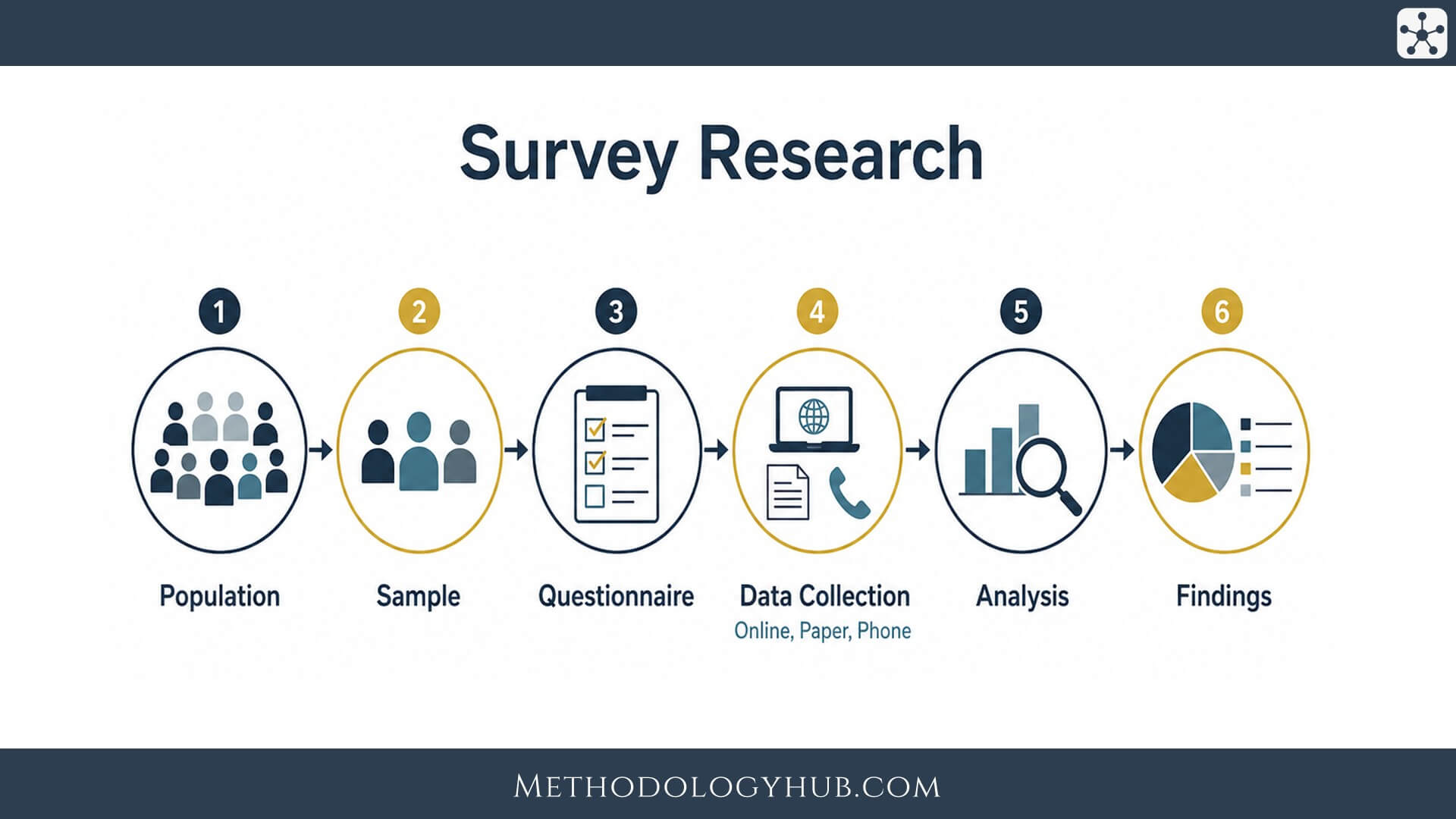
Survey research is a systematic way of studying a population by collecting responses from a sample. The researcher defines who the study is about, selects or recruits respondents, asks a planned set of questions, and analyses the answers in relation to the original research question.
The word survey can refer to the instrument, such as a questionnaire, but survey research is broader than the form itself. A short questionnaire placed online is not automatically a strong survey study. A survey becomes research when the population, sample, measurement, data collection procedure, and analysis are planned in a way that can support a clear academic claim.
For example, a researcher may want to know how secondary school students use feedback on written assignments. Interviewing five students could give rich detail, but it would not show how common certain practices are across a larger group. A survey could ask many students about the kinds of feedback they receive, how often they read it, which comments they understand, and which comments they use in later work. The answers can then be summarised and compared across groups, such as year level or subject area.
Survey research definition
Survey research is a research design in which information is collected from respondents through standardised questions so that patterns, frequencies, relationships, or differences can be studied within a defined population or sample. The questions may be closed-ended, open-ended, or a combination of both.
Standardisation is central. Respondents are usually asked the same questions in the same wording or in carefully controlled versions. This makes answers easier to compare. It also means that the researcher has to think carefully before data collection begins. Poor wording, unclear response options, or a weak sampling plan can limit the value of the whole study.
Survey research as a research design
Within the wider family of types of research, survey research is usually treated as a research design rather than a full methodology by itself. It often belongs to non-experimental research because the researcher usually measures variables as they exist instead of assigning people to treatment and control groups.
Survey research can be quantitative, qualitative, or mixed methods. A survey with rating scales and numerical categories fits well with quantitative research. A survey with open written responses may contribute to qualitative research. A study that combines both can be part of mixed methods research, especially when the numerical results and written answers are interpreted together.
This distinction helps students avoid a frequent problem in methods writing: naming the data collection tool but not explaining the design. A methods section should not stop at “we used a survey”. It should say who was surveyed, how they were selected, what the questions measured, how responses were collected, and how the answers were analysed.
Objectives of Survey Research
The objectives of survey research depend on the kind of question the researcher wants to answer. Some surveys estimate how common something is. Others compare groups, describe attitudes, measure experiences, or examine associations between variables. The same survey can serve more than one objective, but the main purpose should be visible before questions are written.
A weak survey often begins with a list of interesting questions. A stronger survey begins with a defined research problem, then builds questions that can produce evidence for that problem. This is why the objective should come before the questionnaire. The study needs to know what kind of answer it is trying to produce.
Describing a population or group
One common objective is description. A researcher may ask what students think about a new assessment format, how teachers use digital materials, how patients experience appointment systems, or how residents use public library services. In this form, survey research is closely connected to descriptive research.
Descriptive survey results are often reported as percentages, means, medians, or frequency tables. The researcher might report that 68% of respondents used a resource at least once a week, or that the average satisfaction score was 3.8 on a five-point scale. These numbers describe the sample. Whether they can also describe the wider population depends on the sampling and response process.
Comparing groups
Surveys are also used to compare groups. A study may compare first-year and final-year students, urban and rural schools, novice and experienced teachers, or patients using two kinds of services. These comparisons can be descriptive, but they can also move toward statistical inference when the sample and analysis support it.
Group comparison requires careful measurement. If two groups receive different wording or if one group is much less likely to respond, the comparison can become difficult to interpret. The researcher should also decide which group differences are part of the question before collecting data, instead of searching through many possible comparisons after the results arrive.
Measuring attitudes, beliefs, and experiences
Survey research is often used when the topic depends on self-report. Attitudes, beliefs, confidence, satisfaction, perceived difficulty, study habits, and service experiences cannot always be observed directly. A survey gives respondents a structured way to report them.
This does not mean self-report is perfect. People may misunderstand questions, choose socially acceptable answers, forget details, or respond quickly without reading carefully. These limits do not make surveys useless. They mean the researcher should write clear questions, avoid loaded wording, pilot the instrument, and interpret results as reported answers rather than direct access to every private thought or behaviour.
Studying relationships between variables
Survey research can examine relationships between variables. A researcher may ask whether study time is associated with academic confidence, whether teacher feedback is associated with student revision behaviour, or whether access to resources is related to course satisfaction. These questions often connect survey research to correlational research.
Association should be read with caution. A survey may show that two variables move together, but that does not automatically show that one caused the other. Causal claims need stronger design features, such as temporal order, control of alternative explanations, or experimental manipulation. Survey research can still be useful for identifying relationships that deserve closer study.
Plain reading: survey objectives usually concern description, comparison, measurement of reported experiences, or relationships between variables. The objective should guide the question wording and the analysis plan.
Tracking change over time
Some surveys study change. A school may survey the same students at the beginning and end of a course. A health service may survey patients every year. A research team may compare public attitudes across several time points. These studies connect survey research to longitudinal research when the design follows change across time.
The exact design affects the claim. Surveying the same people repeatedly can show individual change. Surveying a new sample from the same population each year can show population-level trends, but not necessarily the path of particular individuals. Both forms are useful when the difference is reported clearly.
Key Aspects of Survey Research
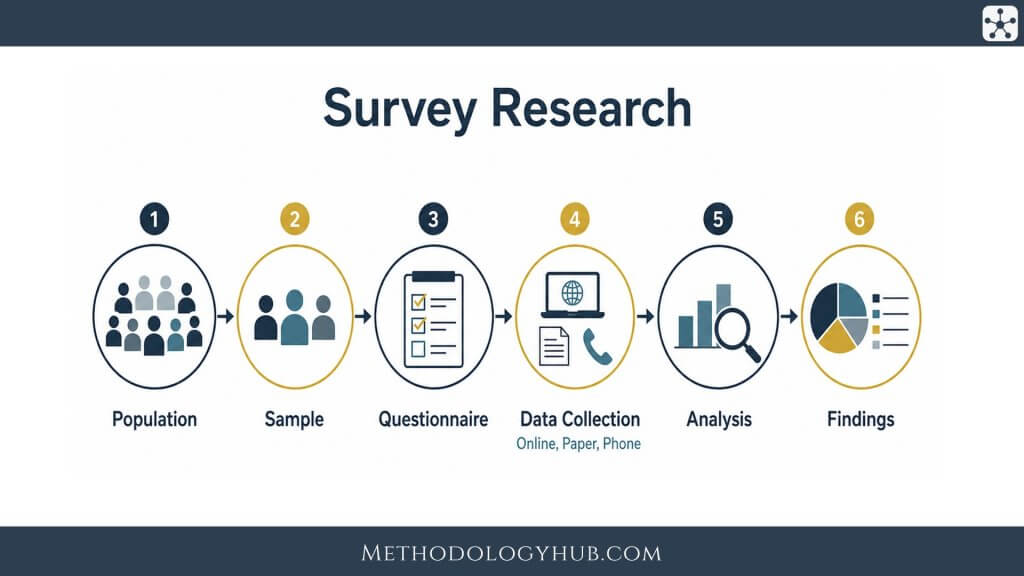
The key aspects of survey research are easier to understand when they are seen as connected parts of one design. A survey begins with a question about a population. The researcher then decides who can answer that question, how they will be reached, which concepts must be measured, what form the questions will take, and how the responses will be analysed.
These decisions should fit together. A carefully worded questionnaire cannot repair a sample that misses the population. A large sample cannot repair confusing questions. Advanced statistical methods cannot repair data that do not measure the concept in the first place.
Population and sample
The population is the full group the study wants to understand. The sample is the smaller group that actually provides responses. In survey research, this distinction is especially important because many survey findings are written as if they describe a wider group.
A population should be specific. “Students” is usually too broad. “First-year undergraduate students enrolled in public universities in one region during the 2026 academic year” is clearer. Once the population is defined, the researcher can decide how to reach it and what kind of sample is realistic.
Sampling and representativeness
Sampling affects how far survey findings can travel beyond the respondents. A probability sample, when done well, gives members of the population a known chance of selection and can support stronger population estimates. A non-probability sample may still be useful, especially in exploratory or small-scale studies, but the findings should be framed more carefully.
Representativeness is not only about sample size. A survey of 5,000 people can still be biased if it reaches only those with easy internet access, strong opinions, or free time to respond. A smaller but well-planned sample may be more informative than a large but narrow one.
Question wording and response options
Question wording is one of the most visible parts of survey research, but it is also one of the easiest to underestimate. Good questions are clear, direct, and suited to the respondents. They avoid asking two things at once, pushing respondents toward an answer, or using terms that only specialists understand.
Response options also need care. If a question asks how often students use a learning platform, the options should cover the possible range without overlap. “Often” and “sometimes” may feel natural, but they can mean different things to different respondents. More precise options, such as “daily”, “several times a week”, “once a week”, “less than once a week”, and “never”, are often easier to interpret.
Measurement and variables
Survey research often turns broad concepts into measurable variables. Academic confidence, satisfaction, trust, perceived difficulty, belonging, or workload are not single objects that can be measured directly with a ruler. The researcher has to decide which questions will represent the concept and how answers will be scored or analysed.
This is where survey research connects to the wider idea of research data. A response option becomes data only after the researcher has defined what it represents. A five-point agreement scale, for example, may produce useful numbers, but only if the item wording and the interpretation are defensible.
Response rate and non-response
Response rate shows how many eligible people completed the survey compared with how many were invited or reached. It is a useful number, but it does not tell the whole story. A high response rate is helpful only if the respondents still resemble the population in ways relevant to the research question.
Non-response becomes a problem when the people who do not answer differ from those who do. For example, a survey about homework pressure may underrepresent students who are too busy to complete it. A survey about digital access may miss those with limited access if it is distributed only online. Researchers should report response procedures clearly so readers can judge the possible limits of the findings.
Data analysis and interpretation
Survey analysis can be simple or complex. A small descriptive survey may use percentages and tables. A larger quantitative study may use confidence intervals, regression, or hypothesis tests. A survey with open-ended answers may use coding, content analysis, or thematic analysis.
The analysis should match the question and the data. A researcher should not treat ordinal ratings, open comments, and precise numerical measures as if they all meant the same thing. Interpretation also needs to return to the design. The strongest survey report explains what the data show, what they do not show, and which features of the design shape the conclusion.
Survey Research Designs
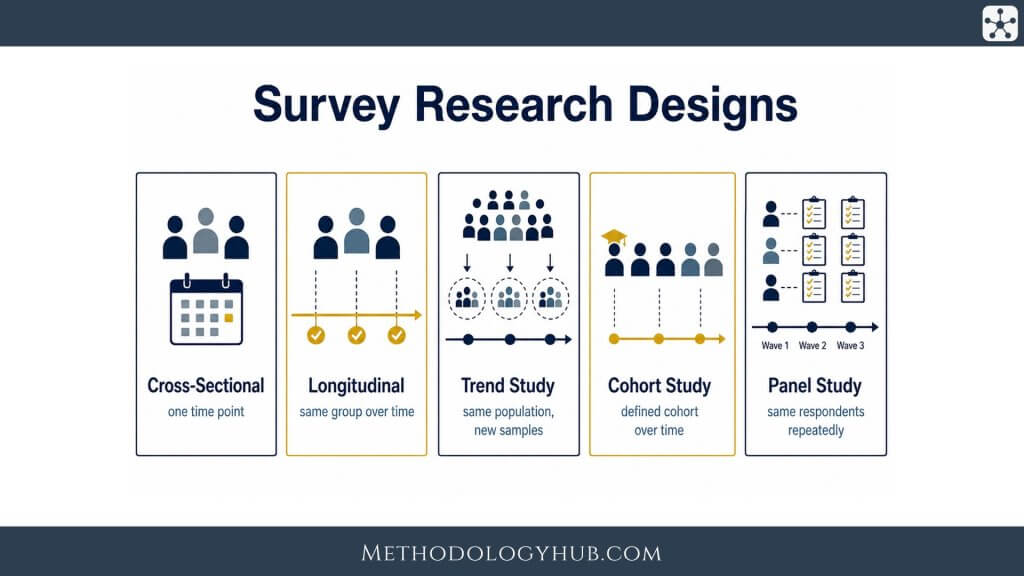
Survey research designs describe the structure of data collection. They show when responses are collected, whether the same respondents are followed, and whether the study is trying to describe a current situation or examine change over time. In survey research, this design decision affects what the findings can reasonably say about a group, a trend, or a sequence of responses.
The most familiar distinction is between cross-sectional and longitudinal survey research. A cross-sectional survey collects data once. A longitudinal survey collects data across more than one time point. Within longitudinal survey research, researchers often distinguish between trend studies, cohort studies, and panel studies because each design handles time and respondents differently.
Cross-sectional survey research
Cross-sectional research collects data at one point in time or during a short defined period. Many surveys use this design because it is practical and well suited to describing current conditions, comparing groups, or examining associations within a sample.
For example, a university may survey students near the end of a semester to describe how often they use academic support services. The study can show patterns during that period. It can compare responses by year of study, programme, or living situation. It cannot, by itself, show how individual students changed from the beginning to the end of the semester.
This design is useful when the research question asks what is happening now, how common something is, or how groups differ at a particular time. It is less suitable when the question is about development, persistence, or change within the same people.
Longitudinal survey research
Longitudinal research collects survey data across two or more time points. The repeated timing allows researchers to examine change, stability, sequence, or long-term patterns. A longitudinal survey may follow the same respondents, draw new samples from the same population, or focus on a defined cohort across time.
A researcher might survey trainee teachers before their first placement, after the placement, and at the end of the training year. If the same people respond each time, the study can examine individual changes in confidence. If different samples of trainee teachers are surveyed each year, the study can examine broader changes in the programme or population.
Trend study
A trend study, also called a repeated cross-sectional survey design, collects data from the same general population at different times, but usually with new samples at each time point. The purpose is to see whether the population-level pattern changes.
For instance, a school district may survey a new sample of parents each year about communication with schools. The result can show whether satisfaction in the parent population rises, falls, or remains stable across several years. Since the same parents are not necessarily followed, the study cannot show whether particular parents became more or less satisfied. It shows change in the population pattern.
Trend studies are useful when the population is more important than individual change. They are often used to study public opinion, student attitudes across school years, staff experiences across repeated institutional surveys, or changes in reported behaviour across several survey waves.
Cohort study
A cohort study follows or repeatedly studies a defined group that shares a starting characteristic, event, or period. The cohort may be students who entered university in the same year, patients diagnosed during the same period, teachers who began a new training programme together, or children born in the same year.
The defining feature is the shared starting point. A study may survey first-year students who entered a programme in 2026 and then survey that cohort again in later years. The researcher can then examine how responses change as that cohort moves through the same broad stage or experience.
A cohort survey can be designed in more than one way. Some cohort studies follow the same individuals, which makes them close to panel studies. Others repeatedly sample from the same cohort without requiring every original respondent to appear in every wave. The important point is that the study is organised around a defined cohort rather than around the whole population at each time point.
Panel survey design
A panel survey follows the same respondents over time. This design is useful when the researcher wants to see how individual answers change. It can show whether students who begin with low confidence later improve, whether views remain stable, or whether changes are connected to earlier experiences.
Panel surveys require extra planning because respondents may leave the study. This loss of respondents is called attrition. If the people who drop out differ from those who remain, the later results may no longer represent the original group well. Researchers should report how many respondents were retained and consider how attrition affects the interpretation.
The strength of a panel design is that it connects responses across time for the same person. Instead of only saying that average confidence increased between two survey waves, the researcher can examine which respondents changed, which stayed similar, and which earlier answers were associated with later responses.
| Survey design | Main structure | Best suited for |
|---|---|---|
| Cross-sectional survey | One time point or short period | Snapshots, description, group comparison |
| Trend study | New samples from the same population over time | Population-level change and repeated estimates |
| Cohort study | A defined cohort studied across time | Change within a group that shares a starting point |
| Panel study | Same respondents followed across survey waves | Individual change, stability, and sequence |
The difference between these designs is easiest to see through the role of time. A cross-sectional survey gives one view. A trend study gives repeated views of the same population. A cohort study follows a group defined by a shared starting point. A panel study keeps returning to the same respondents.
These designs can be combined with different modes of data collection. A cross-sectional survey may be online, paper-based, interviewer-administered, or completed by telephone. A longitudinal survey may use the same mode each time or adapt the mode as respondents move between settings. The important point is to report the design in a way that makes the timing, sample, and respondent structure clear.
Survey Research Methods
Survey research methods are the practical procedures used to collect responses. These include the questionnaire, the mode of administration, the sampling procedure, the follow-up strategy, and the way answers are prepared for analysis. A method is not only the platform used to send the form. It is the full route through which respondents are invited, answer questions, and become part of the dataset.
Questionnaires
A questionnaire is the most common instrument in survey research. It may include closed-ended questions, open-ended questions, rating scales, ranking tasks, checklists, demographic items, or short written prompts. The structure should match the objective of the study.
Closed-ended items are useful when the researcher needs comparable answers across many respondents. Open-ended items are useful when respondents need space to explain an experience in their own words. A questionnaire can include both, but each item should earn its place. Long surveys can reduce completion, especially when questions feel repetitive or unclear.
Online surveys
Online surveys are common because they can reach respondents quickly and record answers directly into a dataset. They are useful for students, staff, professional groups, and other populations that can be reached through email, learning platforms, or secure online systems.
The main limit is coverage. If some members of the population have limited internet access, low digital confidence, or little reason to check the invitation channel, an online survey may underrepresent them. The researcher should consider whether the mode fits the population rather than treating online delivery as neutral.
Paper-based surveys
Paper-based surveys are still useful in classrooms, clinics, community settings, and fieldwork locations where respondents are physically present. They can be easier for some groups and may avoid problems caused by unstable internet access.
Paper surveys require careful handling of data entry. Responses must be transferred accurately, stored securely, and checked for missing or unclear marks. The method can work well when the researcher has direct access to the setting and can explain the procedure consistently.
Interviewer-administered surveys
In interviewer-administered surveys, a trained interviewer asks the questions and records the answers. This method can help when respondents need clarification, have limited literacy, or are being reached through field visits. It may also improve completion for longer instruments.
The presence of an interviewer can influence answers. Respondents may answer in a way that sounds acceptable, or interviewers may unintentionally vary their tone or explanations. Training, scripts, and careful supervision help keep the procedure consistent.
Telephone surveys
Telephone surveys allow researchers to reach respondents without face-to-face visits. They can be useful when the population is geographically spread out or when short structured interviews are enough for the research question.
The method depends on accurate contact information and respondent willingness to answer calls. It may miss people who screen unknown numbers, lack stable phone access, or are difficult to reach during the calling period.
| Method | Strength | Main caution |
|---|---|---|
| Online survey | Fast distribution and direct data capture | May miss people with limited digital access |
| Paper-based survey | Useful in classrooms, clinics, and field settings | Needs careful data entry and storage |
| Interviewer-administered survey | Can support respondents through the questions | Interviewer presence may shape answers |
| Telephone survey | Can reach respondents across locations | Depends on contact accuracy and call response |
Mixed-mode surveys
Mixed-mode surveys use more than one administration method. A researcher may invite respondents online but provide paper copies for those who need them. Another study may begin with a letter and then collect answers by phone or online.
This approach can improve access, but it also adds complexity. If respondents answer in different modes, the researcher should consider whether the mode may influence how questions are understood or answered. For example, people may answer sensitive questions differently on paper than in an interviewer-administered setting.
Survey Research Approaches
Survey research approaches describe the kind of evidence the survey is designed to produce. The most common approaches are quantitative, qualitative, and mixed methods. The choice depends on the research question, the concepts being studied, and the kind of answer the researcher needs.
Quantitative survey research
Quantitative survey research uses numerical responses or coded categories. It is useful when the researcher wants to estimate frequencies, compare groups, calculate averages, or examine relationships between measured variables.
Typical items include rating scales, multiple-choice questions, yes-or-no questions, counts, and ordered categories. The analysis may use descriptive statistics, cross-tabulations, confidence intervals, correlation, regression, or other procedures. The quality of the results depends on the clarity of the variables and the suitability of the sample.
Qualitative survey research
Qualitative survey research uses open-ended responses to study meanings, explanations, experiences, or perspectives across a group. It is useful when respondents need room to explain something in their own words but the researcher still wants the breadth of responses that a survey can provide.
For example, a survey may ask students to describe what makes written feedback useful or difficult to use. The answers can be coded into themes or categories. This approach does not produce the same depth as a long interview, but it can show the range of views across many respondents.
Mixed methods survey research
Mixed methods survey research combines numerical items and open-ended responses in a planned way. A researcher might first use rating scales to measure overall satisfaction, then ask respondents to explain the main reason for their rating. The written comments can help interpret patterns in the numbers.
The two parts should be connected. Adding one open comment box at the end does not automatically make a study mixed methods in a strong sense. The researcher should explain how the numerical and written data are analysed together and what each part contributes to the answer.
Exploratory, descriptive, and explanatory survey approaches
Survey research can also be understood through its objective. An exploratory research approach may use a survey to map a little-known topic or prepare for later study. A descriptive approach may estimate patterns in a group. An explanatory research approach may examine whether variables help account for an outcome.
For instance, an exploratory survey might ask teachers which difficulties they meet when introducing a new curriculum. A descriptive survey might estimate how common each difficulty is. An explanatory survey might test whether training, teaching experience, or school resources are associated with those reported difficulties.
Planning note: choose the approach before building the instrument. Numerical items, open questions, and mixed designs produce different kinds of evidence.
How to Perform Survey Research
To perform survey research, the researcher moves from the research problem to the instrument, from the instrument to data collection, and from the responses to analysis and reporting. The steps below are presented in order, but real projects often move back and forth. A pilot test may reveal that the question needs revision. A sampling plan may change after access is clarified.
Step 1: Define the research topic and question
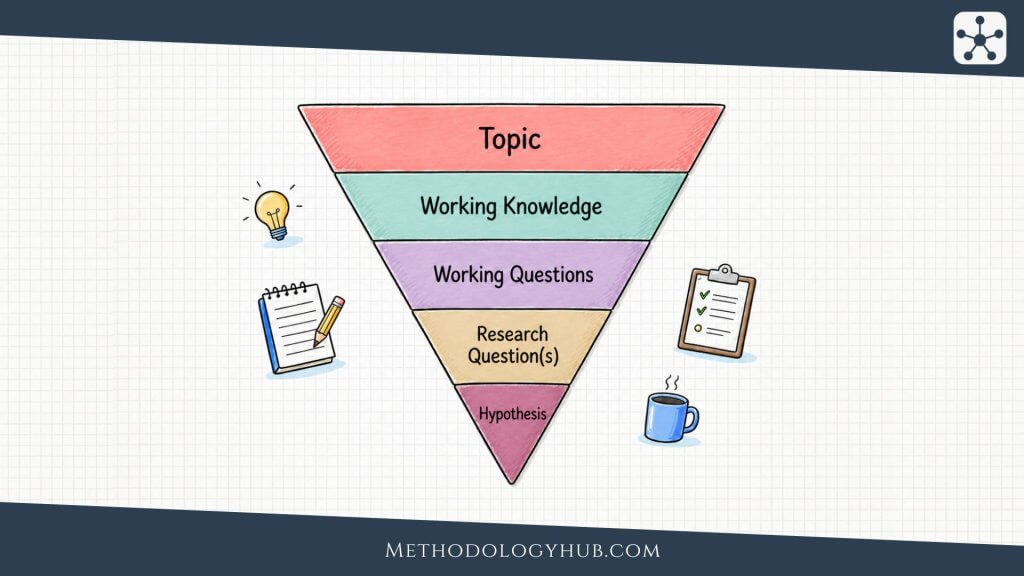
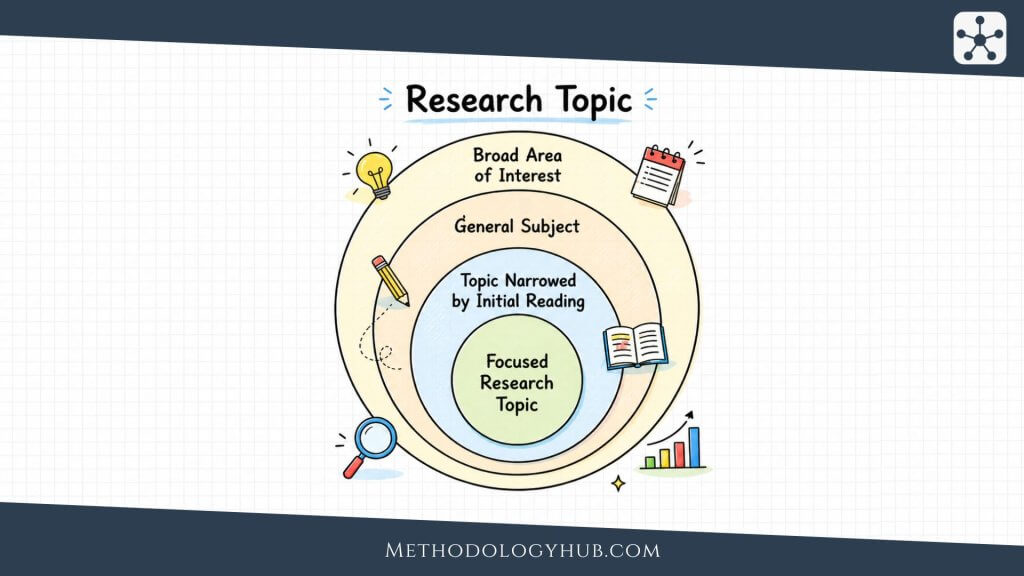
Begin by narrowing the research topic into a question that a survey can answer. A broad topic such as student wellbeing, teacher workload, or patient satisfaction is not yet a survey question. It needs a population, a focus, and a possible form of evidence.
A survey-ready question might ask: “How do first-year students in one university report using academic feedback during their first semester?” Another might ask: “Which forms of support are associated with teacher confidence in implementing a new curriculum?” These questions point toward respondents, concepts, and possible variables.
Step 2: Define the population and sampling plan
Next, decide who the survey is about and who can be reached. The population may be all students in a programme, teachers in a district, nurses in a hospital system, or residents using a public service. The sampling plan should then explain how respondents will be selected or recruited.
If the study aims to estimate population percentages, probability sampling is usually stronger. If the study is exploratory or limited to an accessible group, a non-probability sample may be acceptable, but the report should not overstate generalisability.
Step 3: Identify variables and concepts
Before writing questions, list the concepts the survey needs to measure. Some may be background characteristics, such as age group, year level, role, or setting. Others may be main study variables, such as confidence, use of feedback, satisfaction, perceived access, or reported behaviour.
If the study includes a research hypothesis, the variables should be defined clearly enough to test it. For example, a hypothesis about the relationship between study planning and academic confidence needs a way to measure both study planning and confidence.
Step 4: Write and organise the questions
Questions should be written in plain language and placed in a logical order. Opening items are often easier and less sensitive. More detailed or reflective items can come later, once respondents understand the topic. Demographic questions may appear at the beginning or end, depending on the study and the setting.
Response options should be balanced and complete. If respondents may not know the answer, an option such as “I do not know” may be better than forcing a guess. If an item does not apply to everyone, the survey may need skip logic or a clear “not applicable” option.
Step 5: Pilot the survey
A pilot test checks whether the instrument works before full data collection. Pilot respondents can reveal confusing wording, missing response options, technical errors, or questions that take too long to answer. A small pilot can prevent larger problems later.
Piloting should not be treated as a formality. If several respondents misunderstand the same item, the item should be revised or removed. If the survey takes much longer than expected, the researcher may need to shorten it or divide sections more clearly.
Step 6: Collect the data
Data collection should follow a consistent procedure. Invitations should explain the purpose of the study in appropriate terms, who is eligible, how long the survey will take, and how responses will be used. Reminders may improve response, but they should be planned and not excessive.
The researcher should keep records of invitations, responses, exclusions, and incomplete submissions. These details are needed later when reporting response rate and sample characteristics.
Step 7: Prepare and analyse the data
Before analysis, the data should be checked. The researcher may need to identify missing responses, remove ineligible cases, recode response options, combine scale items, or prepare written answers for coding. These decisions should follow the analysis plan as far as possible.
Quantitative analysis may include descriptive statistics, group comparisons, correlations, regression, or other statistical procedures. Qualitative survey answers may be coded into categories or themes. In both cases, the analysis should remain connected to the original question.
Step 8: Report the survey clearly
A survey report should make the design visible. Readers need to know who was invited, who responded, what instrument was used, how questions were developed, how data were collected, and how answers were analysed. Results should not appear as isolated percentages without enough context.
The interpretation should also stay within the limits of the design. A convenience survey can still provide useful evidence, but it should not be written as if it were a representative national study. A cross-sectional survey can show associations, but it usually cannot establish cause and effect by itself.
Examples of Survey Research
Examples of survey research appear across education, health, psychology, public administration, communication, and many other fields. The topic changes, but the design logic remains similar: a defined group is asked planned questions so that the answers can be analysed systematically.
Survey research in education
An education researcher may survey students about feedback, homework routines, sense of belonging, or use of digital learning tools. The survey can describe how students experience a course or compare responses across year levels, subjects, or schools.
For example, a study may ask first-year university students how often they use library databases, whether they feel confident searching for academic literature, and which forms of support they have used. The results can help describe patterns of use and identify groups that report lower confidence.
Survey research in health studies
Health researchers may use surveys to study patient experiences, symptom reports, service access, professional practice, or public knowledge. Some surveys are short and local. Others are large, repeated, and carefully sampled.
A clinic survey might ask patients about appointment access, clarity of information, and follow-up support. The findings can describe reported experience and may guide further research using interviews, records, or service data.
Survey research in psychology
In psychology, surveys are often used to measure attitudes, self-reported behaviours, emotions, beliefs, or personality-related constructs. Researchers may use established scales or develop items for a specific study.
For example, a researcher may study the relationship between academic stress and sleep habits among students. The survey could ask about sleep duration, perceived stress, workload, and support. The analysis may describe the sample and examine whether reported stress is associated with sleep patterns.
Survey research in public services
Public service surveys may study residents’ access to services, satisfaction with communication, use of community spaces, or experiences with local programmes. These surveys often need plain wording because respondents may have different education levels, languages, and levels of familiarity with the topic.
A library service, for example, may survey residents about opening hours, study spaces, digital access, and staff support. The survey can show which services are used often and which barriers respondents report.
| Field | Example survey question | Possible analysis |
|---|---|---|
| Education | How do students report using teacher feedback? | Frequencies, group comparisons, open-response coding |
| Health studies | How do patients describe access to follow-up support? | Percentages, satisfaction scores, written comments |
| Psychology | Is reported stress associated with sleep habits? | Correlation, regression, scale summaries |
| Public services | Which barriers do residents report when using a service? | Frequency tables, subgroup comparison, theme coding |
These examples also show why survey research should not be reduced to “asking people questions”. In each case, the survey has to define the population, decide who can answer, choose a suitable mode, word questions carefully, and analyse the answers in a way that fits the claim.
Survey Research vs Experimental Research
Survey research is often compared with experimental research because both can use numerical data, variables, and statistical analysis. The difference lies in the structure of the study. Survey research usually measures existing conditions or reported experiences. Experimental research manipulates a condition and examines its effect under controlled comparison.
This difference affects the kinds of conclusions each design can support. A survey can show that students who report more study planning also report higher confidence. An experiment can test whether a planning intervention changes confidence compared with a control condition, if the design is suitable.
How survey research differs from experimental research
In survey research, the researcher asks respondents about variables of interest. These may include behaviours, attitudes, experiences, demographic characteristics, or outcomes. The researcher does not normally assign respondents to different conditions.
In experimental research, the researcher deliberately changes an independent variable and observes an outcome. Random assignment is often used so that groups are comparable before the intervention. This gives experiments a stronger basis for causal claims, although experiments still need careful measurement and interpretation.
| Aspect | Survey research | Experimental research |
|---|---|---|
| Main action | Asks respondents planned questions | Manipulates a condition or intervention |
| Typical aim | Describe, compare, measure, or examine associations | Test the effect of a change or condition |
| Causal claims | Usually limited unless design features support them | Stronger when manipulation and random assignment are used well |
| Example | Survey students about study routines and confidence | Assign students to different study-planning supports and compare outcomes |
Survey research and quasi-experimental research
Some studies sit close to the boundary between survey and quasi-experimental research. A researcher may survey students before and after a new policy is introduced, without random assignment. The survey collects the data, while the quasi-experimental structure comes from the comparison over time or between groups.
In this situation, the survey is a data collection method inside a broader design. The researcher should describe both parts. It is not enough to say that the study used a survey, because the timing and comparison structure affect the claim.
Survey research and case study research
Survey research is also sometimes used inside case study research. A case study may focus on one school, one programme, or one organisation, and include a survey of participants inside that case. The survey can show patterns within the case, while interviews, documents, and observations may add context.
The scale of the claim should follow the design. A survey inside one school can describe respondents in that school. It should not be presented as if it estimates the views of all schools unless the sampling design supports that wider claim.
Conclusion
Survey research is a flexible research design for collecting comparable answers from a defined group of respondents. It can describe a population, compare groups, measure reported experiences, examine associations, and study change over time. Its strength comes from planning: the population, sample, questions, response options, mode, and analysis all need to fit the research question.
A strong survey study does not treat the questionnaire as a shortcut. It explains what the survey is meant to show, who the respondents are, how they were reached, what the questions measured, and how the results should be read. When those parts are aligned, survey research can provide clear and useful evidence for academic projects, student research, professional studies, and public service research.
FAQs on Survey Research
What is survey research?
Survey research is a research design that collects information from respondents through planned and comparable questions. It is used to study patterns, opinions, behaviours, experiences, characteristics, or relationships within a defined group or population.
What is the main purpose of survey research?
The main purpose of survey research is to collect systematic responses from a sample so the researcher can describe a group, compare groups, measure reported attitudes or experiences, examine associations between variables, or track change across time.
Is survey research qualitative or quantitative?
Survey research can be quantitative, qualitative, or mixed methods. Closed-ended items and rating scales usually produce quantitative data, open-ended questions can produce qualitative data, and a planned combination of both can support a mixed methods survey study.
What are the main types of survey research designs?
The main survey research designs include cross-sectional surveys, longitudinal surveys, panel surveys, and repeated cross-sectional surveys. Cross-sectional surveys collect data at one time point, while longitudinal designs collect data across time.