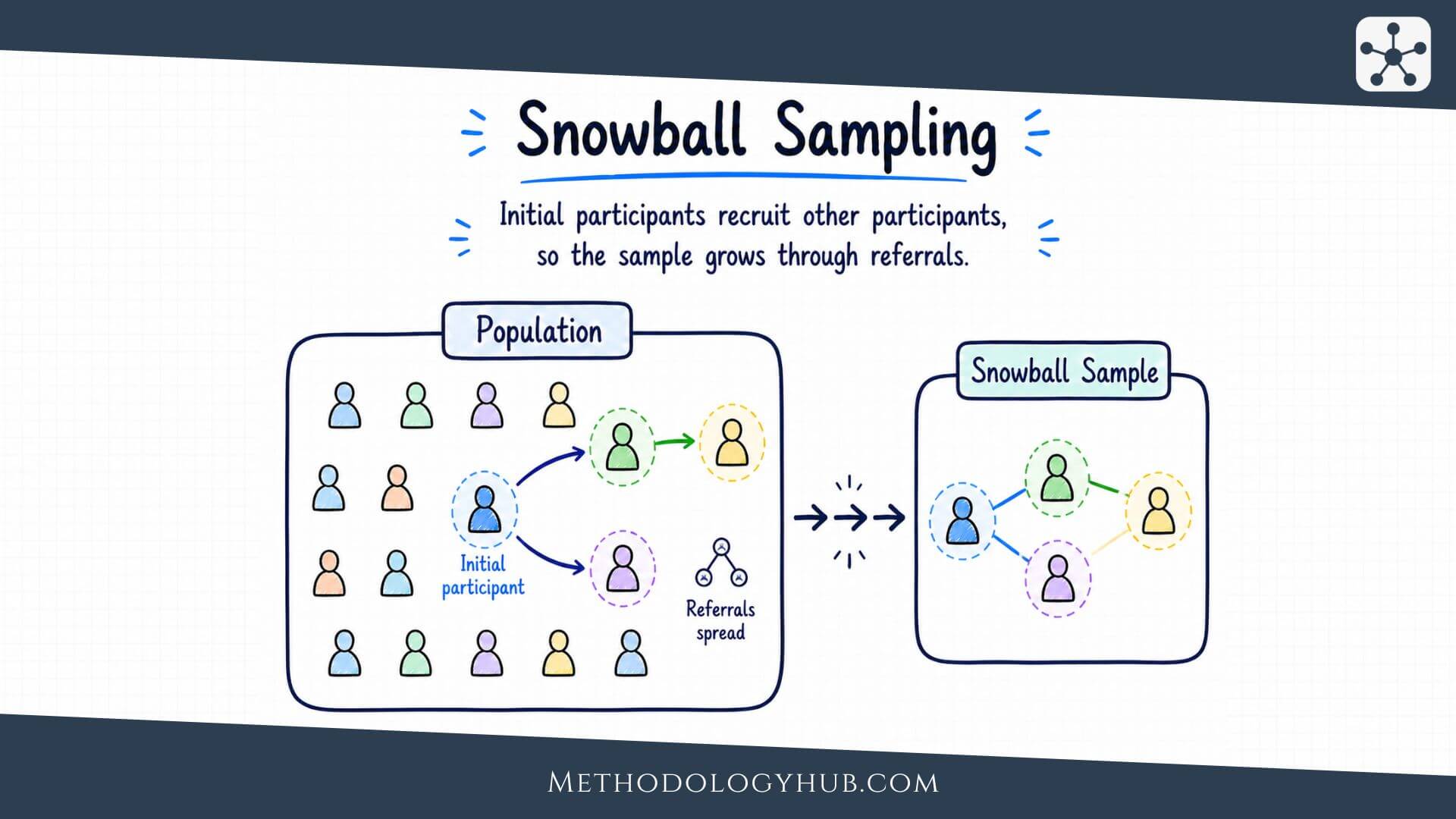
Snowball sampling is a non-probability sampling method in which existing participants help the researcher reach other people who fit the study criteria. Instead of beginning with a complete list of everyone in the population, the researcher begins with a small number of suitable contacts, asks them for referrals, and gradually builds the sample through those social or professional links.
This article explains what snowball sampling is, how referral chains work, when the method is suitable, how to use it in a research project, and how to report its strengths and limits without treating it as a random sample.
What Is Snowball Sampling?
Snowball sampling is a method for recruiting participants through referrals. A researcher starts with one or more people who meet the study criteria. These first participants, often called initial contacts or seeds, are then asked whether they can suggest other people who may also be eligible. The new participants can then suggest further participants, so the sample grows through a chain of connections.
The name comes from the image of a snowball growing as it rolls. In research, the growth is not made of snow, but of referrals. One interviewee leads to two more, those two lead to others, and the sample may slowly expand into groups that would have been difficult to reach through a public list, classroom roster, patient register, or formal institution.
Snowball sampling definition
Snowball sampling means selecting participants by using referrals from people who are already connected to the population of interest. It is usually treated as a non-probability sampling method because the researcher does not draw participants from a full sampling frame, and the chance of selection is not known for every member of the population.
This point separates snowball sampling from random sampling. In a random sample, selection is based on a probability rule applied to a defined frame. In a snowball sample, selection depends on networks, trust, eligibility, willingness to refer, and willingness to participate. That does not make the method weak by default. It means the method supports a different kind of research claim.
How the referral process works
A simple snowball sample begins with a small number of carefully chosen contacts. These people should fit the study criteria and should have some route to others who also fit those criteria. After the first data collection step, the researcher asks whether they know anyone else who may be suitable for the study. The next participants are contacted, screened, invited, and, if they agree, included in the study.
The referral chain can be short or long. In some studies, two or three waves are enough. In others, referrals continue until the researcher reaches the planned sample size, observes repeated themes, or finds that new referrals are no longer adding useful variation. The stopping point should be planned and explained, not left as an afterthought.
Seeds, eligibility, and referral chains
The first participants in a snowball sample shape the rest of the sample. If the seeds are drawn from only one school, clinic, neighbourhood, organisation, online group, or friendship circle, the later referrals may stay close to that same social area. If the researcher begins with several different seeds, the chains may reach a wider range of participants.
Eligibility criteria are therefore important. A referral should not enter the study simply because someone mentioned their name. The researcher still needs to check whether the person fits the study boundaries. For example, a study on first-year university students who commute from home might require participants to be enrolled in their first year, travel from a non-campus residence, and have attended for a minimum number of weeks. A friend of a participant may be easy to contact, but still not eligible.
Snowball sampling and non-probability sampling
Snowball sampling belongs to the wider family of non-probability sampling. It often sits close to purposive sampling, because the researcher usually begins with people who fit a clear purpose. It can also look close to convenience sampling if referrals are accepted only because they are easy to reach. The difference lies in the logic: snowball sampling uses networks as the recruitment route.
Because selection probabilities are unknown, snowball sampling is not usually the best method for estimating a population percentage or average. It is more often used when access is difficult, when the population cannot be listed, or when the researcher needs people who share a particular experience, role, condition, practice, or connection.
Snowball Sampling in Research
Snowball sampling is used when the researcher cannot easily move from a population to a sample through a standard list. Some groups are small, dispersed, sensitive, informal, or connected mainly through personal networks. In those situations, formal recruitment may reach only a narrow slice of the population, while referrals can open routes that are otherwise difficult to see.
The method appears often in qualitative research, but it is not limited to interviews. It may also be used in surveys, mixed-methods projects, community research, education studies, health research, migration studies, and network-related research. The design must still match the research question. A referral-based survey can describe the people who entered through the chains, but it should not be written as if it were a random population survey.
Reaching people who are difficult to list
Many studies begin with a simple problem: the relevant participants exist, but there is no complete list of them. A researcher may want to interview teachers who have quietly left classroom work, students who support family members while studying, adults who use informal care networks, or people with rare experiences that are not recorded in a public register. The population can be described, but it cannot be reached through one clean frame.
Snowball sampling can help because people inside a group often know others with similar experiences. One participant may know a former colleague, another may know a local support group member, and another may know someone who has avoided formal services altogether. The sample grows from inside the network rather than being imposed from outside it.
Using trust and contact networks
Access is not only about finding names. It is also about whether people feel safe enough to respond. In studies involving sensitive topics, participants may ignore a general invitation from an unknown researcher. A referral from someone they know can make the study easier to evaluate, especially when the first participant can explain what participation involved.
This does not mean that participants should pressure others to join. The role of a referral is to create a contact route, not to transfer consent. The referred person should receive clear information, have the chance to decline, and decide for themselves whether they want to participate. Good snowball sampling keeps the door open without pushing people through it.
Planning note: A referral should help the researcher reach a possible participant. It should not replace screening, informed invitation, or the person’s own decision to take part.
Snowball sampling in qualitative studies
In qualitative research, snowball sampling is often used to locate people who can speak in detail about a process, experience, setting, or social network. A study on how first-generation students navigate postgraduate applications might begin with a few eligible students and ask each one whether they know others in a similar position. The value of the sample comes from relevance and depth, not from statistical representation.
Because qualitative projects often look for variation in experience, researchers should avoid letting one referral chain become the whole sample too quickly. If every participant comes from the same peer group, the interviews may become repetitive for reasons created by the recruitment path. Starting with several different seeds, using more than one recruitment site, or pausing to check who is missing can make the sample more informative.
Snowball sampling in quantitative studies
Snowball sampling can also appear in quantitative studies, especially where the target group is hard to reach and a probability sample is not feasible. A researcher might circulate a survey among a small group of eligible participants and ask them to pass the invitation to others who meet the criteria. This can produce a larger dataset than the researcher could reach alone.
The interpretation, however, needs care. If a survey spreads through friendship groups, professional circles, or online communities, the final sample may overrepresent people with larger networks or stronger interest in the topic. Statistical tools such as statistical analysis can still describe the data, but the sampling route limits population-level claims. A mean, percentage, correlation analysis, or regression analysis from a snowball sample should be read in relation to how participants were reached.
Types of Snowball Sampling
Snowball sampling is sometimes described as if it were one fixed procedure, but researchers use it in several ways. The same basic idea remains: existing contacts lead to further contacts. What changes is how many referrals are requested, how much control the researcher keeps over selection, and whether the chain is allowed to grow freely or is guided by study criteria.
These types are best understood as practical patterns rather than separate worlds. A real study may combine them. For example, a researcher may begin with purposive seeds, allow several waves of referrals, and then become more selective later when the sample lacks certain types of participants.
Linear snowball sampling
In linear snowball sampling, each participant refers one additional participant, or the researcher uses only one referral from each person. The sample grows in a narrow chain. Participant A refers participant B, participant B refers participant C, and the process continues until the planned sample is reached or referrals stop.
Exponential snowball sampling
In exponential snowball sampling, each participant can refer more than one person. The sample can grow faster because several branches develop at once. A teacher may refer two colleagues, each of those colleagues may refer others, and the network of possible participants becomes wider.
Discriminative snowball sampling
Discriminative snowball sampling gives the researcher more control over which referrals are followed. Participants may suggest several people, but the researcher selects from those referrals based on the study criteria, sample balance, or the need for variation. The method is still referral-based, but it is not automatic.
For example, a study of students who combine school with paid work may receive many referrals from one age group or one programme. If the researcher already has enough participants from that category, later referrals may be screened for different schedules, fields of study, or family responsibilities. This helps prevent the sample from becoming a mirror of one network.
Purposive snowball sampling
Purposive snowball sampling begins with purposeful selection and then uses referrals to continue recruitment. The researcher does not simply ask any available person to join. They begin with participants who meet specific criteria and can speak directly to the research question.
This form is common in interview studies. A researcher studying school counsellors who support newly arrived pupils might begin with counsellors from different school types, then ask each one whether they know colleagues with similar responsibilities. The referrals extend the sample, while the purposive criteria keep it connected to the study purpose.
Online snowball sampling
Online snowball sampling uses digital routes for referrals. Participants may forward a survey link, share an invitation in a closed group, or send information to contacts who meet the criteria. This can be useful when the group is geographically spread out or when digital communication is already part of the population’s everyday life.
| Type | How recruitment works | Good fit |
|---|---|---|
| Linear snowball sampling | Each participant leads to one further participant. | Small exploratory studies with a narrow recruitment route. |
| Exponential snowball sampling | Each participant may refer several people. | Studies that need faster recruitment or several referral branches. |
| Discriminative snowball sampling | The researcher chooses which referrals to follow. | Projects that need variation and stronger control over sample shape. |
| Online snowball sampling | Invitations are shared through digital networks. | Geographically spread groups or studies using online surveys. |
When to Use Snowball Sampling?
Snowball sampling fits studies where the relevant participants are hard to identify, hard to contact, or unlikely to respond to a general invitation. It is especially useful when people are connected through social, professional, educational, care, or community networks that are easier to enter through referral than through a public list.
The method should be chosen because it fits the research question, not because it is an easy way to get participants. A snowball sample can be quick in some settings, but in others it can be slow, uneven, and difficult to control. The strongest use of the method begins with a clear reason for why referral-based recruitment is needed.
Use it when no practical sampling frame exists
Snowball sampling is often useful when the researcher can define the population but cannot list it. For example, a study may focus on parents who share informal childcare across households, students who have quietly withdrawn from a course before completion, or retired teachers who still tutor pupils privately. These people may not appear together in a single database.
In such cases, the lack of a frame makes random sampling, stratified sampling, or systematic sampling difficult to carry out. Snowball sampling offers another route. It does not create known selection probabilities, but it may allow the study to reach people who would otherwise remain outside the research.
Use it for hard-to-reach or sensitive populations
Some participants are difficult to reach because the topic is sensitive, the group is small, or formal contact routes are weak. This can include people with rare health experiences, members of informal learning groups, caregivers outside formal services, students with undocumented support needs, or professionals working in roles that are not clearly recorded.
In these situations, the first contact may be the most difficult part of the study. Once the researcher has spoken with one eligible participant, that person may be able to suggest others who would understand the invitation and decide whether to respond. The referral does not guarantee participation, but it creates a bridge.
Use it when networks are part of the study
Snowball sampling can also fit studies where networks themselves are part of the research setting. A researcher may study how students exchange revision resources, how early-career teachers find informal mentoring, or how patients learn about support groups. If the research question involves connected people, recruitment through connections may be methodologically sensible.
Still, the researcher should distinguish between using networks for recruitment and studying networks as data. A referral chain can tell the researcher something about access, but it does not automatically map the whole network. If the study aims to analyse network structure, the sampling plan needs to be designed for that purpose from the beginning.
Use another method when population estimates are the main goal
Snowball sampling is usually a poor fit when the main goal is to estimate how common something is in a wider population. Because participants are recruited through connections, people with many links may be more likely to appear than people with fewer links. Some groups may be missed entirely if no seed reaches them.
For population estimates, a probability-based design is usually stronger when it can be implemented. If a school district wants to estimate the average reading time of all pupils, a random or stratified sample from school records is usually more suitable. If a researcher wants to understand how a small group of pupils with a particular experience talk about reading support, snowball sampling may be much more realistic.
How to Use Snowball Sampling
Using snowball sampling well requires more than asking participants to “send someone else.” The researcher needs to define the group, choose starting points, protect voluntary participation, document referral chains, and decide when recruitment should stop. Without those decisions, the sample may grow, but the method section will be difficult to defend.
The steps below describe a general process. A small interview study may use them in a simple form. A larger mixed-methods project may need more detailed tracking, separate recruitment waves, and stronger procedures for screening. The same basic logic remains: define the study boundaries first, then let referrals work inside those boundaries.
Step 1: Define the target population
The target population is the group the study wants to learn from or about. It should be defined clearly enough that the researcher can decide whether a referred person is eligible. “Students” is too broad. “First-year students who have changed degree programme during the current academic year” gives a clearer boundary.
The definition should include the unit of analysis. In some projects, the unit is a person. In others, it may be a household, a classroom, a professional team, a patient record, an informal group, or an online community. A snowball sample becomes confusing when the researcher recruits one kind of unit but later writes as if the study analysed another.
Step 2: Set inclusion and exclusion criteria
Inclusion criteria state who can enter the study. Exclusion criteria state who will be left out, even if they seem close to the topic. These criteria protect the sample from drifting as referrals arrive. Without them, a participant may suggest someone interesting but outside the study’s actual scope.
For example, a study on peer support among trainee teachers may include participants enrolled in a teacher education programme and currently placed in schools. It may exclude fully qualified teachers, school mentors, or students who have not yet begun placement. Those excluded people may have useful views, but they do not belong to that particular sample.
Step 3: Choose diverse initial contacts
The first contacts should be selected with care because they influence the direction of the sample. If all seeds come from one location or one friendship group, the referral chains may stay there. If the study needs variation, the researcher should start with several seeds from different parts of the population.
In an education study, this could mean beginning with students from different programmes, year levels, or study modes. In a health study, it may mean using more than one clinic, support group, or community route. In a professional study, it may mean starting with people in different roles or regions. The aim is not to force artificial balance, but to avoid building the whole sample from one doorway.
Practical check: Before recruitment begins, write down where each seed comes from and what kind of network they may open. This makes the early sample shape visible.
Step 4: Ask for referrals in a careful way
The referral request should be clear and respectful. Participants can be asked to pass on study information, ask potential participants whether they are willing to hear from the researcher, or provide contact details only with permission. The exact procedure depends on the study setting, institutional rules, and sensitivity of the topic.
What should be avoided is pressure. A participant should not feel responsible for recruiting friends, classmates, patients, colleagues, or relatives. A referred person should not feel that refusal would damage a relationship. The researcher can reduce this pressure by using neutral wording and by making clear that participation is voluntary at every stage.
Step 5: Screen referrals before including them
Every referral should be checked against the inclusion criteria. This can be done through a short screening form, a brief conversation, or eligibility questions at the start of an online survey. The screening step helps keep the sample connected to the research question.
It also helps prevent duplicate participation. In network-based recruitment, the same person may be referred by more than one participant. The researcher should have a way to identify duplicates without collecting unnecessary personal information. In many studies, a simple log of referral source, contact date, eligibility result, and participation status is enough.
Step 6: Track recruitment waves
A recruitment wave is one round of referrals. The seeds form the first wave. People referred by seeds form the next wave, and so on. Tracking waves helps the researcher see how the sample developed. It shows whether the sample came from several branches or from one dominant chain.
This record is useful later in the methods section. Instead of writing only that “snowball sampling was used,” the researcher can explain how many seeds were used, how many waves followed, how many referrals were received, and how many referred people entered the final sample. That level of detail makes the study easier to judge.
Step 7: Decide when to stop recruitment
Snowball sampling needs a stopping rule. The rule may be a planned sample size, a set number of waves, the point at which referrals become repetitive, or the point at which the study has enough variation for its purpose. In qualitative research, recruitment may stop when new interviews add little to the emerging analysis. In survey research, it may stop when the planned number of eligible responses is reached.
The stopping rule should be linked to the design. Stopping because the researcher ran out of time is sometimes unavoidable, but it should be reported honestly. Stopping because the sample has reached planned variation, repeated themes, or a predefined size gives the reader a clearer basis for interpretation.
Advantages of Snowball Sampling
Snowball sampling has several advantages when the study needs access to people who are not easy to find through formal lists. Its strengths are practical and relational. It can turn one contact into a route toward others, and it can help the researcher enter networks that would otherwise remain distant.
It can reach participants who are hard to find
The clearest advantage is access. Some participants do not appear in public registers, formal organisations, or obvious recruitment sites. Others may appear in records but may not respond to direct recruitment because the topic feels personal or sensitive. A referral from someone already involved in the study can make the invitation more visible and easier to consider.
This is especially useful when the population is small or dispersed. A researcher may not know where to find enough participants at the start, but early participants may know relevant people in other settings. The sample can therefore move beyond the researcher’s first contact point.
It can make recruitment more efficient
Snowball sampling can reduce the amount of time spent searching for possible participants. Instead of contacting many people who do not fit the study, the researcher receives leads from people who understand the eligibility criteria. This can be helpful in student projects, field studies, interview studies, and early exploratory work.
It can support trust in sensitive studies
When participants are asked about personal experiences, informal support, health, identity, exclusion, or difficult educational pathways, trust can affect whether they respond. A referral can help potential participants understand that the study is real, relevant, and not a random request from a stranger.
It can reveal variation inside a network
Referral chains can show that a population is not as simple as it first appears. One participant may lead the researcher toward people in a different school, age group, role, region, or support setting. This can help an exploratory study broaden its view and notice differences that were not visible at the start.
This advantage is strongest when the researcher pays attention to sample shape during recruitment. If the sample is becoming too narrow, new seeds can be added. If one chain dominates, the researcher can pause that branch and look for a different entry point. Snowball sampling does not have to mean giving up control over the sample.
Limitations of Snowball Sampling
Snowball sampling also has limits that should be stated plainly. The method depends on networks, and networks are rarely neutral. People are more likely to know others who share their location, background, interests, language, programme, workplace, or experience. A sample built through referrals can therefore become clustered around a small part of the population.
The problem is not that snowball sampling is unusable. The problem is that it supports certain claims better than others. It can be very helpful for access, exploration, and depth. It is less suitable for estimating population values unless a more specialised design is used and the assumptions are clearly addressed.
Selection probabilities are unknown
In most snowball samples, the researcher does not know the chance that each member of the population had of being selected. Some people may have many social links and receive several invitations. Others may have few links and never hear about the study. This makes standard population inference difficult.
For this reason, a snowball sample should not be described as representative simply because it includes many people. A large referral-based sample can still be tilted toward active network members, visible groups, or people close to the original seeds. Size helps with some forms of analysis, but it does not remove the recruitment pattern.
The sample can become too homogeneous
Because people often refer others who are similar to themselves, snowball samples can become homogeneous. In a student study, participants may refer friends from the same programme. In a professional study, early contacts may refer colleagues with the same role. In a community study, one local network may dominate the sample.
This can narrow the findings. If the study aims to explore a range of experiences, the researcher should check whether the sample is becoming repetitive because of the topic or because of the recruitment route. Adding new seeds from different settings can help, but the final sample boundaries should still be reported.
Referral chains can stop unexpectedly
Snowball sampling can stall. Participants may not know anyone else, may not want to refer others, or may worry about sharing contact information. Referred people may not respond. A chain that looked promising can end after one wave.
For this reason, researchers should avoid depending on one seed or one route. Several starting points create a more stable recruitment plan. It also helps to prepare alternative access routes, such as organisations, student groups, clinics, community contacts, or professional associations that can circulate study information without naming individuals.
Confidentiality needs careful handling
Snowball sampling can create privacy concerns because referrals involve social connections. A participant may reveal that someone else belongs to a group or has a certain experience. In sensitive studies, that information can be personal. The researcher should avoid collecting more information than needed and should allow possible participants to make contact themselves when that is safer.
For example, instead of asking a participant to provide a friend’s contact details, the researcher may give the participant an invitation text that can be forwarded. The friend then decides whether to contact the researcher. This approach reduces pressure and protects the referred person’s privacy.
Snowball Sampling vs Other Sampling Methods
Snowball sampling becomes easier to understand when it is compared with nearby methods. It is not the same as convenience sampling, although both can involve accessible participants. It is not the same as purposive sampling, although it often begins purposively. It is also different from probability methods because referrals do not give every member of the population a known chance of selection.
The comparison is useful because the method name alone does not tell the reader what kind of claim the study can support. A research report should connect the sampling method to the study purpose, the recruitment route, and the intended interpretation.
Snowball sampling and convenience sampling
Convenience sampling selects people because they are easy to reach. A researcher may recruit students in one class, patients attending one clinic, or people who respond to a public link. The selection is driven mainly by access.
Snowball sampling also uses access, but the route is more specific. Participants enter through referral chains. The method is stronger when the referrals are tied to clear eligibility criteria and when the researcher tracks how the chains develop. If a researcher accepts every referral without screening or sample planning, the snowball sample can slip into convenience sampling with a different label.
Snowball sampling and purposive sampling
Purposive sampling selects participants because they fit the study purpose. The researcher may look for people with a specific experience, role, background, or type of knowledge. Snowball sampling can begin in this way, especially when the first seeds are selected because they meet clear criteria.
The difference is the recruitment route after the first contacts. In purposive sampling, the researcher may keep selecting cases directly. In snowball sampling, participants help identify further cases. Many qualitative projects combine the two: purposive criteria define who is needed, and snowball referrals help the researcher find them.
Snowball sampling and random sampling
Random sampling uses a probability procedure to select from a defined population or sampling frame. It is designed for studies that want stronger population-level interpretation. Snowball sampling does not usually start from a complete frame, and participants do not have known selection chances.
This difference affects later analysis. Random sampling can support many forms of inferential statistics when the design is sound. Snowball sampling can still produce useful data, but statistical claims should be framed around the sample and recruitment process unless the study uses a specialised design that justifies wider inference.
Snowball sampling and respondent-driven sampling
Respondent-driven sampling is related to snowball sampling, but it is more structured. It usually limits the number of referrals each participant can make, tracks recruitment chains carefully, and may use statistical adjustments based on network size. It was developed to improve inference in studies of hard-to-reach populations.
Not every snowball sample is respondent-driven sampling. A study that simply asks participants to suggest others should not use the more specialised label. If a researcher uses respondent-driven sampling, the design, referral rules, incentives, network questions, and analysis approach should be reported in detail.
| Method | Selection route | Main caution |
|---|---|---|
| Snowball sampling | Existing participants refer further eligible participants. | Referral chains may overrepresent connected groups. |
| Convenience sampling | Participants are selected because they are easy to reach. | The sample may reflect access rather than the target population. |
| Purposive sampling | The researcher selects cases that fit the study purpose. | The logic of selection must be explained clearly. |
| Random sampling | Units are selected through a probability rule from a frame. | It needs a usable frame and careful response follow-up. |
Reporting Snowball Sampling in a Study
A methods section should make the snowball process visible. Readers should be able to see how the researcher moved from the target population to the final sample. A vague sentence such as “participants were recruited using snowball sampling” does not give enough information to judge the sample.
Clear reporting is especially important because snowball sampling can take many forms. Two studies may use the same label while doing very different things. One may begin with three seeds from one group and accept all referrals. Another may begin with twelve seeds across several settings, screen each referral, and stop when planned variation is reached. Those are not the same design.
Describe the target population and criteria
The report should begin by explaining who was eligible. This includes the target population, inclusion criteria, exclusion criteria, and unit of analysis. If the study focused on people with a particular experience, the report should say how that experience was defined and how eligibility was checked.
For example, a study might report that participants were undergraduate students who had transferred into a new programme during the current academic year. It might then explain that students who changed only one module were excluded because the research question concerned full programme transfer. These details help readers understand the sample boundaries.
Explain the seeds and referral waves
The report should state how the initial contacts were found and why they were suitable starting points. It should also describe how referrals were requested. Did each participant receive an invitation text to forward. Were participants asked to obtain permission before sharing contact details. Were referrals limited to a certain number. These details shape the recruitment process.
Where possible, the researcher should also report the number of seeds, referral waves, referred people, eligible referrals, and final participants. A short paragraph can be enough, but it should show the chain from recruitment to final sample.
Report sample composition without overstating it
The final sample should be described honestly. In qualitative research, this may include roles, age ranges, study settings, years of experience, programme types, or other relevant characteristics. In quantitative research, it may include counts, percentages, and variables used in the analysis.
The description should avoid claiming representativeness unless the design can support it. A better approach is to say what the sample included and how it was reached. For example: “The final sample included 32 participants recruited through six initial contacts across three schools.” This gives concrete information without pretending that every eligible person had the same chance of selection.
Connect the sampling method to interpretation
The discussion section should return to the sampling design when interpreting findings. If the sample came mainly from one network, that should be noted. If the researcher used several seeds to broaden participation, that should also be explained. If some groups were difficult to reach, readers should know.
In student work, this level of reporting can make a major difference. It shows that the researcher understands the method rather than using the name as a shortcut. In published research, it helps other readers assess transferability, credibility, and the fit between sampling, variables, data collection, and analysis.
Conclusion
Snowball sampling gives researchers a practical way to reach participants through referral chains. It is most useful when the population cannot be listed easily, when access depends on trust, or when people with relevant experience are connected through informal networks. The method begins with initial contacts, grows through referrals, and depends on careful screening at each step.
Its strength is access. It can help a study reach people who may be missed by public invitations or formal lists. Its limit is inference. Because the chance of selection is usually unknown, snowball sampling should not be treated like a probability sample. The researcher needs to describe how the sample grew and keep conclusions close to what the design can support.
Used well, snowball sampling is not a shortcut. It is a deliberate recruitment strategy. It asks the researcher to choose starting points carefully, protect voluntary participation, follow referral chains with attention, and report the final sample in a way that readers can understand. When those pieces are in place, the method can support thoughtful research on groups and experiences that are difficult to reach by ordinary sampling routes.
FAQs on Snowball Sampling
What is snowball sampling?
Snowball sampling is a non-probability sampling method in which existing participants help the researcher reach other eligible participants through referrals. The sample grows through contact chains rather than through selection from a complete sampling frame.
What is an example of snowball sampling?
An example is a researcher interviewing students who changed degree programme and asking each participant to pass the study invitation to other students with the same experience. Each new eligible participant may then refer further participants.
When should researchers use snowball sampling?
Researchers should use snowball sampling when the target population is difficult to list or contact, and when referrals can help reach people who fit the study criteria. It is often used with hard-to-reach groups, sensitive topics, or networked populations.
Is snowball sampling qualitative or quantitative?
Snowball sampling is common in qualitative research, especially interview studies, but it can also be used in surveys and mixed-methods research. The main issue is not whether the study is qualitative or quantitative, but whether referral-based recruitment fits the research question.
What are the advantages of snowball sampling?
Snowball sampling can help researchers reach participants who are difficult to find through formal lists, make recruitment more focused, and support trust in studies where participants may not respond to a general invitation.
What are the limitations of snowball sampling?
Snowball sampling can produce a sample that is shaped by social networks, referral patterns, and the first contacts chosen by the researcher. Selection probabilities are usually unknown, so the method is not normally suitable for precise population estimates.