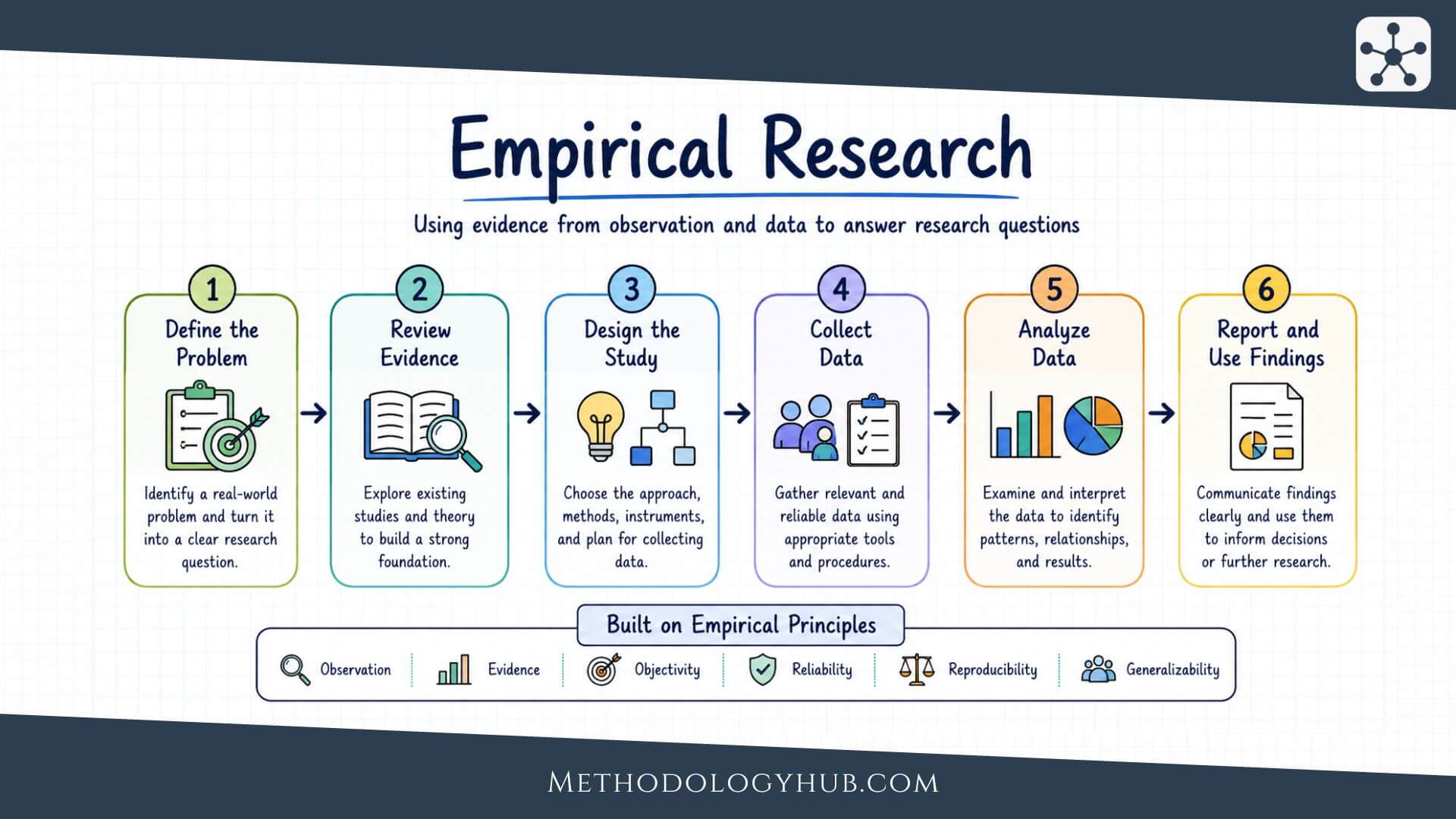
Empirical research is research based on evidence that can be observed, measured, recorded, or otherwise examined through systematic data collection. Instead of relying only on abstract reasoning or existing theory, empirical research asks a question about the world and then uses evidence to support, refine, or challenge an answer.
This article explains what empirical research is, how it differs from theoretical research, which objectives and methods it can use, and how to plan an empirical study.
What Is Empirical Research?
Empirical research is a type of research that uses evidence from observation, measurement, experience, documents, records, or participant accounts. The evidence may be numerical, textual, visual, behavioural, historical, or material. What makes the study empirical is not the format of the evidence, but the fact that the answer is built from data that can be traced back to some observed source.
A study of exam scores, interview transcripts, classroom interactions, rainfall records, patient files, survey responses, historical letters, or coded policy documents can all be empirical. The researcher does not simply argue from a theory. They collect or use evidence and then explain how that evidence answers the research question.
Empirical research definition
Empirical research means systematic investigation based on evidence gathered from observation, measurement, experience, or recorded material. The researcher may collect new data or analyse existing data, but the conclusion must be connected to evidence rather than belief, intuition, or reasoning alone.
For example, a researcher who wants to know whether a new feedback routine improves student revision can collect drafts, compare revisions, observe lessons, and interview students. Another researcher may examine hospital records to study appointment waiting times. A third may analyse interview data to understand how first-generation university students describe academic support. These studies differ in method, but each one uses empirical evidence.
What makes a study empirical?
A study becomes empirical when the route from question to evidence is visible. Readers should be able to see what was observed, who or what was included, how the data were gathered, and how the findings were produced. A short statement such as “data were collected” is not enough. The method section should show the path from the research situation to the evidence and from the evidence to the conclusion.
Empirical research can be small or large, simple or complex. A small interview study can be empirical if the participants, questions, and analysis are explained clearly. A large survey can be weak if the sample, measures, or analysis are unclear. The label does not guarantee quality. It tells the reader that the study is based on evidence from some form of observation or recorded experience.
Empirical research in the research process
In the research process, empirical work usually begins after the topic has been narrowed and the question has become researchable. The researcher then decides what kind of evidence could answer the question. That decision shapes the design, sample, instruments, procedure, and analysis.
The process is easier to follow when the evidence fits the question. If the question asks how often something happens, the researcher may need counts, records, or survey data. If it asks how people experience a process, interviews or observations may fit better. If it asks whether two variables are related, the study needs clear measures of those variables and a plan for analysing the relationship.
Objectives of Empirical Research
The objectives of empirical research depend on what the study is trying to learn from evidence. Some empirical studies describe what is happening in a setting. Others compare groups, test relationships, examine change over time, or understand a process from the perspective of participants. The same broad label can therefore cover many kinds of research.
It helps to think of empirical research as a way of answering questions with evidence, not as one fixed design. A classroom study, a public health survey, a laboratory experiment, a field observation, and an archival analysis may all be empirical, but they do different jobs.
Describing patterns and conditions
One objective is description. A descriptive empirical study may document how often an event occurs, what characteristics appear in a group, how a service is used, or what patterns appear in documents. The study may not try to explain every cause. It first gives a careful account of what is there.
For example, a researcher might study how many students use a tutoring centre in one semester, which kinds of support they request, and which programmes they come from. That study could support later descriptive research, evaluation, or planning. Its strength depends on accurate records, clear categories, and honest boundaries.
Testing relationships and explanations
Another objective is explanation. A researcher may ask whether attendance is related to achievement, whether a programme changed an outcome, or whether one condition helps explain another. This kind of empirical work often needs comparison, measurement, and attention to alternative explanations.
In quantitative studies, this may lead to a research hypothesis, defined variables, and statistical analysis. In qualitative studies, explanation may come from comparing cases, tracing a process, or showing how participants connect events in their own accounts. In both situations, the evidence must support the level of explanation being claimed.
Understanding experiences and processes
Empirical research can also study meanings, decisions, practices, and experiences. A researcher may want to understand how patients make sense of a diagnosis, how teachers adjust lessons during a new curriculum, or how students experience a transition from school to university. These questions are empirical because they are answered through data from people, settings, documents, or interactions.
In this type of work, the researcher often uses interviews, observations, field notes, documents, or open-ended responses. The aim goes beyond collecting personal stories. The study should analyse the material systematically so that the final interpretation is more than a set of interesting examples.
Plain reading: empirical research can describe, compare, test, interpret, or explain. The objective should match the question and the evidence available.
Evaluating change or practice
Many empirical studies examine change in real settings. A school may introduce a reading programme, a clinic may change an appointment system, or a community project may introduce a new support service. The researcher then gathers evidence about implementation, outcomes, participant experiences, or the conditions that shaped the result.
This objective often connects empirical research with applied research, evaluation research, or action research. The design should make clear whether the study is judging an outcome, learning from a process, improving a practice, or doing more than one of these at the same time.
Core Aspects of Empirical Research
The core aspects of empirical research form one chain of reasoning. A researcher begins with a topic, turns it into a question, decides what evidence can answer that question, collects or selects data, analyses the data, and then explains what the findings show. If one link is weak, the whole study becomes harder to read.
For students, this chain is often more useful than memorising definitions. A study is easier to plan when each decision answers the previous one. What do I want to know? What evidence could show it? Who or what should be included? How will I analyse the evidence? What can I reasonably claim from the results?
Research question and scope
The research topic gives the general area, but the research question gives the empirical task. “Student motivation” is a topic. “How do first-year students describe motivation during their first semester?” is a question that points toward interviews or open-ended data. “Is study time associated with exam score among first-year biology students?” points toward measured variables and statistical analysis.
Scope also shapes interpretation. A study conducted in one school, one hospital, one archive, or one country should not be written as if it automatically speaks for all settings. The empirical boundary should be stated early so readers know what the evidence can support.
Evidence and data sources
Empirical evidence may come from people, documents, instruments, observations, administrative records, physical measurements, digital traces, or published datasets. The researcher should explain why that source is suitable for the question. Evidence does not become useful simply because it exists. It becomes useful when it is relevant, collected with care, and analysed in a way that fits the study.
For example, attendance records may be useful for studying participation in a course, but they cannot capture attention, confidence, or understanding by themselves. Interview data can show how participants interpret a process, but they may not show how common that experience is in a wider population. Each evidence source has strengths and limits.
| Aspect | Main question | Example in empirical research |
|---|---|---|
| Question | What does the study ask? | Do two teaching formats differ in student outcomes? |
| Evidence | What data can answer it? | Test scores, attendance records, student interviews, classroom notes |
| Design | How is the study structured? | Experimental, quasi-experimental, survey, case study, or longitudinal design |
| Analysis | How will evidence become findings? | Descriptive statistics, coding, comparison, modelling, or thematic analysis |
| Claim | What can be concluded? | A description, association, interpretation, or cautious explanation |
Sampling and inclusion
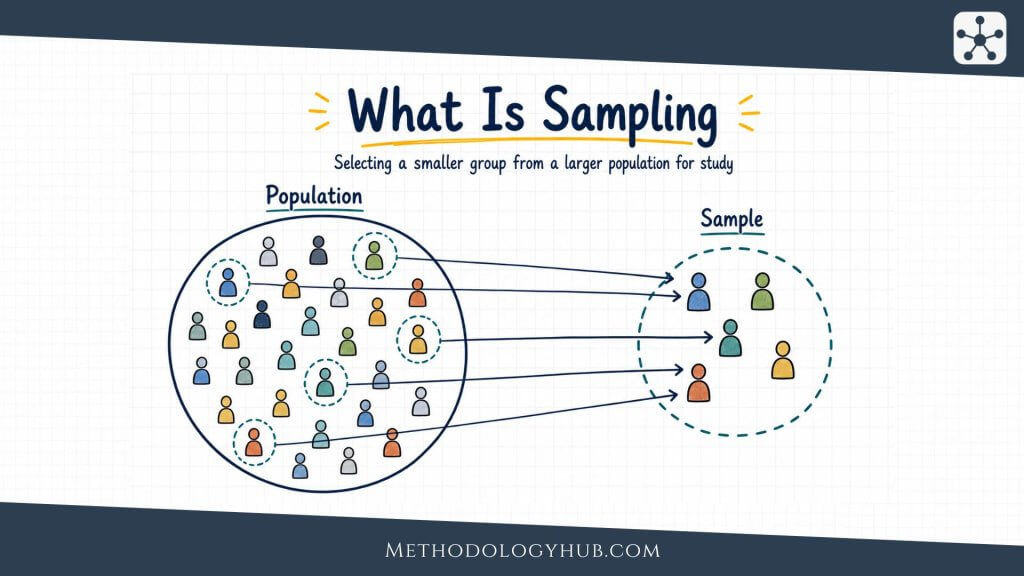
Empirical research needs a clear account of who or what was included. In a study with people, this may involve a sample of students, patients, teachers, households, or professionals. In a document study, it may involve articles, court cases, policy texts, letters, or images. In an observation study, it may involve lessons, meetings, interactions, or events.
The selection method should fit the question. A survey that aims to estimate a population needs a different sampling method from an interview study that seeks depth from information-rich cases. The researcher should explain inclusion criteria, recruitment or selection procedures, and any limits that shape the final data.
Analysis and interpretation
Analysis is the point where collected material becomes findings. In a quantitative study, this may involve coding variables, checking distributions, calculating estimates, or using statistical methods. In a qualitative study, it may involve coding transcripts, comparing cases, building themes, or tracing a process across field notes and documents.
Interpretation should stay close to the design. A correlation does not by itself prove causation. A small interview study does not estimate a national percentage. A document analysis does not automatically show what people thought unless the documents can support that claim. The strongest empirical reports make the size of the claim fit the evidence.
Transparency and reporting
Empirical research depends on transparency. The report should show how the study moved from question to evidence and from evidence to conclusion. Readers do not need every field note or every software command, but they do need enough detail to judge whether the method fits the claim.
Transparent reporting usually includes the research setting, participants or materials, data sources, instruments, procedures, analysis steps, and limits of interpretation. This does not make the article mechanical. It makes the reasoning visible.
Empirical vs Theoretical Research
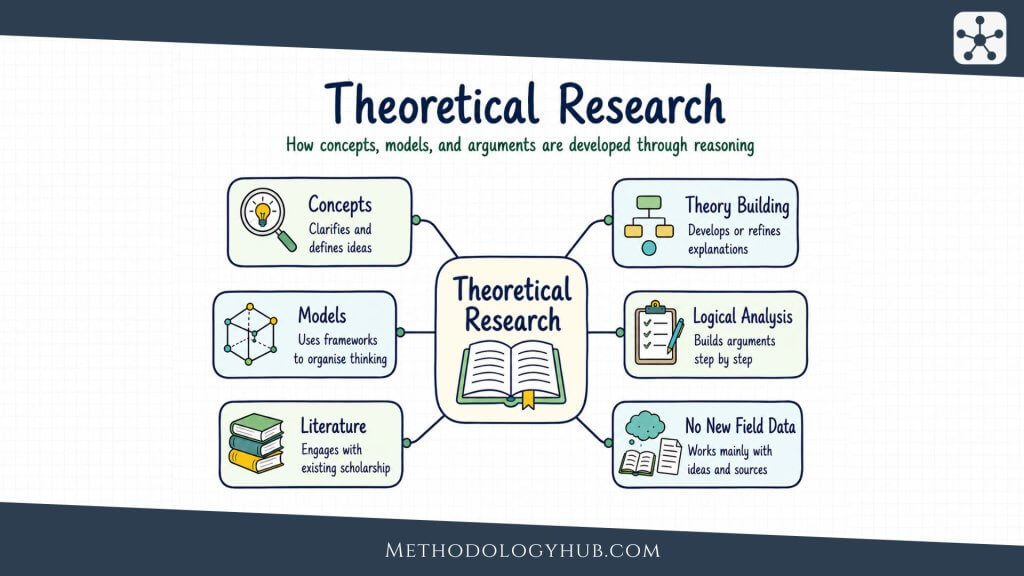
Empirical research is often compared with theoretical research. The distinction is useful because the two forms of work build knowledge in different ways. Empirical research uses evidence from observation or data. Theoretical research works mainly through concepts, models, arguments, and existing literature.
The difference is not a conflict. Good empirical research often needs theory, and good theory often grows from evidence. The distinction simply tells readers where the main support for the article comes from.
How empirical research differs from theoretical research
In empirical research, the author usually reports a dataset, field study, experiment, observation, survey, interview study, document analysis, or similar source of evidence. The findings depend on what was observed or recorded. In theoretical research, the author may develop a model, compare concepts, refine an argument, or critique a theory without collecting new field data.
For example, a theoretical article may propose that feedback works through motivation, attention, and revision planning. An empirical article may collect student drafts and interviews to examine whether that proposed process appears in practice. The two studies can speak to each other, but they do not use the same form of evidence.
| Aspect | Empirical research | Theoretical research |
|---|---|---|
| Main basis | Observed, measured, recorded, or collected evidence | Conceptual reasoning, models, arguments, or literature |
| Typical output | Findings based on data | Concepts, frameworks, propositions, or critiques |
| Examples | Survey, interview study, experiment, observation, archival analysis | Conceptual paper, theory paper, model-building article, philosophical argument |
| Main question | What does the evidence show? | How should a concept, theory, or explanation be understood? |
How empirical and theoretical research connect
Theory helps empirical researchers decide what to observe and how to interpret findings. A study rarely begins from a blank page. The researcher usually draws on existing concepts, earlier studies, and assumptions about how the topic works. Those ideas shape the question and the data collection plan.
Empirical findings can then support, refine, or challenge theory. If the evidence does not fit a model, researchers may revise the model or develop a new explanation. If the evidence fits in one setting but not another, the theory may need clearer boundaries. This movement between theory and evidence is one way a field develops over time.
Simple distinction: empirical research asks what evidence shows. Theoretical research asks how ideas, concepts, or explanations should be built and understood.
Empirical vs non-empirical research
Non-empirical research is a broader label that can include theoretical essays, conceptual papers, philosophical analysis, methodological argument, and some literature-based work. These studies may be rigorous, but their main evidence is not a newly collected or directly analysed dataset.
The boundary can sometimes be less tidy than it looks. A systematic review may analyse published studies rather than collect new participant data, but it still uses a systematic body of evidence. A theoretical paper may draw on earlier empirical findings, even though it does not conduct a new empirical study. For this reason, it is better to explain the evidence source clearly than to rely only on a label.
Methodological Approaches in Empirical Research
Empirical research does not belong to one methodology. It can be quantitative, qualitative, or mixed methods. The choice depends on the question and on the kind of evidence needed. A question about frequency, size, or association usually needs a different approach from a question about meaning, experience, or process.
Quantitative empirical research
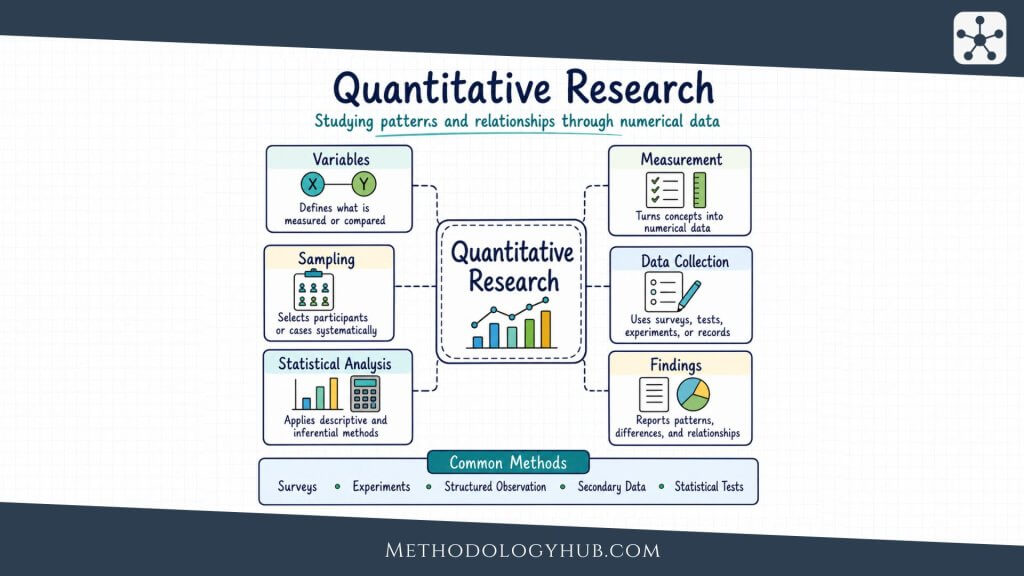
Quantitative research uses numerical data to measure variables, compare groups, estimate patterns, or test relationships. It is often used when the researcher asks how many, how often, how much, how strongly, or whether one measured variable is associated with another.
Quantitative empirical studies may use tests, surveys with closed questions, physiological measures, administrative records, counts, or coded observations. The analysis may include descriptive statistics, confidence intervals, hypothesis tests, regression models, or other procedures. The method works best when concepts are defined carefully and the variables represent those concepts well.
Qualitative empirical research
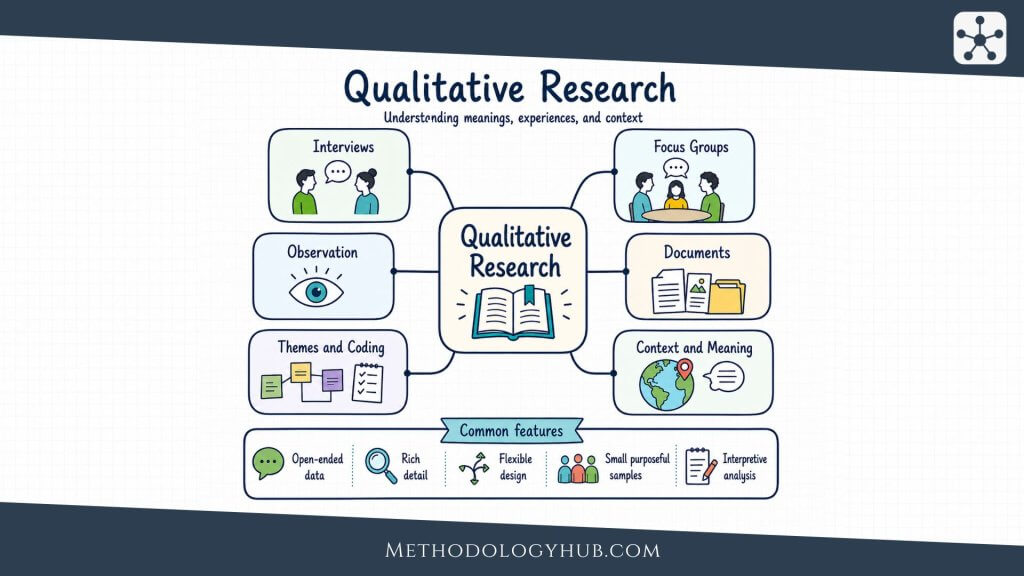
Qualitative research uses non-numerical data to study meanings, experiences, interactions, documents, practices, and contexts. It is often used when the researcher wants to understand how people interpret a situation or how a process unfolds.
Qualitative empirical studies may use interviews, focus groups, field notes, observations, open-ended responses, documents, images, or recorded interactions. The analysis may identify themes, categories, narratives, contrasts, or stages in a process. The strength of the study depends on careful selection, rich data, transparent analysis, and a clear connection between evidence and interpretation.
Mixed methods empirical research
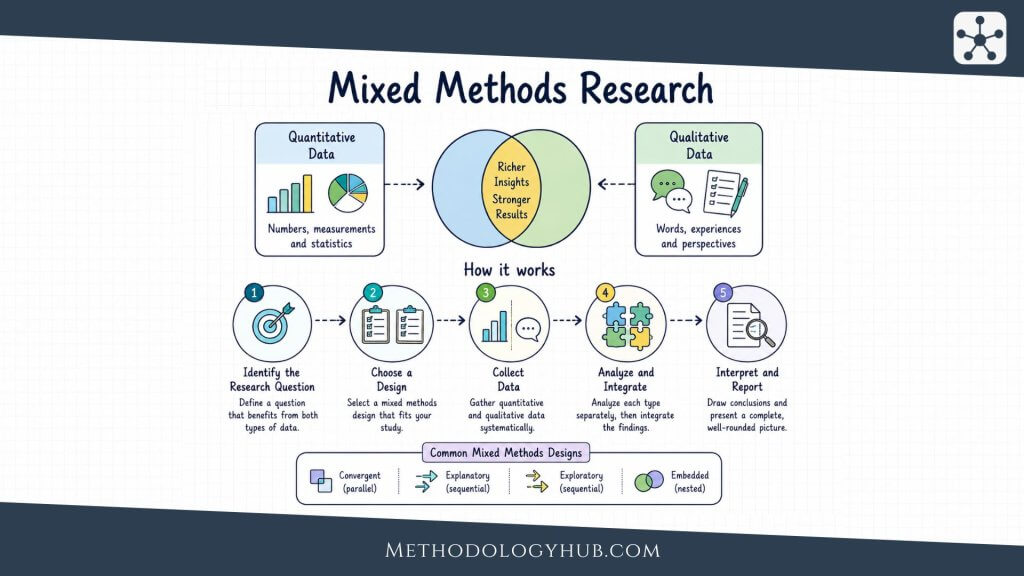
Mixed methods research combines quantitative and qualitative evidence in one study. The combination should be planned rather than added at the end. One part may explain, expand, test, or deepen the other.
A researcher might first run a survey to identify patterns and then interview selected participants to understand those patterns more closely. Another study might begin with interviews to design a questionnaire and then test the questionnaire with a larger group. The mixed methods design should show how the parts connect and what is learned from reading them together.
Research design in empirical studies
Empirical research can also be described by design. In experimental research, the researcher manipulates a condition and studies its effect under controlled conditions. In quasi-experimental research, groups or conditions are compared without full random assignment. In non-experimental research, the researcher observes variables, cases, or settings without manipulating the main condition.
Other designs are also common. A correlational research design examines associations between variables. Survey research collects structured responses from participants. Case study research examines a bounded case in depth. Comparative research studies similarities and differences across groups, cases, settings, or periods.
Timeframe in empirical research
Time also shapes empirical research. A cross-sectional research design collects evidence at one point or over a short period. It can describe a current pattern or compare groups at that time. A longitudinal research design follows change across time through repeated observations, records, surveys, tests, or interviews.
The timeframe should match the question. If the question asks how students experience the first week of university, a short data collection window may be enough. If it asks how confidence changes across the first year, the study needs evidence across time.
Empirical Research Methods
Empirical research methods are the practical ways researchers gather or analyse evidence. A method should not be chosen because it sounds formal or familiar. It should be chosen because it can produce evidence that fits the question.
Many studies use more than one method. A project may combine a survey with interviews, observations with document analysis, or test scores with field notes. The combination should be purposeful. Each method should add a form of evidence the other method cannot provide as clearly.
Experiments and tests
Experiments are used when the researcher wants to study the effect of a condition, treatment, task, or intervention. A simple experiment may compare two groups that receive different learning materials. A laboratory study may control the timing, setting, and task closely. A field experiment may take place in a real educational, clinical, or community setting.
Tests and measurements are common in experimental and quasi-experimental work. They may record achievement, memory, reaction time, blood pressure, reading fluency, or another outcome. The method becomes stronger when the measure fits the concept, the comparison is clear, and the procedure is described in enough detail for readers to follow.
Surveys and questionnaires
Surveys collect structured responses from participants. They are useful when researchers need information from many people or when the question concerns attitudes, behaviours, frequencies, experiences, or characteristics that can be reported through questions.
A survey can be descriptive or explanatory. It may estimate how many students use a study service, compare responses across groups, or examine associations between variables. The quality of a survey depends on the sampling method, question wording, response options, administration procedure, and analysis plan.
Interviews and focus groups
Interviews allow participants to explain experiences, decisions, interpretations, and practices in their own words. They are especially useful when the researcher needs depth, detail, or insight into a process that is not easily captured through closed survey questions.
Focus groups bring several participants into a guided discussion. They can show how people talk about a topic together, where views differ, and which shared assumptions appear in conversation. Both interviews and focus groups need careful question design, thoughtful sampling, and transparent analysis.
Practical distinction: surveys are often useful for structured patterns across many cases. Interviews are often useful for detailed accounts, meanings, and processes.
Observation and field notes
Observation is used when the researcher wants to study behaviour, interaction, practice, or setting directly. In a classroom study, observation may record participation patterns, teacher feedback, group work, or lesson routines. In a clinic or workplace study, it may record procedures, interactions, or environmental conditions.
Field notes should be more than casual impressions. The researcher needs a plan for what to observe, how to record it, and how the notes will be analysed. Some observations use structured checklists. Others use open field notes that are later coded and interpreted.
Document, record, and archival analysis
Empirical evidence can also come from existing materials. Researchers may study policy documents, legal cases, letters, medical records, meeting minutes, images, published articles, social media posts, or historical archives. These materials are empirical when they are selected and analysed systematically.
The researcher should explain where the materials came from, why they were included, what time period they cover, and how they were analysed. A document study may use qualitative coding, content analysis, quantitative counts, discourse analysis, or comparison across cases.
Secondary data analysis
Secondary data analysis uses data that were collected earlier by someone else. Public datasets, administrative records, census data, educational databases, and research archives can all support empirical research. This method can be efficient, but it requires careful attention to how the original data were collected.
The researcher should check whether the dataset contains the variables needed, whether the measures fit the current question, and whether missing data or sampling design affect interpretation. Secondary data can answer strong questions when the original data source is well understood.
How to Perform Empirical Research
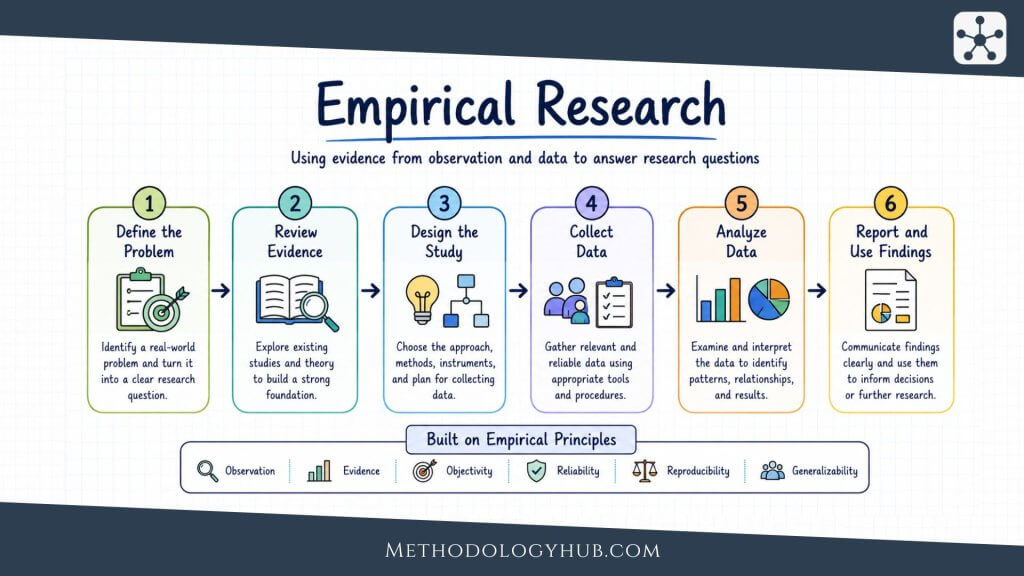
To perform empirical research, the researcher needs to turn a question into a study that can be carried out. The steps below are not a rigid template. In real projects, researchers often move back and forth between them. Still, the sequence shows how an empirical study becomes coherent.
Step 1: Define the research problem
The first step is to define the problem in a way that can be studied. A broad interest such as “student wellbeing” needs to become a more focused problem, such as how students describe workload during the first semester or whether sleep duration is associated with self-reported concentration.
A clear problem gives the study direction. It also helps the researcher decide which literature is relevant, which group or material should be studied, and which data would count as evidence.
Step 2: Write the research question
The research question should name the main issue, group or setting, and type of answer the study seeks. A question about experience needs different evidence from a question about association. A question about change over time needs a different design from a question about a current pattern.
When the question is too broad, the method becomes vague. When it is too narrow, the study may collect data that cannot support a meaningful interpretation. A good empirical question is focused enough to guide data collection but open enough to produce a useful answer.
Step 3: Choose the design and method
The design connects the question to the evidence. A researcher may choose an experiment, survey, interview study, observation, case study, document analysis, or mixed methods design. The choice should be explained in relation to the question, not presented as a default preference.
At this stage, the researcher also decides on the sample, setting, materials, measures, or documents. If the study uses people, recruitment and inclusion criteria should be clear. If it uses records or documents, the selection procedure should be visible.
Step 4: Collect or select the data
Data collection should follow the design. In a survey, this means administering the questionnaire as planned. In an interview study, it means using a guide while allowing enough room for participants to explain their views. In a document study, it means selecting materials according to the stated criteria.
Good data collection is consistent without becoming careless. The researcher should keep records of dates, settings, instruments, response rates, exclusions, or changes made during the study. These details help later reporting.
Step 5: Analyse the evidence
Analysis should be chosen before the researcher becomes attached to a particular result. In quantitative research, this may mean planning descriptive statistics, comparisons, models, or hypothesis tests. In qualitative research, it may mean planning coding, case comparison, theme development, or document interpretation.
The analysis should answer the question directly. Extra tables, quotations, or calculations do not strengthen a study if they do not help the reader understand the evidence. The goal is a clear route from data to finding.
Step 6: Interpret and report the findings
The final step is to interpret the findings in relation to the original question. The report should explain what was found, how strongly the evidence supports the interpretation, and where the boundaries of the study lie. It should also connect the findings to relevant literature without turning the discussion into a list of unrelated references.
Careful reporting is especially important in empirical research because readers need to judge the evidence. They should be able to see how the study was done, what the data showed, and how the conclusion follows from the analysis.
Examples of Empirical Research
Examples can make empirical research easier to recognise because the label appears across many subjects. The examples below show how different questions lead to different evidence, methods, and claims.
Example 1: Survey research in education
A researcher wants to know how often secondary school students use online revision tools and whether usage differs by year level. The study uses a questionnaire with closed questions, collects responses from students across several year groups, and analyses the results with descriptive statistics and group comparisons.
This is empirical because the findings are based on survey data collected from students. It may also be survey research, quantitative research, and cross-sectional research if the data are collected during one period.
Example 2: Interview research in health care
A researcher studies how newly qualified nurses experience their first six months in hospital practice. The study uses semi-structured interviews, transcribes the conversations, and analyses them for themes related to support, uncertainty, workload, and professional learning.
This is empirical because the interpretation is built from participant accounts. It is also qualitative because the analysis focuses on meaning and experience rather than numerical measurement.
Example 3: Experimental research in psychology
A researcher tests whether background noise affects short-term memory. Participants are assigned to complete the same memory task in quiet conditions or with background noise. The researcher compares the scores between conditions.
This is empirical because the researcher collects performance data under planned conditions. It is experimental because a condition is manipulated, and it is quantitative because the main evidence is numerical.
Example 4: Document analysis in social research
A researcher examines how school inspection reports describe student wellbeing. The study selects reports from a defined period, codes relevant passages, compares categories across schools, and interprets the language used to describe support, risk, and responsibility.
This is empirical even though no new interviews or surveys are conducted. The evidence comes from documents, and the analysis is systematic. The study may be qualitative, quantitative, or mixed depending on how the documents are coded and interpreted.
Example 5: Longitudinal empirical research
A researcher follows a group of students across three years to study how academic confidence changes. Data are collected at several points through questionnaires and short interviews. The quantitative data show patterns of change, while the interviews help explain how students interpret those changes.
This is empirical because the study uses repeated evidence across time. It is also longitudinal research and may be mixed methods if the numerical and interview data are integrated in the analysis.
Conclusion
Empirical research is one of the main ways researchers build knowledge from evidence. It does not refer to one single method. A study can be empirical through surveys, interviews, observations, experiments, records, documents, secondary data, or mixed methods. The shared feature is that the conclusion is based on traceable evidence.
The quality of empirical research depends on alignment. The question should fit the evidence. The method should fit the question. The analysis should fit the data. The claim should fit the design. When those parts work together, readers can follow the study and judge how far the findings can be taken.
FAQs on Empirical Research
What is empirical research?
Empirical research is research based on evidence from observation, measurement, experience, records, documents, participants, or other traceable sources. The conclusion is built from data rather than reasoning alone.
What is an example of empirical research?
An example of empirical research is a study that surveys students about study habits and analyses the responses. Other examples include experiments, interview studies, classroom observations, document analysis, and studies using existing records or datasets.
What is the difference between empirical and theoretical research?
Empirical research is based mainly on collected or observed evidence. Theoretical research is based mainly on concepts, models, arguments, and existing literature. The two often connect because theory can guide empirical studies and empirical findings can refine theory.
Is empirical research always quantitative?
No. Empirical research can be quantitative, qualitative, or mixed methods. A numerical survey is empirical, but so is an interview study, an observation study, a case study, or a document analysis when evidence is gathered and analysed systematically.
What are empirical research methods?
Empirical research methods include experiments, surveys, interviews, focus groups, observations, tests, document analysis, archival analysis, secondary data analysis, and mixed methods designs. The best method depends on the research question.