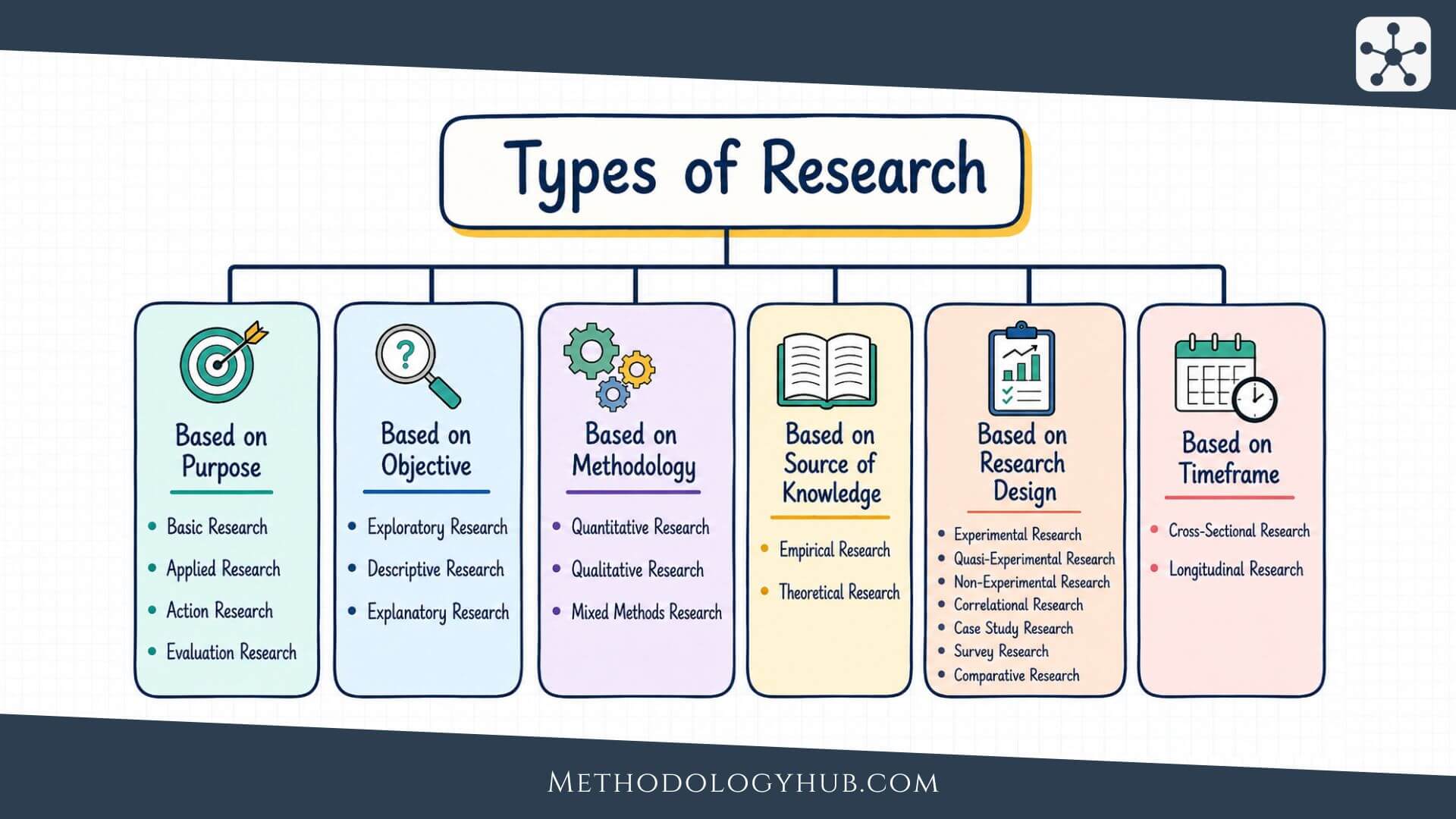
Types of research are the different ways researchers organise a study according to its purpose, objective, methodology, source of knowledge, research design, and timeframe. A study may be basic or applied, exploratory or explanatory, qualitative or quantitative, empirical or theoretical, experimental or non-experimental, cross-sectional or longitudinal. These labels help readers understand what kind of question the study asks, what kind of evidence it uses, and what kind of conclusion it can support.
This article explains the main types of research in a beginner-friendly way. It shows how the categories fit together, how they differ, and how a researcher can choose a suitable type without treating the labels as a rigid checklist.
What Are the Types of Research?
The types of research are categories used to describe the overall logic of a study. They show what the study is trying to do, how it approaches evidence, how data are collected, and how the results should be interpreted. A single project can belong to more than one category because the categories answer different questions.
For example, a study may be applied research because it aims to solve a practical problem. It may also be quantitative because it uses numerical scores, quasi-experimental because the researcher compares existing groups, and longitudinal because the same learners are followed across a school year. These labels do not compete with one another. They describe different parts of the same study.
The main ways research is classified
Research is usually classified in several overlapping ways. The same study can be sorted by its purpose, by its objective, by its methodology, by its source of knowledge, by its design, and by its timeframe. This is why two articles can both be “qualitative” but still be very different. One might be an exploratory case study based on interviews, while another might be an action research project in a classroom.
| Classification basis | Main question it answers | Common types |
|---|---|---|
| Purpose | What is the study trying to contribute? | Basic, applied, action, evaluation |
| Objective | What kind of understanding is the study seeking? | Exploratory, descriptive, explanatory |
| Methodology | What kind of data and reasoning are used? | Quantitative, qualitative, mixed methods |
| Source of knowledge | Does the study use observation, theory, or both? | Empirical, theoretical |
| Research design | How is the study structured? | Experimental, quasi-experimental, non-experimental, correlational, case study, survey, comparative |
| Timeframe | When are observations made? | Cross-sectional, longitudinal |
How the categories work together
Research categories work best when they are read as layers. The first layer is usually the purpose of the study. Is it trying to build knowledge, solve a problem, improve practice, or evaluate a programme? The next layer concerns the objective. Is the study exploring something new, describing a situation, or explaining a relationship? After that, the researcher chooses a methodology, design, data source, and timeframe that fit the question.
This layered view prevents confusion. Quantitative research is not the opposite of applied research. A survey is not the opposite of longitudinal research. A case study is not automatically qualitative, although many case studies are. The question is always: which part of the study is this label describing?
Students often meet these terms one at a time, which can make them feel like separate definitions. In real research, they appear together. A strong method section describes the combination clearly: purpose, question, data, design, sample, procedure, and analysis should point in the same direction.
Types of Research Based on Purpose
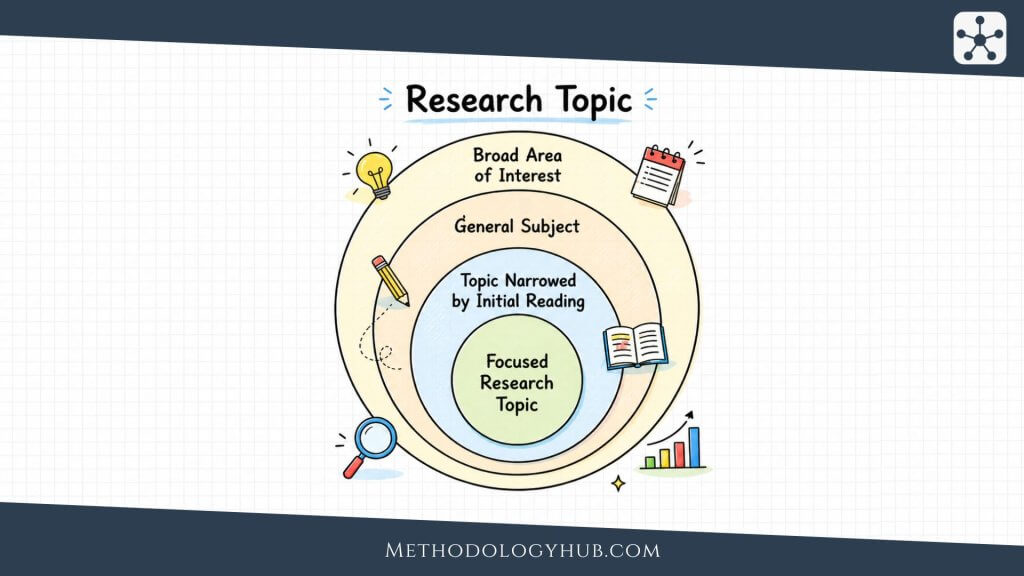
When research is classified by purpose, the focus is on what the study is trying to contribute. Some studies aim to expand knowledge without an immediate practical use. Others are designed to solve a defined problem, improve a local practice, or judge whether a programme is working. These differences shape the way the research topic is narrowed and the way results are interpreted.
The four common types of research based on purpose are basic research, applied research, action research, and evaluation research. They often connect to one another. Basic research can later inform applied work. Evaluation research can reveal new questions for basic or applied studies. Action research can generate local findings that later become part of wider investigation.
Basic Research
Basic research is conducted to develop knowledge, concepts, theories, or explanations. It is sometimes called fundamental research because the main goal is understanding rather than immediate use. A researcher studying how memory changes during sleep, how children acquire grammar, or how a mathematical model behaves may be doing basic research.
This type of research is not “impractical” simply because it does not solve a direct problem on the day it is published. Many practical tools begin with ideas developed in basic research. The difference lies in the first intention of the study. Basic research asks what is true, how something works, or how a theory can be improved.
In practice, basic research often works with carefully defined concepts and controlled comparisons. The researcher may test a theory, refine a model, or examine a relationship that has not yet been fully explained. The results may be useful later, but the study is judged mainly by how well it improves understanding. A basic research project should therefore make its conceptual contribution clear: what does the study help us understand more precisely than before?
One useful way to recognise basic research is to look at the audience for the finding. The first readers are often other researchers, theorists, or advanced students who need a clearer explanation of a concept or process. A basic study may use experiments, simulations, interviews, textual analysis, or mathematical reasoning, but its main contribution is conceptual. It gives later researchers better language, sharper assumptions, or a stronger model for asking the next question.
Applied Research
Applied research uses research methods to address a specific practical problem. The problem may appear in education, health, public administration, environmental management, social services, or another applied field. A study testing whether a reading support strategy improves comprehension among struggling readers is applied research because the design is tied to a real problem.
Applied research still needs careful theory, measurement, and analysis. It is not simply informal problem solving. The researcher must define the problem, state the research question, collect suitable research data, and interpret the results with the same care expected in academic work.
The practical setting usually shapes applied research more strongly than basic research. The study may have to work within a school timetable, clinic records system, public service budget, or community programme. Those limits should be reported rather than hidden. A strong applied study explains the problem, the setting, the evidence used, and the conditions under which the findings are likely to be useful.
Applied research also has to define what counts as a useful answer. In some projects, the answer may be a measurable improvement in outcomes. In others, it may be a clearer diagnosis of a problem, a comparison of possible interventions, or evidence that a current practice should be changed. The study should therefore connect the practical problem to a researchable question, rather than treating the problem itself as enough of a design.
Action Research
Action research is a type of research in which the researcher studies a practice while also trying to improve it. It is common in classrooms, schools, clinics, community organisations, and professional settings where practitioners want to learn from their own work. A teacher may introduce a new feedback routine, observe how pupils respond, adjust the routine, and study the change over several cycles.
The cycle is central. Action research usually moves through planning, acting, observing, reflecting, and revising. The results are often local, but local does not mean weak. A carefully reported action research project can show how a change worked in a real setting and what conditions shaped the result.
Because the researcher may also be a teacher, nurse, manager, or practitioner in the setting, action research needs a clear account of the researcher’s role. Evidence may come from observation notes, participant feedback, student work, performance records, interviews, or short surveys. The strongest reports do not only say that a change was introduced. They show what was noticed, what was adjusted, and how reflection shaped the next cycle.
Action research is especially useful when the person closest to the problem also has the ability to change the practice. The researcher does not stand completely outside the setting. Instead, they document what happens as the change is introduced, how participants respond, and what is learned from each adjustment. This makes the written report stronger when it includes honest reflection on unexpected results, not only the final improvement.
Plain distinction: basic research asks for deeper understanding, applied research asks how knowledge can address a problem, and action research asks how practice can be studied while it is being improved.
Evaluation Research
Evaluation research examines the value, quality, effect, or implementation of a programme, policy, course, intervention, or service. A school district may evaluate a tutoring programme. A hospital may evaluate a new appointment system. A university may evaluate whether a mentoring scheme reaches the students it was designed to support.
Evaluation research can ask several kinds of questions. It may examine whether a programme was implemented as planned, whether participants used it, whether outcomes changed, or whether the programme should be continued. It often combines practical decision making with systematic evidence.
A useful evaluation usually separates the thing being evaluated from the criteria used to judge it. A programme can be popular but poorly implemented. It can reach many participants but miss the group it was designed for. It can improve one outcome while leaving another unchanged. For this reason, evaluation research often looks at process, outcomes, reach, cost, and participant experience rather than relying on one final satisfaction score.
Evaluation research can also be formative or summative. A formative evaluation is conducted while a programme is still developing, so the findings can guide improvement. A summative evaluation is conducted after a programme has been implemented for long enough to judge its results. Many real evaluations include both parts: they ask whether the programme worked, but also whether it worked as intended and for whom.
Purpose-based categories are especially useful at the beginning of a project. They help the researcher decide whether the study needs theory building, problem solving, practice improvement, or programme judgement. Once that purpose is clear, the rest of the design becomes easier to align.
Types of Research Based on Objective
Research can also be classified by objective. Here the question is not mainly whether the study is theoretical or practical. The question is what kind of understanding the study is trying to produce. Some studies open up a little-known topic. Some describe a population, setting, or pattern. Others test why something happens or whether one variable helps explain another.
The three common types of research based on objective are exploratory research, descriptive research, and explanatory research. They often appear in sequence across a field. Researchers may first explore a topic, then describe it more precisely, then test explanations once enough is known.
Exploratory Research
Exploratory research is used when a topic is not yet well understood, when the researcher needs to clarify concepts, or when the study is meant to prepare for a more focused project. It is common at the early stage of a research area or when the researcher is entering a setting where little prior work exists.
An exploratory study might use interviews, focus groups, document analysis, pilot surveys, field notes, or open-ended observations. The purpose is not to deliver a final answer for every part of the topic. It is to learn what should be asked next, which concepts seem relevant, and where a more specific research hypothesis may eventually come from.
Exploratory research is flexible, but it should not be vague. The researcher still needs a clear starting problem, a reason for choosing participants or documents, and a plan for analysing what is found. Its products are often categories, themes, possible variables, early explanations, or improved instruments for a later study. A pilot interview study, for example, may reveal that students describe academic pressure in terms the original survey did not include.
Exploratory research is often strongest when the researcher keeps the analysis open without making it directionless. Early interviews, observations, or documents may reveal words, categories, or concerns that were not visible in the original plan. Those findings can then help refine the research question, develop a better instrument, or decide which group or setting should be studied more closely.
Descriptive Research
Descriptive research aims to show what exists, how often something occurs, who is involved, or what characteristics appear in a group, setting, or body of evidence. It does not need to explain the cause of every pattern. Its first task is accurate description.
A descriptive study may estimate how many students use a library database each week, describe the features of published articles in a field, or document the range of services offered by clinics in a region. Descriptive research can be quantitative, qualitative, or mixed methods. The method depends on what needs to be described.
Depth in descriptive research comes from careful boundaries and measurement. The researcher should say which population, period, setting, documents, or behaviours are included. If the study describes attitudes, the questions should be clear. If it describes documents, the coding rules should be visible. Description may look modest, but weak description can mislead later explanatory work because the field begins from an inaccurate picture.
Descriptive research is also useful when a field has many assumptions but little careful mapping. Before researchers can explain why a pattern appears, they often need to know where it appears, how common it is, and which forms it takes. For example, a descriptive study of feedback comments in student essays may not explain their effects, but it can show which kinds of comments teachers actually write and how often each kind appears.
Explanatory Research
Explanatory research asks why or how something happens. It tries to account for a difference, relationship, process, or outcome. In quantitative research, explanatory studies often examine relationships between variables. In qualitative research, they may explain a process by showing how people interpret events, make decisions, or respond to conditions.
For example, a descriptive study might report that students who attend revision sessions have higher exam scores. An explanatory study would ask whether attendance itself helps explain the difference, whether motivated students are more likely to attend, or whether another factor is involved. That extra step changes the kind of design and analysis the study needs.
Explanatory research therefore pays close attention to alternative explanations. The researcher may use comparison groups, statistical controls, repeated observations, theory-guided qualitative analysis, or process tracing to show why one explanation fits better than another. Explanatory research is strongest when it can connect the proposed cause, mechanism, context, and outcome instead of reporting only that two things appeared together.
The depth of explanatory research depends on how well the study handles rival interpretations. A numerical analysis may control for prior achievement, age, or programme exposure. A qualitative analysis may compare cases where the outcome appeared with cases where it did not. In both situations, the goal is not only to name a possible cause, but to show why that explanation fits the evidence better than other plausible readings.
These objectives should not be forced into a hierarchy where one is always better than the others. A careful descriptive study may be more useful than a weak explanatory one if the field does not yet have reliable description. The objective should match what the topic is ready for and what the evidence can support.
Types of Research Based on Methodology
Research based on methodology is usually grouped into quantitative, qualitative, and mixed methods research. This classification looks at the kind of data the study uses, the way evidence is analysed, and the kind of reasoning that connects the data to the conclusion.
Methodology is broader than a single technique. A survey, interview, experiment, document analysis, or observation can be part of a larger methodology, but it is not the whole methodology by itself. The methodology explains how the study approaches evidence and why that approach fits the question.
Quantitative Research
Quantitative research uses numerical data to measure variables, compare groups, estimate patterns, or test relationships. It is often used when the researcher wants to know how much, how many, how often, how strongly, or whether one measured variable is related to another.
A quantitative study may use surveys with closed questions, test scores, clinical measurements, counts, administrative records, or coded observations. The results are often analysed with descriptive statistics, statistical analysis, or other statistical methods. The strength of this approach is that it can summarise patterns clearly and, when the design supports it, make cautious claims beyond the observed sample.
A quantitative study usually turns the research question into variables before data collection begins. The researcher decides what will be measured, how scores or categories will be recorded, and which comparisons or statistical procedures will be used. This makes the design transparent, but it also means that poor operational definitions can weaken the whole study. If “engagement” is measured only by attendance, for example, the study may miss participation, effort, interest, and interaction.
Quantitative research becomes more convincing when measurement decisions are explained in plain terms. Readers should be able to see why a score, count, scale, or category represents the concept being studied. A study of academic confidence, for instance, might use several survey items rather than one vague question. That detail affects interpretation because statistical results are only as meaningful as the variables used to produce them.
Qualitative Research
Qualitative research studies meanings, experiences, practices, interactions, documents, and contexts. It is often used when the researcher wants to understand how people interpret a situation, how a process unfolds, or how a case works from the inside.
The data may come from interviews, field notes, observations, documents, images, open-ended survey responses, or recorded interactions. Instead of reducing everything to numbers at the start, qualitative research usually works closely with language, context, and interpretation. The analysis may identify themes, patterns, categories, narratives, or processes.
Depth in qualitative research comes from the richness of the evidence and the care of the analysis. Researchers may code interview transcripts, compare field notes, analyse documents, or build themes from repeated patterns. A good qualitative report does not simply list interesting quotations. It explains how evidence was selected, how interpretation developed, and how the final themes or concepts answer the research question.
Qualitative research also depends on sampling choices, even when it does not aim for statistical representation. The researcher may choose participants, documents, or cases because they can show variation, depth, contrast, or experience with the process being studied. A small sample can be suitable when the evidence is rich and the selection logic is clear. What the researcher should avoid is pretending that depth and access are the same thing.
Mixed Methods Research
Mixed methods research combines qualitative and quantitative approaches in one study. The combination should serve the research question rather than simply add more data. A researcher may use survey results to identify patterns and then interviews to understand those patterns in more detail. Another study may begin with interviews to develop a survey instrument and then test it with a larger sample.
The timing and connection between the parts should be clear. In some mixed methods studies, qualitative and quantitative data are collected at the same time. In others, one phase comes first and shapes the next. The value of mixed methods lies in integration. The researcher should explain how the two forms of evidence speak to each other.
The mixed methods label should mean more than placing a few quotations next to a table. In a sequential design, one phase may shape the next. In a convergent design, qualitative and quantitative results may be collected during the same period and then compared. A good mixed methods report tells readers where the two strands agree, where they differ, and what is learned by reading them together.
Mixed methods research can be demanding because each part has to be good enough on its own and meaningful in combination. A weak survey does not become strong because interviews were added, and a thin set of interviews does not become rich because it sits beside statistics. The researcher should plan the point of connection early: one part may explain the other, test the other, expand the other, or show where the two forms of evidence disagree.
Planning note: Choose quantitative methods when measurement and comparison are central. Choose qualitative methods when meaning, context, or process is central. Use mixed methods when the question needs both forms of evidence.
None of these methodologies is automatically stronger than the others. A weak quantitative study can measure the wrong thing very precisely. A weak qualitative study can collect rich material but leave the selection and analysis unclear. A strong study explains why the methodology is suitable and then uses it consistently.
Types of Research Based on Source of Knowledge
Another way to classify research is by the source of knowledge used to build the argument. Some studies rely mainly on observation, measurement, documents, interviews, or other collected data. Others work mainly with concepts, models, theories, arguments, or existing literature. The two broad types are empirical research and theoretical research.
This distinction is not the same as quantitative versus qualitative. Empirical research can be quantitative or qualitative. A survey is empirical because it uses collected data. An interview study is also empirical because it uses data gathered from participants. Theoretical research works differently because it develops understanding through reasoning, analysis, and engagement with ideas.
Empirical Research
Empirical research is based on observed or collected evidence. That evidence may come from experiments, surveys, interviews, observations, tests, records, texts, images, environmental measurements, or archival materials. The researcher uses the evidence to answer a question about the world, a group, a setting, a process, or a body of material.
An empirical study should make the source of evidence visible. Readers need to know what was observed, who or what was included, how the data were collected, and how the data were analysed. Without that information, the study becomes difficult to assess because the route from evidence to conclusion is unclear.
The quality of empirical research depends on the path from question to evidence. Empirical does not automatically mean quantitative. A set of interview transcripts, classroom observations, historical letters, or coded policy documents can also be empirical evidence when they are gathered and analysed systematically. What makes the study empirical is the use of traceable material from observation, measurement, records, or human accounts.
Empirical research should also show how raw evidence became an answer. In a survey, this may mean explaining how responses were coded and analysed. In an interview study, it may mean explaining how themes were developed. In an archival study, it may mean explaining which documents were included and why. The reader should not have to guess how the evidence was transformed into findings.
Theoretical Research
Theoretical research develops, compares, refines, or challenges concepts and theories. It may use existing literature, logical argument, conceptual analysis, mathematical reasoning, or model building. It does not usually collect new field data, but it can still be rigorous when the reasoning is clear and the sources are handled carefully.
A theoretical article might clarify the meaning of a concept, compare two models of learning, extend a theory to a new situation, or show that an existing explanation has internal problems. Its strength depends on the quality of the argument rather than the size of a dataset.
Theoretical research can also prepare the ground for empirical work. A clearer concept may help later researchers decide what to measure. A new model may suggest relationships that can be examined in future studies. A critique of an existing theory may show why earlier findings have been interpreted too narrowly. The article should make the reasoning visible enough for readers to follow and question it.
Theoretical research is often misunderstood as opinion writing, but good theoretical work is more disciplined than that. It defines the problem, selects relevant literature, compares ideas carefully, and builds an argument step by step. A theoretical paper may not include a new dataset, yet it can still change how later studies are designed by clarifying what a concept means or how a relationship should be understood.
How empirical and theoretical research connect
Empirical and theoretical research often feed into each other. Theory can guide what researchers observe and which questions they ask. Empirical findings can challenge a theory, support it, refine it, or show where it no longer works. A field usually develops through movement between the two.
For example, a theory of learning may suggest that feedback timing affects student revision. An empirical study can examine that idea in classrooms or laboratory tasks. The results may then lead researchers to adjust the theory. The distinction is useful, but the relationship is ongoing.
Types of Research Based on Research Design
Research design describes the structure of the study. It explains how the researcher moves from question to evidence in a practical way. Design decisions include whether groups are compared, whether an intervention is introduced, whether variables are measured rather than manipulated, whether one case is studied in depth, and whether data are collected through a survey or another procedure.
The main types of research based on design include experimental, quasi-experimental, non-experimental, correlational, case study, survey, and comparative research. These are not all at the same level. Some describe broad design families, while others describe more specific ways of collecting or arranging evidence.
Experimental Research
Experimental research studies the effect of an intervention, treatment, condition, or manipulation. In a true experiment, the researcher controls the independent variable and uses random assignment to place participants or units into groups. This design gives strong support for causal interpretation when the study is well planned and the measurements fit the question.
A simple education experiment might randomly assign students to two feedback formats and then compare later revision scores. The random assignment helps make the groups similar before the feedback is given. The intervention then becomes the planned difference between the groups.
Experimental research is strongest when the intervention, comparison condition, outcome, and procedure are clearly defined before the study begins. The researcher should also consider threats such as unequal dropout, contamination between groups, or measurement that favours one condition. Random assignment is powerful, but the rest of the design still has to be handled carefully.
Experimental research also needs a clear comparison condition. A treatment group is hard to interpret if the researcher does not explain what it is being compared with. The comparison may be no treatment, usual practice, a placebo condition, or another intervention. The outcome measure should be chosen before the results are known, and the timing of measurement should match the expected effect of the intervention.
Quasi-Experimental Research
Quasi-experimental research also examines an intervention or condition, but it lacks full random assignment. The researcher may compare existing classes, schools, clinics, or time periods. This design is common when random assignment is not realistic, but the researcher still wants to study possible effects.
For example, one school may adopt a new reading programme while another similar school continues with its usual approach. The researcher can compare outcomes, but the groups may have differed before the programme began. Because of that, quasi-experimental research needs careful comparison, baseline information, and cautious interpretation.
Common quasi-experimental strategies include pre-test and post-test comparisons, matched comparison groups, interrupted time series, and difference-in-differences designs. These strategies try to reduce uncertainty about what would have happened without the intervention. They do not make the study identical to a randomised experiment, but they can give useful evidence when random assignment is not possible.
Quasi-experimental research is often strongest when the researcher can show what the groups looked like before the intervention. Baseline measures, previous records, or matching procedures can help readers judge whether the comparison is fair. The study may not remove all uncertainty, but it can reduce the chance that a difference after the intervention is simply a reflection of differences that already existed.
Non-Experimental Research
Non-experimental research studies variables, groups, behaviours, documents, or settings without manipulating an intervention. The researcher observes, measures, records, or analyses what already exists. Many surveys, correlational studies, descriptive studies, and document analyses are non-experimental.
This type is useful when manipulation is not suitable or not possible. A researcher studying the relationship between study time and sleep duration may measure both variables without assigning students to sleep less or study more. The design can show patterns and associations, but causal claims need care.
Non-experimental research covers many ordinary research situations. Researchers may describe a population, analyse existing records, compare naturally occurring groups, or study associations between variables. The main task is to be honest about what was and was not controlled by the researcher. A non-experimental study can be rigorous, but it should not present observed differences as if they were produced by an assigned intervention.
Non-experimental research is not a fallback for weak studies. It is the correct design when the researcher needs to study naturally occurring patterns, existing records, lived experiences, or variables that cannot be assigned. Many serious research questions cannot be answered through manipulation. The strength of the design comes from clear measurement, careful comparison, transparent limits, and cautious interpretation of relationships.
Correlational Research
Correlational research examines whether variables are associated. It asks whether higher values of one variable tend to appear with higher or lower values of another. A study may ask whether reading time is associated with vocabulary scores, whether anxiety scores are related to sleep quality, or whether attendance is related to course completion.
Correlation does not by itself show causation. Two variables can be associated because one influences the other, because a third variable affects both, or because the association appears in a particular sample. The design helps researchers describe relationships, but explanation usually requires additional evidence.
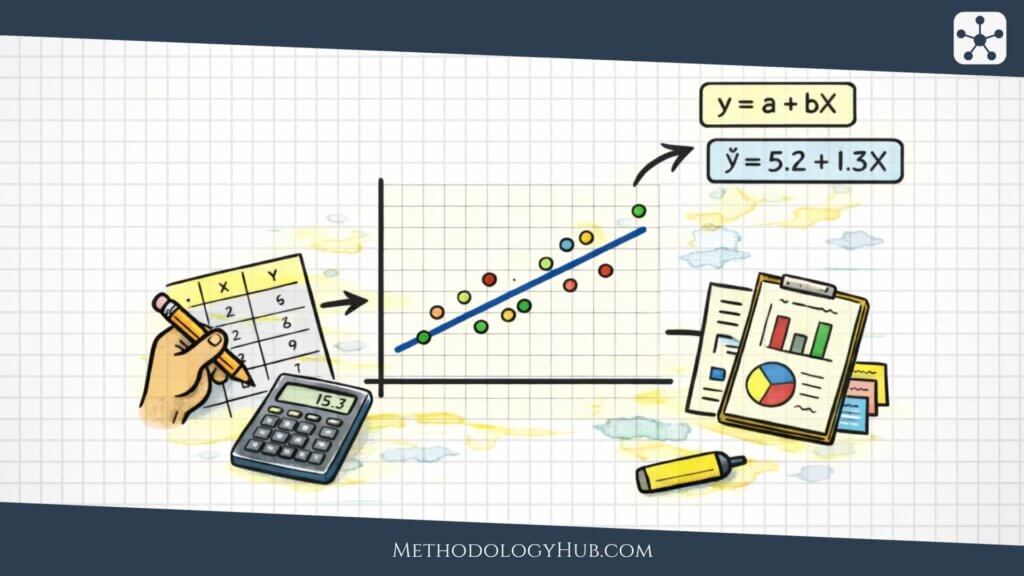
A correlational study should define each variable carefully and explain the expected form of the relationship. Some relationships are linear, while others may be curved or visible only within certain groups. The analysis may use a correlation coefficient, regression model, scatterplot, or other statistical method. The interpretation should return to the design: an association found in a cross-sectional survey supports a different claim from an association observed repeatedly over time.
Correlational research can also be used as a first step toward stronger explanation. If two variables are not associated at all, a proposed causal story may need rethinking. If they are associated, the researcher can ask whether the relationship remains after considering other variables, whether it appears in different groups, and whether the timing makes sense. The design is often a bridge between description and more focused explanatory work.
Case Study Research
Case study research examines one case or a small number of cases in depth. The case may be a person, classroom, school, organisation, event, programme, community, policy, document set, or historical episode. The goal is to understand the case in its context rather than strip it away from its setting.
Case studies often use several forms of evidence, such as interviews, observations, documents, field notes, and records. They can be qualitative, quantitative, or mixed methods, although many are qualitative. A strong case study explains why the case was chosen and what the case can show.
The case should have clear boundaries. Readers need to know where the case begins and ends, which period is covered, and which sources were used. A case may be chosen because it is typical, unusual, influential, newly emerging, or especially informative for a theory. The aim is not always to generalise statistically. Often, the value is analytic: the case helps readers understand a process, mechanism, context, or decision in close detail.
Case study research becomes deeper when the case is treated as more than an example. The researcher should show the setting, actors, documents, history, and conditions that make the case understandable. A case study of a school reform, for instance, may need classroom observations, policy documents, teacher interviews, and outcome records. The detail is useful because the case is interpreted as a connected situation, not as isolated fragments.
Survey Research
Survey research collects information from a group of respondents using a structured questionnaire or interview schedule. It is often used to describe attitudes, behaviours, characteristics, experiences, or self-reported outcomes. Surveys can be cross-sectional or longitudinal, small or large, online or in person.
The quality of survey research depends on the question wording, sampling approach, response process, and analysis. A survey can look simple on the surface, but a poorly worded item or narrow sample can weaken the results. The design should show who was asked, what they were asked, and how responses were interpreted.
Good survey design starts before the questionnaire is distributed. Researchers need to decide whether questions should be open or closed, how response options are ordered, which concepts need multiple items, and whether the language will be understood by the intended respondents. The sample also needs attention. A well-written survey sent only to an unrepresentative group will still give limited evidence.
Survey research can produce broad evidence, but it also depends heavily on respondent understanding. A question that seems clear to the researcher may be read differently by younger pupils, patients, parents, or professionals from another field. Pilot testing, simple wording, balanced response options, and a sensible order of questions can improve the quality of responses before analysis begins.
Comparative Research
Comparative research studies similarities and differences between cases, groups, places, texts, systems, policies, or time periods. The comparison may be qualitative, quantitative, or both. A researcher may compare classroom practices in two schools, health policies across regions, or assessment systems in different countries.
The comparison should be purposeful. Cases should be chosen because they help answer the question, not only because they are easy to place side by side. A good comparative design explains what is being compared, why the comparison is useful, and which features are held constant or examined as possible sources of difference.
Comparative research can use different logics. A researcher may compare very similar cases to understand one important difference, or very different cases to examine whether a pattern appears across contexts. The comparison can be narrow, such as two classrooms using different assessment routines, or broad, such as policy systems in several countries. For the design, the important point is that the basis of comparison is explicit.
Comparative research should also explain the unit of comparison. The unit may be a country, school, classroom, policy, text, group, time period, or case. Confusion appears when the researcher compares at one level but interprets at another. For example, comparing two schools does not automatically explain differences between individual pupils. A clear unit of comparison keeps the conclusion tied to the evidence.
Design labels give structure to a study. They help readers see whether the researcher manipulated a condition, observed existing patterns, examined associations, studied a case, gathered survey responses, or compared cases. That structure shapes the strength and limits of the conclusion.
Types of Research Based on Timeframe
Research can also be classified by when data are collected. Some studies observe a situation at one point in time. Others follow the same people, cases, documents, groups, or settings across more than one time point. This distinction shapes what the study can say about change.
The two main types of research based on timeframe are cross-sectional research and longitudinal research. Both can be useful, but they answer different kinds of questions.
Cross-Sectional Research
Cross-sectional research collects data at one point in time or within a short defined period. It gives a snapshot of a population, group, setting, or set of records. A researcher may survey students during one semester, analyse articles published in one year, or measure patient satisfaction after appointments in one month.
This design is useful for describing current conditions, estimating prevalence, comparing groups at the same time, or exploring associations. It is usually faster and less costly than following participants over time. Its limitation is that it does not directly show how individuals or cases change. A cross-sectional study can compare first-year and final-year students, but it does not follow the same students from first year to final year.
Cross-sectional research is often a good fit for surveys, needs assessments, document reviews, prevalence studies, and one-time comparisons. Its interpretation becomes stronger when the time period is defined clearly. A study of patient satisfaction “in 2026” is less precise than a study of patients who visited three clinics between March and May 2026. Clear timing helps readers understand what the snapshot actually represents.
Cross-sectional research is often useful for planning later studies because it can reveal which patterns deserve closer follow-up. A one-time survey might show that confidence differs by year level, or that access to resources differs by region. Those results do not prove individual change, but they can point toward groups, variables, or settings that a longitudinal or explanatory study should examine next.
Longitudinal Research
Longitudinal research collects data across two or more time points. It is used when the question involves change, development, sequence, persistence, or timing. A researcher may follow students across several semesters, observe classroom interactions before and after a curriculum change, or track health records over several years.
The advantage is that longitudinal research can show change more directly than a one-time snapshot. The challenge is that it takes more planning. Participants may drop out, records may become incomplete, and the researcher must keep measurements consistent enough for comparison across time.
Longitudinal research can take several forms. A panel study follows the same participants repeatedly. A cohort study follows a group that shares a starting point, such as pupils entering secondary school in the same year. A repeated cross-sectional study surveys different samples from the same population at several points. These designs answer different questions, so the researcher should explain whether the study follows individuals, groups, or population snapshots over time.
Longitudinal research also requires decisions about spacing. Measurements that are too close together may miss slow development, while measurements that are too far apart may miss important transitions. The researcher should explain why the chosen time points fit the process under study. A project on weekly study habits, for example, needs a different schedule from a project on academic development across several years.
Choosing between a snapshot and a follow-up design
The choice depends on the research question. If the question asks what a situation looks like now, a cross-sectional design may fit. If the question asks how something changes, develops, or continues, a longitudinal design is usually stronger. The timeframe should be named because it affects interpretation.
For example, a cross-sectional survey may show that older students report more confidence than younger students. A longitudinal study can ask whether the same students become more confident as they gain experience. The difference is not just technical. It changes the kind of claim the study can make.
Choosing the Right Type of Research
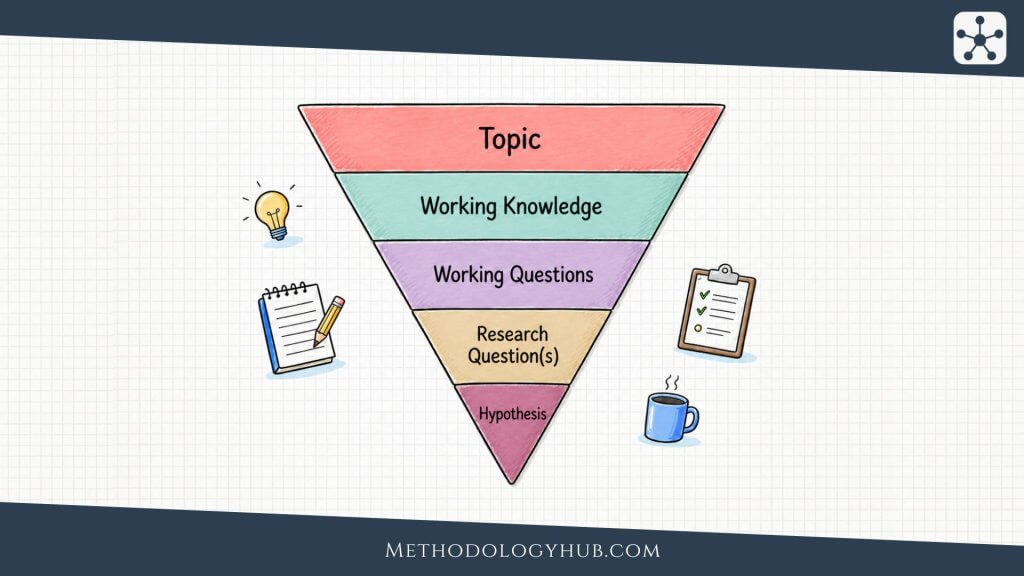
Choosing the right type of research begins with the question, not with the label. A study can sound more formal if it uses many method terms, but the real test is whether those terms fit together. The research process is easier to follow when the researcher moves from topic to question, then to design, data, analysis, and interpretation.
A useful first step is to write the question in plain language. If the question asks “what is happening”, the study may be descriptive. If it asks “why does this happen”, the study may need an explanatory design. If it asks “how do participants experience this process”, qualitative research may fit. If it asks “how many”, “how often”, or “how strongly”, quantitative research may be more suitable.
Start with the purpose and objective
The purpose tells the researcher what kind of contribution the study should make. A study meant to build theory is different from a study meant to evaluate a school programme. A study meant to improve a classroom practice through cycles of reflection is different again.
The objective then narrows the work. An exploratory objective may need flexible data collection. A descriptive objective may need clear definitions and enough cases to describe the pattern. An explanatory objective may need comparison, theory, variables, timing, or stronger controls.
Match the methodology to the evidence needed
The next step is to decide what kind of evidence would answer the question. Numerical evidence may be needed to estimate, compare, or test. Textual or observational evidence may be needed to understand meaning, process, or context. Some questions need both.
This is where the researcher chooses whether quantitative, qualitative, or mixed methods research fits. The choice should be explained in relation to the question. A sentence such as “a qualitative design was used because the study examined how first-year students described their transition into university” tells the reader more than a label alone.
Check the design, source, and timeframe
After the methodology is clear, the researcher can choose a design. If the study tests an intervention with random assignment, experimental research may fit. If it compares existing groups after a programme was introduced, quasi-experimental research may fit. If it observes variables without intervention, non-experimental or correlational research may fit. If it examines one setting in depth, case study research may fit.
The researcher should also state whether the study is empirical or theoretical and whether it is cross-sectional or longitudinal. These choices affect how the results are read. A one-time survey cannot show individual change over time. A theoretical paper cannot be reported as if it collected new participant data. A correlational study should not be written as if it were an experiment.
The final check is alignment. The sample, data, measurements, analysis, and conclusion should all fit the selected type of research. If the study is exploratory, the conclusion should not sound like a final population estimate. If the study is cross-sectional, it should not speak as if it observed development over time. If the study is theoretical, the argument should be clear enough for readers to follow without a dataset.
How Types of Research Fit Into a Research Plan
Research types become most useful when they are connected to the written plan of a study. In a proposal, thesis, article, or report, the reader should be able to see how the topic became a question, how the question shaped the design, and how the design shaped the evidence. The labels should help that explanation rather than interrupt it.
A clear research plan usually names the type of research in relation to the task it performs. For example, a project might say that it uses a descriptive cross-sectional survey to examine study habits among first-year students. That short phrase gives the reader several pieces of information at once. The study is descriptive because it records patterns. It is cross-sectional because the data are collected during one period. It is survey research because responses are gathered through a questionnaire.
Using research types in a proposal
In a proposal, the type of research helps justify the design before data collection begins. If the research question asks how students experience academic feedback, the proposal may justify a qualitative interview design. If the question asks whether two groups differ in mean test scores, the proposal may justify a quantitative comparison. If the question asks whether a new classroom routine can be refined during practice, the proposal may justify action research.
The explanation does not need to be long, but it should be direct. The researcher can state the type, explain why it fits the question, and show what kind of evidence will be collected. This keeps the plan from sounding like a list of method terms. It shows the role of each term in the study.
Using research types in a methods section
In a methods section, research type should be tied to procedure. A study described as empirical should show where the evidence came from. A study described as longitudinal should show the time points. A study described as quasi-experimental should show the groups, the intervention or condition, and the limits created by the lack of random assignment.
This is especially useful when several labels apply to the same project. A researcher might write that the study used an applied, explanatory, quantitative, quasi-experimental, longitudinal design. That phrase is only helpful if the next sentences unpack it. The reader should learn what practical problem was studied, what explanation was tested, what numerical data were collected, how groups were compared, and when measurements were taken.
Writing note: Use research type labels where they clarify the design. A label is useful when the next sentence can explain what it means in that specific study.
Using research types in interpretation
Interpretation should return to the type of research. An exploratory interview study may produce useful themes, but it should not be presented as a statistical estimate of a whole population. A descriptive survey may show a strong pattern, but it may not explain the cause of that pattern. A correlational study may show association, but it needs a careful design before it can support a causal reading.
This does not weaken the study. It makes the interpretation more accurate. Every research type has strengths and boundaries. The strongest reports usually make those boundaries visible, so readers can see what the evidence supports and where another study would be needed.
For students, this is often the easiest way to check a design. Read the research question, then read the research type, then read the conclusion. If those three parts fit together, the study is easier to understand. If they pull in different directions, the design or wording may need revision before the study moves further.
Conclusion
Types of research help organise the many decisions that go into a study. They show whether the study is trying to build knowledge, solve a problem, improve practice, evaluate a programme, explore a topic, describe a pattern, explain a relationship, collect data, develop theory, test an intervention, study a case, compare groups, or observe change over time.
The categories are not separate boxes. A project may be applied, explanatory, quantitative, empirical, quasi-experimental, and longitudinal at the same time. Another may be basic, theoretical, and conceptual. Another may be exploratory, qualitative, empirical, and case-based. The combination should be clear because each label affects the way readers understand the evidence.
The most useful way to choose among the types of research is to begin with the question. Once the question is clear, the purpose, objective, methodology, source of knowledge, design, and timeframe can be selected in a way that supports the study rather than decorating it with method terms.
A well-described research type also protects the interpretation. It keeps a descriptive study from sounding causal, a correlational study from sounding experimental, a cross-sectional study from sounding longitudinal, and a local case study from sounding like a population estimate. That kind of clarity is one of the simplest ways to make research easier to read and easier to judge.
FAQs on Types of Research
What are the main types of research?
The main types of research can be grouped by purpose, objective, methodology, source of knowledge, research design, and timeframe. Common examples include basic, applied, exploratory, descriptive, explanatory, quantitative, qualitative, mixed methods, empirical, theoretical, experimental, non-experimental, cross-sectional, and longitudinal research.
What are the types of research based on purpose?
The main types of research based on purpose are basic research, applied research, action research, and evaluation research. Basic research develops knowledge, applied research addresses practical problems, action research studies practice while improving it, and evaluation research examines a programme, policy, service, or intervention.
What are the types of research based on objective?
The main types of research based on objective are exploratory, descriptive, and explanatory research. Exploratory research opens up a topic, descriptive research records what exists, and explanatory research studies why or how a pattern, relationship, or process occurs.
What are the types of research based on methodology?
The main types of research based on methodology are quantitative research, qualitative research, and mixed methods research. Quantitative research uses numerical data, qualitative research studies meaning and context, and mixed methods research combines both approaches in one planned design.
What is the difference between empirical and theoretical research?
Empirical research uses observed or collected evidence, such as surveys, interviews, experiments, records, or observations. Theoretical research develops knowledge through concepts, models, logic, existing literature, or argument rather than by collecting new field data.