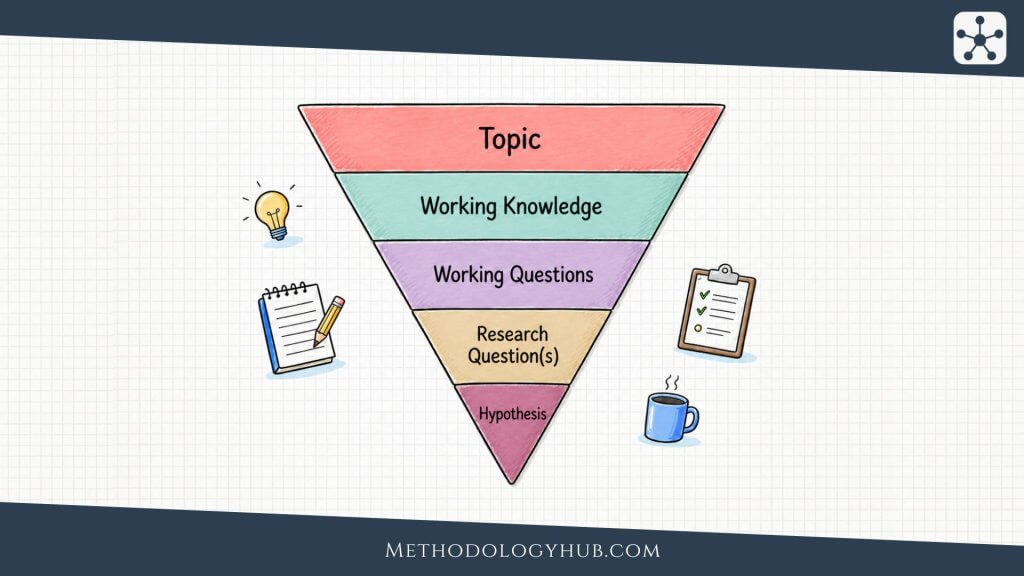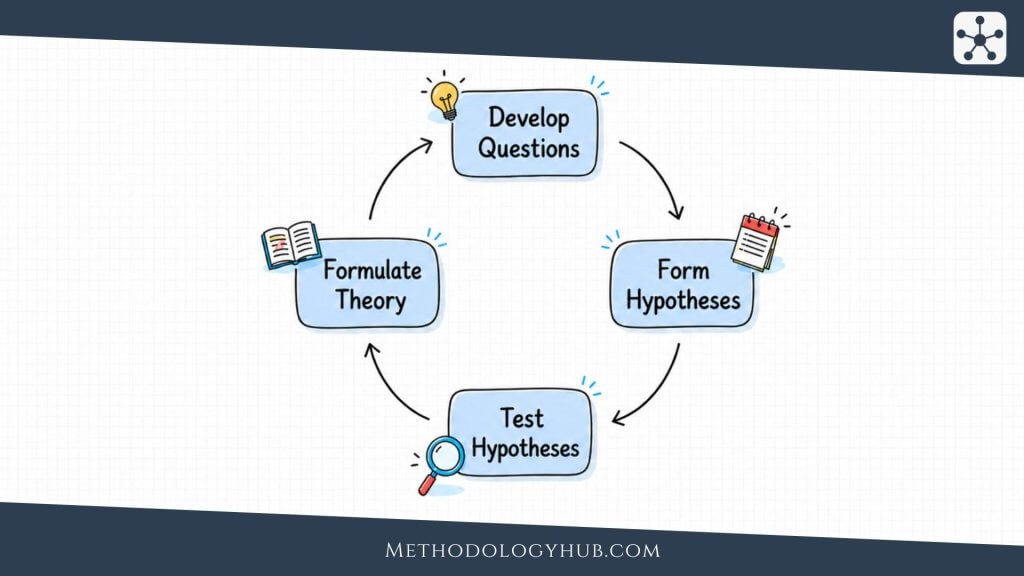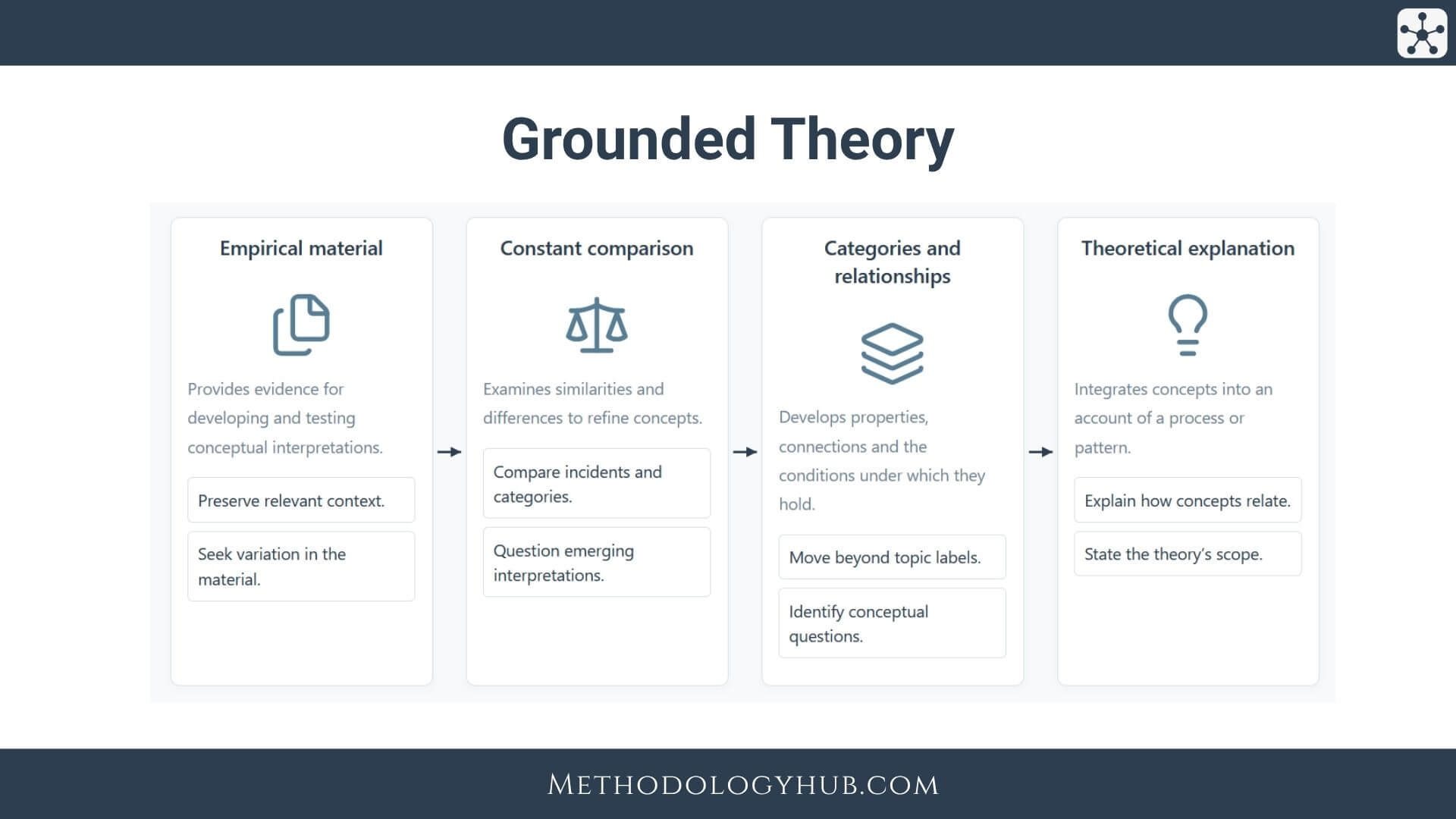
Grounded theory is a research methodology for developing an explanation from systematically collected and analysed data. In qualitative research, it is used to explain how people act, interact and respond to situations, connecting their experiences with the conditions that shape a social process.
As a qualitative approach, grounded theory guides the study as a whole. It connects the choice of evidence with qualitative analysis, so that early interpretations influence what the researcher investigates next.
This article explains grounded theory, its origins, principles, main traditions and applications.
What Is Grounded Theory?
Grounded theory develops theory through repeated comparison of research evidence. Researchers collect and analyse material together, develop conceptual categories and examine how those categories relate. The aim is an explanation of a process or pattern, supported by the material studied.
Definition and Purpose
The term grounded theory refers both to a methodology and to the theory developed through it. The methodology provides ways to move from observations and accounts towards an explanation. The resulting theory connects concepts and proposes relationships among them, with those relationships continually examined against evidence.
Its purpose is especially relevant when existing explanations leave an important process unclear. A study can investigate what people are trying to accomplish, how they respond to changing circumstances and what follows from their actions. The objective goes beyond identifying topics: the findings explain relationships that make the process understandable.
A grounded theory is often substantive, meaning that it addresses a particular area of social life. Formal theory reaches across substantive areas through further conceptual comparison. Neither label means that one study must explain everything about a population. The scope follows the concepts developed and the range of evidence supporting their relationships.
Key Characteristics
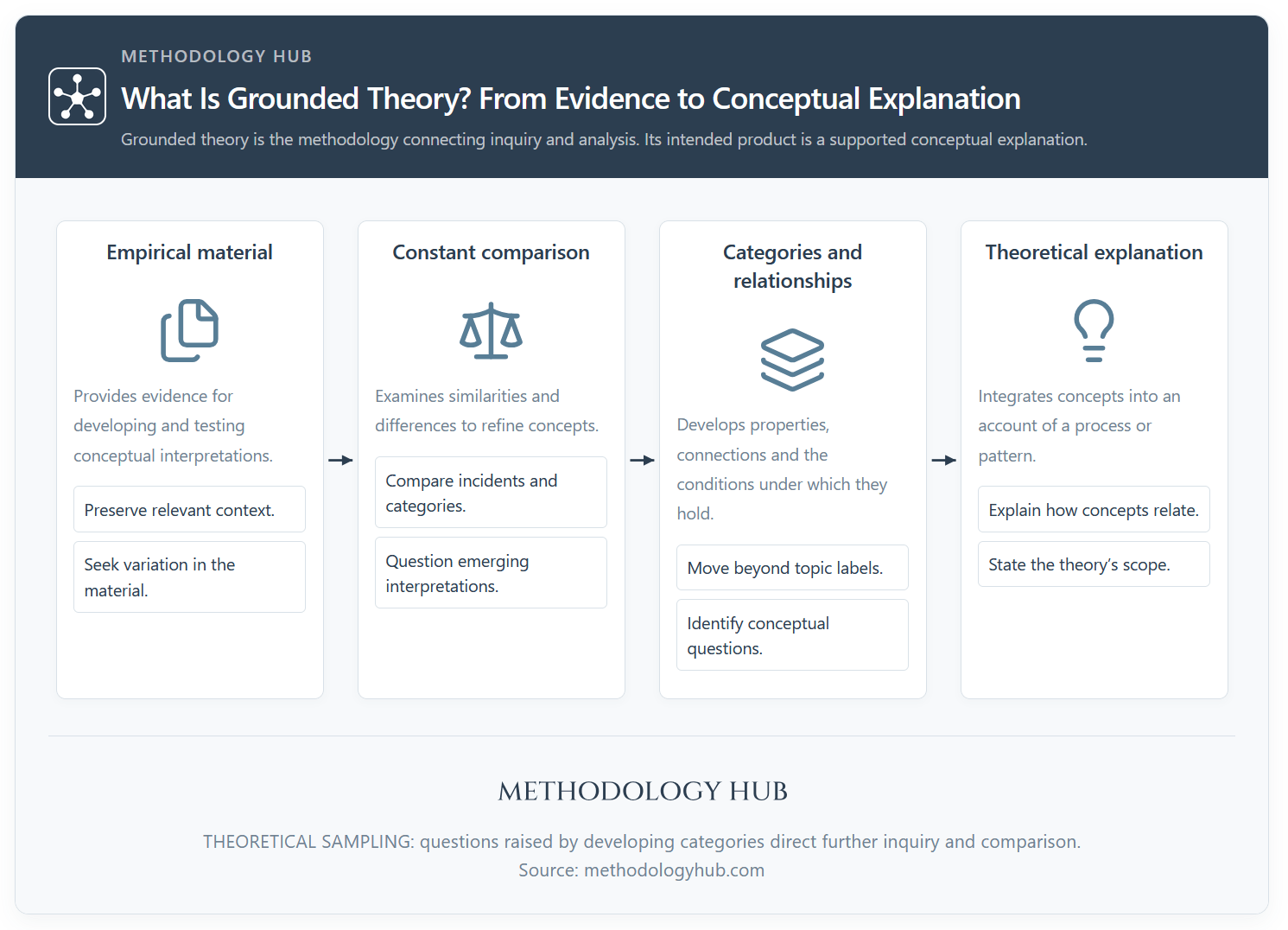
Grounded theory combines constant comparison, theoretical sampling, memo writing and theoretical integration. These activities work together. Comparison develops a category; a memo records a question about it; theoretical sampling seeks material that can clarify the question. The category changes as that evidence is examined.
| Characteristic | Contribution to the methodology |
|---|---|
| Theory development | Connects concepts into an explanation of a process or pattern |
| Constant comparison | Refines concepts by examining similarities and differences |
| Theoretical sampling | Directs further inquiry towards gaps in the developing explanation |
| Memo writing | Develops reasoning about categories and their relationships |
| Concurrent collection and analysis | Allows emerging interpretations to shape further inquiry |
| Theoretical integration | Brings categories together into a coherent explanatory account |
The distinction from a general interview study lies in this relationship among activities. Collecting accounts, assigning codes and presenting categories may support many kinds of qualitative research. A grounded theory research must also show how comparison and theoretically directed inquiry contributed to an integrated explanation.
Grounded Theory in Qualitative Research
Grounded theory belongs among the methodologies that guide research design, rather than being a data collection technique. It can use interviews, observations, documents and other sources. Its original formulation also allowed quantitative evidence; what defines the methodology is the logic of theory generation and comparison, not an absolute prohibition on numbers.
Different traditions disagree about how theory is generated or constructed and how the researcher’s involvement should be understood. These differences affect the language and procedures of a study. They do not remove the shared requirement to connect conceptual claims with a systematic examination of evidence.
Origins and Development of Grounded Theory
Barney Glaser and Anselm Strauss developed grounded theory in the 1960s and presented it in The Discovery of Grounded Theory in 1967. Their work argued that researchers could generate theory through systematic comparison of data. Later developments produced distinct traditions associated with Glaser, Strauss and Juliet Corbin, and Kathy Charmaz.
Glaser and Strauss
Glaser and Strauss worked together on research into hospital care and awareness of dying. Their collaboration combined different intellectual backgrounds. Glaser brought an interest in systematic empirical analysis, while Strauss drew on the Chicago sociological tradition and symbolic interactionism, which examines how meaning develops through social interaction.
The collaboration placed close observation and comparison at the centre of explanation. Researchers could develop concepts while investigating social life, rather than treating fieldwork only as a source of illustrations for an existing theory. Their approach gave qualitative researchers a more explicit account of how analysis could contribute to theory development.
The Discovery of Grounded Theory
Published in 1967, The Discovery of Grounded Theory: Strategies for Qualitative Research set out the relationship among comparative analysis, theoretical sampling and theory generation. It challenged the imbalance between generating explanations and concentrating mainly on verifying theories already available.
This did not make research an exercise in collecting material without direction. The emerging analysis supplied direction through questions about categories and their relationships. The authors’ emphasis was on allowing evidence to shape the explanation instead of requiring the material to fit a theory specified in advance.
How Grounded Theory Evolved
Grounded theory developed through methodological disagreements as well as new philosophical positions. Glaser emphasised emergence and cautioned against forcing data into predetermined analytical schemes. Strauss and Corbin elaborated procedures for examining categories and relationships. Charmaz later developed a constructivist account that makes the researcher’s interpretive involvement explicit.
- 1965: Glaser and Strauss published Awareness of Dying, arising from the research associated with the methodology's early development.
- 1967: The Discovery of Grounded Theory presented their joint methodological argument.
- 1978: Glaser's Theoretical Sensitivity developed his account of conceptual analysis and theory generation.
- 1990: Strauss and Corbin's Basics of Qualitative Research set out detailed analytical procedures, contributing to debate over emergence and methodological guidance.
- 2006: Charmaz's Constructing Grounded Theory provided an influential presentation of constructivist grounded theory.
These publications mark influential developments, rather than a sequence in which one tradition replaced another. Classic, Straussian and constructivist grounded theory continue to offer different ways of understanding the researcher’s relationship with evidence and theoretical explanation.
Key Principles of Grounded Theory
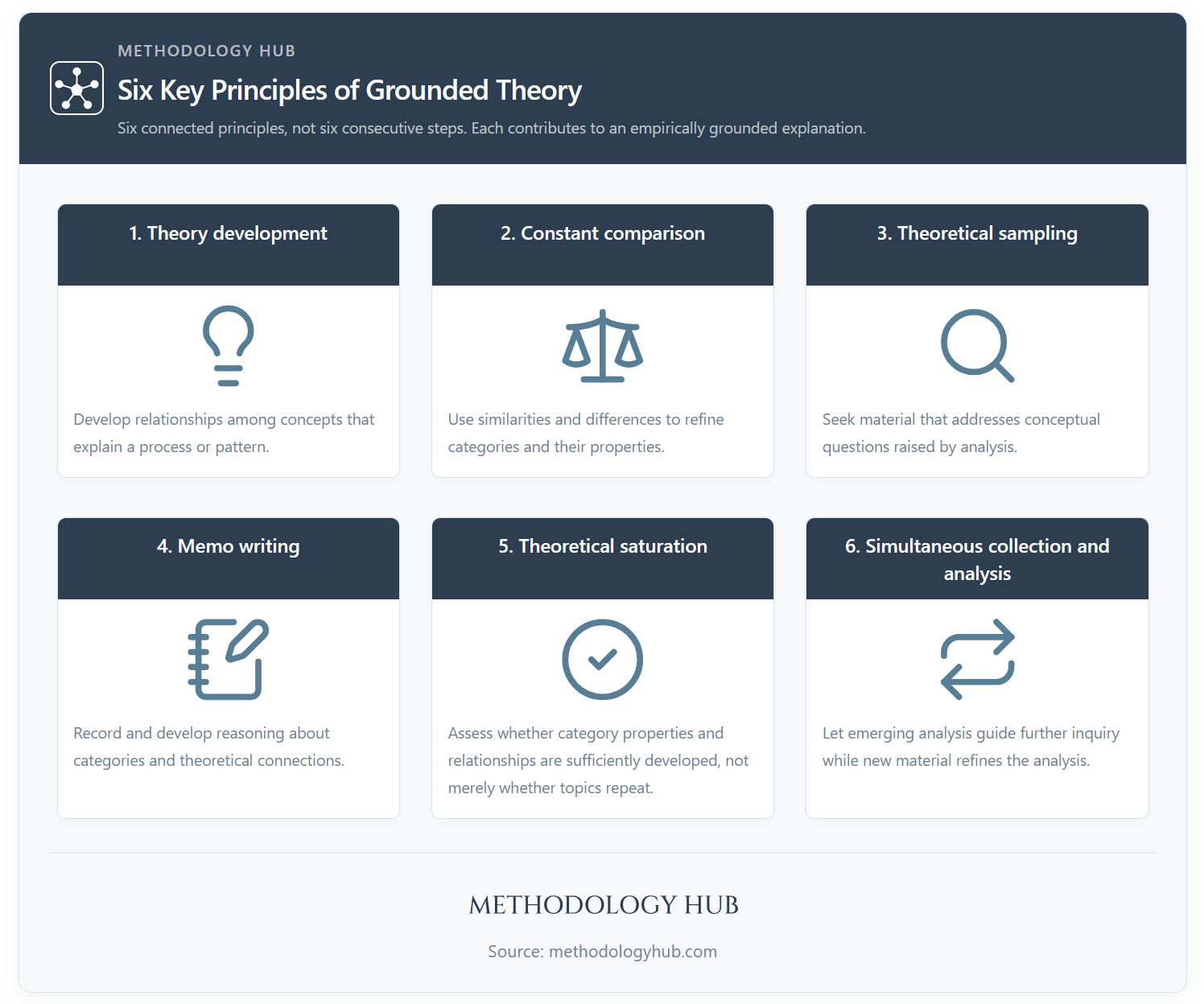
Grounded theory rests on six connected principles: theory development, constant comparison, theoretical sampling, memo writing, theoretical saturation and simultaneous data collection and analysis. Together, they allow an explanation to develop through inquiry rather than being fixed before the evidence is examined.
Theory Development
Theory development means explaining relationships among concepts. A category names a relevant process, action or condition; theoretical work examines how it varies and how it relates to other categories. A theory should clarify what happens, under which conditions and with what consequences, to the extent that the material supports those claims.
Theoretical sensitivity helps researchers recognise potentially useful concepts and relationships. It involves analytical judgement informed by engagement with material, methodological knowledge and experience. Sensitivity does not license accepting an appealing idea without comparison. The concept still needs to account for evidence and remain open to revision.
Constant Comparison
Constant comparison involves examining material against other material, developing concepts and emerging categories. Researchers look for differences as well as similarities, asking whether a category still fits when the situation changes. Comparison can reveal a property’s range, identify a missing condition or distinguish actions previously treated as equivalent.
The term constant describes an ongoing analytical commitment, not a requirement to compare every sentence mechanically. Its value lies in improving the explanation. Repeatedly collecting similar descriptions without examining their conceptual implications adds volume without necessarily developing theory.
Theoretical Sampling
Theoretical sampling selects further material according to questions raised by the developing analysis. Early sampling often begins with people or settings relevant to the research focus. As categories take shape, selection becomes more specific: the researcher seeks evidence that can clarify their properties, relationships or limits.
This differs from fixing every participant characteristic before analysis begins. General purposive sampling can establish an initial point of entry, while theoretical sampling develops in response to conceptual questions. It may involve further interviews, observations, documents or a return to existing material, depending on the analytical need.
Memo Writing
Memo writing develops ideas about what a category means, how it varies and how it might connect with other categories. A memo can examine a tentative relationship, an alternative explanation or a question for further inquiry. It preserves the reasoning behind the emerging theory rather than merely summarising what participants said.
Memos also help distinguish an early hunch from a better-developed interpretation. Reading and comparing them can show how a category changed and which evidence prompted the revision. Their contribution is conceptual: a long collection of descriptive notes does not automatically provide theoretical integration.
Theoretical Saturation
Theoretical saturation concerns the development of categories and their relationships. Researchers assess whether further theoretically directed comparison is adding significant properties, variation or explanatory connections. Hearing familiar topics again is insufficient if central relationships remain unclear.
There is no universal interview count that demonstrates saturation. The judgement depends on the scope of the developing theory, the depth of analysis and the material examined. A report should explain which categories were sufficiently developed and how that judgement was reached, while acknowledging gaps the study could not resolve.
Simultaneous Data Collection and Analysis
Grounded theory connects collection and analysis from an early stage. Initial interpretations guide subsequent questions and selection decisions; further evidence then challenges or elaborates those interpretations. This relationship creates a research process that can respond to what is being learned.
The methodology still needs planning, access and a clear record of decisions. Flexibility concerns how the inquiry develops within those conditions. When all collection is completed before any analysis, opportunities for theoretically directed inquiry become more limited and the researcher needs to explain how the study addressed that constraint.
Types of Grounded Theory
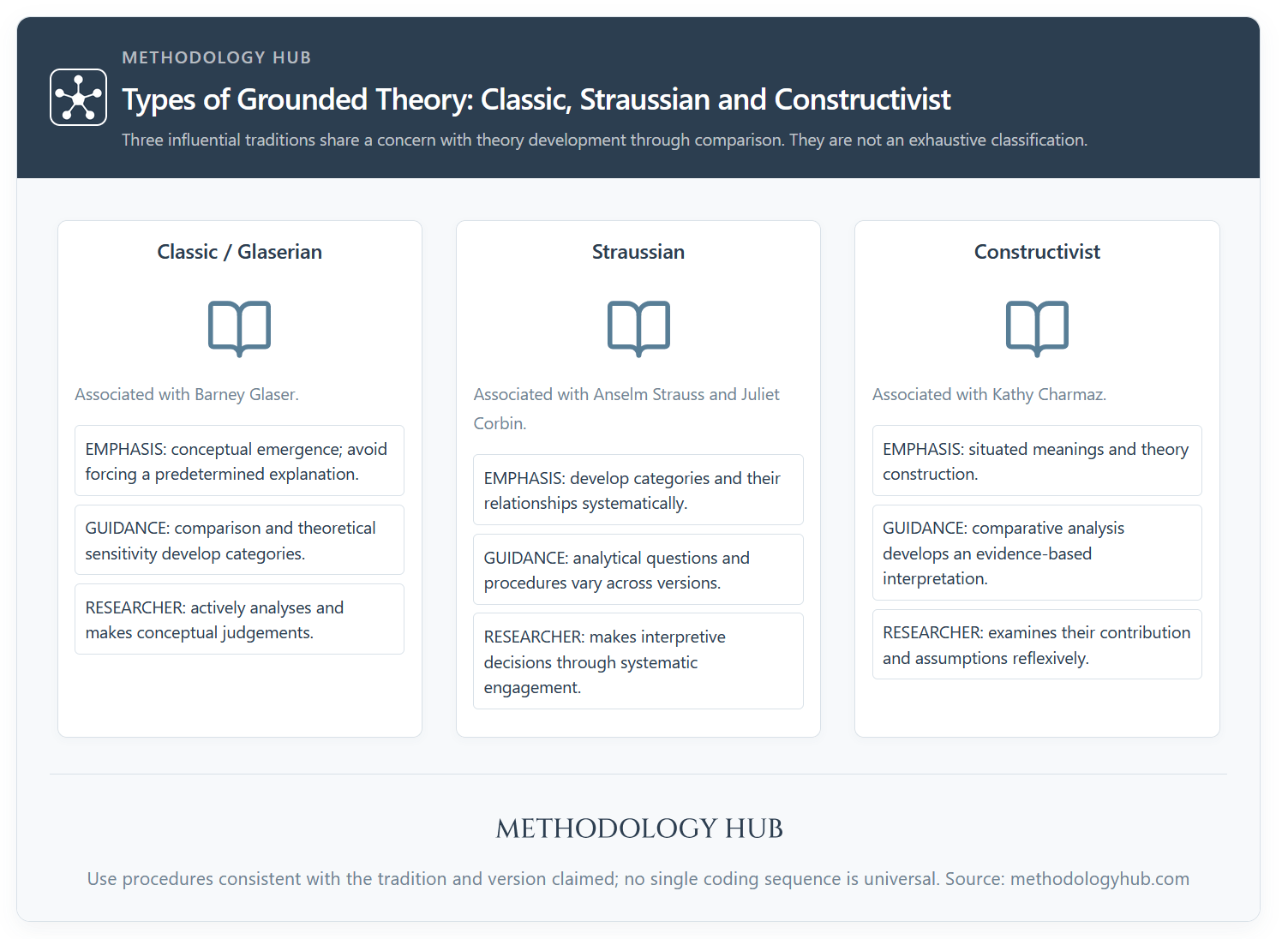
There are three widely discussed types of grounded theory: classic or Glaserian, Straussian, and constructivist grounded theory. They share an interest in theory development through comparison, but differ in their assumptions, analytical guidance and account of the researcher’s role. The labels identify influential traditions rather than an exhaustive classification of all grounded theory work.
Classic (Glaserian) Grounded Theory
Classic grounded theory, associated with Barney Glaser, emphasises developing concepts that explain participants’ main concerns and patterns of action. Categories and theoretical relationships should earn their place through comparison rather than be imposed through a preferred model. Emergence is therefore a methodological commitment to responsiveness to the material.
The researcher still makes decisions, compares incidents and develops theoretical ideas. Describing classic grounded theory as entirely passive would obscure that analytical work. Its caution about forcing concepts concerns how interpretations are generated and checked, rather than a belief that careful analysis can be omitted.
Straussian Grounded Theory
Straussian grounded theory developed through the work of Anselm Strauss and Juliet Corbin. It offers more explicit procedures for investigating categories, their properties and relationships. Open, axial and selective coding are especially associated with influential versions of their work, including attention to conditions, actions or interactions, and consequences.
These terms should not be presented as mandatory stages for every grounded theory tradition. Strauss and Corbin’s own writing also developed over time. A study needs to identify the version it follows and explain how the procedures helped develop its conceptual account.
Constructivist Grounded Theory
Constructivist grounded theory, associated particularly with Kathy Charmaz, treats data and analysis as shaped through interaction and interpretation. Participants and researchers contribute to the meanings produced during inquiry. The theory is presented as a situated analytical construction, with attention to the social conditions in which knowledge is developed.
Initial and focused coding are prominent in this tradition, alongside constant comparison, memo writing and theoretical sampling. Reflexivity examines how the researcher’s position, questions and interpretive choices affect the account. Acknowledging that involvement does not remove the obligation to support categories and relationships through evidence.
| Tradition | Main emphasis | Analytical orientation | Researcher's role |
|---|---|---|---|
| Classic (Glaserian) | Emergent conceptual explanation | Comparison and conceptual development, with caution against forcing categories | Develop concepts that fit and explain relevant patterns |
| Straussian | Systematic examination of categories and relationships | Explicit questioning of properties, conditions, actions and consequences | Actively investigate and integrate conceptual relationships |
| Constructivist | Situated construction of an explanatory account | Interpretive comparison, reflexivity and attention to meaning and context | Examine participation in producing data and interpretations |
Main Differences
The main differences concern how researchers understand theoretical emergence, use analytical procedures and account for their involvement. Their treatment of existing literature also varies. Some classic guidance cautions against early immersion in closely related substantive theory, while constructivist work allows a more explicitly reflexive engagement with prior knowledge.
No tradition requires a researcher to know nothing about the field. The relevant issue is whether existing concepts open useful questions or restrict what the evidence is allowed to show. Choosing a tradition means aligning these assumptions and procedures, rather than selecting whichever coding terms appear most convenient.
How Grounded Theory Works
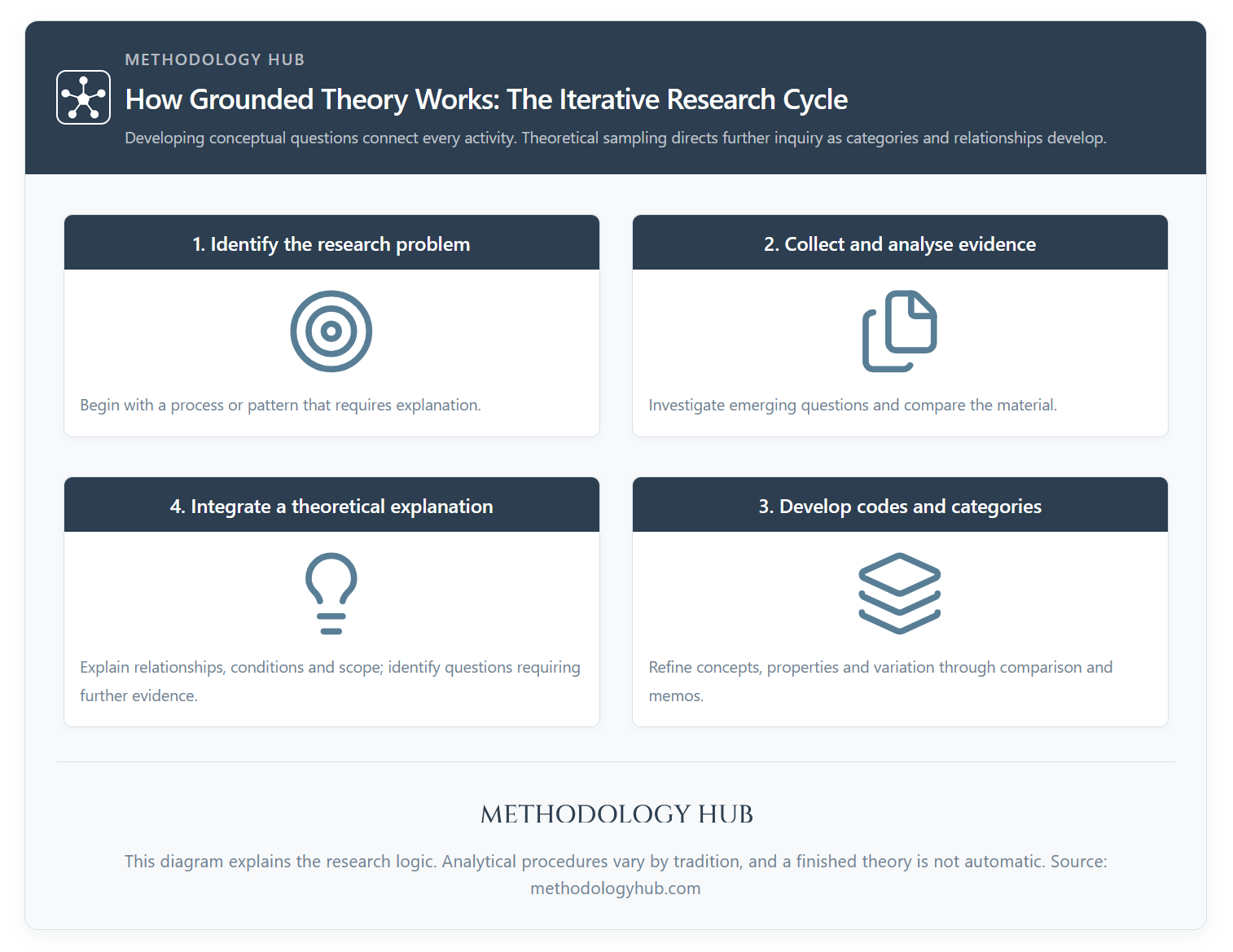
Grounded theory works by linking early inquiry with the development of an explanation. Researchers investigate a problem, compare evidence, develop categories and seek further material that can refine the relationships among them. These activities recur as the theory becomes more precise.
Identifying a Research Problem
A grounded theory research problem identifies something about a process or pattern that needs explaining. The initial focus gives the study direction without specifying the final categories. The question can become more focused as the researcher learns which relationships are central to the phenomenon.
Existing theory can help establish why the problem deserves investigation. Its presence does not automatically rule out grounded theory. The methodology is useful when a study needs to develop an explanation from evidence, including where available concepts do not adequately account for the process under examination.
Collecting and Analyzing Data
Data collection provides accounts and observations relevant to the research focus. Methods can include qualitative interviews, observation and documentary work. Early comparison directs attention towards particular actions, conditions or differences, which then inform further inquiry.
The defining feature is the connection between evidence and the developing theory. A study may combine sources if each contributes to the explanation. The choice should follow an analytical purpose, with enough detail to examine the relationships being proposed.
Developing Codes and Categories
Grounded theory analysis uses coding, constant comparison and memo writing to develop conceptual categories. Coding identifies relevant actions or meanings in the material, while comparison clarifies the categories’ properties, boundaries and relationships. These relationships provide the basis for the emerging theoretical explanation.
Grounded theory coding does not follow one universal sequence. Detailed coding procedures belong to the analytical tradition selected. Across traditions, the important conceptual movement is from organising material towards explaining relationships that the evidence can sustain.
Building a Theory
Theoretical integration brings categories together into an account of how the process or pattern works. A central category or integrating concept may organise those connections, depending on the tradition and findings. A diagram can help communicate the explanation, but arrows and labels still need a reasoned account of the relationships they represent.
An integrated explanation identifies:
- The concepts needed to understand the process or pattern.
- The relationships that connect those concepts.
- The conditions under which the proposed relationships hold.
The completed theory should make clear what it explains, under which conditions and with what limits. Its contribution does not depend on producing a universal law. A substantive explanation can be valuable when it clarifies an important relationship within a defined area of inquiry and remains open to modification through further evidence.
Grounded Theory Examples
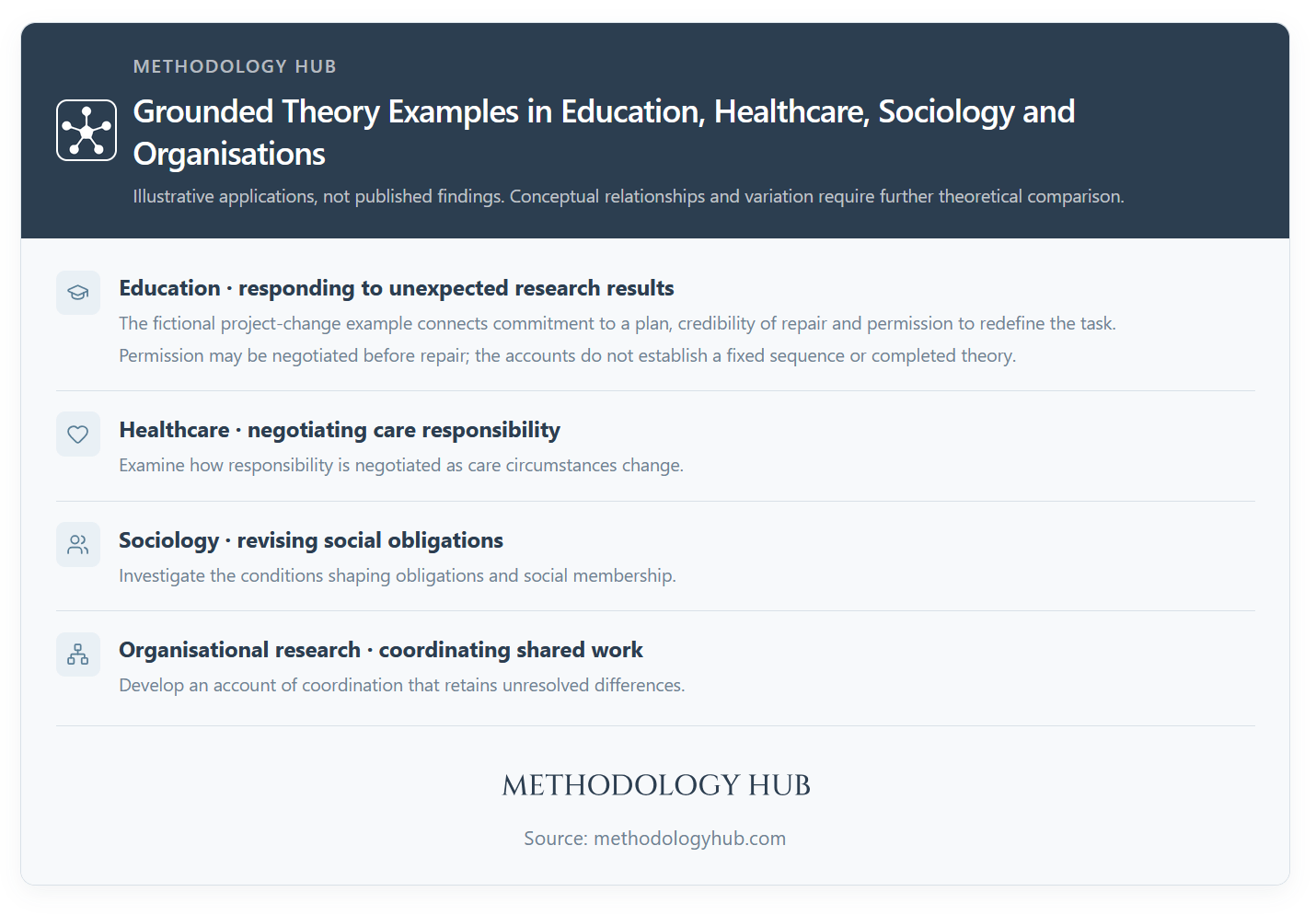
Grounded theory is used in education, healthcare, sociology and organisational research to explain how people respond to situations and coordinate action. Its applications are strongest when the intended finding is a conceptual explanation.
Education
An education study could ask how students decide whether to change a research project after unexpected results. Consider four fictional accounts: one student keeps adjusting the procedure to preserve the original question; another changes direction after a supervisor accepts an unexpected result as worthwhile; a third persists because they believe assessment requires confirmation; and a fourth negotiates permission to change before attempting further repairs.
Comparing these accounts suggests categories concerning commitment to an existing plan, credibility of a repair and permission to redefine the task. The conceptual interest lies in their relationship. Unexpected evidence alone does not determine a change of direction: students also assess whether a revised project will count as legitimate work.
An illustrative explanation might propose that students preserve their original plan while repair remains credible, but that changing the question also depends on permission to reinterpret the task. The fourth account qualifies a fixed sequence: permission may be negotiated before attempts at repair. A fuller study would investigate those conditions through further theoretically directed comparison, rather than treating the four accounts as sufficient to establish a theory.
This differs from reporting separate topics such as uncertainty, supervision and assessment. The proposed explanation connects them by showing how expectations about legitimate work affect responses to contradictory evidence. Its value would depend on how well that relationship accounts for the wider material and its variations.
Healthcare
In healthcare research, grounded theory can examine how patients, relatives or professionals coordinate action under changing conditions. A study of the transition from hospital to home might investigate how responsibility for daily care is negotiated. Theoretical categories could connect changing expectations, available assistance and decisions about when further support is needed.
The research contribution would be an explanation of that coordination process, supported by the relevant accounts and observations. Listing concerns about discharge would provide descriptive information; connecting conditions, actions and consequences would address the grounded theory objective.
Sociology
Sociological applications can investigate how people negotiate membership, maintain relationships or respond to changes in everyday life. Research on neighbourhood mutual assistance could examine how participants decide who can ask for help and what obligations follow. Comparison would explore how those understandings change across relationships and circumstances.
The resulting theory might explain how boundaries of obligation are maintained or revised. That requires attention to cases where assistance is refused, renegotiated or offered without an expected return. These contrasts can reveal conditions that a general description of community solidarity would leave unexplained.
Organizational Research
Organisational research can use grounded theory to explain coordination, professional roles and changes in working practices. In a university, researchers could examine how staff from different disciplines establish shared responsibilities for a joint project. The focus would be on the process through which competing expectations become workable arrangements.
A conceptual explanation might connect claims to expertise, negotiation of tasks and recognition of responsibility. It should also account for unresolved disagreements or arrangements that break down. The aim is to explain how coordination develops under particular conditions, rather than to assume that collaboration naturally reaches agreement.
Grounded Theory vs Other Approaches
Grounded theory aims to develop a conceptual explanation, while other qualitative approaches may centre on lived experience, cultural practice or a bounded case. These aims can overlap, but they place different demands on research design. The appropriate choice depends on the question and intended contribution.
Grounded Theory vs Phenomenology
Grounded theory develops categories and relationships that explain a process or pattern. Phenomenological research examines lived experience, with descriptive and interpretive traditions offering different accounts of that task. Both can use detailed personal accounts, but their analytical purposes differ.
The distinction is not that grounded theory ignores experience. Experiences can provide important evidence for conceptual development. What distinguishes the methodology is how the study moves from that material towards an integrated explanation, rather than treating a detailed account of experience as its primary outcome.
Grounded Theory vs Ethnography
Ethnography investigates social or cultural life through sustained engagement with a setting or group. Grounded theory is organised around theory development through comparison and theoretically directed inquiry. Observation can contribute to both, but using fieldwork does not make their research logic identical.
The approaches can inform one another when the combination is explained. An ethnographic study may use constant comparison, while a grounded theory study may draw on prolonged observation. The methodology claimed should match the study’s main purpose, sampling logic and form of explanation.
Grounded Theory vs Case Study
A case study examines a bounded case in context. It can describe, interpret or develop an explanation through several sources of evidence. Grounded theory instead centres on conceptual development, with further selection directed by the emerging categories and theoretical relationships.
One case can contribute to grounded theory, and case studies can contribute to theory. The practical distinction concerns how the inquiry is organised: whether the case provides the principal boundary or whether developing conceptual questions guide comparison and further evidence selection.
| Approach | Main purpose | Organising logic | Typical contribution |
|---|---|---|---|
| Grounded theory | Develop a conceptual explanation | Constant comparison and theoretically directed inquiry | Integrated categories explaining a process or pattern |
| Phenomenology | Understand lived experience | Close examination of experiential meaning | A descriptive or interpretive account of experience |
| Ethnography | Understand social or cultural life | Sustained engagement with a setting or group | An account of practices and meanings in context |
| Case study | Understand a bounded case | Investigation within explicit case boundaries | A contextual account or explanation of the case |
| Thematic analysis | Develop patterns of meaning | Method-specific coding and theme development | An analytical account organised around themes |
Grounded Theory vs Thematic Analysis
Thematic analysis develops patterns of meaning relevant to a question and includes approaches with different theoretical assumptions. Grounded theory has the more specific methodological commitment to generating or constructing theory through comparison, theoretical sampling and integration.
Themes can be highly interpretive, and their development can contribute to explanation. The difference is not a simple hierarchy from description to theory. A study should be called grounded theory because its research logic supports that claim, rather than because its findings use conceptual language or its coding draws on grounded theory terminology.
Advantages and Limitations
Grounded theory can produce explanations closely connected to empirical material and responsive to unexpected findings. It also demands sustained conceptual work and opportunities to pursue emerging questions. Its usefulness depends on whether the project can support that relationship between analysis and further inquiry.
Advantages
The methodology gives researchers a way to develop an explanation when existing accounts are incomplete. Constant comparison can identify conditions and differences that a fixed framework overlooks. Theoretical sampling then helps investigate those distinctions, allowing the account to become more precise as the study progresses.
Grounded theory can also connect individual experiences with wider patterns of action. Its conceptual categories need not remain tied to the wording of one participant. When adequately supported, they provide an explanation that can be examined, extended or modified in further research.
Limitations
The iterative design requires time, access and flexibility. Researchers may discover a significant conceptual question when recruitment or field access is ending. A project with a completely fixed collection schedule can therefore struggle to pursue theoretical sampling in the way its analysis requires.
The methodology also demands more than detailed coding. Developing relationships among categories is difficult, and a large coding record may coexist with a weak explanation. Claims of saturation need particular care where a study has repeated familiar accounts but has not examined important variation or theoretical connections.
Researcher Reflexivity
Reflexivity examines how the researcher’s position, knowledge and choices influence the inquiry. Its treatment differs among grounded theory traditions, with constructivist work making interpretive involvement especially explicit. Across a study, researchers should be able to explain consequential decisions about what to examine and how a category developed.
Prior knowledge can make a relationship visible while also encouraging a preferred interpretation. Comparison with alternative cases and explanations helps assess that influence. Acknowledging researcher involvement is useful when it clarifies analytical decisions, rather than appearing only as a general statement about subjectivity.
Quality and Credibility
Quality depends on the fit between the tradition claimed, the procedures used and the explanation produced. Classic grounded theory often emphasises fit, work, relevance and modifiability. Constructivist accounts may examine credibility, originality, resonance and usefulness. These criteria reflect different methodological positions and should be explained within the approach used.
Readers need to see what supports the conceptual explanation. A useful assessment asks:
- Do the categories fit the material and account for relevant differences?
- Are their properties and relationships sufficiently developed?
- Did comparison and theoretical sampling address meaningful conceptual questions?
- Does the theory explain something beyond the topics participants discussed?
Credibility also depends on stating limits. A theory may explain a process within a substantive area without supporting population estimates or universal claims. Showing how the account could be revised by further evidence is consistent with grounded theory’s commitment to continued conceptual development.
Conclusion
Grounded theory develops explanations through constant comparison, theoretical sampling, memo writing and the integration of categories. Its distinctive contribution is the relationship between emerging analysis and further inquiry: what the researcher learns helps determine what needs investigating next.
Understanding that logic helps distinguish grounded theory from a general qualitative study that uses coding. The methodology can support different traditions and forms of evidence, but the resulting account must explain relationships and show how those relationships were developed from the material.
Sources and further readings
The following publications are among the foundational works in grounded theory literature.
- Glaser, B. G., & Strauss, A. L. (1967). The Discovery of Grounded Theory: Strategies for Qualitative Research. Aldine.
- Glaser, B. G. (1978). Theoretical Sensitivity: Advances in the Methodology of Grounded Theory. Sociology Press.
- Strauss, A. L., & Corbin, J. M. (1990). Basics of Qualitative Research: Grounded Theory Procedures and Techniques. Sage Publications.
- Glaser, B. G. (1992). Basics of Grounded Theory Analysis: Emergence vs. Forcing. Sociology Press.
- Charmaz, K. (2006). Constructing Grounded Theory: A Practical Guide Through Qualitative Analysis. Sage Publications.
- Corbin, J., & Strauss, A. (2015). Basics of Qualitative Research: Techniques and Procedures for Developing Grounded Theory (4th ed.). SAGE Publications.
- Charmaz, K. (2014). Constructing Grounded Theory (2nd ed.). SAGE Publications.
Cite this article
Whether you are preparing course materials, writing an academic paper, or sharing resources with students, we kindly ask that you acknowledge Methodology Hub as the source.
To make referencing easier, you can use the “Cite this page” tool below to automatically generate a citation in your preferred referencing style, including APA, MLA, Chicago, Harvard, and others. Simply select a citation style and click the generated reference to copy it.
When reproducing images, figures, or other materials from this page, please include an appropriate source credit and a link to the original page. Proper attribution helps others locate the original material and supports the continued development of freely accessible educational resources.