The three main types of grounded theory are classic (Glaserian), Straussian and constructivist grounded theory. Each develops theory through systematic comparison of evidence, but they differ in how researchers understand their findings and organise their analysis. All three are widely used in qualitative research.
Choosing a tradition shapes the study’s philosophical position, coding procedures and account of the researcher’s contribution. The broader grounded theory methodology provides their shared foundation.
This article compares the three traditions, explains their differences and helps you choose one for your study.
What Are the Types of Grounded Theory?
Classic, Straussian and constructivist grounded theory are methodological traditions within grounded theory. They share a commitment to developing conceptual explanations from evidence. Their main differences concern how theory is generated, how analytical procedures are used and how the researcher participates in producing knowledge.
Overview of the Main Traditions
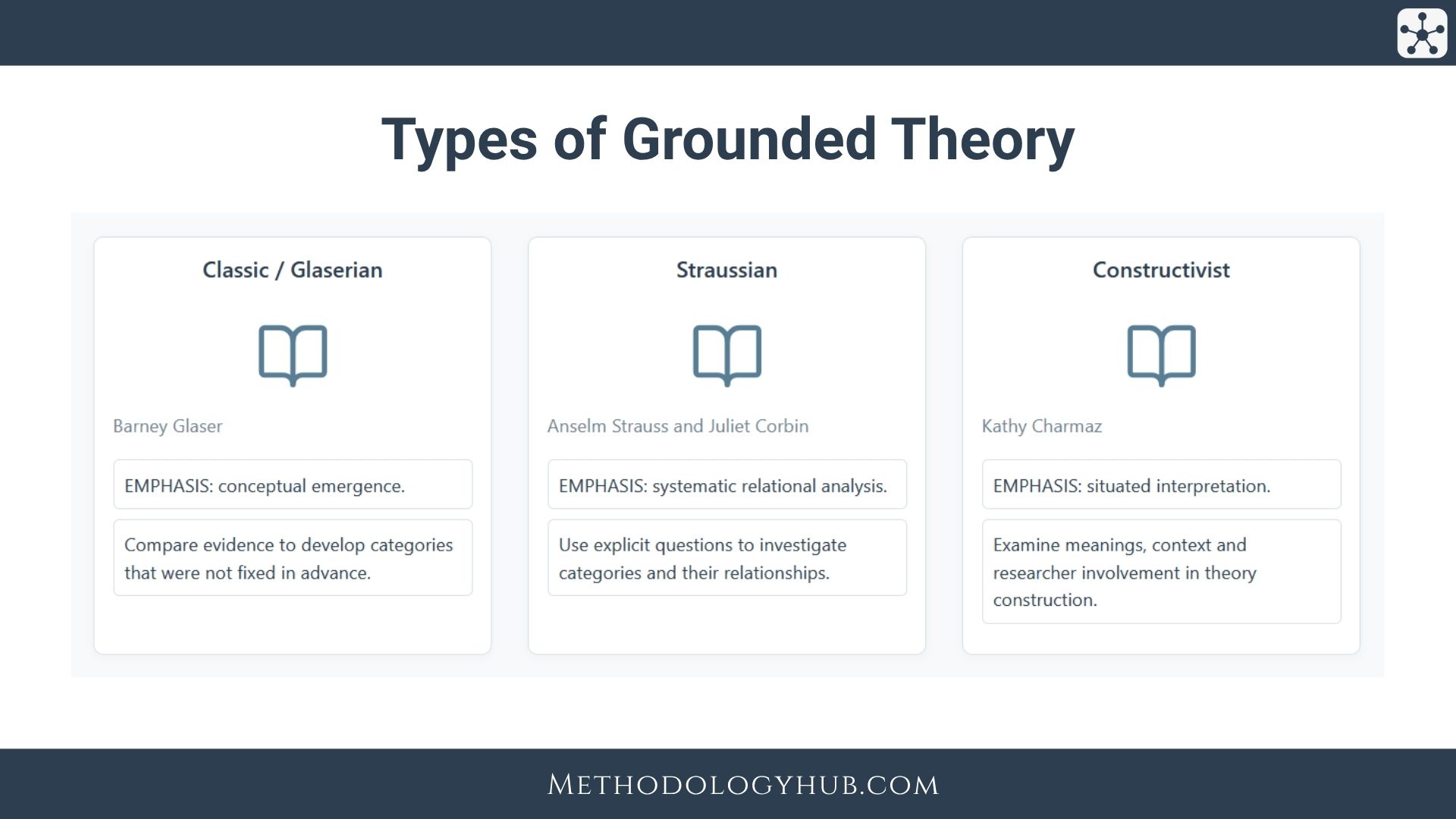
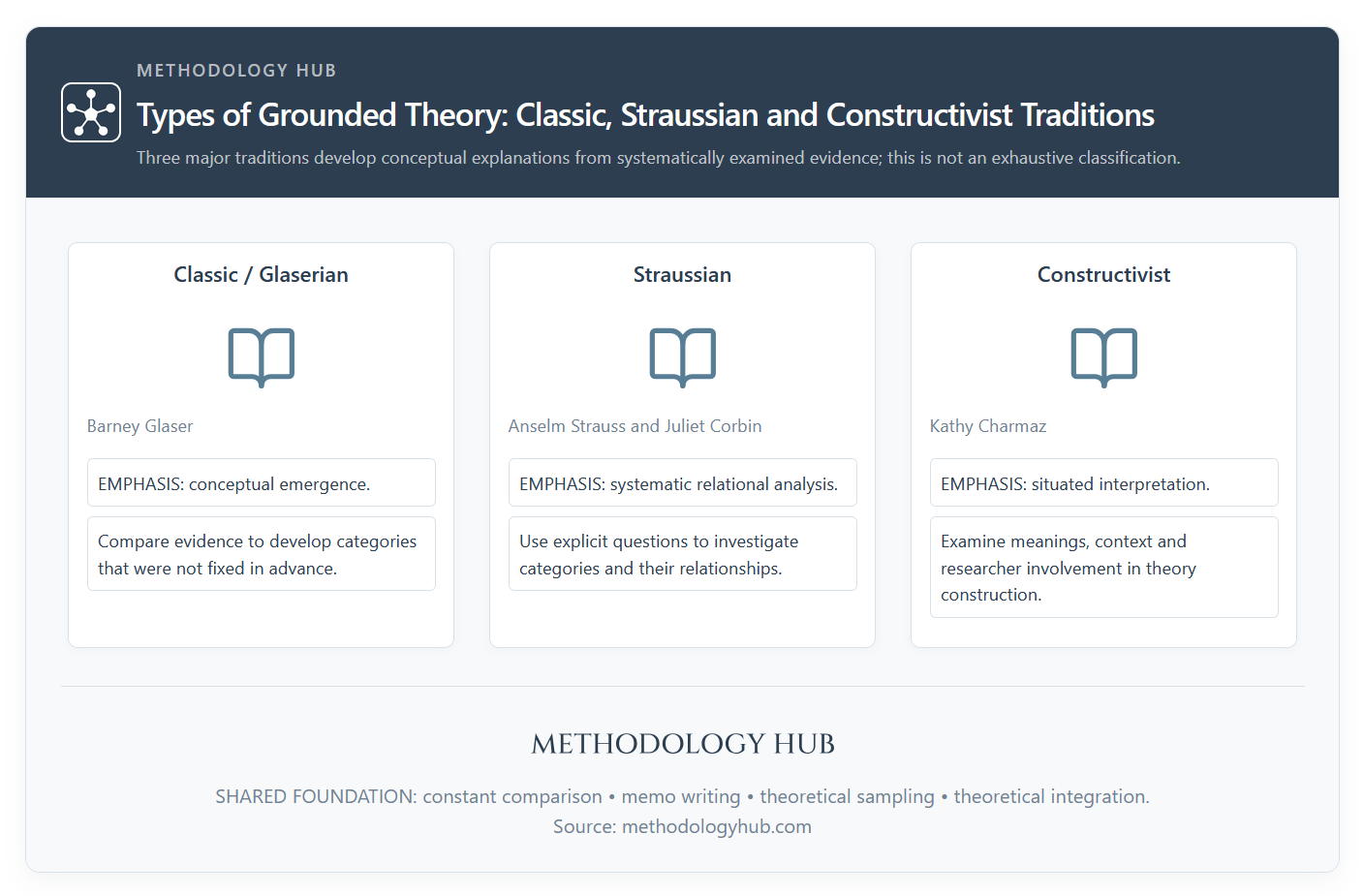
Classic grounded theory is associated with Barney Glaser and emphasises the emergence of conceptual patterns through constant comparison. Straussian grounded theory, developed through Anselm Strauss and Juliet Corbin’s work, offers explicit procedures for examining categories and their relationships. Constructivist grounded theory, associated especially with Kathy Charmaz, treats the resulting theory as an interpretation constructed through research relationships and analysis.
These are three major traditions, rather than an exhaustive classification of every development. Situational analysis and other extensions also belong to grounded theory’s wider intellectual history. Within each tradition, authors and editions differ, so the specific methodological text a study follows deserves attention.
Why Grounded Theory Developed Different Traditions
Glaser and Strauss presented their shared methodology in The Discovery of Grounded Theory in 1967. Their later writings diverged over how researchers should develop concepts and use analytical procedures. Strauss and Corbin’s Basics of Qualitative Research, first published in 1990, became particularly influential in teaching systematic coding.
Glaser argued that prescribed analytical frameworks could force evidence into predetermined relationships. Constructivist writers raised further questions about claims to discover theory independently of the researcher. Charmaz’s Constructing Grounded Theory, first published in 2006, developed a sustained account of interpretation, context and the researcher’s involvement.
Common Principles Across Traditions
Despite these differences, the three traditions connect evidence collection with analysis. Researchers develop concepts while the study is underway and pursue further material to clarify their emerging explanation. Several practices support that work:
- Constant comparison: Compare incidents, codes and categories to establish similarities, variation and conceptual boundaries.
- Memo writing: Record analytical ideas, proposed relationships and questions requiring further evidence.
- Theoretical sampling: Select further material according to the developing categories and their unanswered questions.
- Theoretical integration: Connect categories into an explanation with a clear substantive focus.
Theoretical saturation concerns the development of category properties and relationships. Repeated interview topics alone provide an incomplete basis for judging it. Across traditions, a list of codes or themes also falls short of the intended theoretical contribution.
Classic (Glaserian) Grounded Theory
Classic grounded theory develops an integrated theory by comparing evidence and allowing conceptual patterns to emerge. Associated with Barney Glaser, it asks researchers to investigate participants’ main concern and how they deal with it, while keeping the analysis open to categories that were not anticipated at the outset.
Origins and Philosophical Assumptions
Classic grounded theory draws on Glaser and Strauss’s original collaboration and Glaser’s subsequent methodological writing. Glaser’s Theoretical Sensitivity, published in 1978, developed its account of conceptual analysis and theory generation.
This tradition is often described as objectivist or associated with a realist position: conceptual patterns can be discovered through systematic engagement with data. However, calling it simply positivist can obscure how its proponents describe it. Glaser presented classic grounded theory as a general methodology that can work with different kinds of evidence, including qualitative and quantitative material.
Emergence of Theory
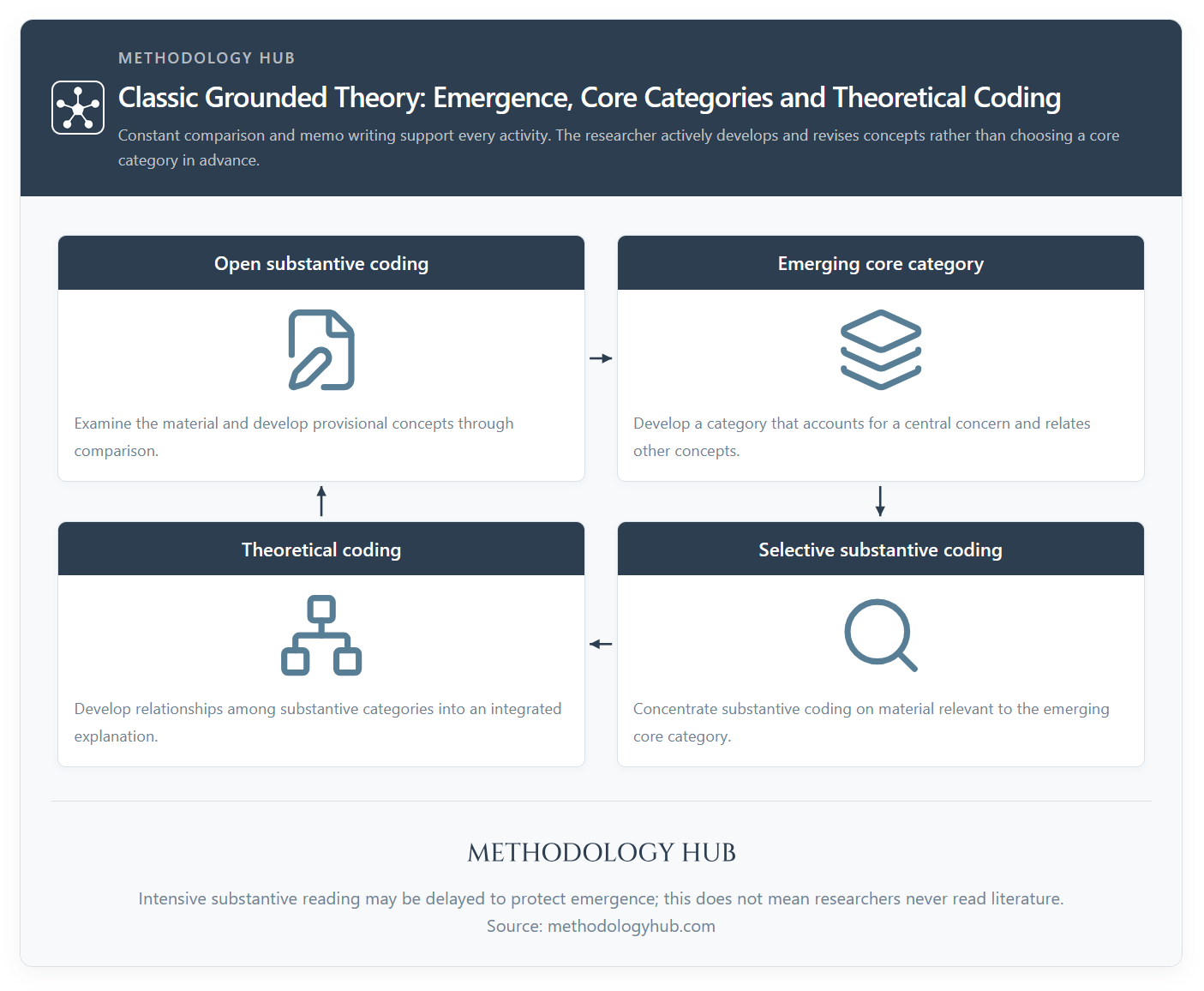
Emergence means that the explanation develops through comparison and conceptual analysis instead of being organised around a framework fixed in advance. Researchers investigate recurring concerns and responses, then consider which category can integrate the developing account.
An emerging concept must explain variation across incidents. Its value does not depend solely on how often a word appears. The researcher considers what the concept accounts for, where it applies and how it changes as new comparisons become available.
This commitment also shapes reading. Classic guidance commonly recommends delaying an intensive review of the substantive literature to reduce the risk of importing established categories too early. It does not require researchers to lack background knowledge or avoid literature permanently. Existing research can later contribute to conceptual comparison and theoretical development.
Coding and Constant Comparison
Classic grounded theory distinguishes substantive coding from theoretical coding. Open substantive coding develops possible categories; selective substantive coding concentrates inquiry around a core category once it has earned that role. Theoretical coding considers how substantive categories relate within the explanation.
These activities depend on constant comparison and memo writing. A theoretical code should articulate a relationship supported by the developing analysis. Selecting a familiar model before examining the evidence would undermine the intended openness. Detailed procedures belong within grounded theory analysis, where the different coding terms can be examined in context.
Role of the Researcher
The classic grounded theorist actively generates and evaluates conceptual ideas. Openness requires attention, questioning and decisions about comparison; theory does not appear through passive observation. Theoretical sensitivity is the ability to recognise potentially significant patterns and develop their conceptual meaning.
The written account typically foregrounds the explanatory theory. It gives less emphasis than constructivist work to the researcher’s biography and the co-construction of each account. Researchers still need to examine assumptions that could cause them to overlook evidence or impose a preferred interpretation.
Strengths and Demands of Classic Grounded Theory
Classic grounded theory suits an inquiry committed to discovering a substantive pattern without prescribing its conceptual structure. Its openness can help researchers move beyond familiar topic labels and develop an account with explanatory reach.
That openness demands sustained comparison and a willingness to abandon attractive early ideas. A researcher seeking a fixed coding template may find its guidance difficult to apply. Decisions need to be justified through the developing theory, with enough evidence to show why the proposed core category earns its central position.
Straussian Grounded Theory
Straussian grounded theory develops theory through systematic examination of categories, their properties and their relationships. Associated with Anselm Strauss and Juliet Corbin, it gives researchers explicit analytical questions for investigating conditions, actions, interactions and consequences.
Origins and Development
Strauss’s methodological work and his collaboration with Corbin developed a distinctive account of grounded theory. Their 1990 and 1998 editions of Basics of Qualitative Research made open, axial and selective coding especially prominent.
The tradition draws on pragmatism and symbolic interactionism. Pragmatism directs attention to action, situations and consequences; symbolic interactionism examines how people develop meanings through interaction. Later editions place different emphasis on particular procedures and on interpretation. A study should therefore identify the version it uses instead of treating every edition as identical.
Systematic Analytical Procedures
Straussian analysis uses questioning and comparison to develop categories in detail. Researchers consider a category’s properties, the dimensions along which those properties vary and the conditions associated with different actions or responses.
The analytical framework helps researchers ask about relationships they might otherwise overlook. It can also become restrictive if its headings are treated as compulsory containers. Categories and connections still require evidence; filling every box in a diagram does not establish a theory.
Open, Axial, and Selective Coding
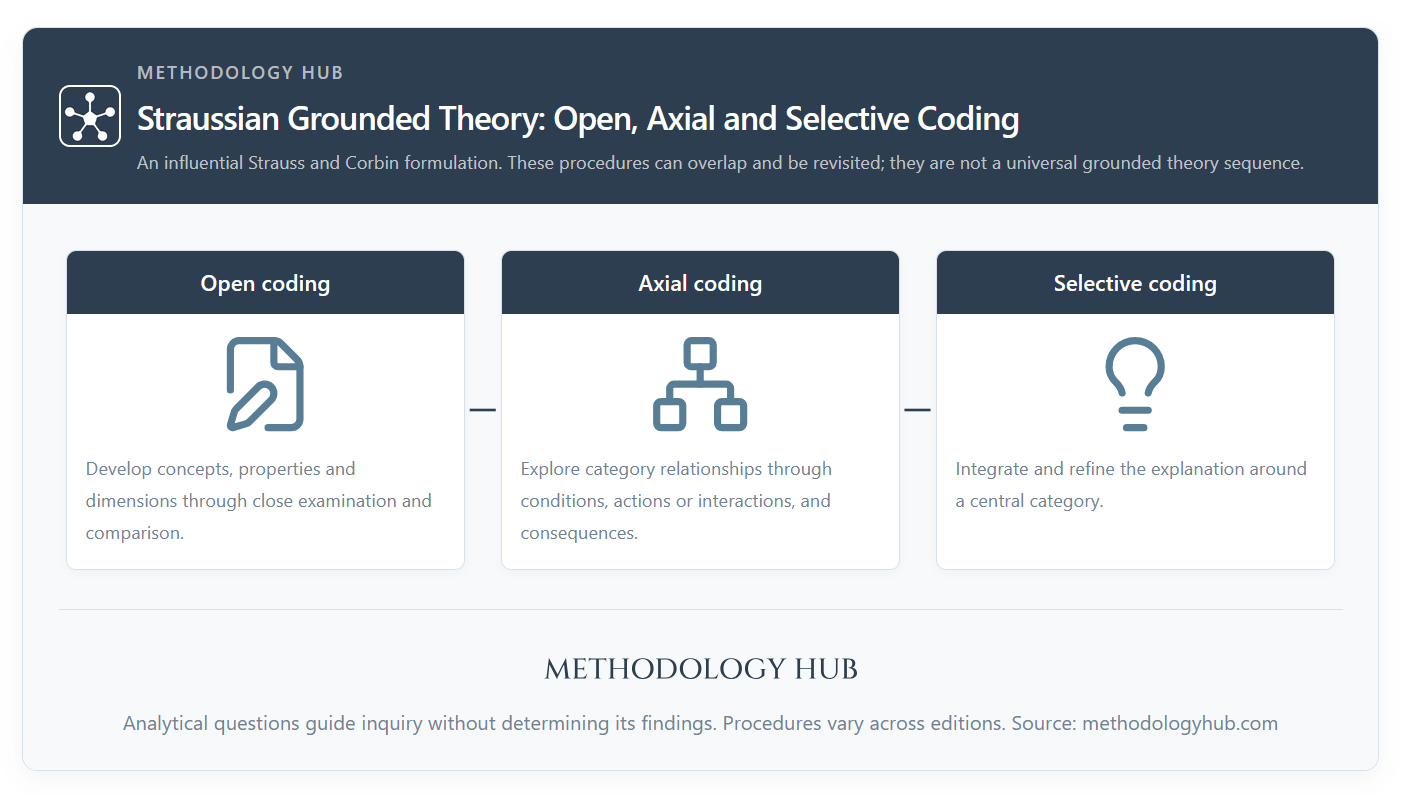
Open coding develops concepts and explores their properties. Axial coding relates categories and subcategories, often through questions about conditions, action or interaction, and consequences. Selective coding integrates and refines the account around a central category.
| Coding procedure | Main analytical task | Evidence of development |
|---|---|---|
| Open coding | Identify concepts and examine their properties and dimensions. | Category definitions distinguish meaningful variation within the material. |
| Axial coding | Explore relationships between categories and subcategories. | Comparisons show how conditions, actions and consequences connect. |
| Selective coding | Integrate and refine the theoretical explanation. | A central category connects the account and unresolved relationships receive attention. |
These procedures can overlap as the analysis develops. Researchers may return to a category’s properties after considering its relationships. The table describes an influential Straussian formulation, rather than a sequence that every grounded theory researcher must adopt.
Role of the Researcher
The Straussian researcher actively questions the evidence, makes comparisons and proposes relationships. Experience and disciplinary knowledge can support analytical sensitivity, provided their influence remains open to examination.
An analytical question is a prompt for inquiry, not a finding. A proposed condition or consequence must be checked against the material and pursued through further comparison when necessary. This distinction keeps systematic procedures connected to evidence rather than allowing the procedure to produce the conclusion by itself.
Strengths and Demands of Straussian Grounded Theory
Straussian grounded theory can help researchers who want explicit guidance for developing conceptual relationships. Its attention to properties and dimensions encourages precision, while questions about conditions and consequences support explanations of variation.
The main demand is to use these procedures flexibly and thoughtfully. A polished category diagram may conceal weak relationships or missing evidence. The final account should show what the categories explain and how the proposed connections were developed, including variation that qualifies the explanation.
Constructivist Grounded Theory
Constructivist grounded theory develops an interpretive explanation while recognising that researchers help produce the evidence and its meaning. Associated especially with Kathy Charmaz, it examines participants’ actions and experiences together with the contexts and research relationships through which they become understood.
Origins and Development
Charmaz developed constructivist grounded theory through her methodological writing and research, drawing on grounded theory’s comparative practices while questioning claims that findings can be independent of the researcher. Her 2006 book Constructing Grounded Theory provided a detailed account of this position.
The tradition retains coding, memo writing, theoretical sampling and conceptual integration. Its distinctive contribution concerns how these practices are understood: the researcher constructs an interpretation through interaction and analysis, with responsibilities for explaining that involvement.
Constructivist Assumptions
Constructivist grounded theory recognises multiple situated understandings of social experience. What participants describe depends partly on their circumstances, relationships and interpretations. The researcher’s questions, position and decisions also influence the resulting account.
This position does not make every interpretation equally persuasive. A theory needs careful comparison, substantial engagement with evidence and a clear account of how its concepts were developed. Alternative readings and differences between participants can strengthen an explanation by exposing its boundaries.
Initial and Focused Coding
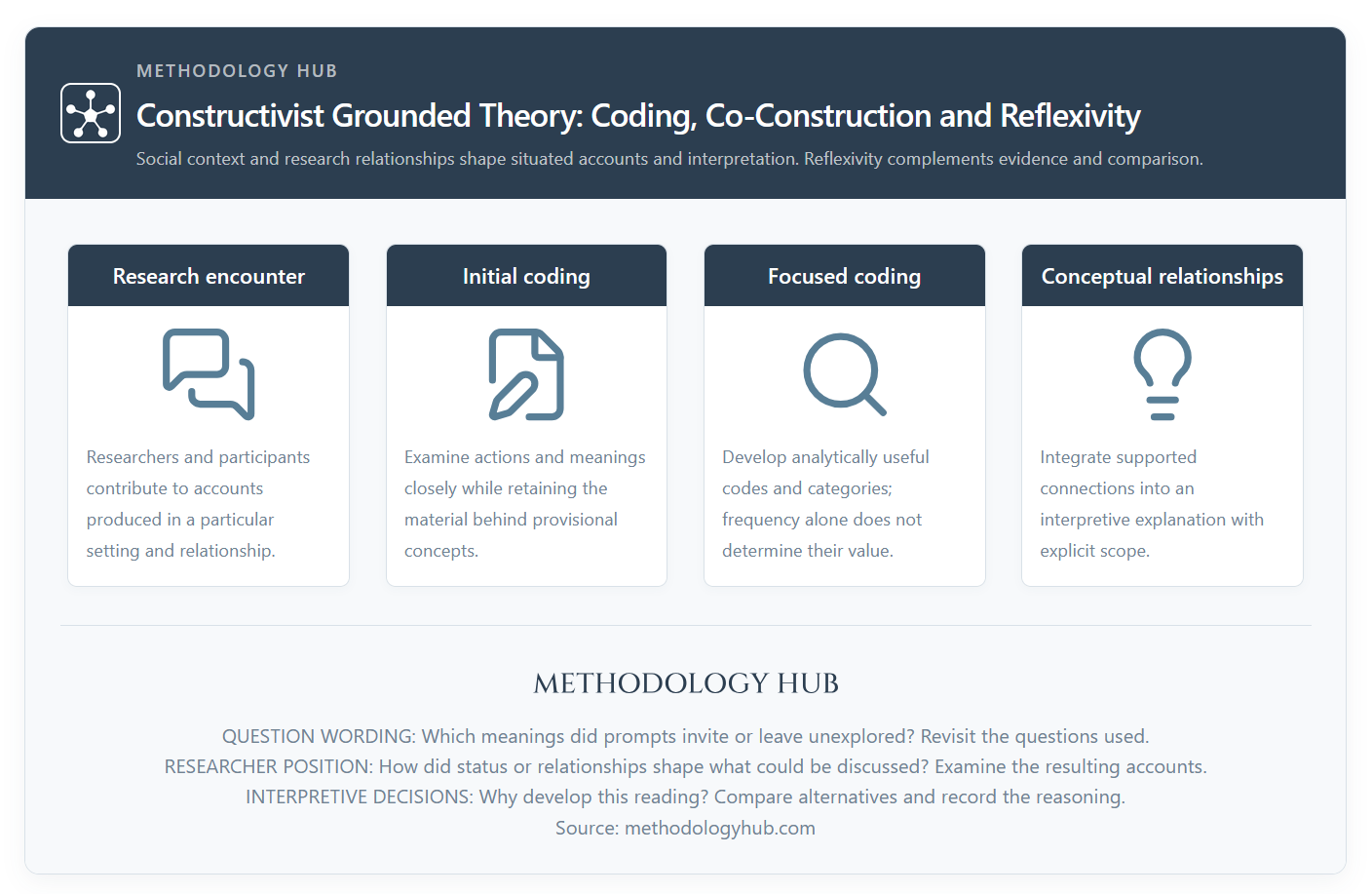
Initial coding examines the material closely, often using action-oriented labels to investigate what people are doing and how meanings develop. Focused coding uses analytically significant or frequent initial codes to organise and examine larger amounts of material.
A focused code must earn its usefulness through comparison. It is not selected simply because it appears most often. Memo writing helps develop the code’s conceptual meaning, clarify category properties and identify questions for further inquiry.
Constructivist analysis also examines theoretical relationships between categories. Charmaz discusses theoretical coding, but the analyst need not adopt a compulsory open–axial–selective sequence. The aim is an integrated interpretation supported by the research, with procedures suited to the question and philosophical position.
Researcher Reflexivity and Co-Construction of Meaning
Reflexivity examines how the researcher’s position affects the inquiry. Co-construction recognises that evidence is produced through relationships: an interview account responds to particular questions in a particular encounter. The analyst subsequently makes choices about coding, comparison and representation.
Useful reflexive records connect a research decision with its possible analytical effects:
- Question wording: Examine which meanings a prompt encouraged or left unexplored.
- Researcher position: Consider how status, experience or relationships affected what participants could comfortably discuss.
- Interpretive decisions: Record why one reading was developed and which alternatives remain plausible.
These records should influence the analysis. A personal reflection that leaves sampling, questioning and interpretation untouched offers limited insight into how the theory was constructed.
Strengths and Demands of Constructivist Grounded Theory
Constructivist grounded theory is useful when the research question requires close attention to situated meanings and the researcher’s involvement in understanding them. It supports an explicit account of how concepts were constructed and whose perspectives the explanation represents.
Its demands include reflexive discipline and theoretical development. An account of the researcher’s experiences cannot substitute for analysing participants’ material. The final theory must connect concepts, explain relevant variation and show how context shapes the interpretation.
Classic vs Straussian vs Constructivist Grounded Theory
The main differences between classic, Straussian and constructivist grounded theory concern the status of theory, analytical guidance and researcher involvement. All three require conceptual development, but they explain that work differently. Choosing between them involves more than selecting a preferred set of coding labels.
Philosophical Assumptions
Classic grounded theory commonly presents theoretical patterns as discoverable through systematic comparison. Constructivist grounded theory presents the explanation as constructed through situated inquiry. Straussian work emphasises action, interaction and interpretation, with its philosophical presentation developing across authors and editions.
These distinctions concern ontology and epistemology: what researchers assume about social reality and how they believe it can be known. Short labels help orient a comparison, but a thesis needs a more specific explanation of the position adopted. Declaring a paradigm without showing its implications for the analysis leaves that position unclear.
Role of Existing Literature
Classic guidance is especially cautious about intensive early reading in the substantive field because established concepts may narrow the analysis. Straussian and constructivist research more readily use existing literature to sensitise inquiry while requiring concepts to remain open to revision.
The difference is not between researchers who read and researchers who do not. It concerns when literature enters the developing explanation and what authority it is given. Across traditions, an established theory should not be treated as confirmed simply because interview extracts can be placed beneath its headings.
Coding and Analytical Procedures
Coding labels name activities within a methodological argument. They cannot safely be transferred without checking what the author means. In classic grounded theory, selective coding narrows substantive analysis around an emerging core category. In influential Straussian formulations, selective coding integrates and refines the theoretical account.
Initial and focused coding also have their own purposes within constructivist analysis. A combined six-stage sequence assembled from all three traditions would conceal these differences. The wider choice of qualitative analysis method should follow the study’s explanatory aim, with coding procedures justified within that choice.
| Dimension | Classic grounded theory | Straussian grounded theory | Constructivist grounded theory |
|---|---|---|---|
| Theory's status | Conceptual patterns discovered through comparative analysis. | Explanation developed through systematic analysis of action, interaction and context. | Interpretive explanation constructed through situated research. |
| Existing literature | Commonly delays intensive substantive review to protect emergence. | Can inform analytical sensitivity without predetermining categories. | Can sensitise inquiry, with assumptions and influence examined reflexively. |
| Coding emphasis | Open and selective substantive coding; theoretical coding. | Open, axial and selective coding in influential formulations. | Initial and focused coding; development of theoretical relationships. |
| Researcher contribution | Theoretical sensitivity and openness to emergent patterns. | Active questioning, comparison and analysis of relationships. | Reflexive interpretation and attention to co-construction. |
| Theoretical integration | A core category integrates the conceptual account. | A central category connects categories and their relationships. | An integrating concept or connected categories support an interpretive account. |
| Quality emphasis | Fit, work, relevance and modifiability. | Grounding, developed concepts, variation, context and process. | Credibility, originality, resonance and usefulness. |
Role of the Researcher
All three traditions require analytical judgement. The difference lies partly in how that judgement is represented and what claims are made for it. Classic accounts foreground conceptual emergence; Straussian accounts make systematic questioning especially visible; constructivist accounts explicitly examine interpretation and the research relationship.
Interviewing, observation and document collection do not by themselves determine the tradition. The same evidence-generation technique can support different methodological commitments. Its role within the study depends on the questions asked, subsequent comparison and interpretation.
Theory Development
Each tradition seeks an explanation that connects concepts. The result may address a process, a pattern of responses or relationships that vary with conditions. Grounded theory does not require every finding to become a sequence of stages.
An explanation also needs a stated scope. Most individual studies develop substantive theory within a particular field of inquiry. A broader formal theory requires further conceptual work across substantive areas; it does not follow automatically from choosing one tradition.
Criteria for Research Quality
Classic grounded theory commonly uses fit, work, relevance and modifiability. These ask whether the theory fits the material, explains the concern under study, addresses something significant and can change as further evidence becomes available.
Strauss and Corbin examine the research process and the grounding and development of the resulting theory, including variation, context and process. Charmaz proposes credibility, originality, resonance and usefulness. These criteria share concerns about a persuasive contribution, but they should be applied with reference to the study’s methodological commitments.
How to Choose a Type of Grounded Theory
Choose a type of grounded theory by matching its assumptions and analytical practices to your research aim. Consider what kind of explanation you want to develop, how you understand knowledge and how you will account for your involvement. A familiar coding sequence alone provides too little basis for the decision.
Research Objectives
Begin with the explanatory work your research question requires. Classic grounded theory emphasises discovering a central concern and its conceptual pattern. Straussian grounded theory provides explicit support for examining conditions, actions and consequences. Constructivist grounded theory emphasises interpreting action and meaning within situated research.
These emphases overlap. Each tradition can investigate social processes, and none owns a particular subject area. The decision should explain why its orientation helps answer the question, rather than claiming that a topic automatically belongs to one tradition.
Philosophical Position
Ask what your account will claim about the relationship between evidence and explanation. Are you presenting conceptual patterns as discovered, or offering an interpretation shaped through the research encounter? What assumptions support that claim?
Reading a tradition’s methodological texts helps clarify the answer. Select the author and edition that support the position you actually intend to use. A philosophical statement becomes useful when it guides how you collect, compare and interpret evidence.
Preferred Analytical Procedures
Consider the kind of guidance you need for developing concepts. Explicit Straussian questions may help organise relational analysis. Classic guidance asks for openness to emerging categories and theoretical relationships. Constructivist procedures combine close coding with focused conceptual work and reflexive interpretation.
Whichever tradition you choose, the design needs room for further inquiry. Initial purposive sampling can establish relevant starting material. Subsequent theoretical sampling should respond to conceptual questions, instead of simply enlarging the original sample according to unchanged criteria.
Researcher Involvement and Reflexivity
Consider your relationship to participants and the setting. Existing experience may provide access and sensitivity while encouraging assumptions that need examination. Decide how the chosen tradition will help you account for those influences.
Constructivist grounded theory makes this involvement an explicit part of knowledge construction. Researchers adopting other traditions still need to consider how their decisions affect the inquiry. The relevant question is how researcher involvement is understood and investigated within the methodological position.
Methodological Consistency
A defensible choice connects the research aim, philosophical position, procedures and final claims. Before committing to a tradition, check those connections:
- Foundational texts: Identify the authors and editions that guide the study.
- Analytical decisions: Explain why the selected coding and comparison practices fit that position.
- Sampling decisions: Allow emerging concepts to direct further investigation.
- Reporting claims: Describe the theory's status, contribution and limits consistently.
Adaptations can be justified, but readers need to understand their purpose and consequences. Borrowing a procedure requires more explanation than listing another author. If procedures rest on conflicting assumptions, explain how the study resolves that conflict.
Examples of Different Grounded Theory Traditions
The same research topic can be investigated through classic, Straussian or constructivist grounded theory. Consider a fictional study of how doctoral researchers decide when to ask for supervisory help. The comparisons below show possible analytical directions, rather than reporting findings from three completed studies.
Classic Grounded Theory Example
A classic study would begin openly with doctoral researchers’ concerns rather than fixing help-seeking as the final explanatory category. Early interviews and observations might indicate a recurring concern about maintaining credibility. Comparison could develop a tentative core category, preserving independence.
Selective substantive coding would then concentrate on material relevant to that category. The researcher might compare seeking help early, delaying a request and consulting peers first. Further sampling would investigate whether the concept explains these different responses and where it fails.
A possible theory would relate the perceived risk to credibility to how researchers manage requests for help. The proposed category remains provisional. If further comparisons show that access to supervisors explains more than independence does, the analysis would need revision.
Straussian Grounded Theory Example
A Straussian study could use open coding to develop categories concerning uncertainty, supervisory availability and anticipated evaluation. Axial analysis would examine how these conditions relate to actions such as preparing a detailed request, seeking reassurance from peers or postponing contact.
The analysis would also investigate consequences. Postponement might preserve a temporary sense of independence while allowing a research problem to grow. Prompt contact might resolve uncertainty but create concern about appearing unprepared. These possibilities would need comparison across accounts and situations.
A central category such as negotiating the threshold for help could integrate the account. Further inquiry would examine how supervisory expectations and the seriousness of a problem alter that threshold. The explanation would need to show those relationships, rather than merely arrange codes beneath conditions, actions and consequences.
Constructivist Grounded Theory Example
A constructivist study could examine how doctoral researchers understand being an independent scholar and how those meanings shape help-seeking. Initial codes might include proving preparation and testing whether a question counts. Focused coding could develop a category such as making help legitimate.
The researcher’s position would require attention. A participant may describe independence differently to an established academic than to another doctoral researcher. An interviewer who praises self-reliance might also encourage accounts that understate the value of support.
Theoretical sampling could investigate contrasting supervisory relationships and changing meanings over time. A possible explanation would connect definitions of independence, anticipated judgement and the conditions under which asking for help becomes acceptable. The report would identify how the interpretation was constructed and whose accounts it could not adequately represent.
Comparing Their Analytical Outcomes
These possible outcomes reflect different questions and analytical commitments. They are not conclusions that a tradition necessarily produces. A different body of evidence could challenge every proposed category in the comparison.
| Tradition | Possible integrating concept | Main relationship to investigate |
|---|---|---|
| Classic | Preserving independence | How concern about credibility organises different ways of seeking or delaying help. |
| Straussian | Negotiating the threshold for help | How uncertainty and supervisory conditions shape actions and their consequences. |
| Constructivist | Making help legitimate | How situated meanings of independence make requests acceptable or difficult. |
The difference is therefore visible in what the analyst investigates and how the resulting explanation is presented. All three would need further evidence, comparison and conceptual development. None of these brief outlines establishes theoretical saturation or supplies a completed grounded theory.
Conclusion
The three main types of grounded theory offer different ways to develop and justify an explanation. Classic grounded theory foregrounds conceptual emergence, Straussian grounded theory offers explicit relational procedures, and constructivist grounded theory examines interpretation and co-construction.
Choose the tradition whose assumptions you can explain and whose practices support the study’s aim. Then carry that choice through coding, comparison, sampling and reporting. A coherent account of those decisions gives readers a stronger basis for assessing the resulting theory than a methodological label alone.
Sources and further readings
The following publications are among the foundational works in grounded theory literature.
- Glaser, B. G., & Strauss, A. L. (1967). The Discovery of Grounded Theory: Strategies for Qualitative Research. Aldine.
- Glaser, B. G. (1978). Theoretical Sensitivity: Advances in the Methodology of Grounded Theory. Sociology Press.
- Strauss, A. L., & Corbin, J. M. (1990). Basics of Qualitative Research: Grounded Theory Procedures and Techniques. Sage Publications.
- Glaser, B. G. (1992). Basics of Grounded Theory Analysis: Emergence vs. Forcing. Sociology Press.
- Charmaz, K. (2006). Constructing Grounded Theory: A Practical Guide Through Qualitative Analysis. Sage Publications.
- Corbin, J., & Strauss, A. (2015). Basics of Qualitative Research: Techniques and Procedures for Developing Grounded Theory (4th ed.). SAGE Publications.
- Charmaz, K. (2014). Constructing Grounded Theory (2nd ed.). SAGE Publications.
Cite this article
Whether you are preparing course materials, writing an academic paper, or sharing resources with students, we kindly ask that you acknowledge Methodology Hub as the source.
To make referencing easier, you can use the “Cite this page” tool below to automatically generate a citation in your preferred referencing style, including APA, MLA, Chicago, Harvard, and others. Simply select a citation style and click the generated reference to copy it.
When reproducing images, figures, or other materials from this page, please include an appropriate source credit and a link to the original page. Proper attribution helps others locate the original material and supports the continued development of freely accessible educational resources.