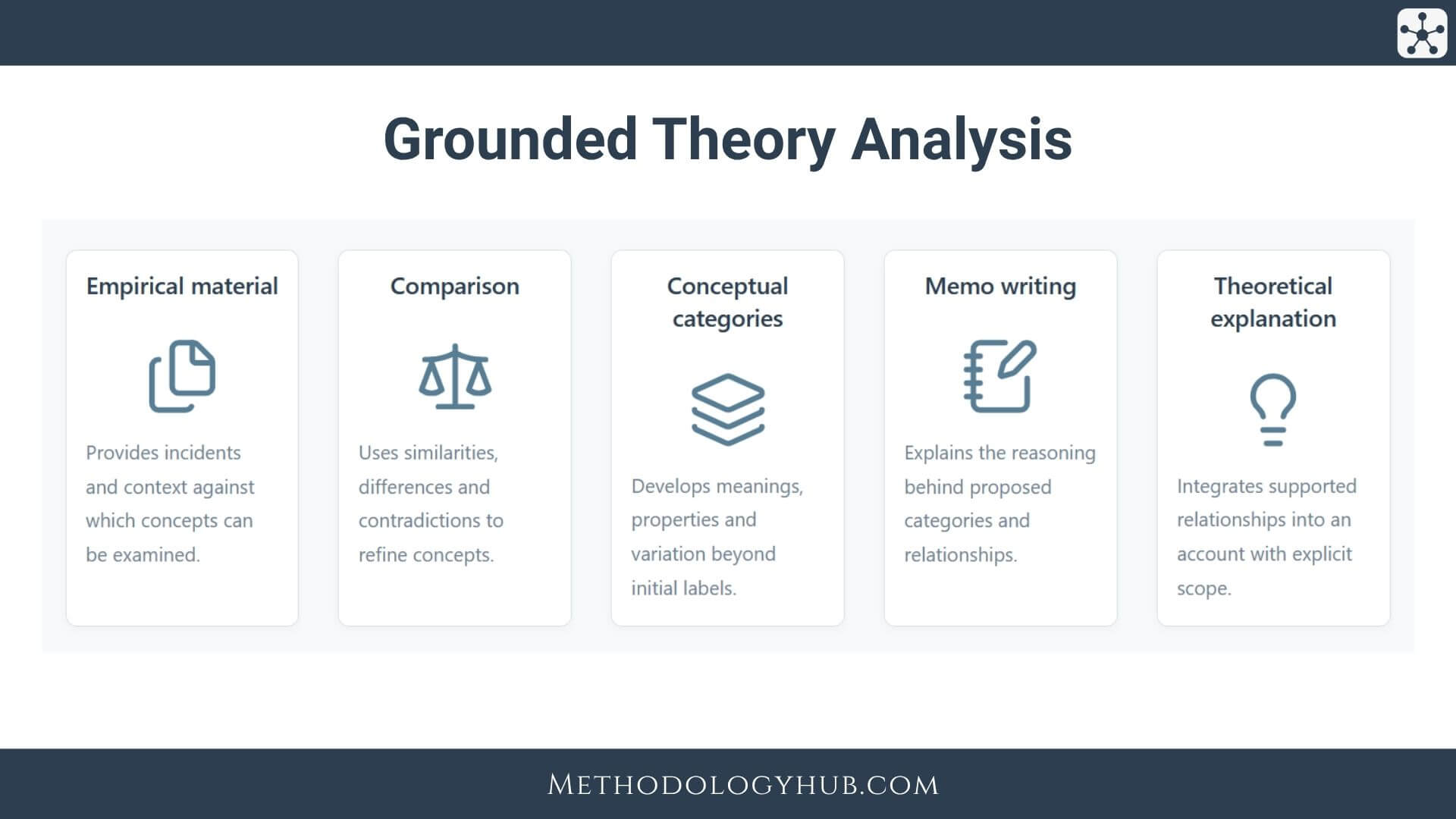
Grounded theory analysis is the process of comparing research material, developing conceptual categories and connecting them into a theoretical explanation. In qualitative research, the analysis develops alongside data collection so that emerging ideas can direct further inquiry.
It is the analytical work within grounded theory. Its focus is on how evidence supports concepts and relationships, while the wider methodology also guides the research design and study as a whole.
This article explains grounded theory coding, constant comparison, memo writing and theoretical integration, with a complete worked example.
What Is Grounded Theory Analysis?
Grounded theory analysis develops an explanation through repeated examination of data and emerging concepts. Researchers compare incidents, code relevant material, investigate category properties and work out how the categories relate. The resulting account should explain a process or pattern, with enough evidence to support its scope.
Definition and Purpose
The purpose is to produce concepts that explain what is happening in the area studied. Codes initially identify actions, meanings or events in the material. As comparison develops, categories bring related observations into a more abstract account. Theoretical work examines how those categories connect and under which conditions the proposed relationships hold.
A collection of codes or interview topics is therefore an intermediate product. It becomes part of grounded theory analysis when the researcher uses it to develop and examine conceptual relationships. The analysis needs to show what the explanation adds and why its categories fit the material.
Main Characteristics
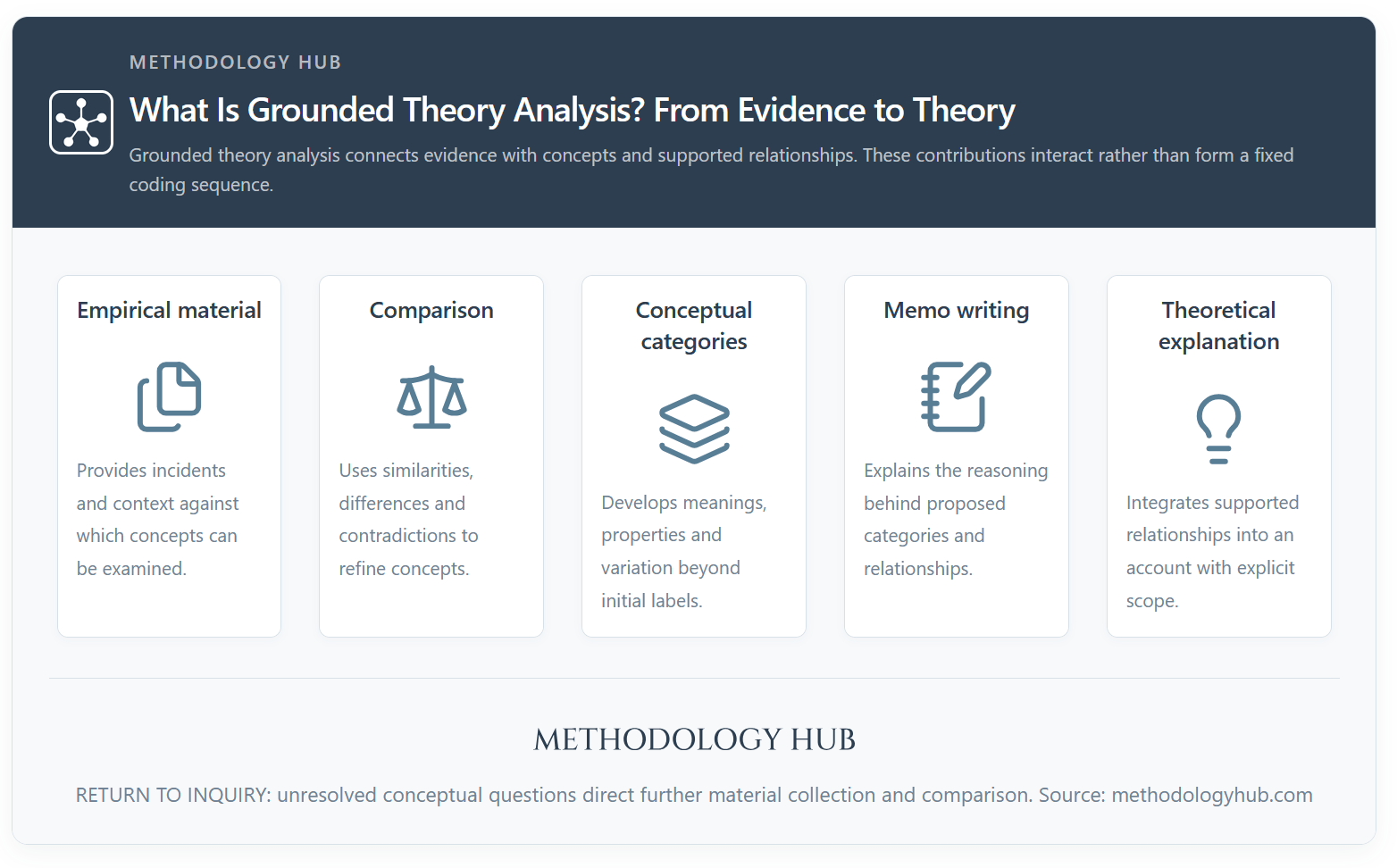
The analysis is comparative, iterative and directed towards theory development. It uses memos to explore ideas and theoretical sampling to pursue questions raised by the emerging explanation. These activities influence one another: a comparison can revise a category, and that revision can change what evidence is needed next.
Its procedures also depend on the grounded theory research tradition. Classic, Straussian and constructivist work use some shared terminology but differ in how analytical decisions are framed. Identify the approach before describing the coding, so readers can understand why particular procedures were used.
Relationship Between Data and Theory
Data provide evidence for an interpretation, while concepts help the researcher ask more precise questions of the material. The relationship develops through comparison. A proposed category must remain open to passages or observations that reveal a different property, condition or relationship.
This does not mean approaching the study without knowledge. It means examining whether existing ideas help explain the material or restrict what can be recognised. The theoretical account should be traceable to the analytical work rather than imposed through an attractive model selected beforehand.
The Analytical Process in Grounded Theory
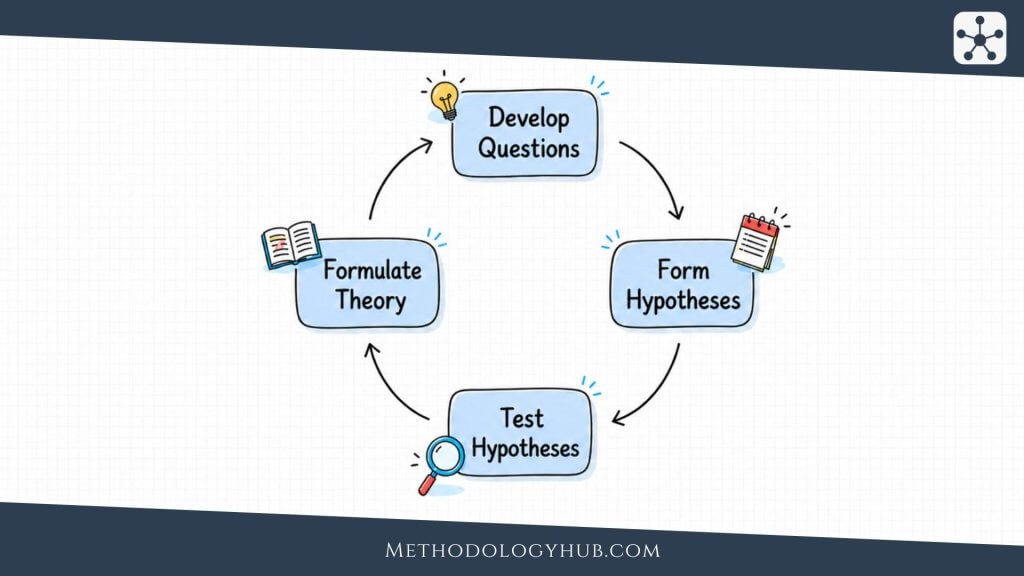
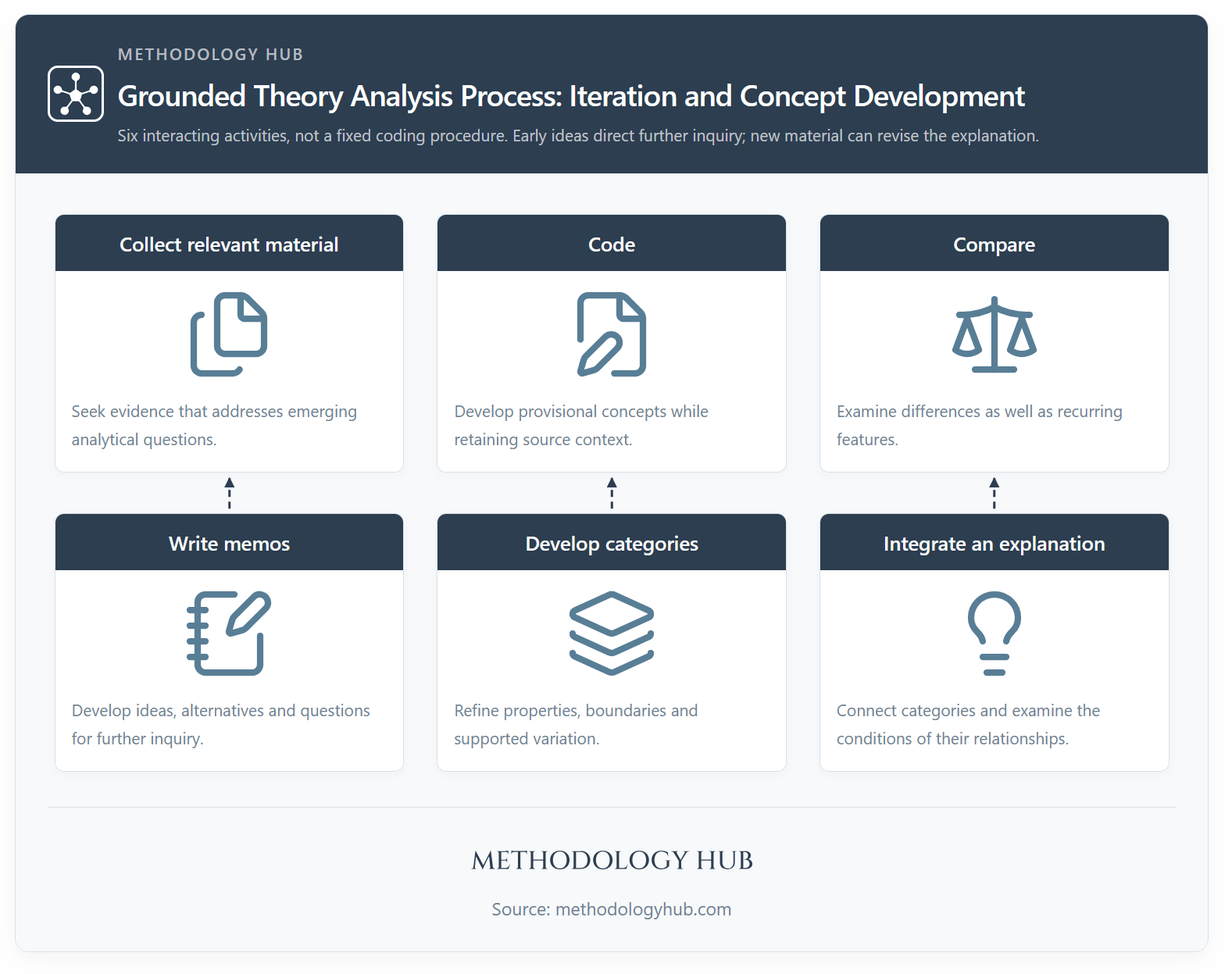
Grounded theory analysis moves repeatedly between collecting material, coding, comparison, memo writing and category development. Early interpretations suggest further questions; new evidence then changes or strengthens those interpretations. The work follows an emerging analytical direction rather than a single pass from transcripts to a finished theory.
Simultaneous Data Collection and Analysis
Begin analysis while collection is still underway. Read early material, compare relevant incidents and identify questions that the next round of inquiry could address. This allows the study to investigate category development instead of discovering important gaps only after access to participants or settings has ended.
The connection can involve further qualitative interviews, observation or documents, depending on the question. A change in data source is useful when it supplies evidence the emerging explanation needs. Its contribution should be recorded alongside the analytical reason for seeking it.
Iterative Analysis
Return to earlier coding and memos when later comparisons alter a category. A revision may narrow a definition, distinguish previously combined actions or identify a condition that changes a relationship. Keep a decision record so the final explanation can be connected with the evidence that prompted the change.
Iteration has an analytical purpose. Repeatedly reading the same passages without asking a clearer question may add familiarity while leaving the explanation undeveloped. Record what a return to the material was intended to clarify and what it changed.
Moving From Data to Concepts
Move beyond repeating participants’ wording by asking what action, process or relationship the material indicates. Compare the proposed concept with other relevant incidents. Its wording can become more abstract as its meaning becomes clearer, but abstraction should preserve an identifiable connection with the evidence.
A category also needs boundaries. Record what it includes, what distinguishes it from neighbouring concepts and which observations suggest variation within it. These distinctions help establish what the category explains and where another concept is needed.
The Role of Theoretical Sensitivity
Theoretical sensitivity is the ability to recognise potentially useful concepts and relationships. It develops through close work with material, methodological reading, disciplinary knowledge and analytical discussion. Use these resources to generate questions, then examine whether the proposed interpretation accounts for the evidence.
Memo writing helps make that reasoning visible. Note when a theoretical idea drew attention to a relationship, what supported it and which alternative remained plausible. Sensitivity contributes to analysis through those decisions rather than through intuition alone.
Coding in Grounded Theory
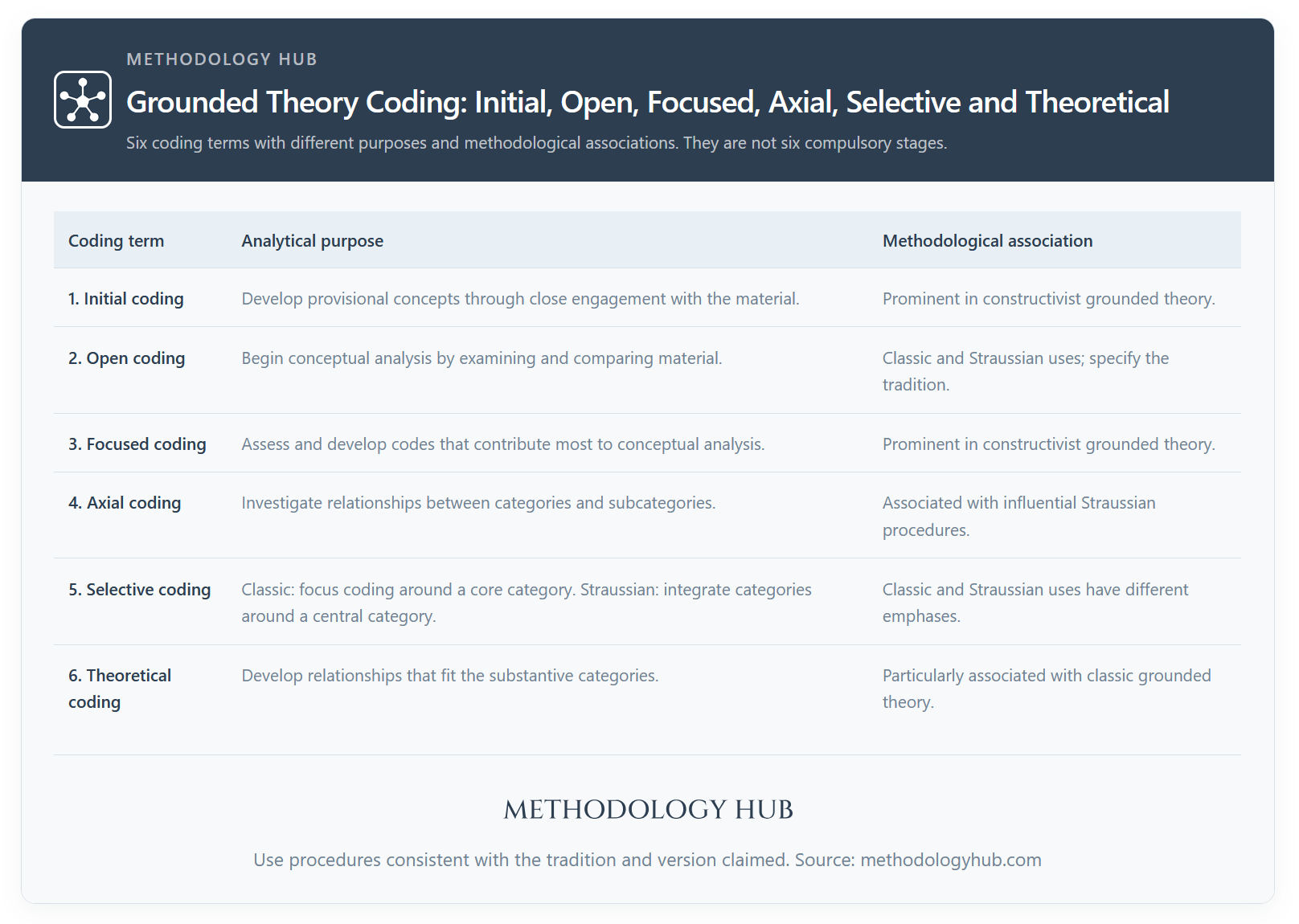
Coding in grounded theory identifies features of the material and develops concepts for further comparison. Initial, open, focused, axial, selective and theoretical coding serve different purposes and belong to partly different methodological traditions. They should not be combined into a universal six-stage procedure.
Initial Coding
Initial coding is especially associated with Kathy Charmaz’s constructivist grounded theory. Work closely through the material and ask what participants are doing, describing or trying to accomplish. Short action-focused labels can keep the analysis attentive to processes. Line-by-line coding is one useful strategy, with segment size adapted to the material.
Keep early codes provisional. Their value lies in opening comparisons and conceptual questions. A label can be revised or replaced when another passage reveals that its meaning is too broad, too narrow or based on an assumption the material does not support.
Open Coding
Open coding refers to an early examination that develops concepts from the material. In classic grounded theory, it forms part of substantive coding before the analysis becomes more concentrated around an emerging core category. In influential Straussian accounts, it also develops categories, properties and dimensions through detailed questioning and comparison.
The term overlaps with initial coding in its attention to early conceptual work, but the methodological context differs. Describe what was done and which tradition informed it. Substituting one label for another does not establish that the underlying analytical commitments are equivalent.
Focused Coding
Focused coding uses analytically useful initial codes to examine larger amounts of material. In Charmaz’s approach, compare which codes best account for relevant actions and variations, then use those codes to develop the analysis. A frequently applied label is a candidate for examination, not automatically the most important concept.
Return to the extracts behind a focused code to assess its reach. If it obscures important differences, refine it or develop a more adequate concept. The transition involves analytical selection and synthesis rather than simply shortening the code list.
| Coding term | Common methodological association | Analytical purpose |
|---|---|---|
| Initial coding | Constructivist grounded theory | Develop provisional concepts through close engagement with material |
| Open coding | Classic and Straussian grounded theory | Identify and develop concepts through early comparison |
| Focused coding | Constructivist grounded theory | Use analytically significant codes to synthesise and develop material |
| Axial coding | Influential Straussian procedures | Examine relationships among categories, subcategories and conditions |
| Selective coding | Classic and Straussian traditions, with different meanings | Concentrate or integrate the analysis around a central category |
| Theoretical coding | Particularly associated with classic grounded theory | Conceptualise relationships that integrate substantive categories |
Axial Coding
Axial coding is associated with influential versions of Strauss and Corbin’s work. It examines relationships among categories and subcategories, including properties, conditions, actions or interactions, and consequences. These questions can deepen an explanation when the material supports the proposed connections.
The procedure should not become a compulsory grid that makes every incident fit the same structure. Explain the Straussian version used and show how the relational questions contributed to category development. Other grounded theory traditions do not require axial coding as a separate stage.
Selective Coding
In classic grounded theory, selective coding concentrates substantive analysis on material relevant to an emerging core category. In Straussian accounts, the term commonly concerns integrating and refining categories around a central category. The shared label therefore needs a clear description of its role in the study.
Selection does not justify removing material that challenges the proposed explanation. Contrasting incidents may expose a missing condition or a relationship needing revision. Retain those comparisons when deciding what is central to the theory.
Theoretical Coding
Theoretical coding conceptualises how substantive categories relate. In Barney Glaser’s work, its contribution concerns integrating concepts into a theoretical account. The relationship may involve conditions, dimensions, strategies or a process; it should not be assumed to take the form of successive stages.
Work from developed categories and analytical memos, asking which relationship best accounts for their connection. A theoretical code needs to earn its relevance through the material. Choosing a familiar model first and arranging categories around it risks forcing the explanation.
The Constant Comparative Method
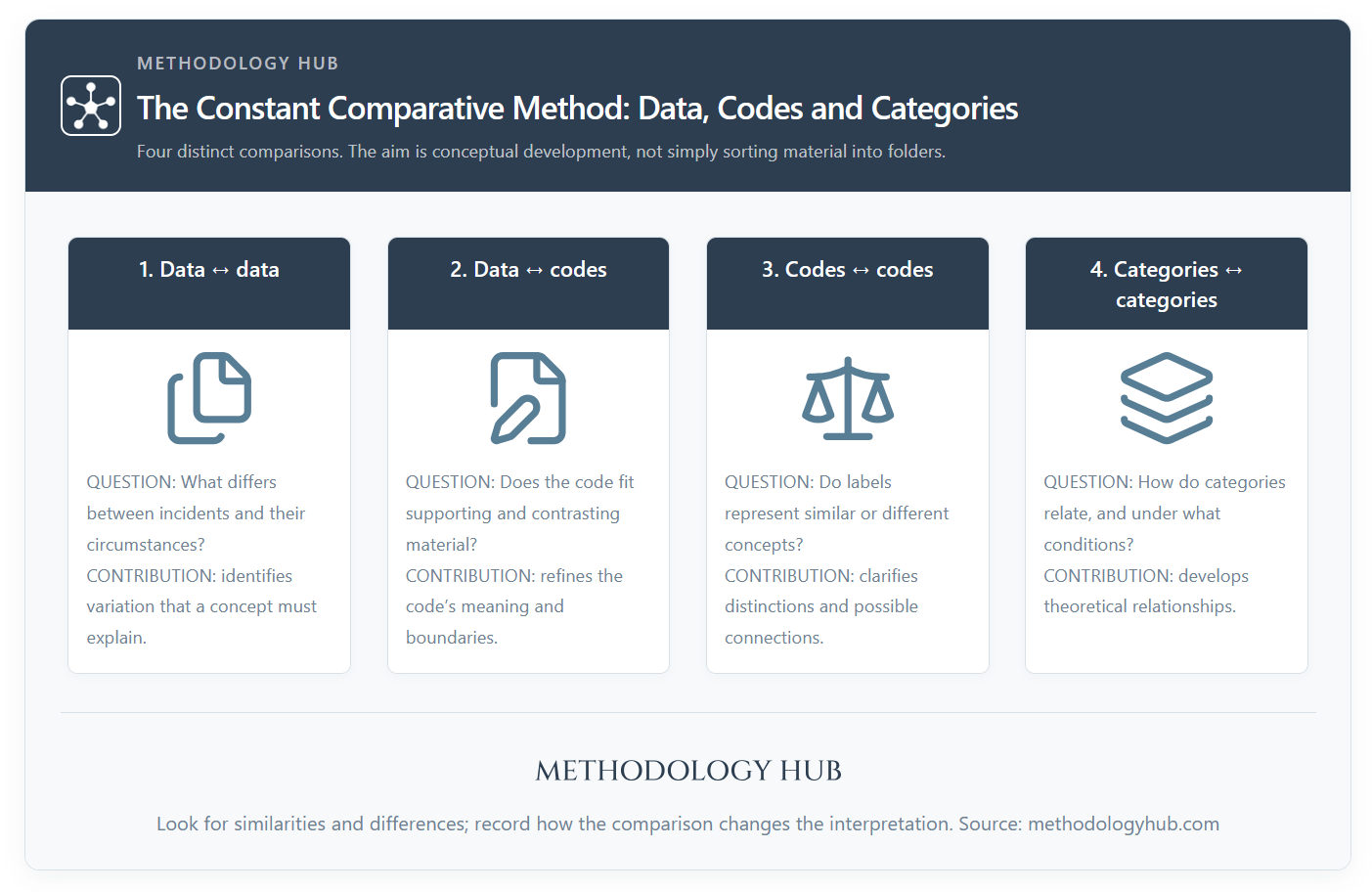
The constant comparative method develops concepts by comparing incidents, codes and categories throughout the analysis. Researchers ask what is similar, what differs and what the difference means for the developing explanation. Each comparison should contribute to a clearer concept or relationship.
Comparing Data With Data
Compare relevant incidents within one source and across different sources. Look at what participants do or describe, the circumstances involved and the consequences reported or observed. Similar wording does not necessarily indicate the same process, and different wording can describe comparable actions.
Preserve the original setting of each incident. Accounts drawn from field notes and interviews may provide different kinds of evidence. Their relationship needs examination rather than an assumption that one simply confirms the other.
Comparing Data With Codes
Return to the material assigned to a code and check whether the label captures its relevant meaning. Investigate passages that fit only partly. They may reveal another property, require a narrower definition or indicate that two different actions have been grouped together.
| Comparison | Practical analytical question | Possible consequence |
|---|---|---|
| Data with data | What changes between these incidents and their circumstances? | Identify variation that a concept must account for |
| Data with codes | Does this label explain the feature found in the passage? | Refine the label or distinguish another meaning |
| Codes with codes | Do these codes capture the same action or a useful distinction? | Merge, separate or relate developing concepts |
| Categories with categories | What evidence supports a relationship between these concepts? | Develop a theoretical connection or identify a gap |
Comparing Codes and Categories
Compare codes by reading the material behind them, then examine whether a broader category can explain their relationship. A category develops when its meaning, properties and boundaries become clearer. It does not become theoretically stronger merely because it contains many codes.
Compare categories with one another to investigate connections. Record what suggests that one condition changes another process and what contradicts that reading. The comparison should lead towards an explicit relational claim or a question requiring further evidence.
Refining Analytical Concepts
Refine a concept by testing its scope against variation. Ask whether it explains contrasting incidents, whether its properties are distinct and whether its name matches the interpretation. Keep previous definitions where they help show why the concept changed.
Conceptual refinement can also reduce complexity. Two provisional categories may describe parts of one relationship, while another apparently broad category may need dividing. The useful outcome is a more adequate explanation, not a larger number of analytical labels.
Memo Writing in Grounded Theory
Grounded theory memos are analytical notes that develop ideas about concepts, categories and their relationships. Write them when a comparison suggests a possible explanation, exposes uncertainty or raises a question for further inquiry. A useful memo shows the reasoning that could otherwise disappear behind a code label.
Purpose of Analytical Memos
Use a memo to explain what a category appears to mean and why. Refer to the material that prompted the idea, identify the proposed relationship and consider alternatives. Questions and uncertainties belong in the memo because they can guide later comparisons or theoretical sampling.
A source summary records what an account contains; a theoretical memo works on what the material indicates conceptually. Both can be useful, but their functions differ. Keep the link between them so the emerging explanation remains connected to its evidence.
Types of Analytical Memos
Memos can serve several purposes without requiring a fixed classification system. Choose labels that help retrieve the analytical work:
- Code memos examine the meaning, boundaries or revision of a code.
- Category memos develop properties, variation and supporting evidence.
- Relational memos investigate connections among categories and alternative explanations.
- Reflexive memos consider how researcher assumptions affect interpretation.
One memo may do more than one of these jobs. The label is useful if it helps the researcher return to an idea and develop it further.
Using Memos to Develop Categories
Read related memos together and compare their conceptual claims. Identify where they describe the same property, propose different explanations or leave a relationship unresolved. Sorting memos can reveal connections that are less visible when records are organised only by interview or collection date.
As categories develop, update the analytical argument rather than only adding new extracts. A category memo should make clear which properties are established, which comparisons support them and what the analysis still needs to investigate.
Reviewing and Using Analytical Memos
Give each memo a date, relevant source references and a clear analytical focus. When revisiting it, distinguish the original idea from the revised interpretation. Record what changed and which evidence contributed, instead of silently replacing an earlier conclusion.
Before using a memo in theoretical integration, check its claims against the material and other memos. An early idea may remain promising without being sufficiently developed. Keep that distinction visible in the final account of how the theory was constructed.
Developing Categories and Theoretical Relationships
Category development turns provisional concepts into an explanation by specifying their properties, variation and relationships. The researcher examines what each category covers, how it changes across circumstances and how it contributes to the emerging theory. Integration connects that work into a coherent account.
Moving From Codes to Categories
Compare related codes and ask what broader concept accounts for the actions or meanings they indicate. Retain a rationale for grouping them. A category should add conceptual understanding rather than merely serve as a heading for similar topics.
Return to incidents that differ from the initial grouping. They may suggest that the category has several properties or that the apparent similarity is superficial. Developing a category involves making those distinctions explicit.
Identifying Category Properties
Properties describe analytically relevant aspects of a category; dimensions express their variation. Identify these through comparison and state what evidence supports them. Not every difference needs a numerical scale, and not every property varies along a single continuum.
Record which properties appear central, which are conditional and which remain uncertain. This prevents a category definition from becoming more comprehensive in wording than the evidence allows. Theoretical sampling can then address a specific gap instead of seeking further material without a clear purpose.
Examining Relationships Between Categories
Write each proposed relationship as a statement that can be examined against evidence. Specify the relevant conditions, actions or consequences without assuming that every relationship is causal. Co-occurrence alone does not explain how concepts are connected.
Compare circumstances in which the relationship changes or does not appear. This may narrow its scope or reveal another condition. A useful diagram should reflect those qualifications rather than making every connection look equally certain.
Theoretical Integration
Theoretical integration brings categories into an account of how the phenomenon works. Depending on the tradition and findings, a central category or integrating concept may organise the explanation. The important question is how the concepts contribute to an intelligible relationship or pattern.
Read and sort analytical memos to examine competing ways of making those connections. Keep the structure supported by the material, whether it involves stages, conditions, strategies or another relationship. A familiar diagram should not determine the form of the theory in advance.
Developing the Emerging Theory
Draft the explanation in connected prose and check what each category contributes. Identify claims that remain descriptive, links that lack evidence and conditions not yet adequately examined. Writing can expose where further comparison or theoretically directed inquiry is needed.
The theory may change as these questions are addressed. Keep its scope proportionate to the material and distinguish a provisional relationship from a developed claim. Conceptual depth concerns how well the explanation works, rather than the number of categories retained.
Theoretical Sampling and Saturation
Theoretical sampling seeks material that can develop an emerging category or relationship. Theoretical saturation assesses whether that conceptual development is sufficiently detailed for the explanation being proposed. Both decisions depend on analysis, rather than a predetermined target number of interviews.
How Analysis Guides Further Data Collection
Turn an analytical uncertainty into a question about the evidence needed. A tentative category may require comparison across different conditions or closer examination of an action already identified. Record why the proposed material could clarify that particular issue.
Initial selection may use purposive sampling to enter the area of study. Theoretical sampling becomes more specific as conceptual questions develop. Its purpose is to refine the emerging explanation, rather than simply increase demographic variety.
Identifying Analytical Gaps
Review category memos for unclear properties, unexplained contrasts and unsupported links. Distinguish an absence of evidence from evidence that a proposed relationship does not hold. These are different analytical situations and may require different comparisons.
| Analytical gap | Further inquiry to consider | Contribution sought |
|---|---|---|
| A category has unclear boundaries | Material near the proposed inclusion and exclusion boundary | Establish what the concept does and does not explain |
| A property has limited variation | Relevant contrasting conditions or incidents | Develop its range and significance |
| A relationship rests on one kind of case | Cases in which the proposed conditions differ | Examine whether the connection changes |
| A contradictory incident remains unexplained | More detail about that incident and comparable cases | Refine or revise the emerging account |
Theoretical Sampling Decisions
Describe the connection between the gap, the selection decision and its analytical consequence. Further inquiry may involve a different participant, another observation, a document or a return to relevant material. The decision should identify what the comparison can contribute.
Practical limits can prevent a useful inquiry. Record the unresolved issue and qualify the explanation where needed. Increasing the sample within easy reach does not automatically address a category gap that requires a different condition or source.
Assessing Theoretical Saturation
Assess saturation through the development of categories and their relationships. Familiar topics can recur while the theory still lacks an important property or explanation of variation. Review the relevant comparisons and memos before deciding that further inquiry is no longer adding significant conceptual understanding.
- Are the central categories sufficiently developed in properties and variation?
- Have important relationships been examined under relevant conditions?
- Have contradictory incidents refined the explanation or remained unresolved?
- What conceptual contribution did the latest theoretically directed inquiry make?
Explain the judgement in relation to the study’s scope. A claim that no new codes appeared is insufficient on its own to establish theoretical saturation.
Grounded Theory Analysis Example
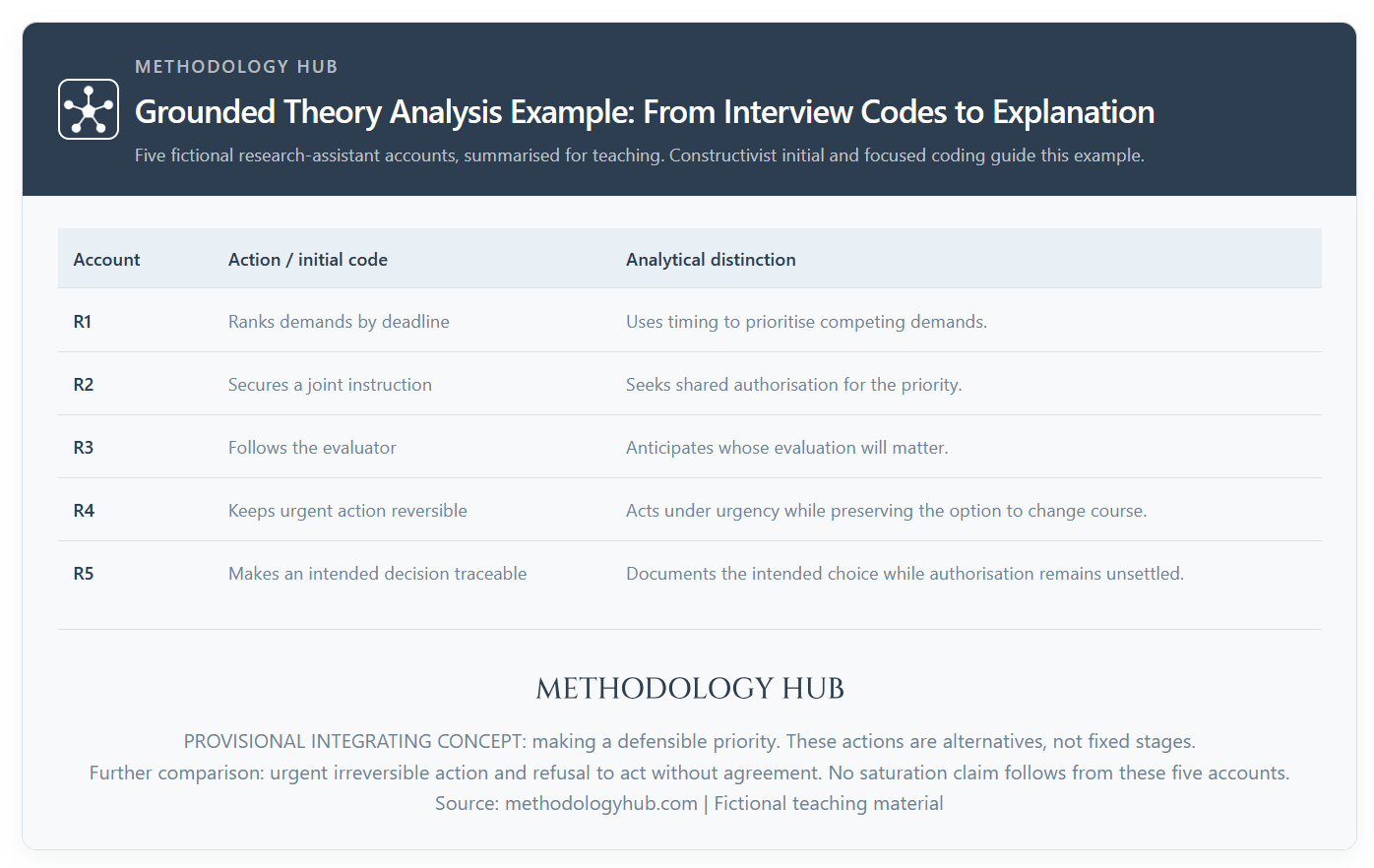
Five fictional interview extracts from university research assistants illustrate how initial coding, comparison and memos can develop a provisional explanation of conflicting instructions. The example follows a constructivist approach using initial and focused coding. It does not combine every coding tradition into one procedure.
Research Question and Data
The question is: how do research assistants handle conflicting instructions on shared university projects? The extracts describe responses to incompatible priorities, differences in authority and limited time. They provide a small teaching dataset, with identifiers R1–R5 retained throughout the analysis.
Initial Coding
Code actions closely enough to preserve differences between the accounts. R1 uses a deadline to choose a priority; R2 seeks a joint decision; R3 considers who will evaluate the work. Treat these as provisional action codes and retain the whole extract when comparing them.
| Fictional interview extract | Initial action code | Focused code or developing category | Analytical contribution |
|---|---|---|---|
| R1: “The two lists did not match. I started with the earlier deadline and told the other supervisor when their work would be ready.” | Ranking demands by deadline; communicating a choice | Justifying a priority through an external criterion | A decision can be made without resolving disagreement between supervisors |
| R2: “I sent both of them the two requests and asked for one order. Once they replied together, I could get on with it.” | Making conflicting requests visible; seeking a joint instruction | Securing shared authorisation | Agreement supplies an explicit basis for choosing a priority |
| R3: “I did not want to look difficult. I followed the person who signs off my work, even though the other request came first.” | Anticipating evaluation; following the assessor | Protecting accountability to an evaluator | Perceived judgement can outweigh the order in which requests arrive |
| R4: “The samples could not wait. I did the part I could undo, then asked before taking the step that would use them up.” | Acting provisionally; postponing an irreversible step | Preserving options under urgency | Action can begin before clarification when its consequences remain reversible |
| R5: “Each told me to ask the other. I kept a log and sent them what I planned to do before I started.” | Recording conflicting advice; announcing intended action | Making a decision traceable | A recorded rationale can support action even while authorisation remains unsettled |
Constant Comparison
Compare R1 and R3: both choose a priority without a joint instruction, but their stated grounds differ. A single code such as following priorities would hide the distinction between a deadline and anticipated evaluation. R2 also differs from R5 because requesting clarification results in agreement in one account and continued uncertainty in the other.
R4 challenges the assumption that clarification must precede action. The assistant acts before asking, but distinguishes a reversible step from an irreversible one. This comparison directs attention towards urgency and the consequences of a decision, rather than treating all action without permission as the same process.
Developing Categories
Focused coding can develop categories concerning grounds for prioritisation, access to shared authorisation and protection against later accountability. The initial codes remain evidence for examining these concepts. Their proposed relationship concerns how assistants make a choice defensible when instructions conflict.
Relevant properties include whether a joint decision is available, who evaluates the work and how reversible the proposed action is. Some properties require more evidence. The extracts suggest variation in urgency, but do not establish how often urgency changes the response or whether the same pattern holds across different projects.
Analytical Memo Writing
A memo can examine the proposed relationship while keeping the contrasting cases visible:
Analytical memo: making a priority defensible
R2 obtains shared authorisation, whereas R5 creates a traceable record without securing agreement. R1 and R3 also justify choices, but through deadlines and evaluation relationships. These comparisons suggest that resolving disagreement is only one way of making action defensible. R4 introduces reversibility when waiting would have consequences. I should compare cases where urgency is high but action cannot be reversed, and ask whether anticipated evaluation changes the response. The explanation must also account for assistants who refuse to act without agreement.
The memo links the comparison with a further question. It also records a reflexive issue: treating clarification as the naturally correct response could lead the researcher to misread provisional action as poor judgement. R4 gives a reason to examine that assumption against the material.
Integrating Categories Into an Explanation
A provisional integrating concept is making a defensible priority. The accounts suggest that assistants seek a basis they can justify through deadlines, shared authorisation, evaluation relationships or a documented rationale. When time is constrained, keeping action reversible may allow work to begin while clarification remains unresolved.
This explanation connects the categories instead of presenting five separate strategies. It also has limits. R3 may reflect concerns about appearing difficult as well as the evaluator’s formal role; R5 does not show whether the written plan was accepted. Further theoretically directed comparison should investigate those differences, including accounts where assistants openly refuse incompatible requests.
The example therefore ends with a provisional explanation and an explicit next analytical question. A completed study would examine full accounts, develop the relevant category properties and justify any saturation claim through additional comparison.
Strengthening Grounded Theory Analysis
Grounded theory analysis becomes stronger when categories remain open to revision, coding contributes to conceptual development and theoretical relationships have evidential support. Review the analytical record for points where a label or model has been accepted before the comparisons justify it.
Prematurely Fixing Categories
Keep category definitions provisional while important variation remains unexplored. Revisit extracts that fit awkwardly and ask whether the definition needs changing. A category can become more stable through comparison, but early confidence is not evidence that its properties and boundaries are sufficiently developed.
Treating Coding as Simple Labeling
For each important code, ask what conceptual question it opens. A label that repeats the passage can support retrieval, but analysis needs to investigate its relation to other incidents. Code revisions should reflect a developing interpretation rather than a preference for more technical wording.
Weak Theoretical Integration
Read the proposed theory as an argument and examine what holds it together. The presence of categories in one diagram does not establish a relationship. Check three connections:
- Each category has an identifiable contribution to the explanation.
- Relationships among categories are supported by comparisons and memos.
- Conditions and exceptions are retained where they change the claim.
If a connection remains weak, identify the missing evidence or revise the scope. Adding another category does not necessarily resolve an unclear relationship.
Confusing Data Saturation With Theoretical Saturation
Repeated accounts may indicate familiarity with the material while leaving theoretical questions unanswered. Distinguish repetition of topics or codes from development of category properties and relationships. Explain what the latest comparisons contributed and which uncertainties remain before claiming the theory is sufficiently developed.
Mixing Coding Traditions Without Justification
Check that the claimed tradition matches the coding described. Explain any use of concepts from another tradition and the analytical purpose it serves. Initial and focused coding should not silently become a compulsory sequence that also includes axial, selective and theoretical coding.
General qualitative data analysis procedures can help organise records and report evidence. What makes the work grounded theory analysis is the coherent development of concepts through comparison, theoretically directed inquiry and integration.
Conclusion
Grounded theory analysis develops through coding, constant comparison, analytical memos and the investigation of category relationships. Its progress is visible when concepts become more precise, comparisons address substantive questions and the explanation accounts for relevant variation.
The final account should show how evidence supports the theory and where further inquiry could change it. Coding terms and procedures vary across traditions, but a detailed coding record alone is insufficient without theoretical integration.
Sources and further readings
The following publications are among the foundational works in grounded theory literature.
- Glaser, B. G., & Strauss, A. L. (1967). The Discovery of Grounded Theory: Strategies for Qualitative Research. Aldine.
- Glaser, B. G. (1978). Theoretical Sensitivity: Advances in the Methodology of Grounded Theory. Sociology Press.
- Strauss, A. L., & Corbin, J. M. (1990). Basics of Qualitative Research: Grounded Theory Procedures and Techniques. Sage Publications.
- Glaser, B. G. (1992). Basics of Grounded Theory Analysis: Emergence vs. Forcing. Sociology Press.
- Charmaz, K. (2006). Constructing Grounded Theory: A Practical Guide Through Qualitative Analysis. Sage Publications.
- Corbin, J., & Strauss, A. (2015). Basics of Qualitative Research: Techniques and Procedures for Developing Grounded Theory (4th ed.). SAGE Publications.
- Charmaz, K. (2014). Constructing Grounded Theory (2nd ed.). SAGE Publications.
Cite this article
Whether you are preparing course materials, writing an academic paper, or sharing resources with students, we kindly ask that you acknowledge Methodology Hub as the source.
To make referencing easier, you can use the “Cite this page” tool below to automatically generate a citation in your preferred referencing style, including APA, MLA, Chicago, Harvard, and others. Simply select a citation style and click the generated reference to copy it.
When reproducing images, figures, or other materials from this page, please include an appropriate source credit and a link to the original page. Proper attribution helps others locate the original material and supports the continued development of freely accessible educational resources.