Discourse analysis examines how language and other forms of communication produce meaning and perform social actions in context. Within qualitative research, it helps researchers investigate how people describe events, establish identities, negotiate relationships and present particular versions of reality.
As a family of methods within qualitative analysis, discourse analysis connects the details of communication with the circumstances in which it occurs. Its traditions differ in their theories, materials and analytical procedures.
This article explains discourse analysis, its approaches, coding and research steps, followed by a worked example.
What Is Discourse Analysis?
Communication does more than supply information about a topic. Descriptions assign responsibility, establish distinctions and make some responses easier to justify than others. Discourse analysis investigates how this happens through identifiable features of language, interaction and representation.
Definition of Discourse Analysis
Discourse analysis is the systematic study of language in use and its relationship to social meaning and action. Researchers examine how communication is organised, what it accomplishes and how its interpretation depends on context. Depending on the approach, the main unit may be an exchange, a document, a collection of texts or a historically situated pattern of discourse.
Purpose of Discourse Analysis
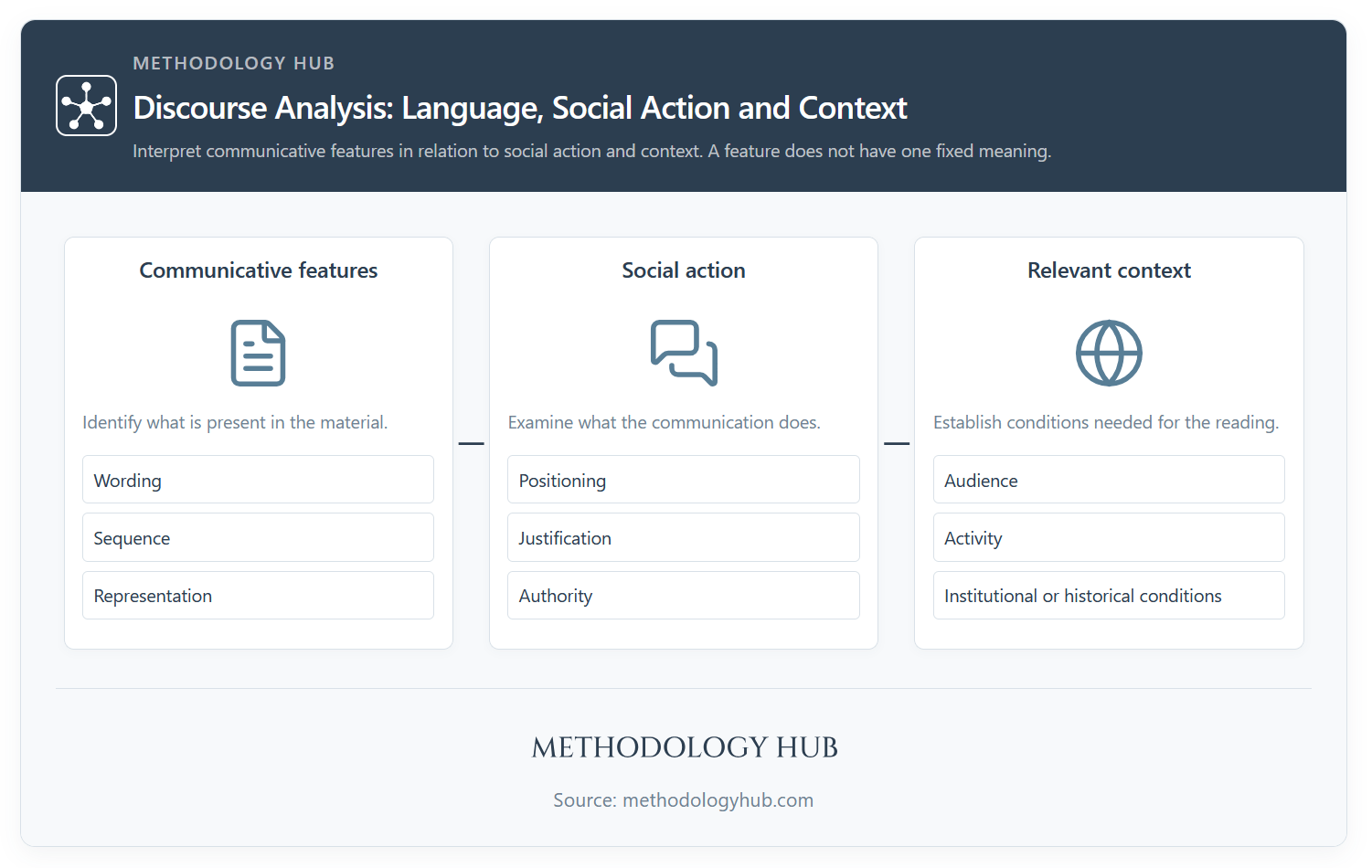
The purpose is to explain how communication works in a particular setting. A study may investigate how an account becomes credible, how a speaker claims authority or how a category acquires a taken-for-granted meaning. Its findings should identify the communicative features supporting that explanation, rather than simply report which topics appeared.
Key Characteristics of Discourse Analysis
Discourse analytical work treats wording, organisation and context as evidence. It attends to variation as well as repetition, since different formulations can accomplish different actions. Interpretation requires close examination of material and a stated theoretical position. There is no single coding scheme, sequence of steps or definition of context shared by every tradition.
What Is Discourse?
The meaning of discourse varies across the field. In interactional work, it often concerns connected language as people use it in an encounter. In other traditions, a discourse is an organised way of understanding and representing a subject, linked to particular concepts, practices and claims to knowledge.
These meanings direct attention towards different questions. Define how the term is being used in the study, then select material that can support that understanding. A collection of statements on the same topic does not automatically establish a coherent discourse.
Discourse Analysis in Qualitative Research
In qualitative research, discourse analysis is useful when the question concerns how communication shapes an account, relationship or social practice. The researcher selects evidence that preserves the wording, sequence or representation being examined and relates those details to the relevant context. Interviews, naturally occurring interaction, documents and multimodal material can all support this work. Quantitative descriptions may help locate linguistic patterns in a larger corpus, but their discursive significance still needs contextual interpretation.
Theoretical Foundations of Discourse Analysis
Theoretical assumptions influence what a researcher notices and what the analysis can claim. Some traditions concentrate on the local organisation of action; others examine broader relationships between discourse, institutions and knowledge. These differences need to remain visible throughout the study.
Language as Social Practice
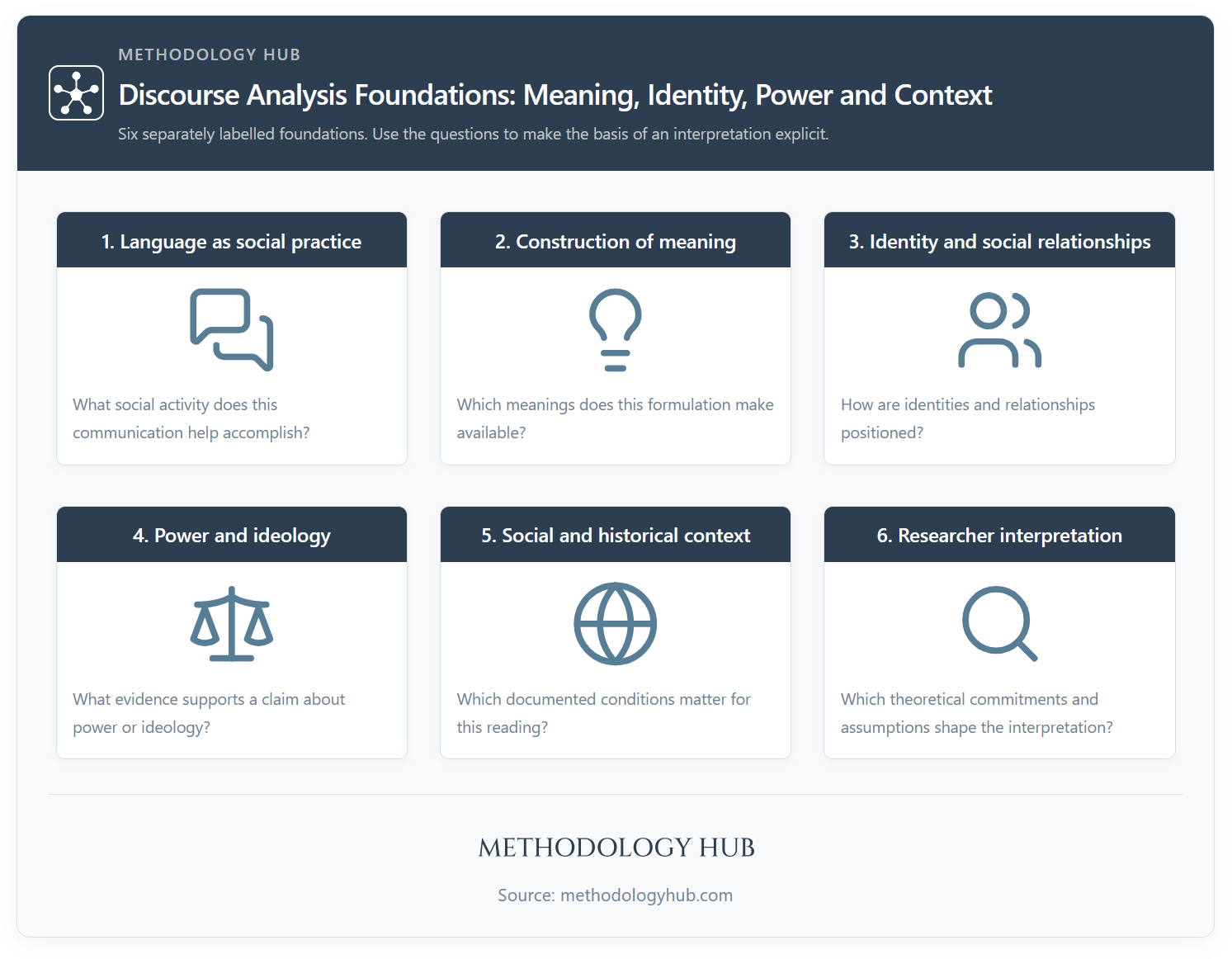
Language forms part of the activities people carry out together. Speaking and writing can establish obligations, make requests, resist accusations or authorise decisions. Analysis considers how an utterance functions within an activity and how others respond. A grammatical form alone does not determine the social action it performs.
Language and the Construction of Meaning
Descriptions select aspects of an event and connect them in particular ways. Naming, emphasis and grammatical organisation can make one account appear ordinary or persuasive while leaving alternatives less visible. Examining this construction does not require claiming that events are unreal. It concerns how versions of those events become understandable and consequential.
Discourse, Identity, and Social Relationships
Identity can be examined through the roles speakers claim, assign or resist. Forms of address, category labels and accounts of responsibility position people in relation to others. A subject position offers particular ways of speaking and acting within a discourse; it should not be treated as a permanent characteristic of every person addressed.
Discourse, Power, and Ideology
Critical traditions examine how communication relates to unequal authority and access to resources. Ideology can involve assumptions that sustain a particular social arrangement by making it appear natural or necessary. Such interpretations require evidence about language and the setting. The presence of an institution or a formal tone does not establish domination on its own.
The Importance of Social and Historical Context
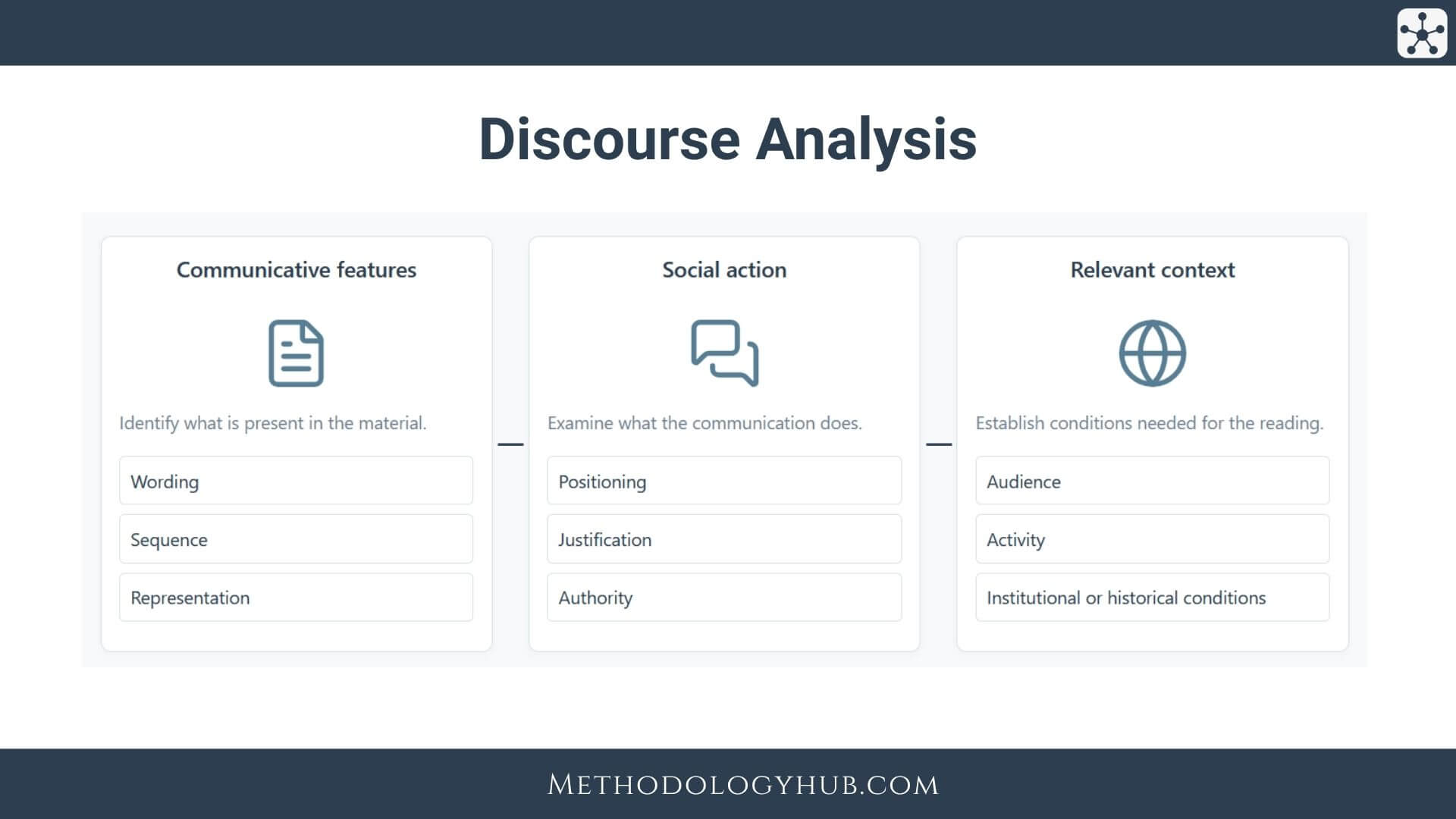
Context includes the immediate exchange, the activity and audience, and relevant institutional or historical conditions. Which elements require investigation depends on the analytical approach. Historical claims need records of change, while claims about interaction need evidence from the encounter rather than assumptions about how participants must have understood it.
The Role of the Researcher’s Interpretive Perspective
Researchers bring concepts and expectations to reading. Make those commitments explicit, including why one interpretation seems better supported than another. A useful analytical note distinguishes three related components:
- A feature directly identifiable in the communication.
- Contextual information obtained from the material or other relevant records.
- An interpretation explaining the relationship between the feature and that context.
Keeping these components connected makes it easier to challenge an attractive but unsupported reading. It also shows where further contextual evidence would change the scope of the conclusion.
Approaches to Discourse Analysis
Choosing a discourse analysis methodology means deciding how the study understands language, context and evidence. The approaches below offer different answers to those questions. Select one according to the explanation the research seeks, then use procedures consistent with its theoretical commitments.
Critical Discourse Analysis (CDA)
Critical discourse analysis investigates relationships among discourse, power and social inequality. It includes several approaches rather than one fixed framework. Norman Fairclough’s work connects textual analysis with the production and interpretation of texts and wider social practice. A critical study must explain how specific representations relate to the institutional arrangements under examination.
Foucauldian Discourse Analysis
Foucauldian discourse analysis draws on Michel Foucault’s work on discourse, knowledge and power. It examines how objects of knowledge become intelligible, which subject positions are available and what can count as a legitimate statement. The analysis commonly extends beyond individual wording to practices and historical conditions. It does not seek a hidden intention behind every sentence.
Discursive Psychology
Discursive psychology examines how psychological descriptions and claims operate in communication. Work associated with Derek Edwards and Jonathan Potter investigates how accounts of knowledge, memory, attitudes or intentions contribute to social action. Instead of treating talk simply as a report of an internal mental state, it examines how those descriptions are used within an encounter or text.
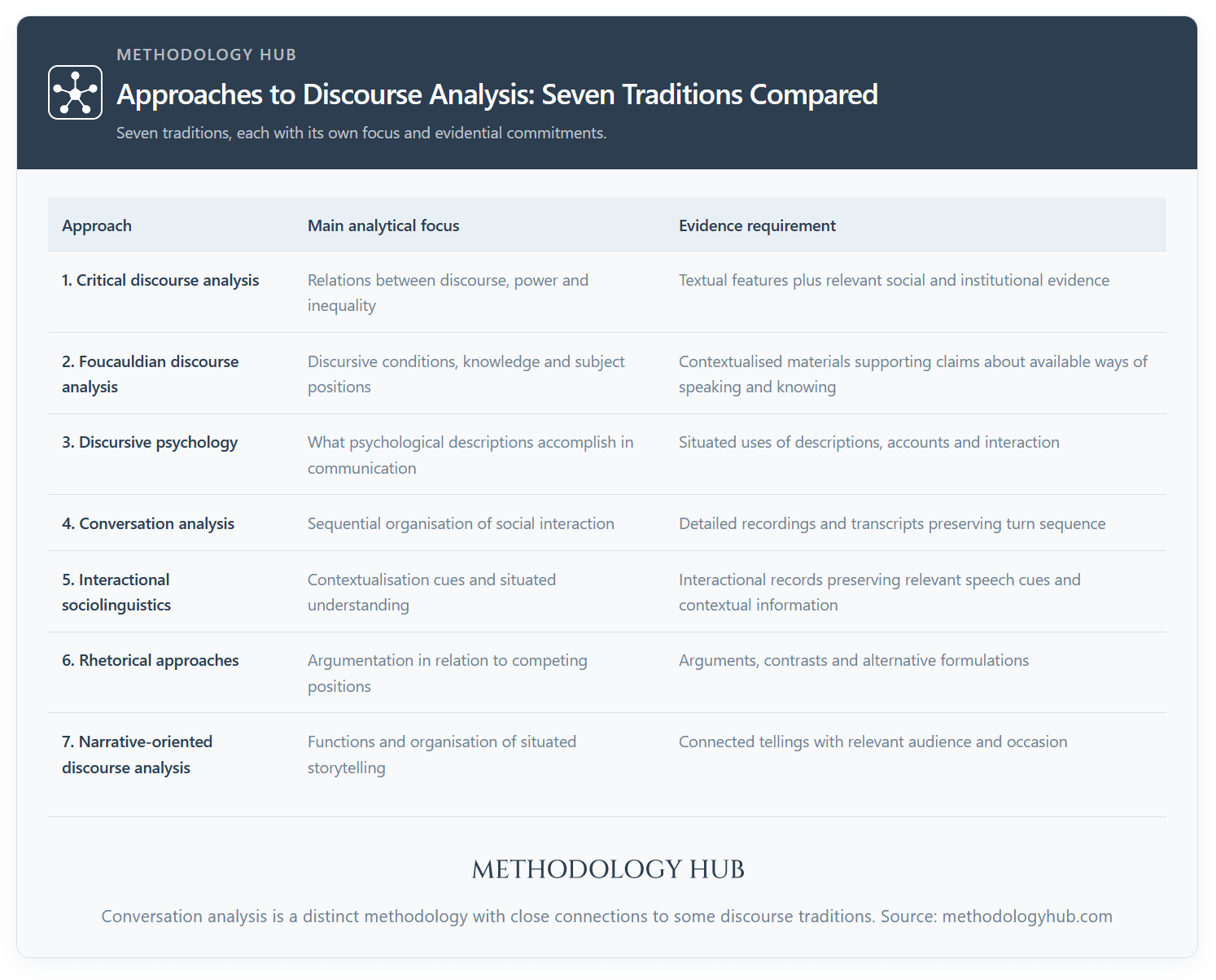
The comparison below identifies each tradition’s main emphasis. The research questions are broad analytical prompts; the study still needs a defined setting, corpus and theoretical rationale.
| Approach | Main focus | Typical material | Analytical question |
|---|---|---|---|
| Critical discourse analysis | Discourse in relation to power and inequality | Institutional texts, public communication and interaction | How does this representation support or contest a social arrangement? |
| Foucauldian discourse analysis | Knowledge, subject positions and discursive conditions | Related texts, institutional practices and historical records | What becomes sayable or authoritative within this discourse? |
| Discursive psychology | Psychological descriptions as social action | Recorded interaction and situated accounts | How is a claim about knowledge or intention used here? |
| Conversation analysis | Sequential organisation of social action | Detailed recordings of interaction | How do participants produce and recognise this action? |
| Interactional sociolinguistics | Contextualisation and conversational inference | Speech recordings with contextual information | Which cues guide participants' interpretation of the exchange? |
| Rhetorical approaches | Argument, persuasion and anticipated opposition | Arguments in spoken and written communication | How is a position made reasonable against alternatives? |
| Narrative-oriented discourse analysis | Storytelling, identity and positioning | Situated personal or public narratives | What does this telling accomplish for this audience? |
Conversation Analysis
Conversation analysis studies how participants organise actions through sequences of interaction. Research associated with Harvey Sacks, Emanuel Schegloff and Gail Jefferson examines turn-taking, repair and the relationship between adjacent actions. It has a close relationship with some discourse traditions but is also a distinct methodology. Detailed sequential evidence takes priority over imposing an external explanation on the encounter.
Interactional Sociolinguistics
Interactional sociolinguistics examines how people infer meaning through linguistic and contextual cues. John Gumperz’s work gives attention to intonation, rhythm, language varieties and other contextualisation cues. The analysis asks how these features guide understanding in an encounter. Differences in interpretation should be demonstrated rather than attributed automatically to a speaker’s cultural background.
Rhetorical Approaches to Discourse
Rhetorical approaches examine how arguments make a position persuasive or defensible. Attention may fall on contrasts, concessions, appeals to shared assumptions and responses to anticipated objections. Michael Billig’s work connects argumentation with everyday thinking and social psychology. The relevant question concerns how a position is built in relation to alternatives, including alternatives left implicit.
Narrative-Oriented Discourse Analysis
Narrative-oriented discourse analysis examines storytelling as situated communication. It considers how an account presents identity, allocates responsibility and addresses an audience through its sequence and evaluation. This is a broad orientation rather than one standard procedure. State whether the analysis focuses on narrative positioning, rhetorical function, interaction or another specified concern.
When to use Discourse Analysis?
Discourse analysis can examine conversations, interviews, speeches, news articles, policies, social media posts, images and videos. Researchers study how these materials present people and events, assign responsibility, express authority or shape relationships.
Spoken Conversations and Interactions
Recordings preserve sequences, timing and participants’ responses that written summaries can lose. Define the encounter boundaries and retain enough preceding and following talk to understand the selected exchange. For analyses involving gesture or gaze, audio alone may leave relevant actions unavailable.
Interviews and Focus Group Discussions
In qualitative interviews, the researcher’s questions help shape the account. Include them when examining how a response is constructed. Focus-group material also requires attention to agreement, disagreement and contributions that redirect the discussion. Statements should not be treated as independent answers if their function depends on the group exchange.
Political Speeches and Public Statements
Public statements can be examined for audience positioning, argumentation and claims to authority. Retain information about the occasion, speaker role and intended circulation. A prepared text and its delivered version may differ; choose the version appropriate to the question and distinguish rhetorical construction from evidence of actual audience response.
News Articles and Media Discourse
News analysis can investigate naming, headlines, quotation patterns and whose accounts receive credibility. Preserve the complete item, publication context and relevant images. When comparing outlets or periods, explain the selection criteria so that an apparent contrast is not simply an effect of choosing different genres or stages of an event.
Institutional Documents and Policies
Documents can establish categories, allocate duties and define acceptable action. Record authorship, document status, version and intended audience. A policy states an institutional position, but does not establish how it was implemented or received. Claims about practice require material that shows how the document entered actual activity.
Social Media and Digital Communication
Digital material may include posts, replies, quotations, images and platform-specific features. Preserve the relevant thread and the relationship between messages rather than collecting isolated phrases. Edits, deleted contributions and platform selection can limit the available record. Visible reactions indicate a form of response without necessarily revealing the audience’s reasoning.
Visual and Multimodal Discourse
Multimodal discourse analysis examines how speech, writing, images, sound and bodily action work together. Research informed by visual methods can attend to layout, framing, gaze, salience and the timing of different modes. Work by Gunther Kress and Theo van Leeuwen provides one influential social-semiotic orientation; visual features still need interpretation in their conditions of production and use.
Key Features in Discourse Analysis
The features worth examining depend on the research question and analytical tradition. A study does not become more convincing by naming every linguistic device. Select features whose function can be explained through the material, and examine how several choices work together.
Word Choice and Naming
Naming places people, events and activities within categories that carry expectations. Compare the labels used, who applies them and whether alternatives appear. Examine grammatical agency as well: who is presented as acting, who receives an action and whether an actor is left unspecified. These observations can support claims about representation without proving deliberate concealment.
Framing and Representation
Framing concerns how communication organises an issue into an intelligible account. It can establish what counts as the problem, which causes receive attention and which responses appear appropriate. Trace the frame across wording, emphasis and document organisation. A single prominent term rarely establishes the complete representation by itself.
Metaphors and Figurative Language
Metaphors connect one area of experience with another, making some associations readily available. Examine how a metaphor develops, what actions it makes understandable and whether the material challenges its implications. Avoid assigning a fixed meaning to a familiar expression without considering how it is used in the surrounding communication.
Pronouns and Identity Construction
Pronouns can establish inclusion, distance or collective responsibility. Examine the referents of first-, second- and third-person forms and whether those referents shift. A collective pronoun may suggest shared interests while leaving membership unclear. Its significance depends on who is speaking, to whom and within what relationship.
| Feature | What to examine | Evidence supporting interpretation |
|---|---|---|
| Naming and agency | Labels, grammatical actors and omitted agents | Contrasts in who receives responsibility or recognition |
| Framing | Problem definitions, causes and proposed responses | A connected representation across the material |
| Metaphor | Associations carried between areas of meaning | How the association is developed or resisted |
| Pronouns | Reference, inclusion and changes in collective identity | The relationship between speaker, audience and named groups |
| Modality | Obligation, permission, likelihood and commitment | Grammatical force read alongside source authority |
| Presupposition | Information treated as already established | Linguistic triggers and the assumptions they introduce |
| Omission | Relevant information absent from a defined record | A justified expectation of inclusion and suitable comparison |
| Interaction | Turn position, timing, overlap and repair | Participants' responses and subsequent actions |
| Intertextuality | Quotation, citation and reworked formulations | Connections with identifiable texts or discourse conventions |
Modality, Certainty, and Authority
Modality expresses degrees of obligation, permission, possibility or commitment. Distinguish requirements from predictions and promises, then examine who is entitled to make them. Strong grammatical certainty does not necessarily establish factual accuracy. The analytical issue is how certainty is presented and what it contributes to the activity or argument.
Presuppositions and Implicit Assumptions
Presuppositions present information as already accepted rather than making it the main point of an assertion. Examine the wording that supports the presupposition and whether recipients accept or challenge it. Broader assumptions also deserve attention, but they should not all be labelled grammatical presuppositions. Make the basis of the inference explicit.
Silences, Exclusions, and Omissions
An omission becomes analytically useful when there is a reason to expect the missing material. Establish the relevant genre, comparison or interactional opportunity before interpreting absence. Silence within an encounter is also different from the absence of a perspective in a document collection. Neither automatically establishes agreement, censorship or intentional exclusion.
Interactional Features and Turn-Taking
Examine how turns respond to earlier actions and shape what can happen next. Pauses, overlap and repair can contribute to the organisation of an exchange, but their functions depend on placement and response. Detailed transcription supports these claims. A thematic summary of the discussion usually removes the timing and sequence needed for interactional analysis.
Intertextuality and References to Other Discourses
Intertextuality concerns the presence or transformation of other texts within communication. Quotation, citation and recognisable formulations can introduce authority or distance a speaker from a claim. Interdiscursivity concerns the combination of different discourse types or genres. Trace these connections where the material supports them rather than treating every resemblance as evidence of borrowing.
How to Do Discourse Analysis
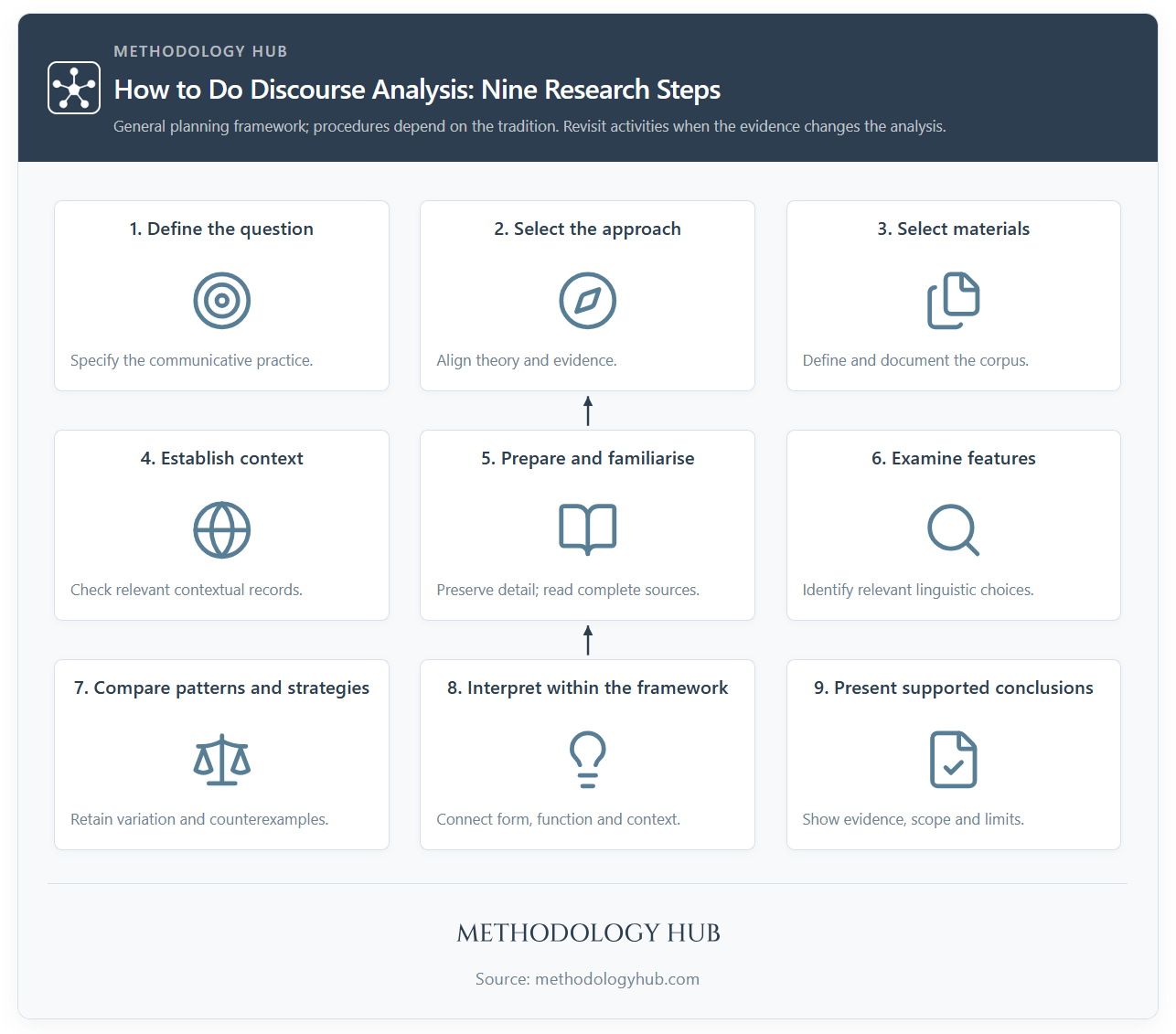
To do discourse analysis, define a question about communication, choose an analytical approach, select relevant material and examine how its language functions in context. Develop interpretations through comparison and support the findings with extracts and contextual evidence. The steps below provide a flexible framework; their detailed application depends on the tradition.
Define the Research Question
Formulate a question about what communication constructs or accomplishes. Specify the setting, activity or discourse being examined and the level of explanation sought. A question about how meaning is produced needs different evidence from a question about whether participants report a shared experience.
Select a Discourse Analytical Approach
Choose an approach whose theoretical commitments fit the question. Explain what the analysis treats as discourse and how it understands context. Combining concepts can be defensible, but each contribution needs a clear role. Naming several traditions without explaining their relationship leaves the reader unable to judge the analytical procedure.
Identify and Select Research Materials
Define the corpus through explicit inclusion and exclusion criteria. Record why each source belongs, its relevant characteristics and any gaps in coverage. Sampling should support the proposed comparison or interpretation. A small corpus can sustain detailed analysis, but the claim must remain proportionate to its scope.
Establish the Social and Historical Context
Gather information about production, circulation, institutional roles and the period relevant to the material. Distinguish contextual facts from assumptions inferred through reading. Do not add a broad history merely as background; identify the conditions needed to explain the communication under examination.
Before close analysis, check the relationship among the main design decisions:
- The question identifies a communicative practice or construction to investigate.
- The chosen tradition specifies what counts as relevant evidence.
- The corpus has documented boundaries and source information.
- The contextual records support the level of interpretation proposed.
- The recording or transcription preserves the features being examined.
Prepare and Become Familiar With the Material
Read or view complete sources before extracting passages. Transcribe to the level required, retain layout or visual sequence where relevant and record early questions. General procedures from qualitative data analysis can support organisation, but preparation should preserve the linguistic and contextual detail needed by the discourse approach.
Examine Relevant Linguistic and Discursive Features
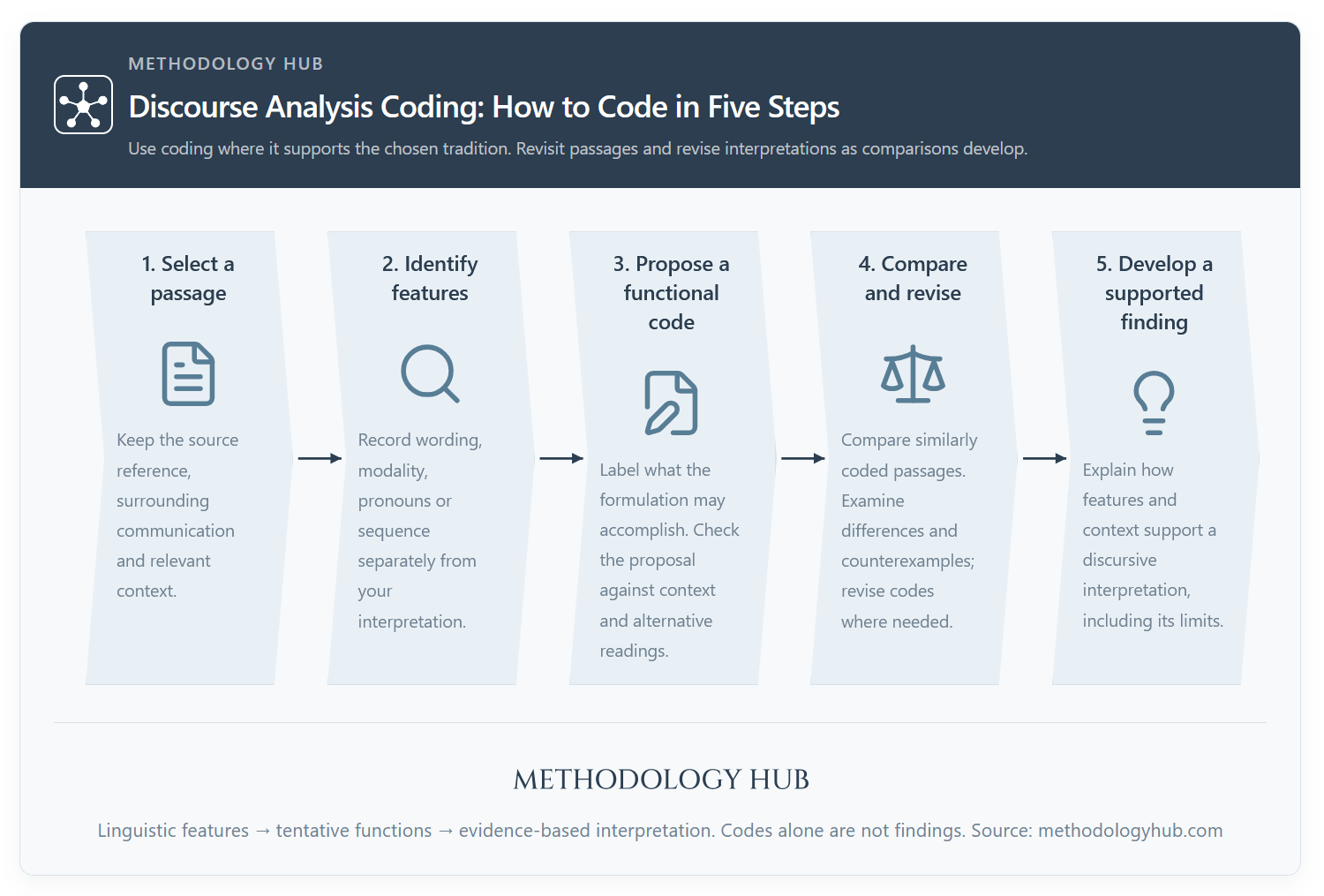
Read selected passages closely and annotate features relevant to the question. Record their location and retain enough surrounding material to examine their function. Where coding helps organise the work, use it to support comparison; the interpretation still depends on reading the communication in context.
Identify Patterns, Differences, and Discursive Strategies
Compare how formulations operate across the selected material. Examine variation, counterexamples and shifts between genres or audiences. A discursive strategy need not be consciously planned by its author. Use the term to describe an evidenced way of accomplishing something, without treating it as proof of private intention.
Interpret Findings Within the Chosen Framework
Connect linguistic observations with the concepts and contextual evidence appropriate to the approach. Consider alternatives and identify what would distinguish them. Where the material supports several readings, qualify the interpretation. Theoretical vocabulary should clarify the reasoning rather than substitute for it.
Present and Support Analytical Conclusions
Build the report around claims supported by carefully contextualised extracts or interactional sequences. Explain the contribution of each passage and retain material that restricts the claim. Readers need enough detail to assess the reading without having to accept the researcher’s authority in place of evidence.
Coding in Discourse Analysis
Coding in discourse analysis marks features or practices for closer examination and comparison. It can help retrieve related passages, track alternative formulations and record changes in interpretation. Its usefulness depends on the approach: a study may use extensive coding, selective annotation or a close reading organised around sequences or whole texts.
What Do You Code in Discourse Analysis?
Select codes according to the question and the evidence the approach examines. Some labels identify linguistic features, including naming, modality, pronoun reference or reported speech. Others record a proposed discursive practice, such as claiming expertise, assigning responsibility or anticipating an objection. Distinguish these levels so that a grammatical observation is not silently treated as an established social function.
Keep the wording or interaction behind each label available. A functional code is an interpretation to examine against the surrounding material and contrasting cases. Applying it repeatedly does not, by itself, demonstrate that the proposed practice operates in the same way across every passage.
Selecting Segments and Recording Context
Code enough material to preserve the relationship being investigated. A clause may contain a relevant modal expression, while its function may depend on a preceding question or the rest of the document. Keep source identifiers, passage locations and contextual notes alongside the coded extract.
In recorded interaction, preserve relevant turns before and after the selected passage. In multimodal material, link the annotation to the image, gesture or timing it concerns. Segment boundaries should follow the analytical need rather than a rule that every code must cover one sentence.
Developing and Revising Codes
Codes can draw on concepts specified by the approach or develop through close reading. Record where a label came from and what evidence would justify applying it. A coding record may include the feature identified, the tentative function, the source location and an alternative reading. This makes it possible to review the inference as well as the label.
Revise codes when comparison reveals differences that the initial label obscures. Revisit earlier passages after a consequential change. A shared codebook can help some projects organise definitions and decisions, but it is not a universal requirement or a substitute for the methodological commitments of a particular discourse tradition.
Comparing Coded Passages
Retrieve related passages and examine how wording, audience, genre or sequential position changes their function. Similar expressions may accomplish different actions, while different expressions may perform comparable work. A code frequency can describe the coding record without explaining those relationships.
Look for material that resists the code’s proposed meaning. It may require a narrower definition or a different account of the practice. Retain that comparison in an analytical memo so the eventual finding shows how the interpretation developed.
Moving From Codes to Discursive Findings
Use the coding record to develop an argument about communication. Explain which features work together, what function they support and how context enters the interpretation. Code names alone leave these relationships unstated. The final account needs extracts and reasoning that allow the proposed reading to be assessed.
The distinction from thematic coding concerns the analytical purpose, rather than the mere use of labels. A discourse study organises its coding around communicative construction or action. A thematic study may use codes to develop patterns of meaning across accounts. Their procedures can overlap, so explain what the coding contributes to the question instead of assuming the label identifies the method.
Discourse Analysis Example
Introducing the Research Question
The research question is: how do university communications represent students’ responsibility for academic success? The example examines how grammatical choices and descriptions allocate responsibility within institutional communication. It follows the material from initial annotation to a contextual interpretation, keeping claims about representation distinct from claims about behaviour or private motives.
Selecting the Research Material
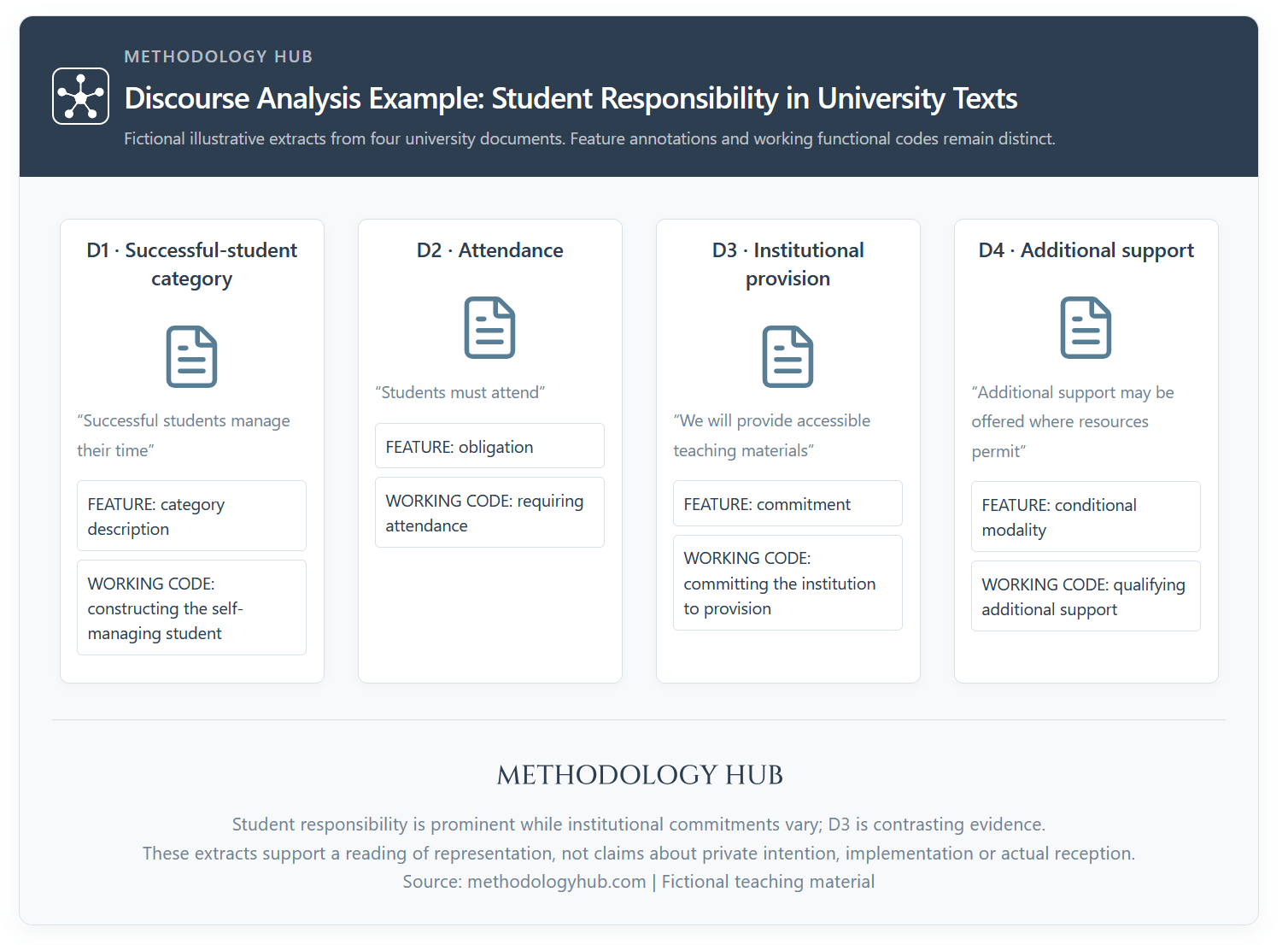
The corpus contains four fictional institutional extracts: a welcome message, an attendance notice, a support policy and a service update. These illustrative materials offer contrasting formulations within one setting. A research study would retain the complete documents, their dates, audiences and publication status before selecting passages for reporting.
Identifying Relevant Language Choices
Begin by marking who is assigned action and how strongly that action is required or promised. D1 links successful identity with particular conduct. D2 addresses students directly through an obligation. D3 names an institutional commitment, while D4 makes support conditional and leaves the provider grammatically unspecified.
Discourse Analysis Coding Example
Annotate the grammatical feature first, then record the proposed function separately. In D2, the modal verb “must” expresses obligation; the functional code requiring student attendance states what that obligation concerns. In D3, “we will” supports a different code, committing the institution to provision. Both passages concern responsibility, but placing them under that topic alone would lose the contrast between who acts and what is promised or required.
| Fictional text excerpt | Feature identified | Working functional code | Interpretation to examine |
|---|---|---|---|
| D1, welcome message: “You shape your success. Successful students manage their time and seek support early.” | Direct address and category description | Constructing the self-managing successful student | Success is represented through an active, responsible student identity |
| D2, attendance notice: “Students must attend all scheduled sessions. If you fall behind, contact your tutor.” | Obligation and conditional instruction | Requiring attendance and student-initiated contact | Students are positioned as responsible for compliance and initiating support |
| D3, support policy: “We will provide accessible teaching materials and review barriers reported by students.” | Collective pronoun and commitment | Committing the institution to provision | Responsibility includes institutional action alongside student reporting |
| D4, service update: “Additional support may be offered where resources permit.” | Conditional modality and passive construction | Qualifying additional provision by resources | Additional support is presented as contingent rather than guaranteed |
Keep D4’s code provisional in relation to the full document. Its wording qualifies additional provision, so a broader label such as withholding support would add an unsupported conclusion. Record this boundary in the coding notes before comparing the clauses. The table preserves the path from a visible feature to a proposed function without presenting that function as a fact established by coding alone.
Examining Framing and Subject Positions
D1 does more than mention time management. By describing what successful students do, it offers a model of the competent student against which conduct can be assessed. D2 extends that positioning through an explicit requirement and an instruction to initiate contact. Together, the extracts make self-directed action central to the representation of academic participation.
That does not establish how every student understands the messages. A reader may accept, resist or ignore the position offered. The texts provide evidence about the representation made available; reception would require further material.
Considering the Institutional Context
Genre affects the force of the wording. A welcome message encourages identification, an attendance notice states a requirement, and a policy may record an institutional commitment. D4 concerns additional provision, so it cannot automatically be treated as cancelling the commitment in D3. The documents’ respective status and scope need checking before a broader conclusion is drawn.
Identifying Discursive Patterns
Compare D2’s requirement with D4’s conditional provision: student attendance is expressed as an obligation, whereas additional support depends on available resources. D1’s account of success gives this contrast a wider identity dimension. The pattern concerns how duties and commitments are formulated, rather than how frequently the word responsibility appears.
D3 prevents a claim that the institution assigns all responsibility to students. It names institutional action and acknowledges barriers. Retaining this contrast produces a more precise finding: different forms of responsibility coexist, and their force varies with the document and the kind of provision being described.
Interpreting the Findings
A defensible interpretation is that these communications foreground active student responsibility while expressing institutional obligations in different forms. Some provision is promised; additional support is conditional. The analysis links that distinction to direct address, modality, category construction and grammatical agency.
The extracts do not show whether resources are adequate, whether support is delivered or whether students experience the messages as blame. Establishing those claims would require other evidence. Nor does the passive construction in D4 prove an intention to evade accountability; it supports the narrower observation that the provider is less explicit in that clause.
Presenting the Analysis
A findings paragraph can bring the observations together while retaining the contrast that limits the claim:
Short discourse analysis findings paragraph
The communications make active student responsibility prominent without assigning all responsibility to students. D1 associates success with self-management, while D2 requires attendance through “must” and instructs students to initiate contact when difficulties arise. Institutional provision has a less uniform formulation: D3 commits to accessible materials through “we will”, whereas D4 makes additional support conditional on resources. The contrast concerns the representation of duties and commitments across document genres. It supports an interpretation of differently specified responsibilities, but does not establish institutional neglect, deliberate blame or students’ acceptance of the positions offered.
The paragraph explains what the wording accomplishes in the supplied documents and shows why an unrestricted claim would fail. A complete report would place the extracts within their source texts and assess whether the same interpretation holds across the defined corpus.
Discourse Analysis vs Other Methods
Several qualitative methods can examine the same material while producing different kinds of findings. The decision concerns the analytical question, not a rule assigning one data type to one method. Context is relevant across these approaches, although its role and treatment vary.
Discourse Analysis vs Thematic Analysis
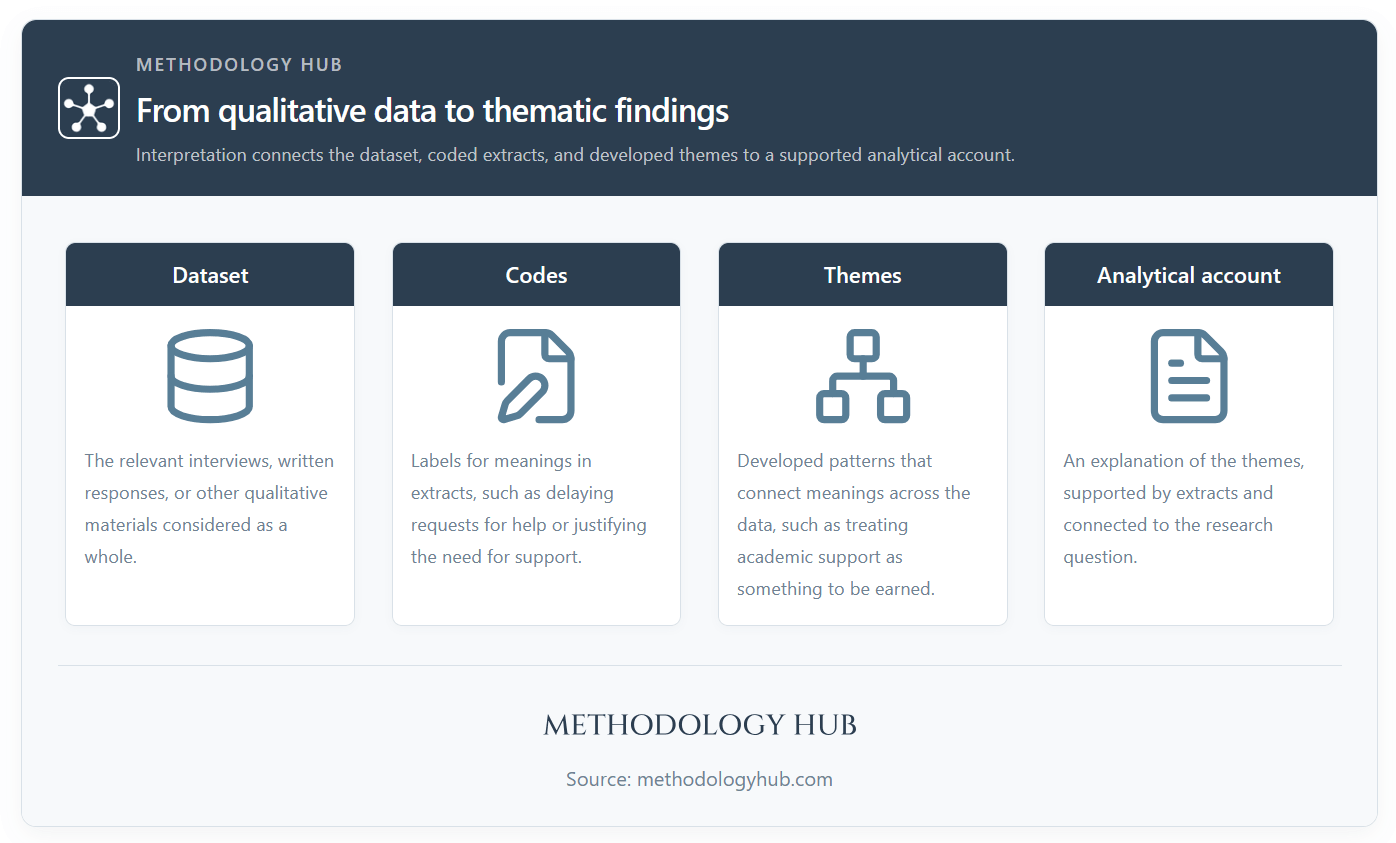
Discourse analysis examines how communication constructs meanings or performs actions in context. Thematic analysis develops patterns of meaning across the material relevant to a question. Constructionist thematic work can also examine how meanings are produced, so the distinction depends on the study’s actual analytical practice rather than the label alone.
Discourse Analysis vs Content Analysis
Qualitative content analysis usually organises and interprets material through categories. Discourse analysis more directly examines what formulations accomplish and how their organisation supports that function. Content analysis can address latent meaning as well as explicit content; reducing the comparison to counting versus interpretation would misrepresent the available approaches.
Discourse Analysis vs Narrative Analysis
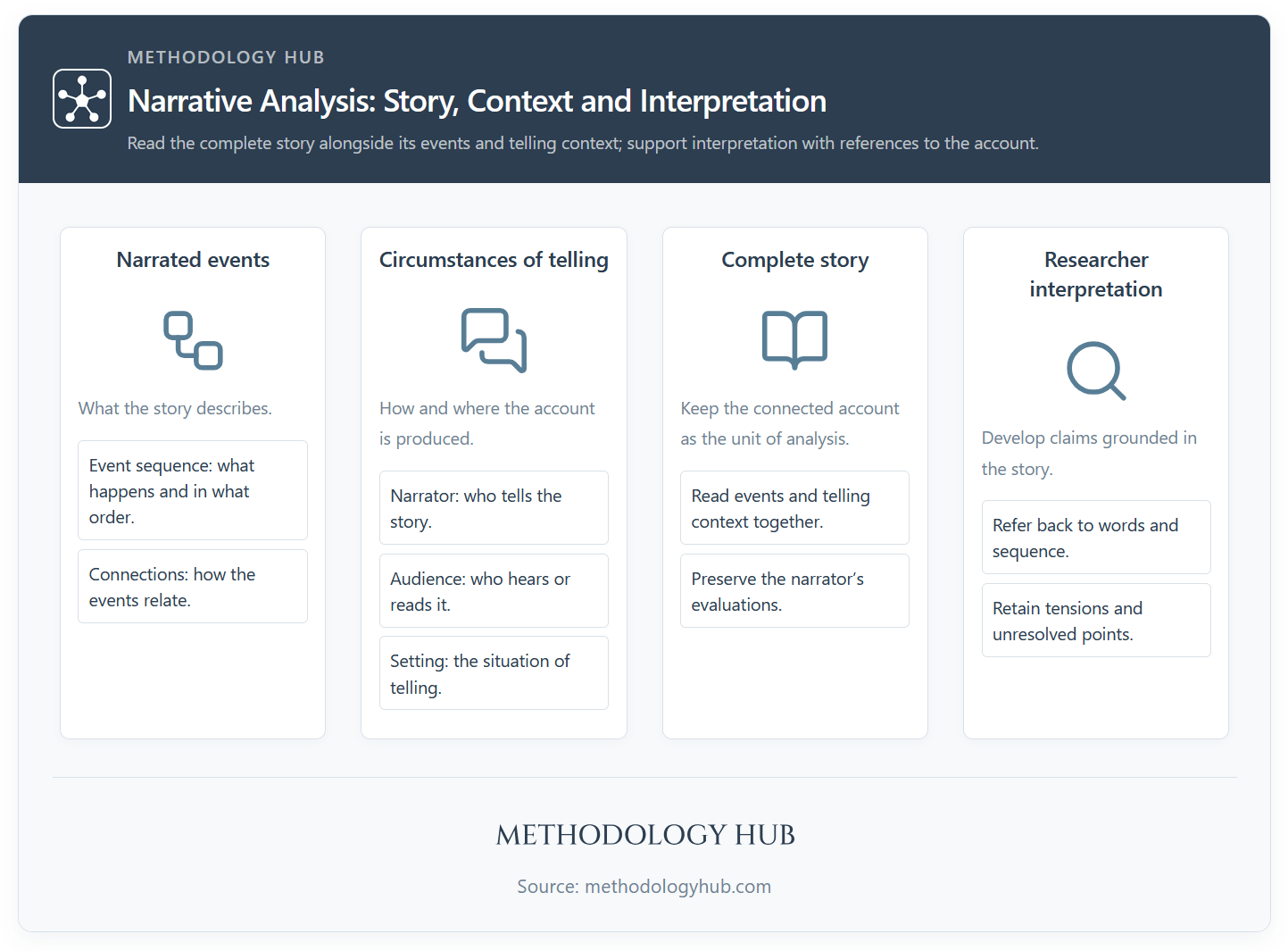
In narrative analysis, the organisation of a connected account is often central evidence. Discourse-oriented narrative work overlaps with this interest when examining identity, positioning or the function of storytelling. Specify whether the analysis follows the account’s development, compares discursive constructions or combines these purposes with a clear rationale.
Discourse Analysis vs Conversation Analysis
Conversation analysis examines participants’ organisation of action through sequential detail. Some discourse analytical work draws on this tradition, while other approaches use broader historical or institutional frameworks. Present conversation analysis as a distinct methodology with close intellectual connections to parts of discourse research, rather than a generic technique for analysing any spoken material.
| Method | Main objective and focus | Role of context | Typical finding and question |
|---|---|---|---|
| Discourse analysis | Explain communicative construction or action | Specified through the chosen tradition | How a formulation establishes a position, account or relationship |
| Thematic analysis | Develop patterns of meaning | Supports interpretation of extracts and the dataset | What shared understanding connects relevant accounts? |
| Qualitative content analysis | Interpret systematically developed categories | Gives categories and their contents meaning | How is a concern represented across the selected material? |
| Narrative analysis | Interpret connected accounts and their organisation | Includes sequence, telling situation and life or social context | How does a story make experience understandable? |
| Conversation analysis | Explain the organisation of interaction | Examined through the unfolding encounter and participant orientations | How is an action produced, recognised or repaired? |
Choosing Between Analytical Methods
Start with the intended finding. If the explanation depends on how wording, sequence or representation accomplishes something, a discourse approach may fit. If the priority is a pattern across accounts or the development of a particular story, examine what thematic or narrative work would contribute.
Then check whether the available material preserves the required evidence. Detailed interactional claims need more than a polished summary, while historically situated claims need more than a collection of current quotations. Method choice and data preparation should support the same analytical objective.
Advantages and Limitations
Discourse analysis is useful when the organisation of communication is part of the phenomenon being studied. Its strengths depend on the quality of the material and the connection between detailed observations and larger claims. Close reading alone does not remove the need to justify selection and interpretation.
Advantages of Discourse Analysis
The method can make routine assumptions, categories and relationships available for examination. It helps explain how authority, credibility or responsibility is established through communication. Attention to variation also reveals how a position changes across audiences or occasions, allowing the study to examine flexibility and contradiction rather than forcing every account into one stable attitude.
Limitations and Methodological Challenges
Detailed analysis can be demanding, especially when it requires transcription, historical records or multiple modes of communication. A selected corpus may support a specific interpretation without establishing how common the practice is. Missing production or reception evidence also limits claims about why a text was created and what effects it had.
Researcher Interpretation and Reflexivity
Researchers decide which features to foreground and which comparisons to pursue. Record these choices and consider readings that challenge the preferred account. Reflexivity should identify consequences for analysis, including how theoretical commitments made particular questions visible. It does not require pretending that interpretation can become perspective-free.
Contextual Dependence of Findings
A discursive practice may have a different function in another activity, genre or period. Describe the conditions under which the interpretation holds so readers can judge its wider relevance. Transferability involves a reasoned assessment of those conditions, not simply repeating the same interpretation wherever similar words occur.
Quality, Transparency, and Analytical Rigor
Quality rests on a coherent relationship between question, approach, material and evidence. The report should make the analysis inspectable by providing extracts, contextual information and the reasoning that connects them. Useful checks include:
- Whether the claimed function is supported by more than a descriptive label.
- Whether counterexamples have changed or restricted the interpretation.
- Whether contextual claims have an identifiable evidential basis.
- Whether the conclusions remain within the scope of the material.
Review procedures should fit the tradition. Agreement between coders is not a universal test of discourse analysis, and frequency does not determine every finding’s importance. A well-supported interpretation can remain open to a different reading if that reading accounts for the evidence more convincingly.
Strengthening Discourse Analysis
Revising an analysis means checking what each claim depends on. Weaknesses often occur when a description of language is made to carry a conclusion about social action, power or intention that the evidence has not established. The remedy is to examine the missing connection.
Treating Discourse Analysis as Simple Word Counting
Frequency can help locate a recurring form or compare a corpus, but it cannot establish what the form does in context. Read occurrences in their surrounding material and examine variation. If numerical patterns support the argument, explain the corpus boundaries and counting decisions alongside the qualitative interpretation.
Confusing Topics or Themes With Discursive Functions
A topic identifies what communication concerns. A discursive function concerns what a formulation accomplishes within an activity or representation. Ask how the wording supports the proposed function and what changes when the formulation changes. Relabelling a topic with theoretical language leaves this analytical work undone.
Ignoring Social and Historical Context
Identify which contextual conditions the interpretation requires, then obtain the relevant evidence. Avoid treating broad claims about society as an explanation of every passage. The analysis should show why a particular institutional arrangement, historical development or interactional circumstance is relevant to the observed communication.
Applying Multiple Analytical Traditions Inconsistently
Check whether the theoretical assumptions and procedures used can work together. A claim about participants’ displayed understanding needs interactional evidence, while a historical claim requires a different basis. If the study combines perspectives, explain how each contributes and where their conclusions remain distinct.
Making Unsupported Claims About Power or Intentions
Separate the authority associated with a source, the representation made available and any demonstrated effect. Claims about deliberate manipulation require evidence of intention; claims about reception require evidence of response. An analysis can identify a discursive pattern without asserting that its author consciously designed every consequence.
Overlooking Contradictory Evidence
Search for formulations or cases that complicate the proposed account. They may reveal a change in audience, a genre difference or an alternative position within the corpus. Record how the contradiction affects the finding. Keeping it visible often produces a more precise explanation than treating variation as a distraction.
Describing Linguistic Features Without Interpreting Their Function
After identifying a pronoun, metaphor or modal expression, explain its role in the surrounding communication. Consider what the observation contributes to the question and which contextual evidence supports that contribution. If the link remains unclear, the feature may belong in preliminary notes rather than in the final analytical argument.
Conclusion
Discourse analysis investigates how communication constructs meaning and contributes to social activity. Its traditions offer different ways to examine language, representation and interaction, with different requirements for material and contextual evidence.
A convincing study makes those choices explicit. It shows which features support the interpretation, how context enters the explanation and where another reading or missing evidence limits the claim. The result is an account of how communication works in the setting examined.
Cite this article
Whether you are preparing course materials, writing an academic paper, or sharing resources with students, we kindly ask that you acknowledge Methodology Hub as the source.
To make referencing easier, you can use the “Cite this page” tool below to automatically generate a citation in your preferred referencing style, including APA, MLA, Chicago, Harvard, and others. Simply select a citation style and click the generated reference to copy it.
When reproducing images, figures, or other materials from this page, please include an appropriate source credit and a link to the original page. Proper attribution helps others locate the original material and supports the continued development of freely accessible educational resources.