Thematic analysis is a method of interpreting patterns of meaning across qualitative data. Researchers use it to examine how people understand experiences, describe situations and make sense of their social worlds. Within qualitative research, it can support both detailed descriptions and more interpretive explanations.
It belongs to the wider range of qualitative research methods, but it concerns analysis rather than data collection. Interview transcripts, group discussions, diaries and documents can all provide material for a thematic study.
This article explains how thematic analysis works, how its approaches differ and how researchers develop codes into themes.
What Is Thematic Analysis?
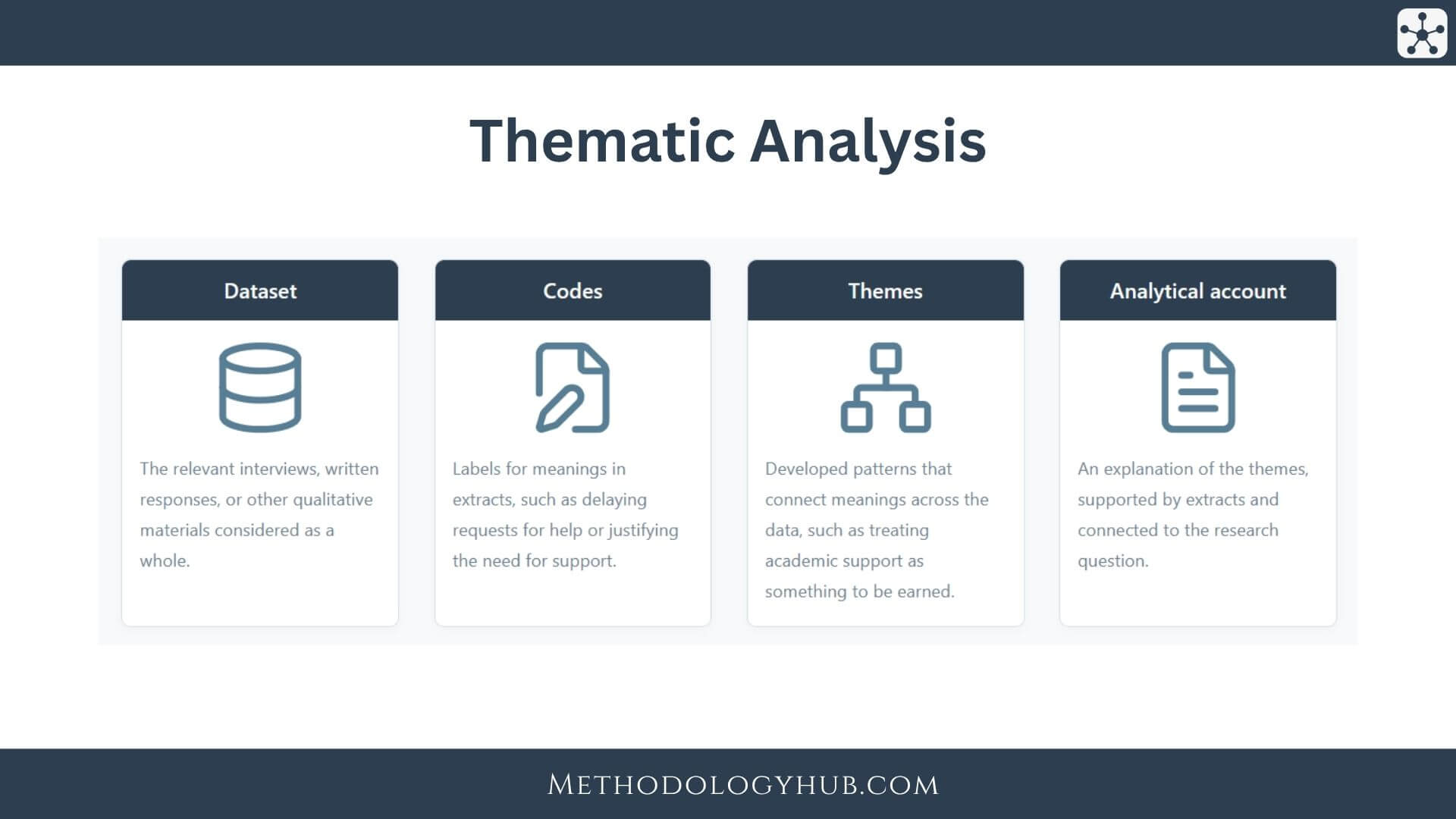
Thematic analysis involves working across a dataset to develop an account of meaningful patterns relevant to a research question. A study might examine how students judge whether they need academic support. The analysis would investigate how students describe difficulty, independence and asking for help, then consider how those meanings connect across their accounts.
The dataset consists of the material selected for analysis, such as a collection of interview transcripts. Each transcript is a data item; a passage selected from it is a data extract. Keeping these relationships visible helps a researcher move between a particular statement, the surrounding conversation and patterns across the wider collection.
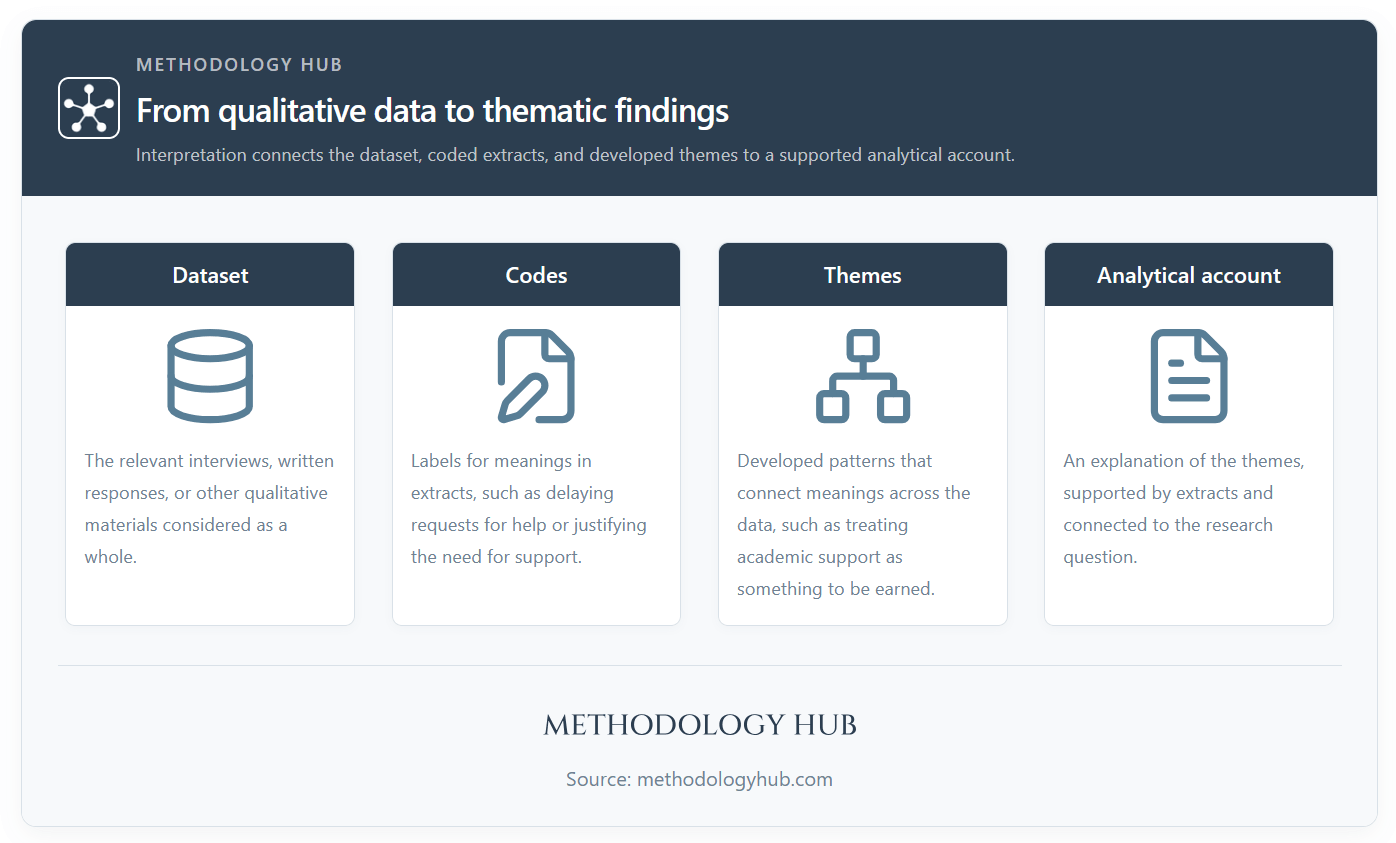
Coding begins that process of comparison. A code draws attention to something relevant in an extract, such as “waiting until the problem becomes serious”. As coding develops, the researcher considers how this idea relates to other accounts. Delaying a request, apologising for a question and comparing oneself with more deserving students might contribute to a theme about having to justify the need for help.
The word theme needs some care because thematic approaches do not all use it identically. In reflexive thematic analysis, a theme develops a pattern of shared meaning around a central organising concept. Other approaches may organise findings through broader topic summaries. A methods section should explain what counts as a theme in that particular study.
Thematic analysis is therefore a family of approaches rather than one procedure with interchangeable quality checks. Researchers need to specify which approach they use, how they understand meaning and what kind of claim they intend to make. These decisions affect coding, collaboration, theme development and the final report.
When Is Thematic Analysis Used?
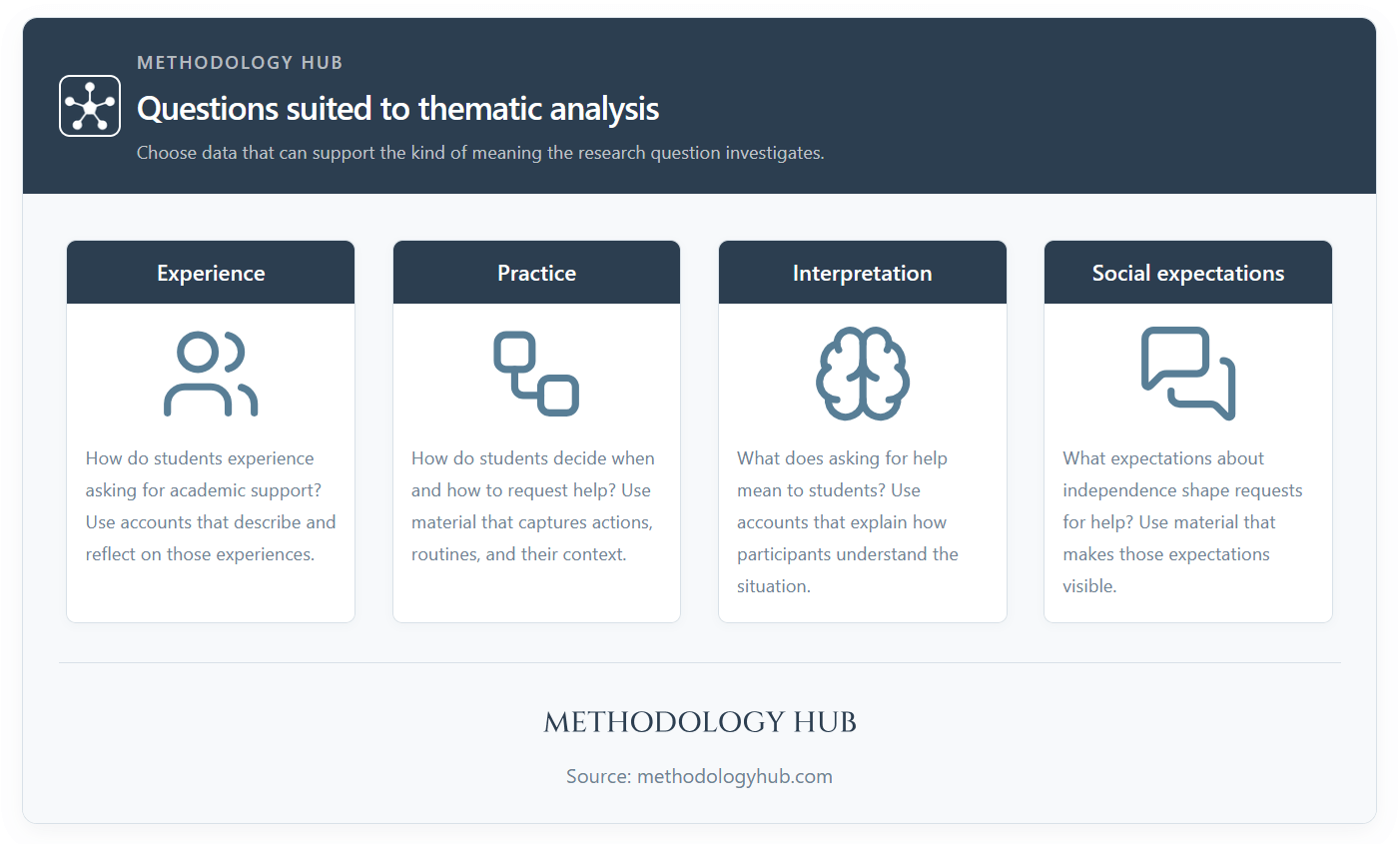
Thematic analysis is useful when the research question concerns meanings shared, negotiated or contested across a collection of accounts. It can explore unfamiliar experiences, examine interpretations of a familiar practice or compare perspectives within a setting. Education, psychology, sociology and health research all contain questions that can be approached in this way.
Suitable questions leave room for explanation. “How do students decide when to seek academic support?” invites an examination of judgement and experience. “What proportion of students attended a support session?” requires a different kind of evidence. The same project could address both questions, but thematic findings would answer the first rather than estimate attendance.
- Experience: How do pupils describe returning to school after a long absence?
- Practice: How do teachers explain adapting an assessment for different learners?
- Interpretation: What meanings do students attach to receiving critical feedback?
- Social expectations: How do families describe responsibility for supporting homework?
The data collection method should provide enough detail for the intended analysis. Qualitative interviews allow researchers to follow an account through examples and further questions. Short written answers can also be analysed thematically, although they may offer less context for interpreting an ambiguous statement.
Group data require attention to interaction. In focus groups, agreement, teasing and disagreement can shape what participants say. Several similar comments may reflect a shared discussion as well as individual experience. Removing that setting from the analysis can change the meaning of the extracts.
Suitability also depends on the intended unit of analysis. Thematic analysis usually examines patterns across data items. If the main aim is to preserve the unfolding story of one person’s life, or study precisely how speakers manage turns in conversation, a narrative or conversation analytic approach may fit better. Choosing a method begins with the question, not with a preference for coding.
Approaches in Thematic Analysis
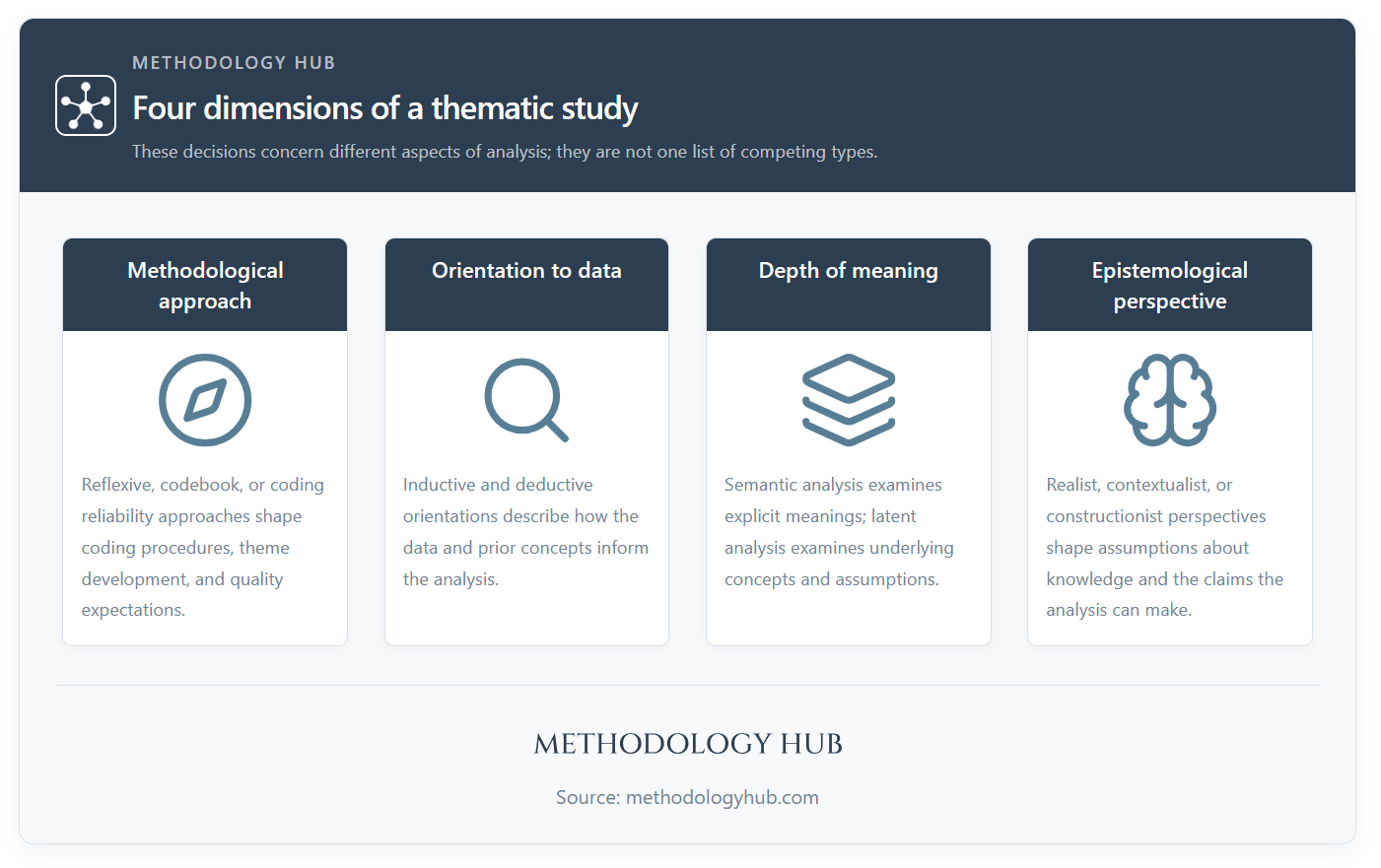
Choosing an approach involves several connected decisions. The methodological approach establishes how coding and theme development will work. Other choices concern the relationship to theory, the level of interpretation and assumptions about knowledge. These are different dimensions of a study, not competing options on a single list.
| Decision | Main options | What the choice affects |
|---|---|---|
| Methodological approach | Reflexive, codebook, coding reliability | Coding procedures, collaboration and quality criteria |
| Orientation to data | Inductive, deductive or a combination | How data and existing concepts guide attention |
| Depth of meaning | Semantic, latent or a combination | Whether analysis focuses on explicit meanings or underlying assumptions |
| Epistemological perspective | Realist, critical realist, constructionist and other positions | What accounts can tell the researcher and how claims are framed |
Methodological Approaches
Reflexive Thematic Analysis
Reflexive thematic analysis treats interpretation as an active part of the researcher’s work. Codes can change as understanding develops, and themes are constructed through sustained engagement with the material. The researcher considers how their background, theoretical commitments and encounters with participants shape the reading of the data.
In this approach, different researchers need not produce identical codes for an analysis to be credible. Collaboration can deepen interpretation through discussion and challenge. Braun and Clarke’s thematic analysis provides a detailed account of this reflexive approach and its six phases.
Codebook Thematic Analysis
A codebook approach uses an organised coding framework to support analysis. The framework may specify code meanings, examples and boundaries, while allowing revision as the team learns more about the data. This can help researchers distribute work across a larger applied project without losing track of the analytical focus.
Codebook approaches vary. Some organise results mainly as summaries of relevant domains; others develop patterns of shared meaning. A shared framework does not automatically require a statistical agreement test, nor does it remove interpretation. Researchers should describe how the framework was developed, revised and used.
Coding Reliability Thematic Analysis
Coding reliability approaches give greater emphasis to consistent coding across researchers. Analysts may independently apply a specified coding frame to the same material, examine agreement and revise unclear definitions. The procedure treats reproducibility of coding decisions as an important part of the study’s methodological design.
That purpose differs from reflexive thematic analysis, where coding differences can be productive interpretations rather than errors to eliminate. An agreement statistic can be appropriate within a reliability-oriented study. Adding one to a reflexive study simply because it looks rigorous can create a mismatch between the stated approach and the actual procedure.
Orientation to Data
Inductive Approach
Inductive analysis develops codes primarily through engagement with the material. A researcher studying student support might expect to hear about appointment availability but find that participants repeatedly discuss whether their problems deserve attention. Coding would follow this concern rather than restricting the analysis to the original expectations.
Induction does not make the researcher free of assumptions. The research question, interview prompts and prior experience still shape what becomes noticeable. The claim is that the analysis remains responsive to the data, not that interpretation happens without an intellectual starting point.
Deductive Approach
Deductive analysis uses existing concepts to direct attention. A study informed by theories of belonging might examine how students describe recognition, exclusion and membership. Those concepts guide the reading, while the researcher still considers what the extracts mean in their particular setting.
A deductive orientation can be used within reflexive, codebook or coding reliability approaches. It does not determine the entire methodology. Researchers can also combine orientations, beginning with theoretical questions while developing additional codes for experiences that the framework does not explain adequately.
Depth of Meaning
Semantic Approach
Semantic analysis focuses on meanings expressed relatively explicitly in the material. If students say they cannot attend an appointment during a laboratory class, the researcher can examine how scheduling conflicts shape their accounts of access. The analysis remains close to what participants articulate.
Staying close to explicit meaning still involves interpretation. The researcher selects relevant passages, compares accounts and explains relationships between them. A semantic analysis can develop a substantial argument without treating participants’ statements as evidence of an unspoken belief.
Latent Approach
Latent analysis examines assumptions and broader meanings that help organise an account. Repeated apologies for asking questions might be interpreted in relation to expectations that successful students should be self-sufficient. The researcher would need to show how the language and context support that interpretation.
Latent analysis is not a search for a participant’s hidden psychological truth. Nor is it automatically more sophisticated than semantic analysis. The appropriate depth depends on the research question, the available material and the theoretical position from which the researcher makes sense of it.
Epistemological Perspectives
Realist and Critical Realist Perspectives
From a broadly realist perspective, participants’ accounts can provide insight into experiences and conditions beyond the interview itself. A researcher may investigate how students encounter support services while recognising that an account is selective and shaped by the circumstances in which it is given.
Critical realism also recognises a reality beyond the account but treats knowledge of it as mediated and fallible. Analysis might consider how institutional arrangements and social expectations help explain the experiences described. An interview can suggest these conditions; it does not by itself establish every proposed causal mechanism.
Constructionist Perspective
A constructionist analysis asks how meanings become possible and persuasive through language and social practices. Rather than treating “independent student” as a fixed personal attribute, it might examine how students construct independence when explaining whether they should ask for assistance.
This changes the claim made from the same extract. “I should manage on my own” might be read as an account of personal expectation, or as part of a culturally available way of presenting a competent learner. The researcher should make the connection between their perspective, coding decisions and interpretation clear.
How to Do Thematic Analysis
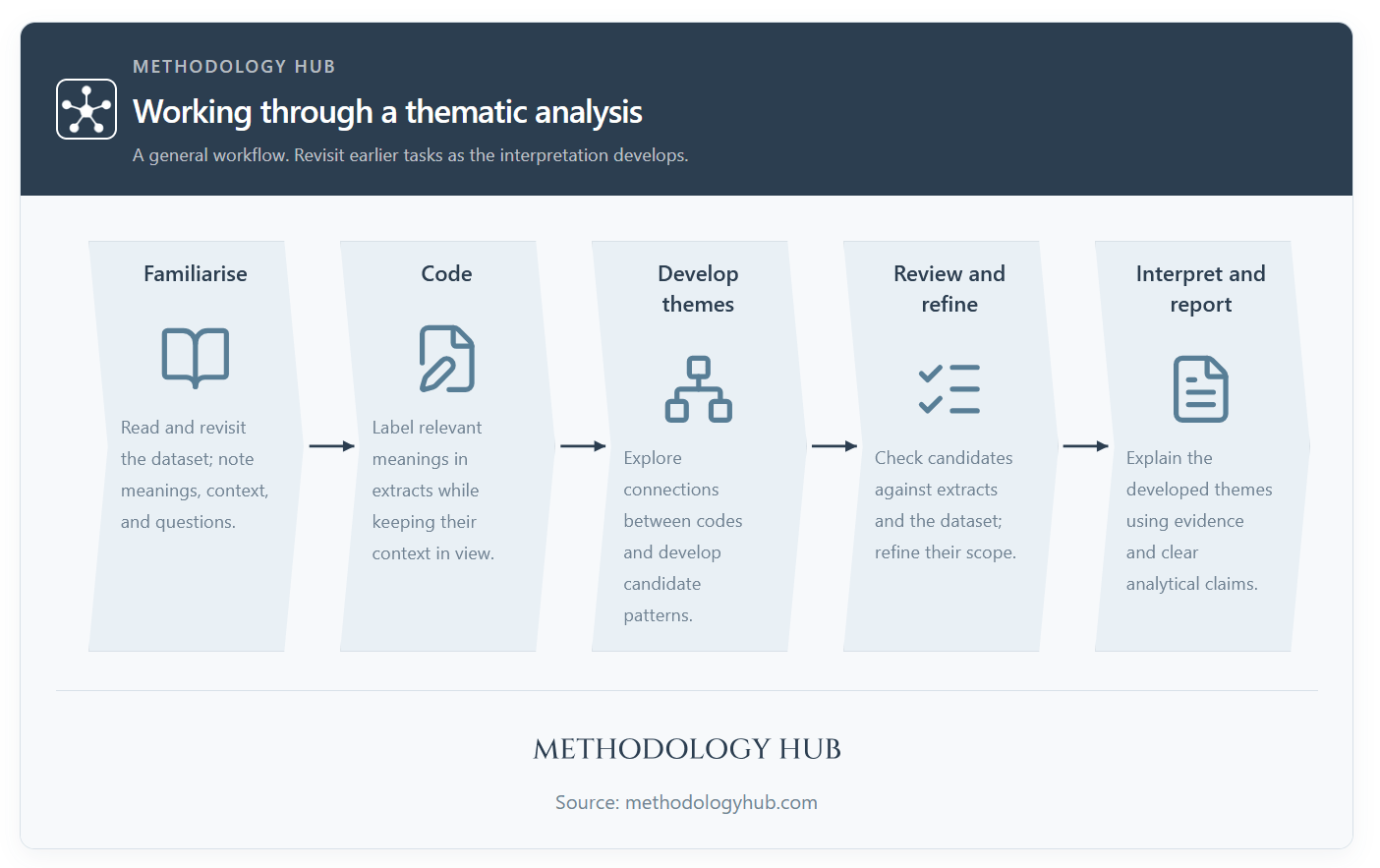
The work moves from close engagement with individual data items towards an organised account of patterns. The following sequence describes tasks found across thematic approaches. Their precise use depends on the methodology: a team applying a codebook will organise some decisions differently from a researcher conducting reflexive analysis.
Familiarise Yourself With the Data
Read each item in full before relying on selected extracts. Where recordings are available, listening alongside a transcript can recover emphasis or context that transcription has flattened. Check that the transcript accurately preserves the material needed for the study, and record uncertainties rather than silently guessing a word or speaker.
Early notes can capture a surprising explanation, a contrast within an account or a question worth revisiting. Keep those notes separate from conclusions. A memorable first interview can become an unhelpful template if every later account is read only for evidence that supports it.
Code the Data
Work systematically through the dataset and label passages relevant to the research question. The coded segment should preserve enough context to make the interpretation understandable. A sentence may be sufficient, but a description of an interaction may require the surrounding exchange.
One extract can receive several codes. A student explaining that they waited to contact a tutor might describe uncertainty about the rules, concern about wasting time and a desire to appear independent. These meanings overlap without being identical. A useful coding record keeps the analytical decisions accessible:
- Extract reference: Record the data item and location of the passage.
- Code label: State the relevant meaning or feature identified in the extract.
- Analytical note: Explain an interpretation, ambiguity or possible connection.
- Revision record: Note substantial changes to labels or coding definitions.
In reflexive analysis, revise earlier codes as understanding develops. In a codebook or reliability-oriented study, follow the agreed process for updating definitions and reconsidering affected material. Whatever the approach, explain how the dataset was covered rather than presenting coding as a task completed by unspecified software.
Develop Initial Themes
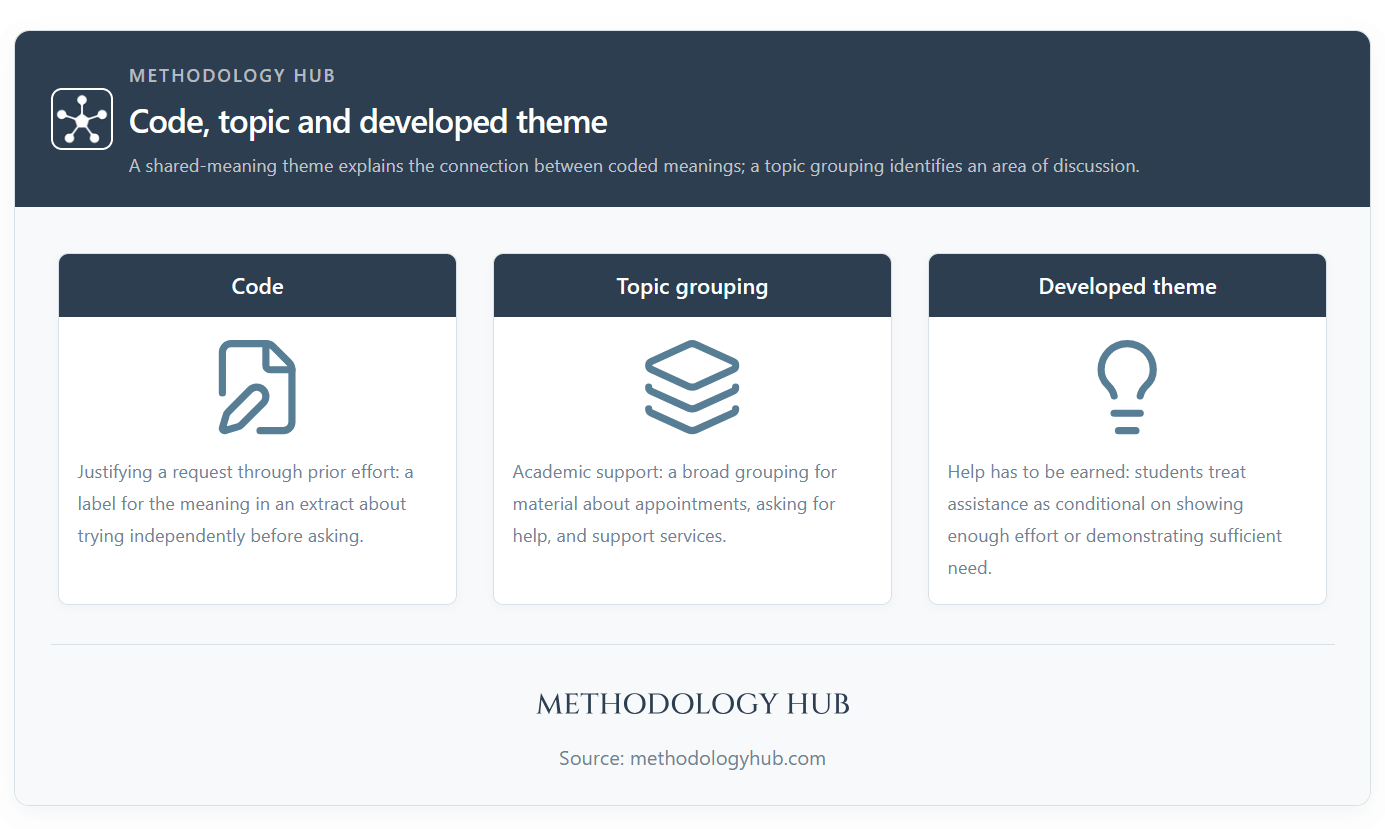
Bring related codes and their extracts together, then ask what connects them. Grouping codes under a broad subject can be a useful intermediate step. Developing a shared-meaning theme requires a further decision about the central concept that makes the grouping analytically informative.
For example, codes about apologising, delaying and comparing needs might initially sit under “asking for support”. A more developed theme could explain how students treat assistance as something they must earn through sufficient difficulty. The theme offers an interpretation of the relationship among the codes.
Review and Refine the Themes
Examine each candidate theme against its extracts and then return to the whole dataset. Ask whether the interpretation fits the material, whether the grouping is coherent and whether important differences have been flattened. A theme can include tension; coherence does not require every participant to agree.
Some candidates will divide into separate themes, while others will combine or disappear. Keep track of the reason for a major revision. For instance, a lack of available appointments may need a different explanation from reluctance to book an appointment that is readily available.
Interpret and Report the Findings
Write an account that connects each theme to the research question. Introduce the analytical point, present a relevant extract and explain how the detail supports the interpretation. Select quotations for their contribution to the argument rather than their emotional force alone.
The methods section should identify the approach, analytical orientation, data collection and coding process. The findings section develops the themes; the discussion considers their implications and relationship to existing knowledge. Drafting often exposes a weak boundary or unsupported claim, so reporting may lead to further analytical revision.
How to Identify Themes in Research
Identifying themes involves analytical judgement rather than finding the most frequently repeated words. A term such as “support” can appear in very different accounts, while a shared concern about legitimacy can be expressed without participants using the same vocabulary. The researcher needs to compare meanings as well as wording.
| Analytical level | Example | Contribution to the analysis |
|---|---|---|
| Extract | “I waited until I had tried everything myself.” | Provides a situated statement for interpretation |
| Code | Exhausting personal options before asking | Identifies a relevant feature of the statement |
| Topic grouping | Seeking academic support | Collects material about a broad subject |
| Developed theme | Help has to be earned | Connects accounts through the perceived need to justify assistance |
Codes vs. Themes
A code usually captures a more specific feature than a theme. It can remain useful even if it never contributes to a final theme. The researcher may code an account of a missed bus, for example, then decide that it provides context without contributing to the study’s central analytical argument.
A theme should do more than reproduce an interview question. If participants were asked about “barriers to support”, using that phrase as a results heading may organise their answers, but it does not yet show what the analysis has established about those barriers. Whether this is sufficient depends on the thematic approach and its intended output.
Developing Themes From Codes
Compare the extracts attached to related codes rather than arranging labels in isolation. Similar code names can conceal different meanings, and different labels may express the same underlying concern. Returning to the passages helps prevent an attractive theme name from organising material that does not actually fit.
There is no universal minimum number of coded extracts or participants required for a theme. Its development should be supported by the dataset and justified in relation to the research question. In reflexive analysis, frequency alone does not determine analytical value. Equally, a striking quotation cannot support a claim about a cross-dataset pattern by itself.
Reviewing and Naming Themes
Write a short definition that states the theme’s central concept, scope and contribution. Then identify what lies outside it. “Help has to be earned” could include accounts of proving effort or seriousness, while excluding transport problems unless participants connect them to deserving assistance.
The title should help the reader anticipate that interpretation. A topic label such as “student experiences” provides little direction; an elaborate metaphor can be equally unhelpful if its meaning remains obscure. Choose a name that is specific enough to distinguish the theme from neighbouring findings and support it with a clear definition in the report.
Thematic Analysis Example
Consider a study asking how first-year university students decide whether to seek academic support. The researcher uses a primarily inductive reflexive approach, reading interview accounts for meanings attached to needing assistance. The initial interest is in the decision to ask, rather than evaluating whether the support service produces better grades.
Illustrative extracts: “I wanted to show I had tried before I emailed.” “Someone else probably needed that appointment more.” “When I failed the second exercise, I finally had a proper reason to go.” These statements express different situations, but each connects asking for help with a judgement about whether the request is justified.
- Demonstrating prior effort: Showing that independent attempts came before the request.
- Ranking the seriousness of need: Comparing one's difficulty with other students' problems.
- Waiting for visible evidence: Treating a clear setback as permission to seek assistance.
The initial codes could contribute to the candidate theme “Help has to be earned”. Its central concept is that students describe access to support as requiring a sufficient claim, even when formal access does not depend on proving need. The analysis would examine how this interpretation operates across the full interviews, including accounts that complicate it.
A student who asks immediately because questioning is part of learning provides a useful contrast. That account could help define the theme’s limits or contribute to a different pattern of meaning. It should not be rewritten as hidden reluctance simply to protect the initial interpretation.
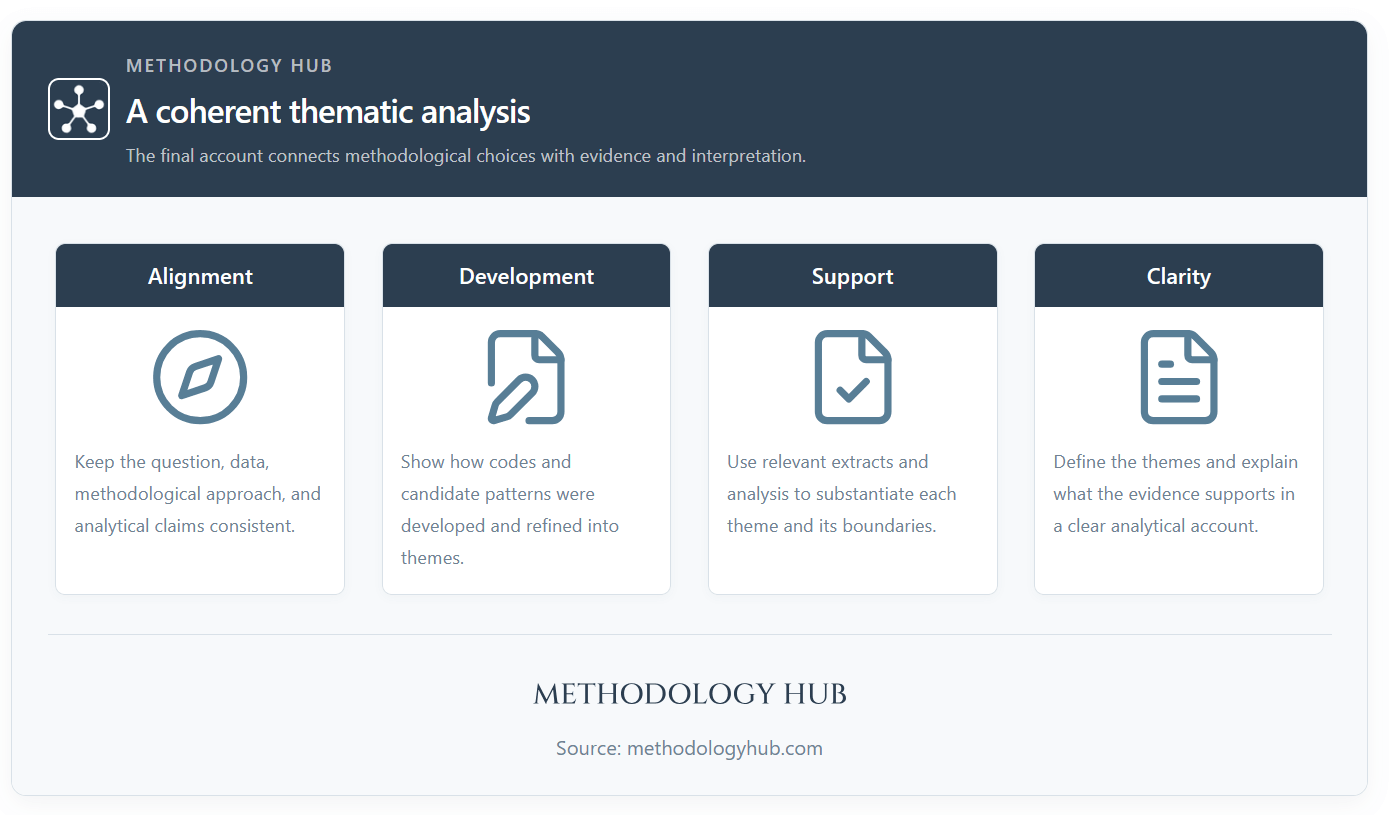
The researcher also separates practical restrictions from perceived legitimacy. An appointment clashing with paid work concerns availability; feeling unworthy of an available appointment concerns entitlement. Both can shape help-seeking, but combining them under a single claim about confidence would lose an important distinction.
A findings paragraph might explain that asking for support was presented as the outcome of a threshold judgement: students first established that they had worked hard enough or encountered sufficient difficulty. An extract would then illustrate how that judgement was expressed. The interpretation remains tied to these accounts rather than claiming that every first-year student thinks this way.
If the research question concerned how such judgements change over a term, diary methods could provide repeated accounts nearer the decisions themselves. That change would also require attention to time during analysis. Collapsing all entries into one undifferentiated collection could conceal a student’s changing understanding of support.
Thematic Analysis vs. Content Analysis
Thematic analysis and content analysis both offer ways to examine qualitative material systematically. Their procedures can overlap, particularly when researchers code text into categories. A useful comparison therefore specifies the version of each method and the intended analytical output.
| Comparison | Thematic analysis | Content analysis |
|---|---|---|
| Main analytical focus | Patterns of meaning, with the definition of a theme varying by approach | Systematic organisation and interpretation of content through categories |
| Role of counting | May describe the dataset, but frequency need not determine a theme's value | Central in some quantitative forms; optional or supporting in qualitative forms |
| Relationship to theory | Can be inductive or deductive | Can develop categories from data or use an existing framework |
| Interpretation | Can examine explicit meanings or underlying assumptions | Can address manifest content or more interpretive meanings, depending on the approach |
| Typical output | An account organised around themes | A structured account of categories, sometimes with distributions or comparisons |
Qualitative content analysis is not simply word counting. It can involve careful interpretation of context and meaning. Hsieh and Shannon distinguish conventional approaches, which develop categories from the material, directed approaches guided by existing theory, and summative approaches that connect counting with interpretation.
Conversely, a thematic study does not become quantitative merely because the report states how many interviews were analysed. Describing the sample differs from treating frequency as evidence that one interpretation is more important or more widely shared in a population.
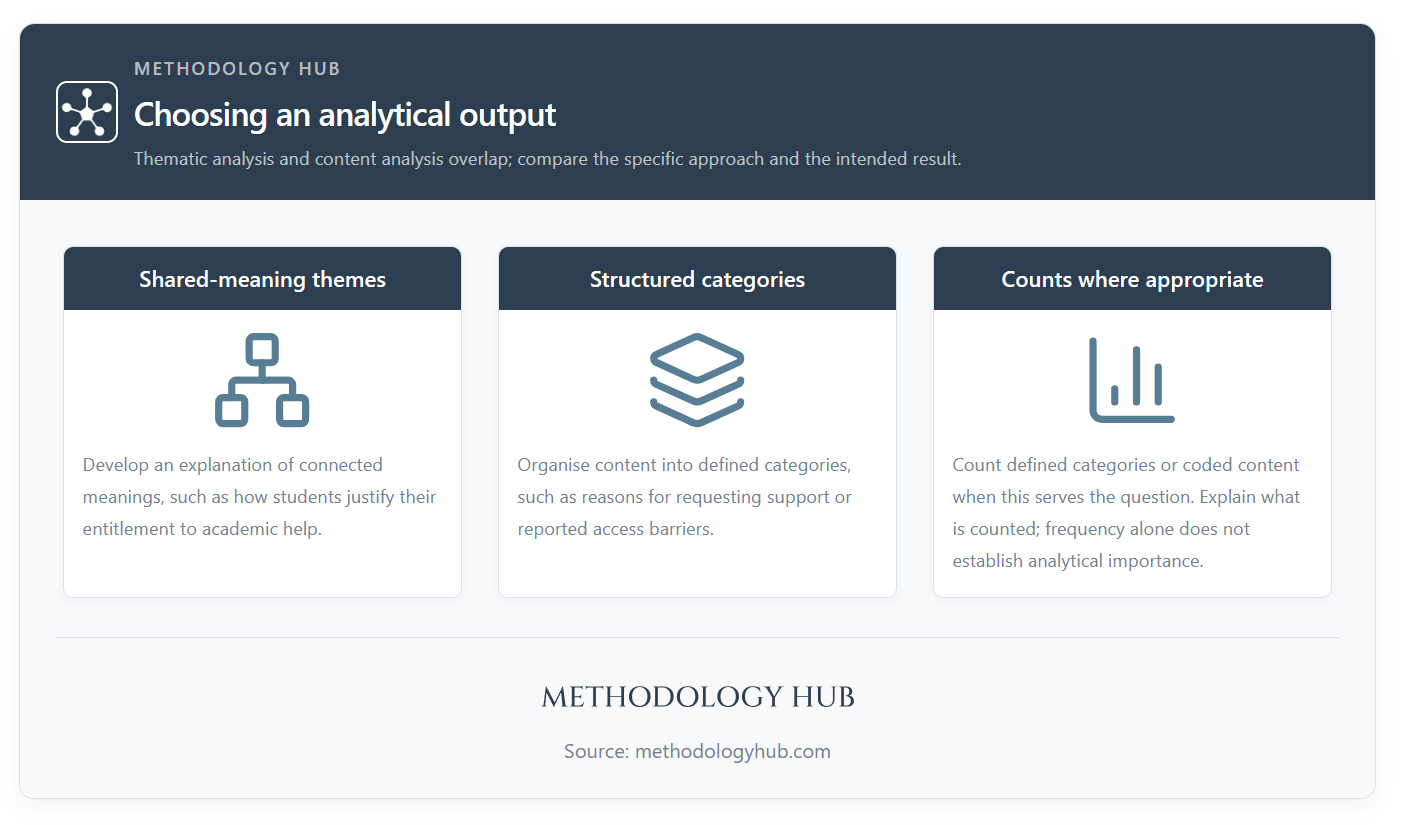
For the student-support question, a content analysis might organise descriptions into categories of access difficulty and compare their distribution across selected groups. A reflexive thematic analysis might instead develop an account of how students justify entitlement to support. Both require interpretation, but the resulting arguments have different purposes.
These are possible applications, not rigid boundaries. A qualitative content analysis can be highly interpretive, and some thematic approaches produce descriptive topic summaries. The researcher should compare the actual analytical practices being proposed, including category development, theme construction and the role of counting.
Choose the method whose assumptions and procedures fit the question. If a project needs a structured comparison of specified content, a category-based design may be appropriate. If it seeks an interpretive account of shared meanings, reflexive thematic analysis may be a stronger fit. Explain that choice through the intended findings rather than through a claim that one method is inherently deeper.
Conclusion
Thematic analysis develops an organised account of meaning through close reading, coding, comparison and interpretation. Its usefulness depends on choosing a coherent approach and making the analytical decisions visible. A strong report shows how the themes answer the research question, how the extracts support them and where the interpretation reaches its limits.
Moving from a topic to a theme requires more than a new heading. It requires a defensible explanation of what connects the material. That connection gives the findings their analytical substance.
Sources:
Braun, V., & Clarke, V. (2006). Using thematic analysis in psychology. Qualitative Research in Psychology, 3(2), 77–101. https://www.tandfonline.com/doi/abs/10.1191/1478088706qp063oa
Braun, V., & Clarke, V. (2019). Reflecting on reflexive thematic analysis. Qualitative Research in Sport, Exercise and Health, 11(4), 589-597. https://www.scirp.org/reference/referencespapers?referenceid=2797898
Braun, V., & Clarke, V. (2021). Thematic analysis: A practical guide. SAGE Publications. https://www.sagepub.com/shop/buy-a-book/thematic-analysis-1-248481
Cite this article
Whether you are preparing course materials, writing an academic paper, or sharing resources with students, we kindly ask that you acknowledge Methodology Hub as the source.
To make referencing easier, you can use the “Cite this page” tool below to automatically generate a citation in your preferred referencing style, including APA, MLA, Chicago, Harvard, and others. Simply select a citation style and click the generated reference to copy it.
When reproducing images, figures, or other materials from this page, please include an appropriate source credit and a link to the original page. Proper attribution helps others locate the original material and supports the continued development of freely accessible educational resources.