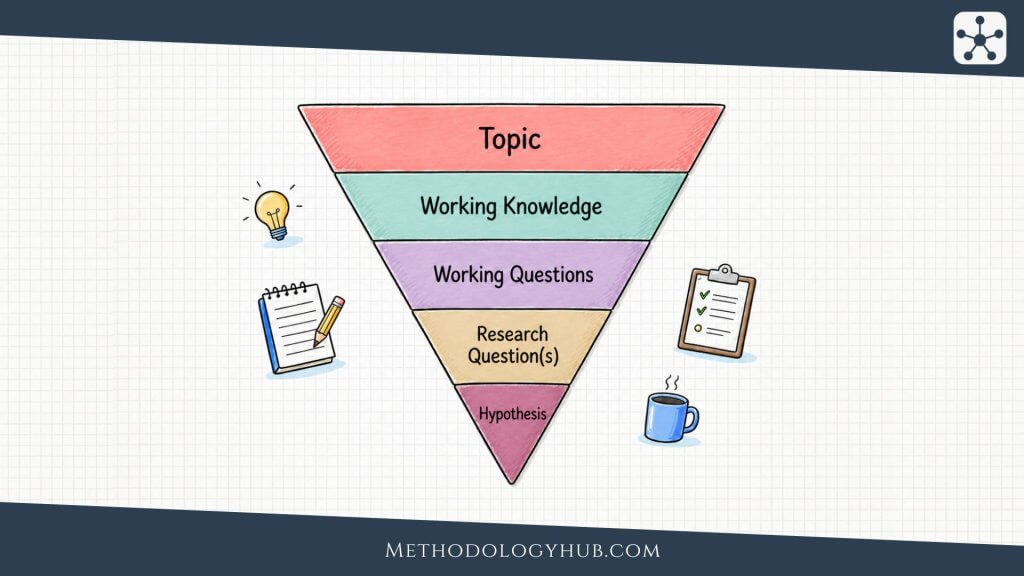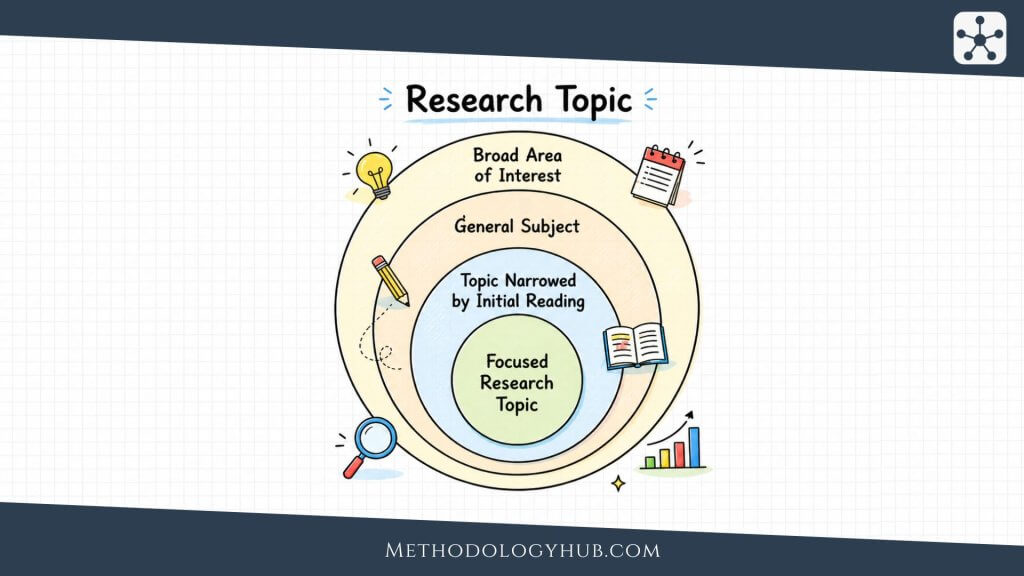
Unstructured interviews are qualitative interviews that use an open conversational format rather than a fixed list of questions. The researcher begins with a broad topic, listens closely to the participant’s account, and asks follow-up questions as the conversation develops. This format is used when the study needs depth, personal meaning, and participant-led detail.
In qualitative research, unstructured interviews are often chosen when the researcher does not want to impose too much order on the participant’s account. They are especially useful for life histories, sensitive experiences, unfamiliar topics, and studies where the way a participant tells the story is part of the data.
This article places unstructured interviews within qualitative research methods and explains how they work in practice. It covers their core features, when to use them, how they differ from other interview types, how to prepare without over-scripting the conversation, and how to analyse data that may vary widely from one participant to another.
The Core Idea of Unstructured Interviews
The core idea of unstructured interviews is simple: the participant’s account should have room to develop in its own shape. The researcher does not arrive with a strict sequence of questions. Instead, they begin with a broad area of interest and use careful listening to decide what to ask next.
This does not mean the interview is unplanned. The researcher still knows the purpose of the study, selects participants deliberately, prepares possible opening prompts, and thinks about the kinds of experiences or events that may appear. What is left open is the route through the conversation.
Unstructured interview definition
An unstructured interview is a qualitative interview in which the researcher uses an open, flexible conversation to collect detailed participant accounts. The interviewer may begin with one broad question or topic and then ask follow-up questions based on what the participant says.
The method is unstructured in relation to question order and wording, not in relation to research quality. A strong unstructured interview still has a purpose, a participant group, a recording plan, and an analysis strategy. The freedom lies in how the conversation unfolds.
How the participant shapes the interview
In an unstructured interview, the participant may decide which events to describe first, which details to emphasise, and which connections to make. This can reveal how the participant organises the topic in memory and meaning. The order of the account may be as informative as the content itself.
A participant talking about returning to education, for example, may begin with childhood school experiences rather than the recent enrolment decision. That choice may show that the current experience is tied to earlier confidence, family expectations, or memories of failure. A fixed interview guide might miss that route.
The interviewer still has an active role. They listen for points that need detail, ask for examples, clarify vague statements, and gently return to the study topic when the conversation moves too far away. The skill is to guide without taking over.
What unstructured interview data look like
Unstructured interview data often look less uniform than data from structured or semi-structured interviews. One transcript may be organised as a life story, another around a single turning point, and another around a set of relationships. This variation is part of the method.
The data may include audio recordings, transcripts, interviewer notes, reflective memos, timelines, and summaries of key episodes. Notes are especially useful because the researcher may need to record how the conversation moved, which topics were participant-led, and where follow-up questions changed the direction of the account.
When to Use Unstructured Interviews
Unstructured interviews are most useful when the researcher needs openness. They are a good fit when a topic is not well understood, when participant meanings may not fit prepared categories, or when the study needs to hear how people organise an account in their own way.
They are less useful when every participant must answer the same questions. If the study needs tight comparison across many people, a more fixed format may work better. Unstructured interviews are strongest when depth, discovery, and participant-led explanation are more important than standardised coverage.
Exploratory research
Unstructured interviews can help when little is known about a topic. The researcher may not know which questions to ask yet, and too much structure may force the data into weak categories. An open interview allows participants to introduce the issues, language, and turning points that are most relevant to them.
For example, a researcher studying a new form of informal online learning may begin with unstructured interviews to understand how learners describe their own routines. Later work could use those early findings to design a more focused interview guide or questionnaire.
Life history and narrative work
Unstructured interviews are often used in life history and narrative research because sequence is central. The researcher may want to understand how participants connect earlier events with later choices, how they describe turning points, and how they make sense of change across time.
A fixed question list can interrupt this kind of account. If a participant is explaining the route from family expectations to career choice, the interviewer may learn more by following the story than by moving too quickly to the next prepared topic.
Recommendation: unstructured interviews work best when the participant’s way of telling the account is part of what the researcher needs to understand.
Sensitive or complex experiences
Some experiences are difficult to discuss through direct prepared questions. Participants may need time to choose words, move around the topic, or begin with a safer part of the account. An unstructured format can give more room for this pacing.
This does not mean the researcher should let the interview become careless. Sensitive interviews require careful preparation, clear boundaries, and attention to participant comfort. The open format gives room, but it also places responsibility on the interviewer to listen closely and avoid pushing for detail that is not needed.
Studies where meaning is uncertain
Unstructured interviews are also useful when the researcher suspects that familiar words may not mean the same thing to participants. Terms such as independence, safety, success, belonging, or support may carry different meanings depending on the person and setting. An open conversation lets participants define those terms through stories and examples.
The researcher can then analyse how meanings are built instead of assuming them at the beginning. This can be especially helpful before designing more structured research tools.
Key Features of Unstructured Interviews
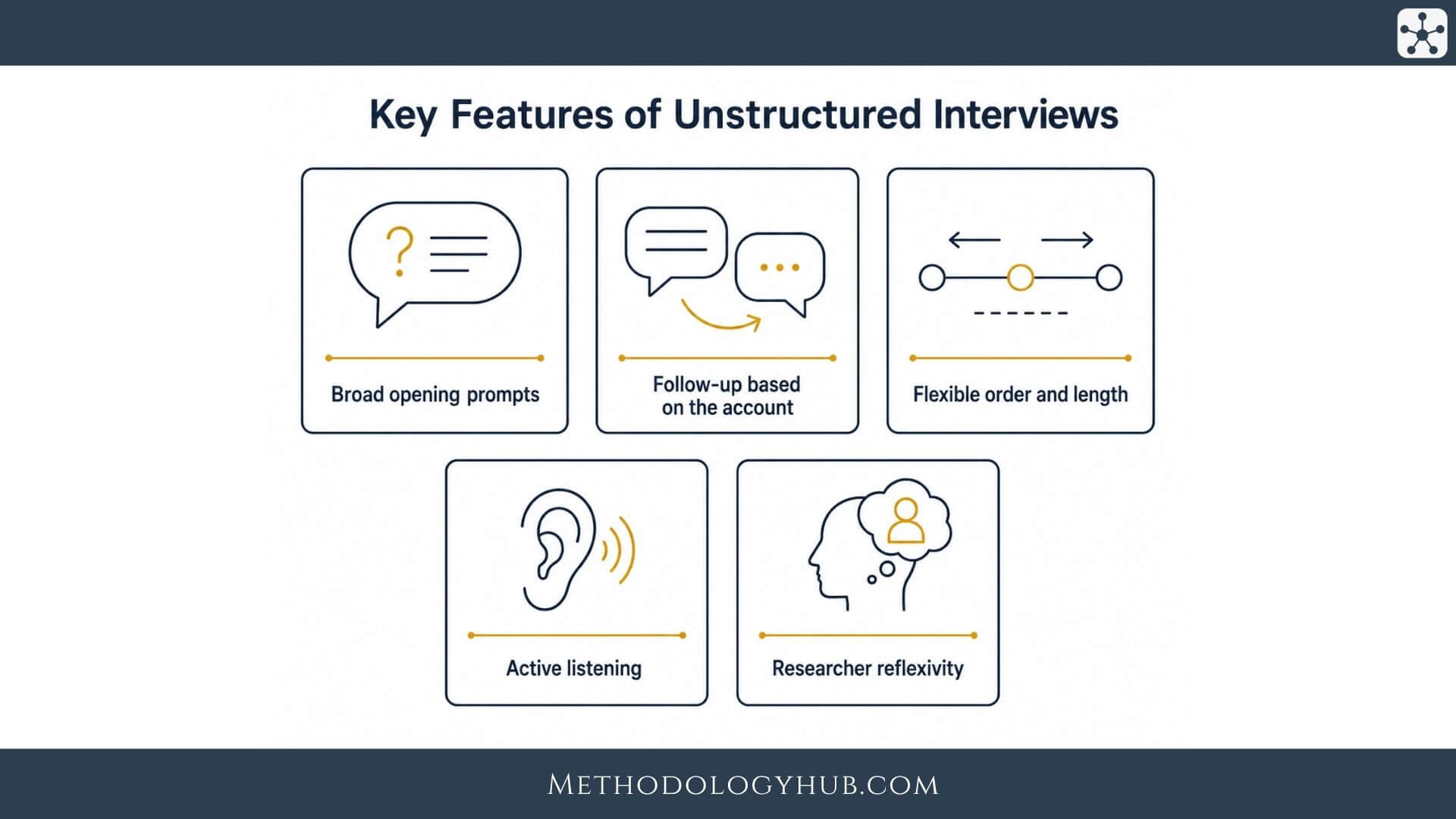
Unstructured interviews have several features that separate them from other interview formats. They use broad prompts, flexible follow-up, participant-led sequencing, and close attention to context. The interviewer does not control every step, but the conversation still remains connected to the research purpose.
The method can feel informal, but the research work is demanding. The interviewer needs to listen analytically while also maintaining a natural conversation. They need to decide when to stay silent, when to ask for an example, and when to move the conversation back toward the topic.

Broad opening prompts
An unstructured interview often begins with a broad prompt. The prompt should be open enough for the participant to choose a starting point but focused enough to connect to the research topic. A prompt such as “Tell me about your experience of returning to study” gives more room than a narrow question about enrolment paperwork.
The opening prompt sets the tone. If it is too narrow, the interview may become more structured than intended. If it is too vague, participants may not know what kind of account is being invited.
Follow-up based on the account
Follow-up questions in unstructured interviews are shaped by what the participant says. The interviewer may ask about a person mentioned in the story, a change in emotion, a repeated phrase, or a moment that seems important. The follow-up comes from listening rather than from a fixed list.
For example, if a participant says, “After that, I stopped trusting the process,” the interviewer might ask what “after that” refers to, what trust meant in that setting, or how the participant noticed the change. These questions open the account without imposing a pre-written category.
Flexible order and length
Unstructured interviews rarely follow the same order across participants. One person may begin with family background. Another may begin with a recent event. A third may speak first about a relationship or a place. The interviewer follows the account and later analyses how that order contributes to meaning.
The length may also vary. Some interviews become long because the participant builds a complex story. Others are shorter because the participant gives a focused account. The researcher should plan enough time so the interview does not feel rushed.
| Feature | What it means in practice |
|---|---|
| Opening prompt | The interview usually begins with a broad invitation rather than a list of detailed questions. |
| Follow-up | Questions are developed from the participant’s account during the conversation. |
| Order | Participants may organise events, meanings, and examples differently from one interview to another. |
| Analysis | The researcher often analyses both content and the way the account is organised. |
Active listening
Active listening is the central skill. The interviewer listens for meanings, gaps, transitions, contradictions, and words that seem important to the participant. Silence can also be part of the method, because participants sometimes continue an account after a pause if the interviewer does not rush to fill the space.
The interviewer should avoid turning every interesting phrase into a new question. Too much probing can break the participant’s flow. The aim is not to show curiosity about everything, but to help the account develop in a way that is useful for the study.
Researcher reflexivity
Because the interviewer makes many decisions during the conversation, reflexive notes are important. After the interview, the researcher can write about why certain follow-up questions were asked, how the participant shaped the conversation, and where the interviewer’s own assumptions may have influenced the exchange.
These notes do not need to become a separate chapter in the final article or report. They help the researcher analyse the data more honestly and understand how the interview was produced.
Unstructured vs Semi-Structured vs Structured Interviews
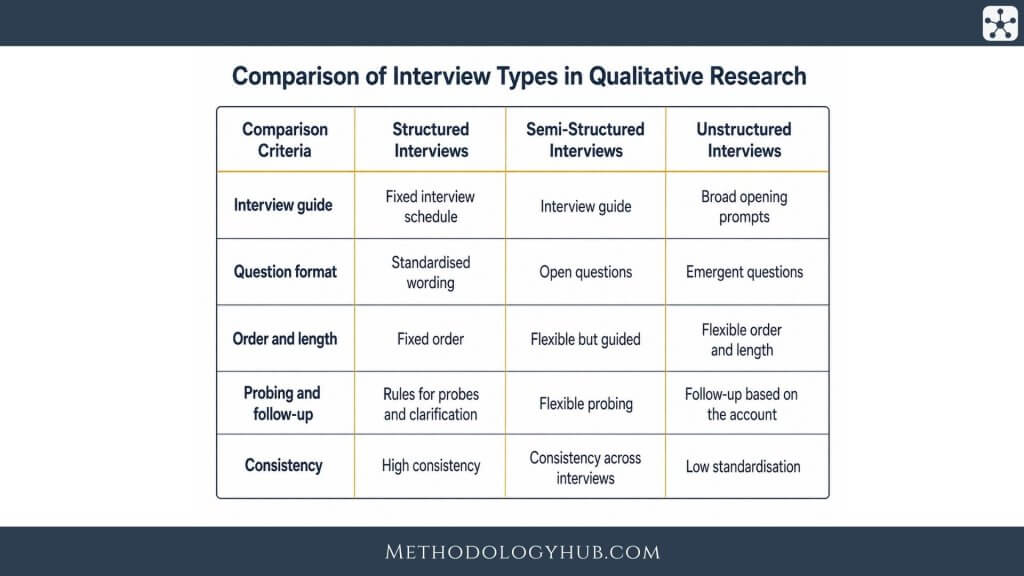
Unstructured interviews can be understood more clearly when compared with other interview formats. Structured interviews use fixed questions and fixed order. Semi-structured interviews use a guide with flexible probing. Unstructured interviews use a broad topic and let the account develop with fewer pre-set boundaries.
The difference is not only about how many questions are written in advance. It affects the kind of evidence produced. The more structured the interview, the easier it is to compare answers directly. The less structured the interview, the more room there is for participant-led meaning, sequence, and unexpected material.
Amount of control
Structured interviews place more control in the interview schedule. Semi-structured interviews share control between the guide and the participant’s answers. Unstructured interviews give the participant more influence over the route, while the researcher keeps the conversation linked to the topic.
This does not mean unstructured interviews have no control. The control is softer and more responsive. The researcher controls the research purpose, the opening frame, the follow-up choices, and the later analysis.
Comparability and depth
Structured interviews usually give stronger comparability. Unstructured interviews usually give stronger participant-led depth. Semi-structured interviews sit between the two. They are often chosen when the researcher wants both shared topics and flexible follow-up.
If the study asks every participant to answer the same narrow set of questions, unstructured interviews may not be the best fit. If the study asks how people build an account of a life transition, unstructured interviews may be more suitable than a fixed guide.
| Format | Interview route | Best fit |
|---|---|---|
| Structured | Fixed questions and fixed order | Close comparison across participants |
| Semi-structured | Guide with flexible order and probing | Shared topics with room for depth |
| Unstructured | Open route shaped by the participant’s account | Exploration, life stories, complex meanings, and participant-led accounts |
Choosing the format
The format should follow the research question. If the researcher needs short comparable answers, a structured interview may work. If the researcher needs common topics with room for detail, a semi-structured interview may be better. If the researcher needs the participant’s own route through the topic, an unstructured interview may fit best.
Researchers can also combine formats across a larger project. Early unstructured interviews may help identify important topics, followed by semi-structured interviews with a larger group. The decision should be explained clearly in the methods section.
Planning an Unstructured Interview Study
Planning an unstructured interview study may sound contradictory, but it is essential. The researcher does not plan every question, but they do plan the study purpose, participant selection, opening approach, recording method, and analysis strategy. Without that preparation, an open interview can become a loose conversation with unclear research value.
The planning also helps the interviewer feel less anxious during the conversation. When the purpose is clear, the interviewer can follow participant-led material while still knowing which kinds of detail are relevant to the study.
Define the research focus
The research focus should be broad enough to allow open accounts but narrow enough to guide the study. “Migration” is too broad for most interview studies. “How adults describe leaving and returning to their home community” gives the interview a clearer frame while still leaving room for different stories.
The focus should also explain why an open format is needed. If the researcher already knows all key questions in advance, an unstructured format may not be necessary.
Select participants carefully
Participants should be chosen because their experiences can illuminate the research focus. In an unstructured interview study, depth often is important more than numbers. The researcher may spend a long time with each participant and return to the same account during analysis.
Variation can still be important. A study of adults returning to education may include participants from different ages, work histories, family situations, or previous school experiences. Variation helps the researcher see different routes through the same broad topic.
Note: open interviews do not need many prepared questions, but they do need a clear reason for being open.
Prepare opening prompts
Instead of a full guide, the researcher may prepare one or two opening prompts. These prompts should invite the participant into the topic without deciding the shape of the account for them. The wording should be simple enough to answer naturally.
Possible openings include “Can you tell me about how this experience began for you?” or “I’d like to hear the story of how you came to this point.” The prompt should fit the topic and the participant group.
Plan recording and notes
Unstructured interviews can be difficult to reconstruct from memory because the conversation may move in unexpected directions. Audio recording is usually useful when participants agree. Notes written after the interview can record how the account unfolded and which follow-up decisions were made.
The researcher may also create a short timeline or topic map after each interview. This can help during analysis, especially when the transcript is long and loosely ordered.
Decide how flexibility will be documented
Because unstructured interviews vary across participants, the researcher should document how each interview developed. Notes can include the opening prompt, major topics, turning points, follow-up questions, and any moments where the researcher redirected the conversation.
This documentation helps the final report explain how the data were produced. It also helps the researcher compare interviews without pretending they followed the same path.
How to Conduct Unstructured Interviews
Conducting unstructured interviews requires a different kind of discipline from reading a fixed schedule. The interviewer needs to begin clearly, listen carefully, follow the participant’s account, and ask questions that open detail rather than narrow it too quickly.
A good unstructured interview often feels calm. The interviewer is not rushing to cover a list. The participant has space to explain events in their own order. At the same time, the conversation remains anchored to the research topic.
Start with a clear invitation
The opening should explain the topic and invite the participant to begin. A clear invitation might ask the participant to tell the story of an experience, describe how something began, or talk through a change. The interviewer should avoid starting with a cluster of narrow questions.
The first answer may set the direction for much of the interview. The interviewer should listen before deciding where to go next. Jumping in too quickly can make the interview feel more controlled than intended.
Use follow-up questions sparingly
Follow-up questions should help the account deepen. They may ask for a concrete example, a sequence, a clarification, or the meaning of a word the participant used. They should not turn the interview into a checklist.
- Example probe: “Can you tell me what happened just before that?”
- Example probe: “What did that mean for you at the time?”
- Example probe: “How did you come to see it that way?”
These probes work because they follow the account rather than replace it. They give the participant more room to explain.
Allow silence and pauses
Silence can be useful in unstructured interviews. Participants may need time to remember, choose words, or decide whether to continue. The interviewer does not need to fill every pause immediately.
Of course, silence should not become pressure. The interviewer can use gentle prompts when needed, but should avoid rushing the participant away from a thought that is still forming.
Return to the topic without closing the account
Open interviews can drift. When the conversation moves too far from the research focus, the interviewer can return gently. This can be done by linking back to something the participant said rather than abruptly changing direction.
For example, the interviewer might say, “Earlier you mentioned the first few weeks after the move. Could we return to that for a moment?” This keeps the conversation open while restoring focus.
Close the interview carefully
The ending should give participants time to add something important. A closing question might ask whether there is anything the participant expected to discuss but did not, or whether there is a part of the story the researcher should understand more clearly.
After the interview, the researcher should write notes while the conversation is fresh. These notes may include a rough topic map, emotional tone, moments of uncertainty, and early analytic ideas.
How to Analyse Unstructured Interview Data
Analysing unstructured interview data can be challenging because each interview may have a different shape. One participant may give a chronological story. Another may move between memories, feelings, and explanations. A third may organise the account around relationships or places. The analysis needs to respect this variation.
The researcher usually begins by reading or listening to each interview as a whole. This helps preserve the flow of the account before coding begins. Only after understanding the interview as a complete account should the researcher break it into smaller analytic parts.
Create an interview summary
A summary can help make sense of long and open transcripts. The summary may describe the main events, key people, turning points, repeated words, and topics introduced by the participant. It can also note where the interviewer asked follow-up questions.
These summaries are not a replacement for transcripts. They are a way of keeping the whole account visible during analysis.
Code carefully and preserve sequence
Coding can be used with unstructured interviews, but it should not flatten the account. If the researcher only extracts short coded fragments, the order and development of the participant’s story may be lost. Sequence may be important evidence.
For example, a participant may first describe an event as a failure, then later reinterpret it as a turning point. Coding only the word “failure” would miss the movement in the account. The analysis should track how meanings change within the interview.
Compare without forcing sameness
Comparison across unstructured interviews requires care. Participants may not all discuss the same topics, or they may discuss them in different ways. The researcher should compare accounts where comparison is meaningful, but should avoid pretending that every interview answered the same questions.
A useful comparison may focus on how participants describe beginnings, turning points, relationships, or endings. It may also compare the different ways participants avoid, resist, or return to a topic.
Recommendation: in unstructured interviews, how the participant gets to a point can be as important as the point itself.
Develop themes from accounts, not from a missing guide
Because there is no detailed interview guide, the researcher should not organise findings as if there had been one. Themes should come from what the accounts show. Some themes may relate to content. Others may relate to narrative form, turning points, silence, contradiction, or the way participants position themselves.
Themes should also account for difference. In unstructured interviews, variation is not a problem to be cleaned away. It can show how participants understand the topic through different experiences and different ways of telling.
Use quotations and longer excerpts
Unstructured interview findings may need longer excerpts than more structured studies, especially when sequence or narrative movement is important. A short quote can support a theme, but a longer excerpt may show how the participant builds an account.
The researcher should still use excerpts selectively. The writing needs to explain the interpretation, not simply present long sections of transcript.
Examples of Unstructured Interviews
Examples of unstructured interviews show how the method works when the researcher wants participant-led accounts. The examples below use different fields, but in each case the open format is useful because the researcher does not want to decide the order of the story in advance.
Example 1: Adults returning to education
A researcher wants to understand how adults describe returning to education after several years away. The interview begins with a broad prompt: “Can you tell me the story of how you came back to study?” Participants may begin with school memories, work changes, family responsibilities, or a moment when they decided they needed a new direction.
The analysis may focus on turning points, confidence, past educational experiences, and the way participants connect earlier events to the decision to return. The unstructured format is useful because the personal route into education differs from one participant to another.
Example 2: Artists describing creative practice
A researcher interviews artists about how they understand their creative practice. Instead of using a fixed list of questions about training, materials, and exhibitions, the interviewer invites participants to describe how their practice developed. Some may begin with childhood experiences. Others may begin with a recent project or a difficult period.
The findings may show different ways of understanding creativity, such as discipline, experiment, memory, identity, or response to place. The order of the account helps show how each participant frames creative work.
Example 3: Families after relocation
A researcher studies families who moved from one region to another. An unstructured interview invites participants to talk through the move in their own way. One participant may focus on practical arrangements. Another may focus on loss of community. Another may describe the move through children’s school experiences.
The analysis may show that relocation is not one event but a series of adjustments. The open format allows participants to decide which parts of the move define the experience.
Example 4: Workers leaving a profession
A researcher interviews former workers from a profession with high turnover. The opening prompt asks participants to tell the story of leaving. Some may start with workplace pressure, others with health, family, values, or a gradual loss of commitment.
The data may show that leaving is often described as a process rather than a single decision. Unstructured interviews are useful because the researcher can follow the participant’s own explanation of how the decision formed.
Conclusion
Unstructured interviews are useful when a study needs open, participant-led accounts. They allow people to describe experiences in their own order, with their own emphasis, and through examples that may not fit a prepared interview guide.
The method works best when the researcher has a clear purpose but does not want to impose a strict route through the topic. Good unstructured interviewing depends on careful listening, thoughtful follow-up, detailed documentation, and analysis that respects both what participants say and how they organise the account.
FAQs on Unstructured Interviews
What is an unstructured interview?
An unstructured interview is a qualitative interview that uses an open conversational format instead of a fixed list of questions. The researcher begins with a broad topic and asks follow-up questions based on the participant’s account.
What is an unstructured interview in qualitative research?
An unstructured interview in qualitative research is an open interview used to understand experiences, meanings, stories, and interpretations in the participant’s own terms. It is useful when the researcher does not want to impose a detailed question schedule.
When should unstructured interviews be used?
Unstructured interviews should be used when the topic is exploratory, complex, sensitive, narrative, or not well understood. They are useful when the participant’s own way of organising the account is important to the study.
How do you conduct an unstructured interview?
To conduct an unstructured interview, prepare a clear research focus, choose relevant participants, begin with a broad prompt, listen closely, ask follow-up questions based on the participant’s account, allow pauses, and write notes after the interview.
What is the difference between unstructured and semi-structured interviews?
Semi-structured interviews use a guide with planned topics and flexible probing. Unstructured interviews use a more open format, where the participant’s account shapes most of the route through the conversation.
What is the difference between unstructured and structured interviews?
Structured interviews use fixed questions in a fixed order, while unstructured interviews use open conversation. Structured interviews support close comparison, while unstructured interviews support depth, exploration, and participant-led accounts.
How do you analyse unstructured interview data?
Unstructured interview data can be analysed by reading whole accounts, writing interview summaries, coding carefully, preserving sequence, comparing accounts without forcing sameness, developing themes, and using quotations or excerpts with context.