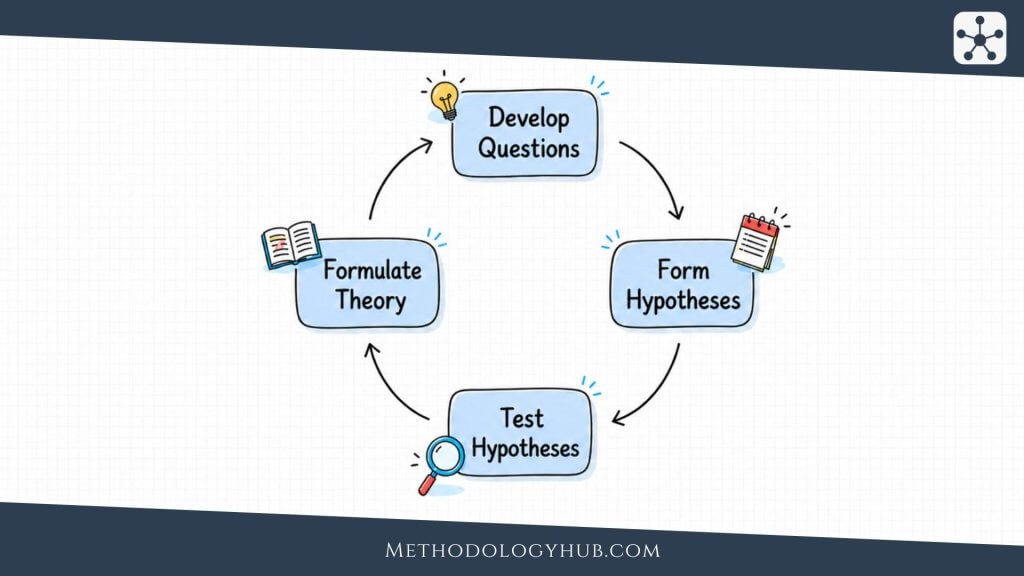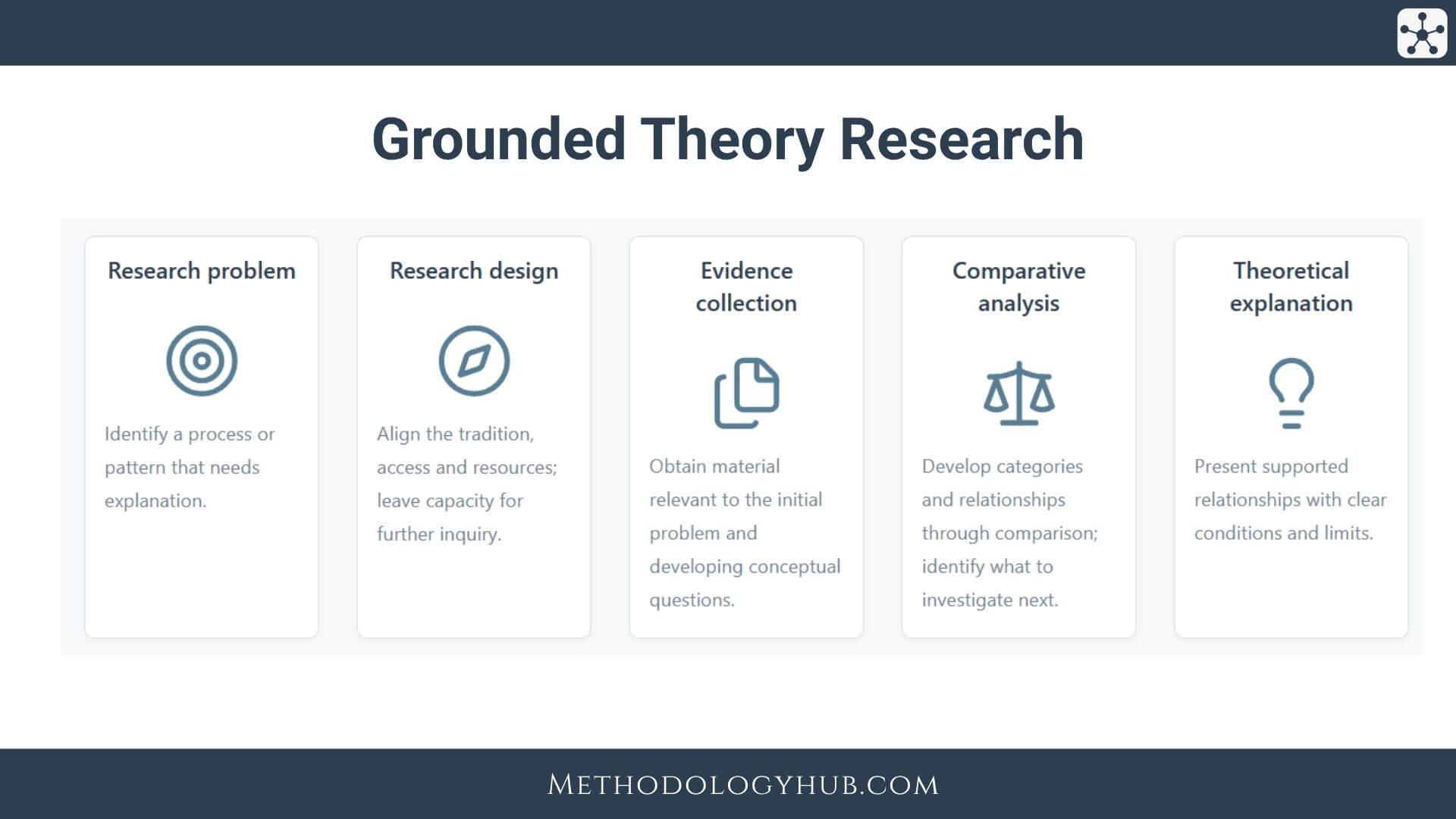
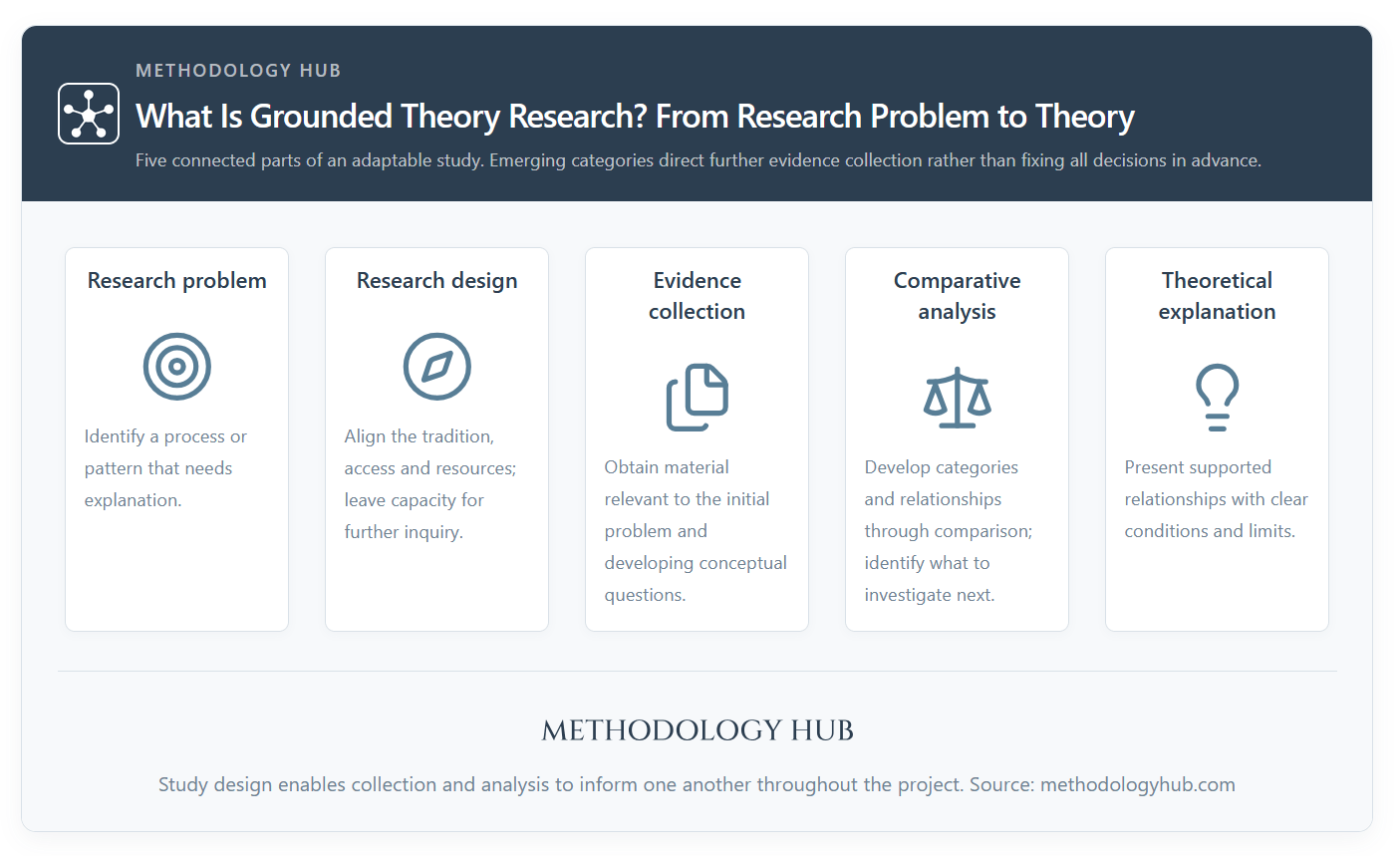
Grounded theory research develops an explanation by collecting and analysing evidence together. In qualitative research, it is used to investigate how people act and respond to changing conditions, with emerging findings guiding what the researcher studies next.
The grounded theory methodology connects the research question, sampling, data collection and theory development. Planning a study therefore involves allowing time and access to pursue questions that arise during the research.
This article explains how to design, conduct and report grounded theory research, with a complete study example.
What Is Grounded Theory Research?
Grounded theory research is a study designed to generate or construct theory through systematic comparison of evidence. Researchers begin with a problem, collect relevant material and develop concepts while the inquiry is underway. Later decisions about participants, sources and questions follow the needs of the emerging explanation.
Definition
The term covers the whole research project, including its methodological position, access arrangements, sampling, collection, analysis and reporting. Grounded theory analysis is the conceptual work within that project. A research design must make it possible to act on analytical questions, rather than simply promise an iterative process that the collection schedule cannot support.
Purpose of Grounded Theory Research
The purpose is to explain a process or pattern that existing accounts do not adequately clarify. The study develops categories, examines their properties and connects them into a theoretical account. Its contribution lies in explaining relationships, including conditions under which actions or responses change.
That aim affects practical choices. Participants and sources are selected because they can contribute to conceptual understanding. Their inclusion should follow a clear reason, with later selection responsive to what the analysis has established and what remains uncertain.
When to Use Grounded Theory
Use grounded theory when the question requires an explanation and the project can support ongoing comparison and further inquiry. It is especially useful where current concepts leave important variation unexplained. The presence of existing literature does not rule it out; the issue is whether that literature supplies an adequate account of the process.
Another design may be more suitable when the main objective is a prevalence estimate, an evaluation against fixed criteria or a detailed description without theory development. Practical constraints also count. If every source and collection decision must remain fixed, explain how the project will investigate emerging conceptual questions before choosing the methodology.
Grounded Theory Research Questions
Grounded theory research questions ask how a process works, how people respond to circumstances or how relationships develop. They identify something that needs explaining while leaving the final categories open. A useful question gives the study direction without specifying the theory it must produce.
Characteristics of Suitable Questions
Specify the phenomenon and a workable area of inquiry. The initial question should be clear enough to guide entry into the field and broad enough to accommodate relevant discoveries. Avoid building an unexamined explanation into the wording, since that can narrow collection before the evidence has been compared.
A research question can become more focused as the study develops. Record why its emphasis changes and how the revised question follows from the material. Refinement should make the inquiry more precise, not quietly replace the original study with an unrelated one.
Exploratory and Process-Oriented Questions
Exploratory questions allow unfamiliar actions or relationships to become visible. Process-oriented questions examine how something develops, is maintained or changes under particular conditions. These interests can work together when the analysis seeks an explanation of variation rather than an inventory of experiences.
Do not assume the final theory must contain consecutive stages. Some accounts are better explained through conditions, strategies or recurring relationships. The wording should allow the evidence to inform that structure.
Developing a Grounded Theory Research Problem
Identify what remains poorly explained in the area of study. Use relevant scholarship and knowledge of the setting to distinguish a conceptual gap from a topic that is merely broad. The problem should show why understanding the process could contribute something beyond another description of its presence.
| Question orientation | Relationship to grounded theory | Design implication |
|---|---|---|
| How a process develops | Supports investigation of actions and changing conditions | Seek material that can explain variation over time or circumstances |
| How people respond to a situation | Can support theory development | Examine responses, their grounds and their consequences |
| How common a behaviour is | Primarily asks for a prevalence estimate | Use a design capable of supporting numerical inference |
| Whether a predetermined model fits | Prioritises examination of an existing explanation | Consider whether the study genuinely leaves room for theory development |
Checking the Question’s Fit
Ask what the completed study would need to explain for the question to be answered. Then check whether the proposed material can support that explanation and whether the design permits further inquiry. A question framed around process still needs a methodology that follows through on that interest.
Distinguish the main research question from interview questions. The research question sets the analytical purpose; interview prompts invite participants to describe situations in enough detail to investigate it. Simply asking participants the theoretical research question may produce general opinions where accounts of action are needed.
Grounded Theory Research Design
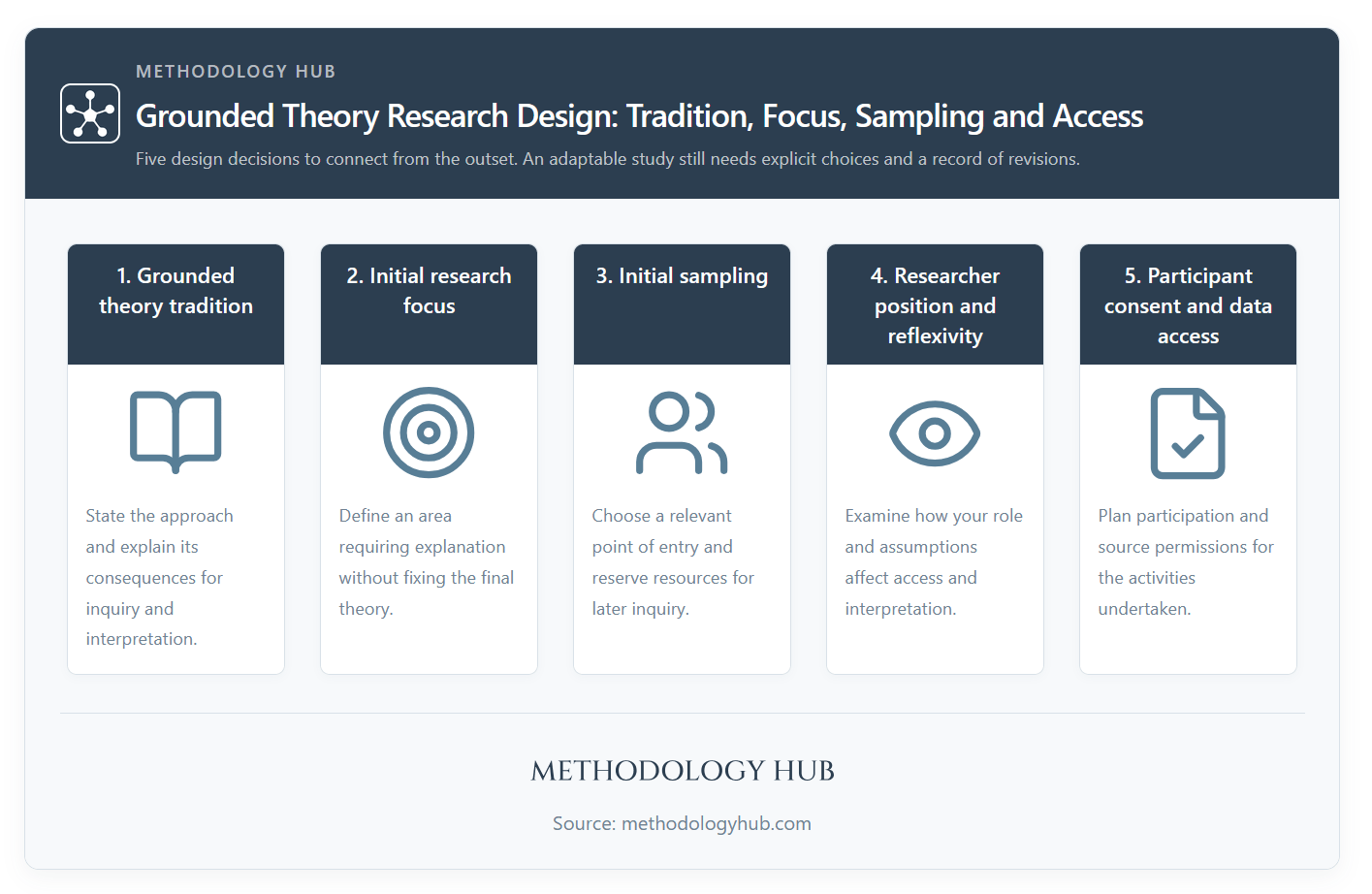
A grounded theory research design sets out the tradition, initial focus, sampling, data sources and access arrangements needed for theory development. It should also explain how collection and analysis will inform one another. An adaptable design still needs clear decisions about what can change and how those changes will be documented.
Choosing a Grounded Theory Tradition
Choose a tradition whose assumptions fit the intended study. Classic grounded theory emphasises conceptual emergence; Straussian work provides explicit relational procedures; constructivist grounded theory examines the researcher’s involvement in developing data and interpretations. These differences influence analysis, use of literature and the account given of research quality.
State the tradition and the methodological sources that guide it. The design should explain the procedures actually proposed, rather than borrow a label while combining incompatible requirements. Detailed philosophical comparison is less useful in a project plan than a clear account of its consequences for the study.
Defining the Initial Research Focus
Identify the area of activity, population or setting through which the study will begin. Explain what falls inside the initial focus and why the material is likely to illuminate the problem. Distinguish these practical boundaries from assumptions about what the final categories will be.
Allow the focus to develop through analysis while keeping the study manageable. A significant change may affect access, consent or the time needed for collection. Record its rationale and check that the revised scope remains feasible.
Planning Initial Sampling
Specify the initial eligibility criteria and recruitment routes. Seek people or sources with relevant experience, including useful variation where the research focus warrants it. The first sample supplies material for early comparison; it does not settle every later selection decision.
Plan capacity for additional inquiry. This may require further visits, follow-up interviews or access to another relevant source. A design that allocates all resources to the first collection round leaves little room for theoretical sampling.
Researcher Position and Reflexivity
Explain the researcher’s relationship to the setting and participants. Professional roles, previous knowledge and expectations can influence access, what participants discuss and which interpretations receive attention. Consider those effects before entry and revisit them as the study develops.
Maintain reflexive notes alongside methodological decisions. Their value lies in showing how an assumption affected collection or interpretation and what changed in response. A general statement about researcher background leaves those consequences unclear.
Participant Consent and Data Access
Plan how participants will understand the study, choose whether to take part and discuss any follow-up contact. Access granted by an organisation does not replace individual participation decisions. Explain how interviews, observations and records will be handled, including identifying details that may appear across sources.
Prepare for changes in collection without assuming that initial permission covers every later activity. Review the relevant consent and institutional arrangements when adding participants, settings or data sources. Keep decisions documented so the flexibility of the methodology remains compatible with the conditions under which the research is conducted.
Data Collection in Grounded Theory Research
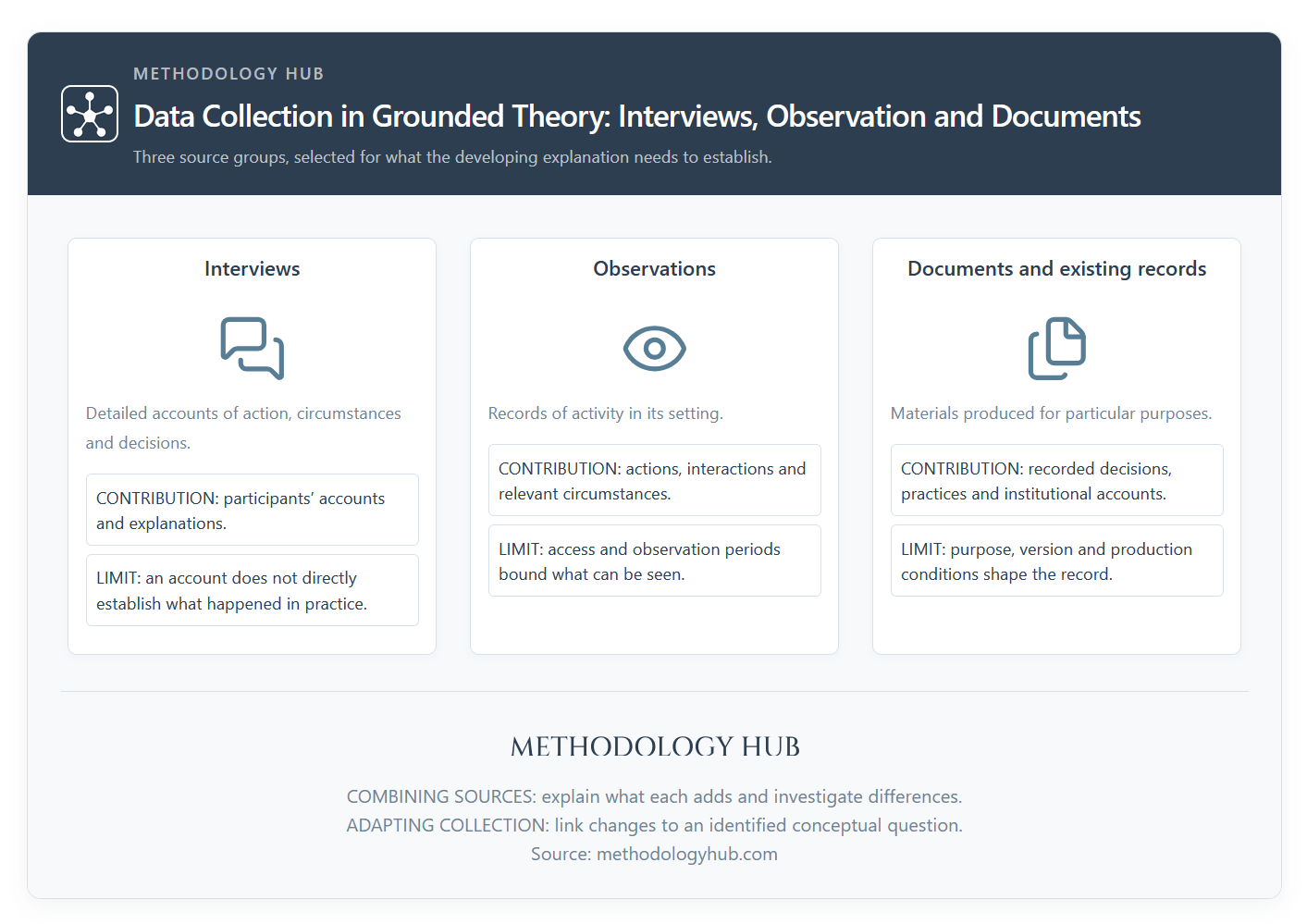
Grounded theory research can collect interviews, observations, documents and existing records. Choose sources according to what the emerging explanation needs to establish. A source contributes to the study when it provides relevant evidence about actions, circumstances or relationships, rather than simply increasing the amount of material.
Interviews
Use qualitative interviews to explore how participants describe situations, decisions and actions. Begin with prompts that allow detailed accounts, then develop follow-up questions through analysis. Retain the interviewer contributions that shaped the responses and note where an account needs clarification.
Later interviews can examine a conceptual question more closely, but avoid asking only for confirmation of the emerging theory. Invite detail that could reveal a different condition, response or consequence.
Observations
Qualitative observation can show activity as it unfolds, including routines, interactions and features of the setting. Record what happened and distinguish it from the interpretation proposed. Repeated observations can examine whether a relationship changes across occasions or conditions.
Observation and interview accounts need not agree completely. Differences can reveal what each source captures or how participants understand their actions retrospectively. Their analytical significance should be investigated rather than treated automatically as error.
Documents and Existing Records
Documents can provide rules, communications and records of activity that help explain the setting. Through qualitative document analysis, examine who produced the material, for whom, when and for what purpose. A written rule establishes a stated position, while evidence of its use requires further investigation.
Record selection decisions and document versions. Existing records may omit activity that was never documented or preserved. Their silence should not be interpreted automatically as evidence that nothing happened.
Combining Data Sources
Combine sources when each addresses a useful part of the developing explanation. State what interviews, observations or documents contribute and how their findings are compared. Collecting several source types does not by itself produce triangulation or guarantee a stronger theory.
Before adding a source, ask:
- Which conceptual question will it address?
- What can it show that the current material leaves unclear?
- How will it be compared with the existing records?
Keep source references available through analysis so a conceptual claim can be checked against its basis. Where sources differ, consider timing, purpose and access before deciding what the contrast means.
Adapting Data Collection as Theory Develops
Revise prompts and source selection when comparison identifies a specific gap. The change may concern an unclear category property, an unexplained contrast or a proposed relationship needing investigation. Record the analytical reason, the collection decision and its consequence for the explanation.
Keep enough consistency to understand how earlier and later material relate. When a prompt changes, note whether a difference in accounts may reflect the question asked rather than a difference in experience.
Sampling in Grounded Theory Research
Sampling begins with access to relevant material and develops towards the needs of the emerging theory. Initial sampling establishes a point of entry. Theoretical sampling then seeks evidence that can refine categories, investigate relationships and address important gaps in the explanation.
Initial Sampling
Define who or what can contribute to the first round of inquiry. Purposive sampling can identify relevant experience or circumstances, with variation chosen for a stated reason. The initial criteria should support useful comparison without claiming to anticipate every conceptual issue.
Theoretical Sampling
Use emerging categories to decide what to investigate next. Specify the property or relationship that remains unclear and the evidence likely to clarify it. Further inquiry can involve additional participants, a different setting, a follow-up encounter or another relevant source.
| Sampling decision | Initial sampling | Theoretical sampling |
|---|---|---|
| Main basis | Relevance to the starting problem and research focus | A question arising from the developing analysis |
| Timing | Establishes the first point of entry | Develops as categories and relationships take shape |
| Selection criteria | Experience, setting or variation judged useful at the outset | Particular conditions, contrasts or gaps requiring investigation |
| Contribution | Supplies material for early conceptual work | Elaborates, challenges or refines the emerging explanation |
Recruitment Decisions
Connect recruitment with the comparison the study needs. Gatekeepers and convenient networks may provide access while limiting whose accounts are available. Consider whether the route excludes people whose experiences could challenge the current explanation.
Document invitations, participation and access constraints at an appropriate level. Where a theoretically useful group cannot be reached, state the resulting limit. Replacing it with more accessible participants does not necessarily answer the same conceptual question.
Sample Size
Plan an initial scope that is feasible for intensive analysis and allows further inquiry. Grounded theory has no universal participant count. The needed material depends on conceptual complexity, depth, variation and the relationships being investigated.
Use the project plan to explain resources and likely collection commitments, while distinguishing those estimates from the eventual basis for stopping. An achieved sample size describes the study; it does not independently demonstrate that the theory is sufficiently developed.
Theoretical Saturation
Theoretical saturation concerns whether further theoretically directed comparison continues to add significant properties, variation or relationships to the central categories. Repeated topics can appear while an important part of the explanation remains unclear.
Assess the relevant memos and comparisons, then explain the judgement in relation to the theory’s scope. If practical limits end collection, report that decision plainly and identify the unresolved questions. A deadline should not be presented as evidence of theoretical saturation.
Grounded Theory Research Process
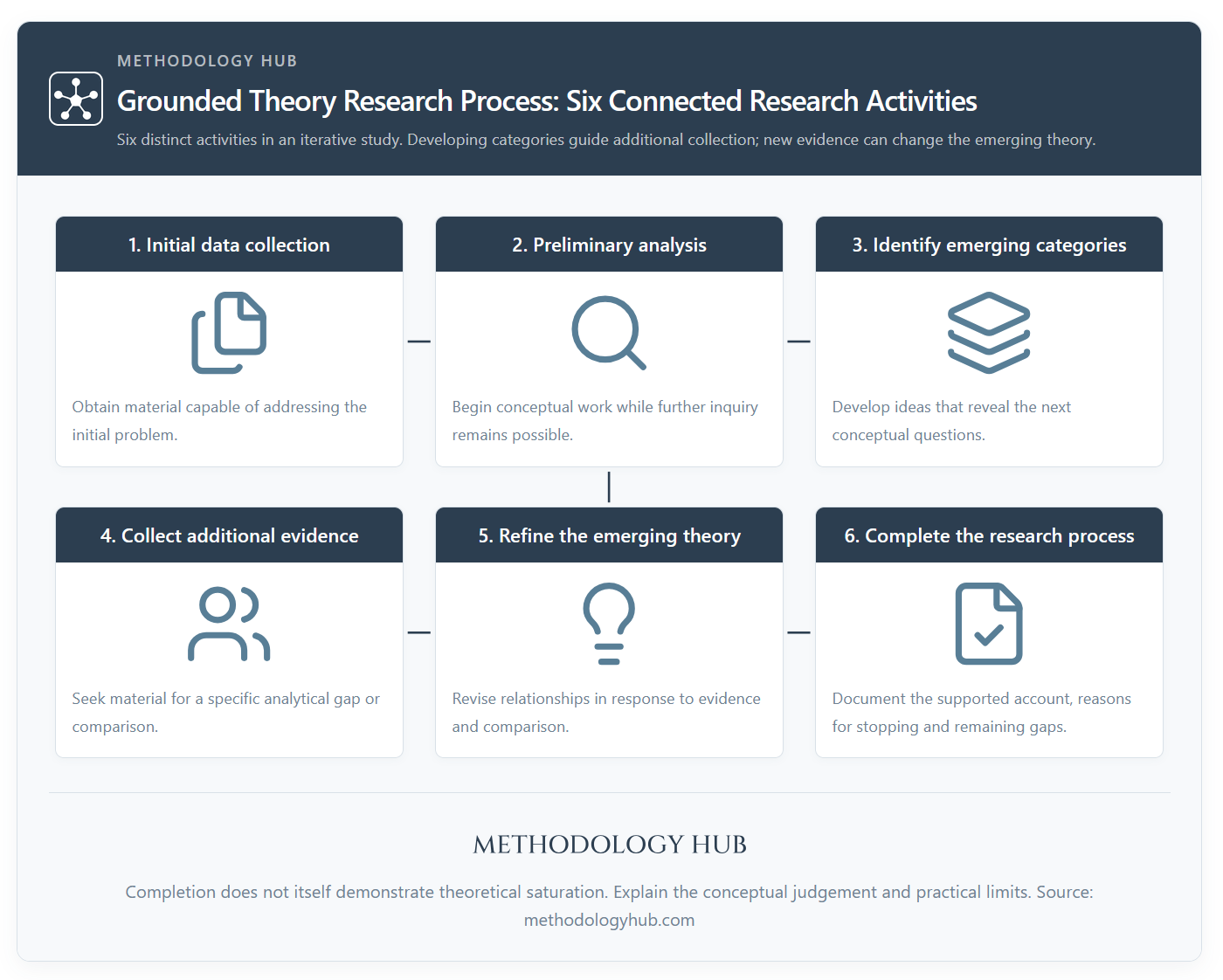
The grounded theory research process connects initial collection, preliminary analysis, category development, further inquiry and theoretical refinement. Researchers revisit these activities as the explanation develops. The study ends with an account whose claims and limits can be supported by the material examined.
Initial Data Collection
Collect material that allows participants or records to illuminate the starting problem. Test whether the questions, recording arrangements and access provide enough detail about relevant actions. Early collection also reveals practical obstacles that may require changes to the research plan.
Preliminary Analysis
Begin close reading and comparison while further collection remains possible. Use coding and memo writing appropriate to the chosen tradition. Identify tentative concepts and questions that could guide the next encounter, rather than waiting for the entire planned sample before examining the material.
Identifying Emerging Categories
Develop categories through comparison of incidents and provisional concepts. Record their meanings, properties and relevant variation. At the project level, the important decision is what these categories now require the study to investigate.
Avoid treating an early category as an instruction to collect only confirming accounts. It should focus inquiry while remaining open to comparisons that could change the explanation.
Collecting Additional Evidence
Pursue the next collection decision according to its analytical purpose. Explain which uncertainty prompted it and why the selected material can contribute. Update recruitment, prompts or source access where necessary, retaining a record of the changes.
Refining the Emerging Theory
Compare the new material with the proposed relationships and revise the explanation. A refinement may identify a condition, narrow the scope or replace a category that fits poorly. Check whether the change also affects earlier interpretations or creates another question for inquiry.
Completing the Research Process
Review the development of the central categories, the evidence for their connections and the unresolved contrasts. Decide whether further collection would make a significant conceptual contribution within the study’s scope. Record the basis for completion alongside any constraints on time or access.
Before writing the final account, bring together the material needed to explain the study’s progression:
- Decisions connecting the initial focus with later collection.
- Memos showing how categories and relationships developed.
- Evidence supporting the explanation and qualifying its scope.
- Reasons for ending collection and any remaining conceptual gaps.
The project record should make these connections understandable without requiring a transcript of every analytical action.
Developing and Evaluating a Grounded Theory
A developed grounded theory connects categories into an explanation of how a process or pattern works. Evaluate it by asking whether its concepts fit the material, its relationships explain variation and its contribution is clear. Quality criteria should be consistent with the tradition used.
Identifying a Central Category or Integrating Concept
A central category or integrating concept can organise the relationships that give the theory coherence. Its usefulness depends on its explanatory contribution. It should connect important parts of the analysis without becoming a broad label that appears to cover everything.
Not every tradition frames integration in identical terms. Explain how the organising concept was developed and what it helps account for, using comparisons and analytical memos as evidence.
Connecting Categories
State the proposed relationships in clear sentences. Identify what changes under different conditions and how the concepts work together. A diagram can communicate the structure, but each connection needs a reasoned explanation grounded in the material.
Distinguish established relationships from plausible suggestions. Where the evidence cannot separate competing explanations, retain that uncertainty rather than giving every arrow in a model the same apparent certainty.
Explaining Social Processes
Explain how actions or interactions develop in relation to the conditions identified. A process account may contain stages, but it may also concern recurring strategies or relationships that change across circumstances. Let the evidence determine whether a fixed sequence is defensible.
| Evaluation concern | Question to address in the report |
|---|---|
| Empirical grounding | Which comparisons support the categories and their properties? |
| Conceptual integration | How do the categories connect into an explanation? |
| Variation | Which conditions and contrasting cases change the proposed relationships? |
| Contribution | What does the theory explain beyond a summary of reported topics? |
| Scope | Where does the evidence support the account, and what remains uncertain? |
Evaluating the Developed Theory
Apply criteria appropriate to the methodology. Classic grounded theory often emphasises fit, work, relevance and modifiability. Charmaz’s constructivist work discusses credibility, originality, resonance and usefulness. Explain the meaning of the criteria used and how the study addressed them.
Evaluation should examine the theoretical account as well as the procedures. A complete coding record or large collection does not establish that relationships are developed. Show what the explanation contributes and how it remains open to revision through further evidence.
Reflexivity and Research Quality
Review how the researcher’s role shaped access, questions and interpretation across the project. Consider whether a preferred account limited the comparisons pursued or made some experiences less visible. Record the consequential revisions rather than presenting reflexivity only as a statement of personal background.
Discussion with participants or colleagues can offer further perspectives. Their contribution should be explained in relation to the methodological approach and the question addressed. Agreement alone does not establish the quality of every theoretical claim.
Grounded Theory Research Example
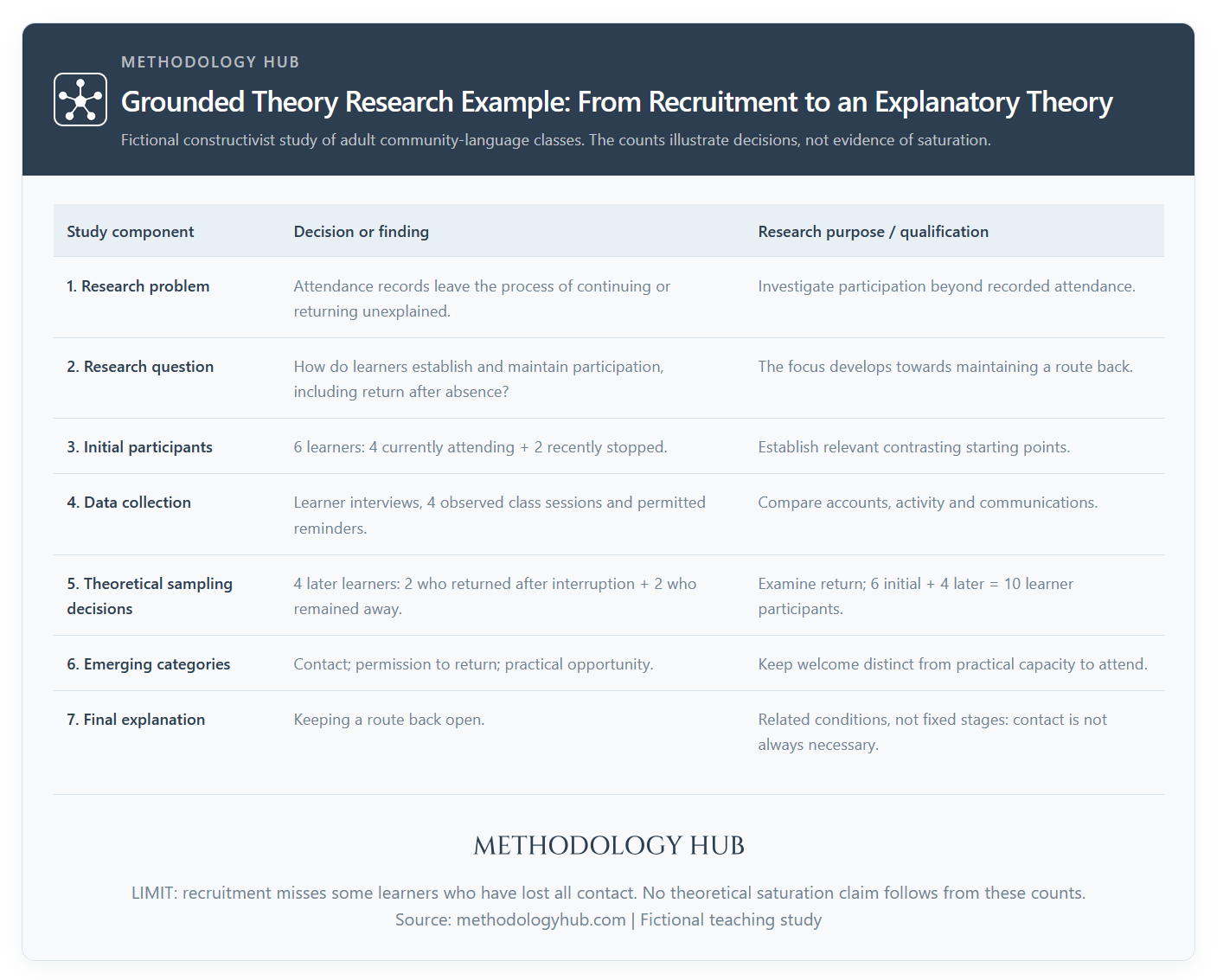
A fictional study of adult community-language classes shows how research questions, recruitment and data collection can change as a theory develops. The study follows a constructivist grounded theory design and examines how learners establish and maintain participation, including returning after an absence.
Research Problem
Enrolment and attendance records show when people attend, but do not explain how they decide whether returning after an absence is still possible. The research problem concerns that process of maintaining a connection with the class, rather than measuring the overall rate of retention.
Research Question
The initial question is: how do adults establish continuing participation in a community-language class? Early comparison focuses the question towards how learners maintain a route back when attendance is interrupted. The researcher records that refinement because it changes the purpose of later recruitment and interviews.
Initial Participants
The initial sample includes six adult learners: four currently attending and two who have recently stopped. This purposive selection provides relevant contrasts at the outset. It is not yet theoretical sampling, because the selection is based on the starting problem rather than a developed category gap.
Participation is invited separately from teaching and attendance decisions. The researcher offers information in an accessible form and explains that taking part will not affect access to the class. Learners choose whether to permit further contact.
Data Collection
The researcher interviews the six learners, observes four class sessions and examines permitted class reminders. Interviews explore particular occasions of attending, missing or returning. Observation records how late arrivals and returning learners are received, while reminders show the wording used to maintain contact.
Early accounts differ: one learner returns because a peer keeps them informed, another attends after a direct welcome from the tutor, and another stays away because they believe missing sessions means falling too far behind. These contrasts suggest a question about how return remains possible and socially acceptable.
| Research decision | Basis in the developing study | Contribution to the explanation |
|---|---|---|
| Begin with six learners in different attendance situations | The initial problem concerns continuing participation | Establish relevant contrasts without claiming representation |
| Combine interviews, observations and reminders | Accounts of returning need contextual evidence | Examine experiences alongside visible practices and communications |
| Focus on the possibility of return after absence | Early comparison connects peer contact, welcome and perceived difficulty | Develop a category concerning an available route back |
| Recruit four further learners with contrasting return experiences | The category needs comparison beyond current attendance | Investigate return after interruption and continued absence |
| Compare welcome with practical capacity to attend | Some accounts describe feeling welcome while still being unable to return | Distinguish social permission from workable opportunity |
| Integrate the categories and state their limits | The comparisons support related but separate conditions | Explain continuing participation without reducing it to motivation alone |
Theoretical Sampling Decisions
The next sample includes four learners: two who returned after an extended interruption and two who remained away. The reason is to investigate the developing category, not simply to reach ten participants. Later interviews examine whether learners know how to rejoin, expect a welcome and have a practical opportunity to attend.
The researcher also revisits the reminders and observation notes for evidence about re-entry expectations. This links the next inquiry with the category rather than adding a new source without a purpose. Access to people who have lost all contact remains a limitation, since the recruitment routes may miss their experiences.
Emerging Categories
The analysis develops categories concerning maintaining contact, recognising permission to return and finding a workable opportunity to attend. Comparison shows that these are related but distinct. A supportive message can preserve a sense of welcome without changing work commitments, while a free evening may not lead to attendance if the learner assumes return is no longer acceptable.
An account of someone returning without ongoing peer contact also challenges the idea that contact is always required. The emerging explanation therefore treats contact as one way of maintaining a route back, rather than a compulsory first stage.
Developing the Final Explanation
The integrating concept is keeping a route back open. Within this fictional study, continuing participation depends partly on whether absence leaves learners able to recognise and use a possible return. Contact and invitations can maintain that possibility, but return also requires a workable occasion and an expectation that rejoining is acceptable.
The account explains why similar attendance gaps may have different outcomes and why welcome alone may not restore participation. It remains limited by the sources and learners reached. The report would describe what the ten interviews and four observations contributed to category development, and whether unresolved comparisons restricted any saturation judgement.
Reporting Grounded Theory Research
A grounded theory research report explains how the study was conducted and presents the theoretical account it developed. Readers need to understand the initial focus, changes in sampling and collection, and the evidence supporting the final relationships. The report should make the research logic visible without reproducing every working note.
Describing the Methodology
State the grounded theory tradition, its relevant assumptions and the procedures used. Explain why it suited the research problem. Describe the relationship between collection and analysis, including changes that affected the project’s focus or sources.
Explaining Sampling Decisions
Distinguish initial selection from later theoretically directed inquiry. For consequential decisions, report the conceptual question, the material sought and what it contributed. State the achieved sample and relevant access constraints alongside the basis for stopping collection.
Presenting Categories and Relationships
Define the categories needed to understand the theory and show their relevant properties or variation. Support relationships with material that allows the interpretation to be assessed. Include contrasts that narrow or qualify the account rather than selecting only the clearest confirming extracts.
Communicating the Developed Theory
Present the explanation in connected prose, with a diagram where it helps readers follow the relationships. Explain the meaning of each link and the conditions under which it holds. Separate participant wording from conceptual language developed through analysis.
Keep the discussion of the study’s contribution connected to its evidence. The theory should be understandable as an account of the phenomenon, not only as a list of categories followed by quotations.
Reporting Limitations
Identify limits that affect the explanation, including inaccessible perspectives, limited variation or a relationship that remained provisional. State what each limitation changes about the claim. Acknowledging subjectivity in general does not explain which parts of this particular theory require qualification.
Before completing the report, check that it explains:
- Why grounded theory and the selected tradition fitted the problem.
- How collection and analysis influenced one another.
- How initial sampling developed into theoretically directed inquiry.
- Which comparisons supported categories and theoretical relationships.
- Why collection ended and what remained unresolved.
- What the theory contributes within its stated scope.
Use the checklist to identify omissions in reporting, while assessing the study itself through the quality criteria relevant to its tradition.
Conclusion
Grounded theory research connects the planning and conduct of a study with its developing explanation. A suitable question, relevant initial material and the capacity for further inquiry make it possible for comparison to shape the research as it proceeds.
The completed report should show how those decisions contributed to the theory. Its strength lies in the coherence of the design, the evidence for the proposed relationships and a clear account of what the study could and could not establish.
Sources and further readings
The following publications are among the foundational works in grounded theory literature.
- Glaser, B. G., & Strauss, A. L. (1967). The Discovery of Grounded Theory: Strategies for Qualitative Research. Aldine.
- Glaser, B. G. (1978). Theoretical Sensitivity: Advances in the Methodology of Grounded Theory. Sociology Press.
- Strauss, A. L., & Corbin, J. M. (1990). Basics of Qualitative Research: Grounded Theory Procedures and Techniques. Sage Publications.
- Glaser, B. G. (1992). Basics of Grounded Theory Analysis: Emergence vs. Forcing. Sociology Press.
- Charmaz, K. (2006). Constructing Grounded Theory: A Practical Guide Through Qualitative Analysis. Sage Publications.
- Corbin, J., & Strauss, A. (2015). Basics of Qualitative Research: Techniques and Procedures for Developing Grounded Theory (4th ed.). SAGE Publications.
- Charmaz, K. (2014). Constructing Grounded Theory (2nd ed.). SAGE Publications.
Cite this article
Whether you are preparing course materials, writing an academic paper, or sharing resources with students, we kindly ask that you acknowledge Methodology Hub as the source.
To make referencing easier, you can use the “Cite this page” tool below to automatically generate a citation in your preferred referencing style, including APA, MLA, Chicago, Harvard, and others. Simply select a citation style and click the generated reference to copy it.
When reproducing images, figures, or other materials from this page, please include an appropriate source credit and a link to the original page. Proper attribution helps others locate the original material and supports the continued development of freely accessible educational resources.