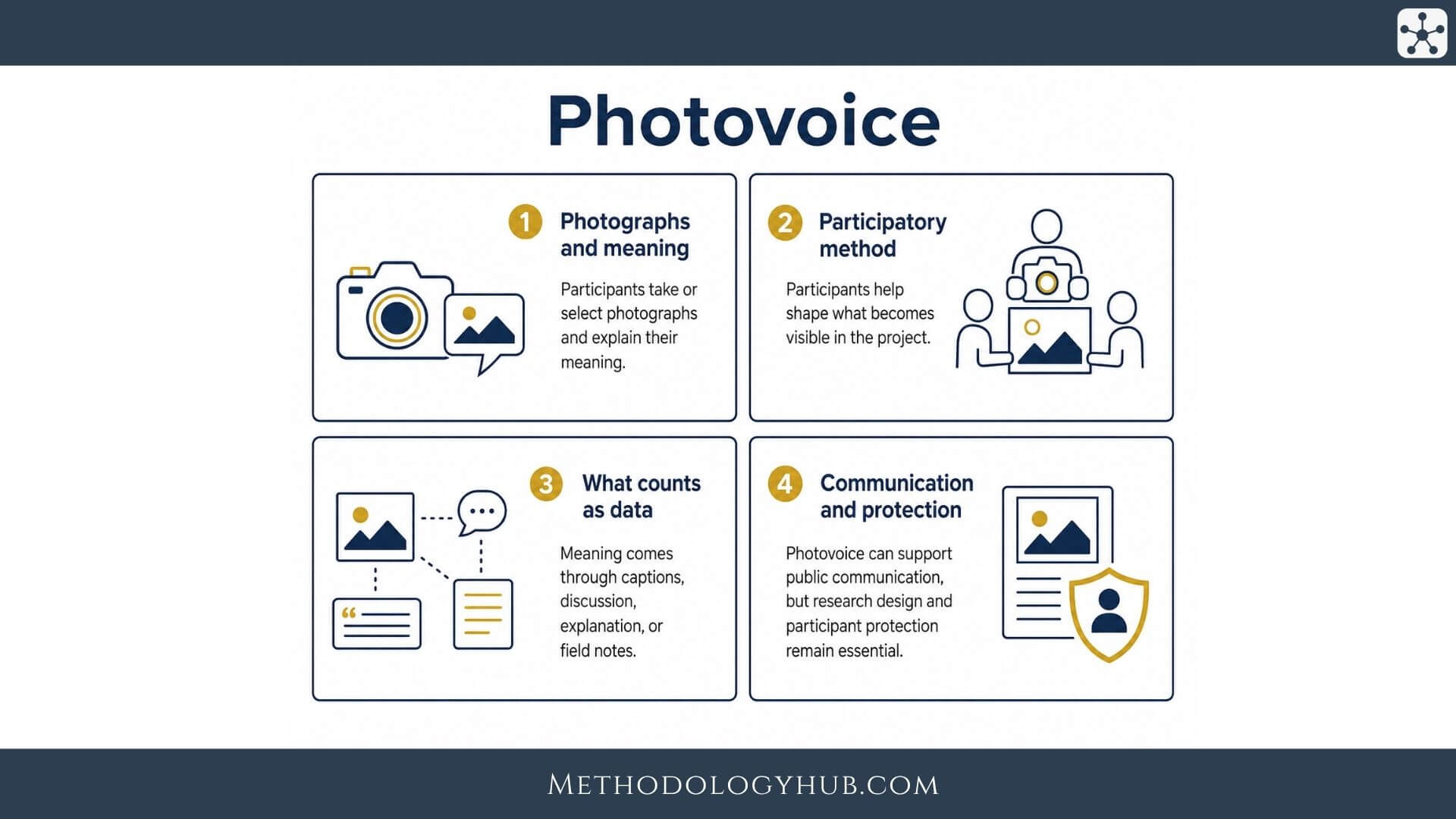
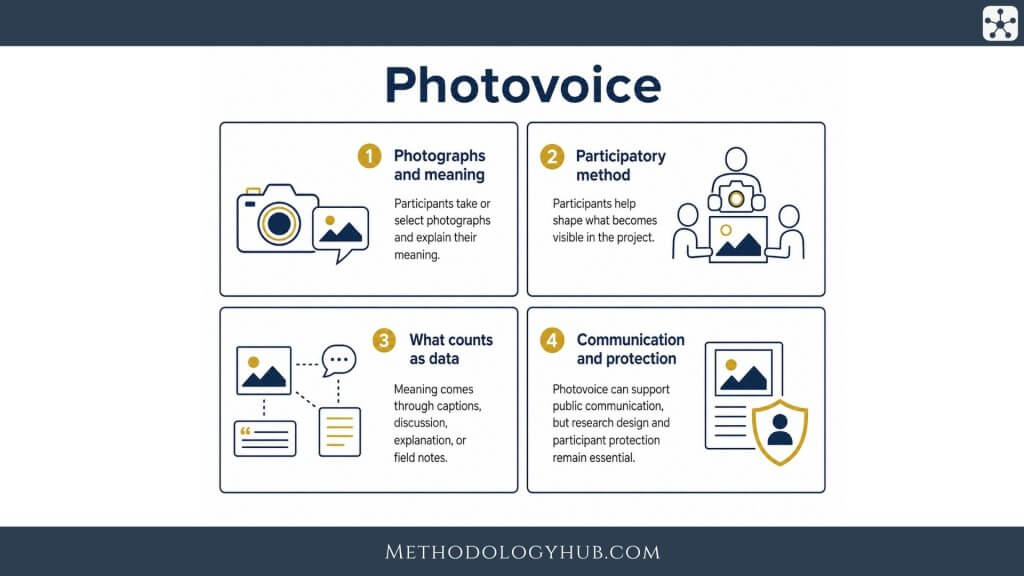
Photovoice is a participatory visual research method in which participants take photographs, discuss what the images mean, and use those discussions to communicate experiences, priorities, and possible changes. The method gives participants a role in deciding what should be photographed, what should be explained, and what should be shown to others.
Projects using photovoice often sit within the broader tradition of Qualitative Research, because the method focuses on lived experience, interpretation, context, and participant meaning. A photograph may show a place, object, barrier, or source of support, but the participant’s explanation is what turns that image into research data.
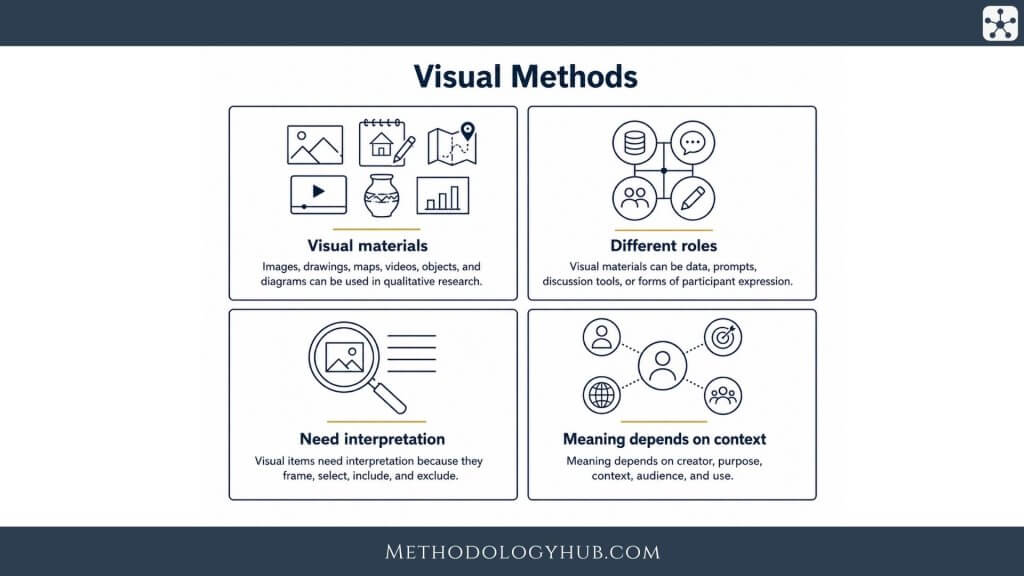
Photovoice also belongs to the wider family of Visual Methods in Qualitative Research, and it can be combined with interviews, group discussions, field notes, diaries, or other Qualitative Research Methods. It is especially useful when a study is concerned with community experience, place, access, inequality, everyday environments, or participant-led representation.
Photovoice at a Glance
Photovoice asks participants to document parts of their everyday world through photographs. The images are then discussed, interpreted, and sometimes shared with audiences beyond the research team. The method is not only about taking pictures. It is about using photographs to support participant-led explanation.
A participant might photograph a broken pavement, a welcoming doorway, an overcrowded bus stop, a quiet study corner, a confusing sign, or a place where they feel excluded. The photograph gives the discussion a concrete starting point, while the participant explains why it was taken and what it represents.
Photovoice definition
Photovoice is a participatory qualitative method in which participants create or select photographs to represent experiences, community conditions, concerns, strengths, or priorities. The photographs are discussed and analysed to understand participant perspectives and, in some projects, to support public communication or change.
The method usually includes several stages: introducing the project, giving photo guidance, allowing participants to take images, discussing selected photographs, analysing themes, and deciding how findings should be shared.
What makes photovoice different
Photovoice differs from many image-based methods because participant control is built into the design. Participants are not only responding to images chosen by the researcher. They often create the images, select which ones to discuss, and help explain what should be learned from them.
This does not mean the researcher disappears. The researcher still designs the project, supports participants, protects privacy, facilitates discussion, organises data, and helps shape analysis. The difference is that participants have a stronger role in deciding what becomes visible.
Photographs and participant voice
The word voice in photovoice refers to participant expression, not only spoken words. A photograph can help participants show something that may be difficult to describe directly. The image can also give participants a way to discuss ordinary spaces, hidden barriers, or community strengths.
The photograph alone is not treated as the whole finding. Participant explanation, group discussion, captions, and research notes are needed to understand the meaning of the image.
| Photovoice element | Role in the study |
|---|---|
| Participant photographs | Show places, objects, conditions, experiences, concerns, or strengths selected by participants. |
| Caption or explanation | Connects the image to participant meaning and context. |
| Discussion | Develops interpretation through individual or group reflection. |
How Photovoice Works
A photovoice project usually unfolds in stages. The researcher introduces the project, participants receive guidance, photographs are created or selected, images are discussed, themes are developed, and findings may be shared with a wider audience.
The order may vary. Some studies begin with a group workshop. Others begin with individual interviews. Some include a public exhibition. Others keep all images private and report findings through anonymised descriptions.
Introducing the project
Participants need to understand the purpose of the project before taking photographs. The introduction should explain the research question, the photo task, privacy limits, expected time, submission process, and how images may be used.
This stage also sets expectations about choice. Participants should know that they can decide what to photograph within the task, skip images they do not want to discuss, and avoid photographing people or places that create privacy risk.
Taking or selecting photographs
Participants then take or select images that respond to the task. The task might ask them to photograph places that support wellbeing, barriers to access, objects that help them manage daily life, or signs of change in a neighbourhood.
The researcher should not assume that more images are better. A small set of carefully discussed photographs can be more useful than a large collection with little explanation.
Discussing the photographs
Discussion may happen individually, in a group, or both. Participants can explain why they selected each photograph, what it shows, what is not visible, what should change, and what others might misunderstand.
Group discussion can add another layer. Participants may recognise similar issues, disagree about interpretation, or build shared categories from the photographs. A facilitator should make sure quieter participants are not pushed aside by stronger voices.
Recommendation: a photovoice project needs time for both image creation and image interpretation. The discussion is not an optional extra.
Developing themes and messages
After discussion, the researcher and participants may identify repeated themes, contrasts, priorities, or possible messages. These may concern access, safety, belonging, service design, public space, health routines, learning conditions, or community strengths.
In some projects, participants help decide which messages should be communicated publicly. In others, analysis remains within the research report. The purpose should be agreed before the dissemination stage begins.
Photovoice vs Photo Elicitation vs Visual Methods
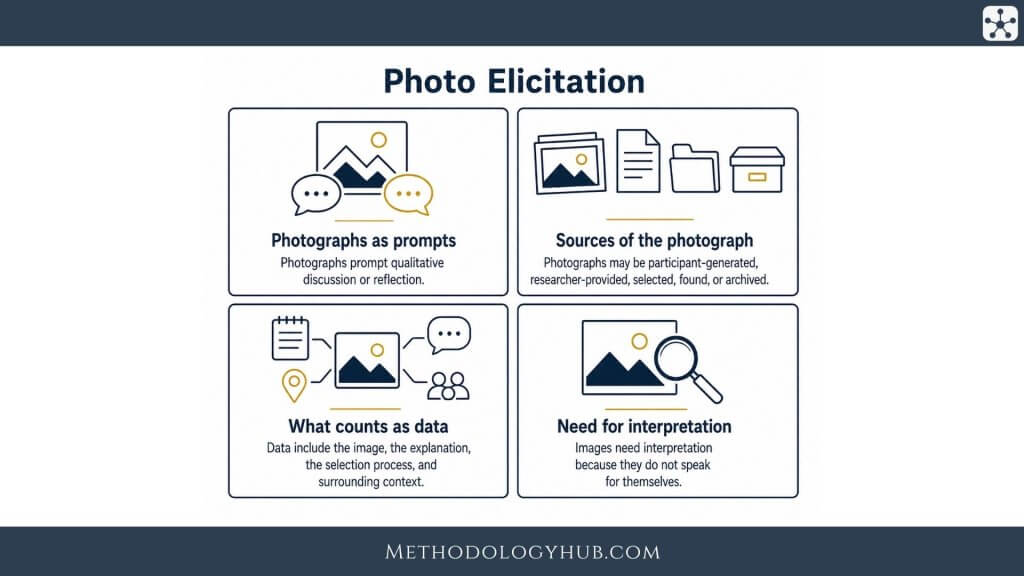
Photovoice is related to photo elicitation, but the two terms are not interchangeable. In photo elicitation, photographs are used to support an interview or discussion. In photovoice, photography is usually part of a participatory process that may include shared interpretation and public communication.
A project can use both. For example, participants may take photographs for a photovoice project, then discuss selected images in a photo elicitation interview. The distinction lies in the purpose and level of participant involvement.
How photovoice differs from photo elicitation
Photo elicitation can be researcher-led or participant-led. The images may be supplied by the researcher, selected from archives, or taken by participants. The goal is usually to support discussion and improve the depth of interview data.
Photovoice usually gives participants a stronger role in creating images, interpreting findings, and sometimes deciding how the findings should be communicated. When a project includes community discussion, collective themes, and public messages, it moves closer to photovoice.
| Feature | Photovoice | Photo elicitation |
|---|---|---|
| Typical role of participants | Create images, discuss meanings, and may shape messages. | Discuss images as part of interview or group data collection. |
| Common purpose | Participant-led representation, shared analysis, possible public communication. | Richer discussion, recall, and explanation during data collection. |
| Image source | Often participant-generated. | Participant-generated, researcher-selected, existing, or archival. |
Connection to visual methods
Photovoice is part of the larger set of visual research approaches. Compared with some other visual methods, it often places more emphasis on participant perspective and possible communication beyond the research setting.
Within this wider area, Photo Elicitation is useful when images support interview discussion, while photovoice is useful when participant-created photographs and shared interpretation are central to the project design.
Connection to group discussion
Photovoice projects often use group discussion because participants can compare photographs and identify shared concerns. A group may discuss which images show individual experience and which show wider conditions.
When a project uses group discussion, the researcher can draw on ideas from Focus Groups in Qualitative Research while also recognising that photographs change the discussion. The image becomes an object that participants can point to, question, and reinterpret together.
Designing a Photovoice Project
A photovoice project needs more than a request for photographs. The researcher must design a process that is clear, manageable, safe, and useful for analysis. The design should specify participant roles, image tasks, discussion format, consent procedures, and how findings may be shared.
The project should also be realistic. Participants may have limited time, different levels of comfort with photography, unequal access to devices, or concerns about taking images in public or private spaces.
Define the research purpose
The research purpose should guide the photo task. If the study concerns access to community services, the task might ask participants to photograph places that help or hinder access. If the study concerns student belonging, the task might ask for images of spaces where belonging is felt or questioned.
A vague purpose can create vague images. A clear purpose helps participants decide what to photograph without forcing all images into the same pattern.
Write a manageable photo task
The photo task should state how many images to take, what kind of situations to focus on, what to avoid, and how captions should be written. A task such as “Take five photographs that show places, objects, or moments that affect your experience of using this service” is usually easier than “Take photographs about access.”
Participants should also know that they do not need artistic skill. The photograph is a research prompt and record, not a photography competition.
Recommendation: ask for enough images to show range, but not so many that discussion becomes rushed or burdensome.
Plan the discussion format
Photographs can be discussed in individual interviews, small groups, workshops, or a combination. Individual discussion may give participants more privacy. Group discussion may help identify shared meanings and community-level themes.
The choice should fit the topic. Sensitive experiences may require individual discussion first. Community issues may benefit from group interpretation after participants have had time to explain their own images.
Prepare image handling and storage
The researcher should decide how photographs will be submitted, labelled, stored, backed up, anonymised, and linked to transcripts or captions. File names and participant codes should be consistent.
Careful organisation is important because analysis may need to connect each image with a caption, interview extract, participant explanation, group discussion, and later theme.
| Design area | Decision to make |
|---|---|
| Photo task | What should participants photograph, how many images, and over what period? |
| Discussion format | Will images be discussed individually, in groups, or both? |
| Image use | Will photographs stay private, appear in a report, or be shared in an exhibition or workshop? |
Pilot the process
A pilot can show whether instructions are clear, whether the photo task is realistic, whether participants understand privacy guidance, and whether the discussion questions produce useful explanations.
Small design problems can become large problems later. If participants take images that cannot be used or do not understand what to avoid, the study may lose both data quality and trust.
Consent, Privacy, and Participant Support
Photovoice can create privacy challenges because participants take photographs in real settings. Images may show faces, homes, workplaces, classrooms, health spaces, street signs, personal belongings, documents, or other identifying details.
Consent and support therefore need attention throughout the project. A participant may agree to discuss a photograph privately but not want it shown in a report or public presentation. Others pictured in an image may not have agreed to take part at all.
Consent for taking and using photographs
Consent should cover several questions: who may take photographs, what can be photographed, whether other people may appear, who can view the images, and whether photographs may be used publicly. These decisions should not be left until after the images are collected.
The researcher should separate consent for participation from consent for image display. A participant may join the study while choosing not to have any photograph reproduced outside the research team.
Guidance on what not to photograph
Participants need clear guidance about avoiding identifiable people, private documents, restricted spaces, screens, addresses, and situations that could create risk. They may also need alternatives, such as photographing objects, angles, shadows, routes, or symbolic scenes rather than faces.
This guidance should be practical. Saying “protect privacy” is not enough. Participants need examples of safe and unsafe images.
Supporting participants during the project
Photovoice can involve sensitive topics such as exclusion, illness, safety, discrimination, housing, education, or care. Participants may photograph or discuss difficult experiences. The researcher should explain support options, skipping rules, and how participants can withdraw images.
Support also includes technical help. Participants may need guidance on camera use, file submission, caption writing, or selecting images for discussion.
Recommendation: before any image is shared beyond the research team, ask whether the participant still agrees with that use and whether anyone else may be identifiable.
Power and representation
Photovoice is often used because it can shift representation toward participants. Even so, power does not disappear. The researcher may still control funding, deadlines, analysis, final writing, and access to audiences.
A careful project explains how decisions will be made. Participants should know whether they can help choose themes, select images for sharing, review captions, or comment on findings before dissemination.
Analysing Photovoice Data
Photovoice data can include photographs, captions, individual interviews, group transcripts, participant-selected themes, researcher field notes, and records of dissemination decisions. Analysis should bring these materials together without reducing the project to image description alone.
The researcher should examine what the images show, what participants say about them, why images were chosen, how participants discuss them together, and which themes are linked to wider conditions.
Start with participant explanations
Participant explanations should guide the first layer of analysis. A photograph may look simple to the researcher but carry a specific memory, frustration, pride, or concern for the participant.
Captions and transcripts help prevent the researcher from imposing meaning too quickly. They also show how participants connect images to routines, relationships, barriers, or possibilities for change.
Code images and discussions together
Coding can include visible content, participant explanation, selection reason, repeated themes, place, objects, emotion, barriers, strengths, and proposed changes. The image and discussion should remain linked during coding.
For example, a photograph of a locked gate might be coded for physical access, safety, exclusion, timing, or service closure depending on how participants explain it.
| Data layer | Analytic question |
|---|---|
| Photograph | What is visible, arranged, repeated, absent, or foregrounded? |
| Caption or interview | What does the participant say the image means? |
| Group discussion | How do participants compare, agree, disagree, or develop shared themes? |
Look for individual and collective meanings
Photovoice analysis may move between individual and collective interpretation. One participant’s photograph may represent a personal experience. Several photographs from different participants may point to a shared condition.
For instance, different images of transport stops, stairs, confusing signs, and long routes may together show an access issue. The researcher should explain how individual images were connected into broader themes.
Use participant involvement in analysis
Some photovoice projects involve participants in theme development, image selection, caption writing, or message creation. This can make analysis more participatory, but it also needs structure. Participants should know what decisions they are being asked to make.
The researcher should document how participant input shaped the analysis. If themes were revised after a participant workshop, the report should describe that process.
Report the limits of the data
Photovoice findings should state what the images and discussions can show. The study may show participant-selected examples of community conditions, but not every part of the community. It may show experiences of those who took part, but not everyone affected by the issue.
Clear limits make the analysis stronger. They prevent photographs from being treated as complete evidence of a whole setting.
Examples of Photovoice
Examples of photovoice show how participants can use photographs to document concerns, strengths, and everyday conditions. The method can be adapted across health, education, community, youth, housing, transport, and service research.
Example 1: Youth access to public spaces
Young people photograph places in their neighbourhood where they feel welcome, watched, excluded, or unsure. In group discussion, they explain why these spaces feel different and identify patterns across the photographs.
The analysis may show that access is shaped by lighting, seating, policing, signs, transport, cost, and informal rules about who belongs in a space.
Example 2: Patient experiences of home care
Patients photograph objects, rooms, notes, or routines that shape care at home. They may show medication storage, appointment letters, mobility aids, kitchen arrangements, or spaces where care feels difficult.
Interviews then explore how formal care instructions are translated into daily practice. The photographs help make practical work visible.
Example 3: Student belonging on campus
Students take photographs of places where they feel included, overlooked, supported, or uncertain. Images may include study spaces, corridors, noticeboards, social areas, digital screens, or quiet corners.
Group discussion can help identify patterns in how campus space communicates belonging. The findings may inform how support information, room design, or student services are experienced.
Example 4: Community transport barriers
Residents photograph bus stops, pavements, crossings, routes, waiting areas, signs, and places where travel becomes difficult. Captions explain when the issue occurs and who is affected.
The photographs can show barriers that may be missed in a standard consultation. Discussion can then connect individual images to shared transport concerns.
Recommendation: a photovoice example should show what participants photograph, how they explain the images, and what shared themes may emerge.
Example 5: Workplace safety and informal solutions
Workers photograph places, tools, signs, or routines that affect safety during daily tasks. Some images may show official safety equipment, while others show improvised solutions that are not documented in formal procedures.
The analysis may reveal gaps between official guidance and actual work. It may also show practical knowledge that workers use to make tasks safer.
Conclusion
Photovoice gives participants a way to document and explain experiences through photographs. It is especially useful when research concerns place, access, community conditions, everyday routines, hidden barriers, or participant-led representation.
The method works best when photography is paired with careful discussion, participant support, privacy planning, and transparent analysis. Photographs can make experiences visible, but participant interpretation is what gives them research meaning.
FAQs on Photovoice
What is photovoice?
Photovoice is a participatory qualitative method in which participants take or select photographs, discuss their meanings, and use the images to communicate experiences, priorities, community conditions, or possible changes.
What is an example of photovoice?
An example is asking residents to photograph places that help or hinder access to community services, then discussing the photographs in a group to identify shared barriers and possible improvements.
How is photovoice different from photo elicitation?
Photo elicitation uses photographs to support interviews or discussions. Photovoice usually gives participants a stronger role in creating images, interpreting themes, and sometimes communicating findings to a wider audience.
When should photovoice be used?
Photovoice should be used when the research question concerns participant perspectives on place, access, community conditions, identity, everyday routines, hidden barriers, strengths, or changes participants want to make visible.
How do you analyse photovoice data?
Photovoice data are analysed by linking photographs with captions, interviews, group discussions, field notes, and participant-selected themes. Analysis should examine visible content, participant explanation, selection context, and shared patterns.
What are the limits of photovoice?
Photovoice can create privacy risks, participant burden, uneven image quality, and challenges around representation. It requires clear consent, careful image handling, participant support, and transparent analysis.