Interviews in qualitative research are a way of collecting detailed spoken accounts from people who have relevant experience of a topic. The researcher prepares a topic, question route, or conversation guide, then uses listening and follow-up questions to understand how participants describe events, choices, relationships, memories, and meanings.
Within qualitative research, interviews are one of the most widely used ways to collect data because they allow participants to answer in their own words. They are especially useful when the study needs an account of experience rather than a score, category, or short written response.
This article focuses on interviews as a qualitative research method. It explains what qualitative interviews are, what they are used for, which interview types exist, how to prepare an interview guide, how to conduct the interview itself, how to analyse the data, and what interview-based studies can look like in practice.
What Are Interviews in Qualitative Research?
Interviews in qualitative research are purposeful conversations used to understand a topic from the participant’s point of view. The researcher usually begins with a research question, chooses participants who can speak about that question, and then creates a conversation that encourages detail, explanation, and examples.
Unlike a survey item with fixed responses, an interview can follow the way a participant explains a situation. If someone says that a training course felt “difficult but useful,” the researcher can ask what made it difficult, what made it useful, when that changed, and how the participant noticed the difference. This movement from a short answer to a fuller account is the main value of the method.
Qualitative interview definition
A qualitative interview is a planned conversation in which a researcher asks open questions and uses follow-up prompts to collect detailed verbal data. The data are then interpreted to understand meanings, experiences, perspectives, decisions, and social contexts.
The word “planned” is important. A qualitative interview may feel conversational, but it is still part of a research design. The researcher decides who to speak with, what the interview should cover, how answers will be recorded, and how the transcript or notes will later be analysed.
How qualitative interviews create data
Interview data are created through interaction. A participant brings memories, opinions, hesitations, examples, and ways of explaining the topic. The interviewer brings questions, listening, timing, and follow-up prompts. The final transcript is therefore not a simple extraction of facts from a person. It is an account produced in a particular research conversation.
This is why the interviewer’s role needs attention. A calm follow-up question can help a participant explain a difficult memory. A rushed question can close down the answer. A leading question can push the participant toward the researcher’s assumption. The quality of the data depends partly on how the conversation is handled.
When interviews are suitable
Interviews are suitable when the study needs access to experiences, interpretations, personal histories, professional judgement, expectations, or decision-making. They are also useful when the researcher wants participants to explain the words they use, the categories they rely on, or the meaning they attach to a situation.
For example, a researcher studying how families choose a school may interview parents about visits, conversations, online information, transport, sibling experience, and trust. The interview can show not only which school was chosen, but how the decision was built and which concerns shaped it.
What interviews cannot do by themselves
Interviews are not a direct window into every action, routine, or event. People may forget details, simplify stories, present themselves carefully, or describe what they believe should happen rather than what usually happens. This does not make interviews unreliable by default. It means the researcher should write claims that fit the method.
If the study needs to compare what participants say with what happens in a setting, interviews can be combined with observation, documents, diaries, or field notes in qualitative research. The interview can then explain meanings while other sources show context or practice.
Objectives of Interviews in Qualitative Research
The objectives of interviews in qualitative research are usually tied to understanding how people see, remember, explain, and organise their experiences. An interview can help the researcher explore a new topic, understand a familiar topic from a participant’s point of view, compare accounts across groups, or trace how decisions and interpretations develop.
These objectives are not all the same. An interview study about patients’ first weeks after a diagnosis has a different purpose from an interview study about how school leaders interpret a policy. Both use conversation, but the first may focus on lived experience and adjustment, while the second may focus on interpretation, institutional pressure, and decision-making.
Exploring a topic before categories are fixed
Interviews are useful when the researcher does not yet know which categories are most relevant. Early interviews can reveal language, concerns, and experiences that would be hard to predict from outside the setting. This is especially useful when a topic is new, under-described, or shaped by local context.
For example, a researcher studying students’ experiences of academic feedback may expect comments about grades. Interviews may instead reveal that students focus on tone, confidence, timing, fear of asking questions, or uncertainty about how to revise. Those findings can reshape the study’s later questions.
Understanding participants’ own explanations
Interviews allow participants to explain how they connect events, choices, and meanings. A researcher may ask not only what happened, but how the participant understood the situation at the time and how that understanding changed afterward. This is useful when meaning is not obvious from behaviour alone.
A teacher who avoids a new classroom technology, for instance, may not be rejecting innovation. The interview may show concerns about unreliable equipment, student distraction, training gaps, or previous negative experiences. The account helps the researcher avoid a shallow interpretation.
Comparing accounts across roles or settings
Interviews can also be used to compare perspectives. The researcher may speak with people who occupy different positions in the same process, such as students, teachers, parents, and administrators. The comparison can show where accounts align, where they conflict, and which assumptions each group brings to the situation.
This kind of comparison is interpretive rather than statistical. The researcher is not simply counting which group agrees more. The goal is to understand how different positions create different views of the same issue.
Following change over time
Some interview studies look at change. A researcher may interview participants at several points during a course, treatment, project, or transition. Repeated interviews can show how participants revise their explanations as they learn more, face new problems, or reinterpret earlier events.
A one-time interview can still ask about change retrospectively, but repeated interviews give the researcher a closer view of development. They can show how early uncertainty becomes routine, how initial confidence breaks down, or how participants gradually find language for an experience.
Recommendation: before writing interview questions, finish this sentence: “I need participants to help me understand…” The answer usually points toward the interview objective.
Building concepts from detailed accounts
Interview data can support concept development when the researcher moves beyond collecting interesting comments. A concept may emerge when several accounts point to a shared pattern, tension, or process. The researcher then tests that idea against further interviews and against examples that do not fit easily.
In a study of adult learners, for example, interviews may suggest a pattern of “quiet persistence”: participants continue attending classes but avoid asking for help because they do not want to appear unprepared. The concept would need to be developed through comparison, not simply named after one quotation.
Key Aspects of Qualitative Interviews
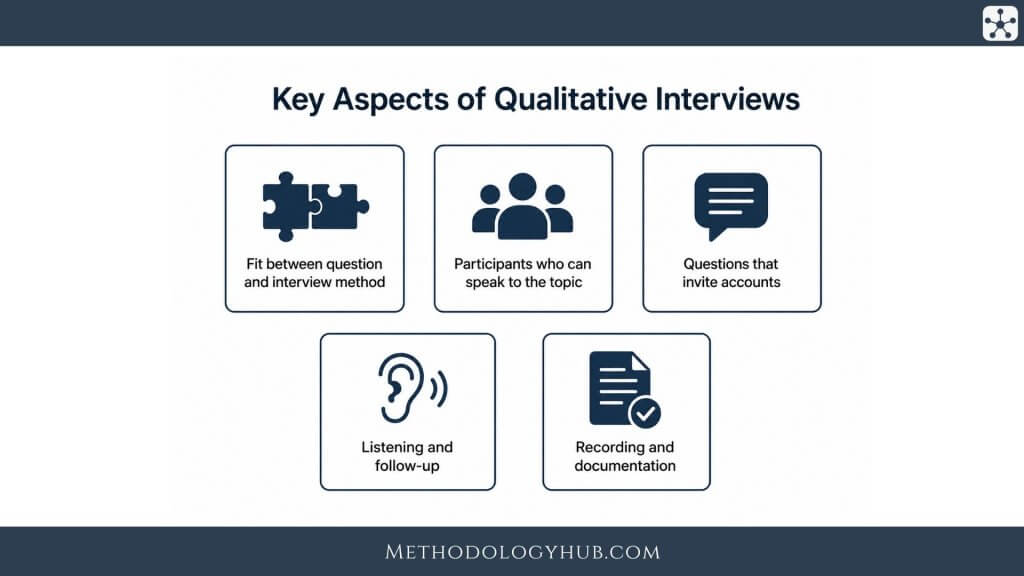
Several aspects make qualitative interviews different from ordinary conversation. The researcher needs to design a route into the topic, choose participants carefully, create questions that invite detail, document the interview process, and analyse the data in a way that preserves context. These parts should work together.
A polished interview guide cannot fix an unclear research question. A large set of participants cannot compensate for thin answers. A lively conversation does not automatically become strong evidence. Interview quality comes from the relationship between question, participant, conversation, record, and analysis.
Fit between question and interview method
The first aspect is fit. Interviews should be used because the research question needs participant accounts, not because interviews feel familiar or easy to arrange. If the question asks how students describe pressure during exams, interviews may be appropriate. If the question asks how many students missed an exam, records or survey data may be more suitable.
Fit also affects the interview style. A study of sensitive personal experience may need slower pacing and more space for narrative. A study of professional routines may need questions about concrete examples, daily decisions, and constraints.
Participants who can speak to the topic
Interview participants should have relevant experience of the topic. This sounds obvious, but weak studies often recruit whoever is easiest to reach. A better sample is built around the research question. If the study concerns support during doctoral writing, participants should have experience with that process, and the sample may need variation in discipline, stage, or supervision arrangement.
Qualitative samples are often smaller than survey samples because the work is detailed. The size should be justified by the depth of the material, the variation needed, and the analysis planned. A small but well-chosen group can produce stronger data than a large group with only a loose connection to the topic.
Questions that invite accounts
Good interview questions invite participants to describe situations rather than simply evaluate them. “Tell me about a time when…” often works better than “Do you think…” because it asks for a scene, not only an opinion. The researcher can then explore sequence, meaning, and consequences.
Questions also need to avoid building the researcher’s answer into the wording. A question such as “How stressful was the process?” assumes stress. A more open version might ask, “How did you experience the process?” or “What was the process like for you?”
Listening and follow-up
Listening is not passive in a qualitative interview. The interviewer listens for vague words, compressed stories, contradictions, turning points, and moments where an example is needed. Follow-up prompts help unpack these moments without taking control away from the participant.
A participant may say, “I stopped asking questions after that.” The interviewer might ask, “What happened before you stopped?” or “What made asking questions feel different after that?” These prompts keep the participant’s account at the centre while helping the data become more detailed.
Recording and documentation
Interview data need a reliable record. Audio recording is common when participants agree, because it allows the researcher to focus on the conversation. Transcripts make the material easier to code and compare. Notes and memos add context that a transcript may not fully capture.
Documentation should also include changes to the interview guide, recruitment decisions, and reflections after interviews. These records help readers understand how the study developed and how the researcher moved from conversation to interpretation.
| Aspect | Practical question for the researcher |
|---|---|
| Purpose | What should the interview help me understand? |
| Participants | Who can give a detailed and relevant account of this topic? |
| Questions | Do the questions invite examples, sequences, and meanings? |
| Record | Will the transcript, notes, and memos preserve enough context for analysis? |
Interpretation and scope
Interview findings need careful scope. A researcher should not use a small interview study to claim how common a view is in a whole population unless the design supports that claim. The strength of interviews is usually depth, not population measurement.
A well-written finding might say that participants in this study described three ways of managing uncertainty. It might compare those ways across roles or settings. It should not pretend to estimate national percentages unless a different design was used for that purpose.
Types of Interviews in Qualitative Research
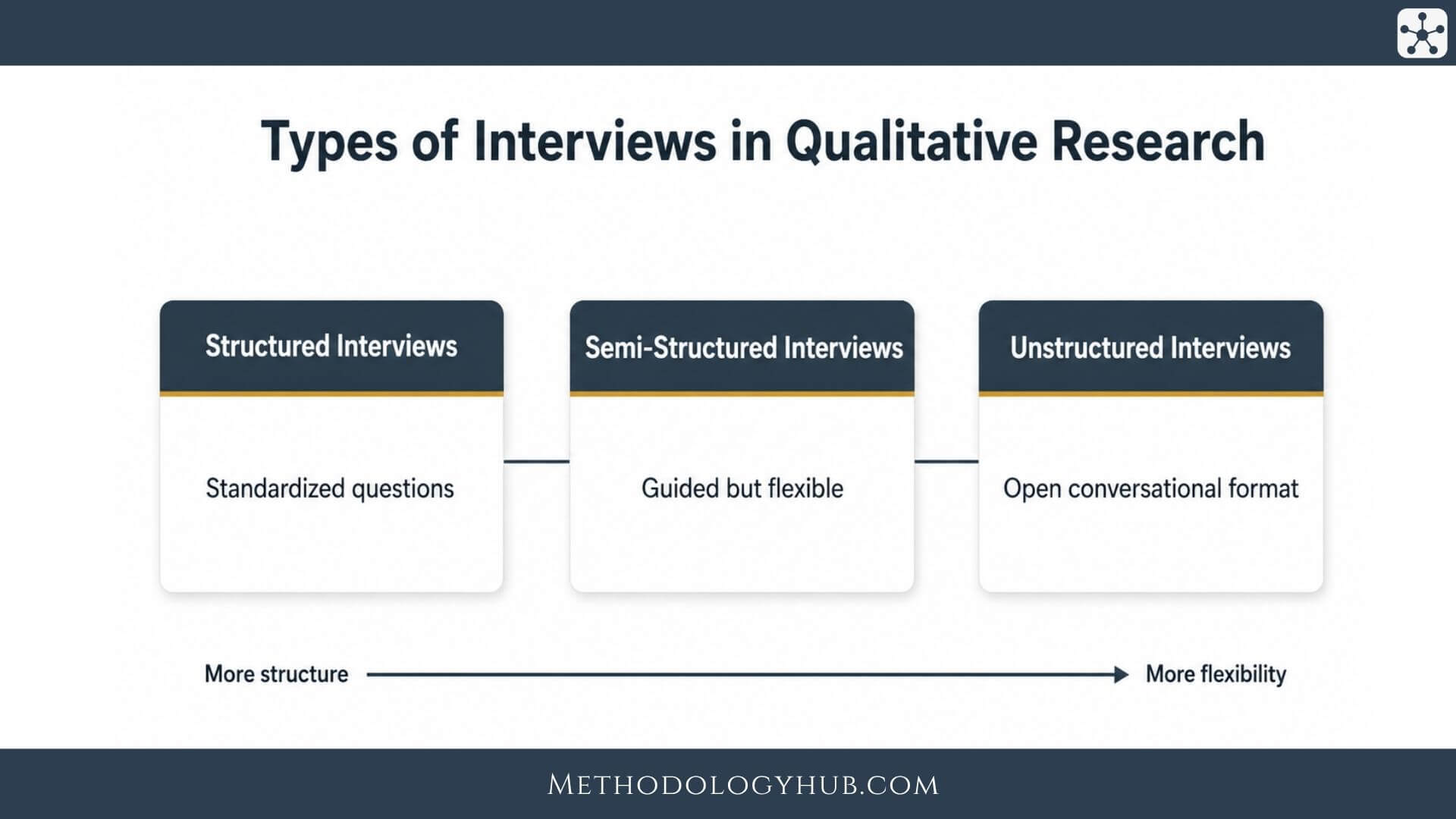
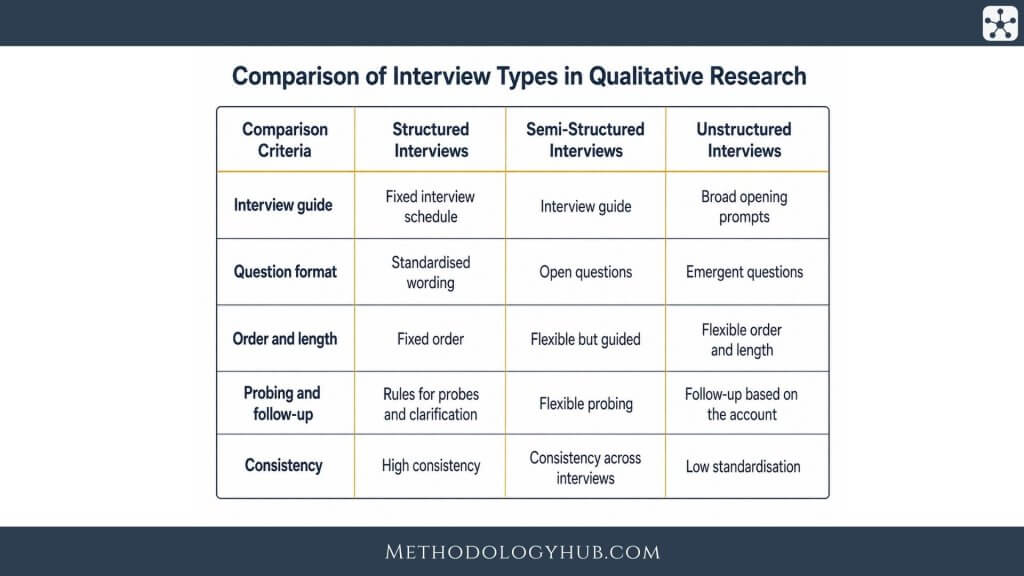
Types of interviews in qualitative research are usually described by the amount of structure in the conversation. Structure affects how much freedom the participant has, how closely interviews can be compared, and how much the interviewer can follow unexpected material.
The three main types are structured, semi-structured, and unstructured interviews. They should not be understood as a ranking from weak to strong. Each type has a different purpose and fits a different kind of study.
Structured interviews
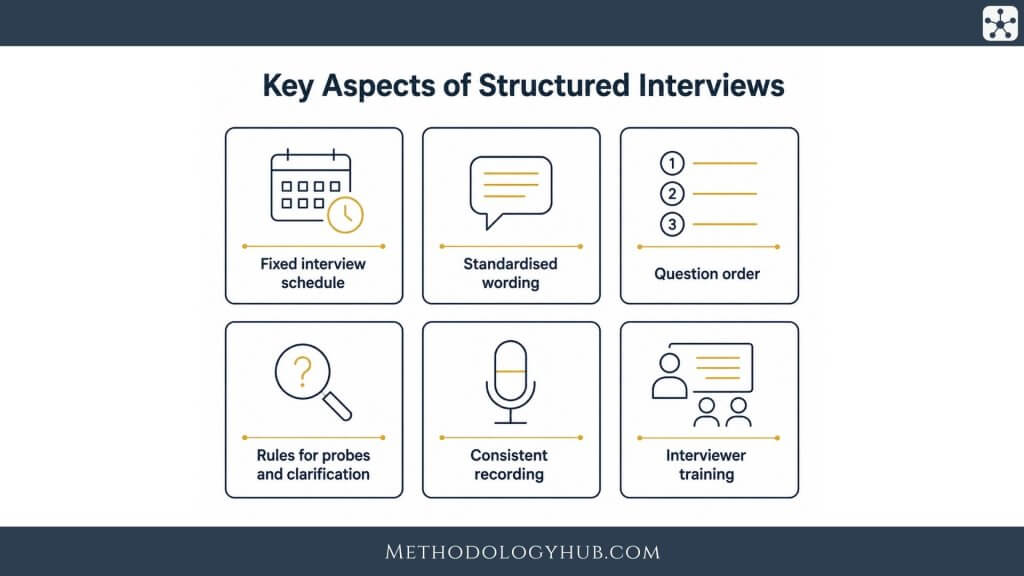
Structured interviews use the same questions in the same order for each participant. This format is useful when the researcher wants answers that can be compared closely across people or groups. It can also help when several interviewers are collecting data and the study needs a consistent procedure.
A structured interview can still be qualitative if the questions are open-ended. For example, every participant might be asked, “Can you describe how you prepared for your first teaching placement?” The wording is fixed, but the answer can still be detailed and personal.
Semi-structured interviews
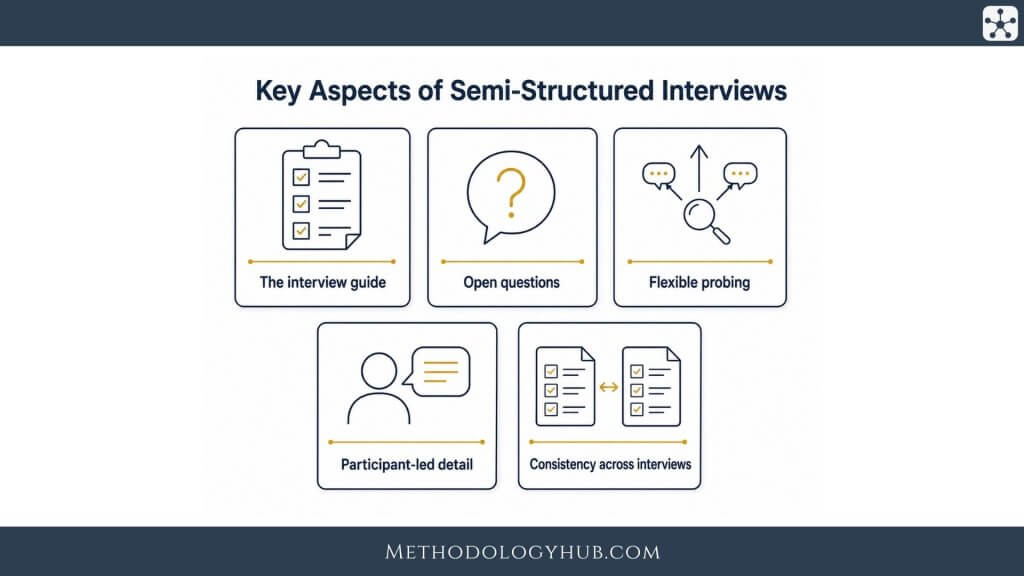
Semi-structured interviews use a guide with main topics, but the interviewer can change the order, ask follow-up questions, and spend more time on answers that are especially relevant. This format is common because it gives the researcher support without closing down the participant’s account.
In a study of first-year teachers, a semi-structured guide might include sections on preparation, classroom routines, support, difficult moments, and changes over the year. Each teacher would discuss the same broad areas, but the conversation could follow the details of their own school and subject.
Unstructured interviews
Unstructured interviews begin with a broad topic and allow the participant’s account to shape much of the conversation. The researcher may have a small number of areas in mind, but the interview is less tied to a formal list of questions.
This format can be useful for life histories, early exploratory work, or topics where the researcher does not want to impose a structure too soon. It also requires careful listening. Without skill, an unstructured interview can drift away from the research purpose.

Choosing between interview types
The choice depends on the research aim, the topic, and the level of comparison needed. A structured format may be useful when the researcher needs close consistency. A semi-structured format may be better when the same broad areas should be covered with room for participant detail. An unstructured format may fit when the participant’s own ordering of experience is part of the data.
| Interview type | What stays stable | What stays flexible |
|---|---|---|
| Structured | Question wording and order | The participant’s open-ended answer |
| Semi-structured | Main topics and core prompts | Order, probing, examples, and time spent on each topic |
| Unstructured | The research topic and interview purpose | The route, wording, depth, and sequence of the conversation |
For many student research projects, semi-structured interviews are practical because the guide supports the interviewer while still leaving room for follow-up. That does not make them automatically better. It simply means they often fit projects that need both focus and depth.
Interviews vs Focus Groups
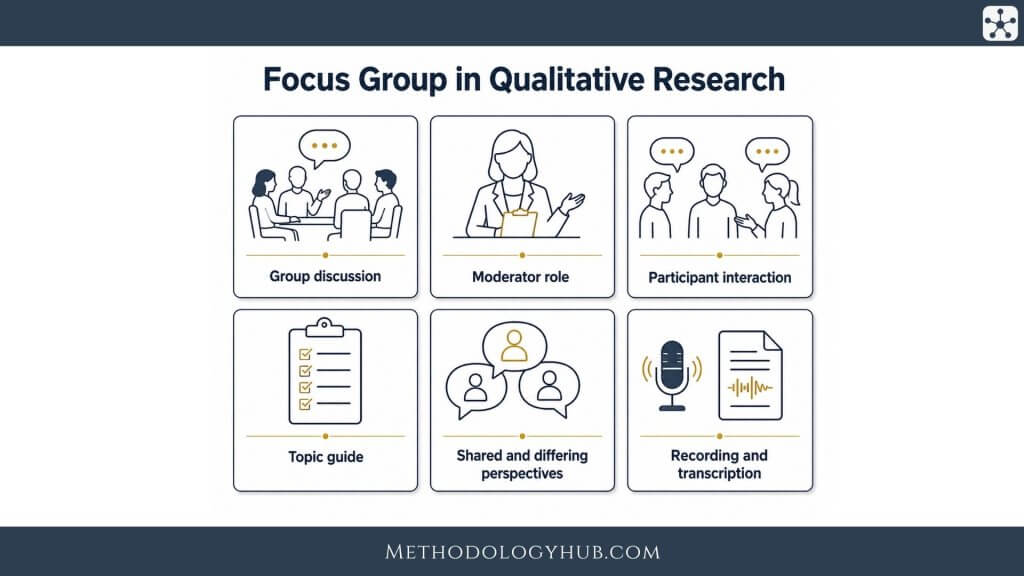
Interviews and focus groups both use spoken data, but they create different research situations. An interview usually gives one participant extended space to describe an experience. A focus group places several participants in a shared discussion where responses are shaped by agreement, disagreement, memory, humour, hesitation, and group expectations.
Focus groups in qualitative research are therefore not just a faster version of interviews. They are a different method. They are strongest when the interaction between participants helps answer the question.
Depth of one account
Interviews are usually better when the researcher needs time with one participant’s experience. The interviewer can ask for examples, return to earlier details, explore sensitive areas carefully, and follow one person’s account across several events. This can be important when the topic involves identity, loss, conflict, uncertainty, or private decision-making.
A study of how students cope after failing an assessment, for instance, may be better suited to interviews. The participant may need privacy and time to explain embarrassment, family expectations, changes in motivation, or fear of repeating the course.
Interaction between participants
Focus groups are better when the research question concerns shared views or group meaning. Participants can respond to each other, disagree, complete each other’s examples, or reveal the language that a group uses around a topic. The researcher can then analyse not only what was said, but how the discussion developed.
A study of how teachers discuss a new marking policy may benefit from a focus group. Teachers might compare interpretations, challenge official wording, and show which concerns are shared in staff conversation.
Recommendation: use interviews when the individual account needs room. Use focus groups when interaction between participants is part of the evidence.
Privacy, power, and comfort
The choice also depends on the social situation. If participants know one another, power differences may influence what can be said. A junior employee may not disagree openly with a manager in a group. A student may avoid discussing failure in front of classmates. In these cases, interviews may give participants more control over what they share.
On the other hand, some participants find group discussion easier because the pressure is not entirely on one person. The method should match the topic, the participants, and the kind of data the study needs.
| Feature | Interviews | Focus groups |
|---|---|---|
| Main data source | One participant’s account | Group discussion and interaction |
| Best fit | Detailed personal experience | Shared language, disagreement, and group norms |
| Risk | The account may rely on memory or self-presentation | Some participants may dominate or hold back |
How to Conduct Interviews in Qualitative Research
Conducting interviews in qualitative research means preparing a study in which each conversation can produce useful evidence. The work begins before the interview starts and continues after the participant leaves. A good interview depends on design, preparation, listening, documentation, and early reflection.
The steps below describe a common interview process. Some projects will move through them in a straight line. Others will return to earlier steps as the researcher learns from pilot interviews or from the first rounds of data collection.
Step 1: Clarify the interview purpose
The researcher should begin by writing a clear purpose for the interview. This purpose should be narrower than the overall topic. “Student wellbeing” is too broad for a single interview guide. “How students describe seeking help during the first semester” gives the conversation a clearer direction.
A clear purpose makes later choices easier. It helps the researcher decide who should be interviewed, which topics belong in the guide, which prompts are unnecessary, and what kind of analysis will be possible.
Step 2: Decide who should be interviewed
The participants should be chosen because they can provide relevant accounts. The researcher may also need variation. In a study of mentoring, for example, it may be useful to interview new students, experienced students, and mentors, because each group sees the process from a different position.
Recruitment should be written plainly. Participants need to understand what the study is about, what the interview involves, how long it may take, and what kind of participation is being requested.
Step 3: Prepare the interview guide
The interview guide turns the research purpose into a workable conversation. It may include opening questions, main questions, follow-up prompts, and closing questions. The guide should be short enough to allow depth, but complete enough to cover the main areas of the study.
Many guides move from easier questions to more specific ones. The interviewer may begin with the participant’s background or role, then ask for recent examples, then move into interpretation, comparison, and reflection.
Step 4: Test the questions
A pilot interview or practice interview helps the researcher see whether the questions work. Questions that look clear on paper may sound awkward when spoken. Some may produce only one-sentence answers. Others may lead participants toward a particular view without intending to.
Testing the guide can also reveal pacing problems. If the interview feels rushed, the researcher may need fewer questions and better prompts. If it feels thin, the guide may need more concrete examples.
Step 5: Conduct the interview
At the start of the interview, the researcher should explain the purpose, confirm practical details, and make sure the participant understands the format. The early questions should be easy enough to answer without pressure. As the interview develops, the researcher can use follow-up prompts to explore important parts of the account.
Useful prompts often ask for an example, a sequence, a comparison, or a clarification. “What happened next?” can open a timeline. “Can you give me an example?” can turn a general comment into data. “How did you see it at the time?” can help separate past experience from later reflection.
Step 6: Record, transcribe, and write notes
If the study uses audio recording, the researcher should check consent and equipment before the interview begins. Afterward, the recording can be transcribed for analysis. The transcript should be detailed enough for the chosen analytic approach.
The researcher should also write brief notes soon after the interview. These notes might record the setting, interruptions, changes to the guide, ideas for later interviews, or first impressions of a possible pattern. They are not a substitute for analysis, but they help preserve context.
Step 7: Review early interviews before continuing
Early review is useful because the first interviews can show whether the guide is producing the right kind of data. The researcher may notice that participants misunderstand a question, that an important topic appears repeatedly, or that one group is missing from the sample.
Reviewing early interviews does not mean changing the whole study without explanation. It means using the flexible nature of qualitative research carefully and documenting why changes were made.
Interview Questions in Qualitative Research
Interview questions in qualitative research should help participants give accounts that are detailed enough to analyse. The best questions usually feel simple when spoken, but they are carefully designed. They invite participants to describe a situation, explain meaning, compare experiences, or reflect on change.
Question writing is not only about wording. It is also about order. A participant may find it easier to describe a recent event before explaining what that event meant. A guide that begins with abstract questions can make the interview feel like an exam rather than a conversation.
Opening questions
Opening questions help the participant settle into the interview and provide context for later answers. They may ask about role, background, setting, or general involvement in the topic. These questions should be easy to answer but still relevant to the study.
In a study of teacher mentoring, an opening question might ask the participant to describe their current role or how long they have been involved in mentoring. The answer gives context without forcing the participant into the most complex part of the topic too quickly.
Experience questions
Experience questions ask participants to describe something that happened. They are often the strongest part of an interview guide because they produce examples. A question such as “Can you tell me about the last time you asked for support?” invites timing, setting, people, and action.
These questions can focus on first experiences, recent experiences, difficult moments, ordinary routines, or turning points. The researcher can then ask follow-up questions that explore sequence and interpretation.
Meaning questions
Meaning questions ask participants to explain how they understood an event or situation. They may ask what something meant, how the participant interpreted a response, or why a particular moment stayed with them. These questions should be asked gently, especially when the topic is personal.
Instead of asking “Why did you react that way?”, which can sound like a challenge, the interviewer might ask, “How did you understand that situation at the time?” The second wording often gives the participant more room to explain.
Comparison questions
Comparison questions help participants explain differences. The researcher might ask how one setting differed from another, how an experience changed over time, or how two forms of support felt different. These questions are useful when the analysis needs variation.
For example, a participant may be asked how online supervision differed from in-person supervision. The answer may reveal differences in access, comfort, timing, confidence, or the type of advice that was easier to request.
Closing questions
Closing questions allow the participant to add something that was not covered. They can also help end the conversation without making the final moment feel abrupt. A useful closing question might ask whether there is anything important about the topic that has not yet been discussed.
This final space can be valuable. Participants sometimes introduce a point near the end because the earlier conversation helped them think through the topic.
How to Analyse Interview Data
Analysing interview data means turning recordings, transcripts, notes, and memos into a clear interpretation of what the interviews show. The researcher reads closely, marks relevant passages, compares participants, develops codes or themes, and writes findings that connect evidence to the research question.
This work is rarely a straight line. The researcher may code part of a transcript, revise the code after reading another interview, return to an earlier account, and then write a memo about a pattern that is beginning to appear. This back-and-forth movement is part of qualitative analysis.
Prepare the material
The analysis begins with organised material. Transcripts should be labelled consistently, stored carefully, and checked against recordings where needed. Interview notes and memos should be kept with enough detail that the researcher can later understand when and why they were written.
The level of transcription depends on the study. A project analysing conversational turn-taking may need pauses and overlaps. A thematic study of professional experience may use a cleaner transcript that captures words accurately without recording every speech feature.
Read before coding
Before coding line by line, the researcher should read transcripts as whole accounts. This helps preserve context. A sentence that looks clear on its own may mean something different when read with the story around it.
Whole-transcript reading also helps the researcher notice tone, sequence, repeated concerns, and points of tension. These early impressions can be recorded in memos before formal coding begins.
Code with the research question in mind
Coding marks sections of data that relate to ideas, experiences, actions, or meanings. Some codes may stay close to the participant’s wording. Others may be more interpretive. The researcher may begin with broad codes and then refine them as more transcripts are compared.
Coding should remain connected to the research question. If every interesting sentence receives a code, the analysis can become crowded and unfocused. The researcher needs to ask what each code helps explain.
Develop themes or categories
Themes or categories develop when codes are compared and organised into larger analytic ideas. A theme should not be only a label for a topic. It should express a pattern or relationship in the data. “Feedback” is a topic. “Feedback as reassurance rather than instruction” is more analytic.
Developing themes requires checking. The researcher should ask whether the theme appears across enough evidence, whether it covers different forms of the pattern, and whether any cases challenge the first interpretation.
Recommendation: a strong theme should help explain the data. If it only names a subject area, it probably needs more analytic work.
Use quotations with explanation
Quotations allow readers to see part of the evidence. They should be used to support an interpretation, show a contrast, illustrate a pattern, or complicate a theme. A quotation should not be left to carry the analysis by itself.
The writing around the quotation is important. The researcher should explain what the excerpt shows and how it connects to the finding. Without that explanation, the findings section can become a string of participant comments.
Check the final interpretation
Before writing final findings, the researcher should check whether the interpretation fits the data. This may involve rereading transcripts, comparing cases, looking for exceptions, and asking whether claims have become too broad. The aim is not to remove complexity, but to make the interpretation more honest and better supported.
A finding may be stronger when it includes variation. For example, not all participants may describe support in the same way. One group may value emotional reassurance, while another may value practical information. Showing that difference can make the analysis more precise.
Examples of Interviews in Qualitative Research
Examples of interviews in qualitative research show how the method can be adapted to different questions. The examples below use different fields and different interview aims. In each case, the interview is useful because the researcher needs participants to explain experience in their own words.
These examples are deliberately compact. They show the relationship between topic, participants, questions, and possible interpretation without turning each example into a full study design.
Example 1: New teachers and classroom confidence
A researcher interviews teachers in their first year of work to understand how classroom confidence develops. The interview asks about early lessons, difficult moments, support from colleagues, feedback from students, and changes across the year.
The analysis may show that confidence does not grow steadily. Some teachers may feel confident with planning but uncertain with classroom behaviour. Others may describe a turning point after receiving practical advice from a mentor. Interviews are useful because the study needs teachers’ own explanations of change.
Example 2: Patients using follow-up care after treatment
A health researcher interviews patients after they begin follow-up care. The interview asks how they understood the instructions, which parts of daily life felt difficult, who helped them, and what they wished had been explained differently.
The findings may show that patients understood the medical plan but struggled to translate it into routines at home. Some participants may rely on family members, while others may avoid asking questions because they do not want to seem ungrateful or confused.
Example 3: Students deciding whether to ask for help
An education researcher interviews students who had access to academic support but did not always use it. The questions ask when students considered asking for help, what stopped them, and how they judged whether a problem was serious enough to mention.
The analysis may show that help-seeking is shaped by embarrassment, timing, previous feedback, peer comparison, and uncertainty about what kind of help is allowed. The interview helps explain a decision that would be hard to understand from attendance records alone.
Example 4: Community organisers describing local participation
A researcher interviews community organisers about how residents become involved in local projects. The interview asks how people first join, what keeps them engaged, which conflicts appear, and why some people leave after early involvement.
The data may show that participation depends not only on interest in the project, but also on trust, practical schedules, informal invitations, and whether people feel their contribution is noticed. Interviews allow organisers to explain the social process behind visible participation.
Conclusion
Interviews in qualitative research give researchers a way to study how people explain experiences, decisions, relationships, routines, and change. They are strongest when the research question needs detail, context, and participant meaning rather than fixed response categories.
A strong interview study depends on more than good conversation. It needs a clear purpose, relevant participants, a suitable interview type, well-ordered questions, careful recording, and analysis that moves from transcripts to supported interpretation.
FAQs on Interviews in Qualitative Research
What are interviews in qualitative research?
Interviews in qualitative research are purposeful conversations used to collect detailed verbal accounts from participants. They help researchers understand experiences, meanings, decisions, perspectives, and contexts in participants’ own words.
What are the types of interviews in qualitative research?
The main types are structured interviews, semi-structured interviews, and unstructured interviews. Structured interviews use fixed questions, semi-structured interviews use a guide with flexible follow-up, and unstructured interviews use a more open participant-led format.
How do you prepare for a qualitative interview?
To prepare for a qualitative interview, define the interview purpose, choose relevant participants, write an interview guide, test the questions, plan recording and transcription, and decide how notes and memos will be kept after each interview.
What makes a good qualitative interview question?
A good qualitative interview question is open, clear, and connected to the research question. It invites participants to describe experiences, give examples, explain meanings, compare situations, or reflect on change.
How many interviews are needed in qualitative research?
The number of interviews depends on the research question, participant variation, depth of data, and analysis plan. Some studies use a small number of detailed interviews, while others need more interviews to compare accounts across groups or settings.