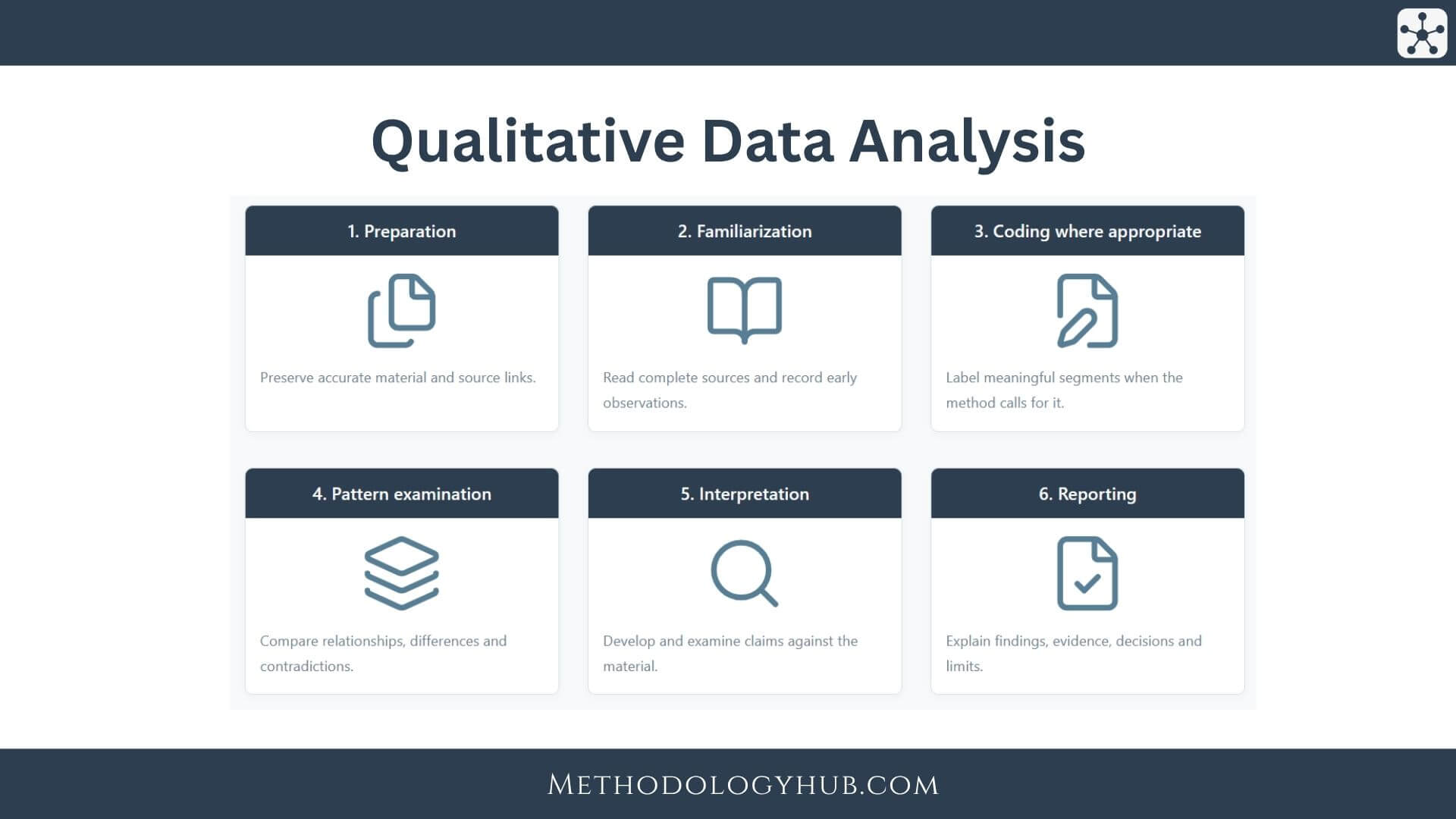
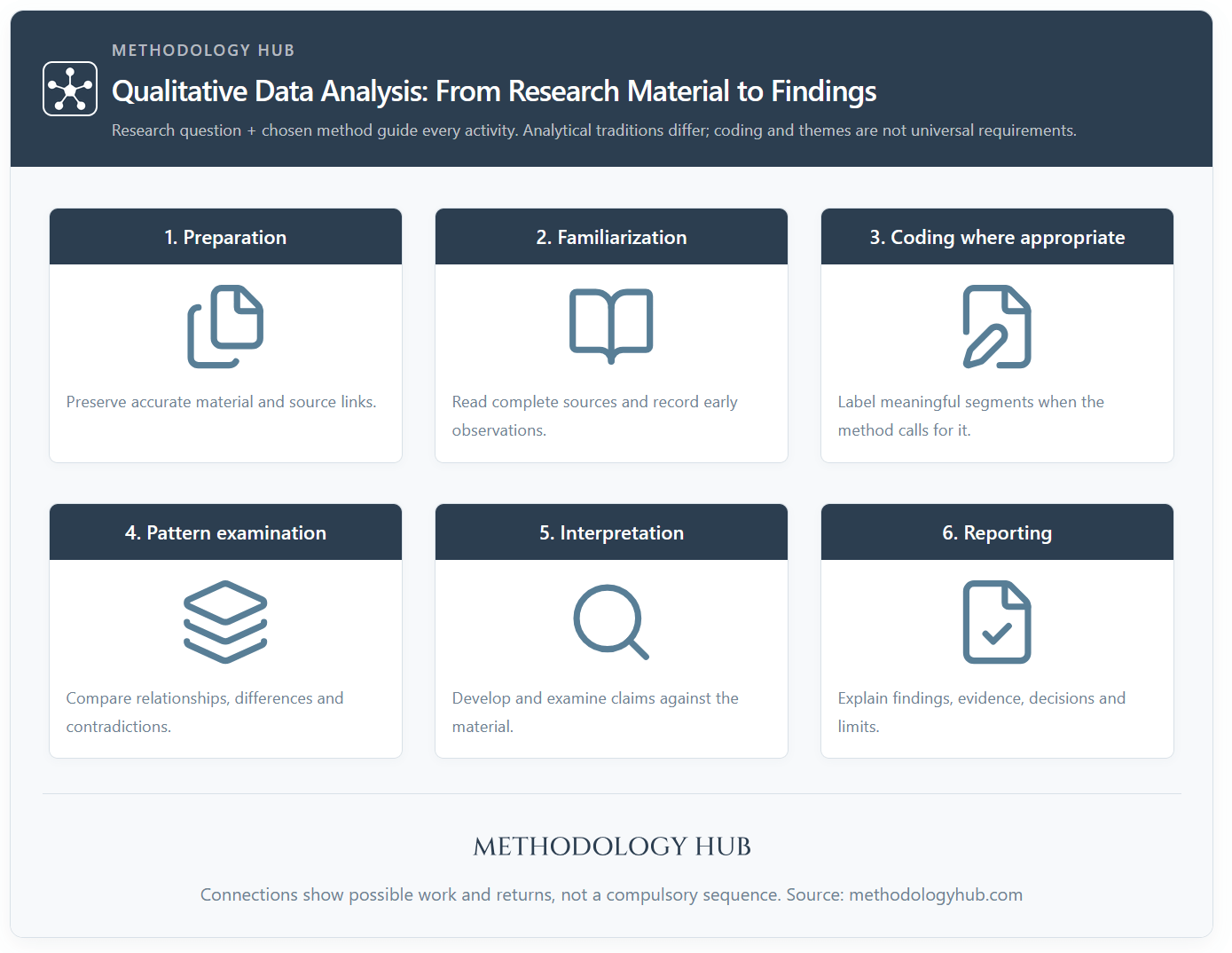
Qualitative data analysis is the practical work of preparing, examining and interpreting qualitative research material to develop supported findings. In qualitative research, it connects interviews, documents, observations and other evidence with the questions a study seeks to answer.
The qualitative analysis overview compares analytical methods and their purposes. Here, the focus is on carrying out the work: organising material, making analytical decisions, checking interpretations and reporting results. Academic literature often uses the two terms interchangeably.
This article explains the qualitative data analysis process, with practical guidance and a complete worked example.
What Is Qualitative Data Analysis?
Qualitative data analysis involves working systematically with material to interpret meanings, practices or experiences. Researchers examine individual passages and their relationship to the wider dataset, using an approach suited to the question. The resulting findings need both an explanation and evidence through which a reader can assess it.
Purpose of Qualitative Data Analysis
The aim is to answer the research question with more than a collection of quotations. Analysis can clarify how experiences differ, explain a process or examine how communication accomplishes social action. Decide what kind of claim the study seeks to make before selecting procedures, so that organisation serves a clear analytical purpose.
Types of Qualitative Data
Different materials preserve different information. A transcript makes wording searchable but may leave out gesture or timing. A document retains a written account without necessarily revealing how it was used. Materials from diary methods also require attention to when entries were made relative to the experiences described.
Key Characteristics of the Analytical Process
Qualitative data analysis is usually iterative: a developing interpretation sends the researcher back to earlier material or prompts a change in coding. Keep a record of those revisions. The process should become more explicit as it develops, even when it does not follow a fixed sequence.
Some studies organise findings around themes, while narrative analysis may preserve the development of an account and conversation analysis examines interaction turn by turn. Use the activities below according to the chosen tradition. Completing a coding exercise does not establish that a method has been applied appropriately.
Preparing Qualitative Data for Analysis
Preparation should make material usable without removing information that the analysis needs. Establish a consistent system before extensive annotation begins. Correcting filenames or speaker labels later can become difficult once extracts circulate across notes, coding files and draft findings.
| Data source | Preparation task | Check before analysis |
|---|---|---|
| Interview recordings | Transcribe and assign participant identifiers | Speech, speaker and recording references agree |
| Focus-group recordings | Distinguish speakers and relevant overlaps | Contributions remain connected to the discussion |
| Field notes | Expand notes and retain original records | Observation and later commentary are distinguishable |
| Documents | Record origin, version and selection reason | The analysed version can be identified |
| Images and video | Catalogue files and record contextual information | Relevant sequence and source links remain available |
Organizing Research Materials
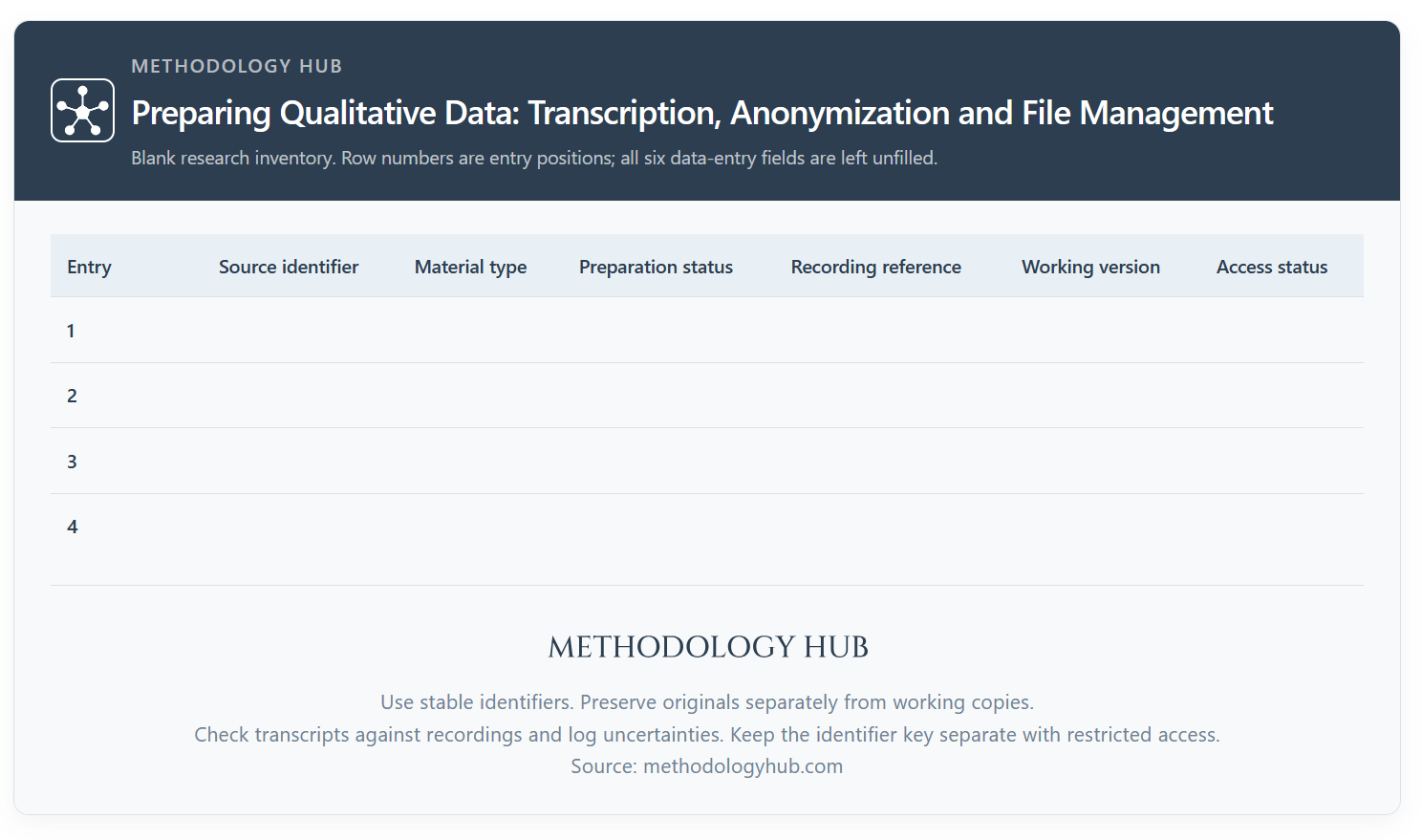
Give each source a stable identifier and use it across the recording, transcript and analytical notes. Maintain an inventory showing the source type, collection date, preparation status and inclusion decision. Keep originals separate from working copies so a correction or interpretive annotation does not silently overwrite the research record.
Transcribing Interviews and Focus Groups
Choose transcription detail according to the analysis. A study of interview content may need accurate wording and speaker turns; interactional work may also require pauses, overlap and emphasis. For qualitative interviews, retain the interviewer’s questions where they shape the response. Check uncertain passages against the recording and mark unresolved speech rather than guessing.
Cleaning and Formatting Data
Correct transcription errors, standardise labels and remove accidental duplication. Keep repetitions, unfinished statements and grammatical features when they contribute to meaning. Add paragraph numbers or timestamps for retrieval. If text recognition or automated transcription was used, inspect the output before treating it as an accurate record.
Anonymization and Confidentiality
Replace identifying details consistently while retaining relevant context. Removing names does not necessarily prevent recognition through a combination of roles, places and events. Keep any identifier key separately with restricted access. Record replacements and review quotations again before publication, since a passage that is appropriate for internal analysis may disclose too much publicly.
Data Management and Documentation
Use a clear version system for transcripts, coding records and analytical notes. Record who changed a file, what was changed and which version informed the findings. Maintain backups and access arrangements appropriate to the material. A preparation checklist can confirm readiness without implying that the evidence is complete:
- Every included source has a stable identifier and an inventory entry.
- Working copies preserve links to originals, recordings and contextual records.
- Transcription uncertainties, replacements and corrections are documented.
- Access permissions and backup arrangements have been checked.
- The analysed versions can be distinguished from superseded files.
Becoming Familiar With the Data
Familiarization gives the analysis a basis beyond isolated extracts. Set aside time to read, listen or view complete records before deciding which features deserve sustained attention. The aim is to understand the material’s range, including the passages that seem awkward or difficult to classify.
Reading and Reviewing Research Materials
Work through each source and note its overall focus, setting and relevant sequence. Listen alongside transcripts where tone, hesitation or the exchange affects interpretation. With a large collection, plan reading sessions and record coverage so repeatedly revisiting memorable cases does not displace less striking material.
Writing Initial Notes and Observations
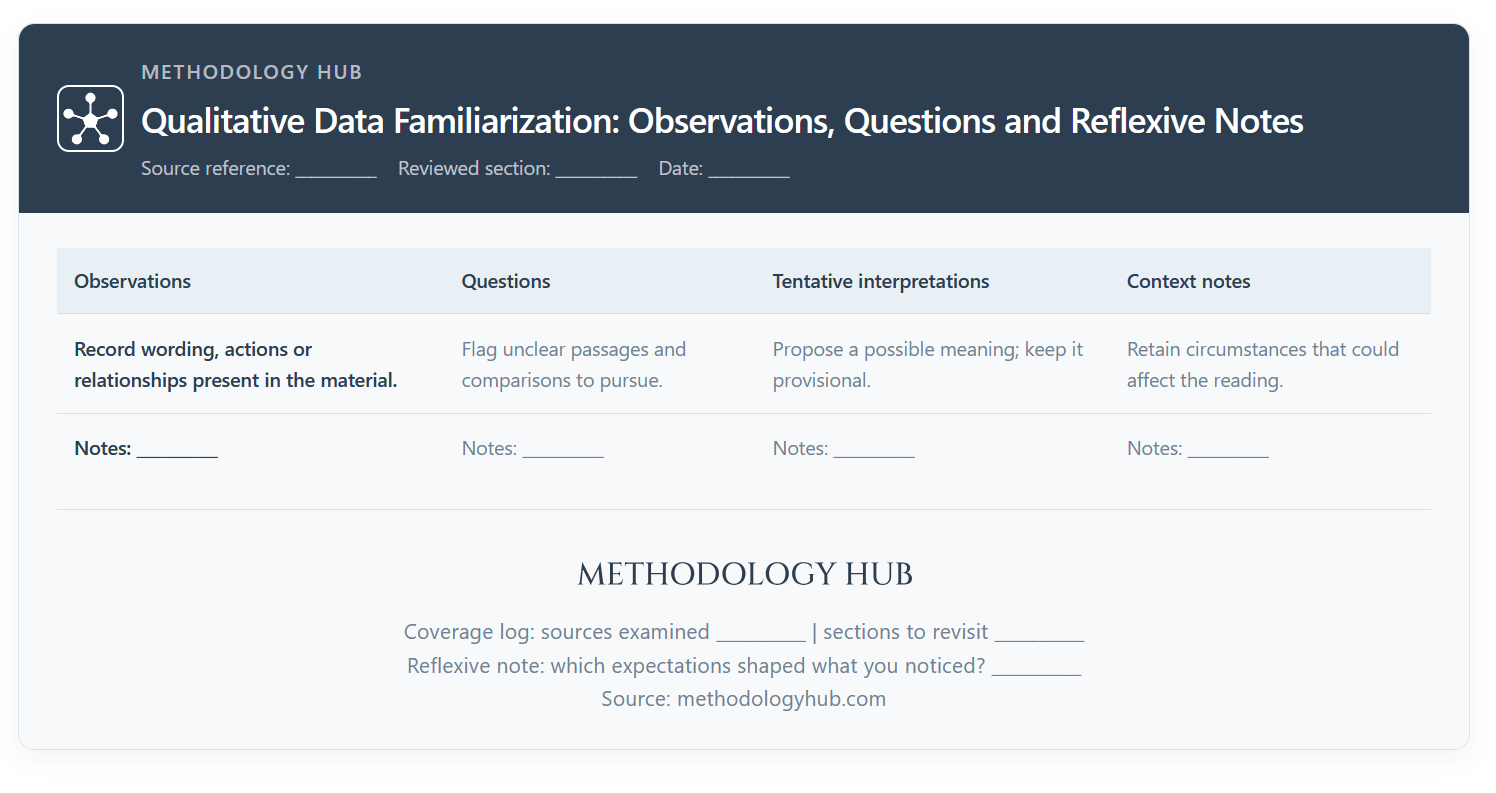
Keep a short source memo that distinguishes what the material says from what you think it may mean. An initial note can remain a question. Record its location so that the later analysis can return to the passage rather than relying on memory.
- Observations identify wording, actions or relationships present in the material.
- Questions mark unclear passages or issues requiring comparison.
- Tentative interpretations propose a possible meaning without treating it as established.
- Context notes retain circumstances that could affect the reading.
Identifying Early Patterns and Contradictions
Compare initial notes across sources, looking for similarities and differences. Repeated wording may reflect a shared prompt rather than a shared experience. Contradictions can also occur within one account. Keep them visible while examining whether they concern different occasions, changing perspectives or a tension that the participant has not resolved.
Reflexivity During Familiarization
Note what you expected to encounter and which passages attracted your attention first. Ask whether professional knowledge, personal experience or the interview design encouraged one reading. Reflexivity becomes useful when it changes what you examine or how you interpret it; a separate statement of researcher background is not enough.
Coding Qualitative Data
Coding helps researchers mark and retrieve material for comparison. It also involves interpretation: deciding where a passage begins, what it expresses and which label captures it are analytical judgements. Use coding when it supports the method, with enough surrounding material to preserve meaning.
| Coding decision | Practical action | Reason for the action |
|---|---|---|
| Select a segment | Include enough text or recorded activity to understand the point | Avoid detaching the statement from its qualification |
| Name a code | State the action, meaning or feature being examined | Make retrieval analytically useful |
| Apply more than one code | Record distinct features within the same passage | Preserve overlapping meanings |
| Revise a definition | Recheck previously coded material | Keep the record consistent with the revised interpretation |
What Is Qualitative Coding?
A qualitative code is a label attached to a meaningful part of the material. It can identify an action, a stated experience or an interpretive feature. Coding reduces the practical difficulty of finding related passages, but the label remains connected to evidence. A list of code names cannot substitute for reading the extracts it represents.
Identifying Meaningful Data Segments
Choose a segment large enough to retain the point being made. It might be a phrase, several sentences, an exchange or an observed episode. Avoid using sentence boundaries automatically. Include a qualification or preceding question when removing it would change the interpretation, and retain the source reference for every selected passage.
Creating and Applying Codes
Read a relevant segment, propose a concise label and check whether the label captures what you intend to examine. A passage may receive several codes when it contains distinct features. Apply codes across the included material, noting uncertain decisions rather than forcing every passage into an existing label.
Inductive and Deductive Coding
Inductive coding develops labels through engagement with the material. Deductive coding starts with concepts specified by a theory, research question or prior framework. A study can combine them if it records their origins and allows evidence outside the initial framework to receive attention. Keep uncategorised but relevant material available for review.
Developing a Codebook
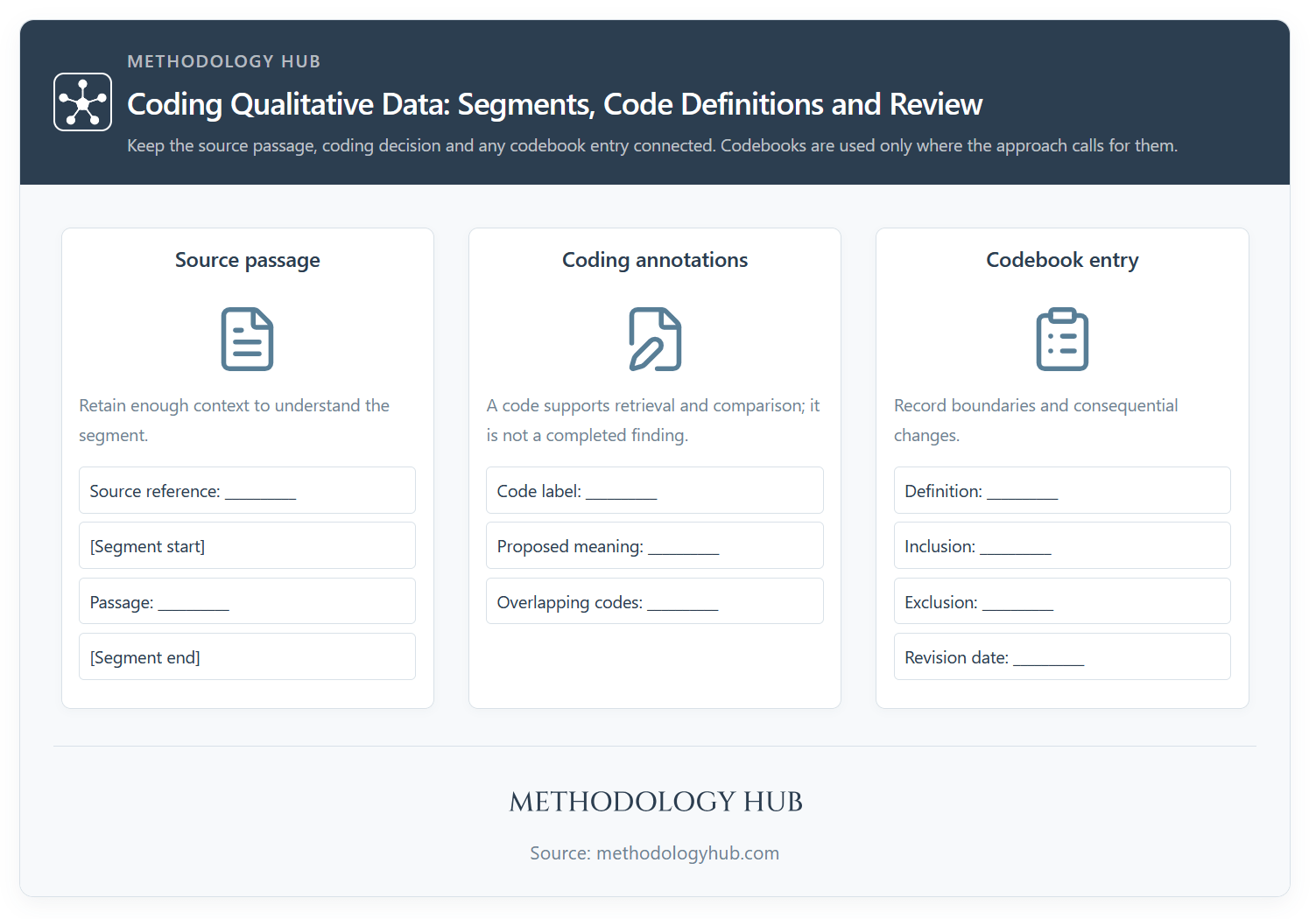
Where the approach uses a codebook, record each code’s name, definition, inclusion criteria, exclusion criteria and a linked supporting extract. Date substantive revisions. This helps a team discuss whether differences arise from unclear rules, different segment boundaries or genuinely different readings.
Codebooks are not universal requirements. In Braun and Clarke’s reflexive thematic analysis, coding develops through the researcher’s interpretive engagement, and a fixed coding frame or intercoder reliability test is not the standard of quality. Explain which coding approach the study actually follows.
Reviewing and Refining Codes
Retrieve the passages attached to a code and read them together. Split a code when it combines meanings that need separate treatment; merge codes when their distinction contributes nothing useful. Recheck earlier material after a consequential revision. A revision log should identify both the change and its effect on the analysis.
Organizing Codes and Identifying Patterns
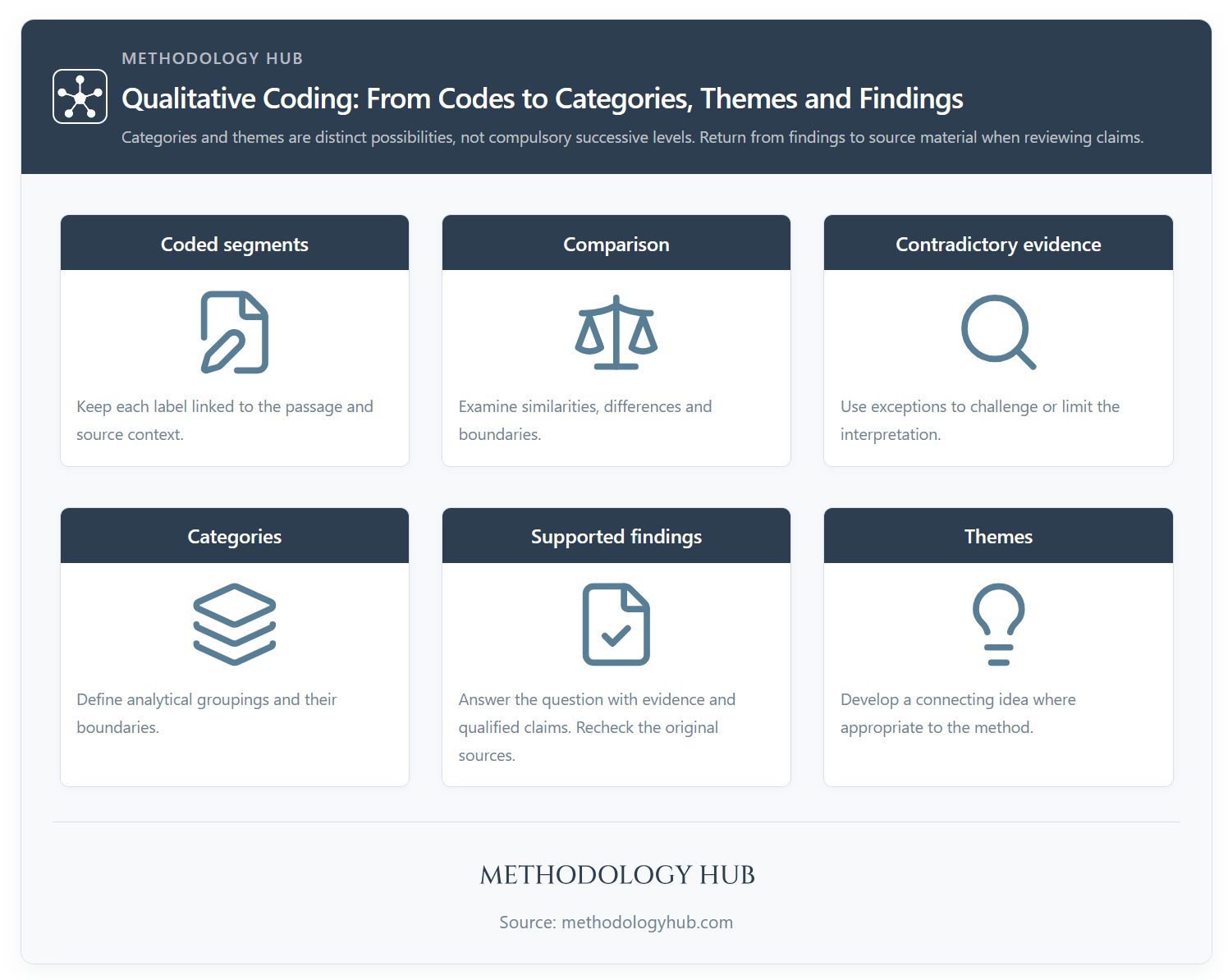
Once coding has produced a usable record, examine what the codes reveal together. Grouping can help manage the collection, but a grouping becomes analytically useful when its relationship to the question is explained. The path from codes to findings depends on the method and may involve repeated reorganisation.
| Analytical element | Role in the work | Question to ask |
|---|---|---|
| Code | Marks a feature in a particular segment | What is being identified here? |
| Category | Organises related material under a defined concern | What belongs together, and on what basis? |
| Theme | Develops a pattern of meaning where the method calls for it | What broader idea connects these passages? |
| Finding | States what the completed analysis supports | What does this explain about the research question? |
Grouping Related Codes
Compare the extracts behind apparently related codes before placing them together. Similar names may conceal different meanings, while differently worded codes may address the same relationship. Keep a note explaining the basis for each grouping so that later revisions do not depend on remembering why a folder was created.
Developing Analytical Categories
Define what a category includes and excludes. It may collect descriptions of a shared concern or express a more abstract analytical distinction. Check its contents against the definition. A category broad enough to contain nearly everything offers little help in explaining differences within the dataset.
Identifying Similarities and Differences
A case-by-category matrix can bring relevant passages into view while preserving source references. Compare within cases before examining differences across them. An empty cell may mean that a topic was not discussed, not asked about or not recorded; it should not automatically be interpreted as an absence of the experience.
Developing Themes Where Appropriate
In thematic analysis, themes organise an account of patterns relevant to the research question. In approaches that seek shared meaning, write a sentence stating the idea that connects the material. A topic heading identifies an area of discussion; a developed theme explains something about how that area is understood or experienced.
Reviewing Categories and Themes
Check a proposed category or theme against both its collected extracts and the wider dataset. Examine whether it has a clear focus, whether its boundaries overlap unnecessarily with another finding and whether its name matches its content. Keep relevant material that complicates the pattern instead of selecting only the most persuasive passages.
Examining Contradictory Evidence
Investigate cases that do not fit the proposed explanation. They may require a narrower claim, an additional condition or a different interpretation. Do not discard an account solely because it is uncommon. Record what the contradiction changes and what the available evidence leaves unresolved.
Interpreting Qualitative Data
Interpretation explains what an observed pattern means in relation to the research question. It draws on close reading and comparison, while making the reasoning between evidence and claim explicit. The task is not to make the account sound more abstract; it is to explain a relationship the material supports.
| Descriptive work | Interpretive work | Supporting check |
|---|---|---|
| Summarise what participants discussed | Explain the significance of a recurring meaning | Examine supporting and contrasting passages |
| Identify differences between cases | Consider the conditions associated with those differences | Check the contextual evidence for each case |
| Describe a sequence of actions | Explain how the sequence contributes to an outcome or interaction | Preserve order and distinguish observation from inference |
| Record a stated explanation | Assess how that explanation operates within the account | Consider qualifications and alternative readings |
Description vs Interpretation
Description establishes what happened or what was said. Interpretation considers what those observations suggest and why. Draft the descriptive statement first, then ask what relationship needs explaining. If the proposed interpretation adds only a more elaborate label, return to the evidence and identify what the analysis actually contributes.
Connecting Findings to Research Questions
For each proposed finding, write how it answers the question. Material may be interesting without being central to the study. Decide whether it provides context, qualifies a finding or belongs outside the report. This keeps the analysis focused without forcing every relevant observation into the same explanation.
Considering Context and Participant Perspectives
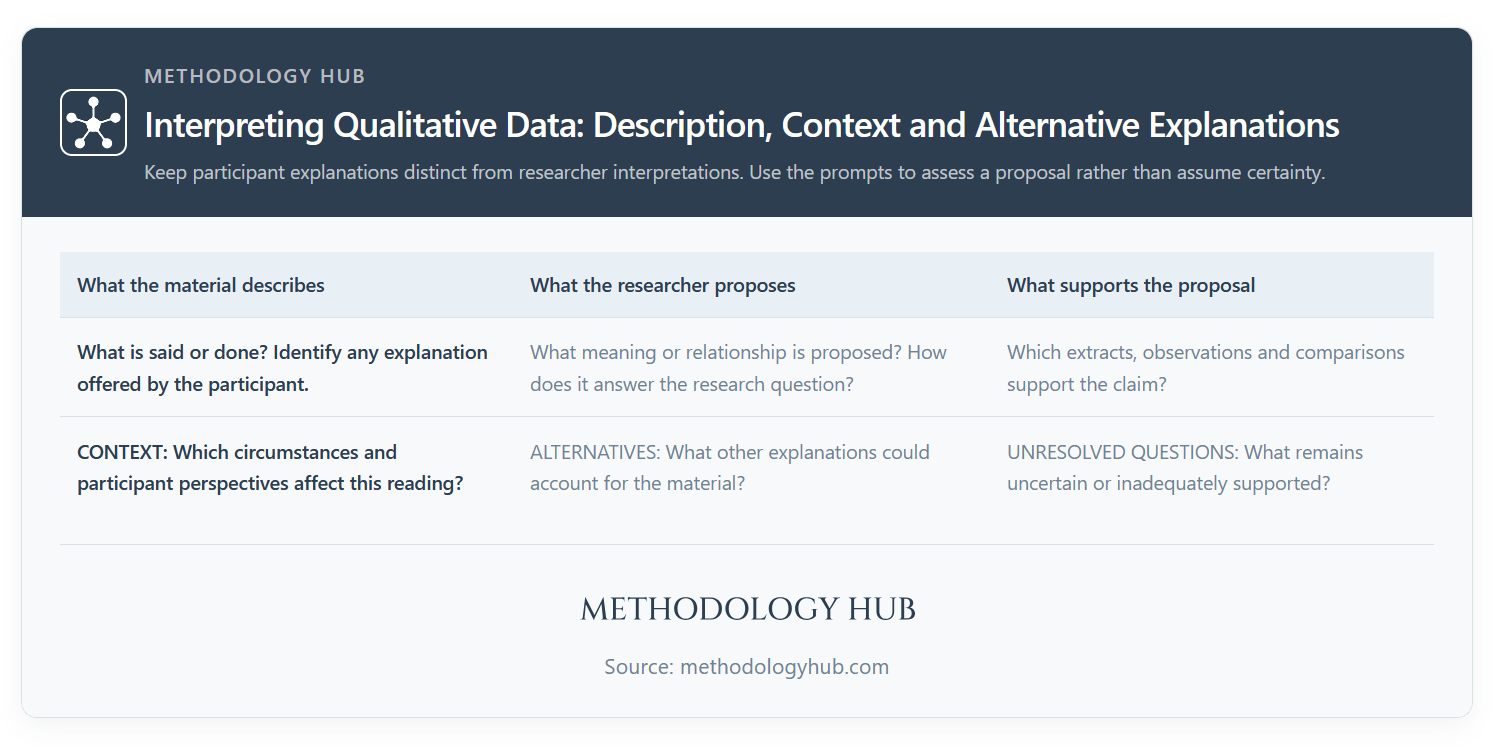
Read statements alongside the circumstances described and the conditions in which they were produced. Distinguish participants’ explanations from the researcher’s interpretation. Agreement with a participant is not required for every analytical claim, but moving beyond the explicit account requires a clear rationale and evidence suited to the methodological position.
Comparing Participants and Cases
Compare like with like where possible, noting differences in prompts, settings and available detail. Read contrasting cases in full before attributing differences to participant characteristics. A matrix can reveal where a relationship appears, but it cannot establish why it occurs without further examination of the accounts.
Exploring Alternative Explanations
Write down plausible competing interpretations and the evidence each would need. Then examine whether the dataset supports one more strongly or cannot distinguish them. This can lead to a qualified finding rather than a decisive conclusion. Avoid using confidence of expression to cover a gap in the material.
Relating Findings to Existing Research
Use relevant literature to clarify concepts, examine differences and develop the explanation. Record when a theoretical idea changed the reading of the material. Returning to scholarship can help explain an unexpected pattern, but the resulting interpretation must still be checked against the study’s evidence.
Qualitative Data Analysis Example
Research Question and Data
The research question is: how do university students describe the conditions that help or hinder participation in online learning? A codebook thematic approach can compare these accounts while retaining differences between students. The five fictional interview excerpts below provide a small teaching dataset for following the analytical decisions.
Preparing the Interview Material
Assign identifiers P01 to P05 and retain the interviewer prompts alongside each response. Record the references for the extracts, preserve their wording and note whether each account concerns live sessions or recordings. Keeping that distinction allows the analysis to examine participation conditions without treating all online activity as equivalent.
| Source and interview excerpt | Initial codes | Analytical category | Contribution to interpretation |
|---|---|---|---|
| P01: “After my shift I watch the recording. I can pause it, but by then the discussion is over and I cannot ask the question when it occurs to me.” | Retiming study; delayed questions | Control over timing; access to dialogue | Flexible viewing preserves access to content while delaying interaction |
| P02: “I am there at nine, but my younger brother is in the room. I keep the microphone off. When everyone leaves, I finally do the reading.” | Concealing background activity; postponing study | Conditions for participation | Being connected does not establish usable study time or readiness to speak |
| P03: “On campus I just listened. Online I put questions in the chat. I can finish writing them before anyone responds.” | Preparing a contribution; using written participation | Control over contribution | Written interaction can make participation more manageable |
| P04: “The recordings are always available, so I keep moving them to tomorrow. The live seminar is the one thing I attend because it has a fixed time.” | Deferring recorded work; relying on scheduled contact | Structure and study timing | Greater timing choice can coexist with a need for a fixed commitment |
| P05: “I have a quiet room and time after class. I still prefer being there in person. I cannot tell whether a pause online means someone is thinking or the connection has gone.” | Uncertain conversational cues; preferring physical presence | Interactional uncertainty | Suitable study conditions do not remove every difficulty with online participation |
Familiarization and Initial Notes
Read each account before grouping its statements. P01 describes both a practical benefit and a loss; P04 values a scheduled session while postponing recordings. A first reading that labels the accounts simply positive or negative would obscure these combinations.
Initial notes from the interview material
Observation: P01 and P04 both use recordings, but describe different relationships with timing. P02 separates attendance from the conditions needed to contribute.
Question for comparison: Does flexibility mean control over when to study, how to speak, or whether an interaction feels understandable?
Reflexive note: An expectation that recorded teaching is inherently convenient could obscure the value P04 gives to a fixed session.
These notes direct attention towards forms of control rather than satisfaction alone. They also preserve P05 as a case that may challenge an explanation centred on time and space. At this point, the researcher has a question to examine, not a completed theme.
Coding Interview Responses
Apply codes to the clauses carrying each relevant meaning, while retaining the whole response for retrieval. P01 receives separate codes for retiming study and delayed questions. Combining them under convenience would lose the distinction between access to teaching content and access to discussion.
Define retiming study as deliberately moving recorded study to a time that fits other commitments. Include accounts of purposeful rescheduling; exclude postponement described primarily as repeated deferral. That boundary separates P01 from P04 while leaving both available for comparison under study timing. Record the distinction in the codebook and recheck it as further material is added.
Developing Categories and Themes
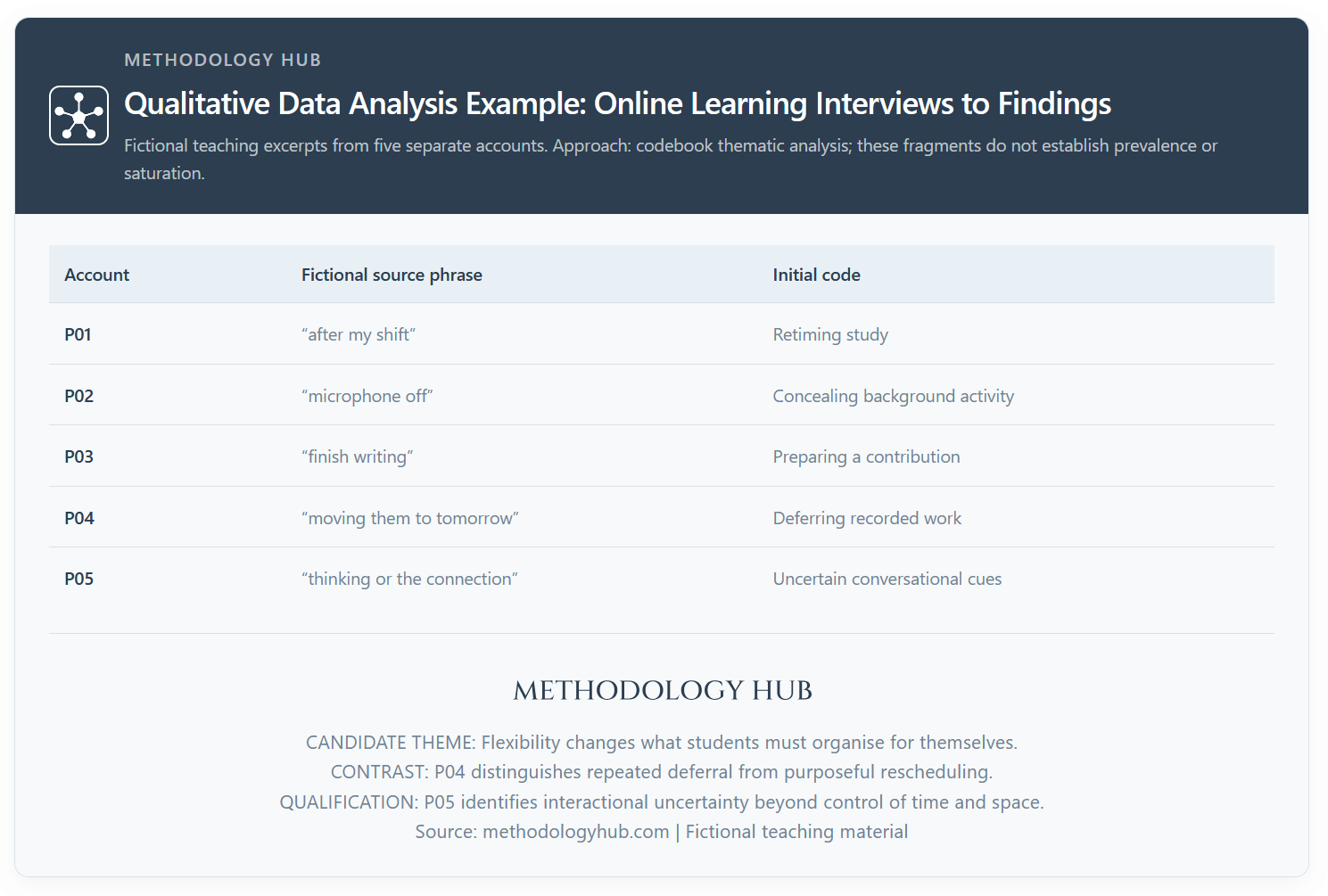
The initial categories organise timing, participation conditions, control over contribution and interactional uncertainty. Comparing their contents suggests a candidate theme: flexibility changes what students must organise for themselves. P01 coordinates learning around work, P02 waits for usable space and P03 manages the preparation of a contribution.
P04 complicates a simple claim that additional choice always helps. A fixed seminar time supplies structure that recordings do not provide for this student. The theme therefore concerns how responsibility for arranging participation shifts, including where students value externally set boundaries.
Interpreting Patterns and Differences
Compare the candidate theme against P05. Quiet space and available time do not resolve uncertainty about conversational cues. The analysis needs to limit the theme’s scope and retain an additional issue concerning interaction. It should not reclassify every difficulty as a failure of personal organisation.
The excerpts also leave other explanations open. P02’s muted microphone may reflect privacy concerns as well as background noise; further interview material would help distinguish them. Record that uncertainty instead of assigning a single motive. Five brief excerpts support this exercise, but cannot establish prevalence or saturation in a wider student population.
Presenting the Findings
Organise the account around the candidate theme, using contrasting extracts to explain its scope. A short findings paragraph can connect the interpretation with selected evidence while identifying the account it does not fully explain:
Short findings section based on the example
Across these accounts, flexibility changed what students had to arrange for themselves. P01 could study after work but found that “the discussion is over” when questions arose. P04 described repeatedly deferring recordings and valued the live seminar because “it has a fixed time”. Together with P02’s need for usable space and P03’s preparation of written questions, these accounts locate participation in the organisation of time, space and contributions. Timing choice alone did not guarantee a workable routine. P05’s uncertainty about conversational pauses identifies a boundary to this interpretation: having time and quiet space did not remove difficulties in reading interaction online.
The paragraph makes a claim about the supplied accounts and shows how the cases contribute differently. P02 and P03 should also appear in a fuller presentation of the pattern. Their roles are already recorded in the analytical table, so the final report need not depend only on the most easily quoted participants.
Before reporting this as a completed study, the researcher would need to examine full interviews and assess whether the interpretation holds across the included dataset. The example ends with a defensible provisional interpretation and a recorded boundary, rather than treating the initial coding as a final result.
Qualitative Data Analysis Tools
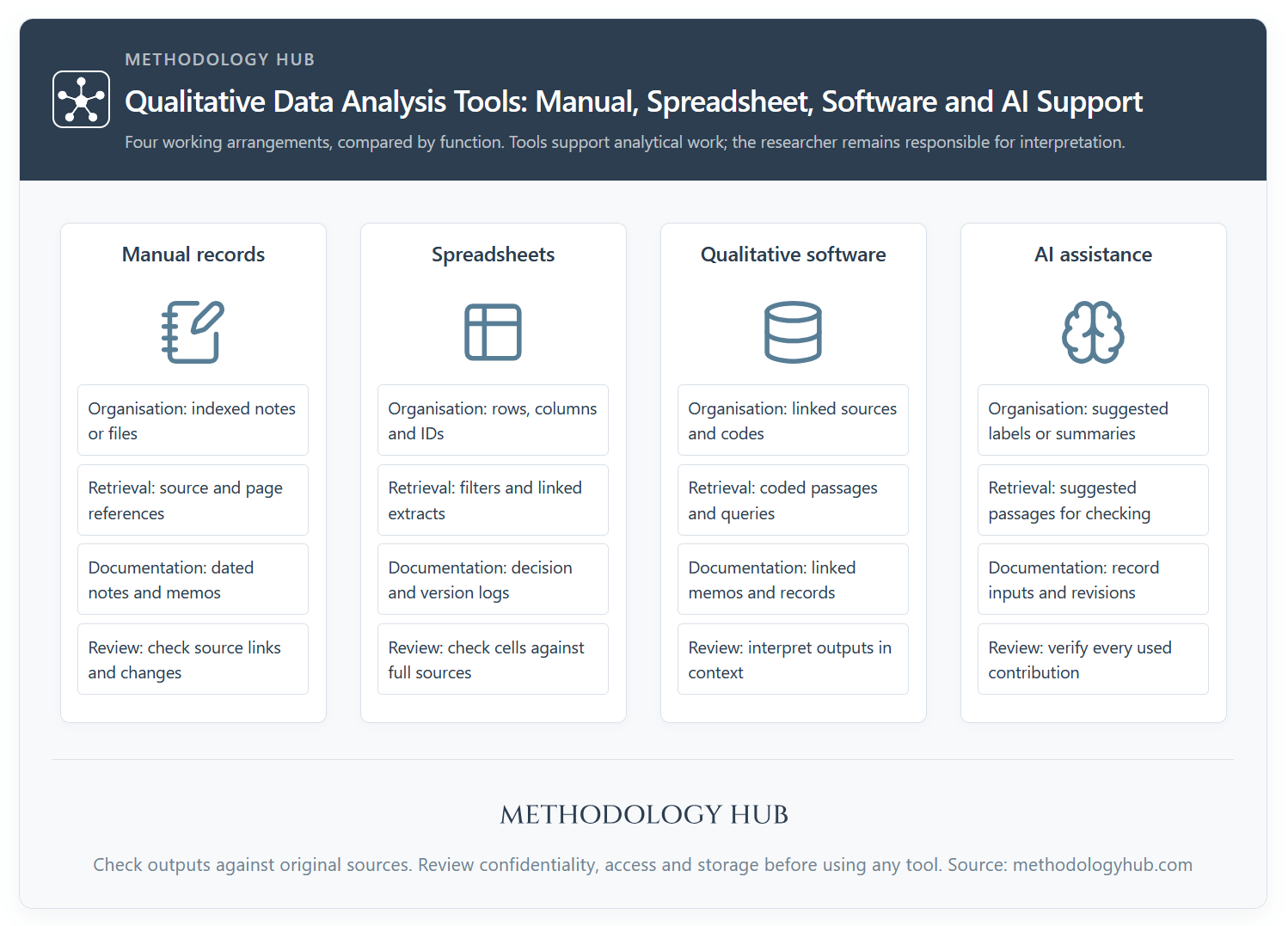
Tools can store, retrieve and display evidence, but the researcher still decides what a passage means and what a comparison supports. Choose functions that address the practical work of the project. A more elaborate system is useful only if it improves access, organisation or documentation.
Manual Qualitative Data Analysis
Manual analysis can use annotated documents, separate extract files or paper records. Keep identifiers and source locations with every copied passage. Use a consistent index so categories and notes remain retrievable. The main constraint is often maintaining those connections as the collection and number of revisions grow.
Using Spreadsheets to Organize and Code Data
Create separate fields for source identifier, extract location, original wording, code and analytical note. Preserve complete rows when sorting. A second sheet can hold category definitions or a case matrix, but it should retain references to the extract log. Avoid treating the spreadsheet’s rows as statistically independent observations.
Qualitative Data Analysis Software
Dedicated qualitative data analysis software like Nvivo or Atlas.ti can connect codes, extracts, memos and source files within one project. Retrieval and comparison functions can reduce repeated administrative work. Inspect how exports preserve context and how revisions are recorded. A code-frequency chart describes the coding record; it does not independently establish the importance of a finding.
AI-Assisted Qualitative Data Analysis
AI assistance can produce draft transcripts, suggest coding possibilities or summarise selected material. Check retained outputs against the source: fluent text may omit qualifications, combine speakers or introduce unsupported wording. Preserve the input, instructions and relevant output so any influence on the analysis can be examined.
Before submitting research material to a service, check whether the project’s consent and data-management arrangements permit that use, where the material will be processed and who can access it. Removing names may leave recognisable detail. Automated summaries should not replace reading the evidence used to support findings.
Choosing Appropriate Tools
Test the intended workflow on a permitted sample before committing the full dataset. Consider how easily the project can be reviewed, continued or exported after the initial analysis.
- The tool supports the material types and analytical operations the study needs.
- Extracts remain linked to source context through coding, comparison and export.
- Access, storage and collaboration arrangements fit the research project.
- The researcher can inspect, correct and document any automated contribution.
Quality in Qualitative Data Analysis
Quality develops through the analysis rather than through a final checklist alone. Select review procedures that fit the methodological position and record their effect. A named technique contributes little if the report does not explain what it revealed or changed.
| Quality strategy | Purpose | Record worth retaining |
|---|---|---|
| Transparent documentation | Make analytical decisions inspectable | Reasons for inclusion, coding and interpretation |
| Reflexive review | Examine the researcher's influence | Assumptions and resulting analytical changes |
| Comparison of contrasting cases | Assess the scope of a finding | Evidence that qualifies or challenges the claim |
| Triangulation | Examine relationships among sources or perspectives | Convergence, differences and their interpretation |
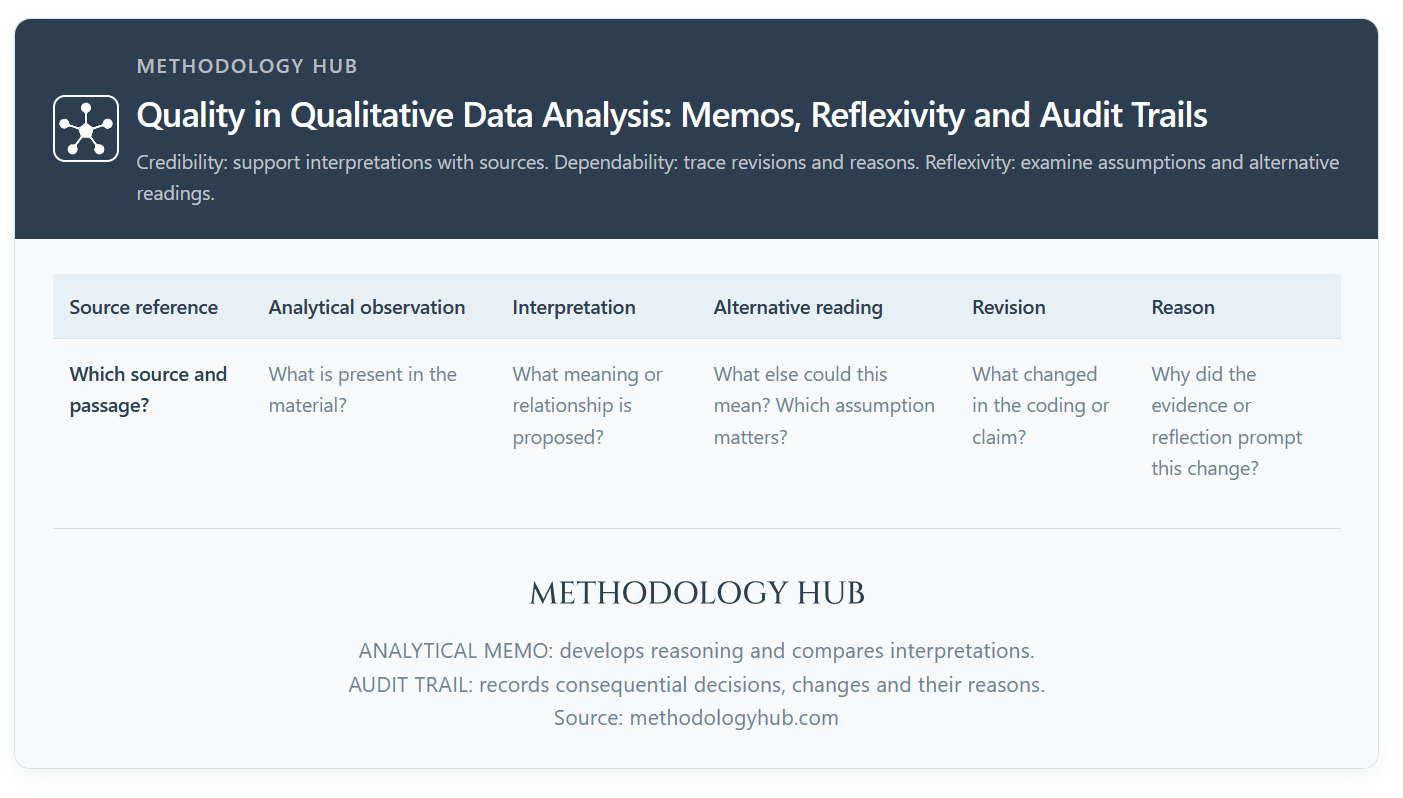
| Analytical memos | Develop and revisit reasoning | Links between observations, alternatives and conclusions |
Transparency and Documentation
Describe how the material was selected, prepared and examined. Keep enough detail to reconstruct consequential decisions, including changes in analytical focus. Transparency does not require publishing confidential records; it requires explaining the procedure and making the basis of claims assessable within the study’s access arrangements.
Researcher Reflexivity
Revisit assumptions identified during familiarization as findings develop. Record when a preferred interpretation survives comparison and when it changes. Discussion with colleagues can expose assumptions, provided disagreement is examined rather than resolved only by authority or majority preference. Different readings may reveal something useful about the material.
Credibility and Dependability
Credibility concerns the plausibility and evidential support of an interpretation. Dependability concerns the coherence and documentation of the research process, including justified changes. Inspect the connection between each claim and its supporting material. These quality concerns do not require every researcher to produce an identical interpretation.
Triangulation and Alternative Interpretations
Compare sources or perspectives when doing so can address a substantive question. Agreement can strengthen an interpretation, but disagreement may reveal differences in timing, position or setting. Participant feedback also offers a situated response. Explain how these comparisons influenced the finding instead of treating them as automatic confirmation.
Analytical Memos and Audit Trails
An analytical memo develops reasoning; an audit trail records how the work progressed. Connect them through dates, source references and revision records. Keep decisions that affect findings, including rejected explanations. For team coding, explain whether review sought consistent application of a coding frame, interpretive discussion or another method-specific objective.
Reporting Qualitative Data Analysis
Writing the findings requires another round of analytical decisions. Select an organisation that makes the argument understandable and provides enough evidence to assess it. The report should explain both what was found and how the researcher arrived there, without turning into a diary of every coding action.
Organizing the Findings
Arrange findings around the analytical contribution. Themes, categories, case accounts, sequences or a conceptual model may provide the structure. Choose an order that develops the explanation, with short introductions showing how each section answers part of the research question.
Presenting Themes, Categories, and Other Results
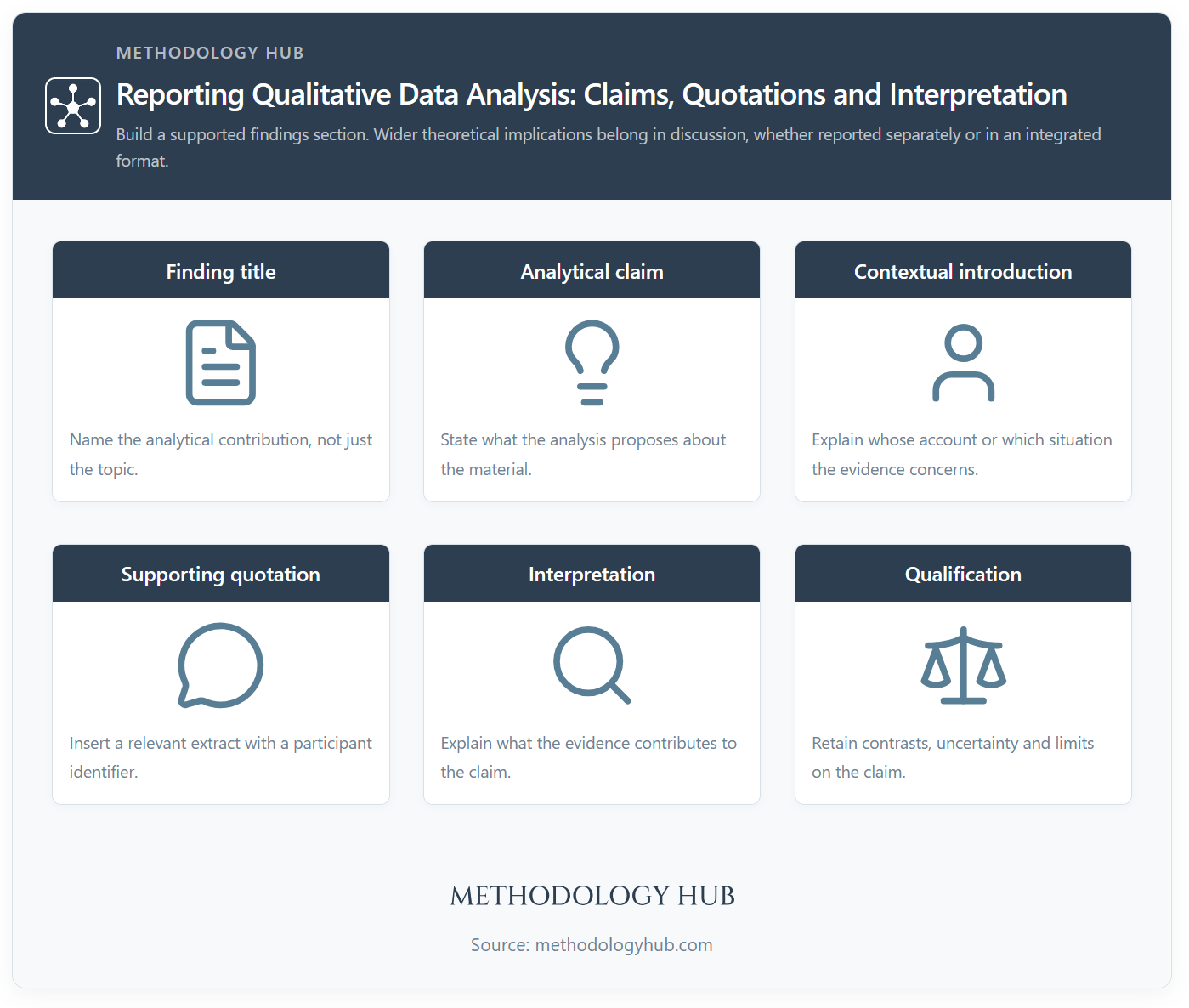
Define each reported finding and explain its relationship to the others. Category labels may be sufficient for a descriptive purpose, while a thematic interpretation needs an account of the connecting meaning. For narrative or interactional findings, preserve the order or surrounding exchange required to understand the analysis.
Using Participant Quotations
Select quotations for the analytical work they perform. Introduce the relevant context, present the extract and explain its contribution. Use consistent participant identifiers and mark omissions or replacements without changing meaning. A quotation can illustrate a pattern, but the claim about that pattern must rest on examination of the wider material.
Explaining the Analytical Procedure
State the method, the material examined and the procedures actually used. Explain how codes or interpretations developed, how comparisons were made and how the researcher’s role was considered. Report relevant software or automated assistance by function in the methods account. Avoid claiming a named approach while describing incompatible procedures.
Findings vs Discussion
The findings present the study’s analytical account and supporting evidence. The discussion considers its relationship to existing scholarship, implications and wider contribution. Some qualitative reports combine these functions. Either arrangement needs a clear distinction between what the material supports and what is proposed as a broader interpretation.
Reporting Limitations
Identify constraints that affect the claims: missing perspectives, uneven detail, uncertain chronology or an analytical decision that restricted what could be examined. Explain the consequence of each limitation. A general statement that qualitative research is subjective does not tell the reader where this particular account is strongest or most uncertain.
Before completing the report, check the connection among procedure, evidence and conclusions:
- The research question and chosen analytical method are stated clearly.
- The included material and consequential preparation decisions are described.
- Findings are defined and supported by relevant extracts or other evidence.
- Contrasting cases and unresolved interpretations receive appropriate attention.
- Researcher involvement and any automated assistance are explained.
- Limitations specify which conclusions need qualification.
Refining the Analysis
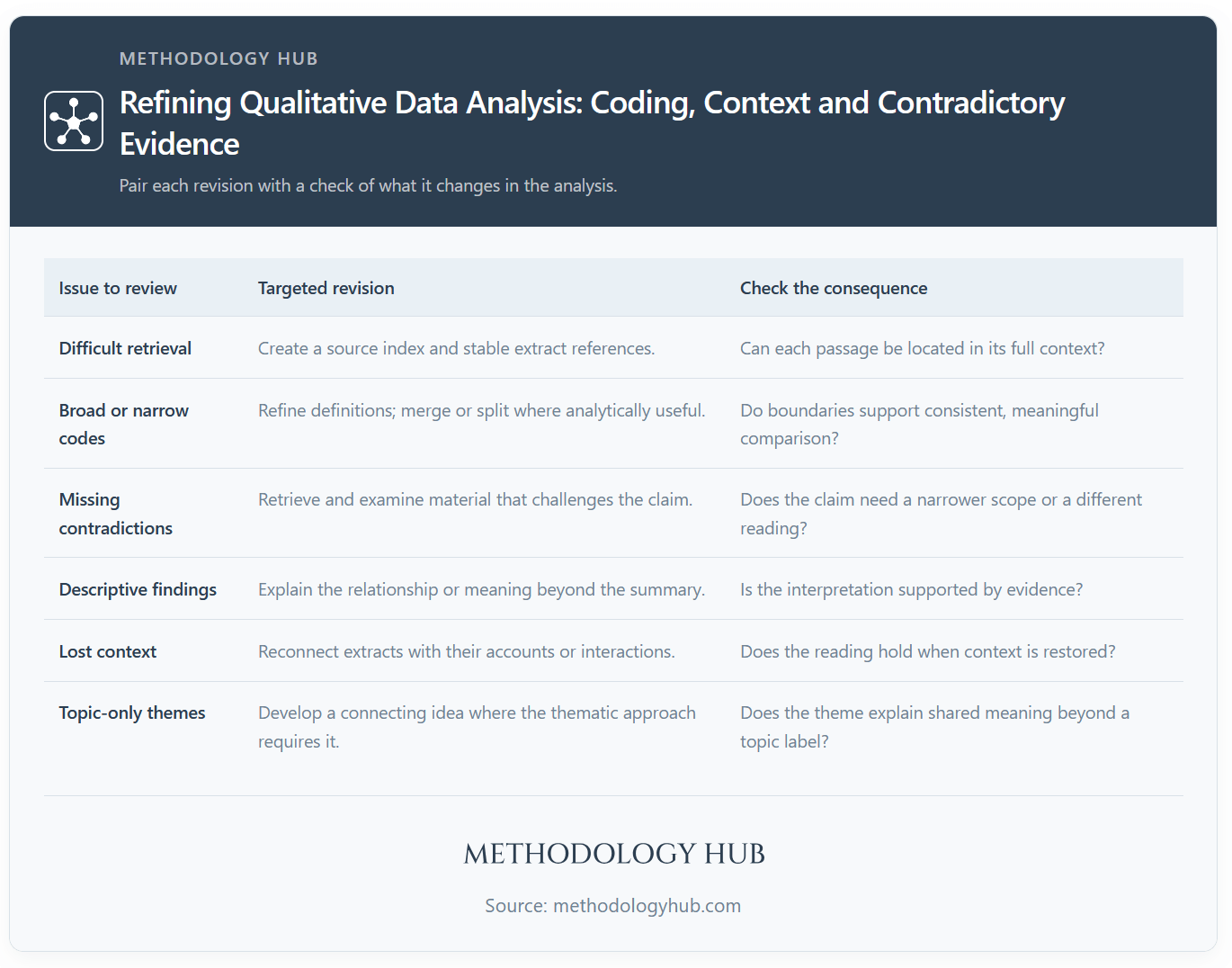
Practical difficulties often indicate that a decision needs revisiting. Identify the specific problem before adding more codes or more material. A targeted revision can improve the analysis while preserving a record of why the earlier arrangement was insufficient.
Managing Large Amounts of Data
Use source summaries, retrieval indexes and planned reading sessions to maintain coverage. Revisit the scope of the question if the collection exceeds what can be analysed adequately. Any exclusion should have a stated rationale; quietly dropping difficult records produces an incomplete account of the analytical work.
Developing Overly Broad or Narrow Codes
Compare the material under a broad code to see whether it contains distinct meanings. For a highly specific code, ask whether the distinction contributes to the question or only repeats unique wording. Merge or split where justified, then inspect the affected extracts rather than changing labels alone.
Overlooking Contradictory Evidence
Keep a place in the analytical record for passages that resist the current explanation. Revisit them when drafting claims. A contradiction may delimit a finding or suggest a different relationship. Recording its effect prevents the final account from appearing more uniform than the material warrants.
Confusing Description With Interpretation
Read a findings paragraph without its quotations and ask what it explains. If it only lists reported topics, identify the relationship, condition or meaning that needs further examination. A descriptive study can remain descriptive, but its claims should match that purpose rather than promise an explanation it has not developed.
Losing Context During Coding
Return coded extracts to their original surroundings before using them in a finding. Check the question, preceding events and later qualifications. This is especially important when retrieving passages from different sources into one view, where convenient proximity can make unrelated statements appear equivalent.
Treating Themes as Simple Topic Summaries
Check how the selected thematic approach defines a theme. Where shared meaning is the objective, write the central analytical idea in a complete sentence and examine which extracts support it. Renaming a topic with more elaborate wording does not create that relationship; the explanation has to be developed through the material.
Conclusion
Qualitative data analysis develops through preparation, close examination and supported interpretation. A useful record connects source material with analytical decisions, revisions and reported findings. Coding, categories and themes contribute where they fit the method; they do not replace an explanation of what the evidence shows.
The work is ready to report when the reader can follow the basis of the main claims and understand their limits. Unresolved evidence should remain visible where further interpretation would require information the study does not contain.
Cite this article
Whether you are preparing course materials, writing an academic paper, or sharing resources with students, we kindly ask that you acknowledge Methodology Hub as the source.
To make referencing easier, you can use the “Cite this page” tool below to automatically generate a citation in your preferred referencing style, including APA, MLA, Chicago, Harvard, and others. Simply select a citation style and click the generated reference to copy it.
When reproducing images, figures, or other materials from this page, please include an appropriate source credit and a link to the original page. Proper attribution helps others locate the original material and supports the continued development of freely accessible educational resources.