A research problem is a specific issue, uncertainty, or gap in understanding that a study investigates systematically. It gives academic research a reason to begin: something needs to be explained, examined more closely, or understood through evidence. That starting point may be a puzzling classroom pattern, a disagreement between published studies, or an interpretation of a historical text that leaves an important question unresolved.
Within academic learning and research, identifying the problem helps turn an interest into a workable investigation. A broad subject can suggest where to read, but the researcher still needs to establish what remains unclear and why examining it would be useful.
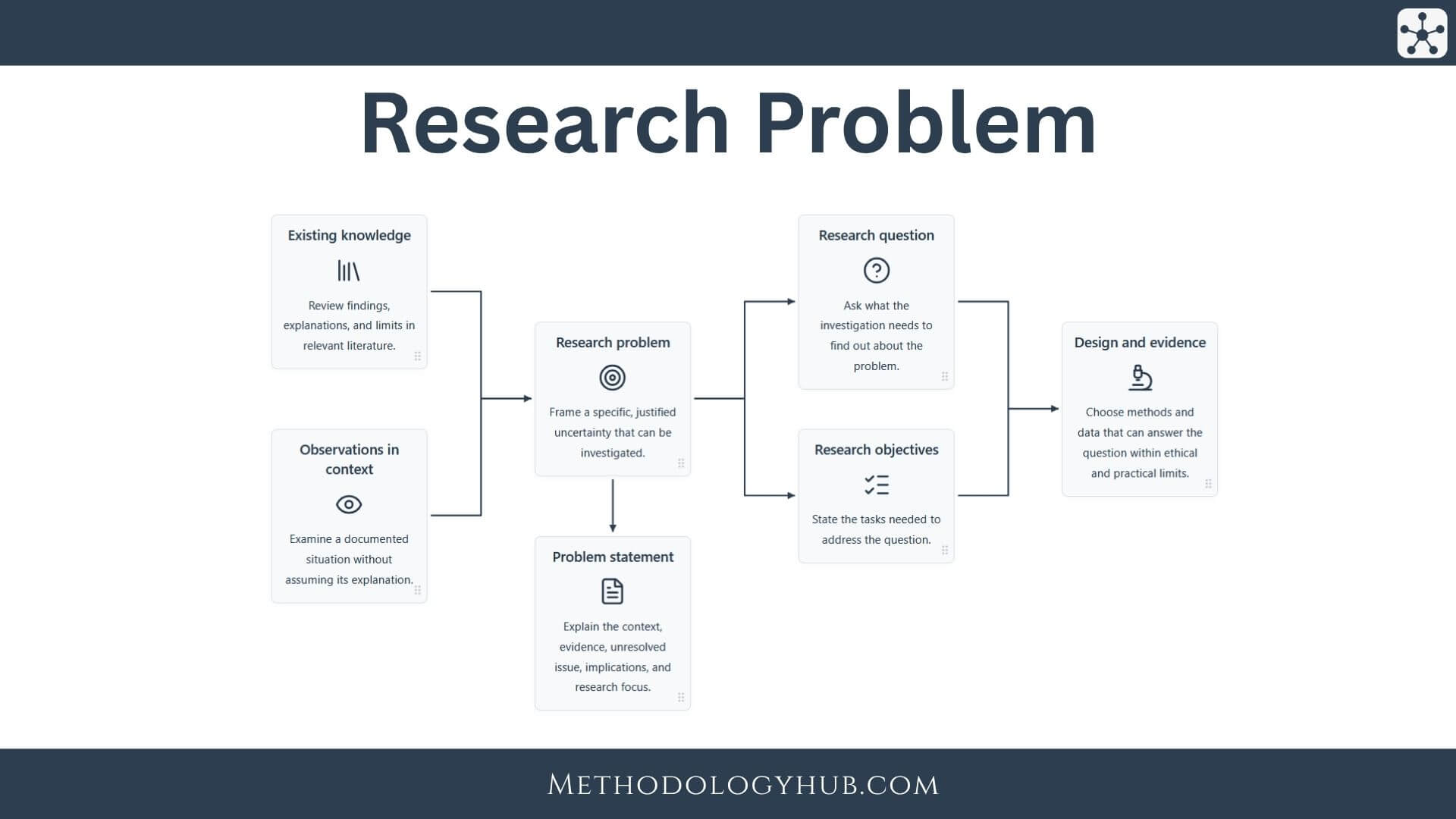
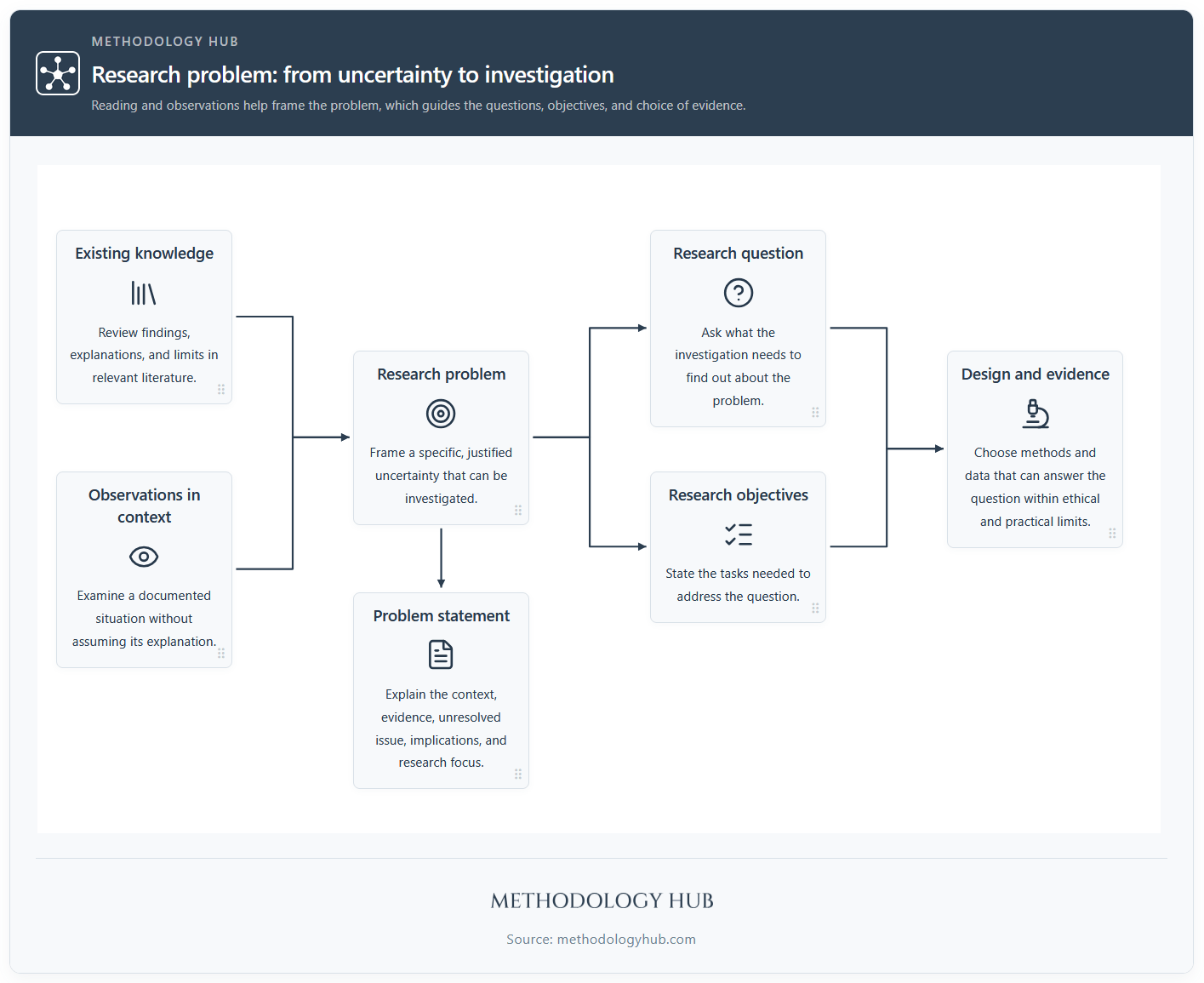
Once the issue has been defined, decisions about research methods become more focused. The problem guides the research questions, research objectives, and evidence needed. This article follows that connection from the first observation through problem identification, formulation, and a written research problem statement.
What is a research problem?
Research often begins when something does not fit the explanation already available. A finding may contradict an earlier study, a familiar theory may leave part of an experience unexplained, or records may show a pattern whose meaning is uncertain. The research problem identifies the part that needs attention.
Research problem definition
A research problem describes what needs to be understood within a defined area of inquiry. Although the word problem can suggest that something has gone wrong, academic investigation also concerns ordinary phenomena whose workings remain unclear. A study of how children interpret an unfamiliar word, for example, can address a research problem without treating their language development as a difficulty.
The unresolved issue may concern knowledge, practice, or the way evidence has been produced. What makes it suitable for research is the possibility of examining it through a reasoned inquiry. Depending on the discipline, that inquiry could involve classroom observations, laboratory measurements, archival sources, close reading, or comparison of theoretical arguments.
Research problems in academic research
In a research proposal, thesis, dissertation, or research paper, the problem explains why the investigation is needed. It helps readers understand the purpose of the study before they encounter detailed decisions about sampling, data collection, or analysis. Without that explanation, even carefully collected evidence can seem disconnected from a clear academic purpose.
Consider a study of mathematics achievement. The researcher first identifies uncertainty about whether access to learning resources helps explain differences in attainment. From there, a research question might ask how resource access relates to mathematics scores among a defined group of students. The research objectives then specify the work needed, such as documenting available resources and examining assessment results. Each part develops the same inquiry at a different level.
What constitutes a researchable problem?
Suppose assessment records show low mathematics scores in several secondary schools. The scores establish an observed condition, but they do not yet explain it. Teaching approaches, attendance, prior attainment, and opportunities to study outside lessons could all deserve attention. Selecting one explanation in advance would risk building the study around an assumption.
A more researchable formulation identifies the uncertainty: the relationship between access to mathematics learning resources and achievement among students in those schools remains unclear. The researcher can now consider which records, measurements, or participant accounts could clarify that relationship. Before using this formulation in a real proposal, they would need evidence for both the assessment pattern and the limits of existing understanding.
Research topic vs. research problem
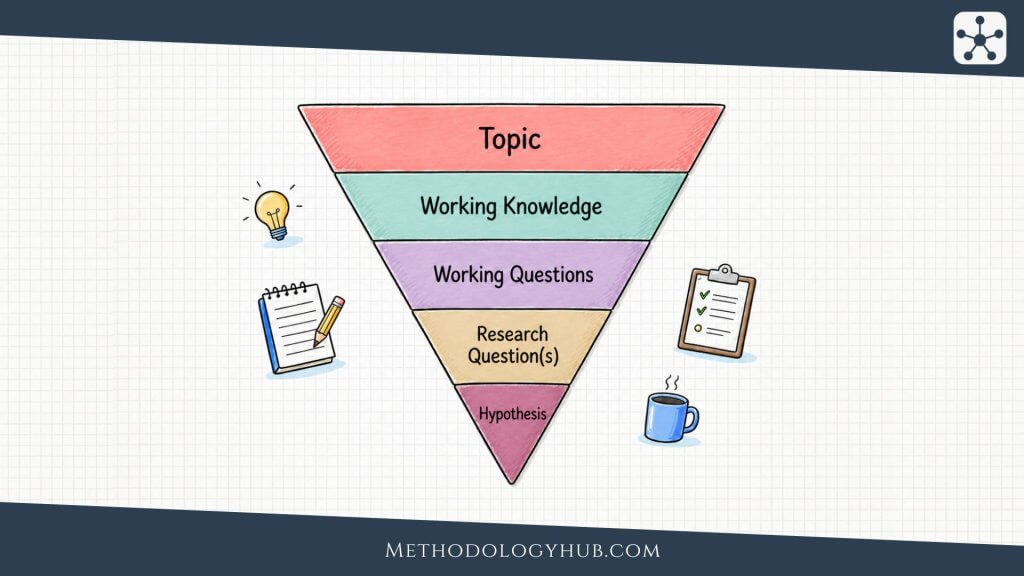
A subject can be interesting long before it gives a study enough direction. Reading about mathematics education may produce dozens of possible investigations. The distinction between a topic and a problem helps explain why choosing the subject is only part of the work.
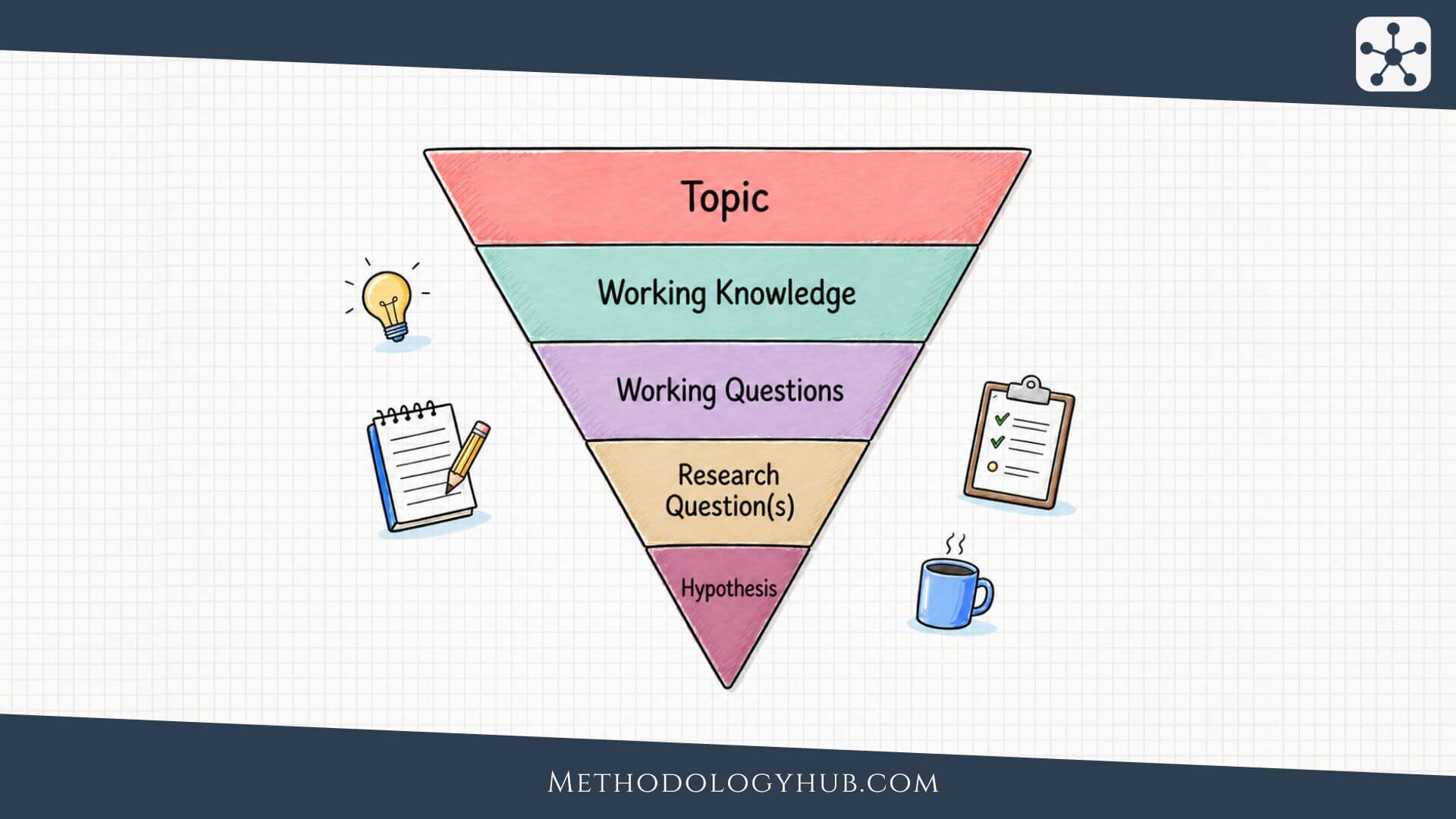
Differences between a research topic and a research problem
The research topic names the area being studied, while the problem identifies the unresolved issue within that area. Topics can already be quite focused. “Access to mathematics learning resources in rural secondary schools” names a population, setting, and educational concern, yet it still leaves open what the investigation needs to find out.
The problem becomes clearer when the researcher explains that available evidence does not establish how students’ access to those resources relates to their mathematics achievement. Another study of the same topic might examine how teachers distribute materials or how students use them at home. The shared topic does not require a shared research problem.
| Aspect | Research topic | Research problem |
|---|---|---|
| Scope | An area or focused subject | An unresolved issue within that subject |
| Purpose | Locates the investigation | Explains what needs investigation |
| Detail | May specify a group, setting, or concept | Specifies the uncertainty concerning them |
| Direction | Provides a starting point for reading | Guides questions and evidence selection |
| Example | Mathematics resources in rural schools | Unclear relationship between resource access and mathematics achievement in selected schools |
From a broad topic to a specific research problem
Begin with education, narrow the interest to academic performance, then focus on mathematics achievement. At this stage, reading and preliminary observations may suggest that learning resources deserve closer examination. Specifying the students and schools makes the inquiry more manageable, but narrowing alone is not enough. There must also be a reason to investigate that particular issue.
If relevant studies and school records leave the relationship uncertain, the topic can develop into a problem about resource access and achievement in that setting. Notice that the formulation keeps the answer open. It does not claim that inadequate resources cause low scores. The study may find a relationship, a more complicated pattern, or little evidence of a connection.
Types of research problems
The same subject can lead to quite different research problems. A study of mathematics learning resources might investigate what students can access, whether access relates to achievement, or whether providing additional materials improves assessment results. Each possibility leaves something different to be established, so each requires a different question and approach to evidence.
Research problems can be classified by the kind of understanding sought and by the broader purpose and setting of the work. Descriptive, relational, causal, difference, and casuist problems distinguish what the investigation needs to establish. Theoretical, applied, and action research problems distinguish why the inquiry is undertaken and how it relates to practice. These classifications can overlap: a study may address an applied problem by investigating a causal question.
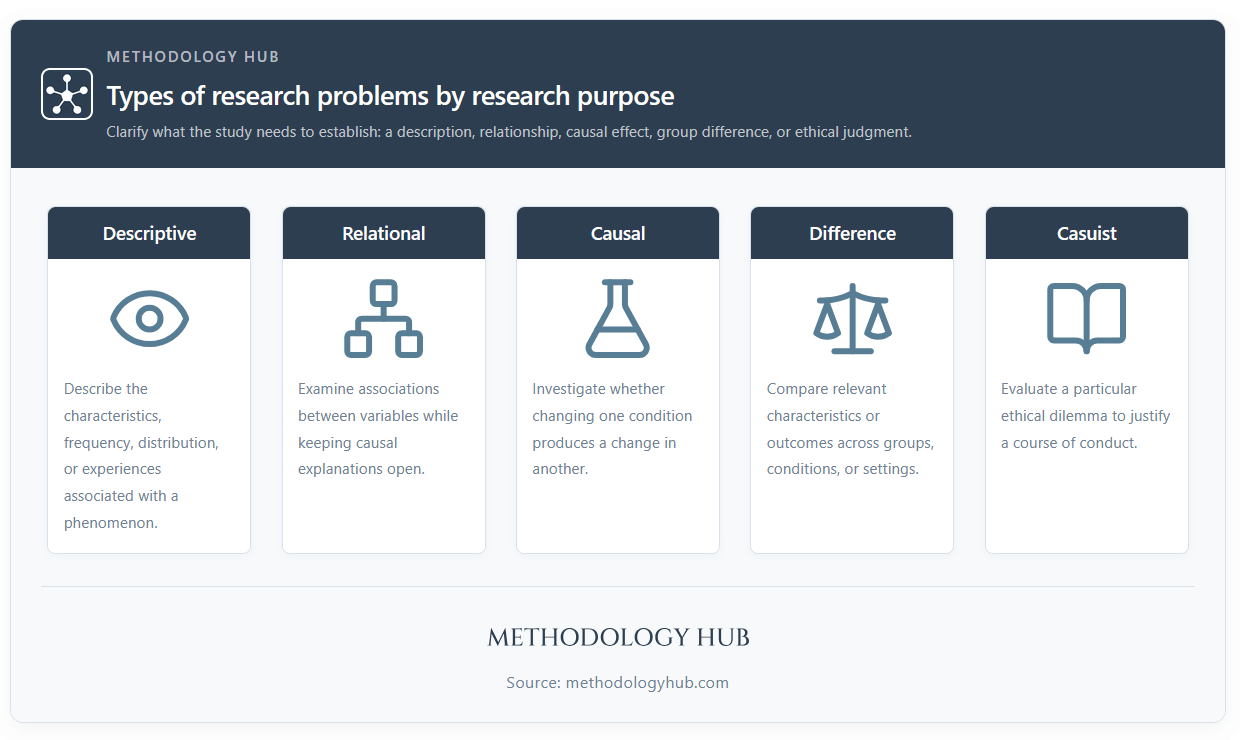
Classification by research purpose
Descriptive research problems
When the available evidence does not adequately describe a situation, the first task may be to establish what is happening. A descriptive research problem concerns the characteristics, frequency, distribution, or experiences associated with a phenomenon. Questions often begin with “What is…?”, “How often…?”, or “What characteristics…?” because the investigation aims to produce a clear account of the situation.
For example, a researcher might find that school records list the mathematics materials provided to students but reveal little about access outside lessons. The problem concerns the missing account of students’ actual opportunities to use those materials. A question such as “What mathematics learning resources can Year 9 students access outside lessons in three rural secondary schools?” could guide questionnaires, interviews, or observations. The researcher would document existing conditions without introducing an intervention. Depending on the question, the findings might describe how many students have access, which resources they use, or the difficulties they experience.
Relational research problems
Once the situation is described, attention may turn to whether its features are connected. A relational research problem examines an association between two or more variables, such as resource access and mathematics achievement. The uncertainty concerns whether changes or differences in one variable accompany changes or differences in another.
In the school example, the researcher could ask “How is access to mathematics learning resources associated with assessment scores among Year 9 students?” Measures of access would be considered alongside achievement data to examine the direction and strength of the relationship. Finding that students with greater access tend to obtain higher scores would establish an association, but would leave its explanation open. Previous attainment, teacher support, or opportunities to study at home might also account for the pattern. A relational problem therefore requires careful measurement and interpretation, especially when the findings could be mistaken for evidence that one variable causes another.
Causal research problems
A causal research problem goes further by asking whether changing one condition produces a change in another. For the mathematics study, the issue would become whether additional resources improve achievement. This requires evidence that can help distinguish the effect of those resources from other explanations for changes in assessment scores.
An illustrative question is “Does providing additional mathematics practice materials improve Year 9 students’ assessment scores compared with their usual learning resources?” In experimental research, the researcher would vary the provision of materials as the independent variable and measure assessment scores as the dependent variable. An appropriate comparison group, attention to previous attainment, and random assignment where feasible would strengthen the investigation. Causal inquiry can also use suitable designs without researcher-controlled manipulation, but these need careful reasoning about alternative explanations. The essential issue is whether the study can support a cause-and-effect conclusion.
Difference research problems
Sometimes the uncertainty concerns how two or more groups, conditions, or settings compare. A difference research problem makes that comparison the focus, asking whether a relevant characteristic or outcome varies between them. It can examine quantities, such as assessment scores, or differences in experiences and perspectives.
A researcher might ask “How does access to mathematics learning resources differ between Year 9 students in rural and urban secondary schools?” The investigation would need comparable measures of access and a clear basis for selecting the schools and students. Any observed difference would then be interpreted in relation to the sampled settings. It would not, by itself, show that school location caused the difference. A causal study may also compare groups, but its purpose is to explain an effect; a difference problem can establish and describe a contrast while leaving the reasons for it unresolved.
Casuist research problems
Some research problems centre on what should be done when ethical principles are difficult to reconcile in a particular case. A casuist research problem examines such a dilemma through reasoned consideration of the circumstances, relevant principles, and comparable cases. Its purpose is to justify a course of conduct, rather than simply record what people believe is acceptable.
Consider a hypothetical school study in which a student interview raises a concern about possible harm. The researcher may face a tension between protecting interview confidentiality and responding responsibly to the concern. A casuist question could ask “Under what circumstances should a researcher disclose confidential information to protect a student from harm?” Investigating it would involve examining the seriousness of the concern, the consent arrangements, and relevant ethical responsibilities. Interviews could reveal how researchers approach the dilemma, but their opinions alone would not settle what ought to be done. The conclusion needs a defensible argument that explains how the circumstances affect the ethical judgment.
These distinctions help keep the problem, research question, and intended conclusion aligned. If the aim is to document students’ access to resources, the study needs evidence that describes access adequately. If the aim is to establish an effect on achievement, a description or an association will leave the central problem unanswered. Choosing the category is useful insofar as it makes that difference clear.
Classification by application and setting
The distinctions above concern what needs to be established. A second way to classify the problem considers the contribution the study is intended to make and its relationship to practice. Research on mathematics resources, for example, could develop an explanation of learning, inform a school’s provision of materials, or help a teacher evaluate a change in their own classroom.
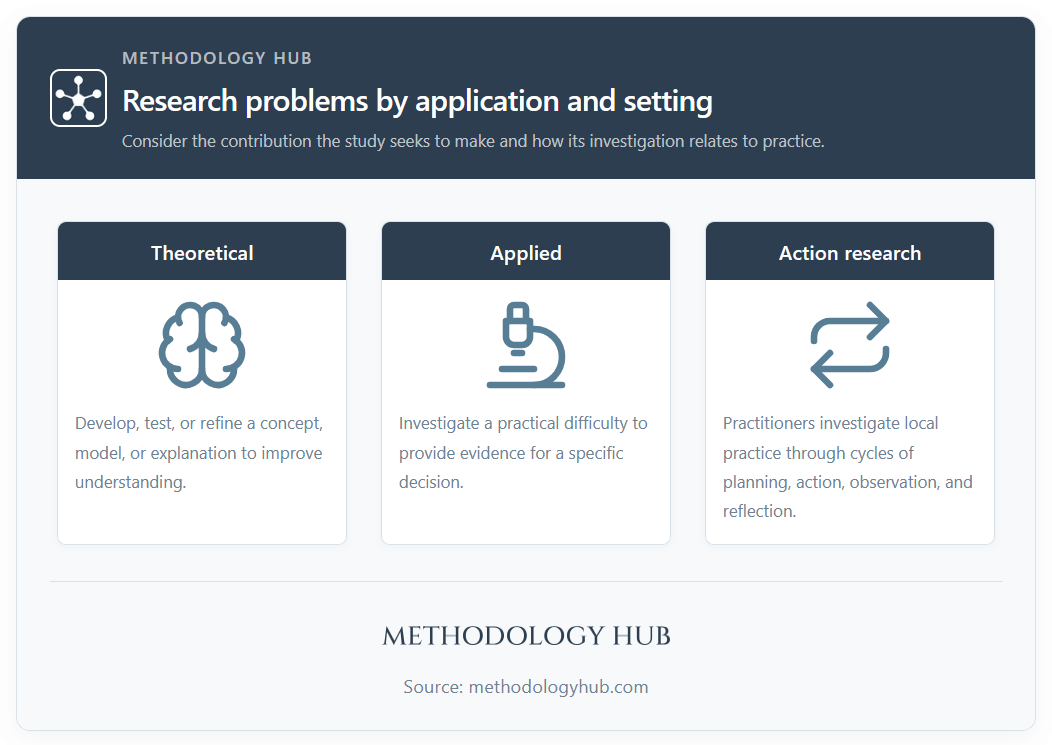
Theoretical research problems
A theoretical research problem arises when a concept, model, or explanation needs to be developed, tested, or refined. The immediate purpose is to improve understanding of a phenomenon. The inquiry may address inconsistent predictions, assumptions that have received little examination, or observations that an existing theory cannot adequately explain.
For instance, a model of independent learning might assume that access to practice materials helps students regulate their own study. A researcher could ask “How should a model of independent learning account for the difference between having resources available and being able to use them effectively?” The investigation might compare existing explanations or examine evidence about students’ resource use. Its contribution would be a clearer account of learning, even if it did not lead immediately to a change in school practice. A theoretical purpose does not rule out collecting empirical data to assess the explanation.
Applied research problems
When the inquiry is directed towards a specific practical need, the problem has an applied purpose. A school might know that students struggle to complete mathematics practice outside lessons but lack sufficient evidence to decide what support to provide. The investigation would seek knowledge that can inform that decision.
A question such as “Which barriers to using mathematics learning resources should the school address when planning support for Year 9 students?” could lead researchers to examine resource availability, study conditions, and students’ experiences. Its applied value comes from connecting the findings to the decision being considered. The study still needs to establish the difficulty carefully and evaluate possible explanations. A practical aim does not justify choosing a preferred solution before the evidence has been examined.
Action research problems
Action research brings investigation into the practitioner’s own work through a cycle of planning, action, observation, and reflection. A teacher may identify a difficulty in their class, introduce a considered change, examine what happens, and use the findings to revise their practice. The problem is situated in that local setting, with the practitioner actively involved in studying it.
For example, a mathematics teacher might ask “How can I adapt weekly practice tasks to help students in my class use the resources available to them?” They could revise the tasks, collect students’ work and feedback, and reflect on which aspects appear to help or create difficulties before planning the next cycle. Systematic records give the investigation a basis beyond personal impressions. Action research can serve an applied purpose, while its distinctive feature is the close connection between investigating practice and changing it. Findings from one class need to be interpreted within that context before being extended to other settings.
A single study can therefore carry labels from both classifications. Examining whether additional practice materials improve achievement could address a causal problem with an applied purpose. A teacher investigating differences in participation before revising a classroom activity could combine a difference problem with action research. The labels help explain the inquiry when they reflect its actual question, purpose, and setting.
Characteristics of a good research problem
A good research problem gives a study a worthwhile purpose and a realistic basis for investigation. Its quality depends on the justification for studying it, the evidence that can be obtained, and the researcher’s ability to carry the work through. Assessing these features together helps establish whether an initial idea can support a sound academic study.
| Characteristic | What to evaluate |
|---|---|
| Significance | Does the rationale justify the study’s contribution to knowledge, practice, or theory? |
| Researchability | Can suitable data be gathered and examined with the available sample, time, funding, and expertise? |
| Originality or replicability | Will the study add understanding, replicate findings, or extend existing scholarship? |
| Suitability for the researcher | Does the problem fit the researcher’s skills, resources, and sustained interest? |
| Ethical appropriateness | Can the investigation respect participants’ rights and meet relevant ethical principles? |
| Potential for further research | Could the findings develop understanding or practice and open further questions for investigation? |
Significance
The problem should deserve scholarly attention. To explain its significance, show what understanding the investigation could add and why that contribution matters within the field or research setting. The justification may concern an unresolved theoretical question, incomplete evidence, or a practical difficulty whose explanation remains uncertain.
In the mathematics example, low assessment scores provide a starting observation. The rationale becomes stronger when the researcher explains how investigating resource access could improve understanding of students’ opportunities for independent practice. A focused study can have significance when its contribution to knowledge, theory, or practice is clearly justified.
Researchability
A researchable problem can be examined carefully and in sufficient detail to support an answer. In empirical research, the researcher needs suitable data and a feasible way to collect or obtain them. That requires attention to the available time, funding, research methods, and access to an appropriate sample.
For a study of resource access and mathematics achievement, questionnaires might document students’ experiences, while school records provide assessment results. Before settling on the problem, check whether those records are accessible and whether the proposed measures can address the uncertainty. The investigation also needs to fit the researcher’s methodological expertise.
Originality or replicability
A problem can support original research by identifying an unanswered question, examining overlooked evidence, or developing an explanation. It can also justify revisiting an existing finding. Replication allows researchers to assess whether earlier results can be reproduced, while an extension examines how far the existing explanation applies under different conditions.
Suppose a previous study examined mathematics resources in urban schools. A project in rural schools could extend that work if differences in the educational setting provide a sound reason for comparison. The justification should explain what the new investigation will test or clarify. Both original inquiry and carefully planned replication contribute to the cumulative development of knowledge.
Suitability for the researcher
The problem needs to fit the person undertaking the study. Relevant subject knowledge and research skills help the researcher recognise useful evidence, choose appropriate procedures, and interpret findings responsibly. Available resources also shape what they can investigate in enough depth.
Interest matters here because the project will require sustained reading, data collection, analysis, and revision. A researcher with experience in mathematics education may have a strong starting point for examining learning resources, although they may still need guidance on sampling or statistical analysis. Assess suitability by considering both existing expertise and the support available for developing the skills the study requires.
Ethical appropriateness
The problem must allow an investigation that respects the people involved. When research includes human participants, its value needs to be considered alongside consent, privacy, and possible harm. These considerations affect the choice of problem as well as the procedures used to investigate it.
A school study, for example, may involve children and sensitive assessment records. Its design should protect student confidentiality and allow appropriate consent arrangements without placing pressure on students to participate. If the proposed evidence could only be obtained through ethically unacceptable procedures, the problem or its planned investigation needs to be reconsidered.
Potential for further research
A useful investigation can open questions that extend beyond its immediate findings. Its results may refine an explanation, suggest a different approach to practice, or identify a relationship that deserves closer examination. This potential helps explain how one focused project could contribute to continuing scholarly inquiry.
A study of mathematics resources might reveal differences between having materials available and being able to use them. That finding could lead to further research on study spaces, teacher guidance, or changes in resource use over time. When justifying the problem, indicate how the anticipated contribution could inform later investigation while leaving the actual findings open.
How to identify a research problem
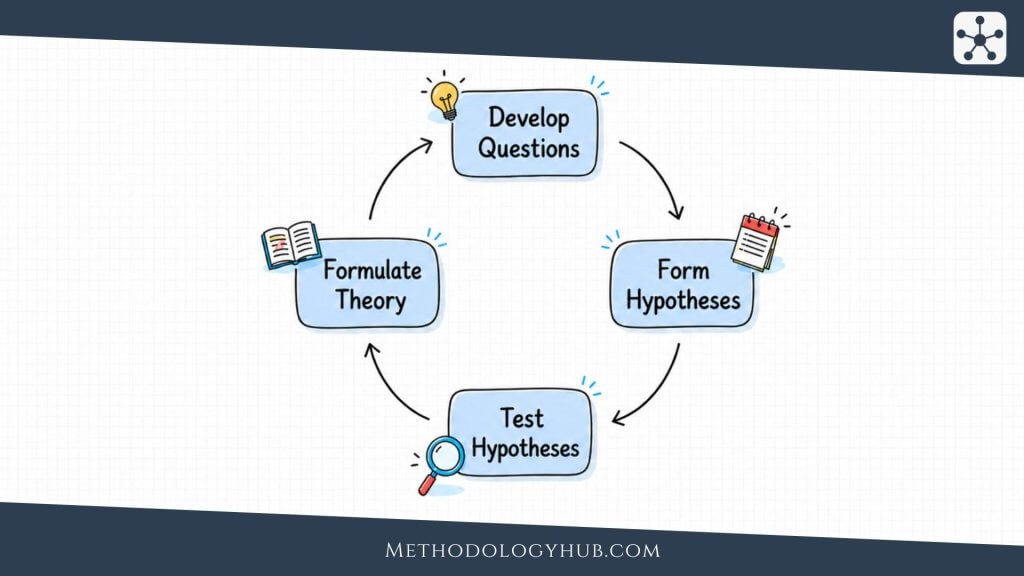
Identifying a research problem usually takes several rounds of reading and revision. An early idea may become more precise as the researcher discovers what has already been examined. Occasionally, the reading shows that the original uncertainty has been resolved, and the inquiry needs a different direction.
Start with a broad research area
Choose an area that connects to the academic task, discipline, or a situation you can examine. Interest helps sustain the work, but the assignment’s requirements and available evidence also need attention. A short research paper and a doctoral dissertation allow very different scales of investigation.
For the mathematics example, academic performance provides the starting area. A teacher’s observations or a preliminary look at assessment records may suggest that mathematics achievement deserves attention. At this point, record the observation and possible questions without deciding that one factor must explain the scores.
Review existing literature
Read relevant scholarly literature to understand how other researchers have approached the issue. Review articles can provide an overview, while individual studies show the populations, measures, and research designs behind particular findings. Reading both helps prevent a proposal from depending on one isolated result.
Compare studies as you read. In the running example, one investigation may measure textbook ownership, another may examine opportunities to use school resources, and a third may consider help with homework. Their conclusions cannot be compared sensibly without considering those differences. Note each study’s sample characteristics, measures, and analytical approach so you can check these comparisons later. Record its findings and limitations alongside the source details you will need for citation.
Identify a research gap
A research gap becomes useful when the literature review shows a specific limit in current understanding. There may be little evidence for a relevant population, findings that remain inconsistent, or methods that overlook an important part of the phenomenon. The task is to explain how that limit affects what can reasonably be concluded.
Identifying the gap prepares the next decision: which part of that missing understanding should this study address? The research problem frames that part as a specific issue for investigation. A review may reveal several gaps, while one project has the scope and evidence to examine only one.
Simply finding that a school has not been studied does not establish a worthwhile gap. Its context must give a reason to question whether existing evidence applies. For example, students’ opportunities to use learning resources may differ where travel arrangements restrict access after lessons. That possibility needs support from relevant literature and local evidence before it becomes a justification for the study.
Keep gap claims limited to what your reading supports. “The studies reviewed provide limited evidence about resource use outside lessons in comparable rural schools” is more defensible than claiming that no research exists. Recommendations for future research can suggest a direction, but they still need evaluation against more recent studies.
Narrow and define the research problem
Now decide which part of the uncertainty the project can investigate. Specify the student population and school setting, clarify resource access, and select a relevant assessment period. Thinking about possible data collection methods at this stage can expose practical difficulties before the formulation becomes fixed.
The following sequence shows how the example could develop. It assumes that the proposed evidence and gap are established during preliminary work.
- Select academic performance as the broad subject, then focus on mathematics achievement.
- Examine published studies and school assessment records to understand the existing evidence.
- Identify uncertainty about how access to mathematics learning resources relates to achievement in the selected schools.
- Check whether suitable records, student accounts, and permissions are available within the project’s scope.
- Formulate a preliminary problem: the relationship between resource access and mathematics achievement among Year 9 students in three rural secondary schools is insufficiently understood.
Revisit that formulation after discussing it with a teacher or supervisor. They may notice that the concept is too broad, the evidence is unavailable, or an important study has been overlooked. Revision at this stage is part of defining the inquiry.
How to write a research problem statement
Once you can explain the problem clearly, you need to present the reasoning behind it. The written statement gives readers enough context to understand how the investigation follows from existing evidence. A concise formulation may name the uncertainty; the statement explains why it deserves investigation.
Research problem statement definition
A research problem statement is a passage that presents the issue, its background, and the justification for studying it. It commonly appears in a research proposal or the introduction to a thesis, dissertation, or journal article. Some academic programmes require a separate section, while others expect the reasoning to develop within the introduction.
The statement’s length depends on those requirements and on how much context the reader needs. A short passage can be sufficient when the issue is straightforward. A complex scholarly disagreement may need a longer explanation before the proposed research focus becomes clear.
Structure of a research problem statement
Start with the context that makes the issue understandable. Introduce the relevant evidence, then explain what it leaves unresolved. The reader should be able to follow the move from what is known to what the study proposes to investigate, including the consequences of leaving the uncertainty unexamined.
Five components can help organise that reasoning:
- Background context locates the issue within an academic field or research setting.
- Existing evidence establishes what previous studies or documented observations already show.
- The unresolved issue identifies the uncertainty, contradiction, or limitation requiring investigation.
- Implications explain what remains difficult to understand or decide while the issue is unresolved.
- The intended research focus states which part of the issue the proposed study will examine.
These components do not need five separate sentences or fixed labels in the final paragraph. Let the explanation determine the sentence structure. When presenting evidence, distinguish between a published finding, an observation from your setting, and a possible interpretation. That distinction keeps the justification from quietly turning an assumption into a fact.
Research problem statement example
The following statement is illustrative. Its school records and literature findings are hypothetical; a real study would need to document those claims with appropriate evidence.
Assessment records from three rural secondary schools indicate that many Year 9 students have difficulty with mathematics tasks requiring independent practice. Research reviewed for this proposal examines learning resources and attainment, but provides limited evidence about students’ opportunities to use those resources outside lessons in comparable school settings. Consequently, the relationship between resource access and mathematics achievement in these schools remains unclear. This uncertainty limits the evidence available for planning support that students can use beyond the classroom. The proposed study will examine access to mathematics learning resources and its relationship with assessment scores among Year 9 students during one school term, using student questionnaires and school records.
The statement moves from a documented classroom concern to a limitation in the reviewed evidence. It then explains the practical implication and identifies the investigation’s population, timeframe, and evidence sources. The final sentence describes the proposed inquiry without promising that resource access will explain the assessment results.
Research problem statement template
A template can help when the first draft feels difficult to organise. Replace the placeholders with specific evidence and concepts, then revise the wording so it suits your study.
In [study context], [documented situation or established finding] provides the background to this investigation. Although [relevant studies or sources] establish [existing knowledge], [specific unresolved issue] remains unclear for [population, case, or material]. This limits understanding of [justified implication]. The proposed study will examine [research focus] within [scope and relevant timeframe].
Check the draft by asking whether a reader could identify the uncertainty and understand why the proposed study addresses it. If the paragraph mainly describes the topic, add the missing reasoning. If it already gives the answer, reconsider whether the formulation has assumed what the evidence should establish.
Examples of research problems
The same principles apply across disciplines, although the sources and forms of analysis change. The examples below are proposed scenarios for explaining problem formulation. They do not establish that the described gaps exist in published research.
Example in education
Within the broad topic of mathematics achievement, a study might investigate uncertainty about students’ use of available learning resources. A school could provide materials while knowing little about which students can use them outside lessons or what difficulties they encounter.
The research problem concerns that incomplete understanding of access and use. Student questionnaires could document patterns, while interviews might help explain particular experiences. If assessment scores are included, the researcher would also need to consider prior attainment and other plausible explanations before interpreting any relationship.
Example in healthcare
Patient attendance provides another starting point. Suppose records from a local clinic network show missed follow-up appointments, but do not explain how patients understand appointment instructions or arrange transport. The narrower issue is uncertainty about the barriers experienced by patients who miss those appointments.
Interviews could examine patient accounts, while appointment records could describe the pattern and its variation between clinics. The formulation should leave room for several explanations. Assuming that patients are simply unwilling to attend would restrict the investigation before their circumstances had been examined.
Example in environmental science
A project on urban heat might focus on the relationship between tree coverage and surface temperatures around school grounds. The research problem could arise because available measurements do not establish how temperature patterns vary across shaded and unshaded areas at those sites.
Repeated temperature measurements and maps of vegetation could provide evidence, with attention to weather, surface materials, and measurement times. The distinction between surface temperature and air temperature would also need to remain clear. Precise formulation helps the researcher decide what to measure and how far the interpretation can extend.
Example in social sciences
Under the topic of participation in public services, a sociology study might examine how rural residents experience access to municipal advice sessions. The unresolved issue could concern the difference between a service being formally available and residents being able to use it.
A qualitative investigation could examine travel arrangements, opening times, and residents’ experiences through interviews and relevant documents. Its purpose might be to understand the process of accessing the service, rather than estimate how common each barrier is across an entire region. The problem and evidence should support the same kind of conclusion.
A descriptive investigation may first establish what occurs, an explanatory study may examine why a pattern appears, and an interpretive study may explore how people understand their experiences. Choosing among these aims depends on the uncertainty being addressed. A specific formulation makes that choice easier to justify.
| Field | Broad topic | Proposed research problem |
|---|---|---|
| Education | Mathematics achievement | Incomplete understanding of resource access and its relationship with attainment in selected schools |
| Healthcare | Patient attendance | Unclear barriers to attending follow-up appointments in a local clinic network |
| Psychology | Sleep behaviour | Uncertain relationship between evening device use and time taken to fall asleep in a defined student group |
| Environmental science | Urban heat | Insufficient evidence about tree coverage and surface temperature patterns around selected school grounds |
| History | School reform | An unresolved interpretation of how local inspection reports represented a particular curriculum reform |
| Sociology | Public services | Incomplete understanding of rural residents’ experiences of accessing municipal advice sessions |
Conclusion
A well-defined research problem gives an investigation a focus that can be carried through the whole project. The initial observation may be broad, but reading and preliminary evidence help establish where understanding is incomplete. From there, the researcher can judge whether the issue is worth examining and whether the proposed work is feasible.
Keep that connection visible when writing the problem statement. Readers need enough background to understand the situation, evidence for the uncertainty, and a clear indication of what the study will investigate. A carefully limited claim is more useful than an ambitious statement whose scope or justification remains vague.
Before moving on, try explaining the problem aloud in a few sentences. You should be able to name what remains unclear, why it deserves attention, and what evidence could help. Those decisions provide a coherent starting point for the research questions and objectives, which can then guide an appropriate research design.
Cite this article
Whether you are preparing course materials, writing an academic paper, or sharing resources with students, we kindly ask that you acknowledge Methodology Hub as the source.
To make referencing easier, you can use the “Cite this page” tool below to automatically generate a citation in your preferred referencing style, including APA, MLA, Chicago, Harvard, and others. Simply select a citation style and click the generated reference to copy it.
When reproducing images, figures, or other materials from this page, please include an appropriate source credit and a link to the original page. Proper attribution helps others locate the original material and supports the continued development of freely accessible educational resources.