Braun and Clarke’s thematic analysis is an approach to interpreting patterns of meaning across qualitative data through six recursive phases. Developed by Virginia Braun and Victoria Clarke, it is widely used in qualitative research and is now articulated by its authors as reflexive thematic analysis.
Among qualitative research methods, this approach gives particular attention to the researcher’s interpretive role. Themes are developed through engagement with the material rather than discovered as ready-made findings.
This article explains the six phases, the development of the approach since 2006 and the use of reflexivity in a worked example.
What Is Braun and Clarke’s Thematic Analysis?
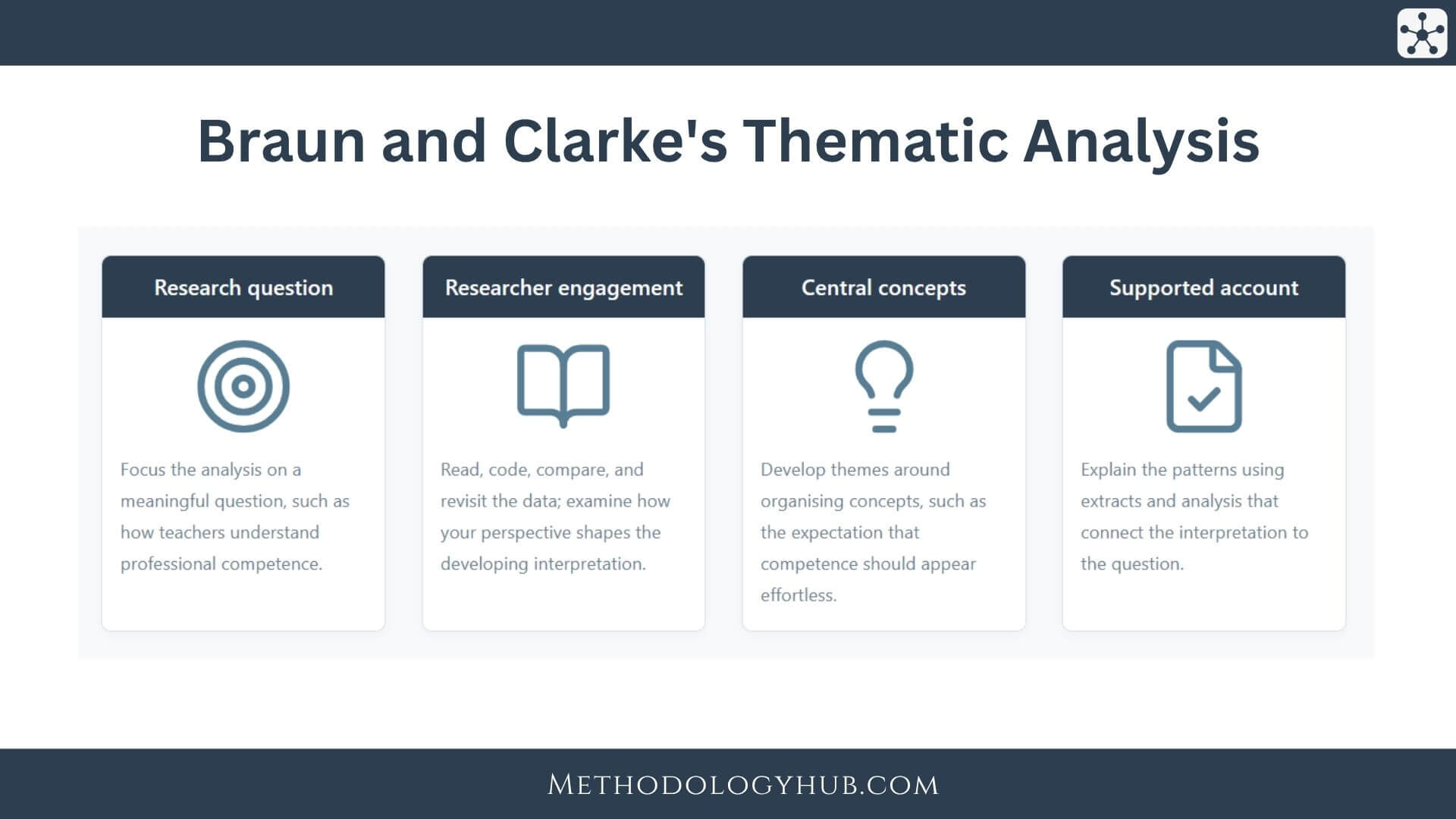
Braun and Clarke’s approach helps researchers construct a reasoned account of patterns across a dataset. It can be used with interviews, written responses, group discussions and other qualitative material. The aim is to develop themes that say something meaningful about the research question, supported by close analysis of the data.
Their 2006 paper, Using thematic analysis in psychology, set out an accessible six-phase framework. Subsequent publications have clarified the assumptions behind their approach and distinguished it more explicitly from other forms of thematic analysis. The term reflexive thematic analysis identifies that methodological position, rather than naming a separate seventh phase.
A theme in this approach develops shared meaning around a central organising concept. Consider interviews with newly qualified teachers about lessons that depart from their plans. A heading such as “lesson planning” identifies a subject. A theme such as “Competence has to look effortless” proposes an interpretation: teachers may describe visible uncertainty as a threat to their professional credibility.
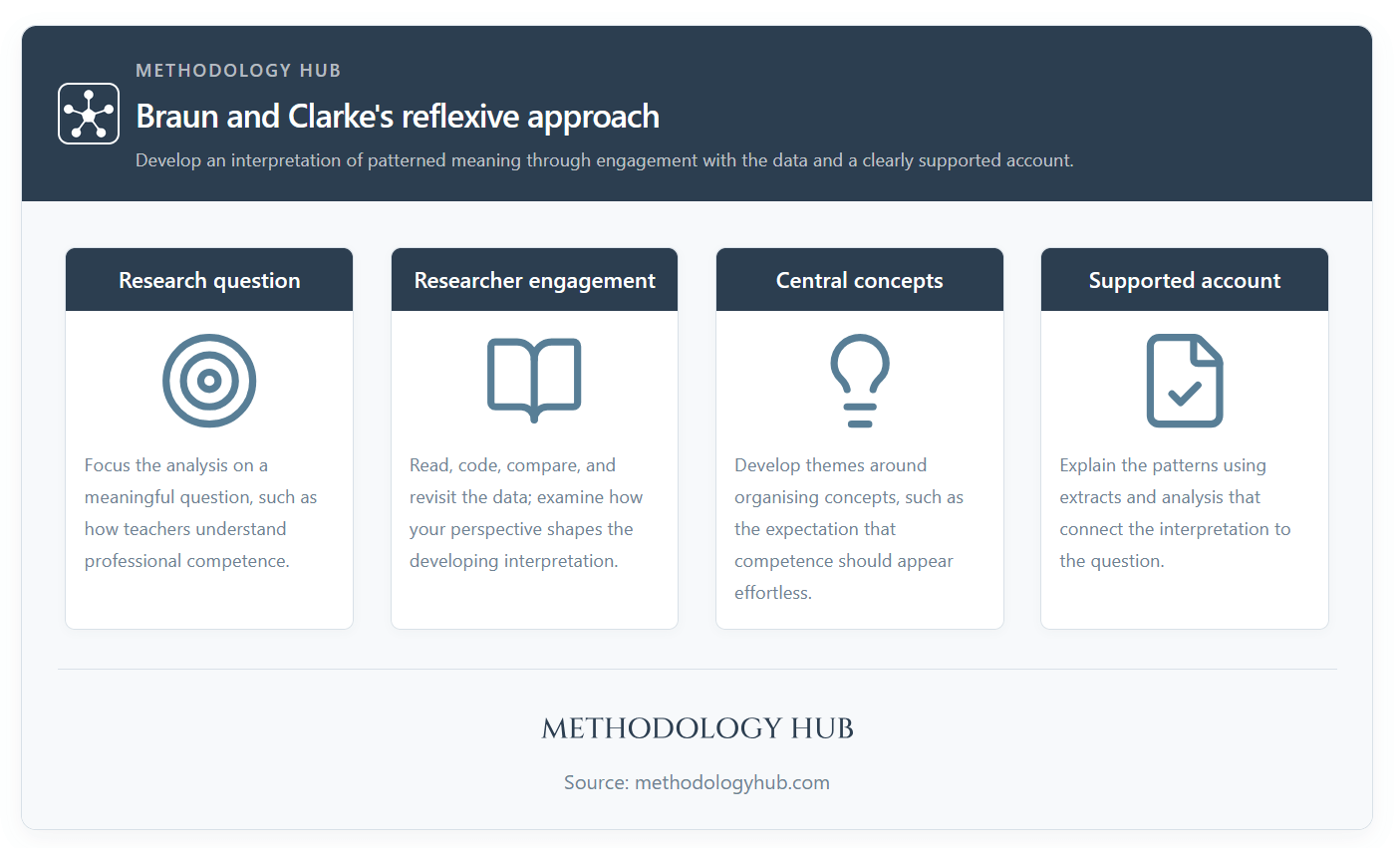
That interpretation would need support across relevant accounts, including attention to contrasting experiences. It cannot be established by selecting one vivid quotation and assigning it a persuasive title. The analytical work involves comparing extracts, revising codes and deciding how a theme contributes to the overall explanation.
The approach is flexible about theoretical orientation, but flexibility requires coherent choices. The researcher should explain the question, the type of knowledge sought and how the analysis was conducted. The six phases provide a practical framework for doing this work; they do not substitute for those decisions.
The Six Phases of Braun and Clarke’s Thematic Analysis
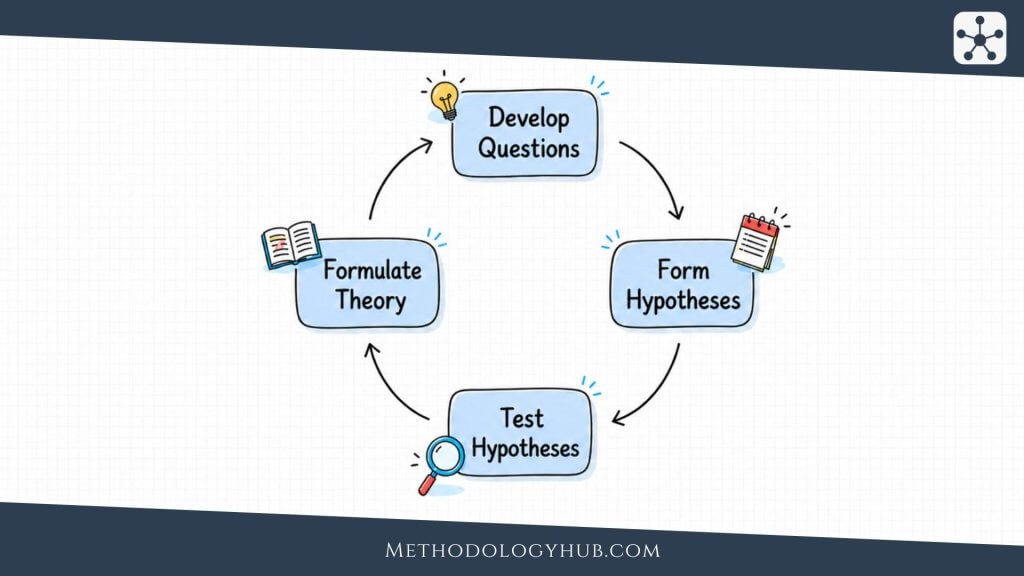
The six phases distinguish tasks that become closely connected during actual analysis. Familiarisation continues during coding, theme development can lead back to particular transcripts, and writing can reveal that two themes overlap. A research account should describe these movements rather than imply that every phase ended permanently before the next began.
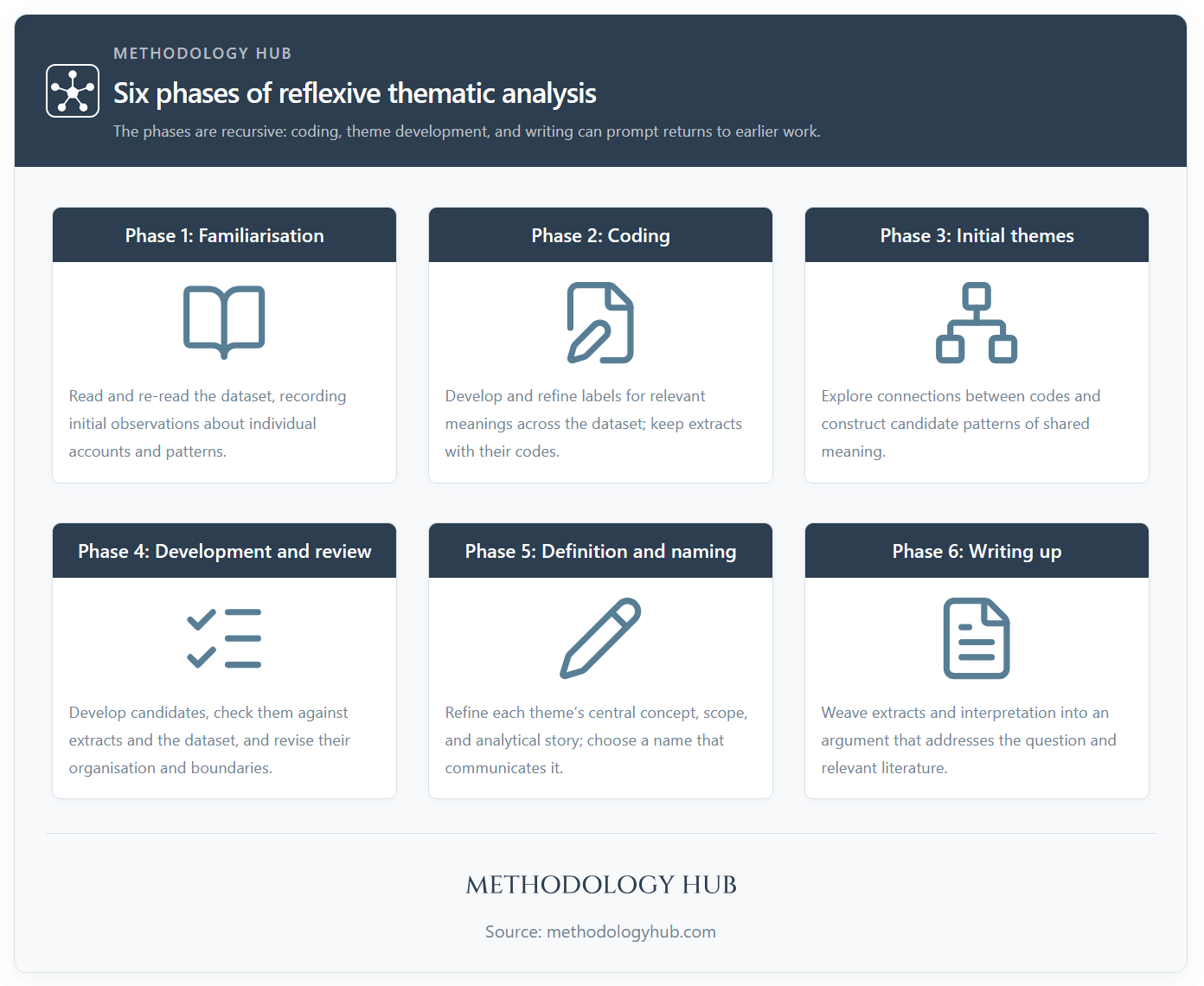
Phase 1: Familiarising Yourself With the Data
Begin by reading the data in sufficient depth to understand individual accounts as well as the collection. If the study uses recorded interviews, listening can help recover pacing, emphasis and the context of an exchange. Transcription can also support familiarisation when the researcher undertakes it, although producing a transcript is not itself the whole analytical task.
Write notes that capture what you notice and what you are assuming. In the teacher study, an early observation might be that a participant spends longer explaining how a failed activity looked to pupils than explaining why it failed. This raises an analytical question about professional presentation without yet establishing a theme.
The way qualitative interviews are conducted also belongs in this reading. A teacher’s account of confidence may follow a prompt that already assumes uncertainty is a problem. Familiarisation should include the interviewer’s contribution to the conversation, especially where it influences the meaning being analysed.
Phase 2: Coding the Data
Code features that appear relevant to the research question across the dataset. A code should identify something analytically useful, whether that is an explicit experience or a more interpretive reading. “Rehearsing answers to unexpected questions” could capture an action, while “protecting the appearance of certainty” proposes a possible meaning attached to it.
Code broadly enough to preserve context and allow more than one interpretation of a passage. A teacher who prepares several alternative activities may be describing anxiety, professional care, enjoyment of improvisation or several of these together. The surrounding account helps determine which codes are supportable.
Codes develop through repeated engagement. Later interviews may encourage the researcher to divide an early code, combine overlapping labels or revisit previously coded material. Keeping an evolving record of these changes supports thoughtful analysis. It does not require a fixed codebook designed to make every researcher classify each passage identically.
Phase 3: Generating Initial Themes
Bring codes together with their extracts and explore the relationships between them. The task is not simply to reduce the number of labels. It is to consider whether a set of coded meanings can support a broader interpretation relevant to the question.
Codes about rehearsing answers, hiding uncertainty and concealing a change of plan might suggest that teachers feel competent teaching should look effortless. Other codes may point to a different understanding, where acknowledging uncertainty demonstrates responsiveness. These possibilities should remain open while the researcher examines their support and relationship.
A candidate theme is provisional. A working title, a brief description and a collection of relevant extracts can help the researcher inspect the idea. Some codes may contribute to more than one candidate at this point; others may remain outside the developing thematic structure without being discarded from the analytical record.
Phase 4: Developing and Reviewing Themes
Review a candidate theme at two connected levels. First, consider whether its extracts support a coherent interpretation. Then return to the wider dataset to assess whether the developing account fits the material and has overlooked something significant. Both forms of review can lead to further coding or a different thematic structure.
Coherence does not mean making every extract say the same thing. A theme about appearing certain might include accounts of successfully maintaining that appearance and accounts of finding it exhausting. The shared concept concerns the expectation of certainty; the different experiences show how that expectation operates.
Look carefully at the boundaries between candidates. “Preparing for every possibility” and “Hiding a change of plan” may be parts of the same broader theme, or they may concern distinct meanings. Decide through the extracts and the research question. A convenient number of headings is not a sufficient reason to merge them.
Phase 5: Refining, Defining and Naming Themes
Develop a concise definition of each theme’s central concept, scope and contribution. Explain what the theme helps the reader understand and how it differs from the others. If the definition requires several unrelated claims, the theme may still be too broad.
For “Competence has to look effortless”, the definition could focus on accounts in which teachers protect credibility by concealing preparation, uncertainty or revision. Ordinary preparation belongs within the theme only when the account connects it to that appearance. This boundary prevents the theme from swallowing every comment about planning.
Choose a name that conveys the interpretation without making a stronger claim than the evidence supports. Subthemes can distinguish important facets of a central concept, but they should serve the analysis rather than decorate it. A theme does not become more developed simply because it contains several additional headings.
Phase 6: Writing Up the Analysis
Writing brings the themes into an ordered argument. Decide what the reader needs to understand first, how the themes relate and how each contributes to answering the research question. The order of presentation need not follow the interview schedule or the sequence in which the themes were developed.
Use data extracts within analytical paragraphs. Establish the relevant claim, show a passage that helps support it and explain the connection. An extract should contribute detail that the surrounding prose then interprets. A sequence of quotations with brief paraphrases leaves much of the analytical work to the reader.
The report should also describe how the researcher worked, including theoretical choices and meaningful revisions. Saying that six phases were followed provides less information than explaining how a candidate about “classroom control” was reconsidered after accounts of professional credibility complicated it. Such detail makes the analysis assessable without pretending that another researcher must reproduce identical themes.
What Is Reflexive Thematic Analysis?
Reflexive thematic analysis treats the researcher as an active participant in producing knowledge. The analysis depends on how that researcher engages with the data, asks questions of it and develops interpretations. Subjectivity is therefore a resource to examine and use thoughtfully, rather than something assumed to disappear through a procedural checklist.
This position does not mean that any interpretation is equally convincing. A strong analysis engages closely with the material, makes coherent theoretical choices and provides evidence for its claims. An interpretation that ignores contradictory passages or imports unsupported assumptions remains weak, however openly the researcher describes their personal perspective.
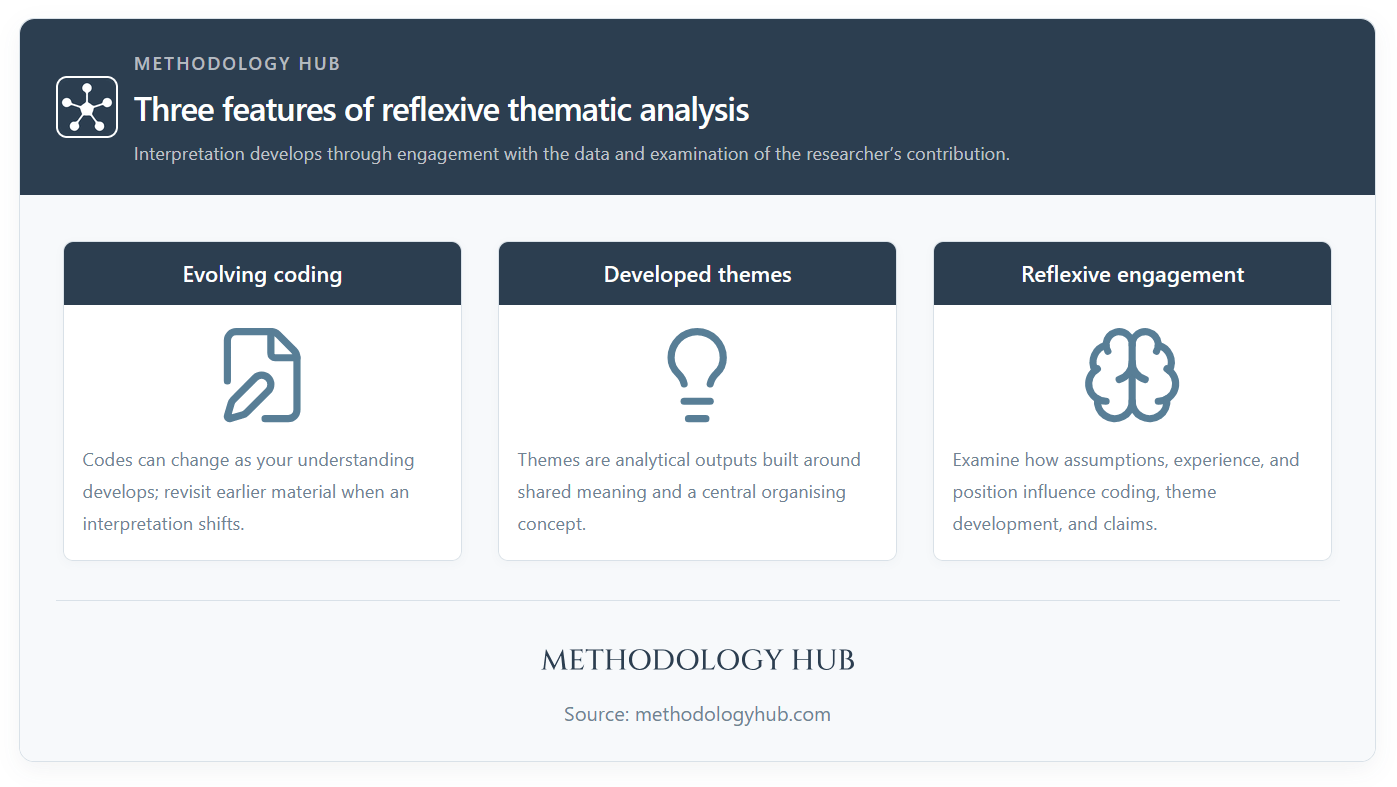
Three features help identify the approach in practice:
- Evolving coding: Labels and interpretations can change as familiarity and analytical understanding deepen.
- Developed themes: Themes are analytical outcomes built around shared meaning, rather than predetermined containers for answers.
- Reflexive engagement: Researchers examine how their position and assumptions influence the study throughout the process.
Working with another analyst can support all three. Colleagues might read an extract differently, question the proposed central concept or notice that a theme depends on a taken-for-granted assumption. The purpose of that conversation is to enrich and challenge interpretation, not to determine which coder has recovered the single correct reading.
This is one position within the broader family of thematic analysis. It should not be combined automatically with procedures from approaches that prioritise standardised coding. Researchers can choose different methods, but their description should accurately represent the logic of the work they conducted.
What Changed Since Braun and Clarke’s 2006 Framework?
The six-phase framework remains recognisable, but the authors’ later writing makes their methodological position more explicit. Reading the changes as a replacement of an originally objective method would be misleading. The researcher’s active role was already present in 2006; subsequent work clarified its implications and addressed ways the framework had been interpreted.
| Area | Original framework and terminology | Later clarification or emphasis |
|---|---|---|
| Name of the approach | Presented as thematic analysis | Explicit identification as reflexive thematic analysis |
| Phase 3 wording | Searching for themes | Generating initial themes, emphasising their active development |
| Phase 4 emphasis | Reviewing themes | Developing and reviewing themes as ongoing interpretive work |
| Meaning of a theme | Patterned response or meaning relevant to the question | Stronger emphasis on shared meaning around a central organising concept |
| Quality practices | Guidance for systematic, theoretically informed analysis | Clearer distinctions from codebooks, agreement measures and other approaches' criteria |
The term “reflexive” became a prominent way of distinguishing their approach in later publications, including their 2019 reflection on its development. It helps separate an interpretive process from forms of thematic analysis designed around a more stable coding framework or the measurement of coding agreement.
Changes in phase labels reinforce that distinction. “Generating” directs attention to the work of making analytical connections. Themes do not sit in transcripts waiting for sufficient reading to reveal them. Researchers develop them through coding, comparison, theoretical engagement and writing.
Later clarification also addresses the difference between a topic summary and a shared-meaning theme. A section collecting everything teachers said about preparation may be informative, but a reflexive theme should explain a meaningful pattern within or across those accounts. This is a difference in analytical organisation, not simply a preference for more imaginative titles.
Quality criteria have likewise become more explicitly linked to methodology. Independent double coding, an agreement coefficient or a fixed coding frame should not be presented as universal requirements of Braun and Clarke’s reflexive approach. Those procedures can serve other designs whose assumptions and aims differ.
For a current study, citing the 2006 paper identifies an important starting point. The methods description should also reflect the approach actually used and the authors’ subsequent clarification. Listing familiar phase names while conducting a different form of thematic analysis leaves the reader uncertain about the study’s analytical logic.
Analytical Approaches
Reflexive thematic analysis can support different kinds of questions, but the researcher needs to explain how their choices fit together. Orientation to theory, depth of interpretation and assumptions about knowledge influence the same analytical process. None of these choices can be settled by naming the six phases alone.
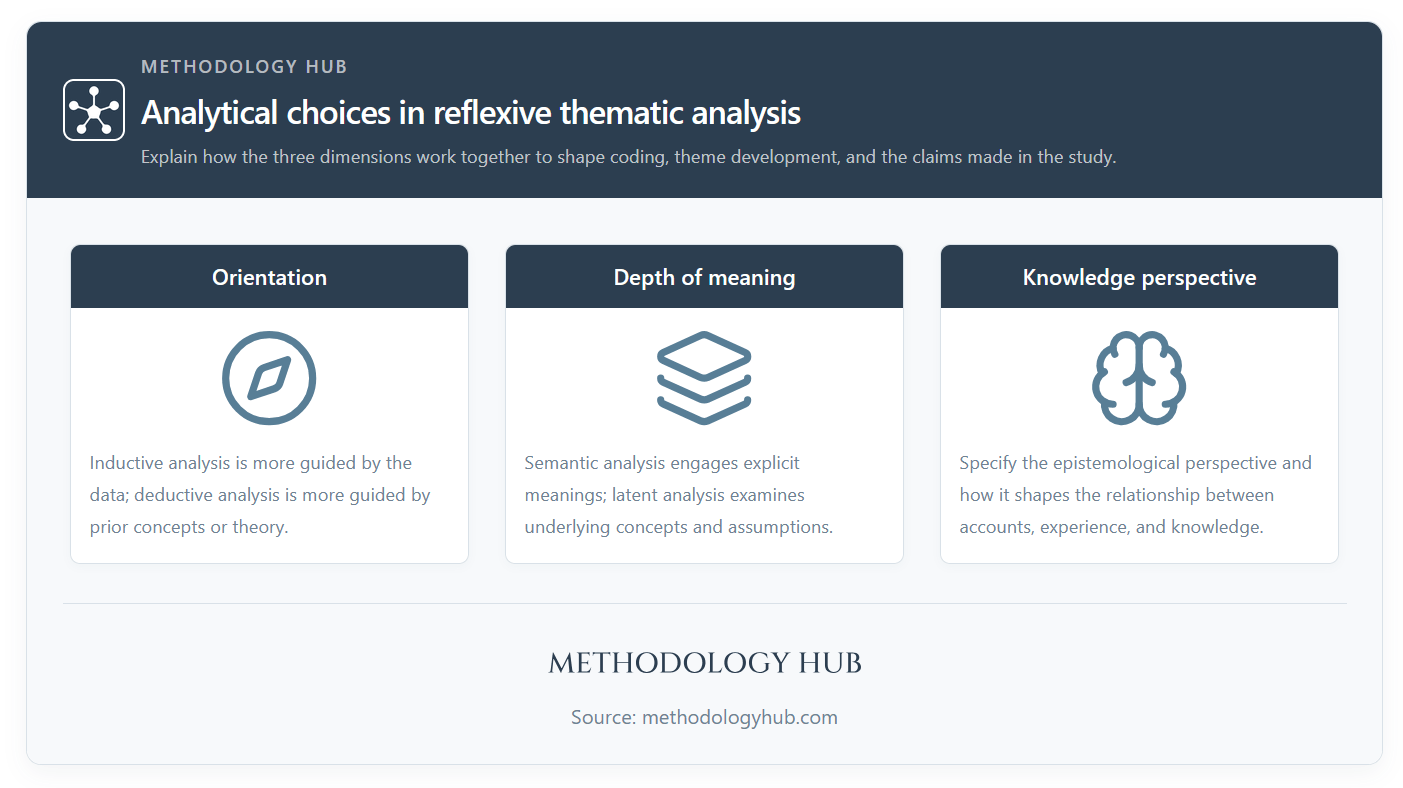
Inductive and Deductive Analysis
A primarily inductive analysis gives substantial attention to meanings developed through engagement with the data. In the teacher study, concerns about appearing knowledgeable might become analytically important even if the interviews initially focused on planning. The researcher follows what the accounts make relevant while recognising their own role in that judgement.
A more deductive analysis uses existing concepts to guide attention. A study informed by professional identity could examine how teachers position themselves as competent practitioners. Theoretical ideas provide questions to ask of the extracts, rather than guaranteeing that every passage will fit a predetermined explanation.
Inductive and deductive work can be combined if the relationship is explained. The methods section might describe an initial focus on professional identity alongside coding for unexpected meanings. Calling an analysis wholly inductive while fitting every extract into categories chosen before reading would obscure how the findings were produced.
Semantic and Latent Analysis
Semantic analysis attends to relatively explicit meanings. A teacher who describes preparing a spare activity because the projector often fails provides material about anticipated disruption. The researcher can develop an interpretation of preparation and adaptation without claiming that the account expresses an unspoken concern about status.
Latent analysis considers assumptions that help make the account intelligible. If several teachers describe hiding alterations because pupils should not see them hesitate, the researcher might examine an expectation of effortless authority. That reading requires contextual evidence and theoretical explanation, not simply the decision to analyse “at a deeper level”.
An analysis can attend to both explicit meanings and underlying assumptions. The report should show when it moves between them. Readers need to distinguish what a participant directly said from the interpretation the researcher develops around that statement.
Epistemological Perspectives
An experiential, broadly realist analysis might use teachers’ accounts to understand how they experience uncertainty in the classroom. A critical realist interpretation could also consider how institutional expectations and working conditions help shape those experiences, while acknowledging the limits of interview evidence for explaining them.
A constructionist analysis would direct greater attention to how competence is produced through language and social expectations. It might ask what a teacher achieves by describing an altered lesson as a deliberate choice rather than an improvised response. The account becomes a site where professional identity is negotiated, not only a report of an earlier event.
The research question should make the intended focus workable. A question about experiences, a question about meaning-making and a question about institutional conditions may overlap, but they support different analytical emphases. State which claims the study is positioned to make and develop the themes accordingly.
The Role of Reflexivity in Thematic Analysis
Reflexivity involves examining how the researcher participates in the production and interpretation of the study’s material. It extends beyond adding a short personal statement to the methods section. The useful question is how a position, assumption or relationship influenced a particular analytical decision.
A former teacher may recognise classroom routines quickly and understand references an outsider would miss. The same familiarity can make an explanation seem obvious too soon. They might interpret detailed preparation as ordinary professional care and overlook passages where preparation concerns protecting status. Both the insight and the blind spot deserve examination.
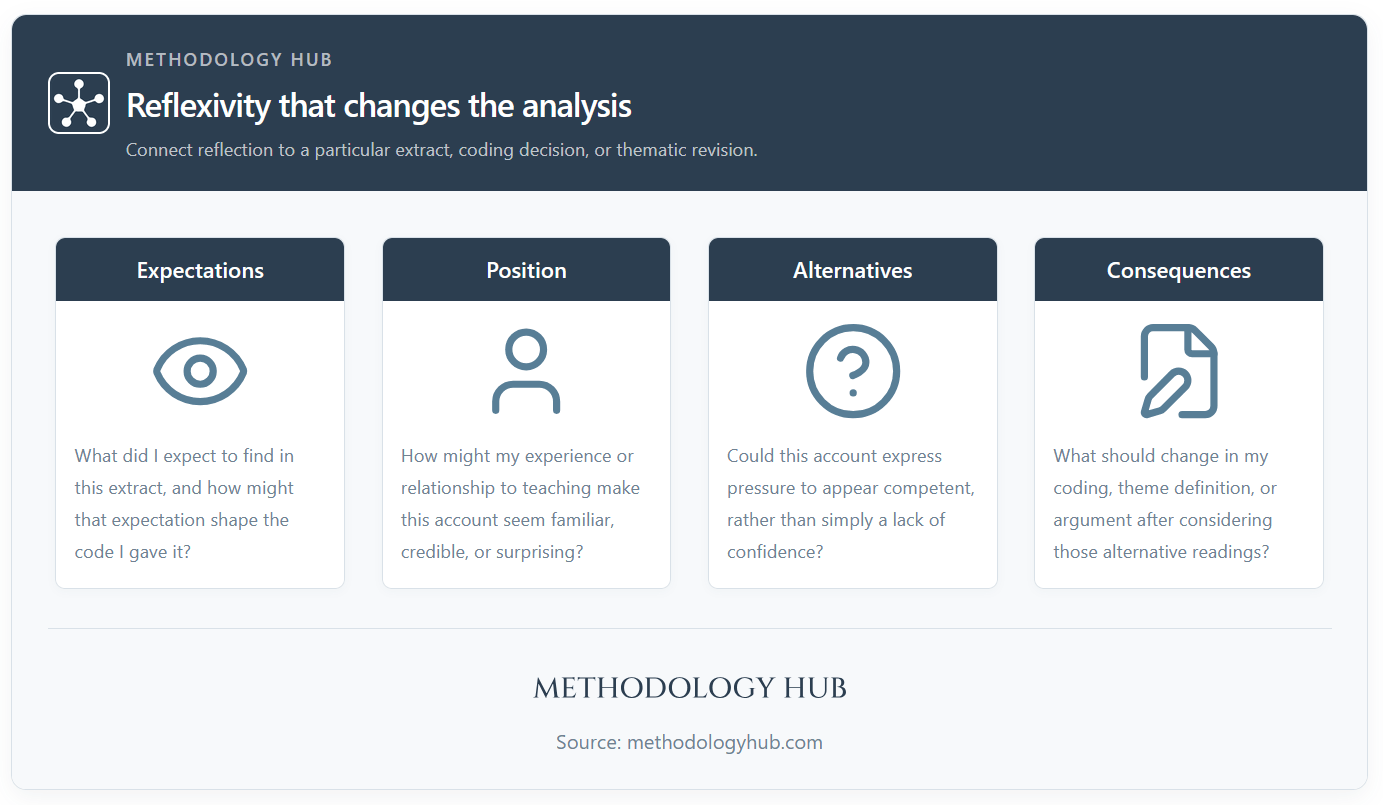
A reflexive journal can record these moments as the analysis develops. It is most useful when entries connect a response to an extract, a coding decision or a possible revision. Prompts might include:
- Expectations: What did I assume this account would show before reading it closely?
- Position: How might my experience or relationship with participants shape this interpretation?
- Alternatives: Which other reading of the extract could challenge my current code?
- Consequences: What changed in the analysis after I reconsidered that assumption?
The journal should support analysis rather than become a record of every research activity. “Read three transcripts” documents progress. “I initially treated visible hesitation as poor preparation, then recoded accounts where hesitation enabled pupil participation” records an interpretive change that may influence a theme.
Data collection choices also shape the material available for interpretation. Diary methods might capture immediate frustration after a difficult lesson, while a later interview may produce a more coherent account of professional learning. Reflexivity includes considering these differences rather than assuming one source transparently reveals the teacher’s true experience.
In the final report, describe the aspects of reflexivity that help readers understand the analysis. Relevant detail might include how professional familiarity influenced initial coding, how discussion with a colleague challenged an assumption, or why a theme was redefined. A list of researcher characteristics without an analytical connection provides much less insight.
Braun and Clarke’s Thematic Analysis Example
A study of newly qualified teachers asks how they interpret lessons that depart from their plans. The analysis focuses on the relationship between uncertainty and professional competence. A primarily inductive, contextual interpretation allows attention to teachers’ experiences while examining expectations expressed in their accounts.
Illustrative extracts: “I changed the activity, but I made it look as though that was always the next step.” “I practise answers so they won’t see me searching for words.” “When I admitted I didn’t know, the discussion got better, although I still felt I had let them down.”
During familiarisation, the researcher notes that these accounts connect classroom decisions with how teachers appear to pupils. Initial coding might distinguish:
- Concealing a change of plan: Presenting adaptation as an intended sequence.
- Rehearsing certainty: Preparing speech to avoid appearing unsure.
- Feeling inadequate despite a useful outcome: Judging visible uncertainty more harshly than its classroom consequences.
The third extract complicates a simple explanation that uncertainty produces poor teaching. The discussion improved, yet the teacher still described personal failure. Comparing that tension with the other coded meanings could support a candidate theme about the expectation that competent teaching should look effortless.
Review would involve returning to the full accounts. A comment about rehearsing could instead concern communicating clearly, and that distinction would affect whether it belongs in this theme. Accounts that celebrate experimentation would also challenge the extent of the interpretation. They might define its boundaries or support a separate theme about adaptation as professional judgement.
The researcher could refine the candidate as “Competence has to look effortless”, defined around the perceived need to conceal uncertainty in order to appear credible. The definition would exclude preparation undertaken solely for clarity or efficiency. It would include the tension between useful improvisation and a teacher’s sense that improvising should remain invisible.
In writing, the researcher would explain that the theme concerns an expectation expressed through the selected accounts. It does not show that pupils actually judged the teachers negatively, because the evidence comes from teachers’ descriptions. Claims about pupil perceptions would need appropriate additional data.
The example also shows why a coding table cannot replace an analysis. The initial labels identify relevant features, but the interpretation depends on comparing their meanings, examining exceptions and specifying a central concept. The written argument makes those relationships available to the reader.
Braun and Clarke vs. Other Thematic Analysis Approaches
The appropriate thematic approach depends on the research aim and the logic of the study. Braun and Clarke’s reflexive approach emphasises situated interpretation and actively developed themes. Codebook and coding reliability approaches organise the work differently and can be appropriate for different analytical purposes.
| Feature | Reflexive thematic analysis | Codebook approaches | Coding reliability approaches |
|---|---|---|---|
| Coding organisation | Flexible and evolving through interpretation | Guided by a structured framework that may be revised | Guided by definitions intended to support consistent application |
| Teamwork | Dialogue can develop and challenge readings | Shared framework supports coordinated analysis | Independent coding may be compared for agreement |
| Researcher subjectivity | An acknowledged resource for interpretation | Handled according to the particular framework and study | Often managed through explicit coding rules and consistency checks |
| Themes | Developed patterns of shared meaning | May be topic summaries or shared-meaning themes | Often organised through predefined domains or consistently coded patterns |
| Quality emphasis | Reflexive engagement, coherence and convincing analysis | Transparent framework development and appropriate analytical use | Clear coding definitions and justified reliability procedures |
These are broad distinctions, not a ranking of methods. A team answering an applied question across many sites may find a shared coding framework useful. A study seeking an interpretive account of meaning may choose reflexive analysis. The important methodological decision is what the procedures are designed to achieve.
In reflexive work, multiple researchers can read and code material. Their involvement does not require a reliability coefficient or a final consensus code for every passage. Discussion can instead explore why readings differ and what each reading makes visible or leaves unexplained.
The approach also affects sampling rationales. Braun and Clarke question treating saturation as a universal endpoint for reflexive thematic analysis, because interpretation does not simply exhaust a finite stock of discoverable themes. Sample adequacy should be justified through the question, scope, richness of material and depth of analytical engagement.
There is consequently no universally correct sample size, number of codes or number of final themes. A focused study with detailed accounts may support a smaller thematic structure than a broad study covering several contexts. The number should follow the analytical purpose and available evidence, with sufficient space to develop each reported theme.
Describe these decisions accurately in the methods section. If a project used a predefined coding frame and assessed agreement between independent coders, that procedure needs an appropriate methodological explanation. Attaching Braun and Clarke’s name to it without addressing the difference creates confusion about how the findings were produced.
Conclusion
Braun and Clarke’s thematic analysis combines a practical six-phase framework with an interpretive understanding of research. Its reflexive form asks researchers to develop themes through sustained engagement, examine their own contribution and explain how the resulting account answers the research question.
The strength of the analysis lies in the connections it establishes: between extracts and claims, between codes and central concepts, and between methodological choices and the final interpretation. Following the phases gives that work direction; making those connections convincing gives the findings substance.
Sources:
Braun, V., & Clarke, V. (2006). Using thematic analysis in psychology. Qualitative Research in Psychology, 3(2), 77–101. https://www.tandfonline.com/doi/abs/10.1191/1478088706qp063oa
Braun, V., & Clarke, V. (2019). Reflecting on reflexive thematic analysis. Qualitative Research in Sport, Exercise and Health, 11(4), 589-597. https://www.scirp.org/reference/referencespapers?referenceid=2797898
Braun, V., & Clarke, V. (2021). Thematic analysis: A practical guide. SAGE Publications. https://www.sagepub.com/shop/buy-a-book/thematic-analysis-1-248481
Cite this article
Whether you are preparing course materials, writing an academic paper, or sharing resources with students, we kindly ask that you acknowledge Methodology Hub as the source.
To make referencing easier, you can use the “Cite this page” tool below to automatically generate a citation in your preferred referencing style, including APA, MLA, Chicago, Harvard, and others. Simply select a citation style and click the generated reference to copy it.
When reproducing images, figures, or other materials from this page, please include an appropriate source credit and a link to the original page. Proper attribution helps others locate the original material and supports the continued development of freely accessible educational resources.