Qualitative observation is the use of observation to collect descriptive, contextual, and interpretive data about behaviour, interaction, settings, routines, and events. Instead of reducing everything to a count, the researcher records what happens, how it happens, where it happens, who is involved, and what the situation appears to mean in context.
In qualitative research, observation is useful when the study needs evidence of practice rather than only accounts given afterward. People may explain what they usually do, but observation can show timing, movement, pauses, use of space, informal rules, and small interactions that are easy to forget in an interview.
This guide focuses on qualitative observation as a distinct way of using observational research. It explains what qualitative observation is, how it differs from quantitative observation, how researchers focus an observation, how field notes are created, how observer roles shape the data, and how qualitative observation findings are analysed and written.
What is Qualitative Observation?
Qualitative observation means watching and recording activity in a way that preserves detail, context, and meaning. The researcher does not only ask how often something happens. They ask what is happening, how people organise it, how the setting shapes it, and what patterns appear across events or situations.
A researcher observing a classroom may record who speaks, but also how a question is asked, how other students respond, where the teacher stands, what materials are used, and what happens after a pause. The observation record becomes a detailed account of practice in context.
Qualitative observation definition
Qualitative observation is a data collection method in which the researcher records descriptive and contextual information about behaviour, interaction, settings, routines, objects, speech, movement, and events. The data are usually analysed to understand patterns, meanings, processes, and relationships in a specific context.
The method can be open and exploratory, or it can use a focused observation guide. In either case, the aim is not simply to measure visible behaviour. The aim is to interpret what the observed activity shows about the research question.
What the researcher observes
Qualitative observation can focus on people, spaces, objects, routines, roles, timing, language, silence, body movement, tools, documents, and interaction. The researcher may observe a meeting, a classroom task, a clinic desk, a community event, a public space, or an online group.
The observation focus should match the research question. If the question concerns participation, the researcher may observe who speaks, who is invited to speak, who is ignored, and how turn-taking is managed. If the question concerns space, the researcher may record movement, access, distance, and repeated use of particular areas.
How qualitative observation creates evidence
Qualitative observation creates evidence through a field record. The researcher writes what was seen and heard, then later analyses that record for patterns and meanings. The quality of the study depends heavily on the quality of the observation notes.
A weak note may say, “The group worked well.” A stronger note describes the evidence: one participant read instructions aloud, another divided tasks, two members asked questions, and the group returned to the instructions when disagreement appeared. The second version gives the researcher something to analyse.
Recommendation: write down the behaviour that led to your interpretation. The interpretation can be developed later, but the field record needs visible detail.
What qualitative observation cannot show by itself
Observation can show what happened in a setting, but it does not automatically show private motives, memories, or feelings. If someone stays silent during a discussion, the researcher should not assume the reason without further evidence. Silence may mean agreement, discomfort, boredom, uncertainty, politeness, or lack of opportunity.
This is why qualitative observation is often combined with interviews in qualitative research, documents, or informal conversations. Observation can show practice, while other data can help explain how participants understand that practice.
Qualitative vs Quantitative Observation
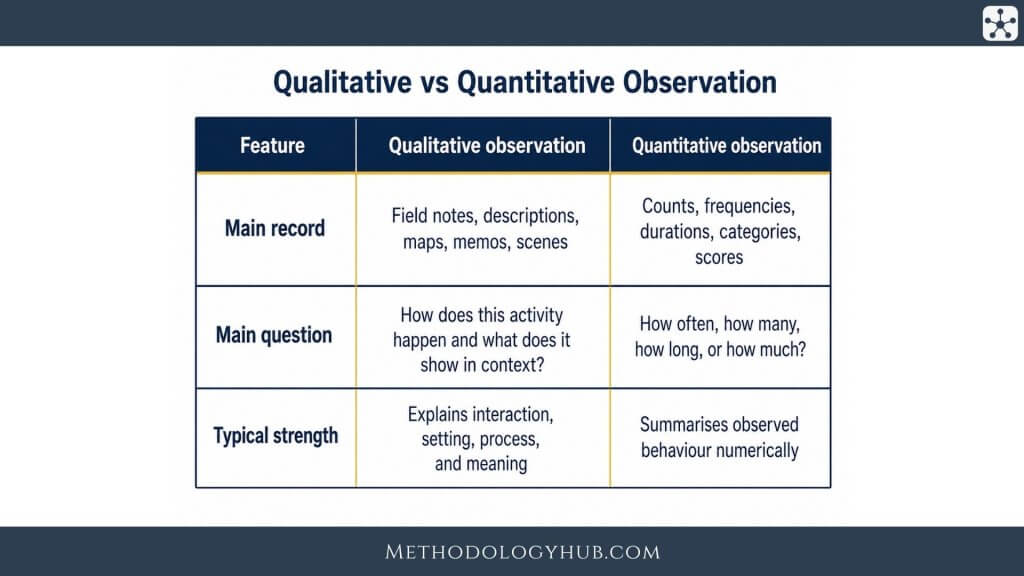
Qualitative and quantitative observation both involve watching and recording behaviour, but they organise the data differently. Qualitative observation records descriptions and context. Quantitative observation records counts, categories, durations, frequencies, or scores.
The difference is not that one method watches carefully and the other does not. Both can be careful. The difference is what the researcher treats as data and what kind of analysis follows.
Qualitative observation focuses on context
Qualitative observation keeps the setting visible. The researcher records actions together with surrounding details: who was present, what happened before, how people responded, where the action took place, and which objects or routines were involved.
This is useful when the meaning of behaviour depends on context. A student leaving a group may mean different things depending on whether the task ended, conflict occurred, the teacher called them away, or the group excluded them.
Quantitative observation focuses on measurement
Quantitative observation is used when the researcher wants numerical records. They may count how many times a behaviour occurs, how long an event lasts, how many people use a space, or how often a category appears.
For example, a researcher may count how many times teachers ask open questions during a lesson. This can show frequency, but it may not explain how students responded, whether the questions changed the discussion, or why some questions had more effect than others.
| Feature | Qualitative observation | Quantitative observation |
|---|---|---|
| Main record | Field notes, descriptions, maps, memos, scenes | Counts, frequencies, durations, categories, scores |
| Main question | How does this activity happen and what does it show in context? | How often, how many, how long, or how much? |
| Typical strength | Explains interaction, setting, process, and meaning | Summarises observed behaviour numerically |
Combining both forms
A study can combine qualitative and quantitative observation. A researcher may count how often students request help and also write descriptive notes about how those requests are made, who responds, and what happens afterward.
This combination can be useful because counts show distribution, while qualitative notes explain process. The design should make clear which part of the study is doing which job.
Planning a qualitative observation study
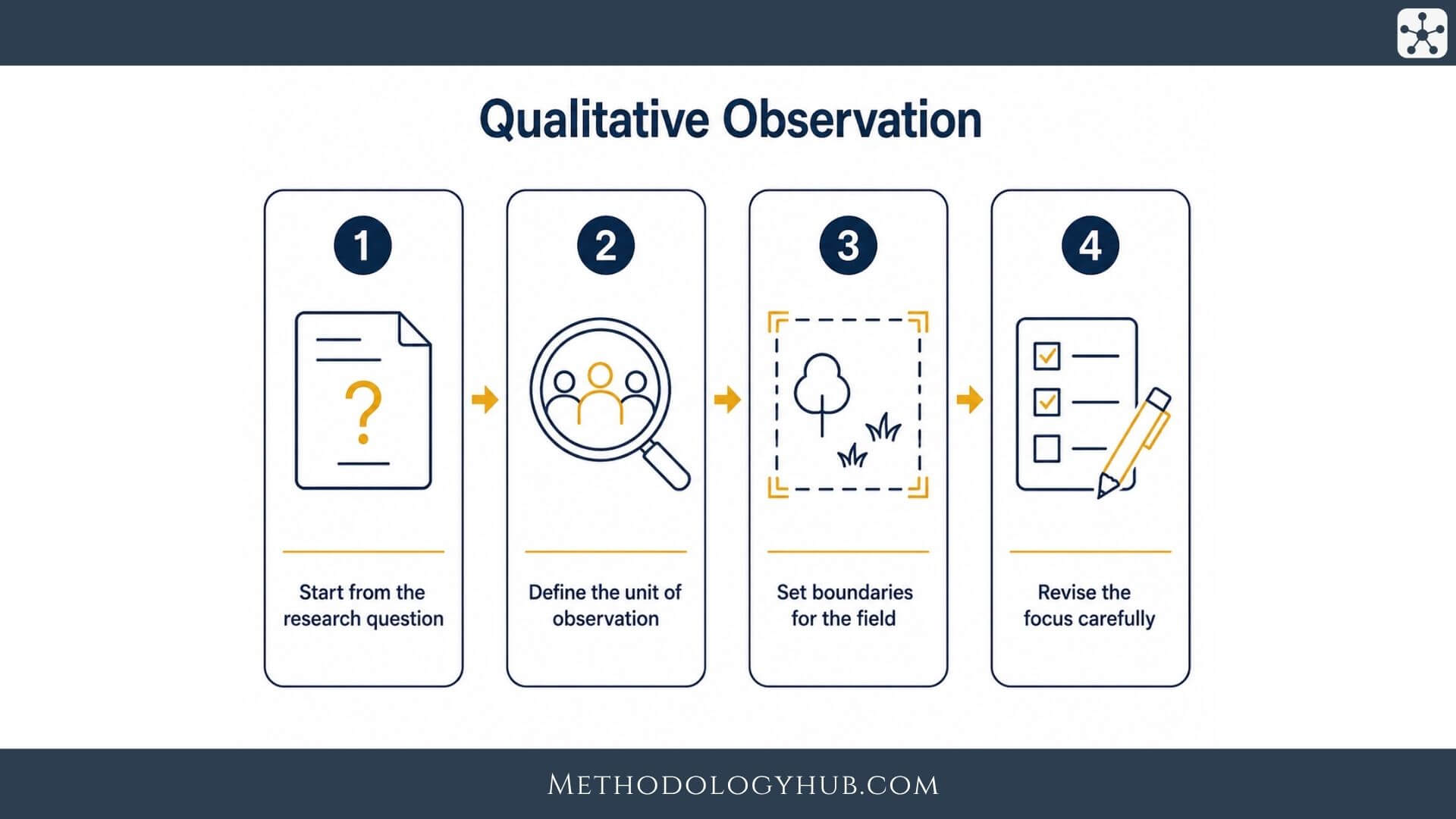
Qualitative observation requires focus. A setting may contain many people, objects, events, and conversations at the same time. The researcher needs a way to decide what belongs in the field record and what can remain background.
The observation focus does not have to be narrow from the first moment. In exploratory work, the researcher may begin with a broad focus and narrow it after initial visits. Even then, the study should not become a record of everything that happened.
A useful focus usually connects an activity, a setting, and a research question.
Start from the research question
The research question should guide the observation focus. If the study asks how students support one another during group work, the researcher should record peer explanations, requests for help, task division, silence, and teacher interruptions. Details about wall posters may be less relevant unless they shape the activity.
If the study asks how people use a public space, the researcher may focus on movement, seating, entrances, gathering points, avoidance, and time of day. The same setting can produce different records depending on the question.
Define the unit of observation
The unit of observation is what the researcher treats as the main thing being observed. It may be a person, a group, an event, a routine, a place, a task, a conversation, or a sequence of actions. Naming the unit helps the researcher stay consistent.
For example, in a study of clinic reception, the unit may be each visitor encounter. In a study of classroom transitions, the unit may be each move from one activity to another. In a study of online discussion, the unit may be each thread or exchange.
Set boundaries for the field
The researcher should decide where the observation begins and ends. Boundaries may be spatial, temporal, social, or activity-based. A study may include the classroom only, or it may include the corridor before class. It may include a public meeting only, or also the informal conversation afterward.
Boundaries should be flexible enough to reflect reality. If participants repeatedly move outside the original field boundary, that movement may itself become relevant.
Recommendation after one pilot observation, ask whether your notes answer the research question or only describe a busy scene.
Revise the focus carefully
Qualitative observation can become more focused over time. A researcher may begin by observing general classroom interaction and later focus on how students request help. Revision is acceptable when it follows early evidence and is documented.
The researcher should record why the focus changed. Without that record, later readers may not understand why some early notes look different from later ones.
Observer Roles in Qualitative Observation
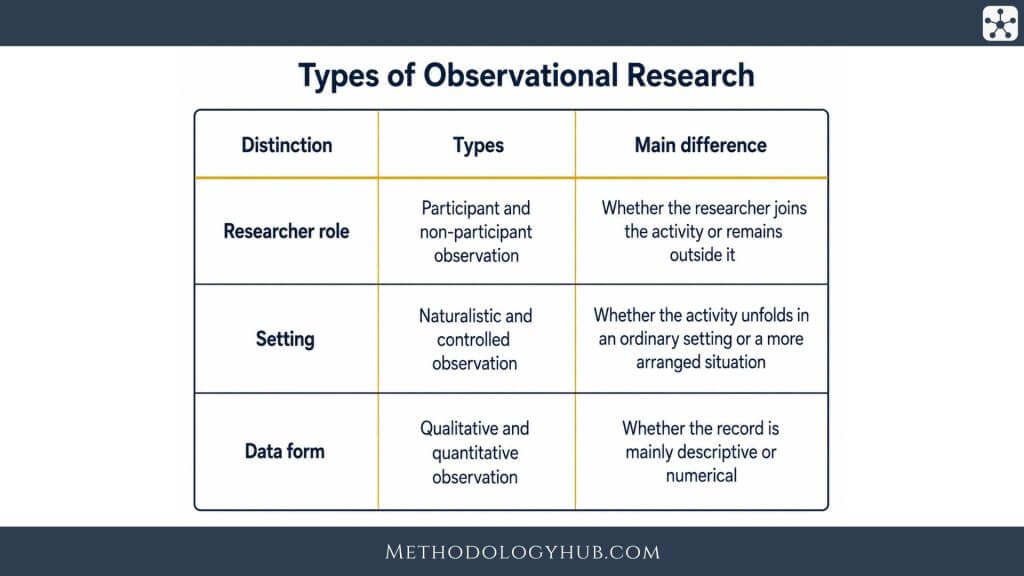
The observer role shapes the data. A researcher who joins the setting may learn through participation. A researcher who watches from a distance may see broader patterns. A researcher in a natural setting may record ordinary routines, while a researcher in a controlled situation may compare responses to the same task.
Qualitative observation can use different observer positions. The researcher should describe the role clearly because role affects access, interaction, and interpretation.
Participant observation
In participant observation, the researcher takes part in the setting while observing it. This can help the researcher understand local routines, informal rules, and inside meanings.
The limitation is that participation can reduce what the researcher can record in the moment. If the researcher is helping with a task, they may not be able to watch the whole setting at the same time. Expanded notes after fieldwork become especially important.
Non-participant observation
In non-participant observation, the researcher does not join the activity directly. This role can be useful when distance helps the researcher observe several people, groups, or actions at once.
The limitation is that the researcher may see what happens without knowing how participants interpret it. Informal conversation or later interviews can help explain actions that are unclear from observation alone.
Naturalistic observation
In naturalistic observation, the researcher studies activity in its ordinary setting. This can be participant or non-participant. The key point is that the activity occurs under normal conditions rather than being created mainly for the study.
This role is useful when context is part of the research question. The setting itself becomes part of the observation record.
Controlled observation
In controlled observation, some part of the situation is planned or standardised. The researcher may use the same task, time limit, instructions, materials, or recording categories across sessions.
Controlled observation can still be qualitative when the researcher records detail and interprets interaction. It simply uses more structure than open field observation.
| Observer role or setting | How it shapes qualitative observation |
|---|---|
| Participant | Gives access to inside practice and informal meaning. |
| Non-participant | Supports distance and wider attention across the setting. |
| Naturalistic | Preserves ordinary context and everyday conditions. |
| Controlled | Supports comparison through a more planned observation situation. |
Documenting role effects
The researcher should record how their role may have shaped the setting. Did participants change behaviour because they were being watched? Did the researcher get invited into some spaces but not others? Did participation create access or limit attention?
These notes do not weaken the study. They help the reader understand how the observation data were produced.
Recording Qualitative Observation Data
Recording is the bridge between observing and analysing. The researcher may notice many things in the field, but only the field record can be revisited, coded, compared, and cited in findings. For this reason, note quality is central to qualitative observation.
The record should capture concrete details before they become broad impressions. A later analysis can interpret the data, but the notes should preserve enough evidence for that interpretation to be checked.
Descriptive field notes
Descriptive field notes record what the researcher saw and heard. They include actions, speech, movement, setting, timing, objects, layout, and sequence. They should stay close to observable detail.
Instead of writing “the meeting was tense,” a descriptive note might record that three people stopped speaking after a proposal, one person looked down at the table, and the chair moved to the next agenda item without asking for comments. The later interpretation may discuss tension, but the note shows how it appeared.
Reflective notes
Reflective notes record the researcher’s early ideas, questions, uncertainties, and possible interpretations. They may ask why a routine occurred, whether a pattern is repeating, or how the researcher’s position affected what could be seen.
Reflective notes should not be mixed up with description. Keeping them separate helps the researcher avoid treating early interpretations as direct observation.
Maps, diagrams, and time records
Qualitative observation often benefits from visual and temporal records. A map can show movement, seating, visibility, or blocked access. A timeline can show when events occurred and how one action led to another.
These records are useful when space and sequence shape meaning. A classroom, meeting room, clinic desk, public square, or online discussion board may all need more than prose notes.
Recommendation: record the scene first, then record what you think the scene may show.
Expanded notes after the session
Brief notes taken during observation should be expanded soon afterward. The researcher can fill in sequence, clarify shorthand, add setting detail, and write separate reflections while the observation is still fresh.
Delayed note expansion can weaken the data. Small details about timing, wording, and position may disappear quickly, especially in busy settings.
Linking field notes to other materials
Field notes can be linked to interview transcripts, documents, photographs, meeting records, or observation schedules. A researcher may observe a routine, then later ask participants about it in an interview. Another study may compare observed practice with written procedures.
These links should be documented. The researcher needs to know which field event connects to which interview, document, or later analytic memo.
Analysing Qualitative Observation Data
Analysing qualitative observation data means moving from field records to an interpretation of practice in context. The researcher reads notes, codes observed details, compares events, develops categories or themes, and checks interpretations against the original record.
The analysis should keep the observed setting visible. If the researcher removes behaviour from its timing, space, sequence, and social context, the analysis loses much of what observation provides.
Read full observation records first
The researcher should begin by reading complete observation records before coding short fragments. This includes descriptive notes, reflective notes, maps, timelines, and method notes. Whole-record reading helps preserve the setting as a connected scene.
It also helps the researcher notice uneven data. One session may include strong notes on interaction but weak notes on space. Another may include detailed maps but little speech. These limits should be considered in analysis.
Code actions and context together
Coding can focus on actions, roles, routines, objects, spaces, interaction patterns, interruptions, silences, transitions, and repeated sequences. The researcher should code in a way that keeps context attached.
For example, a code such as “help request” may need details about who requested help, where the request happened, how it was made, who responded, and what happened afterward. Without these details, the code becomes too thin.
Compare scenes and events
Qualitative observation often gains strength through comparison. The researcher may compare several lessons, meetings, shifts, rooms, time periods, or field visits. Comparison helps identify repeated patterns and exceptions.
For example, a researcher may find that staff support one another informally during quiet shifts but rely on formal procedure during busy periods. The pattern only becomes visible when several observations are compared.
Move from description to interpretation
Interpretation should grow from recorded detail. The researcher may first describe a repeated action, then explain what that action suggests about roles, access, routines, or meaning. A finding should not jump from a single impression to a broad claim.
A strong observation finding might describe how newcomers stood near the doorway, waited for instruction, and were assigned low-visibility tasks. The interpretation may then discuss how belonging was learned through space and task allocation.
Use field note excerpts carefully
Field note excerpts can help readers see the evidence. They may include a short scene, a sequence of actions, a map description, or a recorded exchange. The excerpt should be introduced and explained rather than dropped into the findings without analysis.
The researcher should also protect participant privacy when reporting observation. Details that make people or settings identifiable may need to be changed or removed.
Examples of Qualitative Observation
Examples of qualitative observation show how the method can be used in different settings. In each example, the researcher records descriptive detail and later interprets patterns in context.
Example 1: Peer support during classroom tasks
A researcher observes students working in small groups during regular lessons. The field notes focus on how students ask for help, who explains tasks, how materials are shared, and what happens when one student is confused.
The analysis may show that support is not evenly distributed. Students sitting near confident peers may receive quick explanations, while students at the edge of the group may wait longer or avoid asking.
Example 2: Movement through a community centre
A researcher observes how visitors move through a community centre during open hours. Notes record entrances, waiting areas, help-seeking, signs, doorways, informal greetings, and moments when visitors hesitate.
The findings may show that regular visitors know how to move through the space, while newcomers rely on visual cues and informal help. The observation helps explain access as a practical and spatial process.
Example 3: Communication during a staff meeting
A researcher observes staff meetings to understand how decisions are made. The record includes who introduces topics, who supports or challenges ideas, when humour appears, and how final decisions are summarised.
The analysis may show that formal agreement happens after informal signals from senior members. Observation is useful because the decision process is visible in interaction, not only in meeting minutes.
Example 4: Use of outdoor seating in a public square
A researcher observes how people use outdoor seating in a public square. The notes include time of day, weather, group size, seating choices, movement between areas, and reactions when the space becomes crowded.
The study may show that seating is shaped by shade, visibility, noise, and informal group boundaries. These details would be difficult to understand from a simple count of occupied seats.
Example: qualitative observation is strongest when the example shows what happened, where it happened, and how the situation shaped the action.
Example 5: Informal learning during workplace shadowing
A researcher observes new staff shadowing experienced workers. The field notes record which tasks are explained, which are demonstrated silently, when questions are asked, and how mistakes are corrected.
The findings may show that learning depends on short demonstrations, repeated exposure, and the willingness of experienced staff to make invisible routines visible. The observation record helps show learning as a social process.
Conclusion
Qualitative observation gives researchers a way to study behaviour, interaction, routines, settings, and events in context. It is especially useful when the research question asks how something happens in practice and how the setting shapes action.
A strong qualitative observation study needs a focused question, a clear observer role, detailed field records, careful note expansion, and analysis that connects interpretation to observed detail. The method can be used on its own, but it often becomes stronger when combined with interviews, documents, or quantitative observation records.
FAQs on Qualitative Observation
What is qualitative observation?
Qualitative observation is a research method that records descriptive and contextual data about behaviour, interaction, settings, routines, objects, speech, movement, and events. It is used to understand how activity happens in context.
What is qualitative observation in research?
Qualitative observation in research involves watching a setting or activity and recording detailed field notes for later interpretation. The researcher studies patterns, meanings, roles, routines, and processes rather than only counting behaviours.
What is the difference between qualitative and quantitative observation?
Qualitative observation records descriptions, context, interaction, and meaning. Quantitative observation records counts, frequencies, durations, categories, or scores. The two can be combined when a study needs both context and measurement.
How do you conduct qualitative observation?
To conduct qualitative observation, define the research question, choose a setting, decide what to observe, select an observer role, record descriptive and reflective notes, expand notes soon afterward, and analyse patterns in context.
What should be recorded in qualitative observation?
Researchers may record actions, speech, movement, timing, setting, objects, seating, pauses, routines, interaction, maps, diagrams, timelines, descriptive field notes, reflective notes, and method notes.
What are examples of qualitative observation?
Examples include observing peer support during classroom tasks, movement through a community centre, communication in staff meetings, use of public seating, or informal learning during workplace shadowing.
How do you analyse qualitative observation data?
Qualitative observation data are analysed by reading full field records, coding actions with context, comparing scenes and events, developing interpretations from recorded detail, and using field note excerpts carefully in findings.