Qualitative analysis interprets meaning, experience and social action in research evidence. Within qualitative research, it helps researchers explain patterns, understand individual accounts and examine how language and interaction shape everyday life.
A study’s qualitative approach guides its methodological direction, while qualitative research methods generate or collect evidence. Qualitative analysis provides the methods for interpreting that evidence, with different methods supporting different kinds of findings.
This article explains qualitative analysis, compares its methods and shows how to choose an appropriate analytical approach.
What Is Qualitative Analysis?
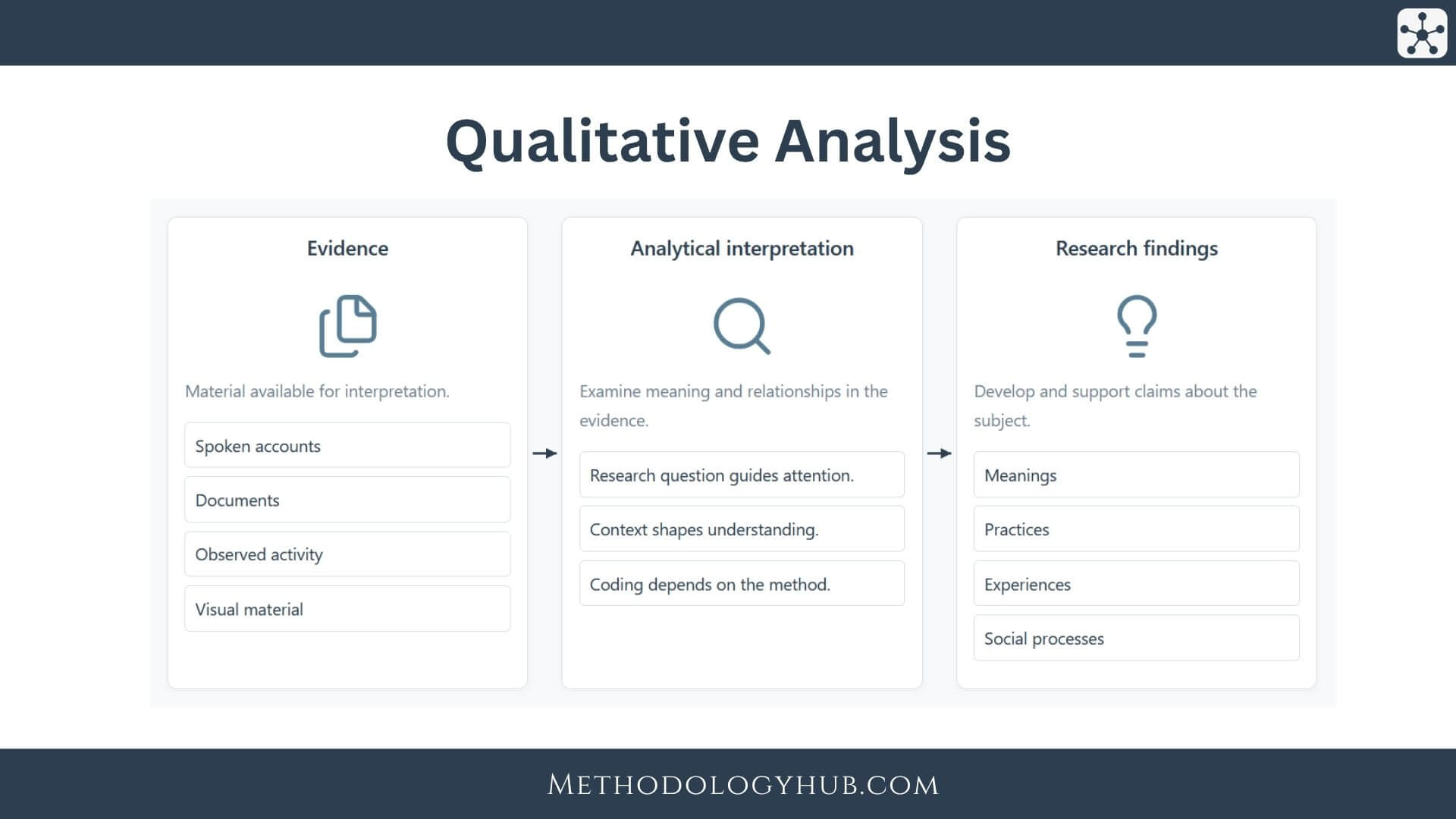
Qualitative analysis connects research material with an interpretation that answers a question. The material may be spoken, written, visual or observational. Its form influences what can be examined, but it does not determine the analytical method on its own.
| Data type | Examples of material | Features available for analysis |
|---|---|---|
| Spoken accounts | Interview recordings and transcripts | Experiences, explanations and ways of telling |
| Group interaction | Focus-group recordings and transcripts | Agreement, disagreement and collective discussion |
| Written material | Documents, letters and diary entries | Categories, arguments, descriptions and changing accounts |
| Observational records | Field notes and recorded activity | Practices, sequences, relationships and setting |
| Visual material | Photographs, drawings and video | Representation, composition, gesture and spatial relations |
Definition of Qualitative Analysis
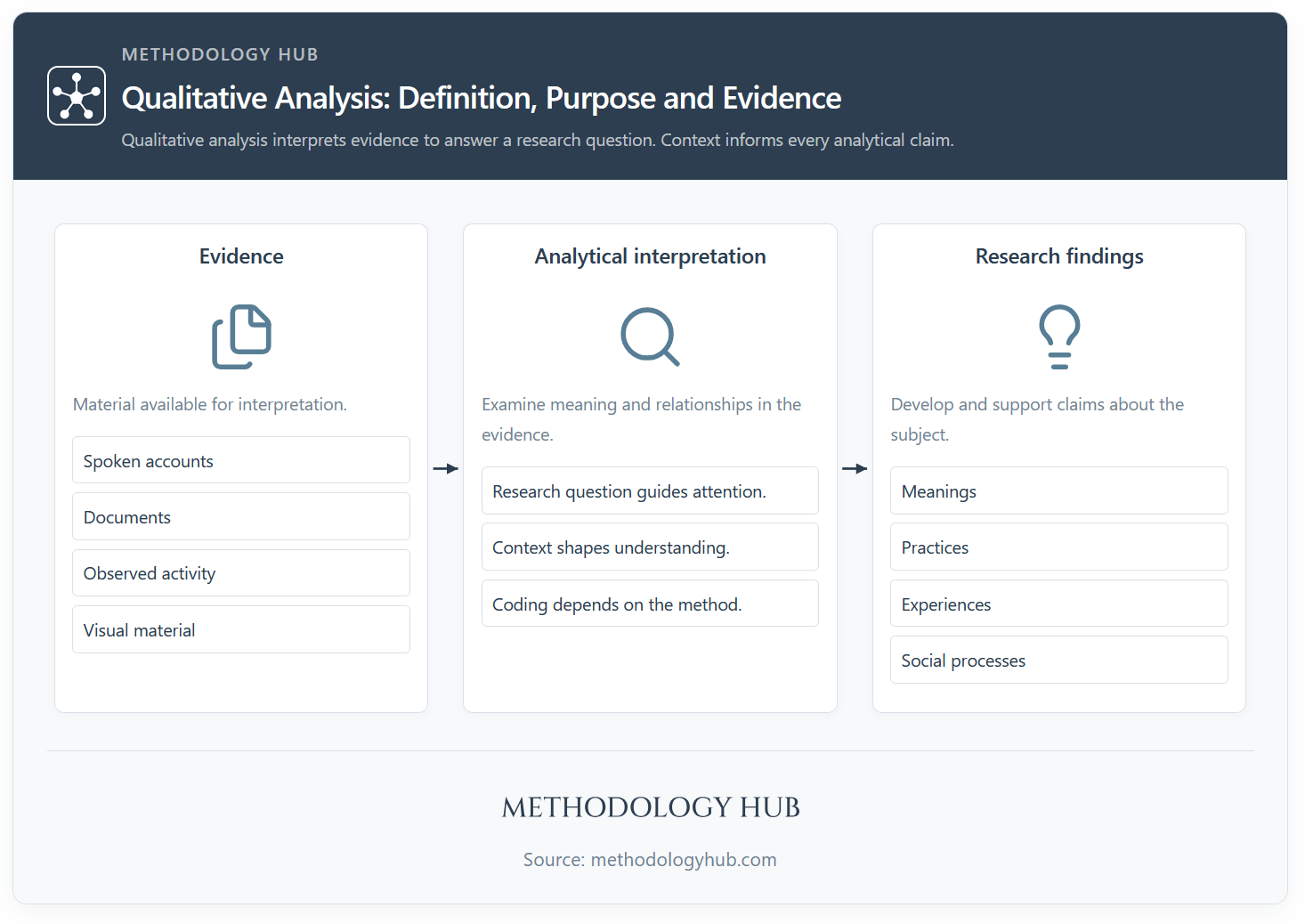
Qualitative analysis is the systematic interpretation of evidence to understand meanings, practices, experiences or social processes. It includes several analytical traditions rather than one standard technique. A finding might explain a pattern across accounts, the organisation of a story or how participants accomplish something through talk.
Here, qualitative analysis concerns those analytical methods and their purposes; qualitative data analysis concerns the practical work of applying them. Research literature often uses the terms interchangeably. The distinction helps separate choosing an analytical method from preparing material, coding passages and writing findings.
Purpose of Qualitative Analysis
The purpose is to develop a supported understanding of the phenomenon under study. Description establishes what the material contains. Interpretation examines relationships, contrasts and implications, explaining how the evidence answers the research question. Some studies stay close to participants’ explicit accounts; others examine assumptions or social conditions that participants do not name directly.
Compared with quantitative analysis, the emphasis falls on meaning and context rather than estimating numerical relationships. Counts can contribute to a qualitative study, but frequency alone does not establish significance. A less common account can expose a limitation in an interpretation that otherwise appears convincing.
Key Characteristics
The analysis develops through close attention to material and a stated way of interpreting it. Researchers make decisions about relevance, comparison and explanation, then examine whether those decisions remain defensible across the available evidence.
- Context connects an extract with the circumstances in which it was produced.
- Interpretation links observations to claims that readers can assess.
- Comparison examines differences as well as recurring features.
- Reflexivity makes the researcher's assumptions and analytical role open to examination.
Types of Qualitative Data
Recordings preserve features that transcripts may omit, while documents retain information about authorship, audience and institutional purpose. Visual material may require attention to composition and movement alongside spoken explanations. Analysis should preserve the features needed to support its claims, including relationships between different forms of evidence.
Data depth also affects the available interpretation. Brief written responses can support a focused comparison, but they may offer little evidence about the development of an experience. Length is not a guarantee of usefulness: the relevant issue is whether the material contains the detail required by the question.
Types of Qualitative Analysis
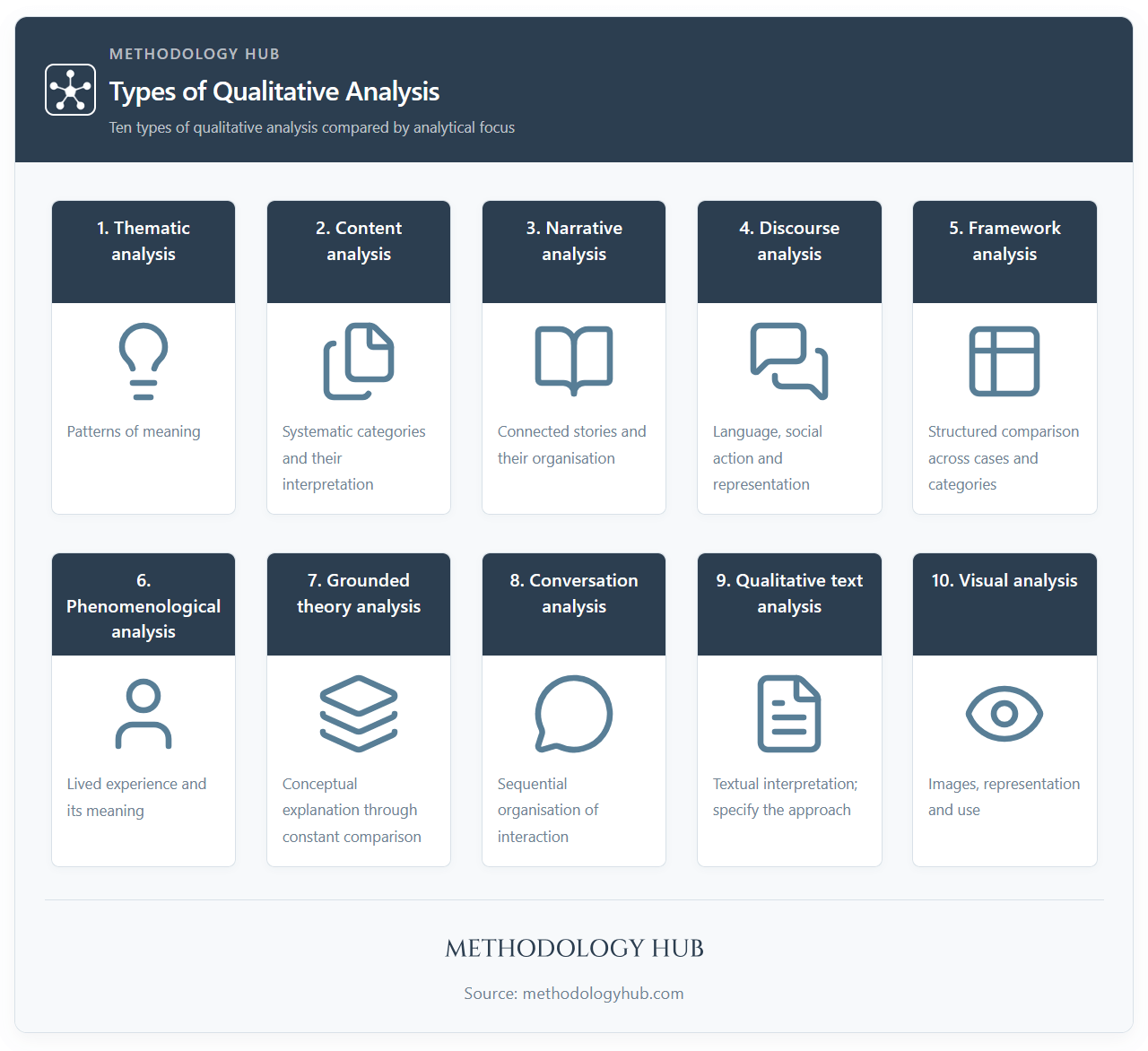
Methods differ in what they treat as the main object of attention. Some compare meanings across cases; others preserve a complete account or examine the organisation of interaction. Several also belong to wider research methodologies, so their use involves more than adopting a coding technique.
Thematic Analysis
Researchers use thematic analysis to develop patterns of meaning across a dataset. Its different forms make different assumptions about coding and the researcher’s role. In Braun and Clarke’s thematic analysis, themes express an interpretation organised around a central idea. Codebook approaches provide a more structured framework for organising material, while coding-reliability approaches emphasise consistent application of codes.
Content Analysis
Qualitative content analysis examines meaning through systematically developed categories. Categories can originate in the material, come from an existing framework or combine both sources. Analysis may address manifest content, which is explicitly stated, or latent meaning that requires further interpretation. Counts sometimes help describe distribution, but qualitative content analysis requires examining what the categories contain and how their use varies with context.
Narrative Analysis
In narrative analysis, the relationships among events remain part of the evidence. Researchers examine how an account begins, moves through time and assigns significance to experience. Depending on the tradition, attention may fall on narrative content, structure, performance or audience. Dividing a story into isolated topics can remove the connections the analysis needs to explain.
Discourse Analysis
Discourse analysis investigates what language does within social settings. It can examine how communication establishes categories, presents knowledge as authoritative or assigns responsibility. Different traditions focus on local interaction, institutional discourse or wider relations of power. The researcher must specify the tradition and connect claims to identifiable features of language and context.
Framework Analysis
Framework analysis supports comparison through a matrix, usually placing cases in rows and analytical categories in columns. Summaries retain links to the source material so researchers can move between a case and the wider dataset. The framework can incorporate both prior concerns and categories developed during analysis. A completed matrix organises evidence; interpretation still requires examining relationships and exceptions.
Phenomenological Analysis
Phenomenological analysis examines lived experience and how it is understood. Descriptive and interpretive traditions differ in their treatment of prior assumptions and the researcher’s interpretive role. Interpretative phenomenological analysis, or IPA, takes an idiographic approach: it studies individual cases closely before considering patterns across them. Using interview quotations about feelings does not, by itself, establish a phenomenological study.
Grounded Theory Analysis
Grounded theory analysis develops an explanation of a social process through constant comparison of incidents, cases and concepts. Coding and analytical memos help connect categories, while theoretical sampling directs further data collection towards emerging questions. Traditions associated with Glaser, Strauss and Charmaz differ in their procedures and assumptions. Using their coding terminology without theory development describes only part of the methodology.
Conversation Analysis
Conversation analysis studies how people organise interaction, including turn-taking, repair and sequences of action. It commonly examines recordings of naturally occurring encounters through detailed transcripts. The placement of a response can be as consequential as its wording. Researchers inspect how participants display their understanding in subsequent turns instead of assigning intentions without interactional evidence.
Qualitative Text Analysis
Qualitative text analysis describes a broad area of work with written or transcribed material. The label alone leaves the analytical procedure unclear. A study should identify whether it uses content analysis, discourse analysis, a thematic approach or another defined tradition. Textual interpretation may examine explicit statements, implicit assumptions, argument structure or relationships between documents.
Visual Analysis
Visual analysis considers how images and visual arrangements produce meaning. Researchers may examine composition, framing, symbolism, spatial relationships and the circumstances of production or viewing. Participant explanations can inform that interpretation, although images also have material and representational features worth examining directly. Video analysis may combine attention to visual action, speech and their timing.
Qualitative Methods
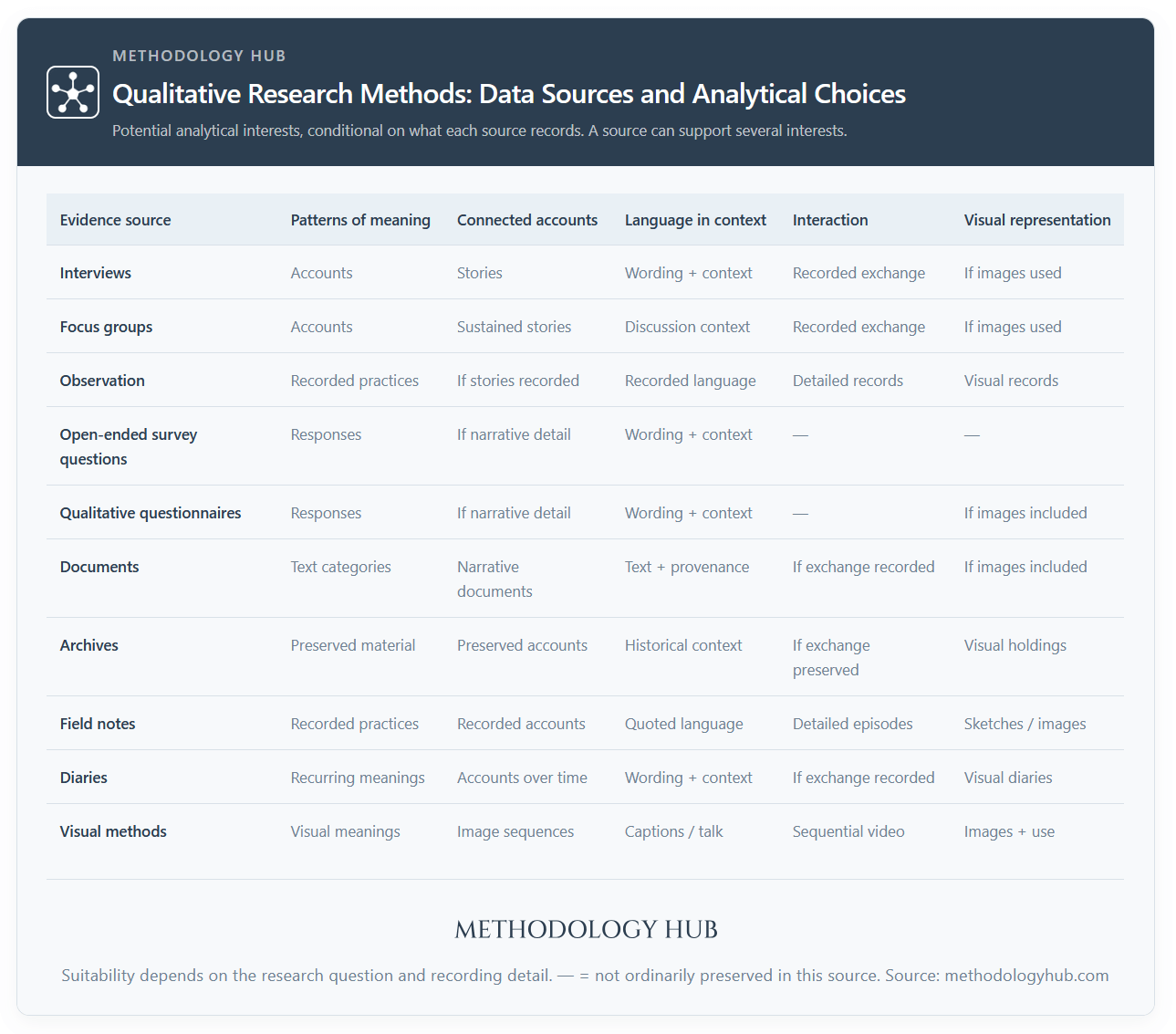
Collection and analysis need to fit together. The same material can support several analytical methods, but each requires particular kinds of detail. Choosing an interview, observation or document source therefore leaves a further decision about what will be examined and what the findings will claim.
| Research method or source | Data produced | Potential analytical use |
|---|---|---|
| Qualitative interviews | Recorded accounts and transcripts | Thematic, narrative or phenomenological analysis |
| Focus groups | Group discussion and interaction | Thematic, discourse or interaction-focused analysis |
| Qualitative observation | Records of action and setting | Analysis of practices, patterns or interaction |
| Open-ended survey questions | Written responses | Content or thematic analysis where detail permits |
| Qualitative questionnaires | Connected sets of written accounts | Within-case and cross-case interpretation |
| Document analysis | Selected documents and contextual records | Content, discourse or other textual analysis |
| Archival research | Historically situated records | Narrative, discourse or contextual comparison |
| Field notes | Researcher-produced descriptions and reflections | Interpretation of practices and situated experience |
| Diary methods | Repeated accounts over time | Thematic, narrative or temporal comparison |
| Visual methods | Images, video and accompanying accounts | Visual, multimodal or thematic interpretation |
Qualitative Interviews
The accounts produced through qualitative interviews can be compared across participants or examined in depth within a case. An interview intended for narrative analysis needs room for connected telling. An interactional analysis also needs the interviewer’s contributions, since questions and responses shape the account being interpreted.
Focus Groups
Focus-group analysis can examine shared meanings while retaining disagreement and the way positions develop through discussion. Treating every statement as an independent response loses the group interaction. Where agreement is analytically relevant, inspect how it was reached and whether other participants challenged, qualified or simply did not respond to it.
Qualitative Observation
Observation provides evidence about activity in context, including routines, spatial arrangements and relationships between participants. Analysis can compare practices across occasions or investigate how actions unfold. Field records support claims about what was observed; attributing motives generally needs further evidence rather than an inference from behaviour alone.
Open-Ended Survey Questions
Written survey responses often support content analysis or a focused thematic analysis. The depth of the answers sets limits on interpretation, especially when follow-up is unavailable. Compare responses in relation to the prompt that produced them, and avoid treating missing detail as evidence that an experience or concern was absent.
Qualitative Questionnaires
A qualitative questionnaire uses open questions to elicit written accounts, potentially offering more sustained material than a single open-ended survey item. Responses can be read together within each participant’s record before comparison across respondents. Preserve that connection when later answers qualify or explain earlier ones.
Qualitative Document Analysis
Documents require attention to authorship, intended audience, purpose and conditions of production. Their content can be categorised, their arguments examined or their language studied as institutional action. Qualitative document analysis can include selecting and appraising documents as well as interpreting them, so its collection and analytical functions should be made clear.
Archival Data
Archival records carry the selection decisions of the people and institutions that produced and preserved them. Analysis should consider provenance, historical terminology and gaps in the collection. Comparing documents across periods requires attention to changing conventions of record keeping; an absent record does not necessarily establish an absent practice.
Field Notes
Field notes combine selective observation with the researcher’s descriptions and early interpretations. Distinguishing these elements helps later analysis assess how a claim developed. Notes can be compared across settings or occasions, with attention to the observer’s position, access and decisions about what to record.
Diary Methods
Material collected through diary methods supports interpretation of changing accounts as well as recurring concerns. Read entries in sequence before pooling passages across participants. The timing of an entry, the diary prompt and gaps between entries help establish what kind of temporal comparison is warranted.
Visual Methods
Photographs, drawings and video can be analysed for their visual properties and for the explanations participants attach to them. Distinguish what an image depicts from how it is interpreted or used. When combining visual and verbal evidence, explain how each contributes instead of treating the image as decoration for an interview quotation.
Inductive, Deductive, and Abductive
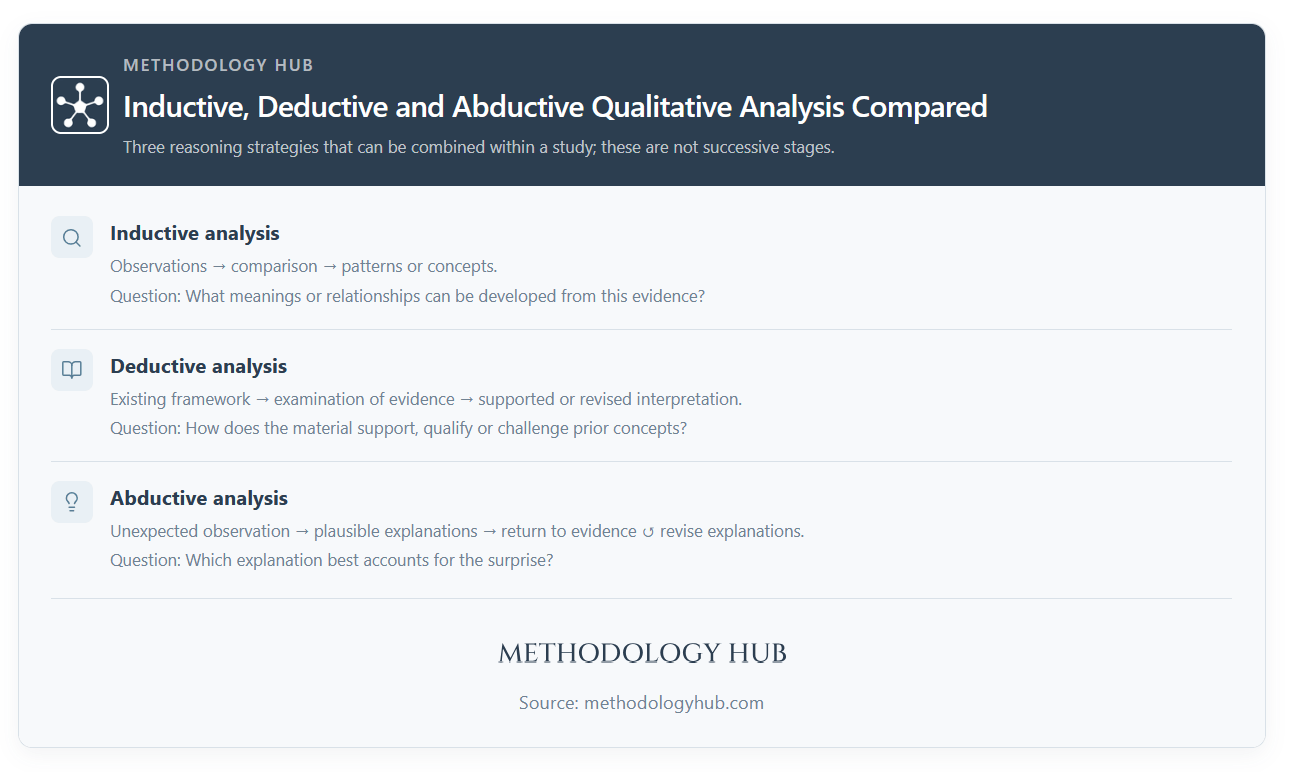
Induction, deduction and abduction describe ways of reasoning, rather than three additional methods competing with thematic or narrative analysis. Their role concerns the relationship between evidence, existing ideas and a developing explanation. A study can move between them as its understanding changes.
Inductive Analysis
Inductive analysis develops categories, patterns or concepts through engagement with the material. Researchers begin with a question but avoid imposing a complete set of answers in advance. Their disciplinary knowledge still shapes attention: induction does not require having no prior ideas. The task is to remain responsive when evidence suggests a different interpretation.
Deductive Analysis
Deductive analysis uses an existing theory, model or framework to guide examination. Its concepts help specify what to look for and how to organise relevant material. The framework must still face the evidence. Record passages that resist its categories and consider whether the difficulty reflects the framework, the interpretation or the available data.
Abductive Analysis
Abductive analysis develops a plausible explanation for something unexpected. The researcher considers alternative interpretations, returns to relevant theory and asks what additional evidence would distinguish the possibilities. The resulting explanation remains open to revision. Abduction involves reasoning through a puzzle, rather than simply relabelling any combination of induction and deduction.
Combining Analytical Strategies
A study can begin with theoretical concepts, develop additional categories inductively and use abduction when neither provides an adequate explanation. Describe these movements clearly enough for readers to see where an interpretation came from. The reasoning strategy should remain compatible with the chosen analytical tradition.
- Record which concepts were brought into the analysis from existing scholarship.
- Distinguish categories developed through reading from those specified beforehand.
- Explain how unexpected evidence changed the interpretation or prompted further inquiry.
Steps in Qualitative Analysis
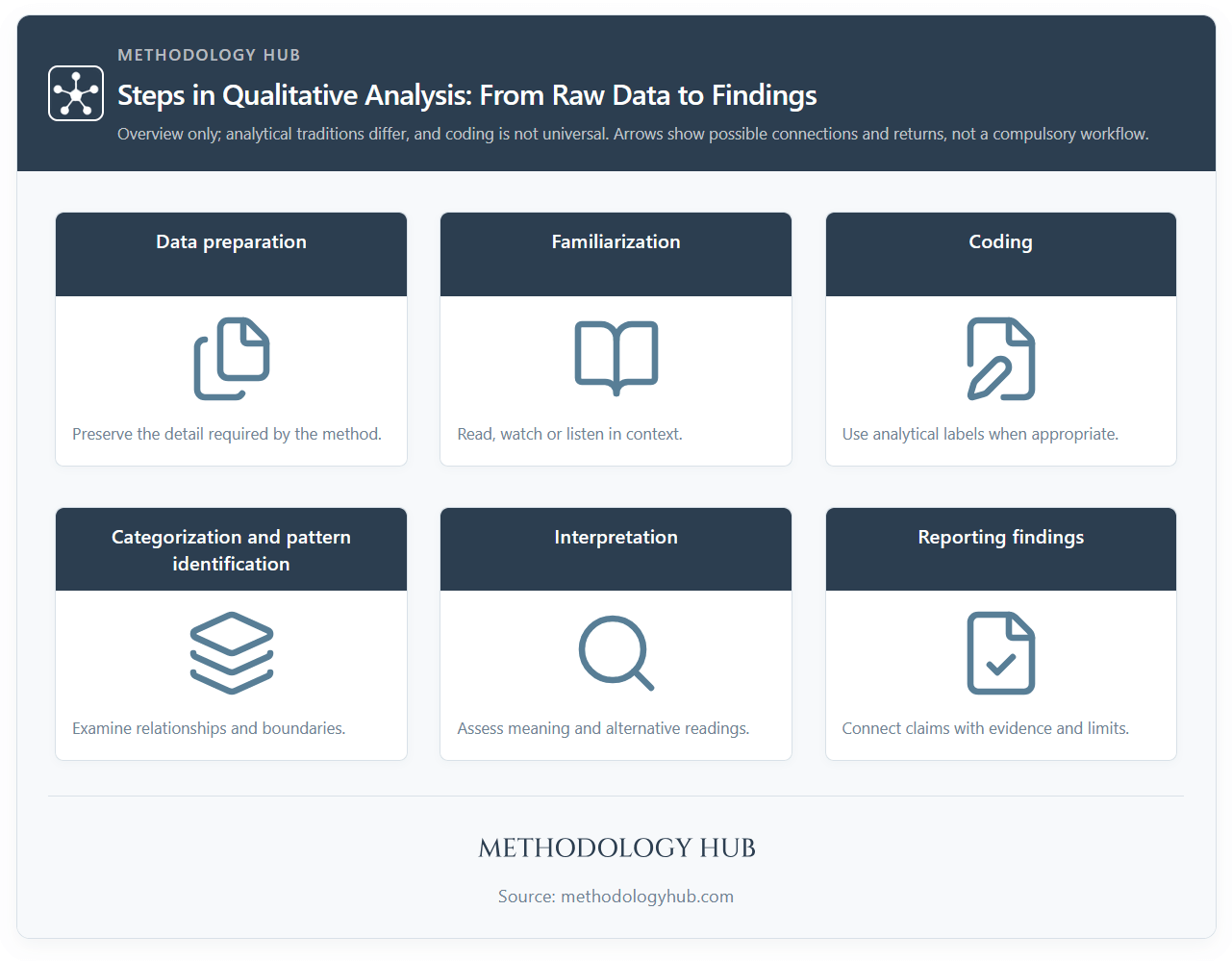
Many studies involve preparation, familiarization, coding, pattern development, interpretation and reporting. These activities overlap and are revisited as understanding develops. They provide a broad orientation; narrative, phenomenological and interactional traditions organise analytical work differently and do not all follow a coding-to-themes sequence.
Data Preparation
Prepare material in a form that preserves relevant evidence and its connection to the source. Transcription, document organisation and recording checks depend on the method. Decisions about what to retain already affect what the researcher will be able to interpret.
Familiarization
Reading, listening or viewing develops an understanding of the material as a whole. Note uncertainties and initial observations while attending to the setting and circumstances of production. Early impressions guide further examination but remain provisional.
Coding
Where coding is appropriate, labels mark features relevant to the analytical question. Codes can support retrieval, comparison and conceptual development. Some traditions instead prioritise detailed sequential or whole-case interpretation, so coding every passage is not a universal requirement of qualitative analysis.
Categorization and Pattern Identification
Compare relevant material to examine similarities, differences and relationships. Categories may organise related content, while themes can express a broader pattern of meaning. Neither develops adequately through sorting alone: the researcher must establish what the grouping explains and where its boundaries lie.
Interpretation
Connect the analysis to the research question and consider competing readings. Explain how particular features support the proposed claim, including qualifications and contradictions. Interpretation can reveal relationships that a descriptive summary leaves unexplained, but it must remain accountable to the evidence.
Reporting Findings
Present findings with the excerpts, descriptions or visual material needed to assess them. Explain analytical decisions and distinguish participant accounts from researcher interpretations. Writing often exposes gaps that require further reading. Detailed procedures for these activities belong within qualitative data analysis.
Qualitative Analysis Examples
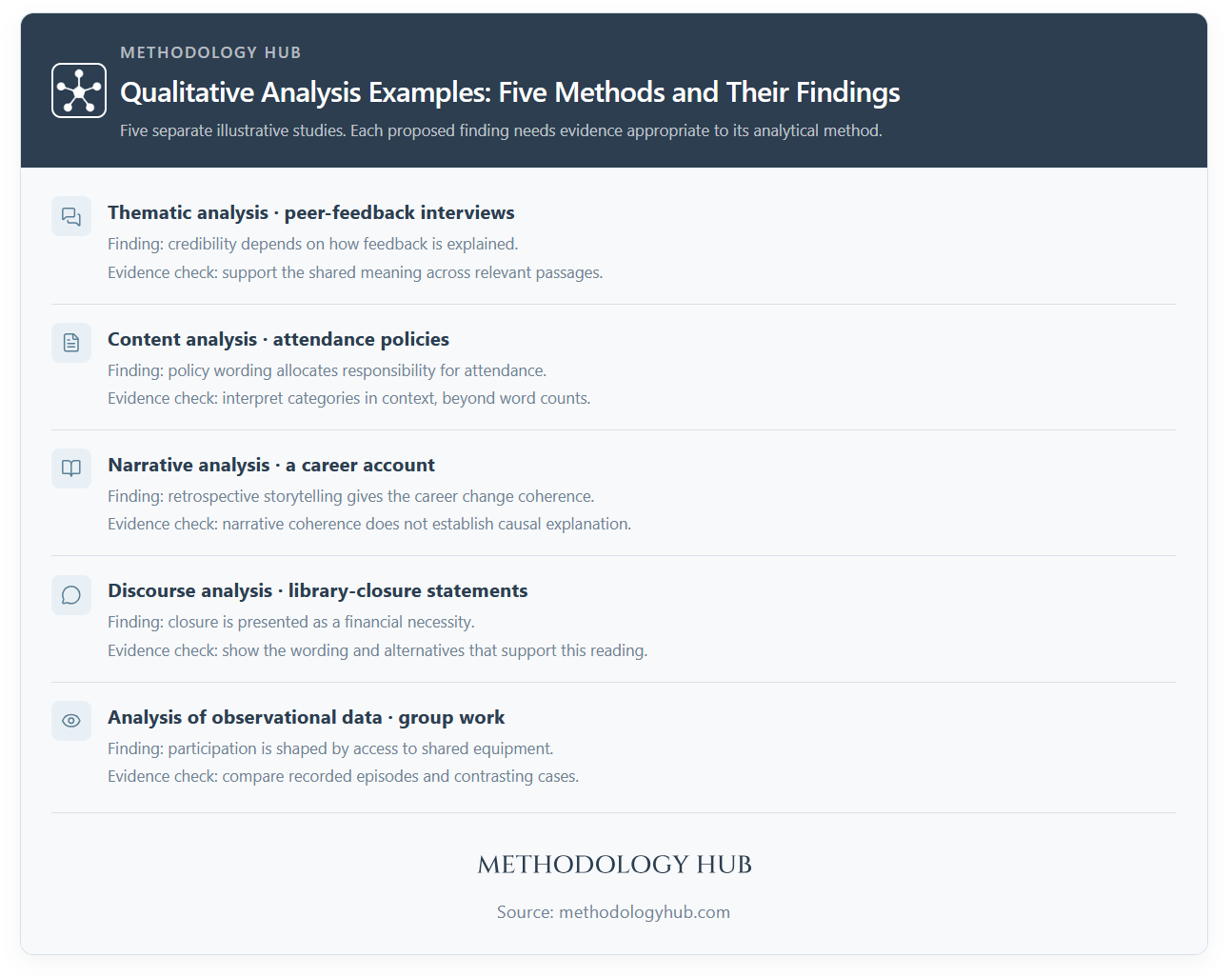
The examples below show how an analytical finding goes beyond naming a topic. Each connects a research question with a particular kind of evidence and a claim to examine. The method changes what the researcher attends to and how the finding is expressed.
Thematic Analysis of Interviews
In interviews about peer feedback, students might describe setting aside vague praise while acting on comments that explain a reader’s confusion. A thematic interpretation could connect these accounts through the idea that feedback gains credibility when the reader makes their reasoning visible. The finding explains how comments acquire authority within the exchange.
Other accounts may give greater weight to a friend’s opinion regardless of the explanation supplied. That difference could qualify the theme or reveal another pattern around familiarity. Comparing these readings establishes whether the proposed theme adequately explains the relevant interviews.
Content Analysis of Documents
An analysis of school attendance policies could compare categories covering family responsibilities, school responsibilities and available assistance. The wording may specify what families must do in detail while leaving institutional commitments less precise. That difference supports an interpretation of how responsibility is represented in the documents.
Counting mentions alone would miss whether a responsibility is mandatory, optional or merely acknowledged. The researcher would inspect the wording and document context before drawing a conclusion. Policy text also cannot establish how staff and families actually act without additional evidence.
Narrative Analysis of Personal Experiences
A graduate explaining a career change may begin with a chance conversation, return to an earlier period of uncertainty and finish by describing the new direction as inevitable. Narrative analysis can examine how this sequence gives coherence to a disrupted trajectory. The opening event receives significance through the later telling.
That interpretation does not prove the conversation caused the career change. Other passages may describe financial constraints or unresolved doubts. Keeping them within the account prevents the analysis from turning a complicated history into a simple story of personal discovery.
Discourse Analysis of Communication
At a public meeting about a library closure, speakers might repeatedly present the decision as financially unavoidable. Discourse analysis could examine how this formulation limits which alternatives appear reasonable and positions disagreement as a failure to accept practical constraints. The evidence lies in wording, argument structure and responses within the meeting.
The analysis would need to examine challenges to that position as well. Describing a justification does not establish that every speaker accepted it or that financial pressures were unreal. The claim concerns how the proposal was presented and contested in communication.
Analysis of Observational Data
Field notes from group work might show that the person holding shared equipment repeatedly determines who contributes next. Comparing several episodes could support an interpretation that access to materials helps organise participation. This finding connects an observed arrangement with the sequence of activity.
It does not establish that quieter participants lack interest. Other observations may show them taking active roles when equipment changes hands. The researcher needs to examine those variations before deciding how widely the proposed relationship holds within the observed setting.
Advantages and Limitations
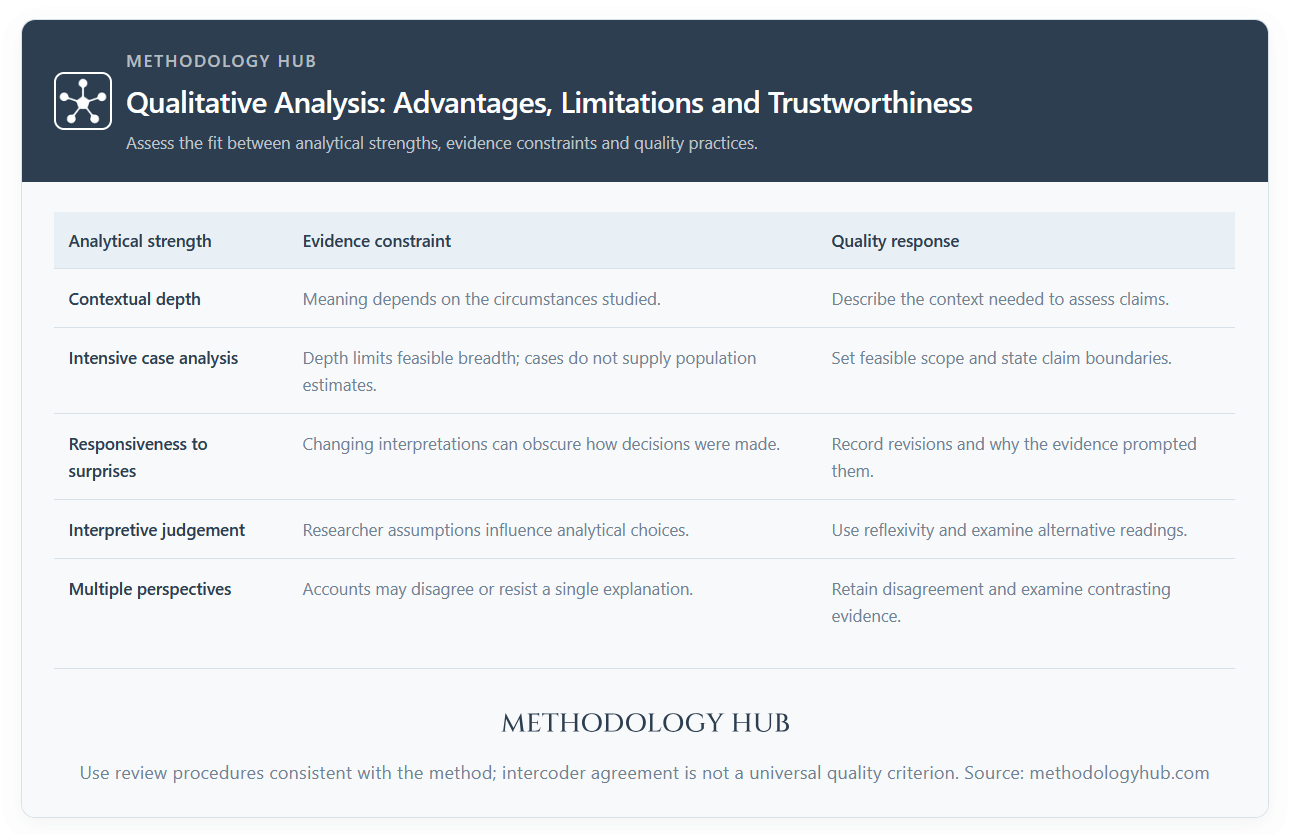
Qualitative analysis offers detailed interpretations of experience and social activity, but its conclusions depend on the evidence available and the way it was examined. An advantage becomes useful only when the study makes the analytical decisions needed to support it.
Advantages
Qualitative analysis can explain how people understand situations, how practices develop and how social meanings are maintained or contested. Its attention to context allows a study to examine relationships that predefined measures may miss. Close analysis can also identify concepts that later research investigates across other settings or with different methods.
Limitations
A purposively selected dataset does not normally support statistical estimates for a population. Findings may still contribute to theory or inform understanding in other settings, but those extensions need justification. Uneven records, limited access and selective recall can also constrain analysis. The report should make clear which questions the material could not answer.
Researcher Bias and Reflexivity
Researchers bring knowledge, expectations and social positions to interpretation. Reflexivity examines how these influence attention, relationships and analytical choices. A useful reflexive record shows the consequences of an assumption and any resulting change in interpretation. A general statement acknowledging subjectivity leaves those decisions unexplained.
Reflexivity also allows researchers to distinguish informed interpretation from an unsupported preference. Reviewing contradictory evidence and discussing alternative readings can expose assumptions that have gone unexamined. Agreement among researchers is not automatically proof of quality, especially where the method treats interpretation as situated and open to more than one defensible reading.
Quality and Trustworthiness
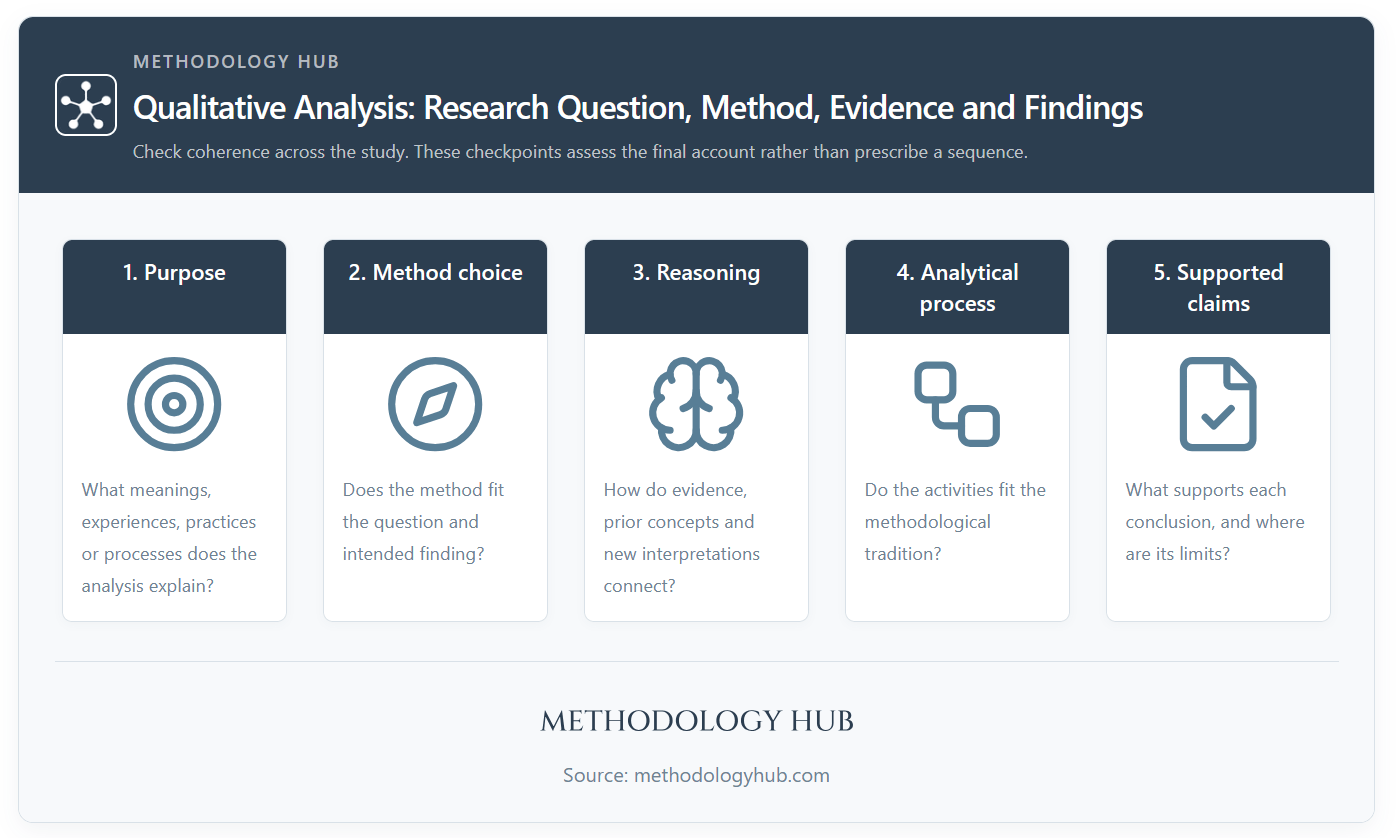
Quality depends on a coherent connection between the question, method, evidence and claims. Credibility concerns whether the interpretation is convincing and adequately supported. Detailed contextual reporting helps readers judge transferability; an account of analytical decisions supports scrutiny of how findings developed. These ideas need to be applied in ways compatible with the methodological tradition.
- Show the material supporting each substantial analytical claim.
- Examine contrasting cases and explain how they affect the interpretation.
- Record consequential decisions, including changes to categories or explanations.
- Use review procedures that fit the method's assumptions about knowledge and interpretation.
Triangulation can compare sources or perspectives, but disagreement may be informative rather than a defect to eliminate. Participant feedback can offer another interpretation without serving as a final verdict on every claim. Coding agreement is appropriate in some traditions; it is not a universal requirement for qualitative research.
Conclusion
Qualitative analysis offers several ways to interpret research evidence. Choosing among them requires attention to what the study asks, what its material preserves and what kind of finding it aims to produce. Thematic patterns, narrative interpretations and explanations of interaction answer different analytical questions.
A convincing study makes those choices visible and follows them through. Its findings explain what the evidence supports, account for relevant differences and leave unresolved questions open where the available material cannot settle them.
Cite this article
Whether you are preparing course materials, writing an academic paper, or sharing resources with students, we kindly ask that you acknowledge Methodology Hub as the source.
To make referencing easier, you can use the “Cite this page” tool below to automatically generate a citation in your preferred referencing style, including APA, MLA, Chicago, Harvard, and others. Simply select a citation style and click the generated reference to copy it.
When reproducing images, figures, or other materials from this page, please include an appropriate source credit and a link to the original page. Proper attribution helps others locate the original material and supports the continued development of freely accessible educational resources.