Qualitative coding assigns short labels to relevant passages, actions or other features of research material. These labels help researchers compare evidence and develop interpretations. Coding is a practical and analytical component of qualitative analysis.
Researchers can code interview transcripts, field notes, documents, images and recordings. The choice of coding technique depends on the research question, methodology and kind of insight sought.
This article explains qualitative coding, its main coding techniques, how to choose and refine codes, and how coding works in a complete example.
What Is Qualitative Coding?
Qualitative coding is the process of assigning meaningful labels to selected parts of research material. A code identifies something the researcher wants to examine, such as a topic, action, belief or relationship. Coding makes it easier to retrieve comparable material and investigate what it means.
Definition of Qualitative Coding
Coding combines selection with interpretation. Researchers decide which segment to examine, what feature to label and how that label relates to the study’s question. A segment might be a few words, a whole exchange, an observed action or part of an image.
Highlighting material without deciding what the highlight represents provides little analytical guidance. A useful code has a clear meaning, even when that meaning remains provisional and changes during later comparison.
Purpose of Qualitative Coding
Qualitative coding helps researchers organise a dataset, compare accounts and examine patterns or differences. It can support description, interpretation, evaluation or theory development. Its purpose depends on the study: the same passage can be examined for its topic, an action it describes or an assumption it expresses.
Coding is one component of qualitative data analysis. The wider process also includes preparing material, understanding context, developing interpretations and reporting findings. A well-organised code list is an intermediate analytical resource.
What Is a Code in Qualitative Research?
A code is usually a word or short phrase attached to a segment because it captures a relevant feature. Researchers may write the label themselves or preserve a participant’s wording. Codes can stay close to an explicit statement or propose a more interpretive meaning.
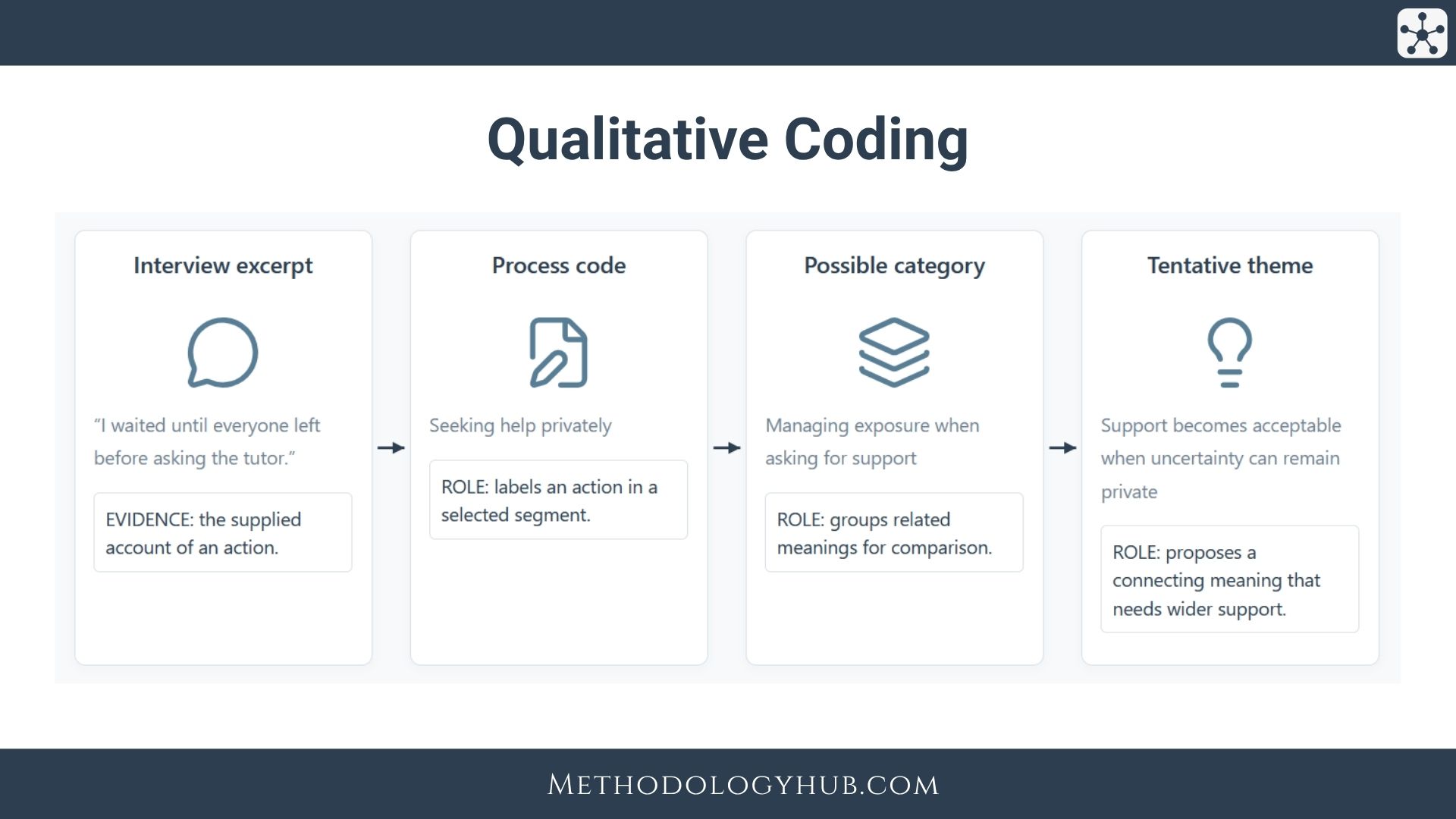
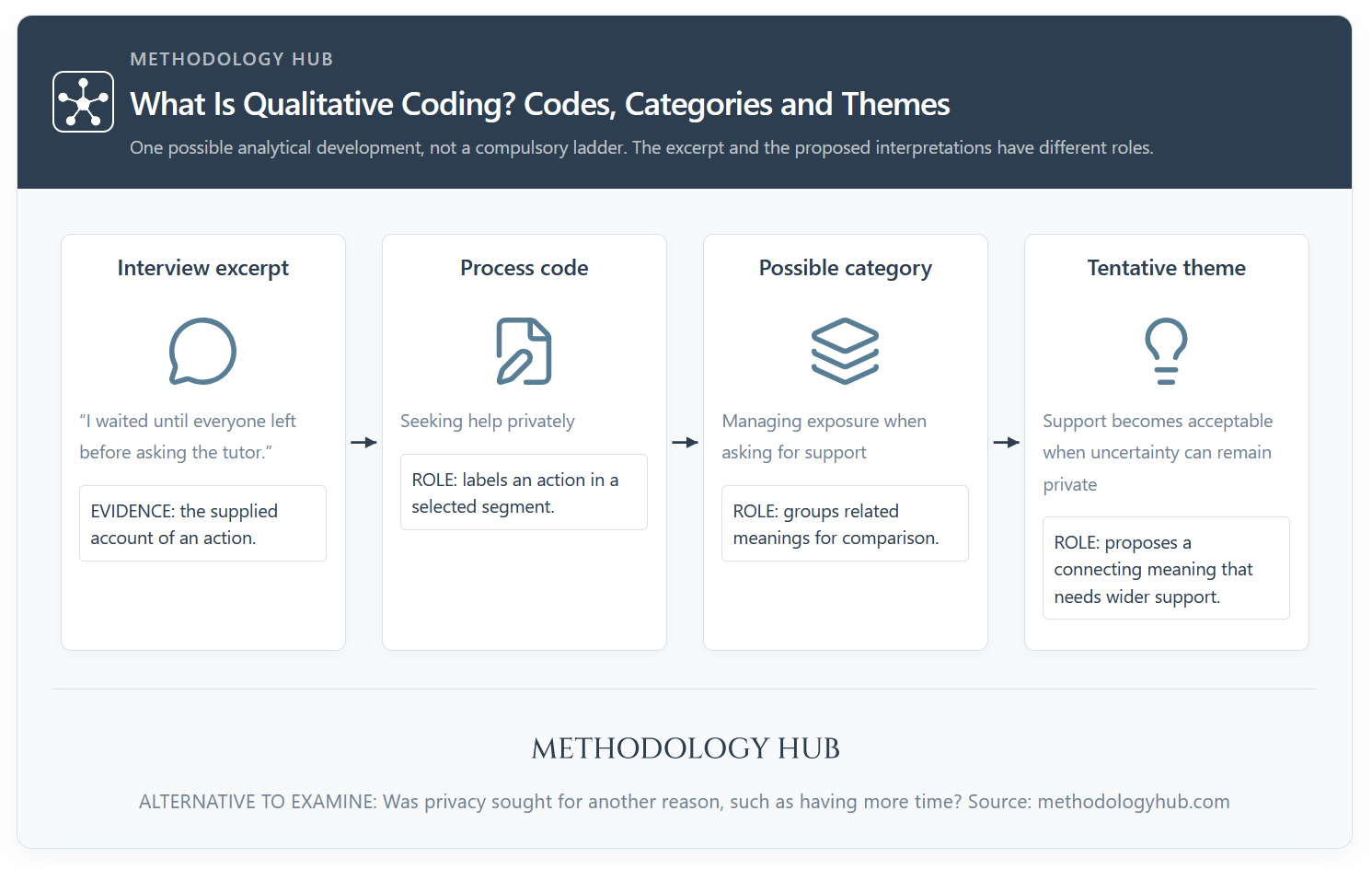
Turning an interview excerpt into a code
Illustrative excerpt: “I waited until everyone left before asking the tutor.”
Possible process code: seeking help privately.
Analytical question: Does privacy protect the student from embarrassment, allow more time, or serve another purpose? The excerpt alone does not settle that question.
Codes, Categories, and Themes
Codes identify features of particular segments. Categories organise related codes or concepts for a broader analytical purpose. Themes develop patterned meanings relevant to the research question, although their definition varies between methodologies.
| Analytical element | Main role | Illustrative form |
|---|---|---|
| Code | Label a relevant feature of a segment. | Seeking help privately. |
| Category | Organise related codes or develop a broader concept. | Managing exposure when asking for support. |
| Theme | Interpret a patterned meaning across the material. | Support becomes acceptable when uncertainty can remain private. |
This is a possible analytical development, rather than a compulsory ladder. Some analyses develop categories without themes. Others develop themes directly through engagement with coded material. Renaming a broad topic as a theme does not by itself create an interpretation.
Coding in Different Qualitative Methodologies
Grounded theory uses coding to develop conceptual categories and theoretical relationships. In thematic analysis, coding contributes to developing patterns of meaning. Other approaches may code narratives, interactional features or documentary content according to different analytical commitments.
Some qualitative studies use limited coding or organise their analysis differently. The technique must serve the methodology. Applying the same coding procedure to every kind of inquiry can remove features, such as sequence or interaction, that the analysis needs to preserve.
Coding by Analytical Reasoning
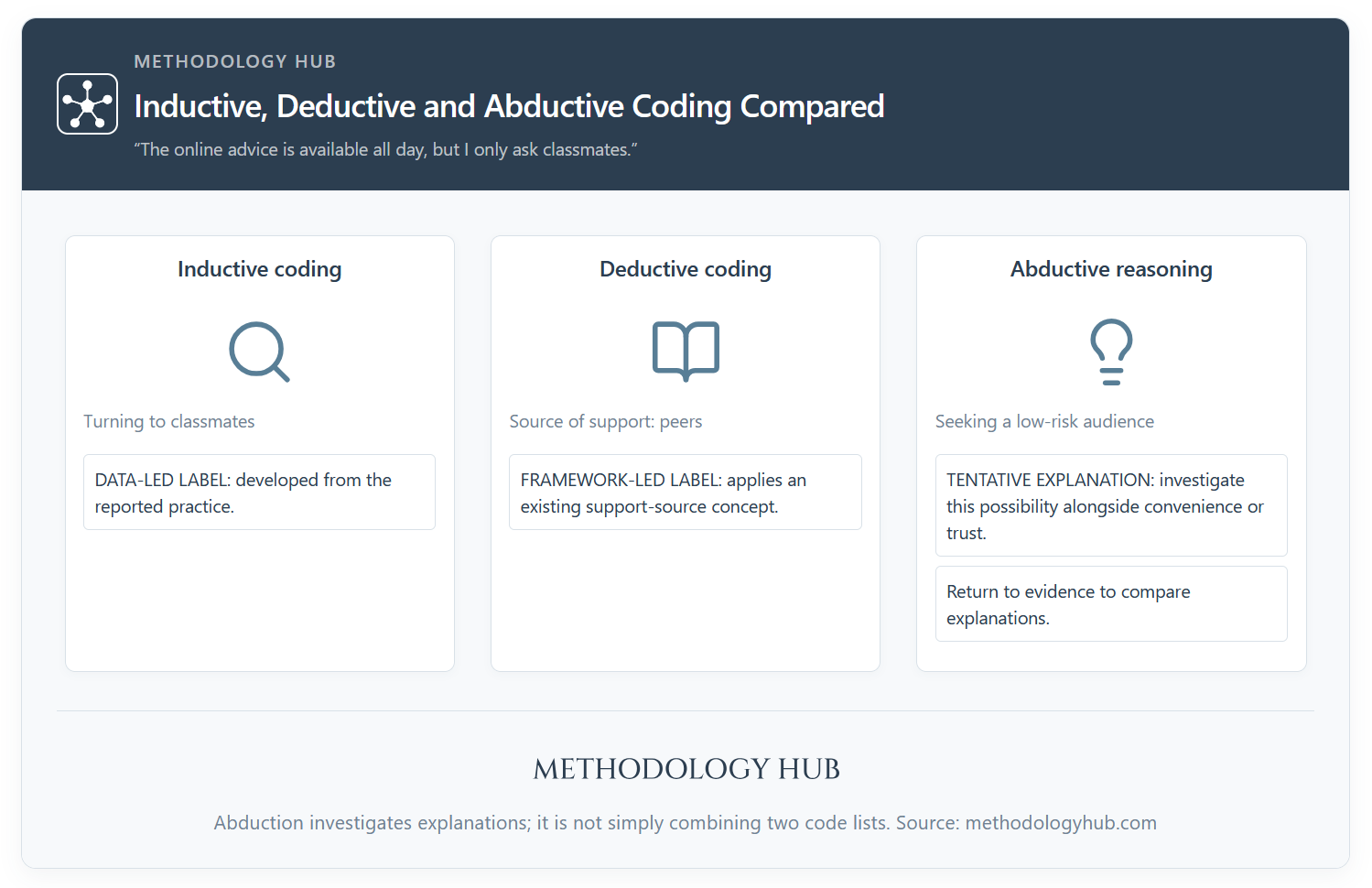
Inductive, deductive and abductive coding describe how researchers relate evidence to concepts and explanations. Inductive coding draws labels from close examination of material. Deductive coding applies concepts selected beforehand. Abductive analysis investigates surprising observations by considering and examining possible explanations.
Inductive Coding
Inductive coding develops codes primarily from the material being studied. Researchers compare segments, propose labels and revise them as their understanding grows. It is useful when an existing framework offers limited guidance or the inquiry needs to remain open to unanticipated meanings.
For example, “We ask each other before contacting the lecturer” might be coded as checking with peers first. The label comes from examining the reported action. Inductive work still involves prior knowledge and researcher judgement; it does not begin from an entirely empty perspective.
Deductive Coding
Deductive coding uses concepts established before examining a particular segment. These may come from theory, earlier research, an evaluation framework or the research question. It helps researchers investigate specified issues systematically across a dataset.
Using a framework of practical and social support, “My classmate explained the assignment” could receive informational support. The researcher must still check whether the definition fits. Material that falls outside the framework may require a new code, a revised definition or separate analytical attention.
Abductive Coding
Abductive coding contributes to a wider reasoning process that asks what could explain an unexpected observation. Researchers move between evidence and theoretical ideas, developing and comparing possible explanations. It is especially useful when an established interpretation leaves a puzzling case unresolved.
If a student reports avoiding a free support service despite needing help, the analyst might tentatively code protecting a competent identity. That interpretation would require comparison with alternatives, including inconvenient opening hours or previous negative encounters. Abduction develops a plausible explanation for investigation; the tentative label is not proof.
| Reasoning strategy | Starting emphasis | Main analytical question |
|---|---|---|
| Inductive | Features encountered in the research material. | What relevant meanings or actions can be identified here? |
| Deductive | Existing concepts or specified analytical concerns. | How does this material relate to the proposed concepts? |
| Abductive | A surprising observation and possible explanations. | What could account for this finding, and how can alternatives be examined? |
Three analytical strategies applied to one excerpt
Excerpt: “The online advice is available all day, but I only ask classmates.”
Inductive: turning to classmates identifies the reported practice.
Deductive: source of support: peers applies a pre-established support framework.
Abductive: seeking a low-risk audience proposes one explanation to investigate alongside alternatives, such as greater convenience or trust.
These strategies can interact within a study. Researchers should explain how concepts entered the analysis and what evidence prompted revision. Combining inductive and deductive codes alone does not establish an abductive analysis.
First-Cycle Coding Techniques
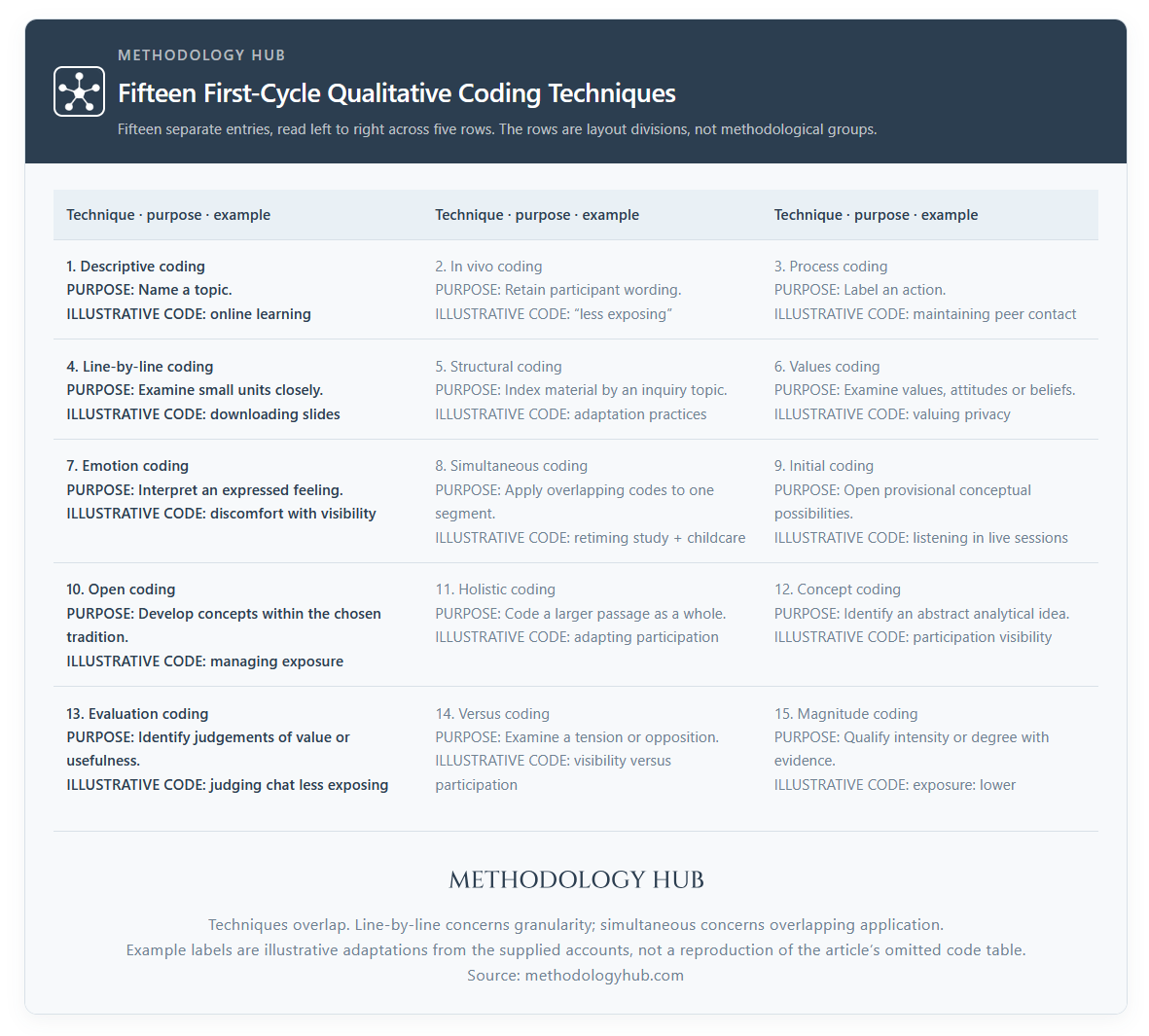
First-cycle coding techniques help researchers examine research material during early analytical work. Some label topics or actions; others preserve wording, identify emotions or control how much material is coded at once. They can overlap and should not be treated as fifteen mutually exclusive methods.
Johnny Saldaña’s The Coding Manual for Qualitative Researchers uses coding cycles to distinguish early engagement from later analytical reorganisation. The distinction is a useful planning aid, with movement between activities as the analysis develops. Line-by-line coding describes granularity, simultaneous coding describes overlapping application, and initial or open coding can encompass several ways of labelling material.
Descriptive Coding
Descriptive coding summarises a segment’s basic topic, usually with a noun or short noun phrase. Its main purpose is to identify what the material concerns and make related passages easy to retrieve. It is useful for an early overview of interviews, observations or documents.
“The bus stops running before the evening seminar ends” could receive transport availability. This records the topic. Later analysis might investigate how transport affects attendance, but the descriptive code alone does not explain that relationship.
In Vivo Coding
In vivo coding uses a participant’s exact words as the code. It preserves expressions that may carry distinctive meanings, local knowledge or important ways of describing experience. Researchers often use it when participants’ language deserves close analytical attention.
For “I felt like a visitor in my own class,” the code could be “a visitor in my own class”. Keep the wording exact and retain its context. A vivid phrase still needs comparison before it can support a broader interpretation.
Process Coding
Process coding identifies actions, interactions or developing responses, often using an “-ing” form. It helps researchers investigate what people do, how they respond and how activities unfold. It is useful for studies of routines, adaptation and social processes.
“I checked the instructions, then asked a friend to read my draft” could receive checking requirements and seeking reassurance. The first stays close to the reported action; the second proposes a purpose that needs support from surrounding material.
Line-by-Line Coding
Line-by-line coding examines small portions of material in close succession. Its purpose is to slow interpretation and notice details that a broad reading might miss. The codes themselves may be descriptive, process-oriented, in vivo or otherwise interpretive.
For two lines, “I typed a question” and “Then I deleted it,” possible codes are preparing to ask and withdrawing a request. Researchers should read the surrounding exchange as well. Transcript line breaks are formatting choices, so they need not determine meaningful segment boundaries.
Structural Coding
Structural coding indexes material according to a research question, interview topic or other organising concern. It helps researchers locate all passages addressing a particular issue before undertaking closer analysis. It is especially useful for organising comparable sections across a large interview dataset.
A response about accessing student advice might receive accessing support. That code identifies its relevance to a research topic. More detailed codes can then distinguish waiting, eligibility, trust or other features within the indexed material.
Values Coding
Values coding examines values, attitudes and beliefs expressed in the material. Values concern what someone regards as important; attitudes express an orientation towards something; beliefs concern what the person takes to be true. Researchers use it to investigate commitments and perspectives.
“Everyone should have a chance to speak” might receive value: equal participation. “Only confident students are heard” could receive belief: confidence determines recognition. Keep these distinctions visible rather than assigning every opinion the same general values label.
Emotion Coding
Emotion coding identifies feelings expressed by participants or interpreted from relevant evidence. It can help researchers examine how emotional experiences relate to events, actions or relationships. Interview accounts, diaries and observations may all provide suitable material.
“I was relieved when the tutor replied” supports relief. A pause or a brief response alone does not establish embarrassment or anxiety. Where an emotion is inferred, record the grounds for that interpretation and remain open to a different reading.
Simultaneous Coding
Simultaneous coding applies more than one code to the same segment because it contains multiple relevant features. Its purpose is to preserve analytical complexity rather than force a passage into one exclusive label. It can combine codes from different techniques.
“I was worried, so I asked my sister to check it” could receive worry and seeking family reassurance. Each label captures something distinct. Apply overlapping codes deliberately; attaching every potentially related code makes retrieval less informative.
Initial Coding
Initial coding develops provisional labels during close early engagement with the material. In Charmaz’s constructivist grounded theory, it commonly attends to actions and processes while keeping interpretations open. It helps researchers identify analytical possibilities to investigate through comparison.
“I watched others before joining the discussion” might receive learning participation rules. The code suggests an action and possible meaning. Later material may show that the student was assessing safety, waiting for an opening or doing something else, requiring refinement.
Open Coding
Open coding breaks material into analytically useful parts and develops possible concepts, properties or distinctions. It is prominent in classic and Straussian grounded theory, although its role differs between those traditions. Researchers use it to open up inquiry before settling on a conceptual organisation.
An account of asking different people for advice could generate availability of guidance and trust in the source. Comparison might then clarify how each varies. Open coding is broader analytical work; it need not mean assigning a new code to every sentence.
Holistic Coding
Holistic coding applies a broad code to a substantial passage or complete unit of material. It provides an initial sense of the whole before detailed examination. Researchers may use it to orient themselves within long accounts or organise material for later analysis.
A page describing a student’s first week might receive adjusting to university. This identifies its overall focus while preserving the extended account. Closer coding may still be needed to distinguish the relationships or contrasting experiences within it.
Concept Coding
Concept coding assigns a label that captures a more abstract idea expressed through the material. Its purpose is to move beyond naming an object or activity towards interpreting its broader significance. It can be useful early in an analysis when a meaningful concept is already apparent.
“They ask for our views after the decision is final” could receive token participation. That label interprets the relationship between consultation and influence. The analyst should check whether the evidence supports it instead of treating an appealing theoretical term as self-explanatory.
Evaluation Coding
Evaluation coding identifies judgements about the quality, value, effectiveness or consequences of something being examined. It is useful in research evaluating educational activities, community programmes or public services. Codes may capture strengths, weaknesses, needs or recommended changes.
“The workshop was clear, but there was no time to practise” could receive clear explanation and insufficient practice time. These codes preserve both parts of the appraisal. Record whether the judgement comes from a participant, a specified evaluation criterion or the researcher’s assessment.
Versus Coding
Versus coding identifies conflicts, tensions or opposing interests represented in the material. It helps researchers examine competing priorities, identities or positions. It can be useful when participants describe dilemmas or contested relationships.
“Finishing quickly means leaving some classmates behind” could receive pace versus inclusion. The code names a tension to investigate. It should not imply that the priorities are always incompatible or that every participant accepts this opposition.
Magnitude Coding
Magnitude coding adds a symbol or other marker indicating intensity, frequency, direction or another relevant degree. It supplements a substantive code so researchers can compare variation systematically. It is useful when those distinctions have a clear basis in the evidence and coding rules.
“I felt slightly anxious before speaking” might receive anxiety: low expressed intensity. Define what that marker means and how uncertain cases are handled. A coded degree is not automatically a validated psychological measurement.
| Technique | Main purpose | Example code | Suitable application |
|---|---|---|---|
| Descriptive | Identify a passage's topic. | Transport availability. | Early topical overview. |
| In vivo | Preserve participant wording. | “a visitor in my own class” | Attention to participants' expressions. |
| Process | Examine actions and responses. | Checking requirements. | Routines and adaptation. |
| Line-by-line | Examine small segments closely. | Withdrawing a request. | Detailed early engagement. |
| Structural | Index material by an organising concern. | Accessing support. | Retrieving material across interviews. |
| Values | Examine values, attitudes and beliefs. | Value: equal participation. | Studies of commitments and perspectives. |
| Emotion | Identify expressed or evidenced feelings. | Relief. | Emotional accounts and responses. |
| Simultaneous | Retain several relevant features. | Worry; seeking family reassurance. | Multi-layered passages. |
| Initial | Generate provisional analytical possibilities. | Learning participation rules. | Early constructivist grounded theory coding. |
| Open | Develop possible concepts and distinctions. | Trust in the source. | Exploratory conceptual analysis. |
| Holistic | Identify a large unit's overall focus. | Adjusting to university. | Orientation within extended accounts. |
| Concept | Capture broader analytical significance. | Token participation. | Developing abstract interpretations. |
| Evaluation | Examine appraisals and consequences. | Insufficient practice time. | Programme or activity evaluation. |
| Versus | Investigate tensions and competing interests. | Pace versus inclusion. | Dilemmas and contested priorities. |
| Magnitude | Mark a relevant degree or direction. | Anxiety: low expressed intensity. | Comparing intensity with defined rules. |
Different codes applied to one excerpt
Excerpt: “I was nervous, so I asked a friend first. It felt like a rehearsal.”
Descriptive: peer advice. Process: rehearsing a request. Emotion: nervousness. In vivo: “like a rehearsal”.
Applying the process and emotion codes to the same passage would also be simultaneous coding. The labels answer different analytical questions.
Choose techniques for the distinctions they help investigate. An early coding pass can combine close attention to wording, actions and feelings without turning each technique into a separate mandatory stage.
Second-Cycle and Advanced Coding Techniques
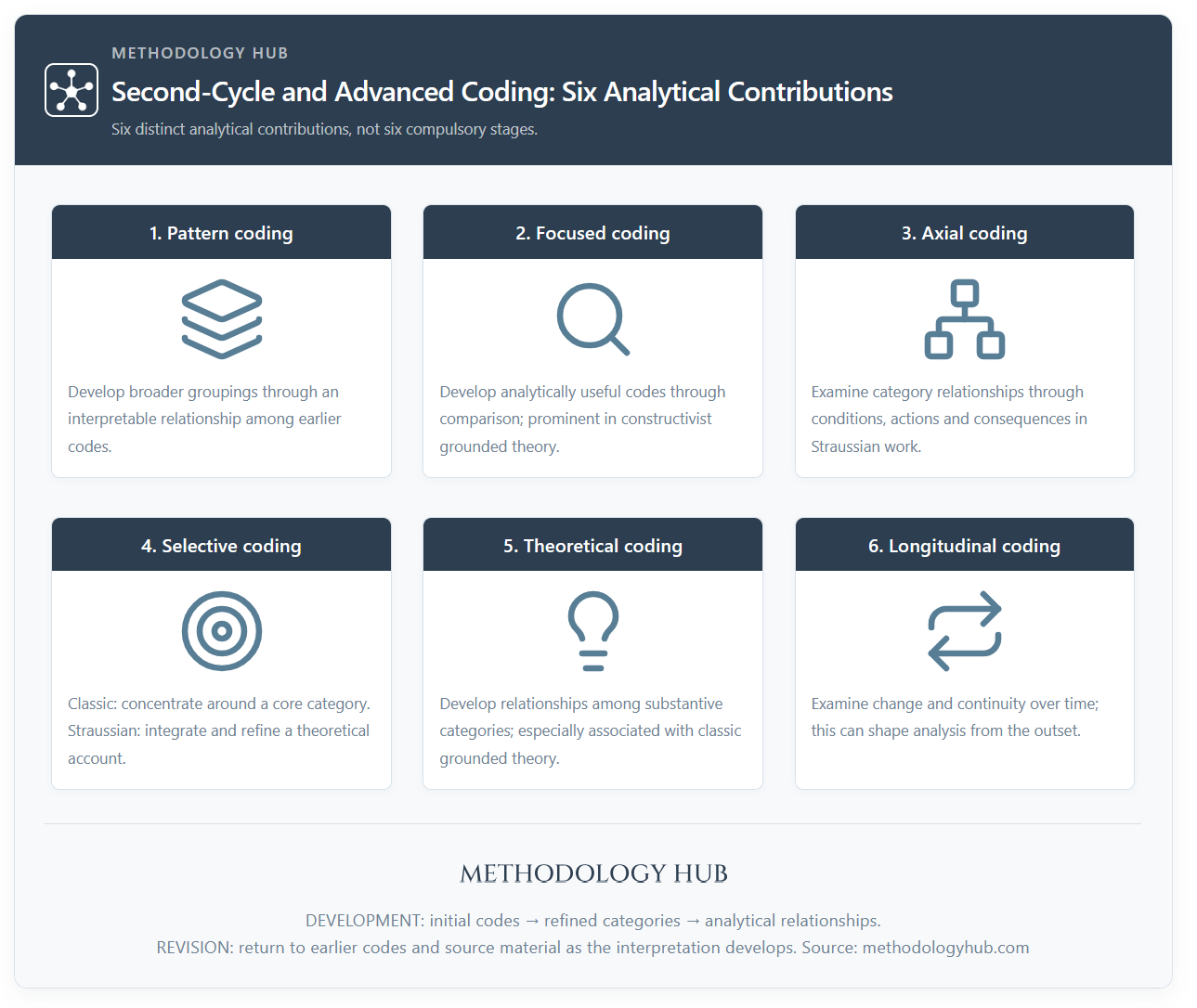
Second-cycle and advanced coding techniques refine earlier codes, develop broader concepts or examine relationships. They help researchers reorganise their analysis as understanding grows. These activities are not a universal sequence, and some, including longitudinal coding, can shape an inquiry from its beginning.
Pattern Coding
Pattern coding brings related earlier codes together under a more explanatory or organising concept. Researchers use it to investigate configurations, relationships or recurring ways that events unfold across material.
Codes such as asking peers first, drafting questions privately and waiting for an empty room might contribute to reducing the exposure of asking. Their relationship needs examination: similar actions may serve different purposes in different cases. A pattern code should clarify that relationship rather than merely replace several labels with a shorter list.
Focused Coding
Focused coding, associated especially with Charmaz, uses significant or frequent initial codes to examine larger amounts of material. It helps researchers decide which ideas offer the strongest analytical direction and develop them through further comparison.
An initial code, testing whether a question is acceptable, might become a focused code used across several interviews. Its usefulness depends on what it helps explain, including variation and exceptions. Frequency can inform selection, but the most common label is not necessarily the most illuminating.
Axial Coding
Axial coding relates categories and subcategories, particularly in influential Strauss and Corbin formulations of grounded theory. It asks how properties, conditions, actions or interactions, and consequences connect. Researchers use it when developing relational explanations.
An analysis might examine how unclear assessment expectations relate to checking with peers, and what follows from that response. Comparison must establish the proposed connection and its conditions. A category diagram can record an analytical argument; its arrows do not provide evidence by themselves.
Selective Coding
Selective coding has different roles across grounded theory traditions. In classic grounded theory, it concentrates substantive coding around an emerging core category. In influential Straussian accounts, it integrates and refines the theory around a central category.
If maintaining academic credibility becomes central, classic selective coding would direct attention towards relevant material. A Straussian formulation would emphasise connecting and refining the surrounding categories. Researchers should identify which meaning they use. These are distinct applications of a shared term.
Theoretical Coding
Theoretical coding examines how substantive categories may relate within an integrated explanation. It is especially prominent in Glaser’s classic grounded theory and is also discussed in other grounded theory writing. Researchers use it to articulate conceptual relationships supported by their analysis.
A proposed relationship might be that perceived exposure changes how students choose a source of support. The analyst would investigate when and how that relationship holds. Theoretical coding goes beyond attaching an existing theory’s name to a passage or choosing a familiar diagram in advance.
Longitudinal Coding
Longitudinal coding examines continuity, change, transitions or sequences across time. Researchers may compare repeated interviews, diary entries or observations within cases and then across cases. The temporal organisation of evidence is central to the analysis.
A participant might move from avoiding questions early in term to seeking clarification publicly later. The analyst would examine what changed and whether the shift persisted. Retrospective accounts require attention to how change is remembered. Longitudinal coding is a temporal analytical strategy, not a universally defined second-cycle step.
| Technique | Main analytical contribution | Methodological qualification |
|---|---|---|
| Pattern | Organise earlier codes into broader patterns or explanations. | A cluster needs an interpretable relationship. |
| Focused | Develop significant initial codes through wider comparison. | Especially associated with constructivist grounded theory. |
| Axial | Relate categories, conditions, actions and consequences. | Prominent in influential Straussian formulations. |
| Selective | Concentrate or integrate analysis around a central category. | Its role differs in classic and Straussian grounded theory. |
| Theoretical | Articulate relationships between substantive categories. | Especially prominent in classic grounded theory. |
| Longitudinal | Investigate continuity and change through time. | Can guide analysis from the outset. |
The detailed use of these procedures in theory development belongs in grounded theory analysis. In other methodologies, researchers may refine codes and interpret relationships without aiming to produce a grounded theory or adopting its coding vocabulary.
Refined categories should clarify what connects earlier codes. Relationships between categories may concern conditions, responses or changes over time. Explain the proposed connection and check it against evidence, returning to earlier coding where the relationship remains unclear.
Coding Management and Quality
Coding management organises code definitions, applications and revisions so researchers can examine how their analysis developed. Quality involves checking whether coding decisions support credible interpretations. Codebooks, frequency counts and reliability assessments can contribute, but their value depends on the methodology and analytical purpose.
Codebook
A codebook records codes and guidance for applying them. It commonly includes a code name, definition, inclusion criteria, exclusions and an example. Teams may use it to coordinate decisions; an individual researcher may use it to clarify boundaries and track changes.
Sample codebook entry
Code: seeking reassurance.
Definition: Asking another person to confirm that an action or understanding is acceptable.
Include: Requests that explicitly seek confirmation or express uncertainty about adequacy.
Exclude: Requests solely for factual information, unless reassurance is also evident.
Illustrative excerpt: “I knew the answer, but I wanted someone to say I was on the right track.”
A developing codebook should retain a revision record. If a definition changes, check earlier applications that may be affected. In reflexive approaches, a flexible record of evolving codes can be useful, while a fixed framework designed to establish one correct reading may conflict with the analytical position.
Code Frequency Analysis
Code frequency analysis counts applications or distributions of codes. Researchers might count coded segments, documents or participants associated with a code. Those units answer different questions and should be specified before making comparisons.
Twelve mentions from one participant differ from twelve participants each discussing an issue once. Segment length, overlapping codes, repeated interview prompts and opportunities to discuss a subject also affect counts. Frequency can direct attention towards patterns, but a rare account may expose a consequential exception. Counts require interpretation and do not establish importance or population prevalence by themselves.
Coding Reliability
Coding reliability concerns consistency in applying an agreed coding system. Where that goal fits the methodology, independent coders can apply a specified framework to common material and compare decisions. Agreement measures require explicit units, code definitions and calculation procedures.
O’Connor and Joffe’s work on intercoder reliability explains its potential contributions and methodological debates. Disagreement can reveal ambiguous definitions or differences in segment boundaries. Revising the framework and assessing a fresh sample may be appropriate, while agreement calculated after jointly resolving every decision would not represent independent agreement.
| Practice | Useful contribution | Question to keep visible |
|---|---|---|
| Codebook | Clarify definitions, boundaries and revisions. | Does the record match how coding is actually being used? |
| Frequency analysis | Examine the distribution of code applications. | What is being counted, and what affects opportunities to appear? |
| Reliability assessment | Examine consistency within an agreed coding system. | Does consistent application fit the methodology's quality aims? |
Reliability-oriented and reflexive approaches have different aims. In Braun and Clarke’s thematic analysis, multiple interpretations can support reflection and conceptual development without an agreement score. Researcher reflexivity, sustained engagement and a persuasive relationship between evidence and claims remain central. No single agreement threshold establishes quality across all qualitative methodologies.
How to Code Qualitative Data
To code qualitative data, read the material in context, identify relevant segments and assign labels that serve the research question. Then compare applications, refine the codes and examine their analytical relationships. The process usually involves returning to earlier material as understanding develops.

Prepare the Research Material
Make material usable and traceable. Give transcripts, notes or other sources stable identifiers, check their accuracy and preserve information needed to understand them. For images or recordings, decide how coded regions or time intervals will be referenced.
Become Familiar With the Data
Read or review complete sources before relying on isolated extracts. Note important contexts, differences and initial questions. Familiarisation helps identify when a brief statement depends on an earlier exchange or on information elsewhere in the account.
Choose a Coding Strategy
Decide what the coding should help investigate. Specify the reasoning strategy, useful techniques and likely segment size. These choices can remain provisional, but recording their purpose helps distinguish an analytical change from inconsistent application.
Identify and Label Relevant Segments
Select enough material to preserve the meaning you are coding. Assign a concise label and retain its source reference. For a passage with several relevant features, overlapping codes may be appropriate. Avoid treating every sentence as equally important simply because it can receive a label.
| Coding activity | Immediate objective |
|---|---|
| Prepare material | Maintain usable, accurate and traceable sources. |
| Familiarise | Understand complete accounts and their contexts. |
| Choose a strategy | Connect coding decisions with the analytical purpose. |
| Label segments | Identify relevant features without losing meaning. |
| Refine codes | Clarify distinctions and review applications. |
| Organise categories | Develop useful conceptual groupings. |
| Interpret relationships | Explain patterns, variation and exceptions. |
| Document decisions | Preserve the reasoning behind analytical changes. |
Review and Refine Codes
Compare material receiving the same label and passages receiving similar labels. Decide whether codes should merge, split, change definition or remain distinct. Revisit earlier material when a revision changes the boundary of a code. Keep an audit trail that explains the reason for important changes.
Organize Codes Into Categories
Group codes where the relationship serves the analysis. Define what connects them and what remains different. Categories may represent a topic, a process or a more abstract concept, depending on the methodology. A neat hierarchy is useful only if its organisation reflects the material and research purpose.
Interpret Patterns and Relationships
Ask what the coded material reveals about the research question. Examine differences between cases, conditions associated with a pattern and evidence that challenges it. Co-occurring codes can suggest a relationship to investigate, but their proximity does not establish causation or shared meaning.
Document Analytical Decisions
Record why a code was introduced, why its meaning changed and how an interpretation developed. Analytical memos can connect these decisions to specific sources and unresolved questions. A record is most useful when it explains judgement rather than merely listing dates and activities.
Before relying on the coded material, check the practical connections:
- Source context: Can every coded segment be traced to its complete account?
- Code meaning: Is the label clear enough for its intended analytical use?
- Revisions: Have important changes been considered across earlier material?
- Interpretation: Have differences and contradictory accounts been examined?
- Decision record: Can the reasoning behind major analytical choices be followed?
The checklist supports review rather than prescribing a fixed number of coding passes. Return to material whenever a conceptual question requires it.
How to Choose a Qualitative Coding Technique
Choose a qualitative coding technique according to what you want to understand and how the study defines knowledge. Consider the research question, methodology, material and stage of analysis together. Several techniques may be useful, provided each has a clear analytical role.
Consider the Research Question
A question about routines may benefit from process coding; a question about commitments may call for values coding. Questions about participant language may require in vivo codes and close contextual examination. Identify the feature the question asks you to investigate before choosing the label format.
Consider the Qualitative Methodology
Methodologies shape the purpose and status of codes. Coding in the different grounded theory types serves conceptual and theoretical development. Its procedures differ from coding within an evaluation framework or a reflexive thematic analysis. Naming a technique does not establish a methodology. Explain how its use supports the kind of interpretation the study aims to produce.
Consider the Type of Research Data
Interview transcripts can support attention to wording, accounts and interaction, while observations may foreground actions or settings. Repeated diaries support temporal comparison. In vivo coding requires an actual verbal expression; a researcher-written description of a photograph is not a participant’s own phrase. Preserve distinctions between observed features and inferred meanings.
| Research situation | Potentially useful techniques | Reason for the choice |
|---|---|---|
| Mapping interview topics | Descriptive and structural. | Organise and retrieve relevant material. |
| Examining participant expressions | In vivo and line-by-line. | Preserve wording and investigate detail. |
| Investigating action or adaptation | Process and pattern. | Compare actions and develop relationships. |
| Examining beliefs and feelings | Values and emotion. | Distinguish perspectives and emotional responses. |
| Evaluating an educational activity | Evaluation, with appropriate deductive codes. | Examine judgements against clear analytical concerns. |
| Investigating change over time | Longitudinal, combined with relevant substantive codes. | Compare continuity and transitions within and across cases. |
Consider the Stage of Analysis
Early analysis may benefit from provisional, detailed codes. Later work may concentrate on category boundaries, patterns or relationships. These are changes in analytical focus rather than compulsory stages. A later conceptual question may require close recoding of a passage that was previously understood too broadly.
Combining Coding Techniques
Combine techniques when they perform complementary tasks. Structural coding can index material before closer process coding. An emotion code can accompany a process code on the same segment. An inductive label can also sit within a deductively organised framework if the relationship between them is explained.
Avoiding Methodological Inconsistency
Check that combined practices rest on compatible purposes. Borrowing grounded theory vocabulary does not turn thematic coding into grounded theory. A fixed codebook intended to produce independent agreement also requires a different justification from evolving reflexive interpretation. Where a procedure is adapted, describe what it contributes and how that adaptation fits the study.
Qualitative Coding Examples
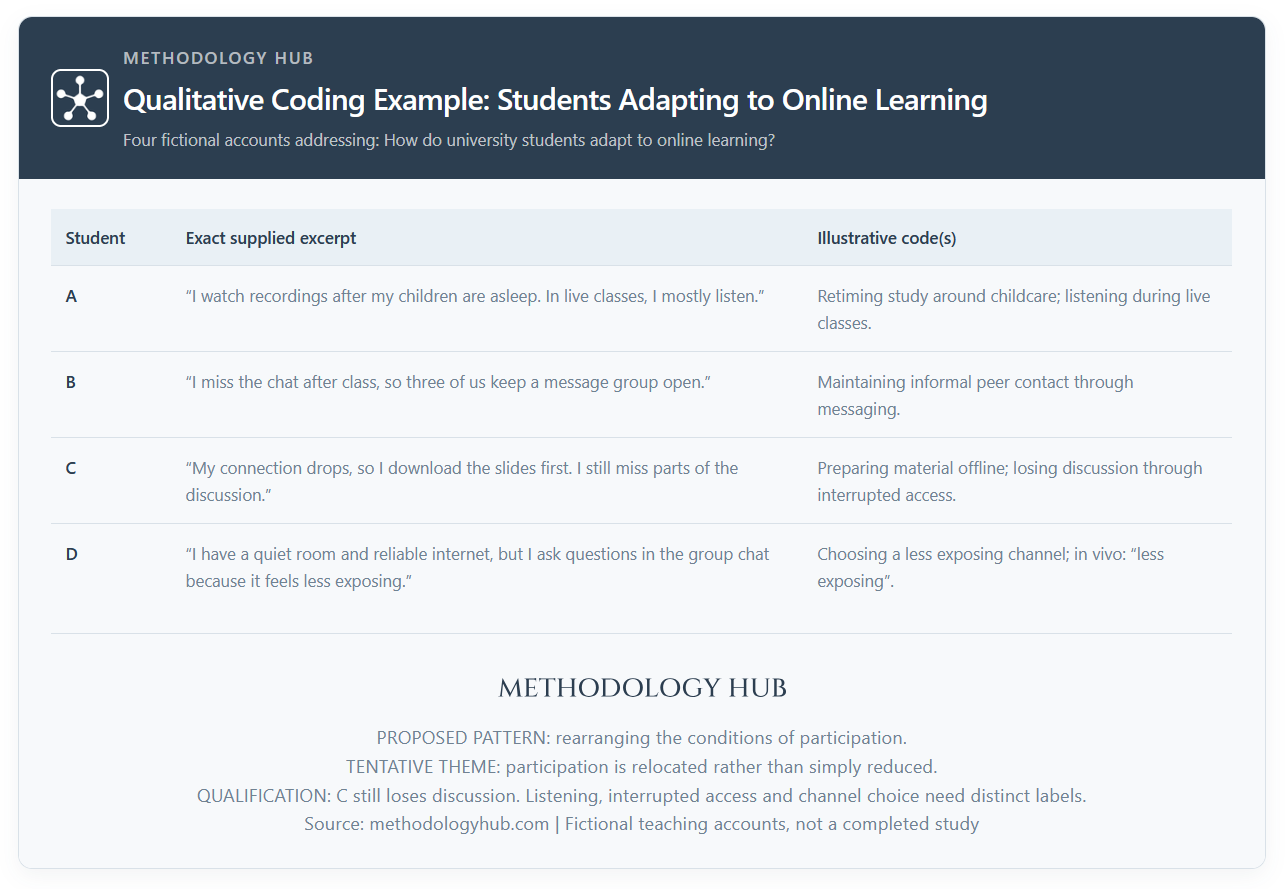
Qualitative coding can show how university students adapt to online learning by identifying practices, constraints and meanings in their accounts. This fictional example asks: How do university students adapt to online learning? It follows several coding decisions through to a tentative interpretation.
Introducing the Interview Data
Four short accounts provide the material. They describe different circumstances rather than a single experience shared by all students:
- Student A: “I watch recordings after my children are asleep. In live classes, I mostly listen.”
- Student B: “I miss the chat after class, so three of us keep a message group open.”
- Student C: “My connection drops, so I download the slides first. I still miss parts of the discussion.”
- Student D: “I have a quiet room and reliable internet, but I ask questions in the group chat because it feels less exposing.”
These extracts are sufficient to demonstrate coding choices. They cannot establish how common the practices are or support claims about all university students.
Applying First-Cycle Coding Techniques
Student A’s account could receive the descriptive code study scheduling and the process code fitting study around care. Student B’s phrase “the chat after class” can be preserved as an in vivo code, alongside maintaining peer contact.
For Student C, unstable connection identifies a constraint, while preparing materials offline identifies a response. Coding both features preserves their relationship. Student D’s preference for a less exposing setting supports an interpretation of managing visibility, while leaving the specific emotion uncertain.
Applying Inductive and Deductive Coding
An inductive pass might develop moving participation into another space from the accounts. A deductive framework distinguishing temporal, technical and social conditions could organise Student A under temporal conditions, Student C under technical conditions and Student B under social conditions.
Student D complicates a simple explanation that alternative participation always results from limited resources. Abductive inquiry could consider perceived exposure as another explanation and seek material that distinguishes it from convenience or habit. The four extracts do not resolve those alternatives.
| Interview excerpt | Coding technique | Applied code | Analytical explanation |
|---|---|---|---|
| A: “after my children are asleep” | Process | Fitting study around care. | Identifies how study is arranged around a responsibility. |
| A: “I mostly listen” | Descriptive | Listening in live classes. | Records the reported participation form without assuming disengagement. |
| B: “the chat after class” | In vivo | “the chat after class” | Retains the student's expression for informal contact. |
| B: “keep a message group open” | Process | Maintaining peer contact. | Identifies an action responding to a missing social opportunity. |
| C: “My connection drops” | Deductive | Technical condition: connectivity. | Applies a defined dimension of the analytical framework. |
| C: “download the slides first” | Process | Preparing materials offline. | Captures a response while preserving the reported constraint. |
| D: “it feels less exposing” | Concept | Managing visibility. | Proposes an interpretation of why the group chat is preferred. |
Comparing and Refining Codes
An early code, avoiding live participation, would overstate the evidence. Student A listens in live classes; Student C loses access involuntarily. These accounts justify separating listening, interrupted access and choosing another channel.
The distinction prevents a single label from making different circumstances appear equivalent. A memo could record that low visible contribution does not necessarily indicate low engagement and identify what additional material would clarify participation in each case.
Applying Second-Cycle Coding
Pattern coding could relate fitting study around care, maintaining peer contact, preparing materials offline and managing visibility under rearranging the conditions of participation. That pattern highlights a shared analytical question while retaining different purposes and constraints.
This example uses pattern coding within a thematic analysis. It does not add axial, selective and theoretical coding as compulsory subsequent stages. Those procedures would need a separate methodological justification.
Different techniques, different insights
Descriptive coding identifies what students discuss. Process coding identifies what they do. In vivo coding preserves a student’s expression. Deductive coding locates material within defined conditions. Pattern coding develops a proposed relationship across earlier codes.
Each contributes something distinct to the same analysis; applying more labels is useful only when those distinctions advance the question.
Developing Categories and Analytical Interpretations
Possible categories are adjusting study time, rebuilding informal contact and controlling access and visibility. A tentative theme could be: participation is relocated rather than simply reduced. It interprets how students move activity across times, channels and relationships.
Student C qualifies that interpretation: relocating resources does not recover the discussion that was missed. The analysis therefore needs to distinguish adaptations that preserve participation from those that leave unresolved losses. Further evidence could revise the categories and the theme substantially.
Conclusion
Qualitative coding helps researchers identify, compare and interpret relevant features of research material. Techniques differ in whether they foreground topics, participant language, actions, values, emotions, conceptual relationships or change over time.
Select a manageable combination that fits the question and methodology. Refine the codes through comparison, retain context and explain important decisions. Coding earns its place in a study through the understanding it supports, rather than the number of labels produced.
Cite this article
Whether you are preparing course materials, writing an academic paper, or sharing resources with students, we kindly ask that you acknowledge Methodology Hub as the source.
To make referencing easier, you can use the “Cite this page” tool below to automatically generate a citation in your preferred referencing style, including APA, MLA, Chicago, Harvard, and others. Simply select a citation style and click the generated reference to copy it.
When reproducing images, figures, or other materials from this page, please include an appropriate source credit and a link to the original page. Proper attribution helps others locate the original material and supports the continued development of freely accessible educational resources.