Controlled observation is an observational research method in which the researcher watches behaviour in a planned or arranged situation. The researcher may define the task, setting, timing, observation categories, instructions, or recording procedure before observation begins. The aim is to make the observation more consistent than it would be in a fully open natural setting.
Controlled observation is part of observational research, but it uses more structure than many field-based approaches.
What is Controlled Observation?
Controlled observation means that the researcher does not simply wait for activity to occur in any form. Some part of the observation situation is planned in advance. The researcher might ask participants to complete the same task, observe the same type of interaction, use the same setting, or apply the same coding schedule in each session.
This control can make the data easier to compare. If every participant group receives the same materials and the same time limit, the researcher can observe how different groups respond under similar conditions. The method still focuses on behaviour and interaction, but the situation is less open than naturalistic fieldwork.
Controlled observation does not always mean a laboratory. It can happen in classrooms, workplaces, clinics, training rooms, online platforms, or community settings. What makes it controlled is the planned procedure, not the building.
Controlled observation definition
Controlled observation is a data collection method in which the researcher observes behaviour under pre-planned conditions. The researcher may standardise the setting, task, instructions, observation time, behaviour categories, or recording procedure to support comparison and clearer documentation.
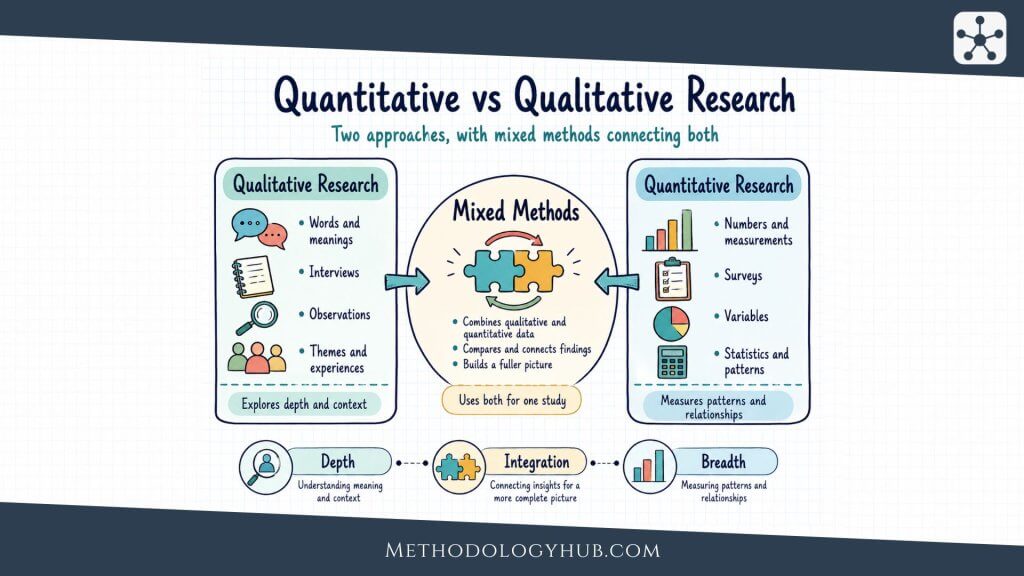
The method can be qualitative, quantitative, or mixed. A qualitative controlled observation may describe how participants interact during the same task. A quantitative version may count behaviours or record durations. A mixed approach may do both.
What is controlled in the study?
The researcher should be specific about what is controlled. Control may involve the physical setting, the task, the timing, the materials, the participant grouping, or the observation sheet. It may also involve the observer role, such as keeping the researcher outside the activity in every session.
A study can be controlled in one respect and open in another. For example, every group may receive the same problem-solving task, but the researcher may allow group discussion to unfold freely. In that case, the task is controlled, while the interaction remains open for observation.
What controlled observation can produce
Controlled observation can produce field notes, coding sheets, time records, video recordings, audio recordings, observer memos, maps of interaction, and behaviour counts. The data form depends on the research question and the design.
A researcher studying group problem-solving might record who speaks first, how roles are assigned, how disagreement appears, when participants ask for clarification, and which materials are used. The same task across groups gives the researcher a shared frame for comparison.
Design question: before using controlled observation, name exactly what will be kept stable and what will be allowed to vary.
Where Control Enters an Observation Study
Control can enter an observation study in several places. Some researchers control the task. Others control the setting, observation time, participant grouping, coding categories, or instructions. Understanding these choices helps prevent vague method descriptions.
The amount of control should match the research question. A study does not become better simply because it controls more. Too much control can make the situation easier to compare but less similar to ordinary practice.
Control over the task
Task control means that participants are asked to do the same activity. A researcher may ask several student groups to complete the same planning task, ask trainees to respond to the same scenario, or ask service staff to handle a simulated request.
This makes comparison easier because each group faces the same starting point. The researcher can then observe differences in role allocation, communication, hesitation, conflict, or use of resources.
Control over the setting
Setting control means that observation takes place in the same room, platform, or arranged environment. The researcher may use the same seating layout, materials, lighting, or equipment across sessions. This reduces differences caused by the physical setting.
However, a controlled setting may not capture how behaviour unfolds in daily life. If the study needs ordinary context, naturalistic observation may be more suitable.
Control over time
Time control means that each observation lasts for the same period or follows the same time intervals. The researcher may observe the first ten minutes of a task, record behaviour every thirty seconds, or compare the same stage of an activity across groups.
This kind of control is useful when timing is part of the research question. It can show when participants begin, pause, ask for help, divide roles, or move from planning into action.
| Type of control | Example | Main benefit |
|---|---|---|
| Task | All groups complete the same problem-solving activity. | Supports comparison of interaction and strategy. |
| Setting | Each session uses the same room and materials. | Reduces variation caused by environment. |
| Time | Observers record the first ten minutes of each session. | Makes sequence and pace easier to compare. |
Control over recording
Recording control means using the same observation sheet, coding categories, field note prompts, or recording equipment in each session. This helps the researcher collect data in a consistent way.
The risk is that a tight observation sheet can draw attention away from unexpected behaviour. Many studies use a structured recording tool plus open notes so the researcher can capture both planned categories and surprising details.
Control over observer behaviour
Observer behaviour can also be controlled. The researcher may decide that observers should not answer participant questions about the task, should sit in the same position, should use the same prompts, or should avoid giving feedback during observation.
This is especially useful when more than one observer collects data. Without shared rules, differences between observers may shape the data as much as differences between participants.
When Controlled Observation Is Useful
Controlled observation is useful when the researcher needs to compare behaviour under similar conditions. It is also useful when the study focuses on a specific activity, response, skill, routine, or interaction that can be observed using a planned task or procedure.
The method can work well in education, training, workplace studies, health communication, service research, usability research, and small group interaction studies. It is less suitable when the researcher needs fully ordinary context or when arranging the situation would remove the feature being studied.
Comparing groups or participants
Controlled observation is often chosen when comparison is central. If several groups complete the same task, the researcher can compare how they organise roles, ask questions, use materials, or handle disagreement. The shared task gives the analysis a common frame.
For example, a researcher may observe how first-year and final-year students respond to the same collaborative planning activity. The observation can show differences in confidence, turn-taking, strategy, and use of prior knowledge.
Observing a specific response
Some studies need to see how participants respond to a particular prompt, message, scenario, or material. A researcher may observe how patients interpret the same health information sheet, how teachers respond to the same assessment example, or how users navigate the same website task.
The controlled prompt makes it easier to compare reactions. At the same time, the researcher can still record qualitative detail, such as confusion, hesitation, shared interpretation, or unexpected use of language.
Studying skill or procedure
Controlled observation can be useful when the study concerns a skill or procedure. Trainees may be asked to complete the same practical activity while the researcher observes sequence, errors, questions, and use of instruction. The aim is not only to judge performance, but to understand how the activity unfolds.
This can be especially helpful when interviews would rely too heavily on memory. Participants may not remember the small steps they took during a task. Observation can record them directly.
Best fit: controlled observation works well when every participant or group should encounter the same activity, prompt, or recording conditions.
When another observation type may be better
If the research question asks how behaviour unfolds in daily life, controlled observation may be too arranged. A classroom task created for research may not show how students normally collaborate during regular lessons. A staged service encounter may not show how staff respond during a busy shift.
In those cases, naturalistic observation may provide stronger contextual evidence. A study can also use both forms: naturalistic observation to understand ordinary practice and controlled observation to compare responses to a specific task.
Controlled Observation and Observer Role
The observer role in controlled observation is usually planned before data collection begins. The researcher may watch without participating, give standard instructions, start and stop the task, or record behaviour using a predefined sheet. Whatever the role is, it should be the same across sessions whenever comparison is needed.
This makes the observer role more procedural than in many open field studies. The observer is not only present. They are part of the design because their actions can affect how participants understand the task and how the data are collected.
Observer as non-participant
Many controlled observation studies use a non-participant observation role. The researcher explains the task or setting, then watches without joining the activity. This helps keep the task focused on participant behaviour rather than researcher involvement.
The observer may still interact at the beginning or end. They may give instructions, answer procedural questions, or collect materials. Those interactions should be standardised as much as possible.
Observer as facilitator
In some studies, the researcher facilitates the session. They may introduce a scenario, start a group task, move participants through stages, or present the same material to each participant. The facilitator role should be scripted enough to avoid uneven support.
If one group receives extra explanation and another does not, the comparison becomes weaker. A written protocol can help prevent this problem.
Using more than one observer
Some studies use two observers. One may focus on timing and coding, while another writes open notes about interaction. This can be helpful when the setting is busy or when the study needs both structured and descriptive records.
When more than one observer is used, training is important. Observers should practise applying categories, recording time, and writing notes. They should also compare early records to see whether they are observing in similar ways.
| Observer role | Use in controlled observation |
|---|---|
| Non-participant observer | Watches the task or activity without joining participant action. |
| Facilitator-observer | Gives standard instructions or presents materials, then records what happens. |
| Second observer | Supports timing, coding, field notes, or recording checks. |
Reducing observer variation
Observer variation occurs when different observers record the same situation differently or affect participants in different ways. Controlled observation tries to reduce this through training, protocols, shared definitions, and pilot sessions.
Variation cannot be removed completely. The goal is to make the observer role clear enough that differences in the data are less likely to come from inconsistent observation practice.
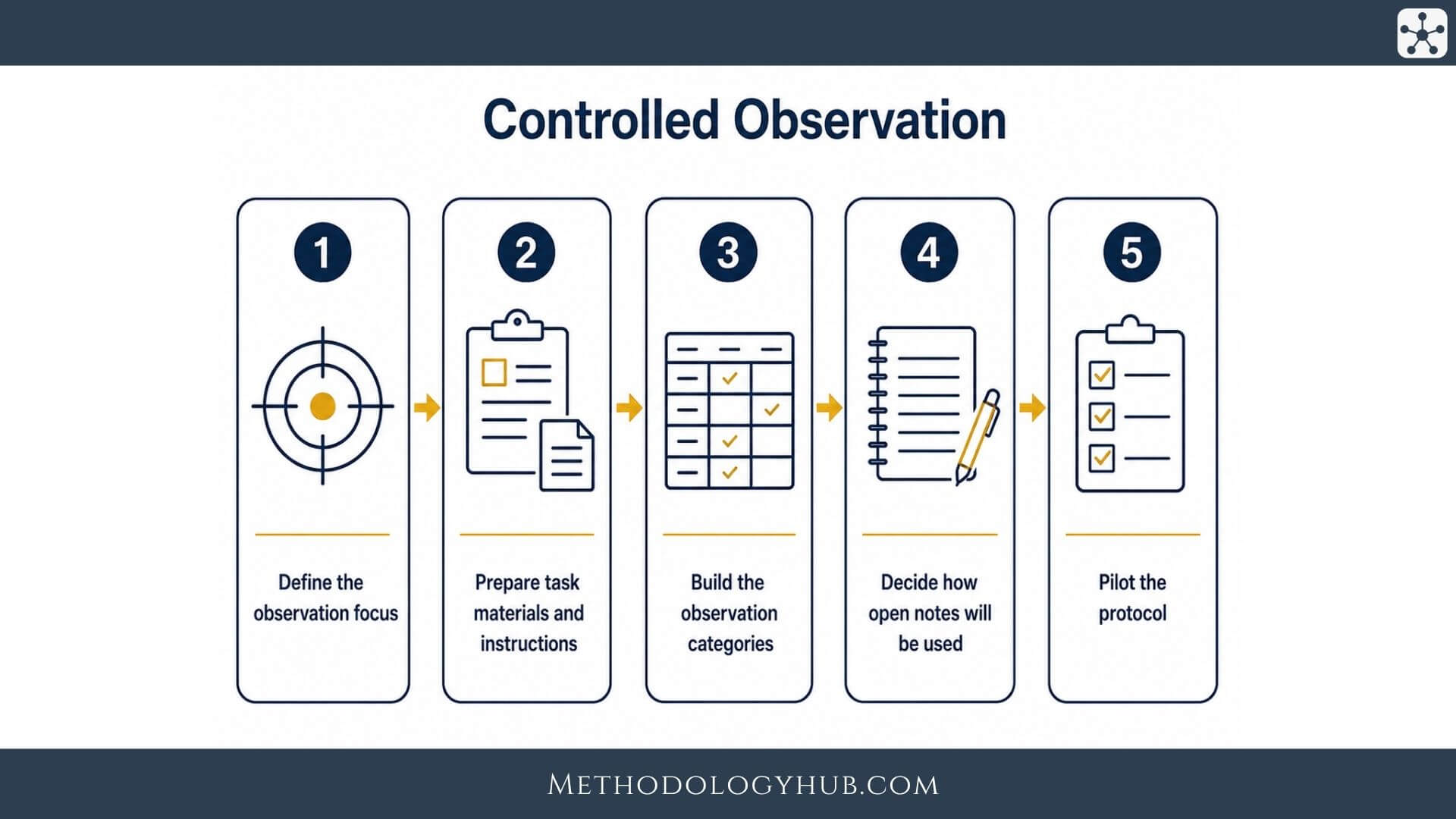
Designing a Controlled Observation Protocol
A controlled observation protocol is the document that explains how the observation will be carried out. It may include the research focus, setting, participant instructions, task materials, observation categories, timing rules, recording sheet, and instructions for observers.
The protocol is useful because controlled observation depends on consistency. If the procedure changes from one session to another without explanation, comparison becomes harder to defend.
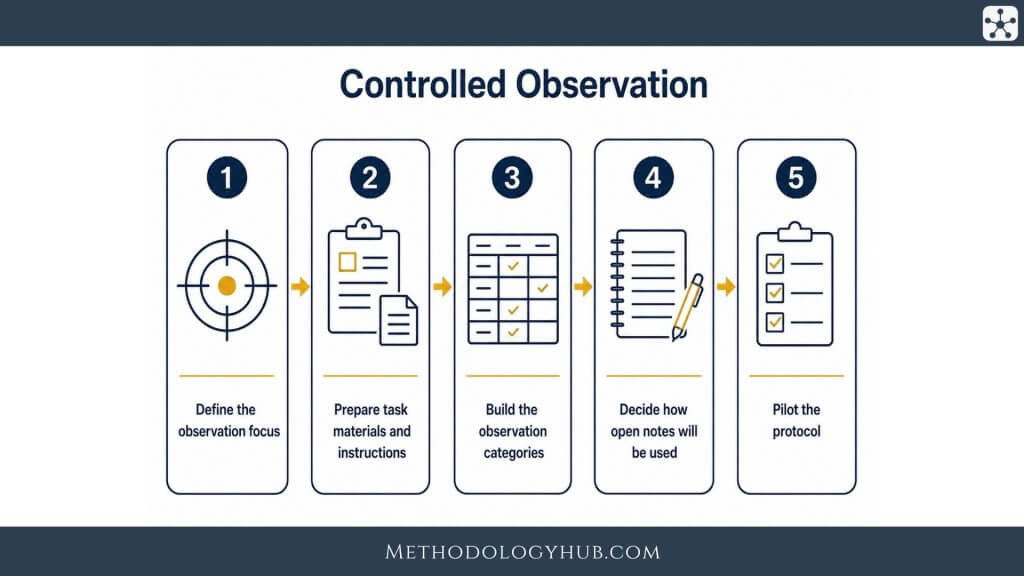
Define the observation focus
The protocol should begin with a clear focus. A broad topic such as “teamwork” is not enough. The researcher should decide which parts of teamwork will be observed: turn-taking, task division, decision-making, disagreement, help requests, or use of instructions.
A focused design helps the researcher choose the task and recording categories. It also keeps the observation from becoming a general impression of the session.
Prepare task materials and instructions
If participants complete a task, the materials and instructions should be prepared carefully. The wording should be clear, the task should be realistic enough to produce useful behaviour, and the difficulty should match the participant group.
Instructions should be delivered in the same way each time. If clarification is allowed, the protocol should state what the observer can say. If clarification is not allowed, the observer should have a standard response.
Protocol check: if an observer would have to improvise during the session, add a rule or standard wording before data collection begins.
Build the observation categories
Observation categories should connect to the research question. They may describe actions, roles, interaction patterns, gestures, use of materials, sequence, or outcomes. Categories should be specific enough for observers to apply consistently.
For example, “participation” may be too broad. More usable categories might include asking a question, making a suggestion, taking notes, reading instructions aloud, disagreeing, or inviting another participant to speak.
Decide how open notes will be used
Controlled observation often benefits from open notes alongside categories. Categories capture planned behaviours. Open notes capture context, unusual events, tone, sequence, and unexpected details. The protocol should give space for both when qualitative interpretation is planned.
Open notes are especially helpful when the same code appears in different ways. Two groups may both show disagreement, but one disagreement may be playful and another may stop the task. The code alone may not capture that difference.
Pilot the protocol
Piloting is necessary because problems often appear only when the protocol is used. The task may be too easy, the categories may overlap, the observer may not be able to record fast enough, or participants may misunderstand the instructions.
After piloting, the researcher can revise the task, timing, definitions, recording sheet, or observer rules. The final protocol should be stable before the main observations begin.
Recording Controlled Observation Data
Recording controlled observation data usually involves a combination of structured and descriptive records. The structured part may include categories, counts, time intervals, or rating fields. The descriptive part may include notes about setting, sequence, tone, and events that do not fit the categories.
The recording system should be tested before the main study. A beautiful observation sheet is not useful if the observer cannot apply it during a fast-moving session.
Observation sheets
An observation sheet gives the researcher a consistent place to record data. It may include participant or group number, task stage, time markers, behaviour categories, notes, and observer comments. The layout should be simple enough to use while watching.
If the sheet is too crowded, the observer may spend more time looking at the form than at the activity. A pilot session can show whether the sheet is practical.
Behaviour categories
Behaviour categories should be defined clearly. If the category is “asks for help,” the protocol should explain whether this includes asking peers, asking the observer, reading instructions aloud, or asking indirectly. Clear definitions help observers apply categories consistently.
Categories can be descriptive or interpretive. Descriptive categories stay close to visible action. Interpretive categories require more judgement. Both can be useful, but interpretive categories usually need stronger training and examples.
| Recording element | Example | Why it helps |
|---|---|---|
| Time marker | 02:30, first disagreement appears | Supports analysis of sequence and pace |
| Category mark | Help request, peer response, task pause | Makes repeated behaviour easier to compare |
| Open note | The group laughs after the disagreement and continues working. | Adds context that the category alone cannot show |
Audio and video records
Audio or video can be useful when the observation involves detailed interaction. Video may help the researcher review gestures, use of materials, or group positioning. Audio may help with spoken turn-taking and exact wording.
Recording does not remove the need for field notes. Notes can capture context, observer impressions, technical problems, and details outside the frame of the recording.
Observer memos
Observer memos are written after the session. They may record what seemed difficult to code, whether instructions worked, whether participants misunderstood the task, and which patterns may need closer analysis. These memos help connect the data collection process with later interpretation.
Memos can also identify problems in the design. If several sessions produce confusion at the same point, that may become a finding or a sign that the task was not well designed.
Analysing Controlled Observation Data
Analysing controlled observation data means comparing what happened under the planned conditions. The researcher may examine patterns across groups, participants, task stages, time intervals, or categories. If open notes were collected, the analysis can also examine how behaviours occurred and what they meant in context.
The analysis should reflect the design. If the study used a structured coding sheet, the researcher can compare categories. If the study collected detailed notes, the researcher can build qualitative themes from repeated patterns, contrasts, and surprising moments.
Start with the observation structure
The first step is usually to organise data by session, group, task stage, category, or time interval. The controlled design gives the researcher a built-in structure for comparison. This structure should be used without letting it limit interpretation too early.
For example, the researcher may compare the first five minutes of each group task, then compare how groups moved from planning to action. The shared task makes these comparisons clearer.
Compare planned categories
Planned categories can be counted, summarised, or compared across cases. The researcher may examine which behaviours appeared often, which appeared rarely, and which appeared at different points in the task. These comparisons can help describe the data.
Counts should be used carefully. If one group asks fewer questions, that does not automatically mean they understood the task better. They may have been confused but silent, dominated by one participant, or reluctant to ask for help. Open notes can help interpret the count.
Analyse sequence and timing
Controlled observation can be strong for sequence. The researcher can examine when behaviours occur: who begins, when roles are set, when disagreement appears, when help is requested, or when the task stalls.
Timing can reveal patterns that are not visible from totals alone. Two groups may ask for help the same number of times, but one may ask immediately and another may ask only after a long period of uncertainty.
Use open notes for interpretation
Open notes help explain how categories happened. A category such as disagreement may cover different situations. One disagreement may be brief and productive. Another may shut down discussion. Another may be expressed indirectly through silence or humour.
Qualitative analysis should keep these differences visible. The goal is not only to report that a behaviour occurred, but to explain how it functioned in the observed situation.
Analysis reminder: in controlled observation, shared conditions make comparison easier, but they do not make interpretation automatic.
Report scope clearly
The findings should state what the controlled design can and cannot show. If participants completed a staged task, the findings describe behaviour in that arranged situation. The researcher should be cautious about claiming that the same behaviour would appear in all ordinary settings.
A strong report can still be useful. It may show how participants respond to the same prompt, where procedures create confusion, or how group interaction changes under shared task conditions.
Examples of Controlled Observation
Examples of controlled observation show how researchers can create a shared observation situation while still studying behaviour in detail. The following examples use different settings and different levels of structure.
Example 1: Student groups completing the same task
An education researcher asks several student groups to complete the same planning task within twenty minutes. The observer records who reads the instructions, who suggests a plan, how roles are divided, and when the group asks for help.
The controlled task allows comparison across groups. The analysis may show that some groups begin by assigning roles, while others start working without discussion and later struggle to coordinate.
Example 2: Trainees responding to a simulated service request
A workplace researcher observes trainees responding to the same simulated service request. Each trainee receives the same written scenario and the same time limit. The researcher records questions asked, steps taken, use of guidance materials, and points of hesitation.
The observation may show which parts of the procedure are clear and which parts create confusion. The staged request helps the researcher compare responses under similar conditions.
Example 3: Patients reading the same health information sheet
A health researcher observes participants as they read and respond to the same information sheet. Participants are asked to highlight unclear sections and explain what they would do next. The observer records pauses, rereading, questions, and comments about wording.
The data may show that certain terms create repeated confusion. The researcher can combine behaviour notes with participants’ verbal explanations to understand how the material is interpreted.
Example 4: Children using the same play materials
A researcher observes small groups of children using the same set of play materials for a fixed period. The record focuses on turn-taking, object sharing, conflict, imitation, and how children change the rules of play.
The controlled materials allow comparison across groups, while open notes preserve the creative and social detail of the play.
Conclusion
Controlled observation helps researchers study behaviour under planned conditions. It is useful when a study needs comparison across participants, groups, sessions, or task stages while still observing action directly.
The method works best when the researcher is clear about what is controlled, why that control is needed, how behaviour will be recorded, and how the arranged situation limits the claims that can be made. Controlled observation can support both qualitative and quantitative analysis when the recording system is designed carefully.
FAQs on Controlled Observation
What is controlled observation?
Controlled observation is a research method in which behaviour is observed under planned conditions. The researcher may control the task, setting, timing, materials, categories, or recording procedure to make comparison easier.
What is controlled observation in qualitative research?
Controlled observation in qualitative research uses planned observation conditions while still recording detailed behaviour, interaction, sequence, and context. The analysis may combine structured categories with open field notes.
What is the difference between controlled and naturalistic observation?
Controlled observation uses a more arranged task, setting, or recording procedure. Naturalistic observation studies behaviour in its ordinary setting. Controlled observation supports comparison, while naturalistic observation supports everyday context.
When should controlled observation be used?
Controlled observation should be used when the researcher needs to compare behaviour under similar conditions, observe responses to the same task or prompt, or use a consistent recording procedure across participants or groups.
How do you conduct controlled observation?
To conduct controlled observation, define the observation focus, decide what will be controlled, prepare the task or setting, create an observation protocol, train observers if needed, pilot the procedure, record behaviour, and analyse patterns across cases.
What should be recorded in controlled observation?
Researchers may record behaviour categories, counts, time markers, task stages, sequence, participant roles, open notes, observer memos, audio, video, and details about any deviations from the planned procedure.
How do you analyse controlled observation data?
Controlled observation data are analysed by organising records by session, task stage, category, or time interval, comparing planned categories, examining sequence and timing, using open notes for interpretation, and reporting the scope of findings clearly.