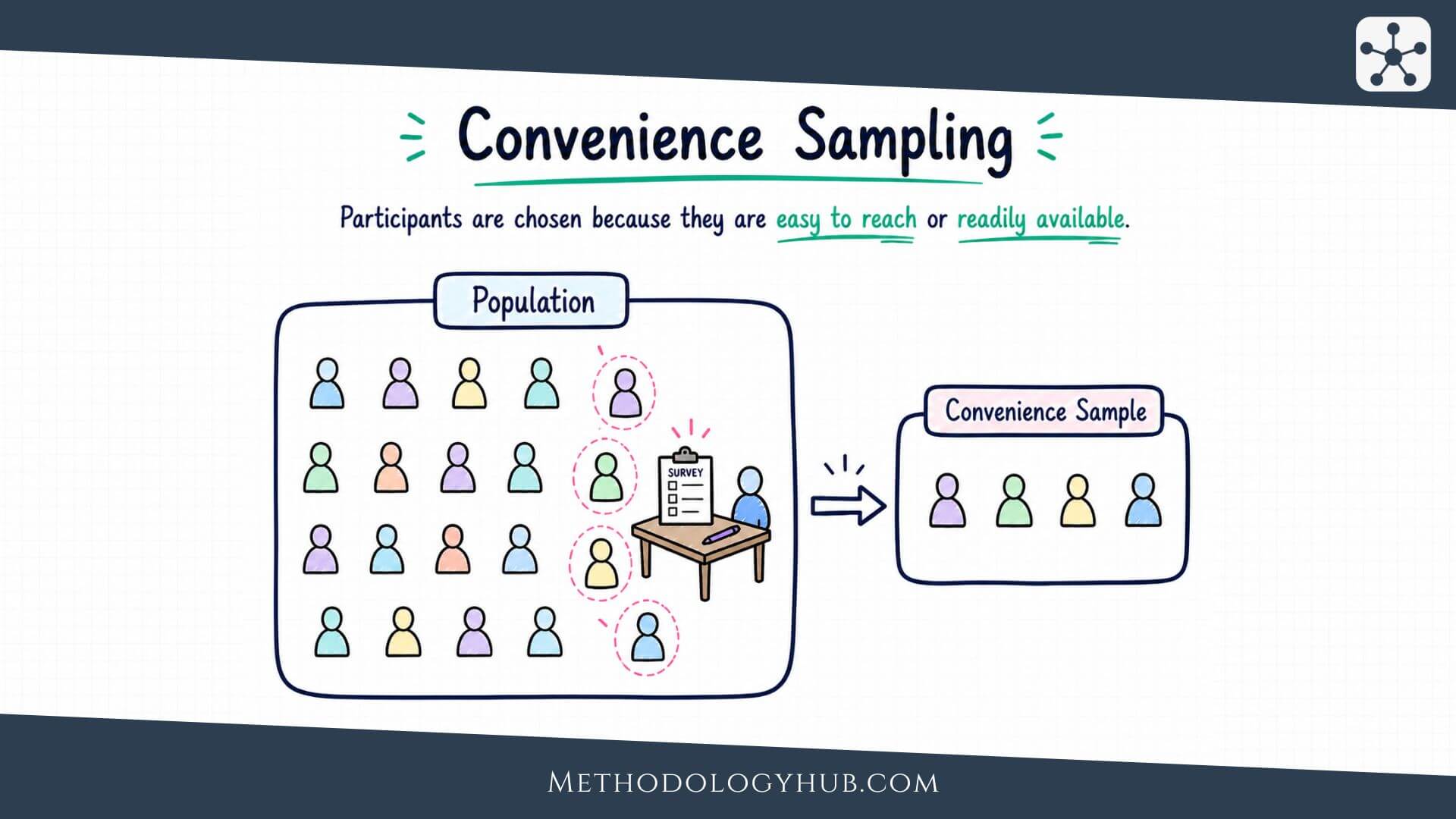
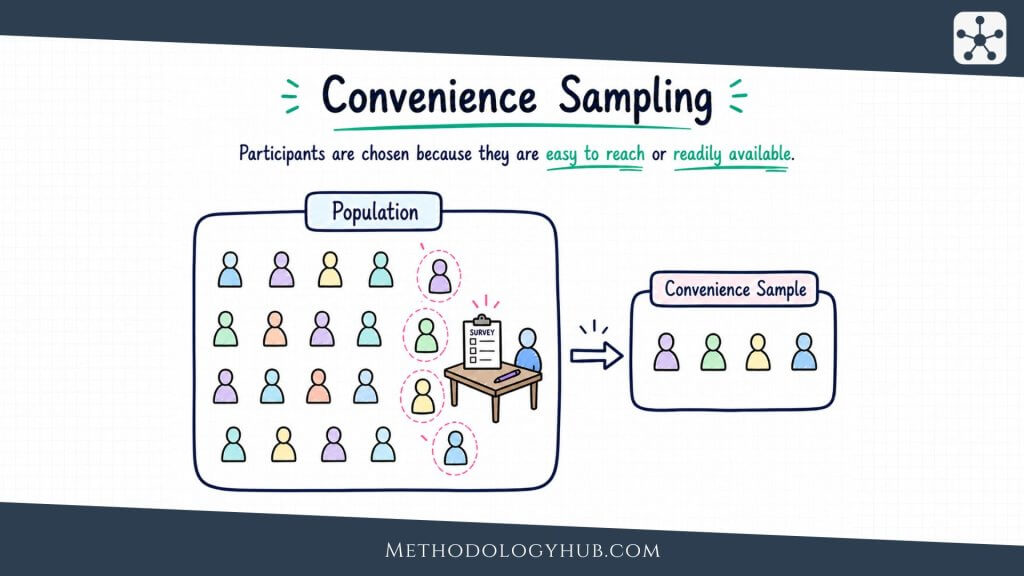
Convenience sampling is a non-probability sampling method in which people, cases, records, places, or observations are selected because they are easy for the researcher to access. Instead of drawing names from a complete list or using a chance-based procedure, the researcher works with the units that are available within a classroom, clinic, organisation, online group, field site, archive, or other reachable setting.
This article explains what convenience sampling is, how it fits into research design, when it can be used, how to plan and report it, and what its advantages and limitations mean for interpreting study results.
What Is Convenience Sampling?
Convenience sampling begins with access. A researcher has a research question, a setting where data can be collected, and a group of people or cases that can be reached without a full sampling frame. The sample is formed from those reachable units. This might mean students in one course, patients attending one clinic during a certain week, visitors to a library, teachers who respond to an email invitation, or documents that are available in one archive.
The method is common because many studies begin under practical limits. A school project may have only a few weeks for data collection. A pilot study may need quick feedback before a larger survey is built. Convenience sampling gives a practical route into data collection, but it also changes the kind of claim the study can make.
Convenience sampling definition
Convenience sampling means selecting units for a study because they are available, nearby, willing, or easy to contact, rather than because they were chosen through random selection. It is a form of non-probability sampling, so the chance that any particular member of the wider population will enter the sample is usually unknown.
How convenience sampling fits into non-probability sampling
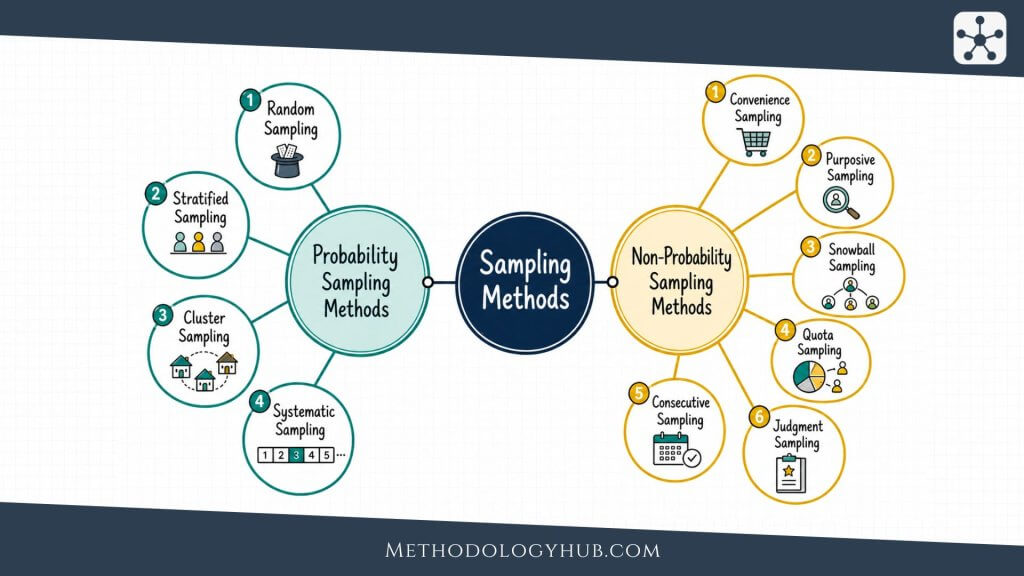
Sampling methods are often grouped into probability and non-probability approaches. Probability methods, such as random sampling, stratified sampling, cluster sampling, and systematic sampling, use planned chance-based selection. Convenience sampling does not. It belongs with other non-probability approaches, including purposive sampling and snowball sampling.
The difference is easiest to see in the reason for inclusion. In purposive sampling, participants are selected because they meet criteria that are directly tied to the research question. In snowball sampling, existing participants help identify further participants. In convenience sampling, the strongest reason for inclusion is access. The person, case, or record is available within the researcher’s reach.
Population, sample, and access point
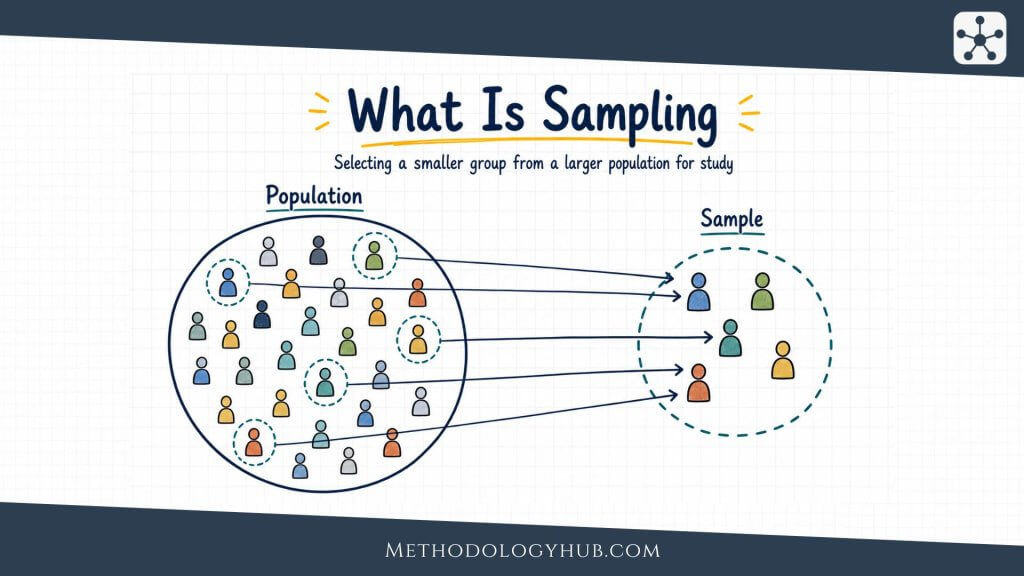
Convenience sampling still begins with a population, even when the final sample is access-based. The population is the wider group the researcher would like to understand. The sample is the group actually studied. The access point is the practical place or route through which participants or cases are reached.
For example, a researcher may be interested in first-year university students. The convenience sample may come from two introductory classes where the lecturer allows recruitment. The access point is therefore not the same as the population. It is only one route into that population. This distinction helps keep interpretation realistic. The study may provide useful evidence about the participating students, but it should not casually speak for all first-year students unless the design gives a stronger basis for that claim.
Convenience Sampling in Research Design
Convenience sampling is not a small technical detail at the end of a methods section. It affects how the study is read from the beginning. The research question may sound broad, but the sample may come from a much narrower group. That gap does not make the study useless. It simply means the design and the wording of the claims need to stay close to one another.
A study using convenience sampling can still be careful. It can define eligibility criteria, collect high-quality data, use suitable statistical methods, and report limitations plainly. What it should not do is hide the recruitment route behind vague language. “Participants were recruited” tells the reader very little. “Participants were recruited from two second-year sociology seminars at one university during March 2026” gives a much clearer picture.
The role of the research question
The research question should guide whether convenience sampling is acceptable. If the question asks for an early description, pilot feedback, feasibility information, or a first look at a pattern, a convenience sample may fit. If the question asks for a population estimate, such as the average score, percentage, or prevalence in a wider group, a convenience sample is usually weaker than a probability-based design.
Consider a teacher who wants to test whether survey questions are understandable before using them across several schools. A convenience sample from one class may be enough for that early purpose. The same sample would be much less suitable for estimating the reading habits of all pupils in the district. The difference is not the number of participants alone. It is the relationship between the sample and the claim.
Units of analysis and eligibility criteria
Even an access-based sample needs clear boundaries. The unit of analysis may be a person, household, class, school, patient record, interview, document, test score, or observation. The eligibility criteria define which units can enter the study. These criteria help prevent convenience from becoming too loose.
Suppose a researcher wants to study how undergraduate students use feedback from written assignments. The sample might be recruited from one course, but eligibility could still be limited to students who submitted at least one written assignment and received tutor feedback in the current semester. That boundary makes the sample more coherent. It also helps readers understand what kind of evidence the study actually collected.
Planning note: A convenience sample is easier to interpret when the researcher separates access from eligibility. Access explains where the sample came from. Eligibility explains who or what could be included.
Convenience sampling and quantitative research
In quantitative research, convenience sampling is often used when the researcher wants to collect numerical data quickly or when a probability sample is not possible. Student surveys, clinic-based questionnaires, online polls, laboratory participant pools, and classroom tests often use this approach.
The main caution concerns inference. A convenience sample can produce means, percentages, correlations, or regression coefficients, but those numbers describe the participating sample first. Moving from those numbers to the wider population needs care. If a researcher uses correlation analysis or regression analysis with a convenience sample, the analysis can examine patterns in the data, but the population reach of the result depends on how the sample was obtained.
Convenience sampling and qualitative research
In qualitative research, convenience sampling may appear when participants are recruited through a reachable setting, such as a school, clinic, workplace, community group, or professional course. It can be useful when the study is small, exploratory, or constrained by access. Still, qualitative sampling usually needs more than availability. The researcher often needs participants who can speak directly to the experience or process being studied.
For this reason, qualitative studies often combine convenience with purposive thinking. A researcher may recruit from an accessible site but still set criteria, seek variation, or continue recruitment until the data are rich enough for the analysis. In the methods section, it helps to name both parts: the access route and the selection logic.
Convenience sampling and inferential statistics
Many beginners meet convenience sampling at the same time they learn inferential statistics. This can create confusion. Software will calculate p-values and confidence intervals for almost any dataset, but the calculation does not turn a convenience sample into a probability sample.
With convenience sampling, formal results should be read alongside the recruitment design. A p-value may describe how a pattern behaves under a statistical model, but it does not prove that the sample speaks for the wider population. A confidence interval may show model-based uncertainty, but it does not automatically include the uncertainty created by unknown selection probabilities. The analysis and the sampling design need to be interpreted together.
When to Use Convenience Sampling
Convenience sampling is most suitable when access is limited, time is short, the study is exploratory, or the researcher is testing tools and procedures before a larger design. It is also used in settings where a complete sampling frame is unavailable. The method can be reasonable when the researcher is honest about what the sample can and cannot support.
The best fit is usually a modest claim. Convenience sampling can help a researcher learn whether a questionnaire works, whether interview prompts make sense, whether a procedure is feasible, or whether an early pattern deserves more careful study. It is less suitable when the study needs precise estimates for a broad population.
Use it for pilot studies
Pilot studies often use convenience sampling because the aim is not to produce final population estimates. The aim is to test the research process. A researcher may try out a survey with 30 accessible students, interview a small group of reachable teachers, or review available records to see whether the planned coding scheme works.
In that setting, convenience sampling can save time while still producing useful information. The researcher can notice confusing questions, missing response options, unrealistic recruitment plans, or data problems before investing in a larger study. The final report should still make clear that the pilot sample was selected by access.
Use it when the population cannot be listed
Some populations cannot easily be turned into a complete sampling frame. A researcher may not have a list of all people who use a public study space, all visitors to a community event, all students who quietly seek informal peer support, or all patients who will attend a clinic over the next month. In those situations, convenience sampling may be one of the few practical options.
The researcher can still improve the design by widening the access window. Instead of recruiting only on one afternoon, data might be collected across several days, times, or locations. Instead of using one class, the researcher may approach several classes that differ in subject or year group. These choices do not make the sample random, but they can reduce the narrowness of the access route.
Use it when access is part of field reality
Some research settings do not allow a neat sampling plan. In clinical studies, eligible cases may appear during routine care. In classroom research, the researcher may only have permission to enter certain classes. In archive work, only some documents may be available, complete, or open for inspection. In field studies, safety, travel, weather, and institutional permission may shape what can be observed.
In these situations, convenience sampling may reflect the conditions under which research can actually be done. The design can still be transparent. The researcher should explain the setting, time period, recruitment route, inclusion criteria, number approached if known, number included, and any visible gaps in the final sample.
Use another approach when representation is central
If the study aims to estimate a population value, convenience sampling is usually a weak choice. A survey of students in one lecture cannot estimate the opinion of all students at a university with the same confidence as a well-designed probability sample. A clinic sample cannot automatically describe all people with the same condition. An online volunteer sample may overrepresent people with strong interest in the topic.
When representation is central, a researcher should consider random, stratified, systematic, cluster, or multistage sampling, depending on the population and available frame. If a probability design is not feasible, quota or purposive sampling may sometimes give more deliberate coverage than pure convenience sampling. The final choice should follow the research purpose rather than the easiest route alone.
Types of Convenience Sampling
Convenience sampling is often described as one method, but it appears in several practical forms. The shared feature is access. The differences lie in where access comes from: a place, a time window, a volunteer pool, a digital route, or a sequence of available cases.
These forms can overlap. A study may recruit volunteers through an online link and also limit recruitment to one university course. Another study may include every eligible patient who attends one clinic during a defined period. Naming the form helps readers see how the sample was assembled.
Location-based convenience sampling
Location-based convenience sampling recruits people or cases from a place the researcher can reach. This might be a classroom, library, clinic, laboratory, workplace, school corridor, public event, or community centre. The sample is shaped by who appears in that place during the recruitment period.
For example, a researcher studying study-space use might approach students in one university library. This gives direct access to people using that library, but it may miss students who study at home, in cafés, in laboratories, or in other campus spaces. The location is therefore part of the sample definition, not a neutral detail.
Time-based convenience sampling
Time-based convenience sampling recruits during a period that is practical for the researcher. A survey may be open for one week. Interviews may be offered during office hours. Observations may happen on two mornings. Clinic records may be reviewed for one month because that is the period available.
This form is simple, but the time window can tilt the sample. Students present in a morning class may differ from evening students. Patients attending on weekdays may differ from those attending weekend services. Library visitors during exam week may differ from visitors earlier in the semester. Reporting the time period helps readers judge these limits.
Volunteer convenience sampling
Volunteer convenience sampling depends on people choosing to take part after seeing an invitation. The invitation may appear on a noticeboard, mailing list, online learning platform, social media group, or classroom announcement. The researcher does not select individuals directly. People self-select into the study.
Self-selection can be useful when participation must be voluntary and recruitment needs to be quick. It can also create a narrow sample. People with more time, stronger opinions, more interest in the topic, or more comfort with research may be more likely to respond. A methods section should therefore describe where the invitation appeared and, when available, how many people responded.
Reading a volunteer sample: When people choose themselves into a study, the final sample reflects both access and willingness to participate.
Consecutive convenience sampling
Consecutive convenience sampling includes every eligible case that appears over a defined period until the planned sample size is reached. It is often used in clinical, educational, or service settings. For example, a researcher may include all eligible patients attending a clinic between 1 March and 30 April, or all eligible assignment scripts submitted during one semester.
This approach is usually stronger than selecting a few convenient cases informally because the rule is clearer. The researcher is not choosing only the easiest or most interesting cases. Still, it remains non-probability sampling when the period and setting are chosen by access rather than by a probability design.
Online convenience sampling
Online convenience sampling recruits through digital routes that are easy to reach: course pages, mailing lists, forums, online communities, survey links, or institutional platforms. It can collect data quickly and can reach people who would be difficult to contact in person.
The limits depend on digital access and group membership. An online sample may miss people who do not use the platform, do not see the invitation, have limited internet access, or are less comfortable responding online. It can also include duplicate, careless, or ineligible responses unless the survey design includes checks. These issues should be handled in planning and described in reporting.
| Type | How selection happens | Point to report |
|---|---|---|
| Location-based | Recruits from an accessible place. | Name the place and who may be absent from it. |
| Time-based | Recruits during a practical time window. | Report dates, days, or times. |
| Volunteer | People respond to an invitation. | Describe where the invitation appeared. |
| Consecutive | Includes eligible cases in sequence. | State the inclusion period and eligibility rule. |
| Online | Recruits through digital platforms or links. | Report the platform and response checks. |
How to Use Convenience Sampling
Using convenience sampling well means making a practical design as clear as possible. The researcher cannot rely on random selection to protect the sample, so the other parts of the design need to be visible: the population, access point, eligibility criteria, recruitment period, final sample, and interpretation.
The steps below describe a general process. A small school project may handle them simply. A journal article or thesis will usually need more detail. In both cases, the aim is the same: let the reader see exactly how the sample came into being.
Step 1: Define the target population
Start by naming the wider group the study is about. Avoid a population definition that is too broad for the actual recruitment route. “Students” is rarely clear enough. “Undergraduate psychology students at one university” is clearer. “Second-year undergraduate psychology students enrolled in Research Methods II in spring 2026” may be clearer still if that is the real access point.
This definition helps later interpretation. If the sample comes from one course, the report should not drift into claims about all students everywhere. A clear population boundary keeps the wording honest and easier to read.
Step 2: Name the access route
The access route is the practical path used to reach participants or cases. It may be a class, clinic, email list, online group, archive, database, service queue, workshop, or field site. The reader should not have to infer it from vague wording.
A good description might say that participants were recruited from three first-year biology seminars, from patients attending one outpatient clinic over four weeks, or from teachers who received an invitation through a school district mailing list. These details are not decoration. They explain the sample’s shape.
Step 3: Set inclusion and exclusion criteria
Convenience sampling should not mean taking anyone without boundaries. Inclusion criteria say who or what can enter the study. Exclusion criteria say who or what will be left out. The criteria should follow from the research question and the planned analysis.
For example, a study on feedback use might include students who received written feedback on at least one assignment during the semester. A clinic study might include adults with a confirmed diagnosis and exclude records with missing outcome data. A document study might include reports published between defined dates and exclude drafts that were never finalised.
Step 4: Decide the sample size
Sample size in convenience sampling depends on the study purpose, method, resources, and analysis plan. In a pilot survey, the sample may be small because the goal is to test wording and procedure. In a quantitative project using group comparisons, the planned analysis may require a larger sample. In a qualitative study, the sample size may depend on the depth and variety of the data.
Convenience should not be the only reason for the final number. It is better to explain the reasoning. The researcher might write that the sample size was set by the number of eligible cases available during a fixed period, by feasibility for a pilot study, by an expected response rate, or by the requirements of the planned analysis.
Step 5: Recruit consistently
Once the access route and criteria are set, recruitment should follow the same rule for everyone. If the plan is to invite all eligible students in three seminars, all eligible students in those seminars should receive the same invitation. Consistent recruitment does not remove selection bias, but it makes the method more orderly.
Step 6: Track response and non-response where possible
In many convenience samples, the researcher can still record useful recruitment numbers. How many people were invited. How many responded. How many were eligible. How many completed the study. How many records were excluded because of missing data. These numbers help the reader understand the final dataset.
Sometimes the denominator is unknown, especially with an open online link. In that case, the report should say so. A statement such as “The number of people who viewed the invitation is unknown” is more honest than pretending the response rate can be calculated.
Step 7: Interpret the findings in line with the sample
The final step is interpretation. Results from a convenience sample should be tied to the sample and setting. The researcher can discuss patterns, relationships, experiences, or preliminary findings, but should be careful with broad population wording.
For example, a study can say that, in the participating classes, students who reported more frequent feedback use also reported higher confidence. It should be more cautious about saying that all students in the university show the same pattern. If statistical analysis is used, the sample design should remain visible when the results are discussed.
Report the sampling procedure clearly
A clear sampling paragraph does not need to be long. It should include the study setting, access route, eligibility criteria, recruitment period, planned or final sample size, and response information if available.
Example wording:
Participants were recruited through convenience sampling from two introductory education courses at University X. Students were eligible if they were enrolled in the spring 2026 semester and had completed at least one assessed written assignment. Of 148 eligible students who received the invitation, 82 completed the survey and 79 provided usable responses.
This kind of wording gives the reader enough information to understand the route from access to final sample. It also avoids making the sample sound broader than it is.
Examples of Convenience Sampling
Examples make convenience sampling easier to recognise because the method often appears in ordinary research situations. The sample is not random, but it is still selected through a describable route. The examples below show how the same method can appear in education, health, psychology, social research, and document-based studies.
Example from education
A student researcher wants to examine how pupils feel about homework feedback. The researcher has permission to collect data in two classes taught by one teacher. Pupils in those classes receive an invitation, and those who return consent forms complete a short questionnaire.
This is convenience sampling because the classes were selected through access, not random selection from all pupils in the school. The study can describe the participating pupils and may offer a useful first look at feedback experiences in those classes. It should not be written as if the sample speaks for every pupil in the school or district.
Example from health research
A clinic team wants to learn how patients understand discharge instructions. During a two-week period, staff invite eligible patients who attend the clinic and are well enough to answer a short survey. The final sample contains the patients who were present, eligible, and willing during that period.
The design is practical and may give the clinic useful information. It may also miss patients who attend at different times, use another clinic, have language barriers, or decline because they are tired or worried. The sample should therefore be interpreted as a clinic-based convenience sample.
Example from psychology
A psychology department uses a participant pool for small studies. Students enrolled in introductory courses can sign up for available research sessions. A researcher studying attention and sleep recruits students from this pool and collects data in a laboratory session.
The convenience lies in the participant pool. The sample may be easy to recruit and suitable for a controlled lab task, but it may not resemble the wider population in age, education, schedule, motivation, or familiarity with research. The researcher should describe the pool and avoid broad population claims unless the design supports them.
Example from social research
A researcher studies how university students use shared study spaces. The researcher stands near the entrance of one study hall between 10:00 and 14:00 on three weekdays and invites people leaving the space to complete a short questionnaire.
This sample reflects a place and time window. It may include frequent users of that study hall, but it may miss students who use the space in the evening, students who prefer other spaces, and students who do not study on campus. The results can still be useful for understanding that site, especially if the study is local and descriptive.
Advantages of Convenience Sampling
Convenience sampling has clear advantages when the study purpose is limited and the method is reported honestly. It is often used because it makes data collection possible under real constraints. For students, teachers, clinicians, and early-stage researchers, those constraints can be decisive.
It is quick to organise
Convenience sampling can often be organised faster than probability sampling. The researcher does not need a complete list of the population, a random selection procedure, or a large fieldwork team. Recruitment can begin through an available site, class, clinic, archive, or online route once permission and eligibility are clear.
This speed is useful for pilot studies, class projects, preliminary surveys, and time-limited research exercises. It can also help researchers identify practical problems before planning a larger study.
It is often low cost
Because participants or cases are easy to reach, convenience sampling usually costs less than probability sampling. There may be less travel, fewer administrative steps, and less need for complex sample management. A researcher who works in a school, clinic, or university may already have access to a setting where eligible participants can be invited.
Low cost does not mean low care. The researcher still needs permission, clear participant information, secure data handling, and a fair description of the sample.
It works for early exploration
Convenience sampling is often useful when a topic is still being shaped. A researcher may want to see whether participants understand a concept, whether a survey scale behaves sensibly, whether an interview guide produces useful detail, or whether a planned data collection procedure is realistic.
At this stage, the sample does not have to carry the full burden of population inference. It can help refine the next version of the study. A small convenience sample can reveal unclear wording, missing response categories, or practical barriers that would otherwise appear later.
Good fit: Convenience sampling is strongest when it helps a researcher test, refine, or explore before making a larger claim.
It can make hard settings more accessible
Some research settings are difficult to enter with a full probability design. A researcher may have limited permission in a school, partial access to a clinic, or only a short period in a field site. In those settings, convenience sampling can make a small but useful study possible.
The method is especially practical when the study focuses on an accessible setting itself. If a university library wants to understand the experience of people using one study hall, a local convenience sample may be appropriate. The sample does not need to represent every student in the country to answer a local service question.
Limitations of Convenience Sampling
The limitations of convenience sampling come from the same feature that makes it practical: selection is based on access. People who are easy to reach may differ from people who are not. Records that are available may differ from records that are missing. A setting that permits research may differ from settings that do not.
These limitations do not mean every convenience sample is poor. They mean the researcher has to keep the sample’s route visible when writing the method, analysing the data, and interpreting the findings.
Selection bias can be difficult to judge
Selection bias appears when the way units enter the sample tilts the results. In convenience sampling, this risk is often hard to measure because the researcher may not know much about the people or cases that were not reached.
A survey distributed through one course may overrepresent students who attend regularly. A clinic sample may overrepresent patients who are already connected to care. An online sample may overrepresent people who are comfortable with digital forms. These patterns can affect the results even when the sample size looks large.
The sample may be narrow
Convenience samples often come from one place, time, group, or network. That can make them narrower than the population named in the research question. A sample of students from one university may not reflect students in different institutions. A sample from one clinic may not reflect patients treated in other services. A sample of volunteers may not reflect those who ignore the invitation.
The problem is the possibility that missing groups would have answered differently. If the missing groups are related to the outcome, the final result may be tilted.
Sampling error is not estimated in the usual way
Probability samples allow researchers to estimate sampling error because the selection probabilities are known or planned. Convenience sampling does not usually provide that basis. The researcher can describe variation inside the sample, but cannot easily calculate how far the sample result is from the population value because the selection process was not random.
This affects confidence intervals, margins of error, and population estimates. A survey based on a convenience sample should not present a margin of error as if the sample had been randomly selected from the full population. If model-based intervals are reported, the sampling design should still be stated.
Generalisation is limited
Generalisation means carrying findings beyond the observed sample. Convenience sampling makes this difficult because the researcher usually cannot show that the sample reflects the wider population in a known way. The safest first interpretation is therefore about the sample and setting that were actually studied.
Researchers can sometimes discuss whether the findings may be relevant to similar settings, especially when the sample and context are described in detail. This is different from claiming that the results estimate a population value. The wording should be careful: “in this sample,” “among participating students,” “in the clinic studied,” or “within the available records” often fits better than broad statements about a whole population.
Volunteer bias can affect results
Many convenience samples depend on willingness to participate. Volunteers may differ from non-volunteers in interest, time, confidence, topic experience, or motivation. A survey about exam stress may attract students who feel strongly about the issue. An interview study about school support may attract people with especially positive or negative experiences.
These differences are not always visible in the data. When possible, researchers can reduce the problem by inviting all eligible people in the access route, keeping the invitation neutral, and reporting response numbers. They should still acknowledge that willingness to participate may have shaped the sample.
Convenience Sampling Compared With Other Sampling Methods
Convenience sampling is easier to understand when compared with nearby methods. Several sampling approaches can look similar from the outside because all of them involve choosing a smaller group for study. The difference lies in the selection logic.
In convenience sampling, access leads the decision. In random sampling, chance leads the decision. In purposive sampling, relevance to the study purpose leads the decision. In snowball sampling, referral chains lead the decision. In quota sampling, category targets guide recruitment, but selection inside categories is usually non-random.
Convenience sampling vs random sampling
Random sampling uses a chance-based procedure to select units from a defined population or sampling frame. Convenience sampling uses availability. This difference affects statistical interpretation. A random sample can support stronger population-level inference when the frame and response process are sound. A convenience sample is usually better read as evidence from an accessible group.
For example, selecting 300 students from a full enrolment list with a random number generator is random sampling. Asking students in one lecture hall to complete a survey is convenience sampling. Both may collect 300 responses, but they do not have the same relationship to the population.
Convenience sampling vs purposive sampling
Purposive sampling selects cases because they fit the study’s purpose. The researcher may seek participants with a specific experience, role, diagnosis, background, or type of knowledge. Convenience sampling selects cases mainly because they are easy to reach.
The two methods can overlap in practice. A researcher may recruit from an accessible school but purposively include teachers from different subjects or experience levels. In that case, the access route is convenient, while the selection within it has purposive elements. Reporting should make that combination clear.
Convenience sampling vs snowball sampling
Snowball sampling begins with initial participants who then help identify others. It is often used when the population is difficult to reach through formal lists. Convenience sampling does not require referral chains. Participants may enter simply because they are present, available, or willing.
A study of students in one course would usually be convenience sampling. A study in which a few students with a rare experience refer the researcher to others with the same experience may be snowball sampling. Both are non-probability methods, but their recruitment routes differ.
Convenience sampling vs quota sampling
Quota sampling sets target numbers for categories before recruitment. A researcher might decide to recruit 50 first-year students, 50 second-year students, and 50 final-year students. Selection inside those categories may still happen through convenience.
Quota sampling can give more visible category coverage than pure convenience sampling, but it does not become random unless participants within each category are selected through a probability procedure. It improves control over some characteristics while leaving other selection bias possible.
| Method | Selection logic | Typical use |
|---|---|---|
| Convenience sampling | Selects accessible units. | Pilots, local studies, early exploration. |
| Random sampling | Selects through chance. | Population estimates and probability-based inference. |
| Purposive sampling | Selects cases that fit the study purpose. | Qualitative depth and criterion-based selection. |
| Snowball sampling | Uses referrals from participants. | Hard-to-reach groups and networked populations. |
| Quota sampling | Sets category targets before non-random recruitment. | Non-probability studies needing visible category coverage. |
Conclusion
Convenience sampling is a practical way to collect data from people, cases, records, or observations that are easy to reach. It is common in student projects, pilot studies, clinics, classrooms, online surveys, local service evaluations, and early-stage research. Its appeal is straightforward: it can make data collection possible when time, access, or resources are limited.
The method also has clear limits. Because selection is based on access rather than chance, the sample may be narrow or biased in ways the researcher cannot fully measure. The results describe the participating sample first. Wider interpretation needs caution, especially when the study talks about a population that was not sampled through a probability procedure.
Used carefully, convenience sampling can still be useful. The researcher should define the population, name the access route, set eligibility criteria, recruit consistently, track response where possible, and report the sample plainly. The strongest convenience sampling reports do not pretend that access-based data are random. They show the reader exactly where the data came from and keep the conclusions within that reach.
FAQs on Convenience Sampling
What is convenience sampling?
Convenience sampling is a non-probability sampling method in which participants, cases, records, or observations are selected because they are easy for the researcher to access. The sample is based on availability rather than random selection.
What is an example of convenience sampling?
An example is a researcher surveying students in one class because that class is available for data collection. The students may provide useful data, but they were not randomly selected from all students in the wider population.
Is convenience sampling qualitative or quantitative?
Convenience sampling can be used in both qualitative and quantitative research. In qualitative studies, it may help researchers reach accessible participants for interviews or observations. In quantitative studies, it may be used for surveys, pilot tests, or local datasets.
What is the difference between convenience sampling and random sampling?
Convenience sampling selects units because they are available or easy to reach. Random sampling selects units through a chance-based procedure from a defined population or sampling frame. Random sampling gives a stronger basis for population-level inference when it is carried out well.
When should researchers use convenience sampling?
Researchers can use convenience sampling for pilot studies, early exploration, local studies, or situations where a complete sampling frame is not available. It is less suitable when the study needs precise estimates for a broad population.
What are the limitations of convenience sampling?
The main limitations are selection bias, narrow sample coverage, unknown selection probabilities, and limited generalisation. A convenience sample can be useful, but the results should be interpreted in relation to the accessible group that was actually studied.