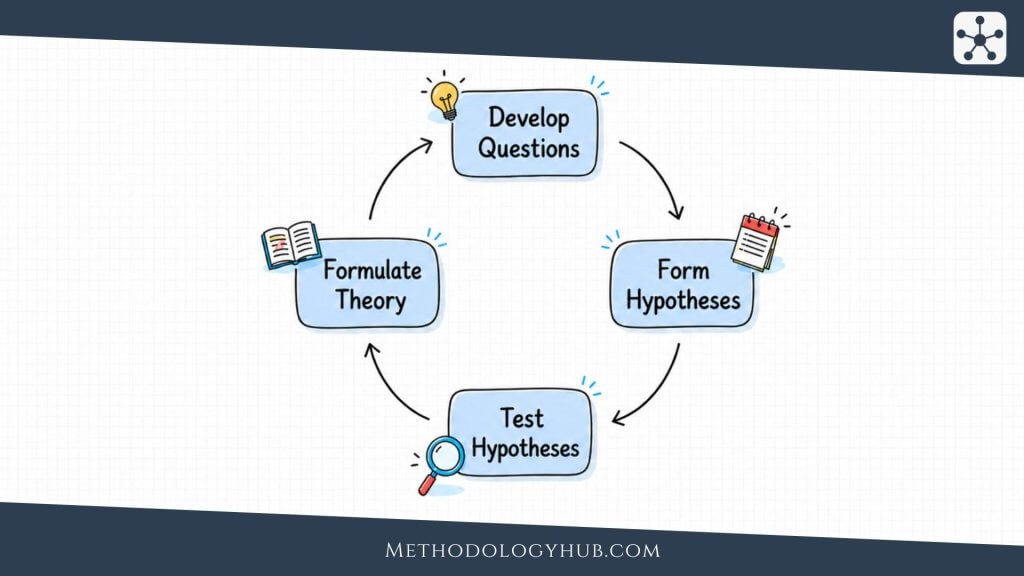
Most Different Systems Design (MDSD) is a comparative research design that investigates a shared outcome or relationship across cases with contrasting social, institutional or historical backgrounds. Researchers examine whether a common explanatory factor operates across those differences. Among the broader types of research, it provides a strategy for studying explanations across varied settings.
Within comparative research, MDSD directs attention towards recurrence: how do different settings produce a similar result, or display a similar relationship? The background contrasts help researchers investigate whether an explanation depends on one particular context.
This article explains how MDSD works, how to select and analyse cases, its relationship to MSSD, and the conclusions it can support.
What Is Most Different Systems Design?
A most different systems study asks how a phenomenon recurs under contrasting conditions. The cases differ on features that could plausibly shape the outcome, yet the phenomenon remains visible. That pattern creates an explanatory question: what connects the cases despite their different backgrounds?
Most Different Systems Design Definition
In its common case-based form, MDSD selects contrasting cases that share an outcome, then examines common factors that might help explain it. The familiar shorthand is different contexts, a shared outcome, investigate a shared explanation. The design identifies a direction for inquiry; detailed evidence is needed to determine whether the proposed explanation fits.
Consider community environmental monitoring projects in an urban river district, a rural wetland area and a coastal town. They operate with different resources, participant populations and local institutions, yet each maintains volunteer participation through a monitoring programme. Regular feedback from a local coordinator could be a common feature worth investigating.
Origins of MDSD
Adam Przeworski and Henry Teune developed the most different systems approach in The Logic of Comparative Social Inquiry in 1970. Their discussion concerned explanations that could operate across social systems, particularly relationships below the system level. An individual-level relationship might recur in different countries even when national institutions and cultures differ.
This original formulation is broader than the teaching example of several countries with one shared national outcome. A study can select different systems and examine a relationship among people or groups within them. The distinction affects both the evidence collected and the level at which the explanation is evaluated.
When to Use Most Different Systems Design
MDSD is useful when a question concerns the reach of an explanation across contexts. A researcher may want to investigate whether a participation mechanism operates under different institutional arrangements, whether a recurring historical process has common conditions, or whether a relationship found in one setting appears elsewhere.
The design can involve a small number of intensive comparisons using case study research. It can also include many observations within a small number of systems. Three community projects remain three project-level cases, even if the researcher follows numerous volunteers inside each one.
Its potential contribution is an explanation with a clearly examined range of application. Contrasting cases can expose a dependence on local conditions that a study confined to one setting might miss. They can also reveal that apparently similar outcomes arise through different processes.
The Logic of Most Different Systems Design
The logic begins with a shared pattern that survives relevant background differences. Comparing that pattern across cases helps identify common explanatory candidates, while the contrasts make some context-specific accounts less persuasive.
Different Backgrounds and a Shared Outcome
The environmental monitoring example can be organised around project conditions, a common practice and continued volunteer participation. The table provides an illustrative comparison whose shared outcome requires further explanation.
| Comparison feature | Urban river project | Rural wetland project | Coastal project |
|---|---|---|---|
| Local setting | Densely populated district | Dispersed settlements | Small coastal town |
| Institutional arrangement | Municipal partnership | Community association | University-supported group |
| Available resources | Dedicated project funding | Limited shared equipment | Laboratory and training support |
| Common practice | Regular coordinator feedback | Regular coordinator feedback | Regular coordinator feedback |
| Outcome under investigation | Continued volunteer participation | Continued volunteer participation | Continued volunteer participation |
The different arrangements make dedicated municipal funding an incomplete explanation for participation across all three projects: the rural project sustains participation without that arrangement. Coordinator feedback remains a plausible common factor, although shared motivation, task accessibility or local environmental concern could also contribute.
Mill’s Method of Agreement
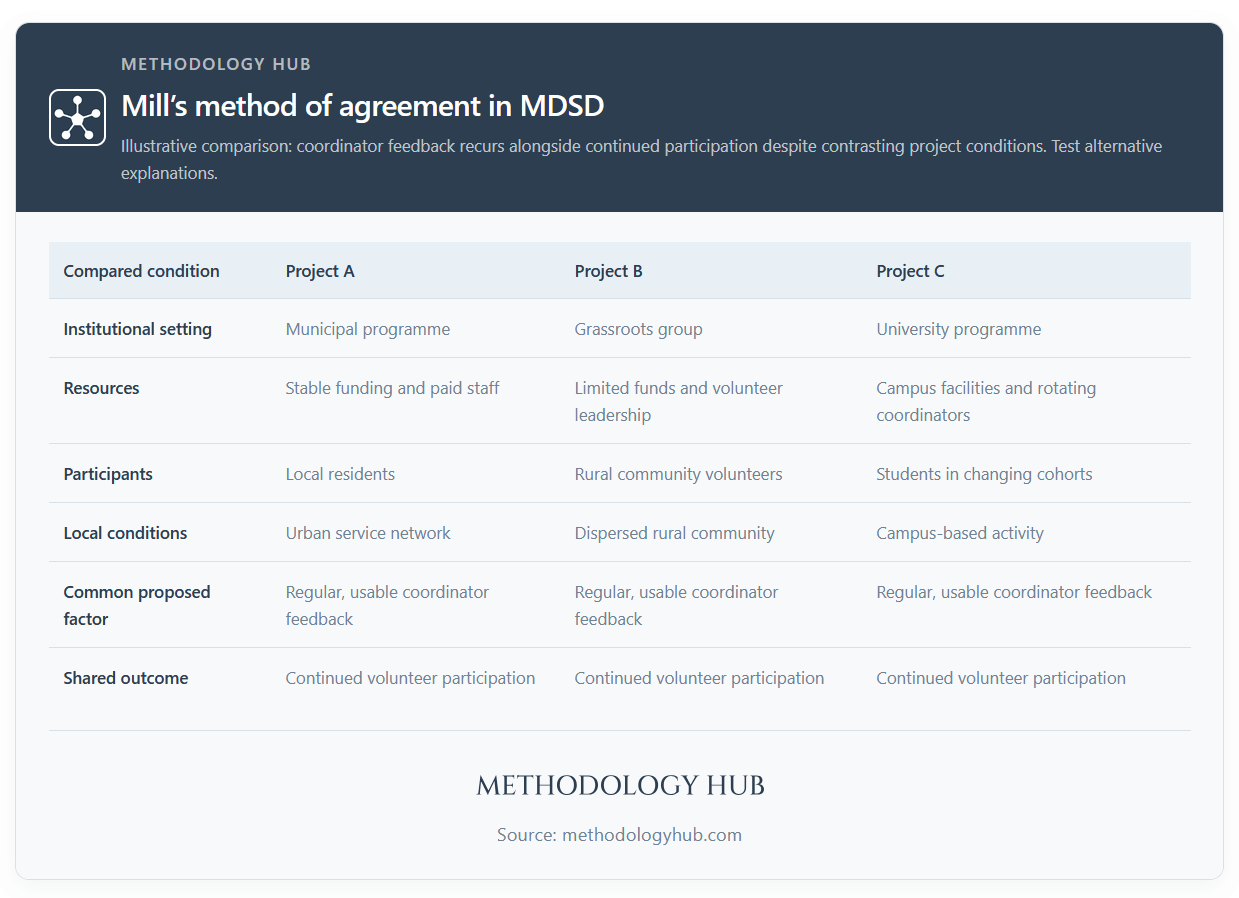
MDSD is often associated with John Stuart Mill’s method of agreement. Its idealised reasoning examines instances of a phenomenon that share one circumstance despite differing otherwise. That common circumstance becomes a possible explanation. Social comparisons rarely isolate a single shared circumstance so neatly.
Several projects may share feedback, committed participants and a manageable workload. The comparison must distinguish their explanatory roles instead of choosing whichever factor is easiest to name. A shared feature also needs to precede the relevant outcome if it is proposed as a cause.
Background differences help assess explanations, but difference alone does not eliminate a factor. Different funding sources might all provide enough resources to keep tasks manageable. What varies in administrative form may remain similar in its practical effect.
Explanatory Factors and Outcome Variables
In this study, continued participation is the outcome, or dependent variable, while coordinator feedback is the proposed explanatory factor. Funding arrangements and local institutions describe the contrasting contexts. Their roles among variables in research follow from the question being investigated.
If all selected projects have feedback and continued participation, the case-level comparison contains no variation in either feature. It cannot estimate their statistical association from those cases alone. It can investigate how feedback operates, examine alternative explanations and identify cases that would challenge the proposition.
Within the projects, volunteer experiences may still vary. Some participants receive useful feedback promptly; others receive little or none. Evidence about those differences can help examine the proposed relationship, provided the analysis respects the distinction between individual volunteers and project-level conditions.
Most Different Systems Design vs Most Similar Systems Design
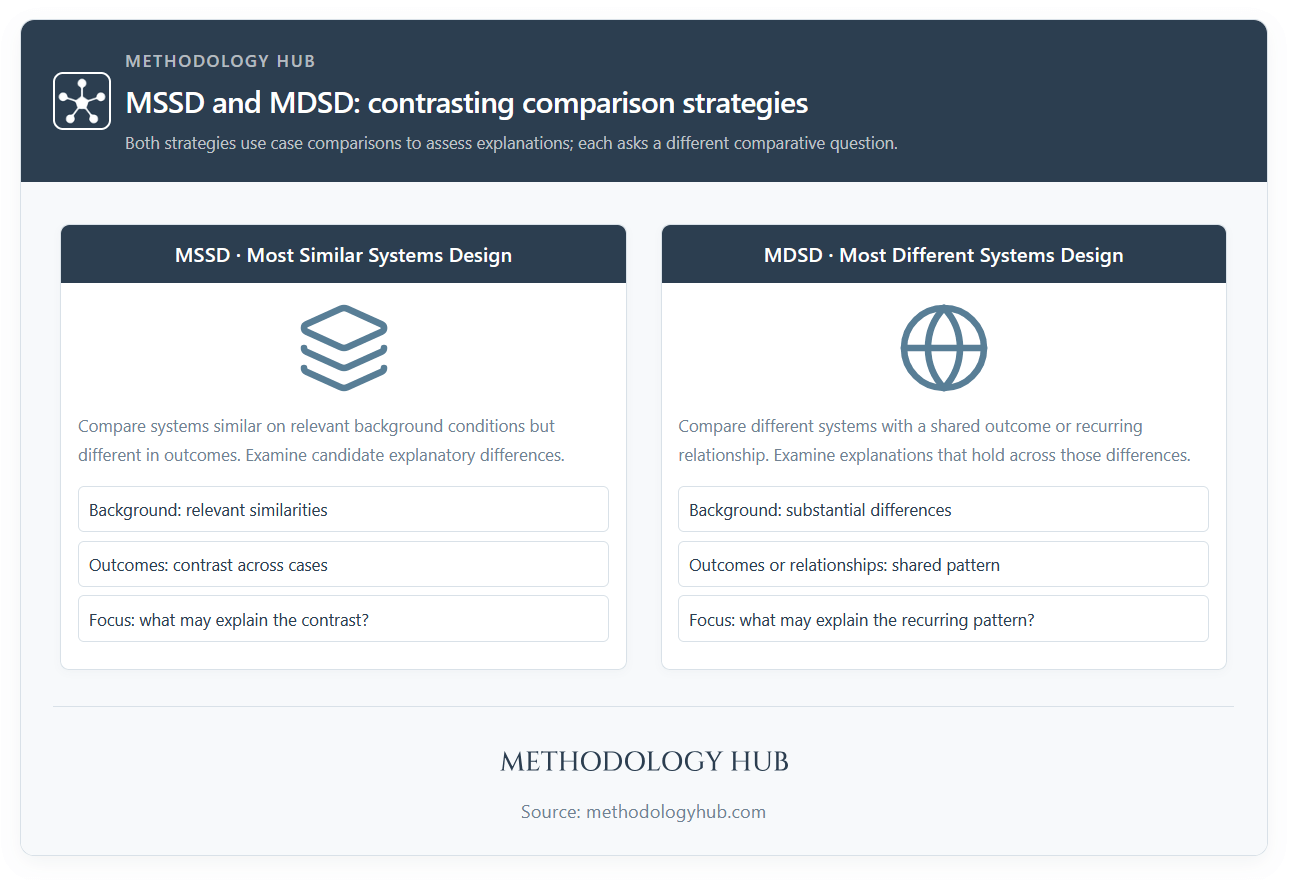
MDSD and Most Similar Systems Design (MSSD) address different comparative questions. The choice depends on the pattern requiring explanation and the kinds of contrast available in the case population.
| Design feature | MDSD | MSSD |
|---|---|---|
| Background selection | Contrasting on relevant conditions | Similar on relevant conditions |
| Usual case-level puzzle | Why does an outcome recur across different settings? | Why do comparable settings produce different outcomes? |
| Candidate explanation | A factor or process shared across contexts | A factor or process that differs between cases |
| Common logical connection | Method of agreement | Method of difference |
| Main selection trade-off | Contextual range increases measurement demands | Close comparability narrows contextual range |
Shared Outcomes and Contrasting Outcomes
An MDSD question could ask how volunteer participation is maintained in projects with different institutional support. An MSSD question could ask why participation declines in one project but continues in another with similar resources and recruitment procedures. Each comparison directs attention towards a different pattern in the evidence.
The background characteristics do different analytical work. In MDSD, their variation helps investigate whether an explanation depends on a particular context. In MSSD, their similarity helps reduce selected alternative explanations for an outcome contrast. Neither strategy makes those background conditions irrelevant to the causal process.
Selecting the Appropriate Design
Choose MDSD when the research question concerns a recurring outcome or a relationship that may operate across different systems. Choose MSSD when the question concerns divergence among sufficiently comparable cases. A design is useful when its selection logic helps discriminate among the explanations under consideration.
The original most different systems approach can examine individual-level relationships within contrasting national settings. It therefore does not always require identical national outcomes. The shorthand in the table describes the common case-level comparison, while the research report should specify the actual level of analysis.
The strategies can also complement one another. A most different comparison may identify a mechanism that recurs across projects. A subsequent comparison of closely similar projects with contrasting participation outcomes can investigate why that mechanism operates in some cases and fails in others.
Case Selection in MDSD
Choosing different cases requires an explicit account of difference. Geographic distance or unfamiliarity provides little justification on its own. The relevant contrasts are those that help examine the explanation, while the cases must remain comparable on the phenomenon being studied.
Defining the Case Population and Outcome
Specify which cases could enter the study. For community monitoring, the population might consist of volunteer projects collecting environmental observations through a defined programme. A project is the main case; its participants provide evidence about behaviour and experience within that setting.
Define continued participation before deciding which projects meet the outcome criterion. For a twelve-week programme, the researcher could require at least three-quarters of initial volunteers to complete nine or more scheduled activities. Justify the threshold before selection and use consistent rules for missed activities. The projects can then be assessed against a shared criterion.
A focused research question identifies the explanation to examine: through what process does coordinator feedback support continued participation across contrasting project settings? Selection then concerns both the shared outcome and the contextual range relevant to that process.
Selecting Theoretically Relevant Differences
Identify the conditions under which an explanation might change or cease to operate. Useful contrasts in the monitoring example could include:
- Institutional support: a municipal partnership, community association or university-supported arrangement.
- Resource availability: differences in equipment, funding and training access.
- Participant composition: variation in prior experience, age groups or available time.
- Local environment: contrasting access conditions, settlement patterns and monitoring tasks.
- Coordination arrangements: how responsibility and decision-making are organised.
A contrast is informative when it challenges a plausible context-dependent explanation. If participation requires substantial prior scientific experience, a project involving mainly inexperienced volunteers provides a useful case. Adding a different landscape contributes less if landscape has no bearing on the proposed mechanism.
Maintaining Conceptual Comparability
The cases need a shared conceptual basis even when their backgrounds differ. Completing a required university assignment is not equivalent to continuing a voluntary community activity. Treating both as volunteer retention would blur the outcome and introduce different incentives.
The same issue applies to feedback. A technical correction, public recognition and an explanation of how observations were used may all be described as feedback, but they could affect participation through different processes. Record the specific practice before deciding whether it represents a common explanatory factor.
Documenting Selection and Additional Cases
Explain how candidate projects were identified, which were eligible and which were selected. A collection drawn only from well-publicised projects may overlook groups that struggled to maintain participation. Access limitations should be connected to their effect on the comparison.
Keep potential counterexamples in view. A project with continued participation but no coordinator feedback challenges a claim that feedback is necessary. A project with feedback but declining participation challenges a claim that feedback alone is sufficient. Such cases extend the investigation beyond the initial set with a shared outcome.
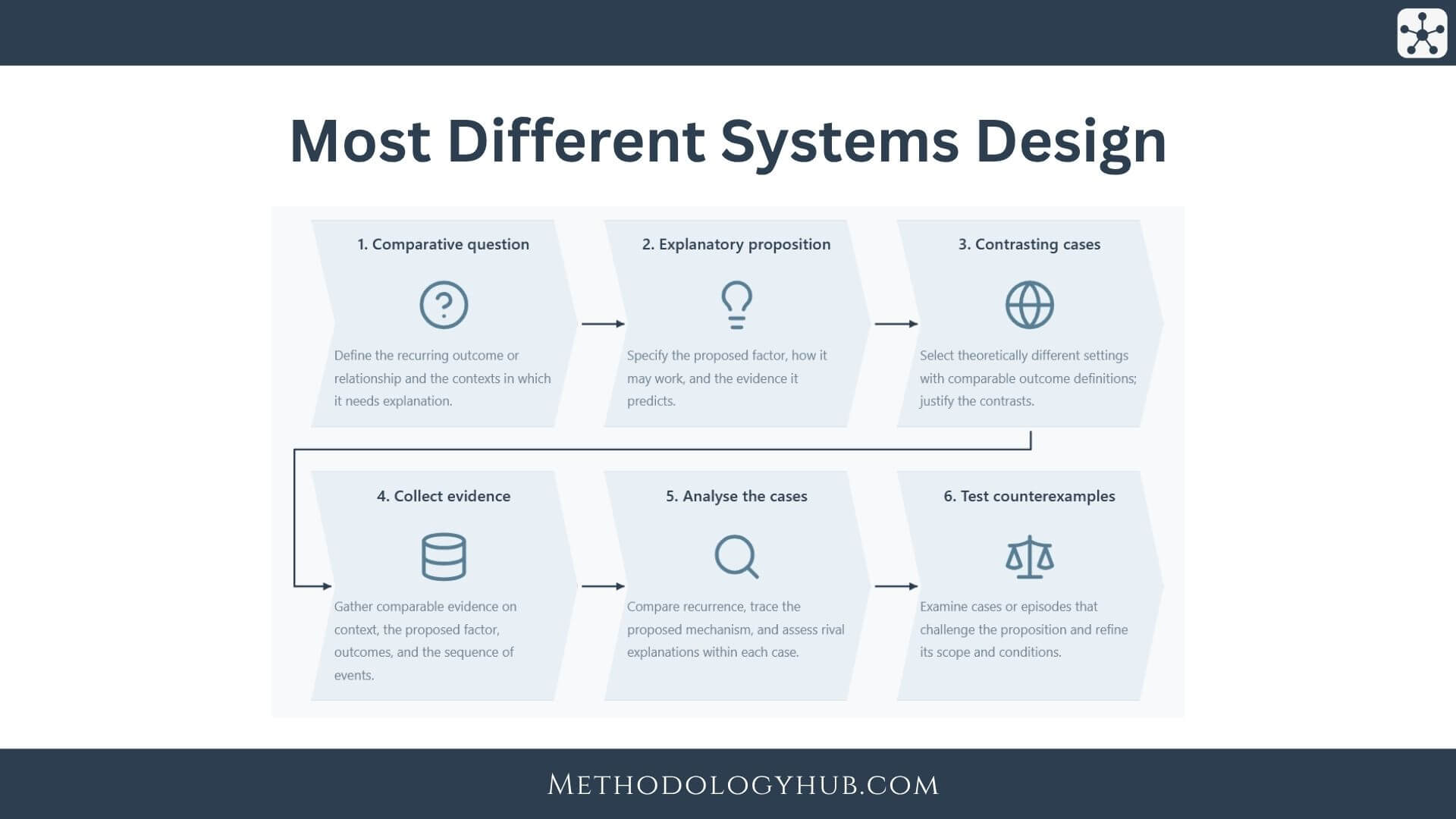
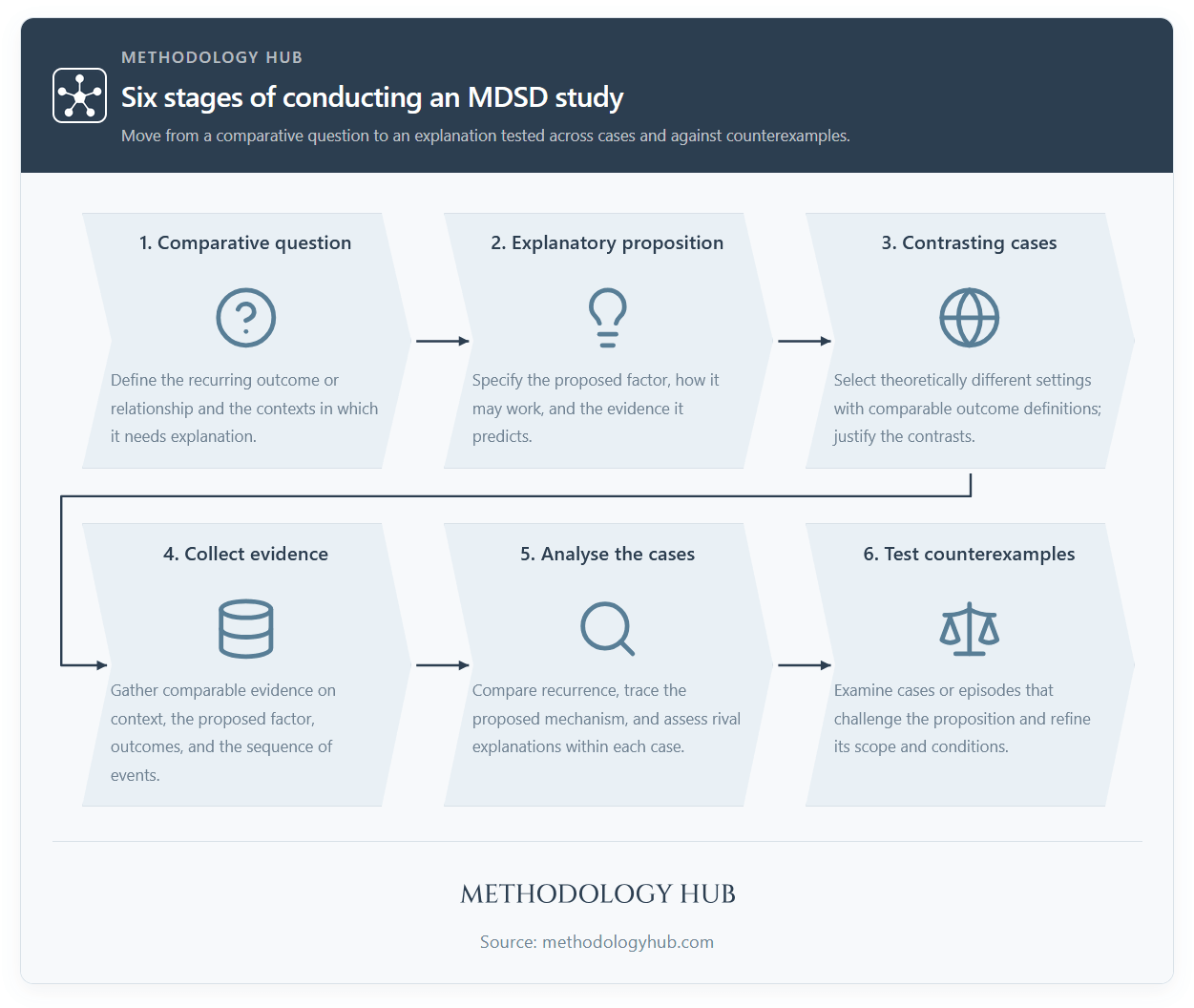
How to Conduct MDSD
Conducting an MDSD study involves linking the selection of contrasting cases with a precise explanatory task. The procedure needs room for revising the explanation when common features turn out to operate differently or when a counterexample changes the interpretation.
- Specify the recurring outcome or relationship that needs explanation.
- Develop a proposition about a shared explanatory factor or mechanism.
- Select cases with relevant contextual contrasts and comparable evidence.
- Collect information about the outcome, proposed factor and competing explanations.
- Analyse the process within each case and compare the findings across settings.
- Examine counterexamples and define the conditions covered by the conclusion.
Developing the Explanatory Proposition
Move from a common feature to an account of how it could affect the outcome. In the monitoring projects, the proposition might be that timely feedback helps volunteers understand how their observations contribute to the project, increasing their willingness to continue. This identifies an intermediate process that the research can examine.
The proposition also guides the search for evidence. Participants should encounter the feedback before deciding to continue, understand its relevance and connect that understanding with their participation. If they remain involved mainly because of social ties, the feedback explanation may account for less of the outcome than expected.
Designing Comparable Data Collection
Select data collection methods that can investigate the same analytical issues in each setting. Participant records can show continuity; observations can capture feedback exchanges; interviews can examine how volunteers interpret their contribution. Project documents establish aims, responsibilities and the schedule of activities.
Keep a common core of questions while adapting practical arrangements. An interview might be conducted after an urban monitoring session or during a visit to a dispersed rural group. The circumstances differ, but the questions about feedback, motivation and continued involvement should remain comparable.
Check whether the records identify the same events. One project may record sign-ups while another records completed activities. Those counts describe different stages of participation. Aligning them requires a common definition and, where possible, access to the underlying records.
Investigating Each Case in Context
Build an account of how participation develops in each project before drawing the cross-case conclusion. Identify when feedback occurs, what volunteers receive and how they respond. Examine episodes of withdrawal as well as continued involvement, so that the case account includes variation hidden by the overall outcome.
Record competing processes alongside the proposed mechanism. A coastal group may continue because monitoring coincides with an established social activity. A rural group may rely on personal commitments to its coordinator. Those conditions could reinforce feedback, substitute for it or explain participation independently.
Comparing Findings and Refining the Claim
Compare the evidence for the mechanism across all selected cases. Regular feedback might have a similar label but perform different functions: resolving technical uncertainty in one project and giving public recognition in another. Decide whether the findings support one broader mechanism or several separate explanations.
Refinement may require a narrower proposition. Feedback could support participation when volunteers can see a connection between their work and the project result, while purely administrative messages have little influence. That conclusion specifies what kind of feedback is explanatory and what evidence would be needed in another setting.
Data Analysis in MDSD
MDSD analysis evaluates how far a shared explanation survives contextual variation. Finding a common feature is one part of that work. The analysis also needs to examine its timing, operation and relationship to alternative pathways.
Evaluating a Common Explanatory Factor
Organise the comparison around questions that can strengthen, narrow or challenge the proposition. Each question should be answered with evidence from every case, so that a detailed account of one project does not stand in for the others.
| Analytical test | What the comparison examines | Evidence in the monitoring example |
|---|---|---|
| Commonality | Whether the proposed practice exists in each case | Feedback records and observed exchanges |
| Temporal order | Whether the factor precedes the relevant outcome | Dated messages and participation histories |
| Mechanism | How the factor could influence continued involvement | Participant responses and subsequent activity |
| Alternative pathways | Whether another process explains the shared result | Social ties, task incentives and withdrawal accounts |
| Counterexamples | Whether the proposed condition fits cases beyond the initial set | Projects missing feedback or losing participants |
The evidence may differ in form without differing in analytical purpose. A written message and an observed discussion can both establish that volunteers received feedback. Their content still needs examination: the presence of communication does not establish that volunteers learned how their contribution was used.
Process Tracing Across Different Contexts
Process tracing reconstructs the sequence through which a proposed explanation could produce an outcome. In each project, the researcher might follow feedback, recognition of a useful contribution and a later decision to participate again. The sequence should be supported by records, observed behaviour or carefully assessed participant accounts.
Compare the sequence across contexts rather than expecting identical procedures. A coordinator may give feedback during a group meeting in one setting and through individual conversations in another. These practices could support the same mechanism if both help volunteers understand their contribution.
Accounts of motivation should be considered alongside behaviour and timing. A volunteer may praise feedback retrospectively even though participation continued before feedback began. That evidence supports a positive view of the project more directly than it supports the proposed causal sequence.
Necessary and Sufficient Conditions
A necessary condition must be present whenever the specified outcome occurs within the claim’s scope. If feedback is claimed to be necessary for continued participation, a project that maintains participation without feedback is a counterexample. Finding feedback in the initial cases is consistent with necessity, but cannot establish it for all eligible projects.
A sufficient condition produces the outcome whenever that condition is present within the specified scope. A project with feedback and declining participation challenges a claim that feedback alone is sufficient. It may instead support a conditional explanation involving accessible tasks, trusted coordination or practical support.
This distinction prevents a common feature from carrying a stronger claim than the comparison supports. The study may identify a contributing condition in a causal combination even when that condition is neither necessary nor sufficient on its own.
Relationships Within Different Systems
In a design focused on volunteers within projects, the researcher can examine whether the relationship between feedback experiences and continued participation appears in each setting. The analysis needs comparable measures and sufficient variation among participants. It should also account for volunteers sharing a project context.
Qualitative comparative analysis offers a separate way to examine configurations of conditions using set relationships. An MDSD selection strategy can inform the choice of cases for such an analysis, but selecting different systems does not itself constitute a formal analysis of necessary or sufficient configurations.
Examples of Most Different Systems Design
MDSD can be used in historical, political and educational inquiry. Published comparisons also show why the design should be described in terms of the actual cases, explanatory level and evidence, rather than forced into a single simplified formula.
Social Revolutions in France, Russia and China
In States and Social Revolutions, Theda Skocpol analysed social revolutions in France, Russia and China. Her account connected revolutionary transformations with the breakdown of state administrative and military power, international pressures and agrarian class relations. The cases had contrasting historical trajectories, while the explanation investigated shared structural conditions.
The comparison is often used to illustrate the search for common explanations across different settings. The countries also shared important features, including established imperial states and agrarian social structures. The study is therefore better understood as a substantive historical comparison than as three otherwise unrelated countries sharing one isolated cause.
For historical comparisons of this kind, archival data can help reconstruct institutional crises, decisions and social relations. The analytical task is to explain the sequence and combination of conditions, while assessing whether the surviving evidence is comparable across cases.
Constitutional Courts and Public Opinion
Sebastian Sternberg, Sylvain Brouard and Christoph Hönnige used a most different systems rationale in a study of constitutional courts in Germany and France. They conducted comparative survey experiments to investigate whether court decisions could influence public opinion on policy, with trust in the court contributing to the proposed individual-level mechanism.
One pooled analysis included 1,694 respondents from Germany and 1,601 from France. Those observations supported an investigation within two national settings. The contrast between court systems supplied the broader comparative context; the experiments and respondent-level evidence addressed the mechanism.
This example follows the broader MDSD approach to relationships within different systems. The research question concerns how an individual-level mechanism operates under contrasting institutional conditions, rather than requiring the two countries to display identical aggregate public opinion.
Peer Explanation in Different Learning Settings
An educational study could examine peer explanation in a secondary-school science group, an adult learning course and a university seminar. The settings differ in age, prior knowledge and course organisation, but each may show improved understanding after participants explain ideas to one another.
The proposed mechanism might involve making reasoning explicit and receiving a response that exposes uncertainty. Evidence could include recorded discussions and changes in participants’ explanations. Assessments would need to measure the same aspect of understanding despite different course content. If one setting improves mainly through teacher correction, the shared outcome would conceal an alternative process.
Across these examples, a useful comparison identifies the level at which the explanation operates. Historical state structures, individual responses to institutions and learning-group interactions require different evidence, even when all three studies use contrasting settings to investigate explanatory reach.
Limitations of Most Different Systems Design
The contextual range of MDSD creates both an opportunity and a challenge. An explanation can be examined under varied conditions, but variation increases the difficulty of making concepts, records and causal processes comparable.
Selection on a Shared Outcome
Cases selected because an outcome occurred can help develop an explanation and investigate how the outcome arose. They provide limited evidence about what happens when the proposed cause is absent or when the outcome fails to occur. A shared feature could also be common throughout the wider population, including unsuccessful cases.
For example, coordinator feedback may be routine in monitoring projects whether or not volunteers remain involved. Studying only projects with continued participation would then make feedback appear explanatory without establishing that it distinguishes the outcome. Counterexamples and broader case information help assess that possibility.
Hidden Common Factors and Reverse Causation
Different settings can share an unrecorded influence. Projects may all recruit highly motivated volunteers, receive informal assistance or rely on trusted coordinators. These similarities can remain hidden when a comparison emphasises visible institutional differences.
The direction of influence can also be uncertain. A coordinator might provide more feedback because an active group asks more questions and submits more observations. Participation would then help generate feedback. Establishing the sequence and examining variation over time is necessary to assess the proposed direction.
Different Pathways to the Same Outcome
Equifinality means that different causal pathways can produce the same outcome. One group may continue because feedback sustains interest, another because participation maintains social ties, and a third because volunteers have a strong prior commitment to environmental protection.
Evidence that would require revising a shared explanation includes:
- The outcome appears in a relevant case without the proposed factor.
- The factor appears in a relevant case without the predicted outcome.
- The expected intermediate process is missing from one or more cases.
- The outcome develops before the proposed cause begins to operate.
The appropriate revision depends on the claim. A missing factor challenges necessity; a missing outcome challenges sufficiency; a missing mechanism questions the proposed process. The study may need to recognise several pathways or narrow the conditions under which its explanation applies.
Measurement and Generalisation
Different contexts may attach different meanings to the same indicator. A completed monitoring activity could involve a short observation in one project and several hours of fieldwork in another. Equivalent participation counts may therefore represent different commitments. Measures should be interpreted against the demands and incentives of each setting.
Contextual diversity does not automatically establish universal applicability. Three contrasting projects cover only part of the range of volunteer activities, institutional arrangements and participant populations. A conclusion should identify the conditions actually examined and those that remain outside the evidence.
The strongest extension follows an explicit mechanism: other cases may fit the explanation if they contain the conditions through which the mechanism operates. Later comparisons can examine that proposition. Diversity helps test explanatory reach, while the scope of the final claim remains tied to the evidence.
Conclusion
Most Different Systems Design investigates recurring outcomes or relationships across contrasting contexts. Its contribution depends on defining the shared phenomenon precisely and examining how a proposed explanation operates in each setting.
A common factor becomes informative when the evidence connects it with the outcome, distinguishes it from alternative pathways and identifies conditions that could challenge the claim. Differences between systems help examine explanatory reach, while within-case analysis shows what the apparent recurrence contains.
Begin with a focused comparative question, select contrasts that test the explanation and keep the level of analysis explicit. The resulting study can develop a transferable mechanism, reveal several routes to the same outcome or establish where an initial explanation needs to be narrowed.
Cite this article
Whether you are preparing course materials, writing an academic paper, or sharing resources with students, we kindly ask that you acknowledge Methodology Hub as the source.
To make referencing easier, you can use the “Cite this page” tool below to automatically generate a citation in your preferred referencing style, including APA, MLA, Chicago, Harvard, and others. Simply select a citation style and click the generated reference to copy it.
When reproducing images, figures, or other materials from this page, please include an appropriate source credit and a link to the original page. Proper attribution helps others locate the original material and supports the continued development of freely accessible educational resources.