Archival data in qualitative research refers to existing records that have been preserved before the current study begins. These records may include letters, meeting minutes, reports, photographs, diaries, institutional files, websites, newsletters, forms, policy documents, oral history transcripts, or other materials kept in an archive, organisation, repository, collection, or digital record system.
In qualitative research, archival data can help researchers study past events, institutional practices, changing language, public communication, decision-making, community memory, and the way people or organisations recorded their own activities. The researcher does not create the data through an interview or questionnaire. The researcher works with records that already exist.
Archival data can be analysed alone or combined with other qualitative research methods. It is especially useful when a study asks how something developed over time, how decisions were recorded, how a group described itself, or how a public issue appeared in documents produced at different moments.
What is Archival Data
Archival data is existing material preserved for record, memory, administration, public access, or later use. It may be kept in a formal archive, a library collection, a public record office, an organisation’s internal files, a community collection, a digital database, or a personal collection made available to researchers.
The word archival does not only refer to old historical documents. Recent digital records, organisational files, newsletters, photographs, transcripts, web pages, and project records can also be archival data if they were produced before the current research and are being studied as existing records.
Archival data definition
Archival data in qualitative research is pre-existing recorded material that is selected, examined, and interpreted to answer a research question. The material may be textual, visual, audio, digital, administrative, historical, public, private, formal, or informal.
The method is qualitative when the researcher analyses meaning, context, language, categories, practices, change, and interpretation rather than only counting items. A researcher may count how often a term appears, but the main analysis asks what the term means in its context and how it is used.
Archival data as already-made data
Archival data differs from data generated directly for the study. In an interview, the researcher asks questions and participants respond for the research project. In archival work, the researcher examines records produced for other purposes.
This difference is important because archival records were not created to answer the researcher’s exact question. A meeting minute may have been written to record decisions, not to preserve disagreement. A photograph may have been kept to celebrate an event, not to document who was absent. The researcher has to interpret the record with that purpose in mind.
What archival data can show
Archival data can show how people described events, how organisations recorded decisions, how categories changed, how public messages were written, how routines were documented, and how a group represented itself at a particular time. It can also show gaps, absences, revisions, and contradictions.
For example, a community organisation’s newsletters may show which activities were celebrated, which concerns were repeated, which groups were named, and how the organisation’s role changed across several years. The data come from the preserved record, not from later memory alone.
| Feature | What it means for analysis |
|---|---|
| Pre-existing | The record was not produced mainly for the current study. |
| Preserved | The material survived through a collection, archive, institution, platform, or personal record. |
| Contextual | The record needs interpretation through its date, purpose, producer, audience, and preservation history. |
Archival Data and Document Analysis
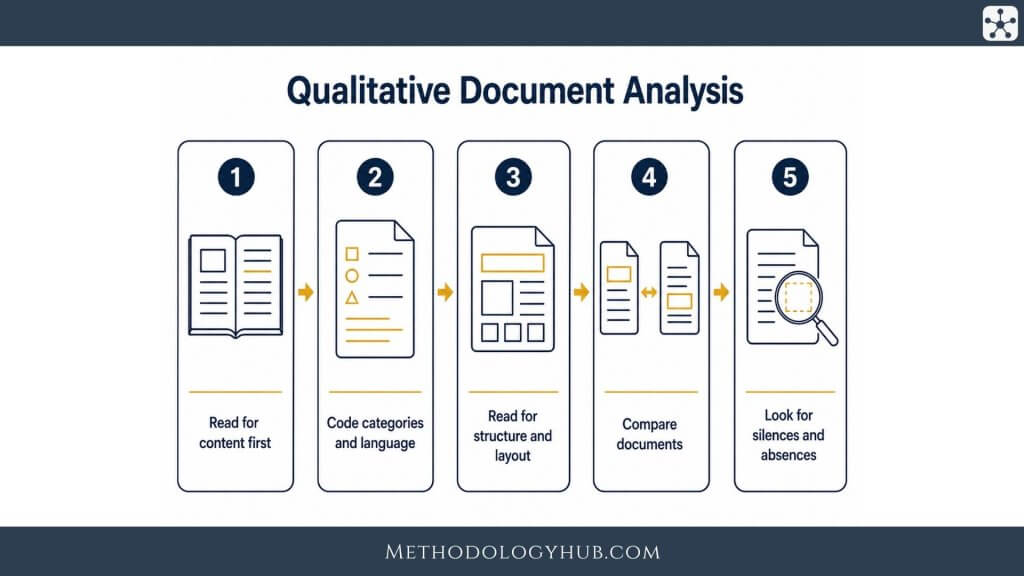
Archival data and document analysis overlap, but they are not identical. Qualitative Document Analysis can examine many kinds of written or visual materials. Archival data refers to the preserved record that the researcher works with, whether the material is a document, image, recording, dataset, or digital trace.
A study may use document analysis to analyse archival data. For instance, a researcher may examine archived policy drafts, old public notices, or newsletters. The data are archival because they are preserved records. The analytic approach may be document analysis because the researcher reads content, wording, structure, and context.
Overlap between the two
Both approaches ask the researcher to treat written or recorded materials as qualitative evidence. Both require attention to context, purpose, audience, and language. Both can examine formal documents, public communications, and working records.
The overlap is strongest when archival data are textual. A file of historical meeting minutes, for example, can be described as archival data and analysed through qualitative document analysis.
Where archival data is broader
Archival data can include more than documents. It may include photographs, audio recordings, maps, catalogues, objects with labels, web archives, databases, oral history recordings, and digitised collections. Some of these materials need visual, spatial, audio, or multimodal analysis rather than only document analysis.
A photograph archive, for example, may require attention to image composition, captions, collection order, event context, and what kinds of scenes were considered worth preserving.
Difference: archival data describes the record. Document analysis describes one way to interpret the record.
Why the distinction helps
The distinction helps the researcher describe the study accurately. “Archival data” explains where the material comes from and how it exists as a preserved record. “Document analysis” explains one possible way to analyse that material.
This clarity is useful in a methods section. A study might say that it uses archival data from a local organisation and analyses meeting minutes, newsletters, and public notices through qualitative document analysis.
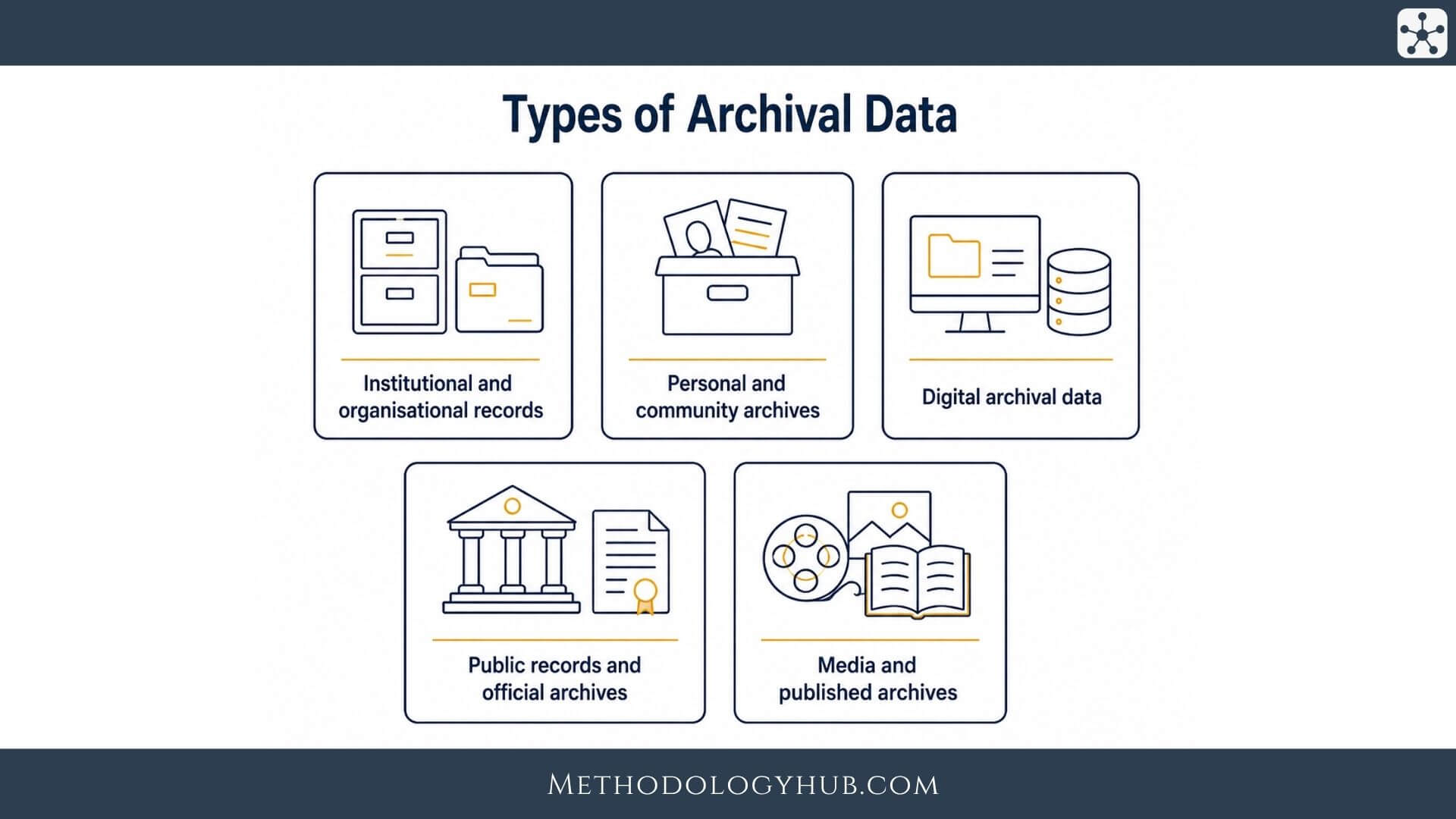
Types of Archival Data
Archival data can appear in many forms. The researcher should describe the type of archival material because different records require different handling and analysis. A handwritten diary, a spreadsheet of service records, a set of photographs, and a digitised website archive all create different kinds of evidence.
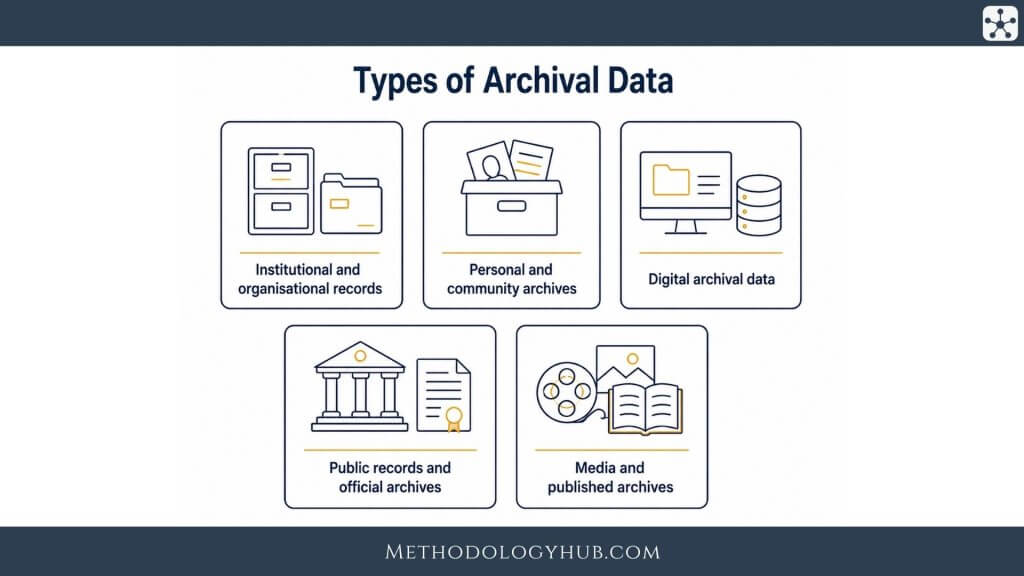
Institutional and organisational records
Institutional records include minutes, reports, policies, internal memos, forms, registers, annual summaries, guidance documents, training materials, and administrative files. They can show how an organisation recorded decisions, named problems, assigned responsibilities, and represented its work.
These records are often formal, but they are not neutral. They reflect the categories, rules, and recording habits of the institution that produced them.
Personal and community archives
Personal and community archives may include diaries, letters, photographs, newsletters, scrapbooks, oral history transcripts, event programmes, posters, and local records. These materials can show memory, identity, belonging, conflict, and community change.
Community archives may preserve material that is missing from official collections. They can also reflect the priorities of the people who collected and organised them.
Digital archival data
Digital archival data includes archived websites, email collections, digital newsletters, forum posts, social media archives, online documents, scanned files, and digital repositories. These materials can show how communication, participation, and records changed across time online.
Digital material needs attention to version, date, platform, access conditions, and preservation format. A webpage captured in one month may differ from the same page captured later.
| Archival data type | Example research focus |
|---|---|
| Meeting minutes | How decisions were recorded and which disagreements were absent. |
| Photographs | How events, groups, places, or identities were visually represented. |
| Archived webpages | How public messages, categories, or instructions changed over time. |
Public records and official archives
Public records may include census materials, court records, planning documents, government reports, public consultations, inspection reports, and official correspondence. These records can help researchers study policy, administration, public decision-making, and social categories.
Official records often carry authority, but they also reflect the viewpoint of the institution that produced them. The researcher should ask what the record was designed to capture and what it was not designed to capture.
Media and published archives
Published archives can include newspapers, magazines, newsletters, radio transcripts, public speeches, campaign materials, and published reports. These materials are useful for studying public language and representation.
A researcher might examine how a local newspaper described housing, schooling, health, or public space over several years. The analysis would need to consider the publication’s audience, format, and editorial choices.
When Archival Data Is Useful
Archival data is useful when the study asks about the past, about change over time, or about records that shaped how people understood a situation. It is also useful when the researcher wants to compare official accounts, public communication, or preserved memory with other forms of evidence.
Archival data can be especially helpful when the people involved are no longer available, when events happened long ago, or when the researcher wants to understand how a topic was recorded before it became the focus of the current study.
Studying change over time
Archival data can show shifts in language, categories, priorities, and explanations. A researcher may compare old and new handbooks, public reports, newsletters, or web pages to understand how an issue changed.
For example, school documents might show how language around student support changed from discipline and attendance toward wellbeing and inclusion. The shift can be analysed through wording, categories, and document structure.
Studying recorded decision-making
Meeting minutes, reports, memos, and correspondence can show how decisions were documented. They may show what was formally recorded, who was named, which options were considered, and how a final decision was justified.
They may also show what was left out. A decision record may preserve a formal outcome while removing uncertainty, disagreement, or informal negotiation.
Studying public communication
Archived leaflets, websites, public notices, speeches, and newsletters can show how an organisation or group communicated with a wider audience. The researcher can examine wording, tone, images, categories, and calls to action.
This is useful when the research question concerns representation. The archive can show how a topic was made public and how the intended audience was addressed.
Recommendation: choose archival data when the preserved record itself can answer the question, not only when it is convenient to access.
Studying absence and survival
Archives show what survived, but they also raise questions about what did not. Some groups may appear often in records. Others may appear only through institutional descriptions or not at all. Some events may be carefully documented, while others leave only a small trace.
These gaps can be part of the analysis. The researcher should avoid treating the archive as a complete record of the past or the organisation.
Building an Archival Data Set
Building an archival data set means deciding which records belong in the study. The researcher needs a selection logic, a search process, a document log, and a way to record limits. The data set should be built in relation to the research question, not only around what is easiest to download.
This step is often slower than it looks. Archives may be incomplete, poorly catalogued, restricted, scattered across locations, or organised according to categories that do not match the research question.
Define the archive boundary
The researcher should decide where the data set begins and ends. Boundaries may be based on time period, organisation, collection, place, document type, platform, event, or keyword. For example, a study may examine all publicly available newsletters from one community organisation between 2005 and 2020.
The boundary should be explained clearly so readers know what was included and what was outside the study.
Create inclusion criteria
Inclusion criteria state which records are part of the data set. The criteria might include date range, producing organisation, topic, language, document type, public availability, or relevance to a specific event.
Exclusion criteria are also useful. A researcher may exclude duplicate copies, incomplete files, unrelated administrative forms, or records outside the chosen time period. These choices should be recorded.
| Data set decision | Question to answer |
|---|---|
| Time boundary | Which years, months, versions, or periods are included? |
| Record type | Which types of records count as relevant data? |
| Access and completeness | Which records are missing, restricted, partial, duplicated, or uncertain? |
Keep a record log
A record log helps the researcher track title, date, creator, collection, file location, format, version, access conditions, notes on relevance, and any uncertainty about the item. This log becomes part of the study’s transparency.
For digital materials, the log should include the access date, capture date if available, file format, and whether the record was downloaded, photographed, transcribed, or viewed in place.
Record gaps and restrictions
Gaps are common in archival work. Some years may be missing. Some files may be closed. Some materials may have been lost, destroyed, never kept, or not catalogued. These limits should be recorded rather than hidden.
A gap may affect what claims can be made. If only public newsletters survive, the study can say more about public representation than internal decision-making.
Context, Provenance, and Gaps
Archival data needs contextual reading. A record does not simply speak for itself. It was produced by someone, for a purpose, under particular conditions, and then preserved through a process that may have changed what is available.
Three questions are especially useful: Where did the record come from? Why was it created? How did it survive? These questions help the researcher interpret archival data without treating it as a complete mirror of reality.
Provenance
Provenance refers to the origin and history of a record. It includes who produced it, when, for what purpose, how it entered the archive, and how it has been organised or described. Provenance helps the researcher understand the record’s position.
A set of staff memos kept by a department has a different provenance from letters donated by a family or newsletters preserved by a community group. Each record type has a different path into the archive.
Original purpose
The original purpose of a record shapes its content. A report may be written to justify funding. A form may be designed to standardise decisions. A diary may be written for private reflection. A photograph may be taken to celebrate a successful event.
The researcher should ask what the record was trying to do. This prevents a record from being read as if it were created to provide a balanced account for later researchers.
Gaps, silences, and uneven survival
Archival records often survive unevenly. Some voices appear frequently because they had authority, literacy, resources, or institutional position. Other voices appear rarely or only through the words of officials.
Silences should be handled carefully. Absence can be meaningful, but it can also result from loss, access restrictions, cataloguing decisions, or the original purpose of record keeping. The researcher should interpret gaps with caution.
Recommendation: every preserved record is also a sign of selection. Ask what survived, what was excluded, and what was never recorded.
Reading against the record
Sometimes the researcher reads against the record by noticing what a document tries to standardise, hide, soften, or make routine. For example, a complaint file may show official procedure, but it may also show how people’s experiences had to be translated into categories the form allowed.
This kind of reading should stay grounded in evidence. The researcher should show how the interpretation comes from wording, structure, comparison, omissions, or context.
Qualitative Analysis of Archival Data
Qualitative analysis of archival data means moving between close reading, comparison, contextual interpretation, and attention to the archive as a collection. The researcher studies individual records, but also how those records relate to one another.
The analysis may be chronological, thematic, comparative, narrative, visual, or document-based. The best approach depends on the research question and the kind of archival data collected.
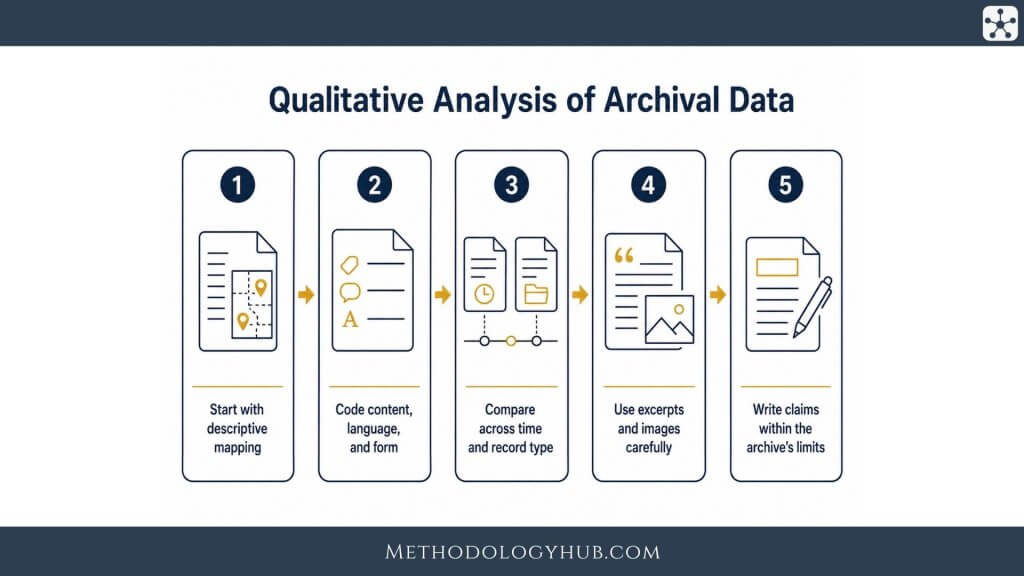
Start with descriptive mapping
Descriptive mapping helps the researcher understand the data set before interpretation becomes too specific. The researcher may map dates, document types, creators, topics, formats, events, and gaps.
This mapping can reveal unevenness. A collection may contain many records for one period and few for another. It may contain official reports but few personal accounts. These patterns shape what analysis can claim.
Code content, language, and form
Coding can examine topics, categories, repeated terms, roles, problem descriptions, explanations, images, layout, and changes in wording. The researcher may code what is present and also note what is absent or difficult to find.
For example, a set of historical newsletters may be coded for community identity, volunteers, funding, public events, conflict, membership, and local partnerships. The researcher can then compare how these categories change across years.
Compare across time and record type
Archival analysis often benefits from comparison. The researcher may compare early and later records, public and internal documents, official and community records, text and photographs, or records from different organisations.
Comparison can reveal tension. Public documents may use welcoming language, while internal documents focus on eligibility, cost, or risk. A photograph may celebrate participation, while minutes reveal difficulty organising the event.
| Analytic move | What it helps show |
|---|---|
| Chronological reading | Change, continuity, sequence, and turning points. |
| Thematic coding | Repeated topics, categories, meanings, and patterns. |
| Cross-record comparison | Differences between public, internal, visual, formal, and informal records. |
Use excerpts and images carefully
Archival findings often include short excerpts, record descriptions, or image details. These should be chosen to support a clear analytic point. The researcher should provide enough context for the reader to understand the record’s date, producer, and role in the data set.
A quotation from a 1980 newsletter, for example, should not be treated as the voice of a whole community unless the analysis explains why it carries that weight.
Write claims within the archive’s limits
The researcher should report what the archival data can show and what remains beyond the record. If the data set includes public documents only, the study can speak strongly about public representation but less strongly about private experience or informal practice.
This does not weaken the study. It makes the interpretation more precise.
Examples of Archival Data in Qualitative Research
Examples of archival data in qualitative research show how preserved records can answer different kinds of questions. The examples below focus on the link between the research question, the archival data set, and the analysis.
Example 1: Community newsletters and local identity
A researcher studies twenty years of newsletters from a community organisation. The analysis examines how the organisation described local problems, celebrated events, named volunteers, and explained its role in the neighbourhood.
The archival data can show changes in language and priorities over time. It may also show which activities were treated as central to community identity.
Example 2: School policy records and student support
A researcher analyses archived school policies, guidance documents, and student support forms from different years. The focus is on how students were described, what kinds of support were named, and how responsibility was assigned.
The analysis may show a shift from discipline-focused language toward inclusion or wellbeing language. It may also show how forms shaped what could be recorded about students’ needs.
Example 3: Meeting minutes from a public planning process
A researcher studies meeting minutes from a local planning process. The records are analysed for who was named, which concerns were repeated, how objections were summarised, and how final decisions were justified.
The minutes may show a formal history of decision-making, but they may also show how disagreement was softened into administrative language.
Example 4: Photographs from a youth arts project
A researcher analyses a photo archive from a youth arts project. The study examines which activities were photographed, who appeared in the images, how captions described participation, and which stages of the project were not shown.
The findings may show how the project represented itself publicly. They may also raise questions about which forms of participation were visible and which were not preserved in the archive.
Example 5: Archived webpages about a health service
A researcher compares archived webpages for a health service across several years. The analysis looks at how eligibility, access, appointment booking, patient responsibility, and support language changed over time.
Example: a strong archival example names the record type, time span, selection logic, and what the records can show.
The archive can show how public instructions shifted and which parts of the service were made easier or harder to understand through wording and layout.
Conclusion
Archival data in qualitative research helps researchers study existing records as evidence of language, practice, memory, decision-making, representation, and change over time. The records may be formal or informal, old or recent, textual or visual, public or restricted.
A strong archival study needs a clear research question, a deliberate data set, a record log, attention to provenance, and analysis that reads both content and context. Archival data can be powerful, but it should never be treated as a complete record of everything that happened.
FAQs on Archival Data in Qualitative Research
What is archival data in qualitative research?
Archival data in qualitative research is pre-existing recorded material that is selected and analysed to answer a research question. It can include documents, photographs, recordings, public records, digital archives, letters, minutes, reports, and organisational files.
What are examples of archival data?
Examples of archival data include meeting minutes, newsletters, policies, diaries, letters, photographs, forms, archived websites, public reports, oral history transcripts, institutional files, and community records.
How is archival data different from document analysis?
Archival data refers to preserved records used as data. Document analysis is one way to analyse those records, especially when they are textual or visual documents. Archival data can also include photographs, audio, digital traces, and other preserved materials.
When should archival data be used in qualitative research?
Archival data should be used when the research question concerns preserved records, past events, change over time, public communication, recorded decisions, institutional categories, or how a group or organisation represented itself.
How do you analyse archival data qualitatively?
Archival data can be analysed by building a clear data set, logging record details, reading for context and provenance, coding content and language, comparing records across time or type, and interpreting gaps and absences carefully.
What are the limits of archival data?
Archival data may be incomplete, selective, restricted, uneven, or shaped by the purpose of the original record. It can show what was preserved, but it should not be treated as a complete account of everything that happened.