Non-participant observation is an observational research method in which the researcher watches a setting, activity, or interaction without joining the activity directly. The researcher remains outside the main action, records what happens, and analyses behaviour, sequence, space, roles, and context from a more distant observer position.
This method is part of observational research and is often used when participation would interrupt the setting, change the activity too much, or make systematic recording difficult. A researcher may sit at the back of a classroom, observe a public service desk, watch a team meeting, or record how people move through a shared space without taking part in the activity being studied.
The sections below explain what non-participant observation means, when it is useful, how it differs from participant observation, how to plan the observer role, how to write observation records, and how to analyse data collected from a distance. The focus is practical: what the researcher does before, during, and after the observation.
What is Non-Participant Observation
Non-participant observation means studying a setting without becoming part of the activity being observed. The researcher may be physically present, but they do not take on the role of a participant. They watch, listen, record, and reflect from a position of distance.
This distance can be useful when the researcher needs a broad view of the setting. In a classroom, for example, joining an activity may limit what the researcher can see. Sitting apart may make it easier to notice how the teacher moves, which students speak, who waits for help, and how groups use materials.
Non-participant observation definition
Non-participant observation is a data collection method in which the researcher observes behaviour, interaction, setting, and events without directly taking part in the activity. The method can produce descriptive field notes, observation schedules, maps, time records, audio or video records, and analytic memos.
The method may be used in Qualitative Research, quantitative research, or mixed designs. In qualitative studies, the researcher usually records detailed descriptions and interprets patterns in context. In more structured studies, the researcher may count actions, mark categories, or record time intervals.
The observer’s distance
Distance is the defining feature. The researcher may still be visible to participants, but they are not joining the work, discussion, lesson, routine, or social activity being studied. This can help the researcher keep attention on the whole setting rather than on their own participation.
Distance does not mean neutrality in a simple sense. The researcher’s presence can still affect the setting. Participants may behave differently because they know they are being observed. The researcher also chooses what to notice, where to sit, and what to record. These choices should be described in the methods section.
What the data can include
Non-participant observation data may include notes about actions, speech, movement, sequence, pauses, space, objects, routines, and interactions. A researcher may also record seating plans, diagrams, time markers, or descriptions of the environment.
For instance, an observation of a public library help desk might record how long people wait, how staff greet visitors, what kinds of questions are asked, where people hesitate, and how the layout affects movement. Some details may be recorded as counts, while others may be written as descriptions.
How the method produces evidence
Non-participant observation produces evidence by documenting what happens in a setting and linking those observations to a research question. The researcher does not rely only on later explanations. They create a record of activity as it unfolds.
The strength of the method often lies in small details: who speaks after whom, how people respond to delay, when a routine breaks down, what objects are used, and which parts of the setting make action easier or harder.
When Non-Participant Observation Works Best
Non-participant observation works best when the researcher needs to study action without becoming part of it. This may be because participation would be impossible, inappropriate, unsafe, disruptive, or analytically unhelpful.
The method is often used in classrooms, meetings, public spaces, waiting rooms, service counters, workplaces, transport settings, online environments, and organised activities where the researcher can watch from the side. It can also be used when the researcher wants to compare similar events across several sites using the same observation focus.
Studying activity without interrupting it
Some settings need the researcher to stay out of the activity. A researcher observing a medical reception desk, for example, should not join the staff’s work or interfere with visitors. A researcher observing a lesson should not take over the teacher’s role.
Keeping distance allows ordinary routines to continue as far as possible. It also helps the researcher record sequences, timing, and interactions that might be missed if they were busy participating.
Watching the whole scene
Non-participant observation can give the researcher a wide field of attention. From a stable position, the researcher may notice movement across a room, parallel conversations, patterns of attention, or repeated interruptions.
This is especially useful in busy settings. In a group activity, a participant-observer may become absorbed in one group, while a non-participant observer can compare several groups at once.
Recommendation: choose non-participant observation when distance helps you see patterns that participation would make harder to notice.
Recording behaviour systematically
Non-participant observation is useful when the study needs systematic recording. The researcher may use an observation schedule, time sampling, a seating map, or a coding sheet. These tools are easier to use when the researcher is not also taking part in the activity.
A school researcher might observe how often teachers move between groups, how long they spend with each group, and what kinds of prompts they use. The researcher can then combine counts with descriptive notes about the lesson context.
Observing public or semi-public settings
Public spaces often suit non-participant observation because the researcher may be interested in movement, use of space, waiting, interaction, or access. Examples include parks, libraries, transport stops, shopping areas, community events, or public service areas.
In these settings, the researcher usually needs a clear focus. A public space contains too much to observe everything. The study may focus on where people gather, who avoids certain areas, how long people stay, or how people respond to signs and barriers.
When the method may be limited
Non-participant observation is less suitable when the researcher needs inside experience, informal access, or participants’ private interpretations. Watching a meeting may show who speaks, but it may not show why some people remain silent. Observing a waiting room may show delay, but not how waiting feels to each person.
For those questions, observation can be paired with interviews, informal conversations, documents, or participant observation. The key is to match each method to the kind of evidence it can provide.
Observer Position and Researcher Role
The observer position is one of the main design choices in non-participant observation. The researcher must decide where to observe from, how visible to be, how much to interact, and how to handle moments when participants speak to them. These practical decisions shape the data.
Non-participant does not mean invisible. In many studies, participants know the researcher is present. The researcher may introduce themselves, explain the observation, and then step back from the activity. The role is visible but not participatory.
Visible observer
In a visible observer role, participants know the researcher is present and observing. This is common in schools, workplaces, meetings, clinics, and community organisations. The researcher may sit in a fixed place, take notes openly, and avoid joining the activity.
The advantage is clarity. Participants understand why the researcher is there. The limitation is that the setting may change at first because people are aware of being observed.
Peripheral observer
A peripheral observer stays near the activity but not inside it. They may sit at the edge of a room, stand near an entrance, or observe from a corner. This position can allow the researcher to follow interaction while keeping enough distance to write notes.
The peripheral position is often useful in classroom studies, workshops, public meetings, and service settings. The researcher is close enough to notice detail but not involved enough to become part of the activity.
Structured observer role
Some non-participant observations use a structured role. The researcher follows a pre-designed observation sheet, records specific behaviours, or observes at fixed time intervals. This role can support comparison across several sessions or sites.
A structured role can help focus the observation, but it may also narrow attention. If the researcher only records pre-set categories, unexpected activity may be missed. Many qualitative studies therefore combine a schedule with open notes.
| Observer role | What it looks like | Main concern |
|---|---|---|
| Visible observer | Researcher is known to participants and observes openly | Participants may alter behaviour because of observation |
| Peripheral observer | Researcher stays near the setting but outside the activity | Some speech or meaning may remain out of reach |
| Structured observer | Researcher follows a schedule, coding sheet, or time interval plan | Unexpected details may be missed if the tool is too narrow |
Managing brief interaction
Even in non-participant observation, some interaction may happen. Participants may ask the researcher what they are writing, invite them to join, or explain something during a break. The researcher should decide how to handle these moments consistently.
A short response may be appropriate, but the researcher should record it. If a participant explains an event during observation, that explanation becomes part of the field record and should be treated as informal data rather than ignored.
Recording the role in field notes
Field notes should include the researcher’s position. Where was the researcher sitting or standing? Who knew they were observing? Did anyone speak to them? Did their presence change the activity? These details help readers understand the conditions under which the observation record was made.
This is especially important when comparing several observations. A researcher sitting near the teacher’s desk may see different things from a researcher sitting near student groups. Position is part of the method.
Non-Participant Observation vs Participant Observation
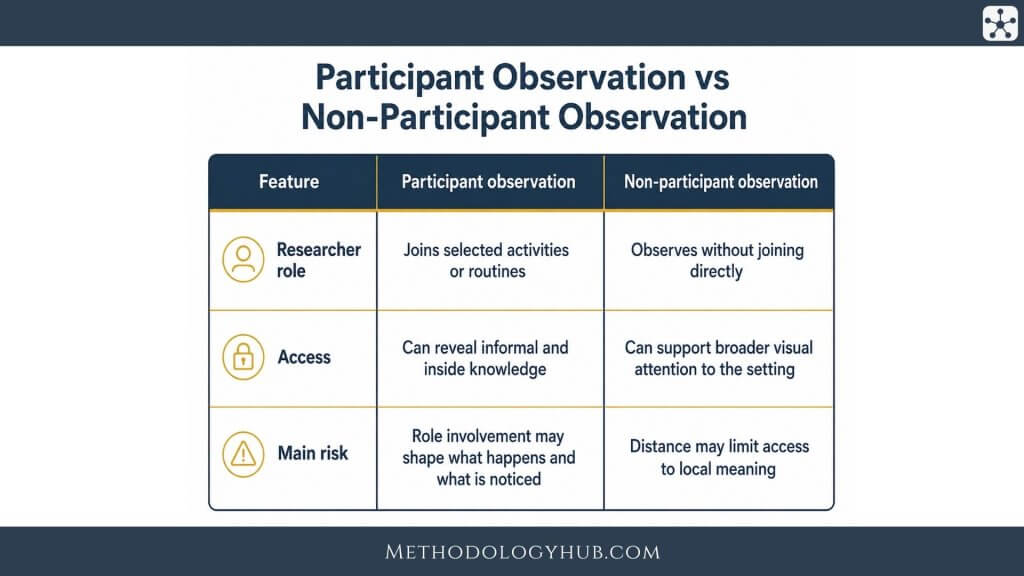
Non-participant observation and participant observation both study activity in context, but they place the researcher in different relationships to the setting. In non-participant observation, the researcher watches from outside the activity. In participant observation, the researcher joins the setting or activity to some degree.
The difference affects what the researcher can see, what they can feel from within the activity, how participants relate to them, and what kind of data are produced.
Distance and involvement
Non-participant observation gives more distance. The researcher can watch the setting without carrying out the activity. This may help them record more continuously and compare several people or groups at once.
Participant observation gives more involvement. The researcher may learn how an activity feels from inside, how informal rules are taught, and what participants say during ordinary participation. The price is that involvement can reduce the researcher’s ability to observe everything at once.
Access to informal meaning
Participant observation may provide more access to informal meaning. People often explain things while doing them, not in formal interviews. By joining an activity, the researcher may hear comments and receive guidance that would not be offered to an outsider.
Non-participant observation may provide a clearer view of patterns across the setting. The researcher may see who is included, who waits, who moves, and how tasks are distributed. However, the meaning of those actions may need later explanation from participants.
Choosing between the two
The choice depends on the question. If the study asks how a routine is distributed across a room, non-participant observation may be stronger. If it asks how newcomers learn that routine from inside the group, participation may help.
Comparison: distance helps the researcher see across the setting. Participation helps the researcher learn from inside the activity.
Some studies use both roles at different times. A researcher may first observe from a distance, then join selected activities after gaining access. Another study may do the reverse, beginning with participation and later stepping back to watch patterns more clearly.
Planning Non-Participant Observation
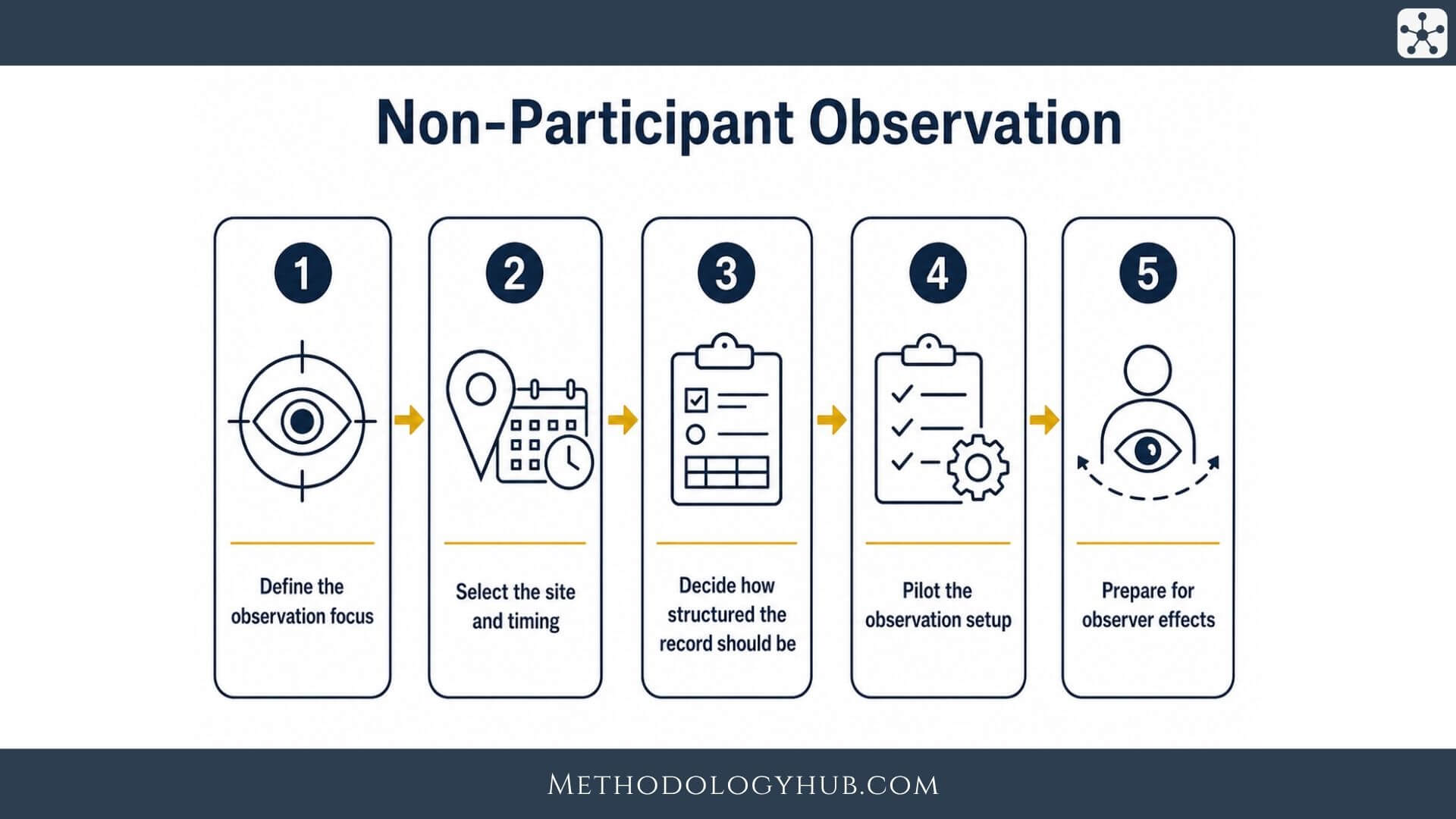
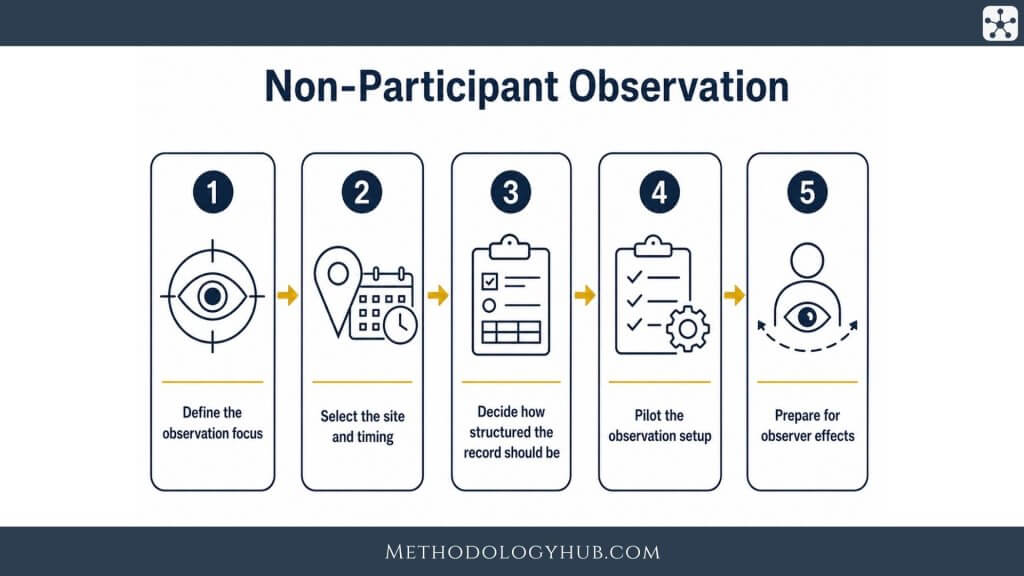
Planning non-participant observation means designing a way to watch a setting without joining it. The researcher needs to decide what to observe, where to sit or stand, how long to observe, what kind of record to make, and how to manage the presence of the observer.
Because the researcher is not participating, the observation plan must do more of the work. The plan should guide attention without becoming so narrow that the researcher misses important activity outside the original categories.
Define the observation focus
The observation focus should be specific enough to guide note-taking. “Observe the meeting” is too broad. A clearer focus might be: observe how decisions are introduced, who responds, how disagreement appears, and how final decisions are stated.
A clear focus does not prevent the researcher from noticing unexpected details. It gives the observation a centre, so the field record does not become an unfocused description of everything in the room.
Select the site and timing
The site should be chosen because it connects directly to the research question. If the study concerns help-seeking, the researcher should observe where help is actually requested, not only where help is officially advertised.
Timing can change the data. A service desk may work differently at opening, lunchtime, and closing. A school corridor may look different before class, during breaks, and after the final bell. The observation plan should explain why the chosen times are appropriate.
Decide how structured the record should be
Some studies use open field notes. Others use structured observation sheets. Many use both. Open notes are useful for rich description. Structured sheets help compare repeated observations across times or sites.
The recording format should follow the research question. A study of turn-taking may need speaker order and time markers. A study of public space use may need maps, movement paths, and counts of people using different areas.
| Planning decision | Question to answer before fieldwork |
|---|---|
| Focus | Which behaviours, interactions, spaces, or routines should be observed? |
| Position | Where can the researcher observe without interrupting the activity? |
| Timing | When does the activity most relevant to the research question occur? |
| Record | Will the study use open notes, a schedule, maps, time records, or a combination? |
Pilot the observation setup
A short pilot observation can reveal practical problems. The researcher may not be able to hear from the chosen position. A category may be too vague. A time interval may be too short. The setting may be too busy for one person to record everything planned.
Testing the setup before main data collection can prevent weak field records. It also helps the researcher practise observing without becoming distracted by the mechanics of note-taking.
Prepare for observer effects
Participants may alter behaviour when they know they are being observed. This effect may reduce over time, but it should not be ignored. The researcher can record signs that participants are reacting to the observation, such as joking about being watched, explaining actions to the researcher, or changing routines.
Observer effects are not solved by pretending they do not exist. They are handled through careful documentation and cautious interpretation.
Recording Non-Participant Observation Data
Recording is central to non-participant observation because the researcher is not relying on participation to build understanding. The field record needs enough detail to show what happened and enough structure to support later comparison.
A useful record often combines immediate notes with expanded notes written soon afterward. Immediate notes capture sequence and detail. Expanded notes add context, clarify abbreviations, and separate description from early interpretation.
Descriptive observation notes
Descriptive notes should record what the researcher saw and heard as concretely as possible. They may include actions, words, movement, gestures, objects, seating, timing, and interruptions.
Instead of writing “participants were confused,” the note might record that four people looked at the instruction sheet, two asked the same question, and one person waited without starting the task. The interpretation can come later.
Time and sequence records
Time records are useful when the order of events is important. A researcher might record when a queue forms, how long people wait, when a teacher arrives at each group, or how often a meeting returns to the same topic.
Sequence is often part of the evidence. The same action can mean different things depending on what happened before and after it. A note about timing can therefore support interpretation, not only description.
Maps and spatial notes
Maps help when space shapes behaviour. A researcher may sketch a classroom, waiting room, park, service counter, meeting room, or online layout. The map can show movement, distance, access, visibility, and repeated positions.
Spatial notes are especially useful when people use a setting differently. One corner of a room may become informal, another may be avoided, and a doorway may become a point of control. These details can be hard to describe without a visual record.
Recommendation: write what showed you the interpretation. “Tense atmosphere” is weaker than a note about silence, seating, interrupted speech, or repeated glances.
Reflective and method notes
Reflective notes record early interpretations, puzzles, and questions for analysis. Method notes record conditions that shaped the observation, such as noise, poor visibility, a changed seating position, missing participants, or a moment when someone addressed the researcher.
These notes help later analysis because they show the limits of the field record. They also prevent the researcher from treating every observation as equally complete.
Expanding notes after observation
After the observation, the researcher should expand brief notes while memory is fresh. This may include clarifying shorthand, adding setting details, writing a short summary, and marking possible themes. The expanded record should make sense to the researcher weeks later.
Waiting too long can make the record thin. Small but important details may disappear, especially in busy settings where many actions happened at once.
Naturalistic and Controlled Non-Participant Observation
Non-participant observation can take place in ordinary settings or in more arranged situations. The difference is often described as naturalistic versus controlled observation. Both can be useful, but they answer different kinds of questions.
In naturalistic observation, the researcher watches activity in the setting where it normally occurs. In controlled observation, the researcher observes in a situation where the task, setting, timing, or behaviour categories are more planned.
Naturalistic non-participant observation
Naturalistic non-participant observation is common in qualitative studies. The researcher observes everyday activity without joining it and without trying to control the setting. The aim is to understand practice as it normally unfolds.
A researcher may observe how people use a public square at different times of day, how students move through a school corridor, or how staff coordinate a shift handover. The setting is not arranged for the researcher, though the researcher may choose when and where to observe.
Controlled non-participant observation
Controlled non-participant observation is more structured. The researcher may ask participants to complete a task, observe a specific scenario, or use a pre-defined recording schedule. The researcher still does not join the activity, but the observation situation is more planned.
This approach can be useful when comparison is important. For example, a researcher might observe how different groups solve the same task, using the same time limit and the same recording categories.
| Type | Setting | Main strength |
|---|---|---|
| Naturalistic | Ordinary activity in its usual setting | Rich context and everyday behaviour |
| Controlled | Arranged task, situation, timing, or recording procedure | Clearer comparison across participants or groups |
Choosing between them
Choose naturalistic observation when the research question needs ordinary context. Choose controlled observation when the question needs a more standard situation for comparison. The choice should be described in relation to the research question, not as a label added afterward.
Some studies combine both. A researcher might first observe ordinary classroom group work, then later observe several groups completing the same planned task. The two forms of observation can answer different parts of the same project.
Analysing Non-Participant Observation Data
Analysing non-participant observation data means moving from field records to an interpretation of what happened in the setting. The researcher may analyse actions, roles, sequences, spatial patterns, interruptions, use of objects, and changes across time or sites.
The analysis often begins with the full record: descriptive notes, schedules, maps, time records, reflective notes, and method notes. Reading across all materials helps the researcher understand both the event and the conditions under which it was recorded.
Organise records before coding
The researcher should first organise the records by date, site, time, session, or observation focus. If the study includes several sites, the records should make it clear where each observation took place and under what conditions.
Organisation is important because observation data can become fragmented. Without clear labels and summaries, it can be difficult to compare observations or trace patterns across sessions.
Code actions, roles, and setting features
Coding can focus on what people do, how they interact, how space is used, which objects matter, and what sequence events follow. Codes may include waiting, interruption, help request, teacher movement, peer explanation, queue formation, side conversation, or avoidance of a space.
In qualitative observation, codes should not remove context. A code such as waiting may need to include where waiting happened, who was waiting, how long it lasted, and what happened afterward.
Compare across observations
Comparison is often useful in non-participant observation because the researcher may observe several sessions, sites, groups, or times. Comparison can show whether a pattern is repeated or limited to one situation.
A researcher observing a service desk may compare morning and afternoon sessions. A researcher observing meetings may compare formal agenda items with informal discussion after the meeting. These comparisons help build a more careful interpretation.
Link observations to interpretation
Findings should be supported by recorded detail. If the analysis claims that one group was less included, the notes should show how that appeared through seating, turn-taking, lack of response, restricted access, or repeated waiting.
The writing should avoid vague claims that are not tied to observation. Strong analysis shows the reader what was seen and how the interpretation was developed from the field record.
Recommendation: every finding should be traceable to something recorded in the observation notes, schedule, map, or memo.
Use counts carefully
Some non-participant observation studies include counts. The researcher may count turns, interruptions, questions, movements, wait times, or use of a space. Counts can help describe patterns, but they do not replace interpretation.
A group that receives fewer teacher visits may need interpretation through context. Did the group need less help, ask less loudly, sit farther away, or get overlooked? The count is a starting point, not the whole analysis.
Examples of Non-Participant Observation
Examples of non-participant observation show how distance can help the researcher record activity without becoming part of it. In each example below, the researcher observes from outside the activity because participation would change the setting or make recording harder.
Example 1: Teacher movement during group work
A researcher observes several classroom group-work sessions from the side of the room. The focus is on how the teacher moves between groups, how long they spend with each group, which students ask for help, and which groups wait without speaking.
The analysis may show that support is not evenly distributed. Some groups receive more attention because they are louder or closer to the teacher’s usual path through the room.
Example 2: Waiting behaviour at a clinic reception
A health researcher observes a clinic reception area without joining staff or patient activity. The notes record queue length, waiting positions, staff greetings, repeated questions, confusion around signs, and how patients respond when delays occur.
The data may show that unclear signage leads to repeated interruptions at the desk. Observation is useful because the researcher can see the pattern as it happens across several visitors.
Example 3: Use of study zones in a library
A researcher observes how students use different areas of a library. The record includes seating patterns, movement between zones, use of headphones, informal group formation, and reactions when noise increases.
The analysis may show that the official labels of spaces do not fully match student use. Some areas marked as quiet may become informal group spaces at certain times of day.
Example 4: Turn-taking in staff meetings
A workplace researcher observes staff meetings from a non-participant role. The notes record who opens topics, who responds, who is interrupted, how disagreements are handled, and how decisions are summarised.
The study may show that participation is shaped by role, seniority, and meeting structure. The researcher can record the pattern without joining the discussion or influencing the decision process directly.
Conclusion
Non-participant observation is useful when a researcher needs to study behaviour, interaction, space, timing, or routine without joining the activity being observed. It gives the researcher distance and can make systematic recording easier.
The method works best when the observer role is clear, the observation focus is specific, the field record is detailed, and the analysis connects visible patterns to careful interpretation. It can stand alone, but it often works well with interviews, documents, or other qualitative materials that help explain what observation cannot show by itself.
FAQs on Non-Participant Observation
What is non-participant observation?
Non-participant observation is a research method in which the researcher observes a setting, activity, or interaction without joining the activity directly. The researcher records what happens from a more distant observer position.
What is non-participant observation in qualitative research?
Non-participant observation in qualitative research is used to record behaviour, interaction, space, timing, and routines in context. The data are usually analysed through field notes, maps, observation schedules, time records, and memos.
How do you conduct non-participant observation?
To conduct non-participant observation, define the observation focus, choose the site and time, decide the observer position, prepare a recording system, pilot the setup, observe without joining the activity, and expand notes afterward.
What is the difference between participant and non-participant observation?
Participant observation involves joining the setting or activity to some degree. Non-participant observation keeps the researcher outside the activity. Participation can provide inside understanding, while non-participation can support wider and more systematic observation.
When should non-participant observation be used?
Non-participant observation should be used when the researcher needs to study behaviour, interaction, timing, space, or routines without interrupting the activity or becoming part of the setting being observed.
What should be recorded in non-participant observation?
Researchers may record actions, speech, movement, timing, sequence, space, objects, seating, interruptions, maps, counts, descriptive notes, reflective notes, method notes, and signs of observer effects.
How do you analyse non-participant observation data?
Non-participant observation data are analysed by organising field records, coding actions and setting features, comparing observations across times or sites, linking interpretations to recorded details, and using counts carefully when relevant.