Open-ended survey questions are survey questions that let respondents answer in their own words instead of choosing from fixed response options. They are used when a researcher wants short written accounts, explanations, examples, reasons, or suggestions from a larger group of people.
In qualitative research, open-ended survey questions can collect text-based data from participants who may not take part in interviews or group discussions. They are useful when the researcher needs a wider range of brief responses while still preserving participants’ own language.
Open-ended questions often sit between a full survey and more intensive qualitative research methods. They do not usually produce the depth of an interview, but they can reveal patterns, categories, wording, concerns, and examples that closed-ended questions would miss.
Open-Ended Survey Questions at a Glance
Open-ended survey questions ask respondents to write their own answer. Instead of selecting “yes,” “no,” “satisfied,” or “unsatisfied,” respondents explain something in their own terms. This makes the data less standardised than closed-ended survey responses, but often more expressive.
A closed-ended question might ask, “Did you use the feedback service?” An open-ended version might ask, “Can you describe how you used the feedback service?” The first gives a fixed answer. The second can show the steps, uncertainty, reasons, or problems behind the response.
Open-ended survey question definition
An open-ended survey question is a survey item that allows respondents to answer freely in written form. It does not restrict the answer to predefined options. The response may be one sentence, a short paragraph, a list, or a longer explanation depending on the question, survey format, and respondent motivation.
Open-ended questions can appear in qualitative surveys, mixed surveys, evaluation forms, student feedback forms, needs assessments, community questionnaires, and exploratory studies. Their value comes from the words respondents choose and the explanations they give.
What open-ended responses can show
Open-ended responses can show reasons, examples, priorities, misunderstandings, suggestions, complaints, stories, and unexpected categories. They can also show language. Respondents may describe a service, problem, or experience using terms the researcher would not have predicted.
This is useful when the researcher does not want to assume all possible answer categories in advance. If a survey asks, “What made it difficult to attend the session?” respondents may mention timing, transport, childcare, confidence, unclear instructions, or lack of relevance. A fixed list might miss some of these.
What open-ended questions do not do well
Open-ended survey questions are not a replacement for every qualitative method. They usually provide less depth than interviews because the researcher cannot ask follow-up questions in the moment. They also depend on how much time, confidence, and interest respondents have when writing.
Some respondents may write detailed answers. Others may write only a few words. The researcher should design the survey with that unevenness in mind.
When to Use Open-Ended Survey Questions
Open-ended survey questions are useful when a study needs written explanations from many respondents. They can collect brief qualitative data without requiring the time and coordination needed for interviews or focus groups.
They are especially useful when the researcher expects variation in experience but cannot predict every response option. They can also help at the start of a project, when the researcher wants to learn how participants describe a topic before designing more focused questions.
Exploring reasons behind a response
A closed-ended survey item can show what respondents selected. An open-ended follow-up can ask why. For example, after asking respondents whether they found a workshop useful, the survey can ask, “What made the workshop useful or not useful for you?”
This combination is common in evaluation research. The closed question gives a quick summary, while the open-ended question helps explain the response.
Collecting suggestions
Open-ended questions work well when the researcher wants suggestions. Respondents may identify practical issues that the survey designer did not anticipate. In a student support survey, suggestions might concern timing, location, staff contact, clearer instructions, or examples of previous work.
Suggestion questions should be specific enough to guide useful responses. “Any comments?” often produces weak answers. “What is one change that would make this service easier to use?” gives respondents a clearer task.
Survey design hint: use an open-ended question when the answer categories are not fully known or when the explanation behind a choice is important.
Capturing participant language
Researchers often use open-ended questions to learn how participants talk about a topic. This can help with later survey design, interview guides, educational materials, or programme evaluation. The exact wording respondents use can be useful data.
For example, a researcher may ask students to describe what “academic confidence” means to them. The responses may show that students connect confidence with asking questions, understanding feedback, speaking in class, or knowing how to start an assignment.
Reaching respondents who cannot be interviewed
Open-ended survey questions can reach people who may not have time for interviews. A short survey can be completed asynchronously, which can help when respondents are busy, geographically dispersed, or uncomfortable with spoken participation.
This convenience should not be overstated. Written responses may be shorter and less detailed than spoken accounts. The method is useful when brief written data are enough for the research purpose.
When another method is better
If the study needs long personal accounts, follow-up questions, or detailed narratives, qualitative interviews may be stronger. If the study needs to understand how views develop in discussion, focus groups may fit better.
Open-ended survey questions are strongest when the researcher needs breadth of written responses rather than deep conversation.
Open-Ended vs Closed-Ended Survey Questions
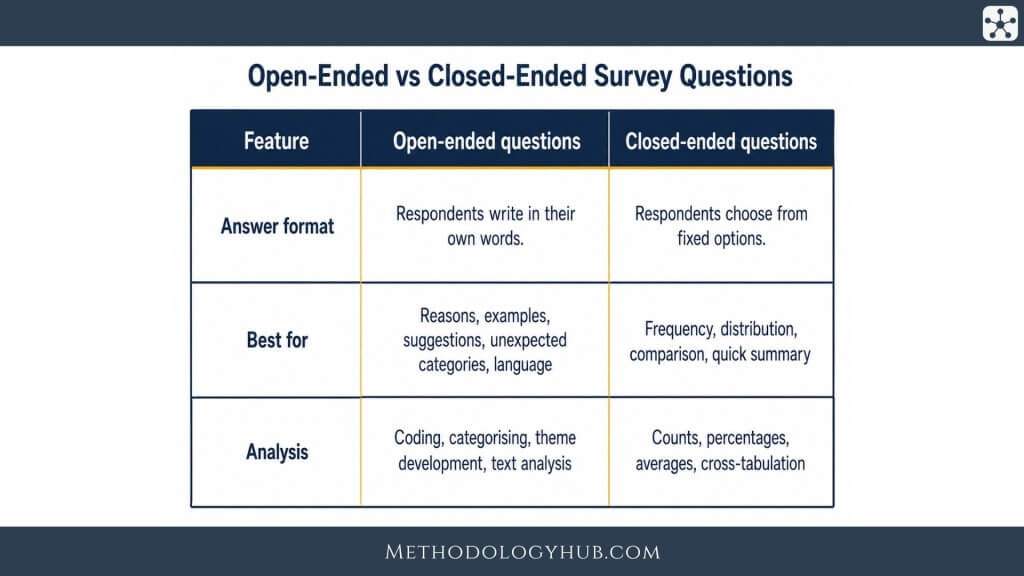
Open-ended and closed-ended survey questions produce different kinds of data. Open-ended questions produce written text. Closed-ended questions produce selected options that can be counted easily. The choice depends on what the researcher needs to know.
In many surveys, both are used together. A closed-ended question may ask respondents to rate an experience, while an open-ended question asks them to explain the rating. This combination can make the results more useful than either format alone.
Closed-ended questions
Closed-ended questions provide answer options in advance. Respondents may choose from yes or no, a rating scale, a checklist, or categories. These questions are useful when the researcher already knows the main response options and wants data that can be summarised numerically.
The limitation is that closed-ended questions can hide unexpected answers. If a respondent’s experience does not fit the options, they may choose the nearest answer or skip the question.
Open-ended questions
Open-ended questions let respondents decide how to answer. They are useful when the researcher wants to capture explanations, examples, language, or categories that may not be known in advance.
The limitation is that open-ended responses take more time to analyse. They can also vary in length and clarity. A researcher may receive one thoughtful paragraph from one respondent and two vague words from another.
| Feature | Open-ended questions | Closed-ended questions |
|---|---|---|
| Answer format | Respondents write in their own words. | Respondents choose from fixed options. |
| Best for | Reasons, examples, suggestions, unexpected categories, language | Frequency, distribution, comparison, quick summary |
| Analysis | Coding, categorising, theme development, text analysis | Counts, percentages, averages, cross-tabulation |
Using both in one survey
A useful survey often uses closed-ended questions for quick summary and open-ended questions for explanation. For example, a survey might ask respondents to rate a service, then ask, “What is the main reason for your rating?”
This format gives the researcher both a pattern and an explanation. The closed-ended item shows how responses are distributed. The open-ended item shows how respondents understood the experience.
Choosing the right balance
Too many open-ended questions can make a survey tiring. Respondents may write less as the survey continues. Too few open-ended questions can make the survey shallow if the topic needs explanation.
The right balance depends on the purpose. A short evaluation survey may use one or two open-ended items. A qualitative questionnaire may rely mostly on written responses and fewer fixed options.
How to Write Open-Ended Survey Questions
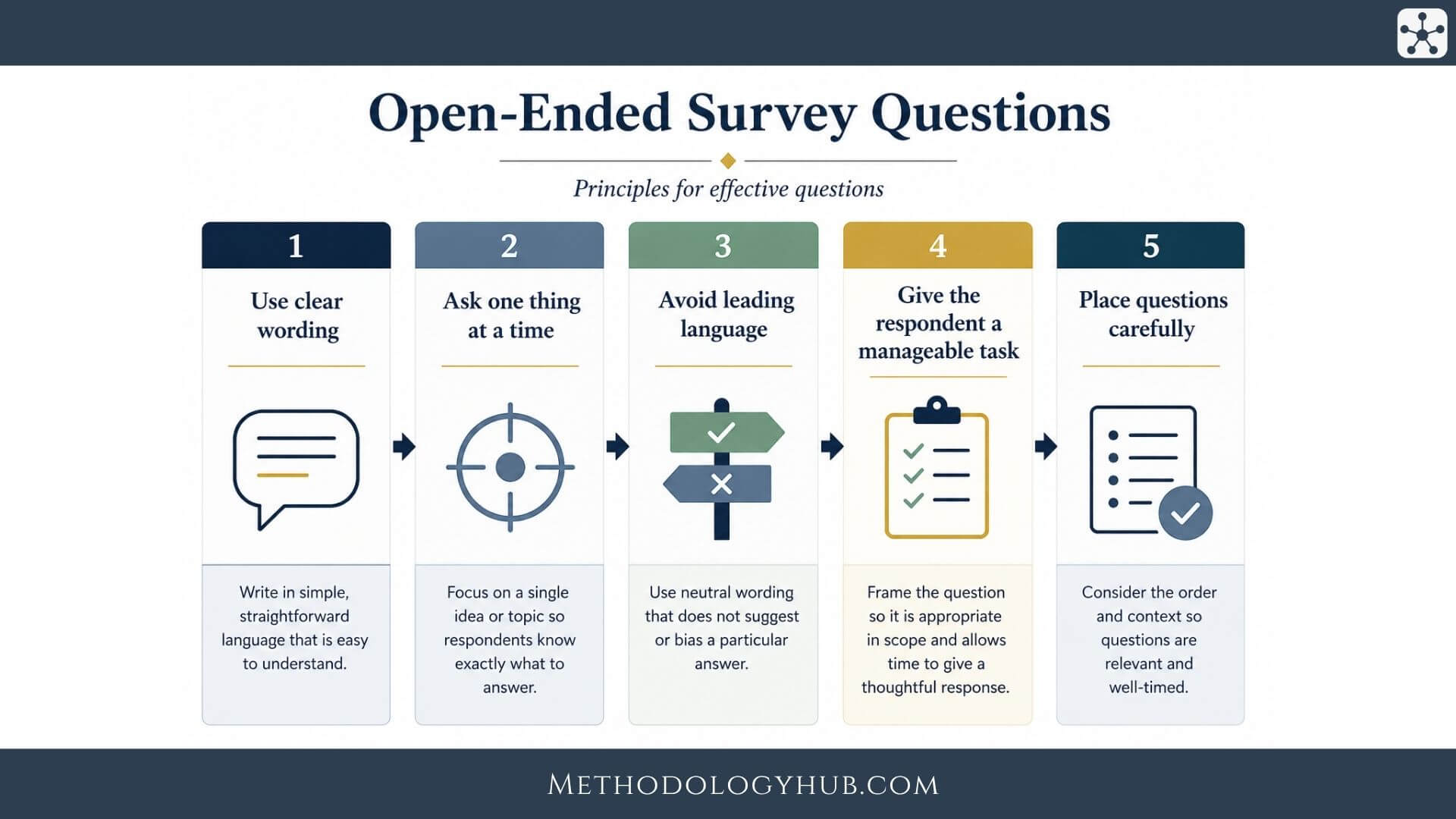
Writing open-ended survey questions is harder than adding a text box to a survey. The wording affects the length, clarity, and usefulness of the response. A strong question gives respondents enough direction to answer well without forcing them toward a particular answer.
The best questions are clear, focused, neutral, and easy to answer in writing. They also match the amount of effort the researcher can reasonably expect from respondents.
Use clear wording
Respondents should understand what the question is asking without extra explanation. Long, abstract, or multi-part questions often produce vague answers. A question such as “How did the programme affect your learning, confidence, and motivation over time?” asks too many things at once.
A clearer approach is to split the question. One item might ask about learning. Another might ask about confidence. The researcher can then analyse each response more directly.
Ask one thing at a time
Open-ended survey questions should usually ask one main thing. When a question asks several things at once, respondents may answer only one part. This makes analysis harder because the researcher cannot know whether the missing parts were ignored, unclear, or irrelevant.
For example, “What did you like and dislike about the workshop?” may produce mixed answers. It is often better to ask two separate questions: one about what worked well and one about what could be improved.
Avoid leading language
Leading wording pushes respondents toward a preferred answer. “What did you find useful about the new service?” assumes that the service was useful. “How would you describe your experience of the new service?” gives more room for positive, negative, or mixed responses.
Neutral wording is especially important when the survey evaluates a programme, service, lesson, or policy. Respondents should feel that critical answers are acceptable.
- Weak: What problems did the confusing instructions cause?
- Better: How clear or unclear were the instructions? Please explain your answer.
- Weak: Why did you enjoy the session?
- Better: How would you describe your experience of the session?
Give the respondent a manageable task
A survey response is usually shorter than an interview answer. Questions should be designed for brief written responses. If the question needs a long story, an interview may be more suitable.
Wording such as “Please describe one example” can help respondents focus. It is often easier to answer than a broad request such as “Tell us everything about your experience.”
Place questions carefully
Question placement affects response quality. Open-ended questions placed at the end of a long survey may receive shorter answers because respondents are tired. Important open-ended items should appear where respondents still have enough attention to answer.
It can also help to place an open-ended follow-up directly after a related closed-ended item. The respondent’s answer is fresh, and the written explanation can connect clearly to the selected option.
Using Open-Ended Questions in Qualitative Questionnaires
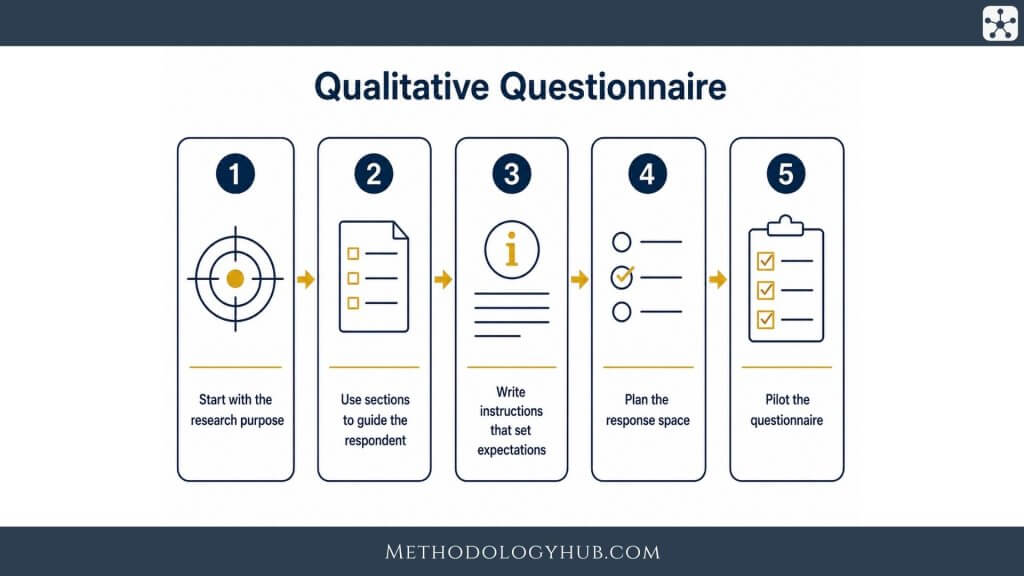
Open-ended survey questions can appear as one or two items in a mostly quantitative survey, or they can form the basis of a qualitative questionnaire. The difference is the role the written answers play in the study.
In a mostly closed survey, open-ended questions often explain a rating or add optional comments. In a qualitative questionnaire, written answers are the central data source. The questionnaire is designed to collect text that can be coded and interpreted.
Short follow-up questions
Short follow-up questions are common after ratings or choices. They ask respondents to explain a selected answer. Examples include “What is the main reason for your rating?” or “Please describe one factor that influenced your choice.”
These questions should be placed close to the closed-ended item they explain. This makes the response easier for the respondent and easier for the researcher to interpret.
Standalone open-ended items
A standalone open-ended item asks for written input without being tied to a previous rating. It may ask respondents to describe an experience, identify a challenge, suggest an improvement, or explain what a concept means to them.
Standalone items need careful wording because respondents do not have the support of a previous answer. The question should make the requested response clear.
| Use in survey | Example question | Role in the study |
|---|---|---|
| Follow-up to rating | What is the main reason for your rating? | Explains a selected option. |
| Standalone item | Please describe one challenge you experienced. | Collects a short written account. |
| Qualitative questionnaire | Can you describe how you usually approach this task? | Provides the main qualitative data. |
Optional comment boxes
Optional comment boxes can be useful, but they often produce uneven data. Some respondents use them to add detailed explanations. Others leave them blank. The researcher should not rely on optional comments for data that are essential to the study.
If a question is important, it should be asked directly. “Any other comments?” is better as a final opportunity than as the main way to collect qualitative evidence.
Response length guidance
Respondents may benefit from guidance about expected length. A prompt such as “Please write one or two sentences” can reduce uncertainty. A larger text box can invite more detail, while a small box may signal that only a short answer is expected.
The design should match the analysis plan. If the researcher expects detailed qualitative analysis, the survey should create space for meaningful written answers.
Coding and Analysing Open-Ended Survey Responses
Analysing open-ended survey responses means turning a set of written answers into patterns that answer the research question. The researcher may code responses, group similar ideas, compare categories, identify themes, and use short quotations to illustrate findings.
The analysis is different from interview analysis because responses are often shorter and less contextual. A single sentence may contain a useful category, but it may not explain the respondent’s wider experience. The researcher should avoid over-reading thin responses.
Prepare the response set
The first step is to prepare the data. Responses may need to be exported, cleaned, anonymised, and organised by question. Blank responses, duplicate entries, irrelevant text, and unclear answers should be handled consistently.
If open-ended responses are linked to closed-ended answers, the researcher should preserve that link. For example, explanations for low ratings may need to be analysed separately from explanations for high ratings.
Read before coding
The researcher should read the full response set before creating final codes. This helps identify common wording, repeated issues, unexpected categories, and the range of answer lengths.
Early reading also helps the researcher decide whether the data can support themes or whether the responses are better treated as short categories and examples.
Code responses consistently
Coding involves assigning labels to parts of responses. Codes may describe reasons, barriers, suggestions, emotions, misunderstandings, or examples. A single response may receive more than one code.
For example, a response such as “The session was helpful, but it was too late in the day and the room was hard to find” could be coded as usefulness, scheduling barrier, and location barrier.
Analysis caution: short survey answers can show categories and reasons, but they may not support deep claims about personal experience unless enough detail is present.
Group codes into categories
After coding, the researcher can group related codes into broader categories. For example, timing, transport, childcare, and work shifts may be grouped under access barriers. Confusing instructions, unclear emails, and missing examples may be grouped under communication issues.
Categories should remain close to the data. If the categories become too abstract, they may lose the practical meaning of respondents’ answers.
Use counts without replacing interpretation
Researchers often count how many respondents mentioned a category. This can be useful, especially when the response set is large. However, counts should not replace interpretation. A less frequent category may still be important if it identifies a serious problem or a group-specific experience.
Counts should also be reported carefully. Open-ended responses show what respondents chose to write, not necessarily everything they experienced.
Write findings with short examples
Findings from open-ended survey questions often work well when they combine category summaries with short examples. A short quotation can show the wording respondents used, but it should not be used as if it represents everyone.
The writing should make clear whether a category was common, occasional, rare, or especially important for a subgroup. It should also connect the finding back to the survey question.
Examples of Open-Ended Survey Questions
Examples of open-ended survey questions show how wording shapes the response. A good open-ended question gives respondents a clear written task. The examples below can be adapted for education, health, community, workplace, and service research.
Questions about experience
Experience questions ask respondents to describe what happened or how they experienced a situation. They are useful when the researcher wants short accounts rather than only ratings.
- Can you describe one part of the session that affected your learning?
- What was your experience of using the service?
- Please describe one moment when the process was easy or difficult for you.
Questions about reasons
Reason questions ask respondents to explain a choice, rating, or action. They are often used after closed-ended items.
- What is the main reason for your rating?
- Why did you choose this option?
- What influenced your decision to attend or not attend?
Questions about barriers
Barrier questions ask what made something difficult. They should avoid assuming that everyone faced a barrier. Neutral wording can allow respondents to say that nothing was difficult.
- What, if anything, made this task difficult?
- Were there any barriers to using the service? Please describe them.
- What made it easier or harder to complete the process?
Questions about suggestions
Suggestion questions invite respondents to propose changes. They are useful in evaluation and service improvement, but they should be specific enough to produce actionable answers.
- What is one change that would improve this process?
- What information would have made this easier to understand?
- What should be kept, changed, or removed in future sessions?
| Research purpose | Useful open-ended wording |
|---|---|
| Understand a rating | What is the main reason for your rating? |
| Find barriers | What, if anything, made this difficult? |
| Collect suggestions | What is one change that would improve this process? |
Questions to avoid or revise
Some open-ended questions look open but produce weak data. Very broad prompts, leading questions, and double questions can confuse respondents or push them toward a narrow answer.
“Any comments?” can be useful at the end, but it is usually too vague for the main research question. “Why was the session helpful?” assumes the session was helpful. “What did you like and dislike and what should we change?” asks too much at once.
Conclusion
Open-ended survey questions are useful when researchers need written answers in respondents’ own words. They can collect reasons, examples, barriers, suggestions, and unexpected categories that fixed response options may not capture.
The method works best when questions are clear, focused, neutral, and placed carefully in the survey. Strong analysis then codes the responses, compares patterns, uses counts cautiously, and supports findings with short examples from the written data.
FAQs on Open-Ended Survey Questions
What are open-ended survey questions?
Open-ended survey questions are questions that let respondents answer in their own words instead of choosing from fixed response options. They are used to collect written explanations, examples, reasons, suggestions, or comments.
What is an example of an open-ended survey question?
An example of an open-ended survey question is: “What is the main reason for your rating?” Another example is: “Please describe one change that would make this service easier to use.”
When should open-ended survey questions be used?
Open-ended survey questions should be used when the researcher wants written explanations, participant language, suggestions, barriers, reasons behind ratings, or response categories that may not be known in advance.
What is the difference between open-ended and closed-ended survey questions?
Open-ended survey questions allow respondents to write their own answers. Closed-ended survey questions require respondents to choose from fixed options. Open-ended questions produce text, while closed-ended questions produce standardised responses that are easier to count.
How do you write good open-ended survey questions?
Good open-ended survey questions are clear, focused, neutral, and manageable. They ask one main thing, avoid leading wording, and give respondents a clear written task such as explaining a rating or describing one example.
How do you analyse open-ended survey responses?
Open-ended survey responses are analysed by preparing the response set, reading all answers, coding responses, grouping codes into categories, using counts carefully, and writing findings with short examples from the data.
Are open-ended survey questions qualitative?
Open-ended survey questions can be qualitative because they collect written text in respondents’ own words. They are often used in qualitative questionnaires, mixed surveys, evaluations, and exploratory research.