Field notes in qualitative research are written records of what a researcher observes, hears, notices, thinks, and begins to interpret during fieldwork. They help turn live experience into data that can be read, coded, compared, and used in analysis.
A researcher might write field notes after observing a classroom, attending a community meeting, conducting an informal conversation, shadowing a workplace routine, or watching how people use a public space. The notes preserve details that would otherwise fade quickly: who was present, where people stood, what happened first, which words were used, how the setting felt, and what questions the researcher needs to follow up.
Within Qualitative Research, field notes are closely linked to observation, interviews, document work, and other Qualitative Research Methods. They are not only reminders. They are part of the evidence base that allows the researcher to move from field experience to supported interpretation.
What are Field Notes in Qualitative Research
Field notes are the researcher’s written account of fieldwork. They may begin as quick jottings in a notebook or phone, then become fuller records after the session. They can include description, reflection, questions, sketches, timelines, maps, and reminders for later analysis.
The basic purpose is simple: to preserve enough detail for the researcher to return to the field situation later. Memory alone is not enough. A setting that feels clear on the day of fieldwork can become vague after several interviews, observations, meetings, or site visits.
Field notes definition
Field notes are written research records made during or after fieldwork to document observations, interactions, settings, events, researcher reflections, and early analytic ideas. They are commonly used in qualitative observation, participant observation, ethnographic work, interview-based projects, and studies that involve repeated contact with a field setting.
The form of field notes varies. Some researchers write long narrative accounts. Others use structured templates. Some combine brief jottings, expanded notes, diagrams, and analytic memos. The best format is the one that captures the data needed for the research question.
Field notes as data
Field notes are not just personal reminders. In many qualitative studies, they are part of the data. They record what the researcher saw, heard, and noticed, as well as how the researcher began to make sense of the field.
This means field notes should be written carefully. A note such as “the meeting was awkward” may be useful as a first impression, but it is not enough by itself. A stronger note describes the evidence: long pauses, avoided eye contact, side comments, sudden topic changes, or laughter after disagreement.
Field notes and interpretation
Field notes always involve interpretation. The researcher chooses what to record, what to leave out, how to describe people, and when to add their own reflections. This does not make field notes unreliable. It means the researcher should be transparent about how the notes were made.
Separating description from reflection can help. The researcher can write what happened in one section and write early interpretations, doubts, or questions in another. Later analysis can then check interpretations against recorded detail.
Recommendation: write enough concrete detail that another reader can see why you reached an interpretation.
What to Record in Field Notes
Field notes should record the details that help answer the research question. A researcher cannot write everything. The note-taking focus should be specific enough to guide attention, but flexible enough to capture unexpected events.
In an observation study, the researcher may focus on behaviour, interaction, timing, space, and objects. In an interview study, notes may focus on setting, interruptions, tone, non-verbal cues, and reflections after the conversation. In a document-based project, notes may record how documents were found, handled, compared, or connected to field context.
Setting and context
Field notes should identify where and when the fieldwork took place. Setting details may include the room, layout, lighting, noise, seating, entrances, tools, signs, and atmosphere. These details can shape what people do.
A note about a clinic waiting room, for example, may include where people line up, which signs are visible, how staff call names, and where people hesitate. Those setting details may later help explain confusion or delay.
People, roles, and interaction
Notes should record who was present and how people related to one another. The researcher may use pseudonyms, role labels, or participant codes depending on the study. The record should make clear who spoke, who waited, who moved, who led, and who remained at the edge of activity.
Interaction details are often central. Turn-taking, interruptions, invitations to speak, jokes, silence, side conversations, and physical positioning can all become analytic evidence.
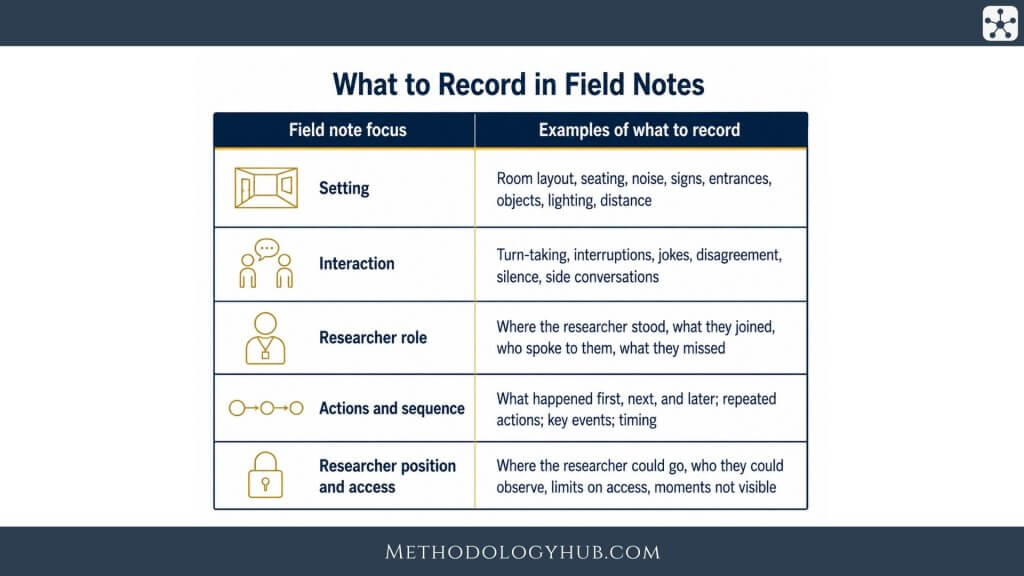
| Field note focus | Examples of what to record |
|---|---|
| Setting | Room layout, seating, noise, signs, entrances, objects, lighting, distance |
| Interaction | Turn-taking, interruptions, jokes, disagreement, silence, side conversations |
| Researcher role | Where the researcher stood, what they joined, who spoke to them, what they missed |
Actions and sequence
Actions should be recorded in order where possible. Sequence helps analysis because meaning often depends on what happened before and after. A pause after a question may mean something different from a pause before a topic change.
Time markers can help. The researcher does not need a timestamp for every line, but noting key times can make the field record easier to reconstruct.
Researcher position and access
The researcher’s role should be part of the record. Did the researcher observe from the back of the room? Join the activity? Help with a task? Sit with participants during a break? Were some conversations inaudible or some spaces closed?
These details help later interpretation. A researcher using participant observation may gain inside access but miss wider patterns while taking part. A researcher using non-participant observation may see more of the room but hear less informal explanation.
Descriptive, Reflective, and Method Notes
Field notes usually become stronger when the researcher uses different note layers. The three most common are descriptive notes, reflective notes, and method notes. They can be written in separate sections or clearly labelled within one field note document.
These layers help the researcher avoid mixing what happened with what they think it means. A field note can include interpretation, but the reader should be able to see which part is description and which part is reflection.
Descriptive notes
Descriptive notes record what happened as concretely as possible. They include observed actions, speech, movement, setting details, sequence, and visible interaction. Good descriptive notes avoid jumping too quickly into summary labels.
Instead of writing “participants were uncomfortable,” a descriptive note might say that three people looked down, one shifted away from the table, and nobody answered the facilitator’s question for several seconds. The later interpretation may discuss discomfort, but the note preserves the evidence.
Reflective notes
Reflective notes record the researcher’s early thoughts, questions, doubts, and possible interpretations. They can include ideas about emerging patterns, surprises, emotional reactions, or connections to earlier field visits.
Reflective notes are useful because analysis often begins in the field. The researcher may notice a repeated silence, an unexpected term, or a pattern of movement before formal coding starts. Writing those ideas down helps preserve them for later checking.
Method notes
Method notes record how the data were produced. They include access problems, recording limits, changes in position, interruptions, technical problems, role changes, and parts of the setting that were not visible or audible.
Recommendation: description says what happened, reflection says what it might mean, and method notes say how the record was made.
A method note might say, “I could not hear the side conversation because I was standing near the doorway,” or “Several participants addressed me directly after the activity began.” These details help the researcher understand limits in the field record.
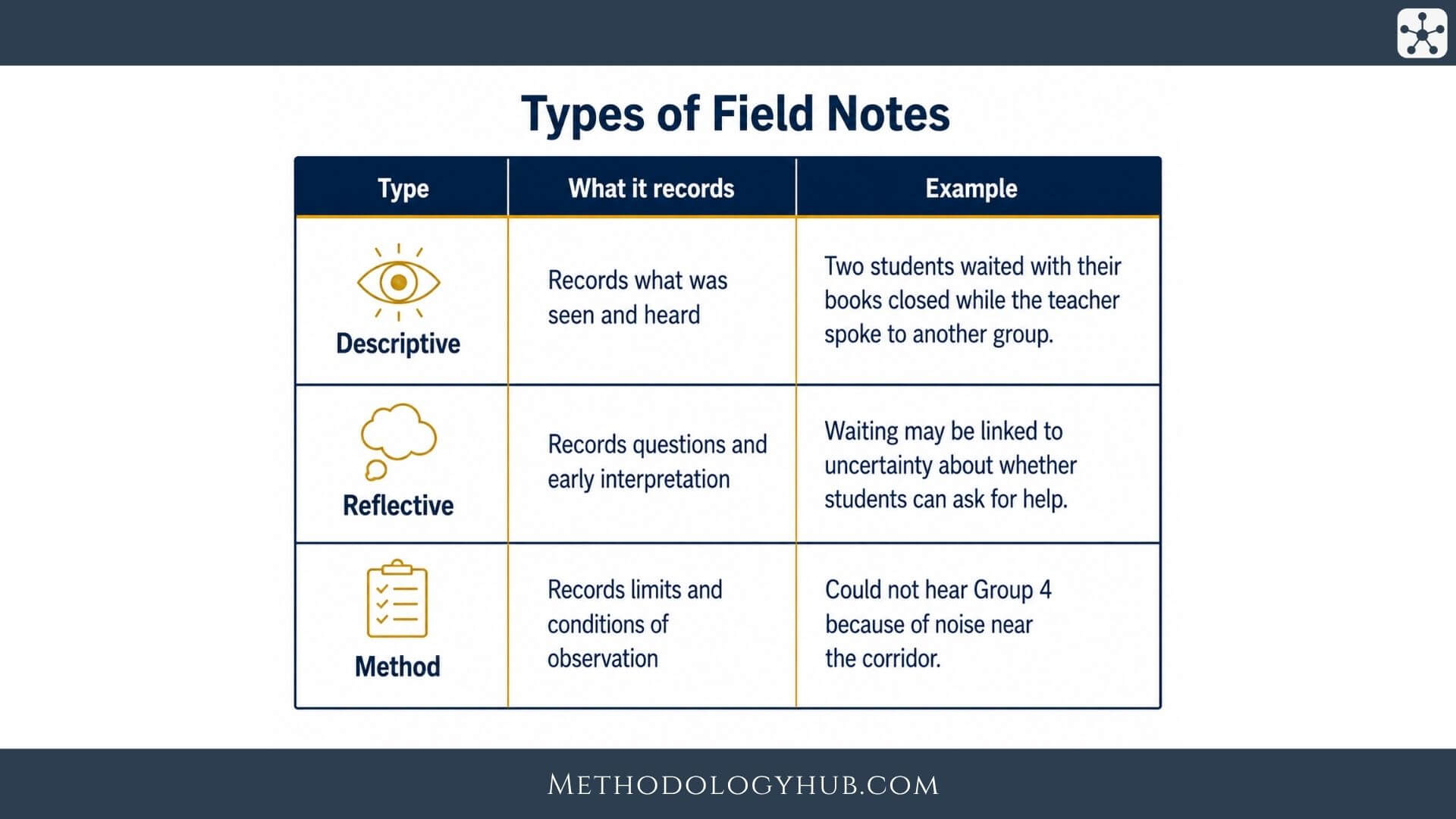
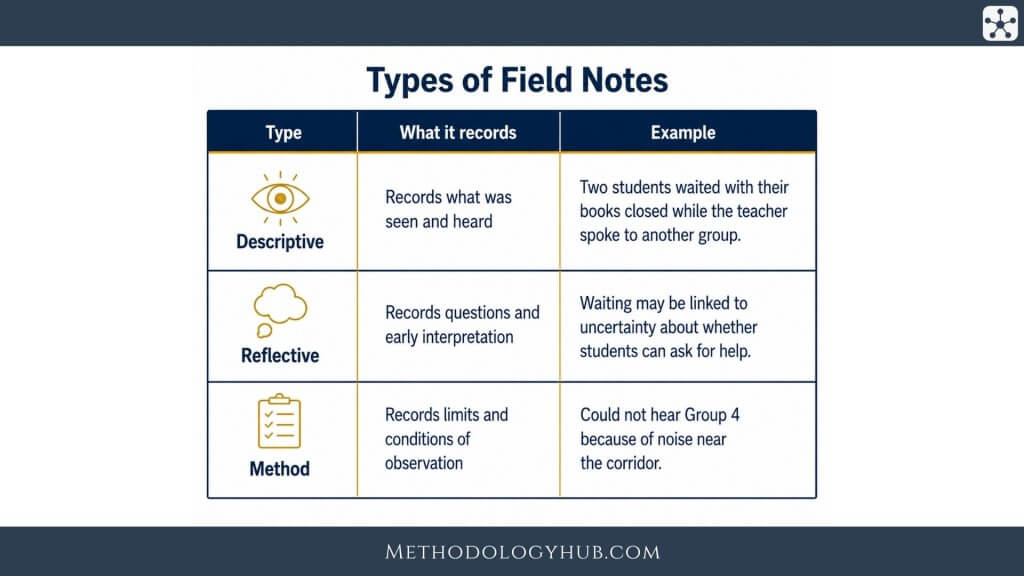
| Note type | Purpose | Example |
|---|---|---|
| Descriptive | Records what was seen and heard | Two students waited with their books closed while the teacher spoke to another group. |
| Reflective | Records questions and early interpretation | Waiting may be linked to uncertainty about whether students can ask for help. |
| Method | Records limits and conditions of observation | Could not hear Group 4 because of noise near the corridor. |
Analytic memos and field notes
Analytic memos are longer reflections that develop ideas from field notes. They may be written after several field visits, during coding, or when a pattern begins to form. A memo can connect notes across time, compare cases, or explore a possible theme.
Memos are not a replacement for field notes. Field notes preserve what happened. Memos help the researcher think with the data.
Taking Notes During Fieldwork
Taking notes during fieldwork is a practical skill. The researcher has to pay attention to the setting, interact appropriately, record enough detail, and avoid becoming so focused on writing that they miss what is happening.
The best note-taking strategy depends on the field setting. A researcher observing a public meeting may write openly throughout. A researcher participating in a community event may only be able to write short reminders during breaks. A researcher conducting an interview may write brief notes after the conversation ends.
Use jottings during the session
Jottings are brief words, phrases, times, or reminders written during fieldwork. They help the researcher remember details to expand later. They do not need to be complete sentences.
A jotting might read: “3:20, doorway pause, Maria asks ‘Are we allowed in?'” Later, this can become a fuller note about access, uncertainty, spatial boundary, and participant wording.
Protect attention while writing
Writing too much during fieldwork can reduce attention. The researcher may miss tone, movement, and interaction while looking down at a notebook. A short system of abbreviations or timed notes can help.
Some researchers write only key words during the event and expand the notes immediately afterward. Others use an observation sheet with spaces for time, action, setting, and reflection.
Know when not to write
There are moments when writing may be inappropriate, disruptive, or distracting. During sensitive conversations, informal interaction, or active participation, the researcher may need to wait before recording.
Waiting does not mean abandoning the note. The researcher can write as soon as the situation allows. They should also record that the note was written from memory after the moment passed.
| Field situation | Possible note strategy |
|---|---|
| Public meeting | Open note-taking with time markers and speaker roles. |
| Participant observation | Short jottings during breaks, then expanded notes after activity. |
| Interview setting | Brief post-interview notes on setting, interruptions, tone, and follow-up ideas. |
Record exact wording when possible
Exact wording can be useful, especially when a phrase seems important. The researcher should mark direct wording clearly so it is not confused with a paraphrase. Quotation marks or a note such as “exact phrase” can help.
When exact wording is not possible, the researcher should paraphrase honestly and avoid making the field note sound more precise than it is.
Expand notes quickly
Short jottings lose value if they are not expanded. The researcher should expand field notes as soon as possible, ideally the same day. Expansion adds sequence, setting detail, reflection, and questions for later analysis.
A field note written the next week may still be useful, but it is likely to lose small details. Quick expansion protects the richness of the field record.
Expanding and Organising Field Notes
Expanded field notes turn brief reminders into a fuller record. This is where the researcher fills in context, reconstructs sequence, separates description from reflection, and adds questions for later analysis.
Organisation is just as important as detail. A large fieldwork project can produce many notes. Without a clear system, the researcher may lose track of dates, sites, participants, versions, and links between field notes and other materials.
Write a heading for each field note
Each field note should begin with basic information: date, time, location, type of fieldwork, researcher role, participants or group, and any relevant session code. These details make the record easier to search and compare later.
A heading might include: “Observation, community meeting, 14 March, 18:00 to 19:20, researcher seated near entrance, 22 participants, notes expanded same evening.” This gives the later reader a clear frame.
Build a consistent structure
A consistent structure helps the researcher write and analyse notes. A field note template might include sections for setting, participants, sequence, key interactions, direct phrases, researcher role, descriptive notes, reflective notes, and follow-up questions.
The template should not be so rigid that it prevents unexpected details from entering the record. It should provide a frame, not a cage.
Recommendation: future analysis depends on small details such as date, site, role, and note timing. Add them before they are forgotten.
Use file names and logs
Digital field notes should be named consistently. A file name may include date, site, activity, and version. A separate fieldwork log can list all notes, interviews, documents, observations, and analytic memos.
This is especially useful when field notes are linked to interviews, photographs, maps, or documents. A log helps the researcher trace which materials belong together.
Protect confidentiality
Field notes often contain identifying details. The researcher should use pseudonyms, remove unnecessary identifiers, store files securely, and separate consent information from analytic notes where appropriate.
Confidentiality is not only a final reporting issue. It begins when notes are written and stored. A raw field note may contain details that should not appear in a publication or shared file.
| Organisation element | Use |
|---|---|
| Field note heading | Records date, site, session, role, participants, and note timing. |
| Fieldwork log | Tracks notes, interviews, documents, maps, and memos across the study. |
| Confidentiality system | Protects participant identities and separates identifying details from analysis files. |
Write follow-up questions
Expanded notes should include questions for later fieldwork. These questions might point to something unclear, a pattern to check, or a topic to raise in a later interview. Field notes can therefore shape the next stage of data collection.
For example, after observing that newcomers waited near the doorway, the researcher might write: “Ask later how newcomers learn where to sit and when to join.” This connects observation to future data collection without assuming the meaning too early.
Qualitative Analysis of Field Notes
Field notes become most useful when they are actively used in analysis. The researcher can code them, compare them across sites or sessions, connect them to interview data, and use them to build themes, categories, or case descriptions.
Good analysis keeps field notes close to context. A coded fragment should not lose the setting, sequence, role, and conditions that gave it meaning.
Read field notes as a set
The researcher should read field notes across the whole project before focusing only on small excerpts. Whole-set reading helps identify repeated patterns, changes over time, uneven detail, and moments that need further explanation.
This reading may reveal that early notes were broad while later notes became focused. It may also show that some settings were recorded in more detail than others. These differences should be considered during analysis.
Code actions, settings, and reflections
Field notes can be coded for actions, routines, roles, spaces, objects, language, interaction patterns, silences, interruptions, and researcher reflections. Codes should preserve enough context to avoid flattening the field record.
For example, “waiting” may be a code, but the analysis should still record who waited, where, for how long, what happened before, and how others responded. The meaning of waiting depends on the field situation.
Connect field notes with other data
Field notes often work alongside interviews, focus groups, documents, or questionnaire responses. An observation note may lead to an interview question. An interview may explain something that was seen in the field. A document may show the official version of a routine that field notes recorded in practice.
This can be especially useful in projects combining observation with qualitative interviews or focus groups in qualitative research. Each source can show a different angle on the same setting.
Use excerpts and scenes
Field note excerpts can help readers see the evidence behind a finding. A short scene can show how a routine unfolded, how a participant moved through a space, or how a group handled disagreement.
Excerpts should be selected carefully and explained. A scene should not be treated as proof of everything in the study. It should show a pattern, contrast, or analytic point that is supported by the broader data set.
Check interpretations against description
The researcher should return to descriptive notes when developing findings. If the analysis says that access was difficult, the notes should show how that appeared: signs, locked doors, waiting, unclear instructions, missing staff, or repeated questions.
This check protects the analysis from becoming too abstract. It also makes findings easier for readers to trust because they can see the link between interpretation and evidence.
Examples of Field Notes in Qualitative Research
Examples of field notes show how raw observation can be written in a way that supports later analysis. The examples below are shortened, but they show the difference between thin notes, descriptive notes, reflective notes, and method notes.
Example 1: Classroom observation
A thin note might say: “Group 3 needed help.” A fuller descriptive note might say: “Group 3 read the task sheet twice. Two students looked toward the teacher, but neither raised a hand. After four minutes, one student copied the title into a notebook while the others waited.”
The fuller version gives the researcher details to analyse: waiting, help-seeking, uncertainty, teacher attention, and group coordination.
Example 2: Community meeting
A field note from a community meeting might record that a proposal was introduced, followed by silence, then a joke from a long-term member, then a change of topic. A reflective note might ask whether humour was used to move away from disagreement.
The interpretation should remain tentative until checked against other notes or later conversations. The field note provides a starting point, not a finished explanation.
Example 3: Interview setting note
Field notes are also useful after interviews. A researcher may record that the interview took place in a busy staff room, that the participant lowered their voice when discussing management, and that interruptions occurred twice during one topic.
These notes do not replace the transcript. They help interpret the conditions of the interview and the way the account was produced.
| Weak note | Stronger note |
|---|---|
| The room felt confusing. | Three visitors stopped at the entrance, looked at two signs, then asked staff where to queue. |
| The group was engaged. | All four members spoke during the task, passed the worksheet around, and added notes to the shared page. |
| Participants seemed unsure. | After the instruction, two participants reread the form, one asked “Do we write here?”, and another left the first box blank. |
Example 4: Public space observation
A researcher observing a public square may record movement, seating, timing, weather, and informal boundaries. A useful note might describe which benches were used, who avoided the centre of the square, and how people changed routes after a group gathered near one entrance.
This kind of note can support analysis of space use, access, comfort, and informal rules. It also connects closely to naturalistic observation, where ordinary setting details are part of the data.
Conclusion
Field notes in qualitative research help preserve the details that make fieldwork analysable. They record settings, actions, interaction, sequence, researcher role, early interpretations, and methodological limits. Without them, field experience can remain vivid but difficult to support as evidence.
Strong field notes are concrete, organised, reflective, and connected to the research question. They do not need to capture everything, but they should capture enough for later analysis to remain grounded in what was seen, heard, and noticed.
FAQs on Field Notes in Qualitative Research
What are field notes in qualitative research?
Field notes in qualitative research are written records made during or after fieldwork. They document observations, interactions, settings, events, researcher reflections, method details, and early analytic ideas.
What should be included in field notes?
Field notes can include setting details, people, roles, actions, speech, movement, sequence, timing, objects, researcher position, descriptive notes, reflective notes, method notes, and follow-up questions.
What is the difference between descriptive and reflective field notes?
Descriptive field notes record what was seen and heard as concretely as possible. Reflective field notes record the researcher’s early interpretations, questions, doubts, and analytic ideas.
When should field notes be written?
Field notes can begin as brief jottings during fieldwork, but they should be expanded as soon as possible afterward. Quick expansion helps preserve sequence, wording, setting detail, and early interpretation.
How are field notes used in analysis?
Field notes are used in analysis by reading them as a set, coding actions and context, comparing events, linking them to other data, writing analytic memos, and checking interpretations against descriptive evidence.