Observational research is a method of studying people, behaviour, interaction, routines, spaces, and events by watching and recording what happens in a setting. In qualitative research, observation is used when the researcher needs to understand practice in context rather than rely only on what participants say afterward.
Observation has an important place in qualitative research because many research questions are about action, not only opinion. Observation can however also be used in quantitative research or mixed methods research. A teacher may describe how group work is organised, but classroom observation can show how students actually form groups, who speaks first, where the teacher stands, and what happens when instructions are unclear.
The guide below focuses on observation as a practical research method within research methods. It covers the logic of observational research, situations where observation is useful, major observation types, planning decisions, field records, analysis, and examples from education, health, public space, and workplace research.
What is Observational Research
Observational research means collecting data by watching a setting, activity, group, event, or interaction and recording what happens. The researcher may observe a classroom lesson, a hospital handover, a public meeting, a playground, a workplace routine, or an online group space. The point is to study action and context while they are unfolding.
In qualitative observation, the researcher is usually interested in meaning and detail. They may record who enters a space, how people position themselves, what is said, how objects are used, when a routine changes, and what remains unsaid. These details help the researcher understand more than the visible action itself.
Observational research definition
Observational research is a data collection method in which a researcher systematically watches and records behaviour, interaction, activities, environments, or events. The observations may be written as descriptive field notes, coded into categories, supported by audio or video, or combined with other materials such as interviews and documents.
The method can be qualitative, quantitative, or mixed. In a qualitative study, observation usually produces detailed descriptions and interpretations. In a quantitative observation study, the researcher may count behaviours, durations, or frequencies. Some projects do both.
Observation as contextual evidence
Observation is useful because social life often depends on context. A brief action may mean different things depending on the room, the role of the people involved, the timing, and the history of the setting. A student looking down during group work may be disengaged, embarrassed, reading notes, waiting for a turn, or avoiding conflict. The surrounding field record helps the researcher interpret the action carefully.
Context also includes material details. Seating arrangements, documents, tools, screens, signs, doors, noise, time pressure, and movement through space can all shape what people do. These details can be difficult for participants to describe later because they feel ordinary at the time.
What counts as observational data?
Observational data can include field notes, observation schedules, sketches, maps, photographs, audio, video, researcher memos, and records of time, sequence, and setting. The most common qualitative record is a field note: a written account of what the researcher saw, heard, noticed, and began to interpret.
Observation data should not be treated as a perfect copy of reality. The researcher chooses where to stand, what to notice, what to write down, and how to describe it. This is why observation needs a clear focus and a transparent record of decisions.
Note: observation is not only watching. It is watching with a research question, a record-making system, and a plan for interpretation.
What observation can reveal
Observation can reveal routines that people do not mention, tensions that are easier to see than describe, and small forms of coordination that make a setting work. It can show how a rule is used in practice, how participants respond to interruptions, and how people adapt when official procedures do not match daily reality.
It can also reveal gaps between formal accounts and lived practice. A workplace may describe itself as collaborative, while observation shows that decisions are made by a small number of people. A school may describe support as available to all students, while observation shows that only some students know how to access it.
When Observational Research Is a Good Fit
Observational research is a good fit when the research question depends on practice, setting, timing, interaction, or routine. It is also useful when participants may not be able to describe a process fully because the details are too ordinary, too fast, or too embedded in daily activity.
The method is often used in classrooms, clinics, public spaces, workplaces, community settings, homes, meetings, and digital environments. It can stand alone, but it is often combined with interviews, documents, or field notes in qualitative research that continue beyond the formal observation period.
Studying behaviour in context
Observation is useful when the researcher needs to see what people do in a setting. A study of peer collaboration, for example, may need to observe how students divide tasks, ask questions, ignore suggestions, use materials, and respond to teacher feedback.
These details are not always available through interviews. Participants may summarise the process afterward, but observation can show the order, interruptions, pauses, and small adjustments that shape the activity.
Studying interaction
Many research questions are about interaction rather than individual attitudes. Observation can show who initiates contact, who is interrupted, who waits, who moves, who makes decisions, and how participants respond to one another. It can also show how power, role, or familiarity appears in everyday exchanges.
A researcher studying a staff meeting might note who speaks early, whose suggestions are taken up, which topics are avoided, and how humour is used to soften disagreement. These details can be missed if the study relies only on meeting minutes or later interviews.
Studying routines and taken-for-granted practices
People often forget to mention routines because those routines feel normal. Observation can make the ordinary visible. A researcher may notice how a nurse checks equipment before speaking to a patient, how a teacher uses the doorway to manage transitions, or how residents avoid a certain path in a public space after dark.
These small patterns can become important evidence. They show how a setting works before participants turn it into a formal explanation.
When observation may not be enough
Observation is weaker when the researcher needs private meanings, memories, motives, or emotions that cannot be inferred from behaviour. The researcher may see that a participant avoids speaking, but the reason may remain unclear. The participant may be uncertain, bored, intimidated, reflective, or following an informal rule.
In these cases, observation can be paired with interviews in qualitative research or short informal conversations. Observation can show what happened, while interviews can help participants explain how they understood it.
Types of Observational Research
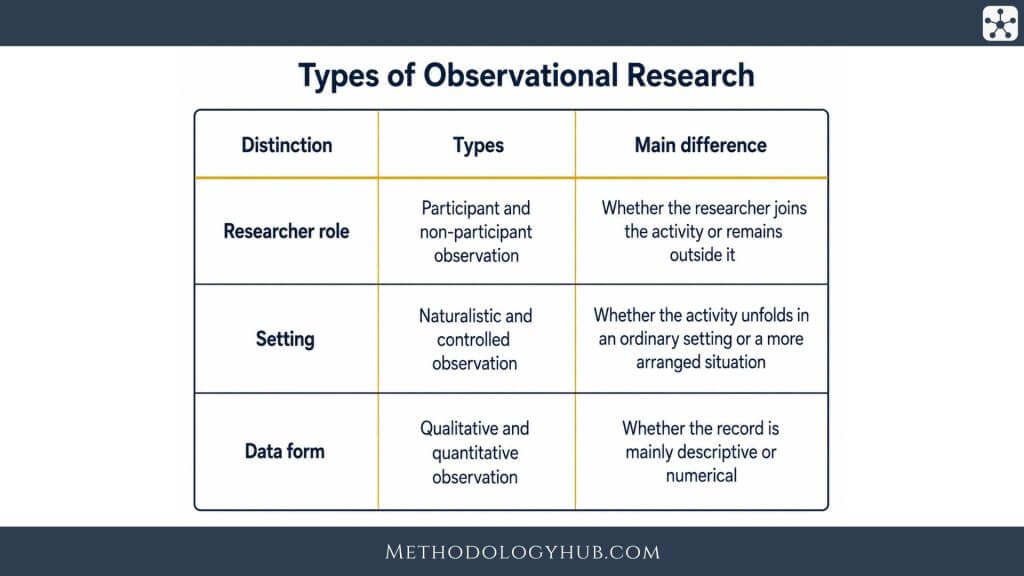
Types of observational research are often grouped by the researcher’s role, the setting, and the form of data recorded. These distinctions help the researcher explain what kind of observation was conducted and what kind of claim the study can support.
A study may fit more than one type. A researcher could conduct participant observation in a natural setting and write mainly qualitative field notes. Another researcher could conduct a controlled observation and record counts of specific behaviours.
| Distinction | Types | Main difference |
|---|---|---|
| Researcher role | Participant and non-participant observation | Whether the researcher joins the activity or remains outside it |
| Setting | Naturalistic and controlled observation | Whether the activity unfolds in an ordinary setting or a more arranged situation |
| Data form | Qualitative and quantitative observation | Whether the record is mainly descriptive or numerical |
Participant observation
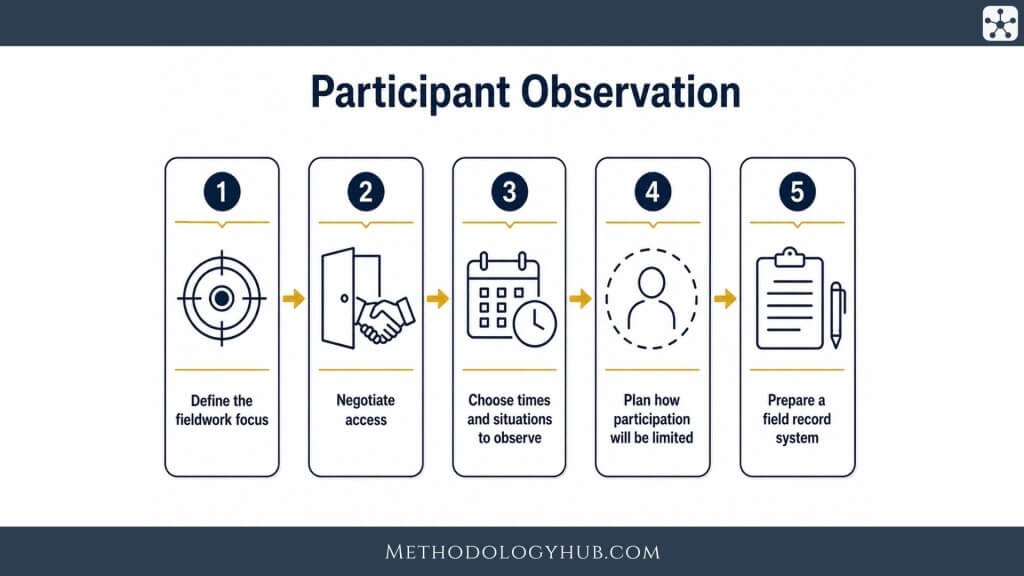
In participant observation, the researcher takes part in the setting or activity to some degree. They may join meetings, attend events, help with tasks, or spend time in the field as a known participant-observer. This position can give access to inside experience and informal details that may not be visible from the outside.
The challenge is that participation changes what the researcher can see. When the researcher is involved in an activity, they may miss details that an outside observer would notice. Reflexive notes are therefore important.
Non-participant observation
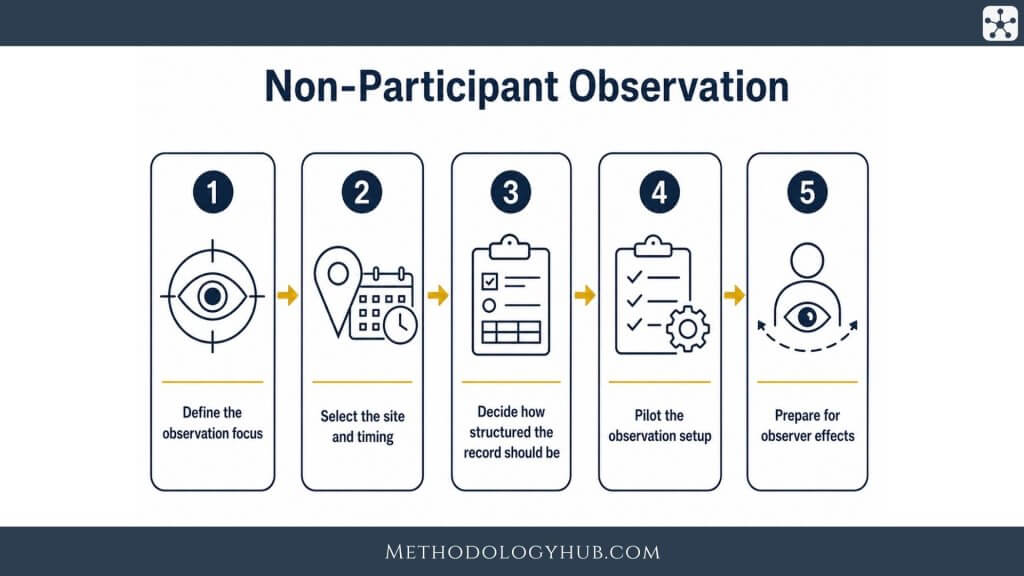
In non-participant observation, the researcher watches without joining the activity directly. This can be useful when participation would interrupt the setting or change the activity too much.
A researcher observing a classroom from the back of the room, for example, may record student interaction without joining the lesson. This can preserve distance, but it may also limit access to participants’ private meanings and informal explanations.
Naturalistic observation
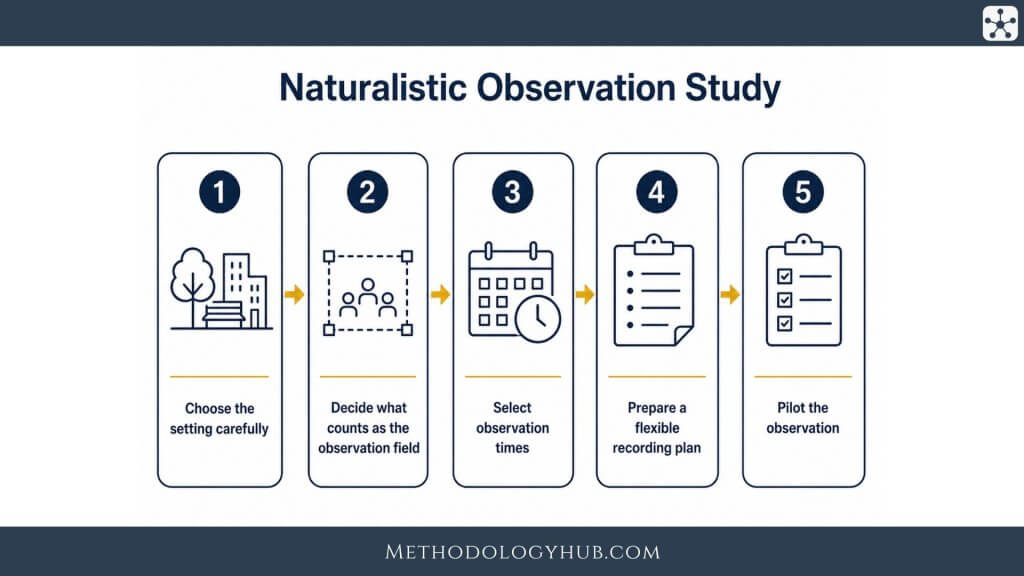
Naturalistic observation studies behaviour in the setting where it usually occurs. The researcher tries to understand ordinary activity with as little disruption as possible. This can be useful for classrooms, playgrounds, clinics, public spaces, and workplaces.
The strength is ecological detail. The researcher can see how people act in real conditions. The limitation is that the setting can be messy, unpredictable, and difficult to control.
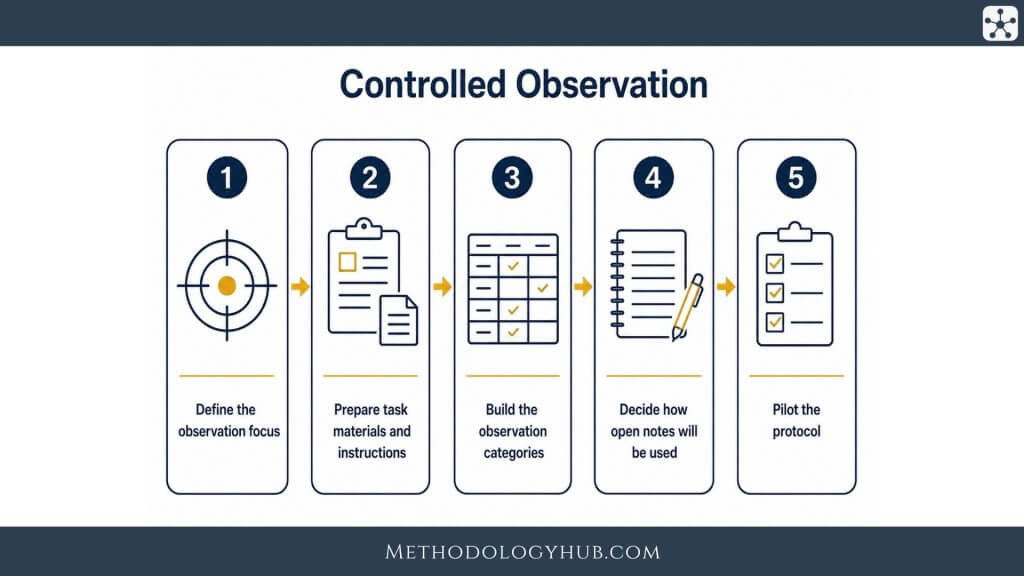
Controlled observation
Controlled observation takes place in a more arranged situation. The researcher may define the task, setting, timing, or behaviour categories before observation begins. This can make comparison easier, especially across participants or groups.
Controlled observation can still produce qualitative detail, but it usually gives less access to ordinary context than naturalistic observation. The researcher gains structure and gives up some everyday complexity.
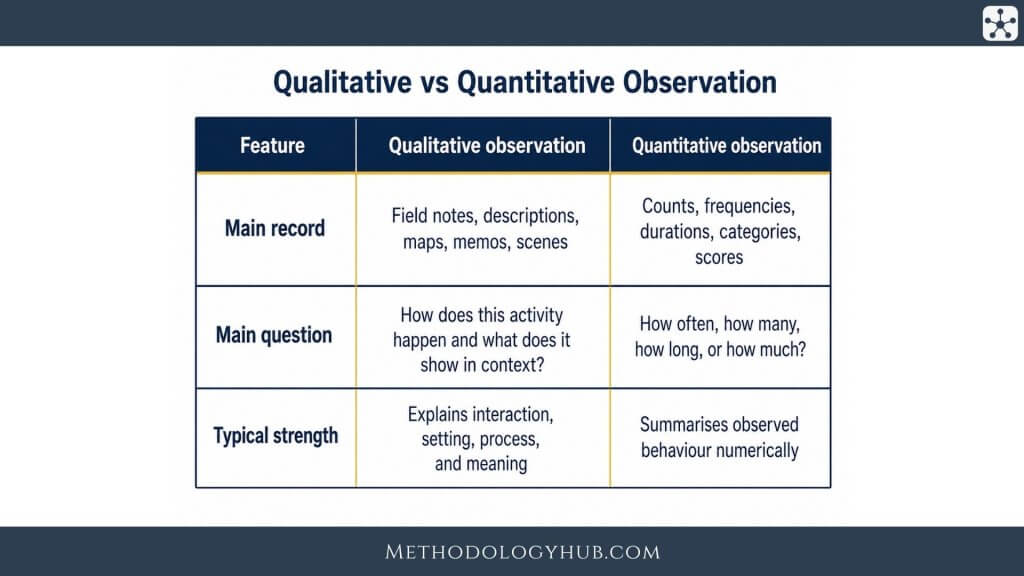
Qualitative and quantitative observation
Qualitative observation records rich descriptions of behaviour, setting, meaning, and interaction. Quantitative observation records behaviours as counts, durations, categories, or frequencies.
The same study may include both. A researcher may count how often students ask questions and also write descriptive notes about when those questions occur, how the teacher responds, and which students remain silent.
Planning an Observation Study
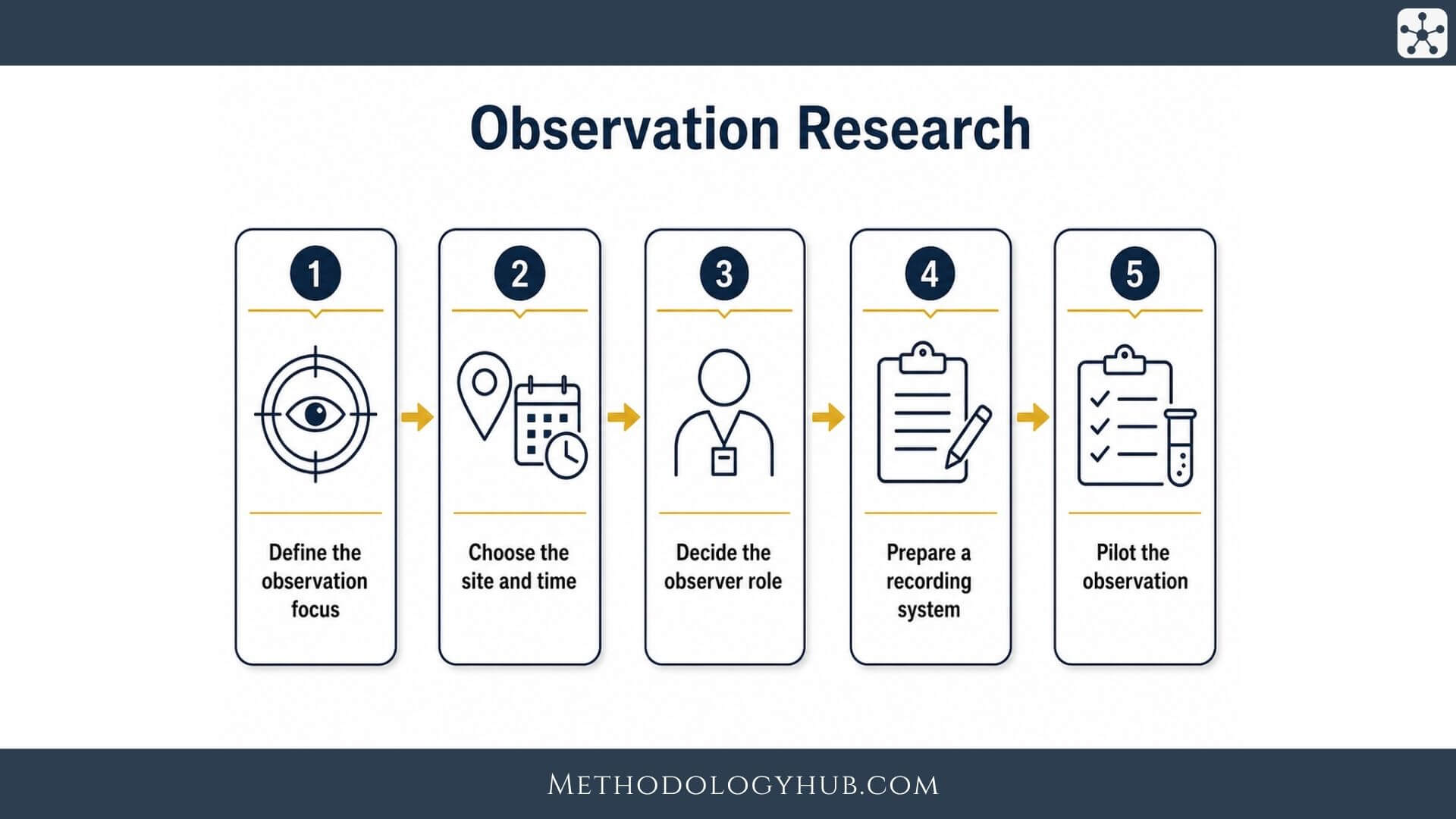
Planning an observation study means deciding what to observe, where to observe, when to observe, what role the researcher will take, and how the data will be recorded. These decisions should follow the research question rather than convenience alone.
The researcher should also think about access. Observation often requires permission from organisations, gatekeepers, or participants. A study in a school, clinic, workplace, or community group may need careful negotiation before the researcher can enter the setting.
Planning is not about making the setting predictable. It is about making the research process clear enough that the observations can later be interpreted.
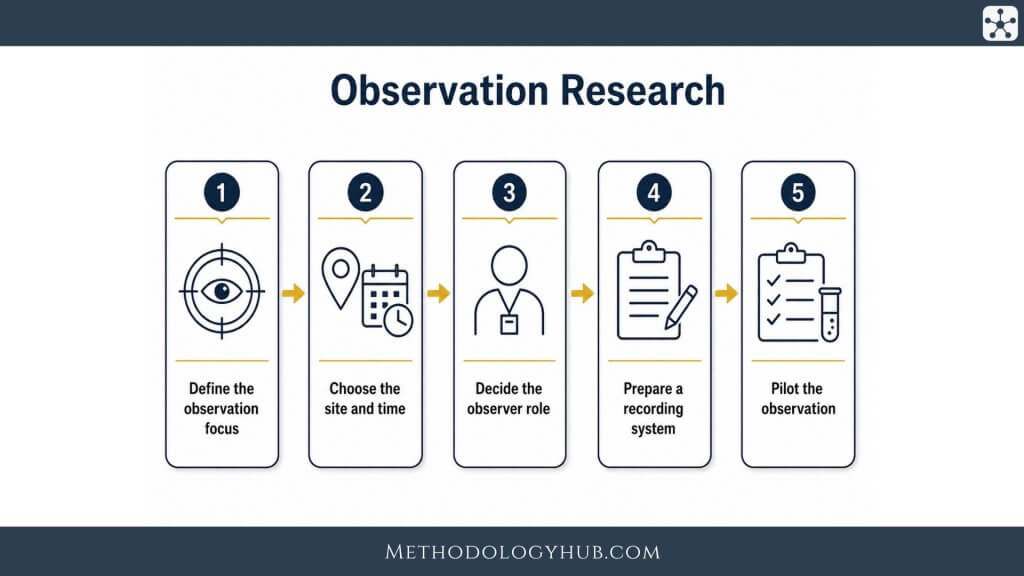
Define the observation focus
The observation focus should be specific. A researcher cannot observe everything in a busy setting. The focus may be teacher-student interaction, use of space, handover routines, turn-taking, movement through a public area, or the way participants use documents during a meeting.
A clear focus helps the researcher decide what to record and what to leave aside. It also helps prevent field notes from becoming a long description with no analytic direction.
Choose the site and time
The observation site should be relevant to the research question. If the study concerns informal peer support, the most useful setting may not be the formal classroom but the corridor, study area, online group, or after-school space where support actually happens.
Timing can also shape the data. Observing a clinic at opening time may show different routines from observing it near closing. Observing a school during exam season may not show ordinary classroom life. The researcher should explain why the chosen time was appropriate.
Decide the observer role
The researcher needs to decide whether to participate, remain separate, or move between roles. This decision affects access, behaviour, and interpretation. A participant observer may understand the setting from inside activity. A non-participant observer may preserve more distance.
The role should be communicated clearly to participants where appropriate. If people do not understand why the researcher is present, the observation setting can become tense or misleading.
Prepare a recording system
The researcher should decide how observations will be recorded before entering the field. Some studies use open field notes. Others use an observation sheet with categories, time intervals, or prompts. Some use maps, seating charts, photographs, or audio and video when suitable.
The recording system should fit the question. A study of movement through a public space may need maps and time notes. A study of classroom dialogue may need detailed notes on sequence and speaker roles.
Recommendation: before observing, decide what would count as relevant evidence. Otherwise the field record may become detailed but unfocused.
Pilot the observation
A short pilot observation can show whether the focus is realistic. The researcher may discover that the setting is too busy, the categories are unclear, the chosen time is unhelpful, or the note-taking system cannot keep up with the pace of events.
Piloting also helps the researcher practise writing notes while still paying attention to the setting. This is a practical skill, not only a design issue.
Recording Observational Data
Recording observational data is one of the hardest parts of the method. The researcher has to notice what happens, decide what is relevant, write enough detail, and avoid jumping too quickly from description to interpretation. Good records make later analysis possible.
The field record should be detailed enough for the researcher to return to the setting in analysis. A note that says “students were confused” may be too thin. A stronger note would describe what students did: looked at one another, asked repeated questions, waited without starting, or copied from the board without speaking.
Descriptive notes
Descriptive notes record what happened as concretely as possible. They may include actions, speech, movement, objects, layout, sequence, timing, and setting. These notes should avoid turning interpretation into fact too early.
Instead of writing “the group was bored,” the researcher might write “three students looked at their phones, two stopped writing, and one asked when the activity would finish.” The interpretation may come later, but the descriptive evidence is clearer.
Reflective notes
Reflective notes record the researcher’s early thoughts, questions, doubts, and possible interpretations. They might include an idea about a pattern, a question for later interviews, or a note that the researcher’s presence may have affected the setting.
Separating descriptive and reflective notes helps analysis. It allows the researcher to see the difference between what was observed and what was inferred.
| Type of note | Example | Use in analysis |
|---|---|---|
| Descriptive | The teacher stood beside Group 2 for four minutes and asked three questions. | Supports evidence about action, sequence, and setting. |
| Reflective | Group 2 may receive more support because they ask questions loudly. | Stores early interpretation for later checking. |
| Method note | Could not hear Group 4 clearly because of noise near the door. | Documents limits in the observation record. |
Maps, sketches, and time notes
Maps and sketches are useful when space affects the activity. A classroom seating plan, clinic layout, or map of a public square can help the researcher analyse movement, visibility, distance, and access. These details may be hard to describe in prose alone.
Time notes help when sequence is important. The researcher may record when a meeting begins, how long a transition lasts, when interruptions occur, or how often a routine repeats. Time is often part of the observation data, not only background information.
Expanding notes after observation
Brief notes written during observation should often be expanded as soon as possible afterward. The researcher can add detail while memory is fresh, separate description from interpretation, and write questions for later data collection.
Waiting too long can weaken the record. Small details that seemed obvious in the moment may become unclear later.
Observation Compared with Interviews and Focus Groups
Observation, interviews, and focus groups all collect qualitative data, but they answer different kinds of questions. Observation studies behaviour and setting. Interviews study personal accounts. Focus groups in qualitative research study group discussion and interaction around a topic.
The methods can overlap. An observation study may include informal conversations. An interview study may ask participants to describe observed events. A focus group may discuss routines that could also be observed. The difference is the main route to evidence.
Observation and interviews
Observation is stronger when the researcher needs to see action in context. Interviews are stronger when the researcher needs participants’ interpretations, motives, memories, or feelings. A study of classroom silence might use observation to see when silence occurs and interviews to understand how students interpret it.
The two methods can correct each other’s limits. Observation can challenge what people say they do. Interviews can explain what observation cannot show directly.
Observation and focus groups
Observation can show how people interact in a setting. Focus groups can show how people discuss that setting later. A researcher studying a public park may observe movement through the space and then hold focus groups to understand how residents describe safety, belonging, and access.
The group discussion does not replace observation. It gives another kind of evidence: shared language, disagreement, and explanation.
Choosing the best method mix
The best method mix depends on the research question. If the question asks what happens during a routine, observation may come first. If the question asks how participants understand that routine, interviews may be needed. If the question asks how a group discusses the routine, focus groups may be useful.
Recommendation: use observation for practice, interviews for personal meaning, and focus groups for shared discussion.
Combining methods should not be done only to make a study look larger. Each method should have a clear role in the design.
How to Analyse Observational Research Data
Analysing observational research data means moving from field records to an interpretation of action and context. The researcher reads notes, organises events, identifies patterns, compares settings, and checks early interpretations against the observation record.
Analysis should not rely only on memory of the field. The field notes, maps, time records, and memos provide the evidence. If the notes are thin, later interpretation becomes weaker.
Start with the full field record
The researcher should begin by reading the whole field record. This includes descriptive notes, reflective notes, maps, timelines, and any observation sheets. Reading everything together helps the researcher understand the setting before coding fragments.
Whole-record reading can also show where the data are uneven. One observation may contain detailed notes on interaction but little on space. Another may include strong time records but weak description of language. These differences should be considered during analysis.
Code actions, settings, and sequences
Observation data can be coded for actions, roles, spaces, objects, routines, interruptions, transitions, and patterns of interaction. Codes should be close enough to the data to preserve what happened, but analytic enough to answer the research question.
For example, a study of group work might code teacher intervention, peer explanation, task avoidance, waiting, material use, and requests for help. The researcher may also code where these actions happen and what comes before or after them.
Compare across times and places
Observation often becomes more useful when cases are compared. The researcher may compare different classrooms, shifts, meetings, locations, or times of day. Comparison can show whether a pattern belongs to one moment or appears across the study.
A clinic may function differently in the morning and afternoon. A classroom may change when a teaching assistant is present. A public space may feel different on weekdays and weekends. These differences can shape the analysis.
Check interpretation against description
The researcher should return to descriptive notes when developing themes. If a theme says that a group was excluded, the notes should show how exclusion appeared: seating, turn-taking, lack of eye contact, ignored suggestions, or restricted access to materials.
This checking helps prevent the analysis from becoming too abstract. Observation findings are strongest when the reader can see the link between interpretation and recorded detail.
Write findings with setting detail
Observation findings should include enough setting detail for readers to understand where the evidence came from. The writing may describe the room, timing, roles, objects, sequence, or repeated actions. This context helps readers judge the interpretation.
The researcher should avoid overloading findings with description. The goal is to use detail to support an analytic point, not to reproduce every field note.
Examples of Observational Research
Examples of observational research show how the method can be used when the researcher needs to study practice in context. The examples below use different settings, but each one depends on watching and recording what happens rather than relying only on later accounts.
Example 1: Classroom group work
A researcher observes group work in a secondary school classroom. The observation focuses on how students divide tasks, who asks questions, how the teacher moves between groups, and what happens when groups become stuck.
The field notes may show that quieter groups receive less support because they do not call the teacher over, while louder groups receive more attention. The study can then examine how help is distributed during ordinary classroom activity.
Example 2: Hospital shift handovers
A health researcher observes shift handovers on a hospital ward. The focus is on where handovers happen, which information is repeated, how interruptions are handled, and how staff check understanding before the shift changes.
The observation may show that handover quality depends on timing, noise, access to records, and whether staff are pulled away during the process. Interviews could later help explain how staff interpret those pressures.
Example 3: Public space use in a local square
A researcher studies how people use a public square at different times of day. The researcher maps where people sit, walk, wait, gather, or avoid. Notes also record lighting, noise, entrances, and informal rules about who uses which areas.
The analysis may show that the same space functions differently for commuters, older residents, teenagers, parents with children, and street vendors. Observation is useful because the use of space is visible in movement and timing.
Example 4: Team meetings in a workplace
A workplace researcher observes team meetings to understand participation. The notes record who introduces topics, who responds, how decisions are made, how disagreement is managed, and which suggestions are ignored or taken up.
The study may show that participation is shaped by role and seniority even when the organisation describes meetings as open. Observation allows the researcher to study interaction as it happens.
Conclusion
Observational research helps researchers study action, interaction, routine, space, and setting as they unfold. It is especially useful when the research question asks what happens in practice, how people coordinate activity, or how context shapes behaviour.
A strong observation study needs a clear focus, a suitable site, a defined observer role, careful recording, and analysis that links interpretation to field evidence. Observation can stand alone, but it often becomes stronger when combined with interviews, documents, or other materials that help explain what was seen.
FAQs on Observational Research
What is observational research?
Observational research is a data collection method in which a researcher watches and records behaviour, interaction, activities, settings, or events. It is used to study what happens in context rather than relying only on later accounts.
What is observational research in qualitative research?
Observational research in qualitative research records detailed descriptions of behaviour, interaction, space, routines, and context. The data are usually analysed to understand meaning, practice, and social processes in a setting.
What are the types of observational research?
Common types of observational research include participant observation, non-participant observation, naturalistic observation, controlled observation, qualitative observation, and quantitative observation. These types differ by researcher role, setting, and data form.
How do you conduct observational research?
To conduct observational research, define the focus, choose the site and time, decide the observer role, prepare a recording system, pilot the observation, collect field data, expand notes, and analyse patterns in behaviour and context.
What should be recorded during observation?
Observation records may include actions, speech, movement, space, timing, objects, interruptions, routines, interactions, descriptive field notes, reflective notes, maps, sketches, and time records.
What is the difference between observation and interviews?
Observation studies behaviour and setting as they happen, while interviews collect participant accounts, meanings, memories, and explanations. Observation is stronger for practice in context, while interviews are stronger for personal interpretation.
How do you analyse observational research data?
Observational research data are analysed by reading the full field record, coding actions and settings, comparing patterns across times or places, checking interpretations against descriptive notes, and writing findings with enough context to support the analysis.