Most Similar Systems Design (MSSD) compares cases that share relevant background characteristics but differ in the outcome being investigated. Researchers examine the remaining differences to identify possible explanations for that outcome. It belongs to types of research that use comparison to investigate relationships and develop explanations.
Within comparative research, MSSD offers a way to study a small number of cases in depth. Two schools, regions or countries may share conditions that would otherwise complicate the analysis, allowing the researcher to examine a narrower set of explanatory differences.
This article explains the logic of MSSD, how to select and analyse cases, its advantages and limitations, and how it differs from Most Different Systems Design.
What Is Most Similar Systems Design?
A most similar systems study begins with a contrast: cases that appear comparable have produced different results. The research task is to explain that divergence. Similarity provides a starting point because shared conditions make some explanations less persuasive, while differences suggest factors that deserve closer investigation.
Most Similar Systems Design Definition
Most Similar Systems Design is a comparative research design in which cases are selected for similarity on theoretically relevant background factors, while variation in an outcome helps researchers investigate potential explanatory factors. The familiar shorthand is similar cases, different outcomes, investigate the explanatory difference. In practice, several differences may remain, and the study must examine them.
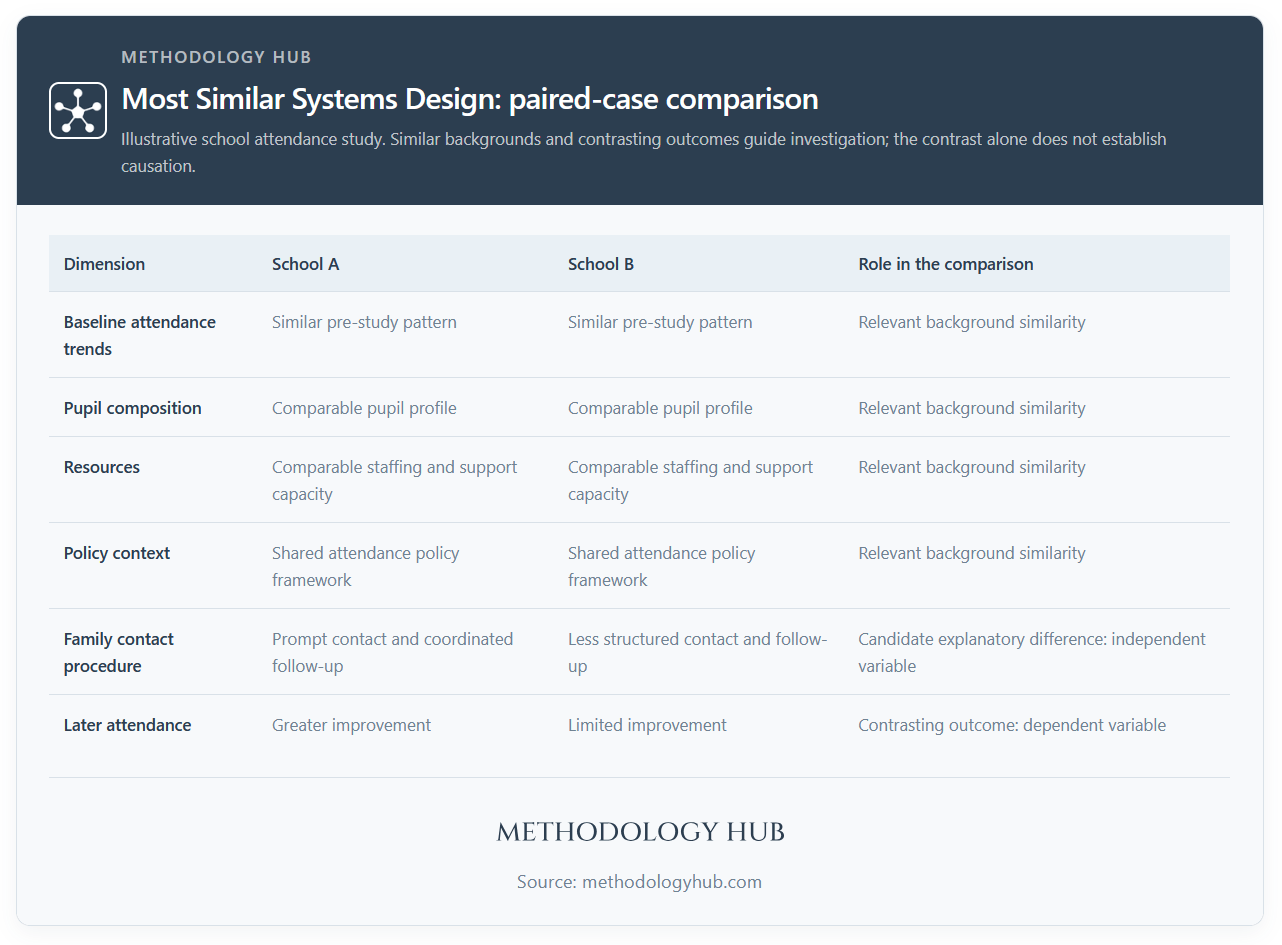
Consider two secondary schools in the same district. They follow the same attendance regulations, serve similar age groups and receive funding through the same system. Yet attendance improves in one school and remains largely unchanged in the other. A comparison could investigate whether differences in family contact, transport provision or attendance support help explain the contrasting results.
MSSD in Comparative Politics and Social Research
The term is associated with Adam Przeworski and Henry Teune’s The Logic of Comparative Social Inquiry, published in 1970. In comparative politics, the systems being compared are often countries, with institutional arrangements, economic conditions and political histories providing the background for the comparison. The same selection logic can be applied to subnational regions, public institutions or local communities.
MSSD specifies how the comparison is constructed. It can work alongside case study research, where each selected case receives detailed examination. Interviews, records, observations and numerical indicators then provide the material needed to investigate the explanation.
Small-N Comparative Research
The expression small-N refers to a small number of cases at the level of comparison. A study of two schools has two school-level cases even if it examines attendance records for hundreds of pupils. Those records enrich the evidence, but pupils exposed to the same school policy do not become hundreds of independent school-policy comparisons.
A paired comparison is common, although MSSD can include more than two cases. The appropriate number depends on the research question, the available comparisons and the depth of evidence required. Adding a case is useful when it helps distinguish explanations or establish where an explanation applies.
The Logic of Most Similar Systems Design
The logic of MSSD is easiest to follow when the shared background, proposed explanation and observed outcome appear in the same comparison. This makes the researcher’s reasoning visible before the study moves into the history and detail of each case.
Similar Background Conditions and Different Outcomes
In an illustrative school-attendance comparison, both schools begin with the same attendance rate and operate under the same district rules. One introduces early telephone contact after unexplained absences; the other continues its existing weekly notification procedure.
| Comparison feature | School A | School B |
|---|---|---|
| District attendance regulations | Same regulations | Same regulations |
| Pupil age range | 11 to 16 years | 11 to 16 years |
| Attendance before the comparison period | 90% | 90% |
| Family contact after unexplained absence | Early telephone contact | Weekly notification |
| Attendance during the comparison period | 94% | 90% |
The four-percentage-point difference in later attendance directs attention towards the contact procedure. The shared baseline also helps establish that the outcome contrast emerged during the period under investigation. It does not establish that contact caused the improvement: staff changes, transport disruption or differences in pupil health could also explain the pattern.
Independent, Dependent and Control Variables
In this comparison, the contact procedure is the proposed explanatory factor, or independent variable, while attendance is the dependent variable. District rules, age range and baseline attendance provide background characteristics used to judge comparability. These variables in research have different roles because the study asks whether one practice helps explain a particular outcome under specified conditions.
Calling a background characteristic a control variable means that the researcher has tried to hold it sufficiently similar through case selection. It does not mean that the characteristic has been experimentally controlled. Two schools can have similar average class sizes while differing considerably in the distribution of pupils across classes.
A shared condition can also help explain the overall level of attendance without explaining the difference between schools. District regulations may influence attendance in both cases. Their similarity makes them less useful as a standalone explanation for the contrast, but they may shape how the contact procedure operates.
Mill’s Method of Difference
MSSD is commonly related to John Stuart Mill’s method of difference. In its ideal form, two instances share all relevant circumstances except one, and the outcome differs. The remaining circumstance becomes a candidate explanation. Real social settings rarely meet that demanding requirement, so MSSD uses an approximation of the logic.
The comparison therefore produces a proposition to investigate: earlier family contact may improve attendance when it reveals problems quickly enough for the school to respond. The next task is to examine whether that sequence occurred and whether another factor offers a stronger account of the outcome difference.
Case Selection in MSSD
Case selection determines what an MSSD study can explain. Two nearby schools may be convenient to visit, but their location alone provides little justification for treating them as comparable. The relevant similarities depend on the outcome and on the explanations the researcher needs to assess.
Defining the Case Population
Begin by identifying the set of cases to which the study refers. For the attendance example, that might be publicly funded secondary schools within one district during a particular academic year. This defines a case population and a period within which regulations, records and school practices can be compared.
A focused research question then guides selection: how does early family contact help explain attendance differences between otherwise comparable schools? That question requires variation in contact procedures and sufficient similarity in conditions that could independently affect attendance.
Selecting Relevant Similarities
Use existing research and knowledge of the setting to identify background factors that could influence both the proposed explanation and the outcome. For a school-attendance study, useful selection criteria might include:
- Prior attendance: rates and trends before the contact procedure began.
- Pupil composition: age groups, support needs and relevant household circumstances.
- Institutional resources: staffing, school size and attendance-support provision.
- Access conditions: transport availability and distance from home to school.
- Policy context: district rules and other attendance initiatives during the study period.
The criteria should have an explanatory reason. Matching schools on uniform colour would add detail without improving this comparison. Matching on prior attendance trends is more informative because a school already improving before the new procedure began could continue improving for unrelated reasons.
Matching Cases and Assessing Differences
Matching means finding cases with sufficiently similar values on the selected background factors. Some characteristics can be matched exactly, such as district membership or school type. Others require a justified tolerance, such as comparable enrolment ranges or broadly similar levels of socioeconomic disadvantage.
Where a larger dataset is available, matching procedures can help identify plausible pairs. The resulting pair still needs substantive examination. Similarity in a summary score can conceal a large difference on a factor directly relevant to the research question, such as transport access.
Selection should normally focus on conditions that existed before the explanatory factor could affect them. If early family contact improves parental engagement, matching schools on engagement measured afterwards could remove part of the process the study seeks to explain. Establishing the timing of each selection criterion avoids that problem.
Justifying Outcome Variation
The classic MSSD comparison includes different outcomes, but an observed contrast should not be the only reason for choosing the cases. Explain which schools were eligible, how similarities were assessed and whether comparable cases with other outcomes were available. This lets readers evaluate whether the selection favours the proposed explanation.
A third school can be especially useful if it introduces early contact without an attendance improvement. That additional case may reveal that contact works only when staff can resolve the problems families report. It can also show that the initial explanation needs revision. Cases that challenge an explanation provide evidence about its limits.
Most Similar Systems Design vs Most Different Systems Design
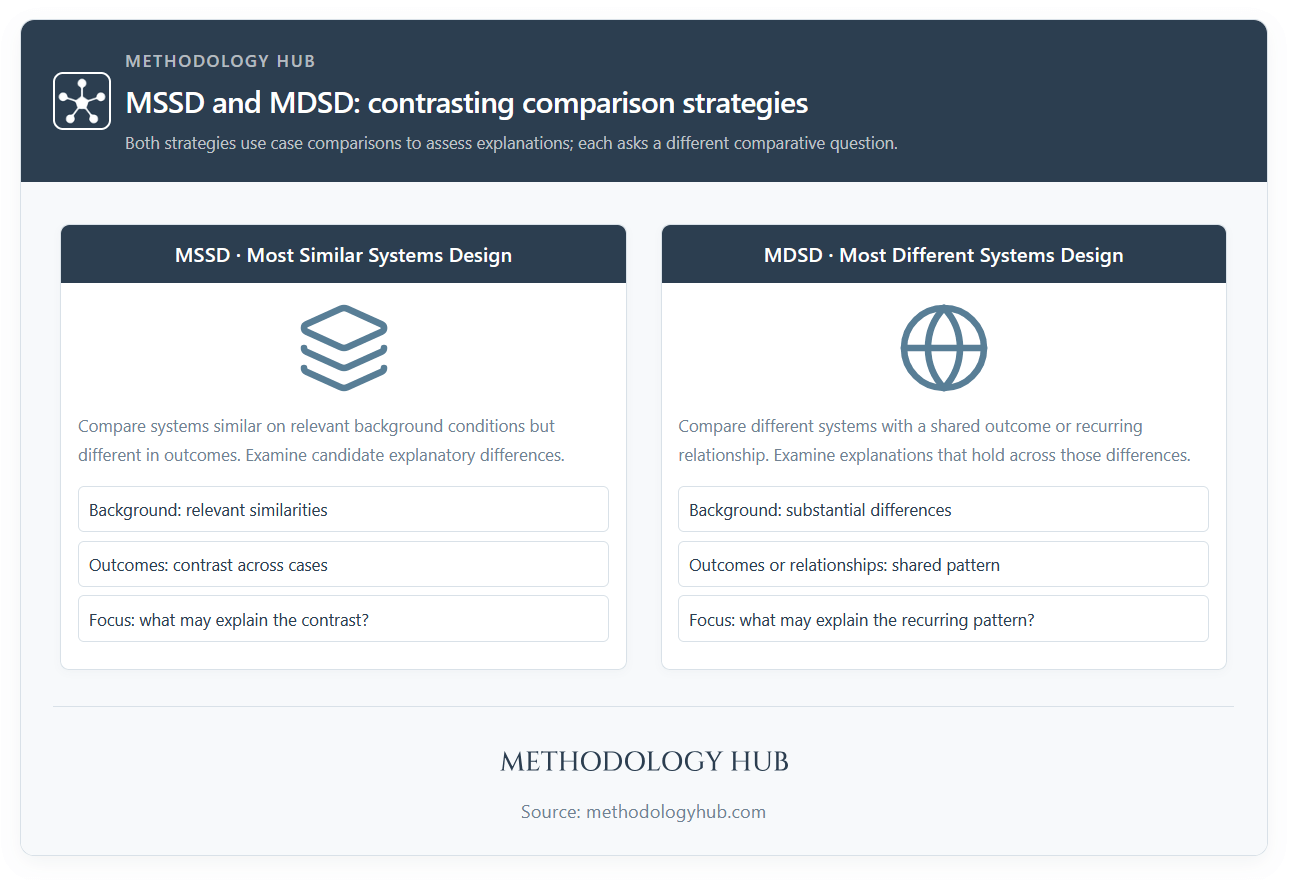
MSSD and Most Different Systems Design (MDSD) organise case comparison around contrasting selection strategies. Both seek explanatory patterns, but they begin with different combinations of background similarity and outcome variation.
Explaining Divergence and Convergence
An MSSD study might examine why two comparable schools show different attendance trends. An MDSD study could instead investigate why schools in contrasting settings both improve attendance, asking whether a shared practice helps explain that convergence despite differences in resources, pupil populations and local conditions.
A shared factor in different settings is a candidate explanation, rather than proof of a universal cause. The schools could have reached the same outcome through different processes. Conversely, a factor that differs between similar schools may work only in combination with a condition they share.
Choosing Between MSSD and MDSD
MSSD is useful when the question concerns divergence within a reasonably comparable set of cases. MDSD is useful when the question concerns a recurring outcome or relationship across contrasting settings. The choice follows the explanatory problem and the available evidence, rather than a general preference for similarity or difference.
The shorthand in the table captures common teaching versions of the designs. Przeworski and Teune’s original discussion of most different systems also examined relationships below the system level across contrasting systems. MDSD can therefore involve comparing a relationship across countries, rather than simply selecting countries with the same national outcome.
Researchers can use the strategies in sequence. A most similar comparison may develop an explanation of how early contact works within one district. A later comparison across different districts can investigate whether the same mechanism operates under other institutional conditions, extending the inquiry beyond the original pair.
How to Use Most Similar Systems Design
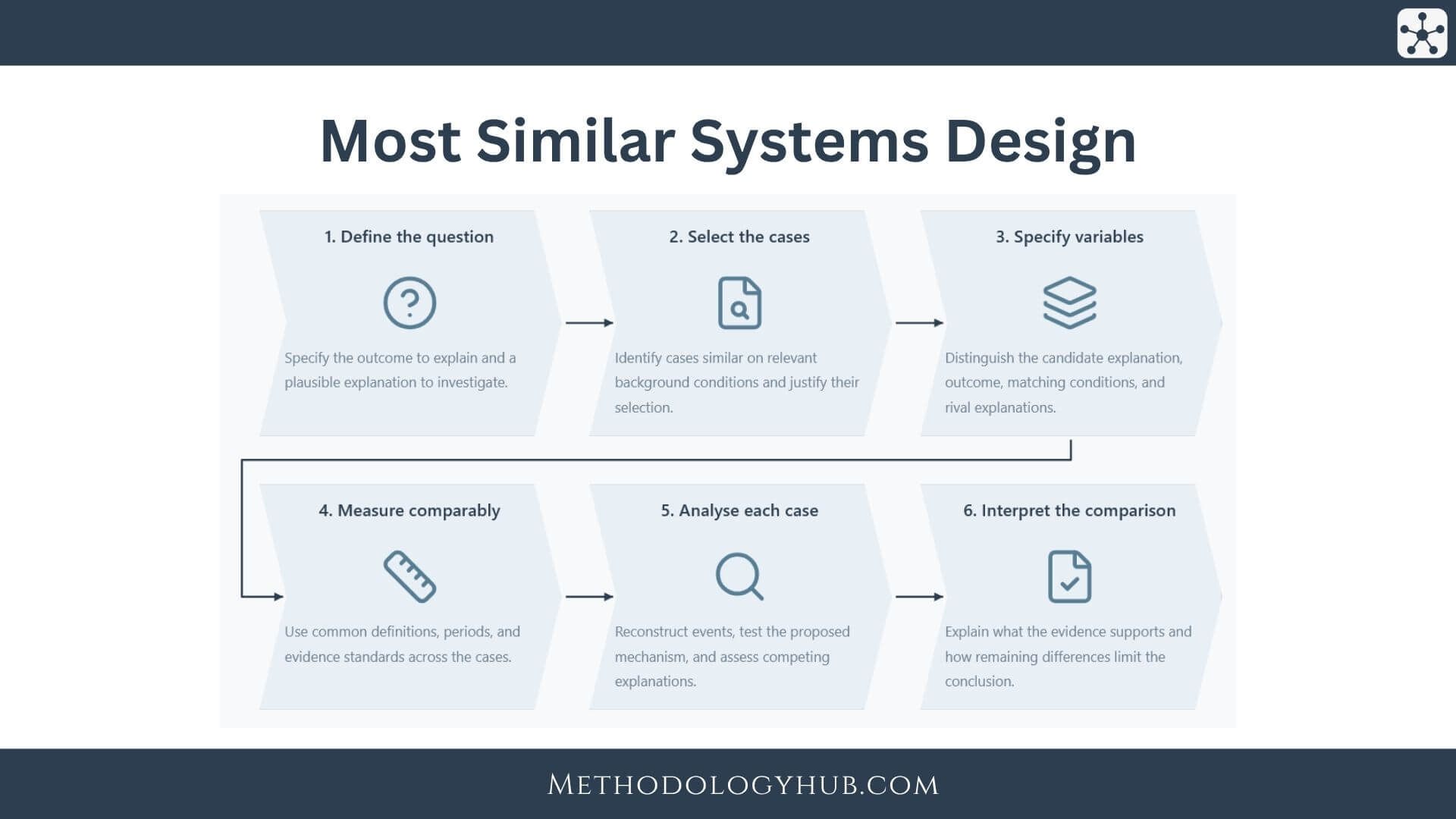
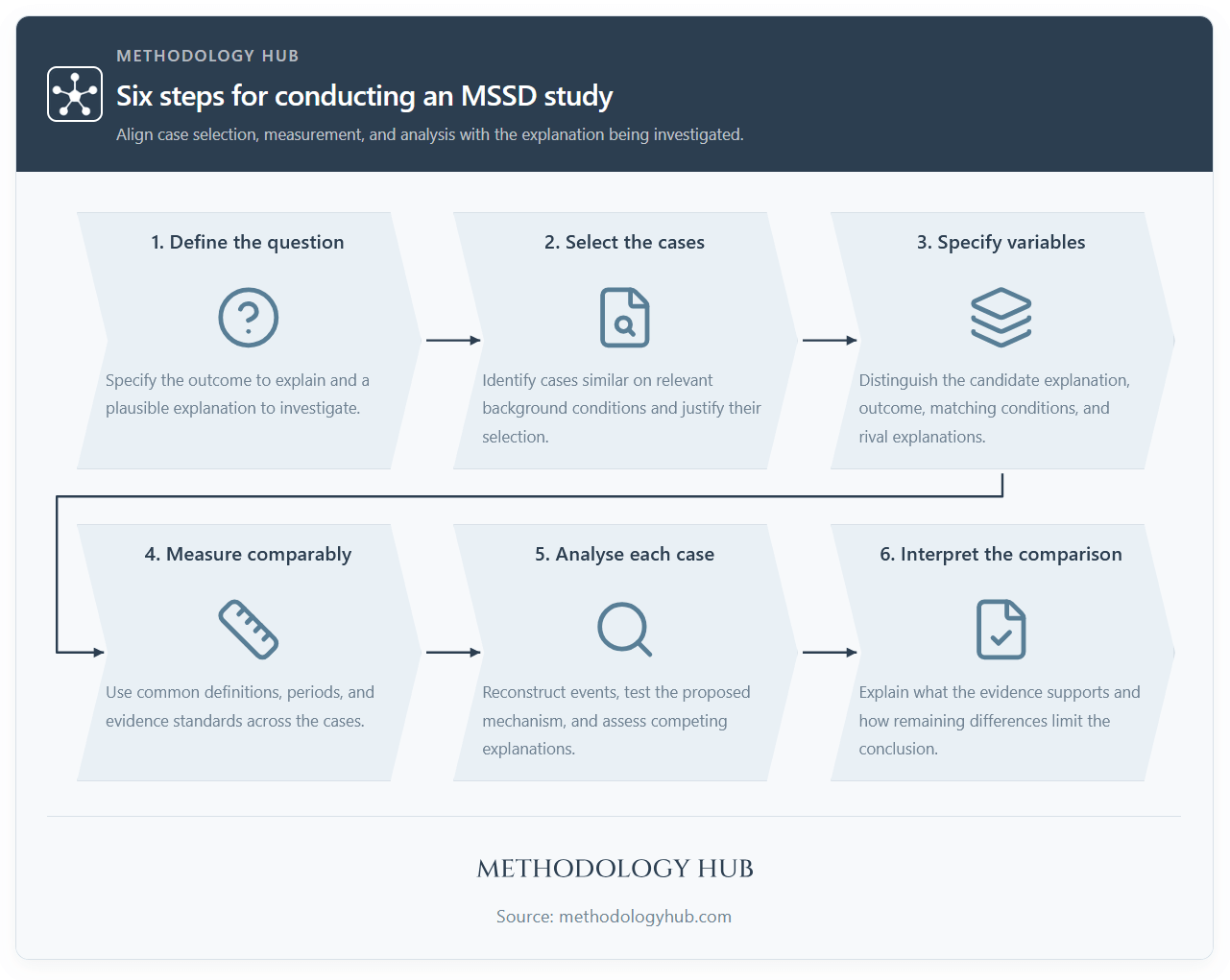
Using MSSD involves building a comparison that can distinguish plausible explanations. Each decision, from the definition of attendance to the choice of schools, should make the final argument easier to assess. The basic procedure follows six steps:
- Formulate the outcome-focused research question and proposed explanation.
- Define the eligible cases and the period under investigation.
- Select comparable cases using justified background criteria.
- Measure the outcome and explanatory factors consistently.
- Compare the cases and investigate the processes within each one.
- Evaluate rival explanations and state the scope of the findings.
Formulate the Question and Proposed Explanation
Begin with an outcome that requires explanation. In the school example, the question concerns attendance improvement over one term. The proposed explanation is that early contact helps staff identify and address barriers before absences accumulate. This gives the research a mechanism to investigate, rather than leaving it with an unexplained association between telephone calls and attendance.
Specify what would support or weaken the proposition. Support might include documented contact followed by action on a reported difficulty and improved attendance among the pupils concerned. Evidence that attendance improved before the procedure began would weaken that account.
Build the Case Comparison
Review the eligible schools and record their background characteristics before settling on a pair. Document why the selected cases are sufficiently similar for the question, which differences remain and what those differences might explain. A comparison matrix helps keep these decisions explicit.
Data access also affects the design. If one school has detailed daily records and the other retains only term totals, the pair may support an outcome comparison but offer much less evidence about timing. It may be necessary to choose another case or narrow the question.
Establish Comparable Measures
Define attendance consistently across schools. Specify whether the measure concerns pupils present, sessions attended or days attended, and whether authorised absences are included. The observation periods should align so that holidays, examinations or seasonal illness do not create an artificial difference.
Define the contact procedure with equal care. A school policy stating that families receive early contact does not establish how often that contact occurs. Record when calls were attempted, whether families were reached and what follow-up actions occurred. This distinguishes the stated policy from its implementation.
Collect Evidence Within Each Case
Choose data collection methods that capture both the outcome pattern and the proposed process. Attendance registers show changes over time; contact logs establish timing; staff and family interviews can explain what happened after a call. Observations may show whether the procedure fits into daily school routines.
Use the same core questions in both schools. Ask how unexplained absence is identified, who contacts families, how responses are recorded and what assistance follows. Comparable questions produce evidence that can be analysed across cases without erasing differences in local practice.
Assess the Explanation and Report the Findings
Compare the observed sequence with the proposed mechanism. Then examine alternatives such as changes in staffing, enrolment or transport. A credible account explains how the evidence discriminates between these possibilities and identifies any uncertainty that the available records cannot resolve.
The final report should show the selection rationale, measurement rules, case findings and cross-case reasoning. Readers need to see why a difference is treated as explanatory, how it connects to the outcome and which conditions limit the conclusion.
Data Analysis in Most Similar Systems Design
Analysis in MSSD moves between the comparison and the evidence inside each case. The comparison identifies a pattern; detailed case analysis examines whether the proposed explanation fits the events that produced it. Both are needed for an explanatory argument.
Organising the Cross-Case Evidence
Organise the evidence by analytical question, so that the same issue can be examined in each school. This structure makes gaps visible: an outcome may be well documented even when evidence about the contact procedure is incomplete.
| Analytical question | Relevant evidence | What to examine |
|---|---|---|
| Are the schools comparable? | Baseline records and school profiles | Relevant similarities and remaining differences |
| Did the contact procedure operate? | Dated contact logs and staff accounts | Actual implementation and coverage |
| Did the outcome change? | Attendance records for aligned periods | Magnitude, timing and distribution of change |
| How could contact affect attendance? | Family responses and follow-up records | Evidence for the proposed sequence |
| Could another factor explain the pattern? | Transport, staffing and policy records | Alternative events and their timing |
A numerical difference should be interpreted alongside its distribution. A school-wide attendance increase could reflect improvement among previously absent pupils, changes in enrolment or a change in recording practice. Examining pupil-level records helps determine which pattern occurred, while keeping the school as the main comparative case.
Qualitative evidence can be organised through a common coding framework. Categories might cover reasons for absence, responses to family contact and forms of assistance. Apply the framework to both cases, while retaining accounts that do not fit the initial categories. Those accounts may suggest a different explanation.
Process Tracing and Causal Mechanisms
Process tracing investigates the sequence connecting a proposed cause to an outcome within a case. For early contact, the expected sequence could involve identifying an absence, reaching the family, learning about a barrier, arranging assistance and observing subsequent attendance. Each stage requires evidence appropriate to the claim.
A dated transport-support record is more informative about that sequence than a general statement that staff communicate well with families. Evidence is stronger when it helps distinguish the proposed mechanism from a rival account. If a new bus service began before attendance improved, the analysis must examine its contribution as well.
Timing supports causal reasoning, but temporal order alone is insufficient. The contact procedure may have started before improvement while another initiative produced the change. Examine whether the evidence connects the procedure to the pupils and absences involved, rather than only establishing that two events occurred in sequence.
Combining Qualitative and Quantitative Analysis
Numerical indicators can describe baseline similarity, outcome variation and trends. Interviews and documents can explain implementation and participant responses. Their combination allows the researcher to connect a measured pattern with evidence about how it developed.
Before-and-after records can strengthen an MSSD comparison, although a formal difference-in-differences analysis requires additional assumptions, including a defensible parallel-trends assumption. Two school cases with many pupil records also require attention to clustering. The number of records cannot compensate for a very small number of independently varying school policies.
Examples of Most Similar Systems Design
The comparison changes with the discipline, but the selection question remains consistent: which cases share the conditions relevant to this explanation, and which differences help investigate the outcome? Countries are familiar examples, though institutions and local settings often permit closer matching.
MSSD Example in Comparative Politics
A study of voter turnout could compare democracies with similar levels of economic development, comparable registration procedures and elections held under broadly similar conditions. The cases differ in whether voting is compulsory and in their turnout levels. Compulsory voting becomes a candidate explanation for the turnout contrast.
The study would examine how the rule operates: whether sanctions are enforced, whether voters understand the obligation and whether election administration makes participation accessible. It would also investigate electoral competitiveness and mobilisation. A legal difference can suggest an explanation, but the causal argument depends on the practices and incentives through which the law affects participation.
MSSD Example in Education
A researcher could compare two university departments offering similar first-year courses to students with comparable entry qualifications. One provides scheduled peer-feedback sessions before essays are submitted, while the other uses its established tutorial format. The outcome is the quality of evidence use in students’ final essays, assessed through a shared rubric.
Suitable background comparisons would include assignment difficulty, teaching time and prior writing performance. Analysis could examine changes between draft and final essays, alongside observations of feedback sessions. If the departments also differ in assessment guidance, that difference needs investigation. Selecting similar courses reduces the explanatory field without making the feedback sessions equivalent to a randomly assigned intervention.
MSSD Example in Historical Research
A historical study could compare neighbouring districts operating under the same education legislation during a defined decade. They share an administrative framework and broadly similar starting levels of literacy, yet literacy develops at different rates. Variation in teacher-training provision becomes one possible explanation.
School registers, inspection reports and training records would help establish whether teachers received preparation before the outcome divergence. archival data can also reveal differences in school access or population movement. The analysis needs to account for uneven record survival and changes in how literacy was recorded, since an apparent difference may partly reflect the available documentation.
Across these examples, the explanatory factor is a rule or practice operating within a setting. A useful MSSD account specifies both: the factor under investigation and the conditions under which it could produce the outcome. That combination makes the conclusion more informative than a simple statement that the cases differ.
Limitations of Most Similar Systems Design
Real cases differ in more ways than a comparison table can display. The strength of an MSSD conclusion depends on how well those differences are investigated and how closely the final claim follows the evidence. Several limitations affect the interpretation.
Unobserved Differences and Confounding
A confounding factor can influence both the explanatory variable and the outcome. A well-resourced school may introduce early family contact while also offering stronger pupil support. If resources are poorly measured, the study could attribute attendance improvement to contact when the broader support system explains much of the change.
Matching on observed characteristics reduces selected differences; it leaves unobserved differences unresolved. Relevant evidence may emerge during interviews or document analysis, requiring the researcher to reconsider the initial pair. That reconsideration should be reported because it changes the explanatory basis of the comparison.
Selection Bias and Limited Outcome Variation
Choosing cases because they display a striking contrast can help investigate a puzzle, but it does not produce a representative sample of all eligible schools. A pair selected for its outcome difference cannot establish how common the proposed relationship is across the wider population.
The selection can also favour a theory if comparable cases that contradict it are ignored. Recording the candidate cases and examining a disconfirming case where feasible helps assess this possibility. Additional cases should be selected for their explanatory contribution, rather than added simply to increase the count.
Multiple Causes and Interactions
An outcome may arise from several conditions working together. Early contact might improve attendance where families can obtain transport assistance but achieve little where the underlying difficulty remains unresolved. The same practice can therefore produce different results under different circumstances.
Shared background factors may participate in that causal combination. A district support service can be identical across schools while enabling effective contact in only the school that refers families to it. Treating every shared characteristic as irrelevant would miss the interaction between policy context and implementation.
Generalisation Beyond the Selected Cases
MSSD can support an explanation that is relevant beyond the observed pair, but the extension requires a reasoned account of comparable conditions. When presenting the scope of a finding, specify:
- The case population: which institutions or settings the explanation is intended to cover.
- The enabling conditions: the resources, rules or circumstances required for the proposed mechanism.
- The period: when the evidence and institutional arrangements apply.
- The unresolved alternatives: explanations the available evidence could not adequately distinguish.
This supports analytical generalisation: assessing whether an explanation could apply to other cases with relevant conditions. It differs from estimating a population-wide effect using a representative sample. A detailed account of two schools may explain a mechanism well while leaving its prevalence and average effect uncertain.
There is also a trade-off between close matching and broader coverage. Selecting schools within one district improves comparability but limits institutional variation. Later studies in other districts can examine whether the explanation survives changes in the conditions deliberately kept similar in the original design.
Conclusion
Most Similar Systems Design builds an explanatory comparison from relevant similarities and contrasting outcomes. Case selection narrows the field of possible explanations; consistent measurement and detailed case evidence determine how far the argument can go.
A useful study makes those connections visible. It explains why the cases were selected, shows how the proposed factor operated and evaluates alternatives against the observed sequence. The result may support an explanation, identify a condition under which it works or reveal that the initial proposition needs revision.
The practical starting point is a clear outcome-focused question and a defensible set of comparable cases. From there, the research should follow the evidence through each case and return to the comparison with a conclusion whose scope is explicit.
Cite this article
Whether you are preparing course materials, writing an academic paper, or sharing resources with students, we kindly ask that you acknowledge Methodology Hub as the source.
To make referencing easier, you can use the “Cite this page” tool below to automatically generate a citation in your preferred referencing style, including APA, MLA, Chicago, Harvard, and others. Simply select a citation style and click the generated reference to copy it.
When reproducing images, figures, or other materials from this page, please include an appropriate source credit and a link to the original page. Proper attribution helps others locate the original material and supports the continued development of freely accessible educational resources.