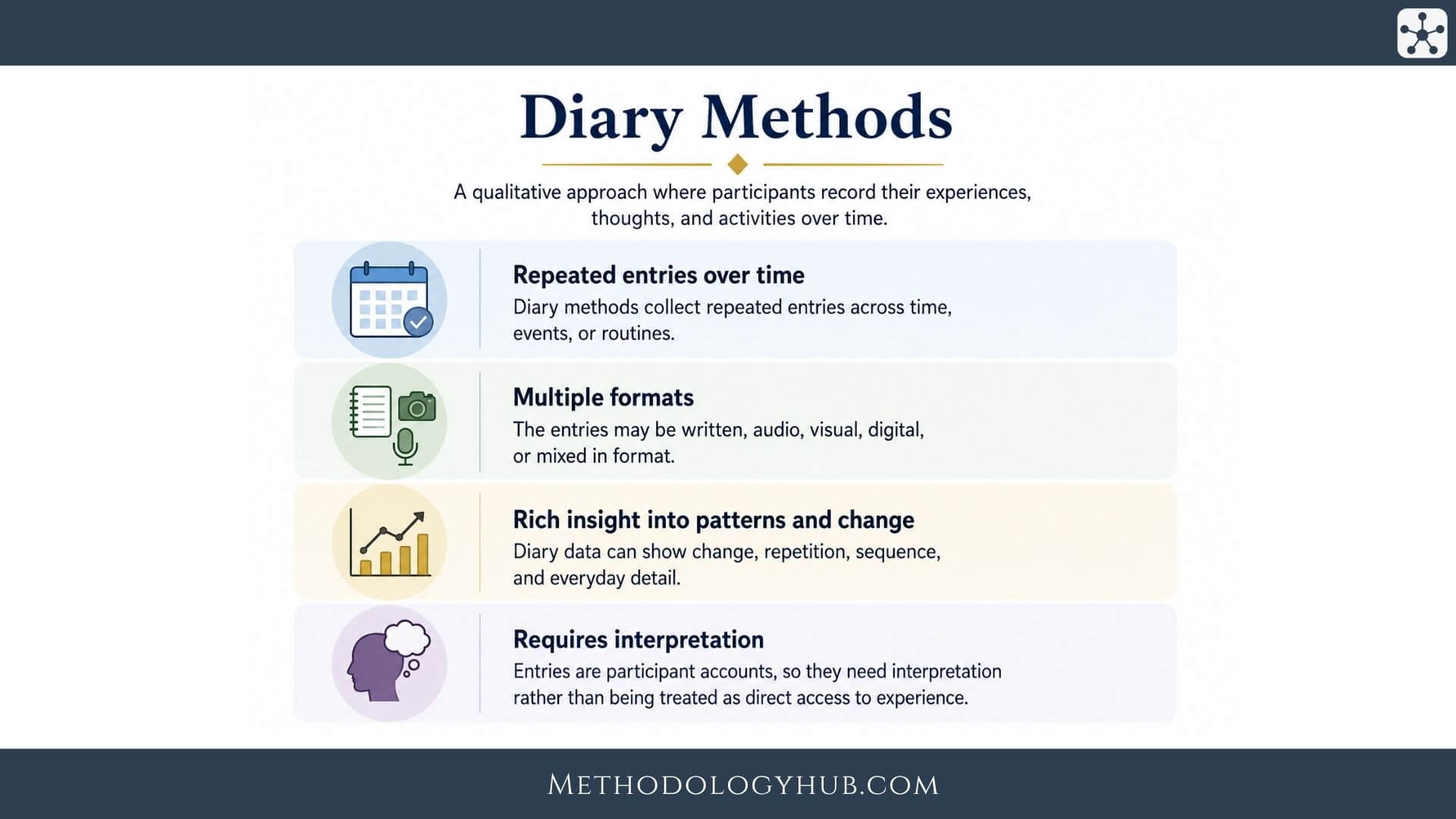
Diary methods in qualitative research ask participants to record experiences, actions, thoughts, feelings, routines, or events over a defined period of time. Instead of relying only on a single interview or survey completed after the fact, diary methods collect accounts closer to the moment when things happen.
A diary study might ask students to write short reflections after each study session, patients to record moments of uncertainty during treatment, workers to note interruptions during a shift, or parents to describe daily decisions around childcare. The value comes from repeated entries that show change, rhythm, contrast, and everyday detail.
Researchers use diary methods within qualitative research when timing, sequence, and lived routine are central to the question. Diary data can stand alone, but they can also support interviews, questionnaires, observation, or document analysis as part of a wider set of qualitative research methods.
Diary Methods as a Research Design
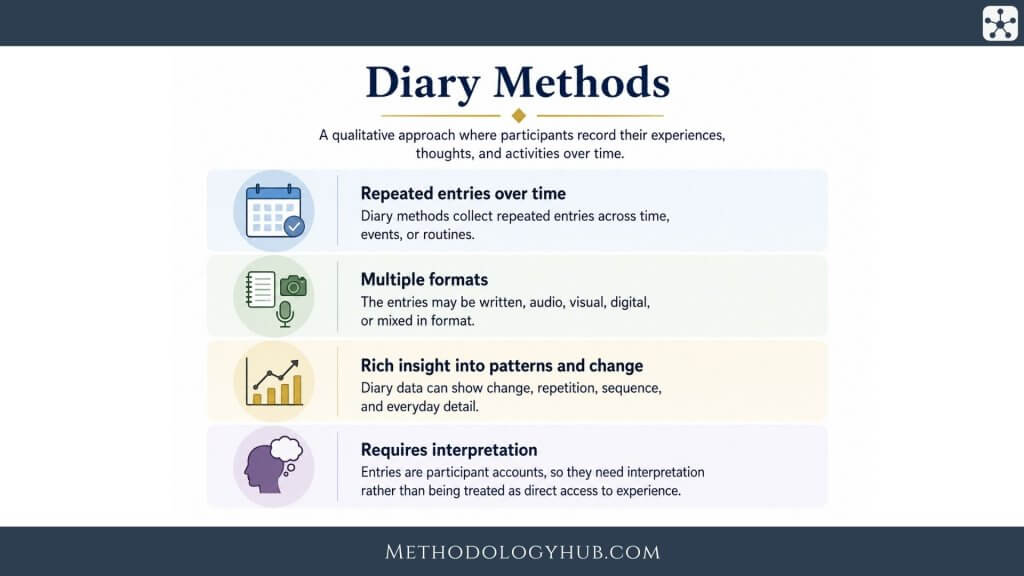
Diary methods are designed around repeated recording. The participant does not give a single retrospective account. They produce a series of entries across days, weeks, events, tasks, or moments. This makes diary research useful for studying processes that unfold over time.
A diary entry can be written, audio-recorded, photographed, video-recorded, or completed through a mobile form. Some diaries are highly structured, with fixed questions each day. Others are more open, asking participants to record anything relevant to the study topic.
Diary methods definition
Diary methods are qualitative data collection approaches in which participants record entries about experiences, actions, feelings, events, or routines during a defined period. The entries are later analysed to understand patterns, meanings, changes, and everyday processes.
The diary may be participant-led or prompt-led. In a participant-led diary, the participant decides what to record within broad guidance. In a prompt-led diary, the researcher provides specific questions or tasks for each entry.
What diary data can show
Diary data can show repetition, variation, turning points, daily routines, practical barriers, emotional shifts, decision-making, and how people interpret events as they unfold. A set of entries can reveal a pattern that may not appear in a single interview.
For example, a participant might describe one appointment as clear on the day it happens, then write later entries showing that instructions became confusing when they tried to act on them at home. The diary captures the movement from understanding to uncertainty.
| Diary feature | What it can add to qualitative research |
|---|---|
| Repeated entries | Shows change, rhythm, and recurring patterns over time. |
| Participant timing | Records experiences closer to when they happen. |
| Personal wording | Preserves how participants describe events in their own terms. |
Why timing is central
Many experiences change quickly. A person may remember a difficult week differently after it is over. They may forget small frustrations, moments of support, changes in mood, or practical barriers that felt obvious at the time. Diary methods reduce some of that distance by recording closer to the event.
This does not mean diary entries are perfect records. They are still written from the participant’s viewpoint and shaped by what the participant notices, chooses to share, and has time to record. Their strength is not objectivity, but closeness to lived sequence.
When Diary Methods Fit a Qualitative Study
Diary methods fit questions about process. They work well when the researcher needs to understand how something unfolds, repeats, changes, or becomes meaningful across time. A diary can also capture small events that participants might not remember during a later interview.
The method is less suitable when participants cannot realistically write or record entries, when the topic requires long conversation, or when repeated self-recording would place too much burden on participants.
Studying everyday routines
Many routines are ordinary enough that people do not recall them in detail. A diary can ask participants to record small parts of daily life: when a task was done, what interrupted it, what helped, and what felt difficult.
This can be useful in studies of learning, caregiving, commuting, health management, work routines, media use, food practices, or community participation. The diary shows how routine is lived, not only how it is described after the week is over.
Studying change and transition
Diary methods are useful during transitions. A researcher may study the first weeks of university, return to work after leave, adjustment to a new health routine, moving into a new neighbourhood, or learning a new role in an organisation.
Repeated entries can show uncertainty at the start, strategies that develop over time, setbacks, support, and moments when a participant’s understanding changes.
Recommendation: choose a diary method when the research question depends on sequence, repetition, or short-term change.
Studying sensitive or private experiences
Some participants may find it easier to write privately than speak in a live interview. Diary methods can give participants more control over timing and wording. They can pause, edit, skip, or return to an entry later.
This does not remove the need for care. A diary can ask participants to revisit difficult experiences repeatedly. The researcher should avoid prompts that create unnecessary distress and should explain how participants can stop or skip entries.
When interviews may work better
If the study needs clarification, probing, or a long narrative, qualitative interviews may be stronger. A diary entry can be short, unclear, or incomplete. An interview allows the researcher to ask what happened next or what a phrase meant.
Many diary studies therefore use a follow-up interview. The diary records events over time, and the interview helps participants explain, connect, or reflect on their entries.
Types of Diary Methods
Diary methods can be designed in several ways. The format should match the research question, the participant group, the topic, and the practical conditions of the study. A diary can be daily, event-based, audio-based, mobile, visual, or combined with another method.
The choice affects the data. A daily diary may show rhythm. An event-based diary may capture moments as they occur. A visual diary may reveal objects, spaces, or materials that written entries would describe only briefly.
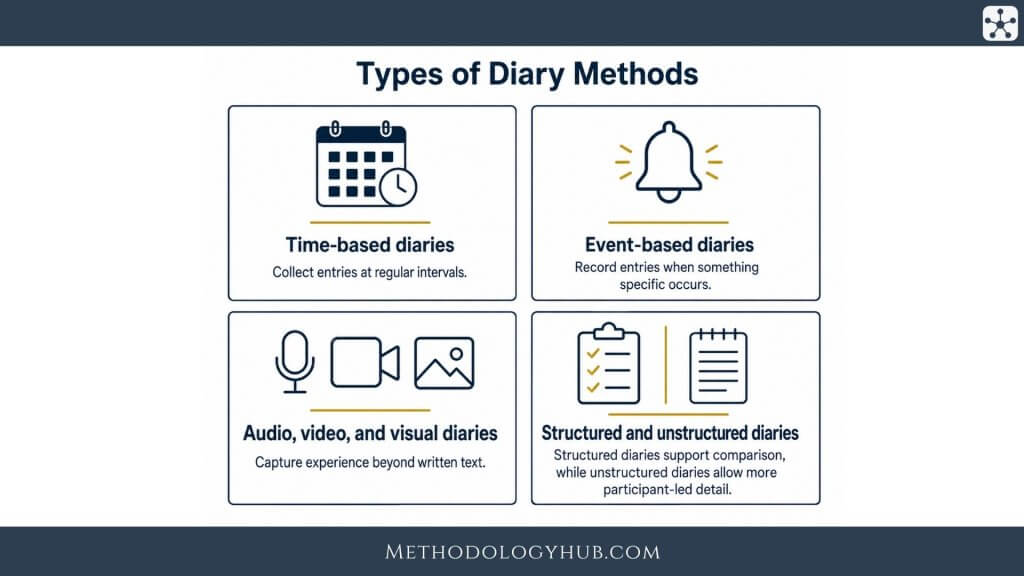
Time-based diaries
Time-based diaries ask participants to record entries at set times. They may write every evening, twice a week, after each shift, or at the end of each study day. This structure helps create a steady record across the study period.
The limitation is that not every scheduled entry will contain something relevant. Some entries may be repetitive, short, or written only because the schedule requires it.
Event-based diaries
Event-based diaries ask participants to record an entry when a specific event occurs. For example, a participant may write when they receive feedback, ask for help, experience pain, complete a task, or encounter a barrier.
This format can produce focused entries because each response is tied to a relevant moment. The challenge is that participants may forget to record an entry during busy or stressful events.
Audio, video, and visual diaries
Diary entries do not have to be written. Participants may record voice notes, short videos, photographs, screenshots, sketches, or combinations of text and images. These formats can be useful when written responses are too slow, difficult, or limited.
Visual diaries are especially useful when objects, spaces, routines, or materials are part of the research question. A participant studying remote work, for example, may photograph their workspace at different points in the week and add short comments.
| Diary type | Best suited to | Possible challenge |
|---|---|---|
| Time-based diary | Daily routines, change, rhythm, repeated reflection | Some entries may feel repetitive or forced. |
| Event-based diary | Specific moments, incidents, barriers, decisions | Participants may forget to record during the event. |
| Visual diary | Space, objects, material routines, visual context | Privacy and interpretation need careful handling. |
Structured and unstructured diaries
Structured diaries use fixed prompts or categories. They are easier to compare across participants because everyone responds to similar questions. Unstructured diaries give participants more freedom and can reveal unexpected topics.
A balanced design may use a short set of fixed prompts plus an open space for anything else the participant wants to record. This gives the researcher some consistency without closing down participant voice.
Designing Diary Prompts
Diary prompts shape what participants record. A vague prompt may produce thin answers. An overly detailed prompt may make the diary feel like homework. Good prompts give enough direction while still leaving room for participants to describe what was important in their own terms.
The researcher should also think about how often prompts appear. A long prompt every day can become tiring. A short, repeated structure may help participants build a habit.
Ask about recent moments
Diary prompts work best when they ask about a recent moment, action, event, or decision. “Describe one moment today when you needed support” is easier to answer than “Reflect on your overall support experience.”
Recent-moment prompts reduce the pressure to summarise everything. They also help the researcher collect grounded entries with concrete detail.
Keep prompts short and specific
Participants need to understand the task quickly. A prompt should not contain several questions hidden inside one sentence. If the researcher wants description, feeling, and follow-up action, those can be separated into short lines.
For example, a diary entry might ask: “What happened? What did you do next? What made the situation easier or harder?” This structure is clear without being too restrictive.
Recommendation: a participant should know what to record within a few seconds of reading the prompt.
Avoid prompts that assume an experience
Leading diary prompts can distort the data. “What frustrated you today?” assumes frustration occurred. A more neutral prompt might ask, “Was there anything that felt easy, difficult, or unclear today? Please describe one example.”
Neutral prompts allow participants to record positive, negative, mixed, or uneventful days. This is important because absence, routine, or ordinary ease may be relevant to the study.
Include a space for anything else
A final open prompt can capture something the researcher did not anticipate. It might ask, “Is there anything else from today that you think is relevant?” or “Was there anything you wanted to record that the prompts did not ask about?”
This space should not carry the whole study. It works best as a supplement to focused prompts.
| Weak prompt | Stronger prompt |
|---|---|
| How was your week? | Please describe one moment this week that affected how you approached the task. |
| What annoyed you today? | Was anything easy, difficult, or unclear today? Please describe one example. |
| Write everything you remember. | What happened, what did you do next, and what helped or got in the way? |
Managing Diary Data Collection
Diary studies need practical support. Participants have to understand what to record, when to record it, how long entries should be, how data will be submitted, and what to do if they miss an entry. Without clear guidance, diaries can become inconsistent or burdensome.
The design should respect participants’ time. A diary that feels simple during planning can feel demanding during a busy week. The researcher should reduce unnecessary effort wherever possible.
Set a realistic diary period
The diary period should be long enough to answer the question, but short enough that participants can complete it. A three-day diary may work for a focused event. A two-week diary may suit routines. A longer study may need check-ins and flexible expectations.
Longer diaries are not automatically better. A shorter diary with rich entries may be stronger than a long diary with repeated missing or rushed entries.
Give clear instructions
Instructions should explain the purpose of the diary, the entry schedule, expected length, examples of suitable entries, privacy guidance, and how to submit data. Participants should also know whether they can skip questions or stop taking part.
Example entries can help, but they should not push participants toward a specific answer. A good example shows the level of detail expected without telling participants what they should feel or say.
Plan reminders and support
Light reminders can help participants keep the diary habit. These may be email reminders, text prompts, app notifications, or planned check-ins. Reminders should not pressure participants into recording more than they want to share.
Support is especially useful when diary tasks are unfamiliar. Participants may need reassurance that short entries are acceptable or that an uneventful day can still be recorded.
Handle missing entries carefully
Missing entries are normal in diary research. A participant may forget, feel too busy, or have nothing to say. The researcher should decide in advance how missing entries will be handled in the analysis.
A missing entry can sometimes be analytically relevant, but it should not be over-interpreted. The participant may simply have had no time.
| Design decision | Practical question |
|---|---|
| Diary period | How long can participants realistically record entries? |
| Entry length | Should entries be one sentence, a paragraph, audio notes, or longer reflections? |
| Submission | How will participants send entries securely and conveniently? |
Protect privacy in diary entries
Diaries can contain personal details about participants and other people. The researcher should explain what participants should avoid recording, how names can be replaced, and how files will be stored.
Visual and audio diaries need extra care because they may capture people, places, voices, screens, or documents that were not intended for the study. Participants need clear guidance before recording begins.
Analysing Diary Entries
Analysing diary entries means working with both content and sequence. The researcher studies what participants wrote, but also when they wrote it, what changed between entries, what repeated, what disappeared, and how participants made sense of events across time.
Diary data can be analysed across participants, within each participant’s timeline, or both. A strong analysis often moves between individual trajectories and patterns across the whole data set.
Read each diary as a timeline
The first reading should often treat each diary as a sequence. The researcher can ask how the participant’s experience changed, which events returned, and whether entries became more confident, uncertain, detailed, or brief over time.
This timeline reading prevents the diary from being broken too quickly into separate codes. A diary entry gains meaning from the entries around it.
Code themes and turning points
Coding can focus on barriers, strategies, emotions, routines, help-seeking, decisions, language, expectations, and changes. Turning points should also be noted. These may be moments when a participant changes behaviour, gains clarity, loses confidence, or meets a new barrier.
For example, a student diary may show repeated confusion until one entry describes a helpful peer conversation. Later entries may then show a different approach to assignments.
Compare across participants
After reading diaries individually, the researcher can compare across participants. Do similar barriers appear? Do participants respond differently to the same event? Are some patterns tied to timing, setting, confidence, role, or access to support?
Cross-participant comparison should not erase individual sequence. Two participants may both mention stress, but one may experience it as a short spike during deadlines while another records it as a steady background condition.
Recommendation: do not code diary entries as isolated fragments too early. Read the sequence before breaking the data into themes.
Use follow-up interviews
Follow-up interviews can help participants reflect on their own entries. The researcher may ask about repeated patterns, unclear moments, missing entries, changes over time, or entries that seem especially important.
This approach can deepen analysis without making the diary only a preparation task. The diary remains data, and the interview becomes a second layer of interpretation.
Report diary findings clearly
Diary findings may be written as themes, timelines, short case summaries, event sequences, or comparisons across participants. The writing should show how the repeated-entry design shaped the interpretation.
Short excerpts can be useful, but they should be placed in context. A quote from day one may mean something different when read alongside day seven.
Examples of Diary Methods
Examples of diary methods show how the design can be adapted to different fields. The examples below vary in schedule, format, and analytic focus.
Example 1: Student study routines
A researcher asks students to complete a short diary after each independent study session for two weeks. Prompts ask what they planned to do, what they actually did, what interrupted them, and what helped them continue.
The analysis may show that study routines are shaped by space, fatigue, confidence, peer contact, and unclear task boundaries. Follow-up interviews can ask students to explain repeated patterns in their diaries.
Example 2: Managing a health routine
Participants record audio diaries each evening while adjusting to a new health routine. They describe moments when the routine felt easy, confusing, or difficult to fit into daily life.
The data may show how instructions that sounded clear in an appointment became harder to apply at home. The audio format may also capture uncertainty, hesitation, and emphasis in ways written entries would not.
Example 3: Visual diary of public space use
Participants take photographs of places they use or avoid during a normal week and add short captions. The researcher analyses images, captions, routes, and repeated themes across participants.
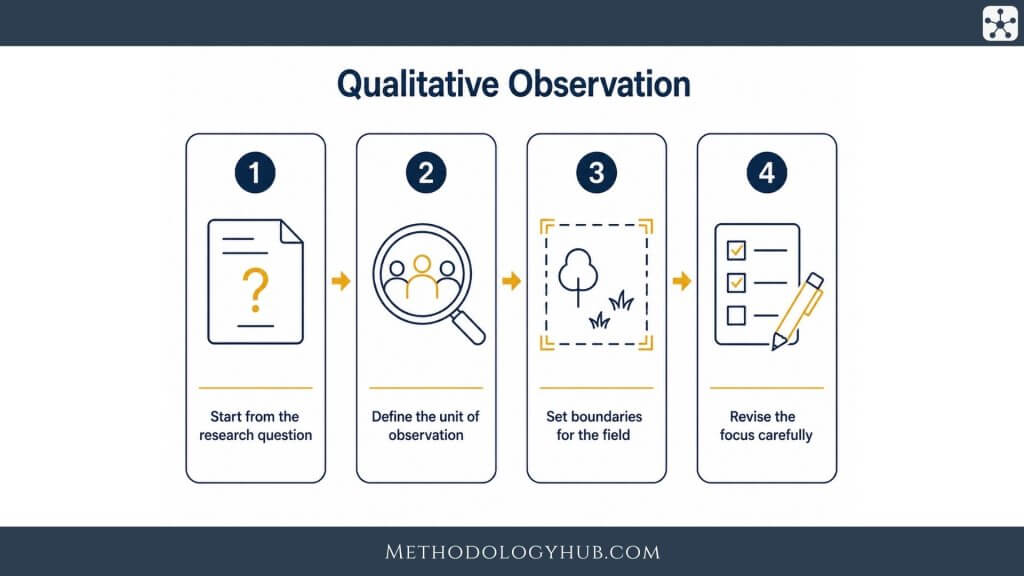
This type of diary can support studies of access, comfort, belonging, movement, and everyday environment. It can also be paired with qualitative observation of the same spaces.
Example 4: Workplace interruptions
A workplace study uses event-based diaries. Participants make a short entry whenever an interruption changes the task they were working on. They record what happened, who was involved, and what they did next.
The analysis may show recurring interruption patterns, informal support, hidden coordination work, and differences between planned work and actual work.
Conclusion
Diary methods in qualitative research help researchers study experience as it unfolds across time. They are especially useful for routines, transitions, repeated events, private reflections, and situations where small details may disappear from later memory.
A strong diary study needs a clear time frame, manageable prompts, realistic participant expectations, privacy guidance, and an analysis strategy that preserves sequence. Diary entries can be brief, but when collected across time, they can show patterns that a single interview or survey response may miss.
FAQs on Diary Methods in Qualitative Research
What are diary methods in qualitative research?
Diary methods in qualitative research ask participants to record entries about experiences, actions, feelings, routines, events, or decisions over a defined period. The entries are analysed to understand patterns, meanings, changes, and everyday processes.
When should diary methods be used?
Diary methods should be used when the research question concerns sequence, change, routines, transitions, repeated events, or experiences that are easier to record close to the moment than to remember later.
What types of diary methods are used in qualitative research?
Common types include time-based diaries, event-based diaries, written diaries, audio diaries, video diaries, visual diaries, mobile diaries, structured diaries, and unstructured diaries.
How do you design diary prompts?
Diary prompts should be short, clear, neutral, and focused on recent moments or specific events. They should avoid assuming an experience and should give participants a manageable recording task.
How are diary entries analysed?
Diary entries are analysed by reading each diary as a timeline, coding themes and turning points, comparing patterns across participants, noting repetition and gaps, and preserving sequence during interpretation.
Can diary methods be combined with interviews?
Yes. Many diary studies use follow-up interviews so participants can explain repeated patterns, unclear entries, missing entries, or changes across time. The diary remains data, and the interview adds a second layer of interpretation.