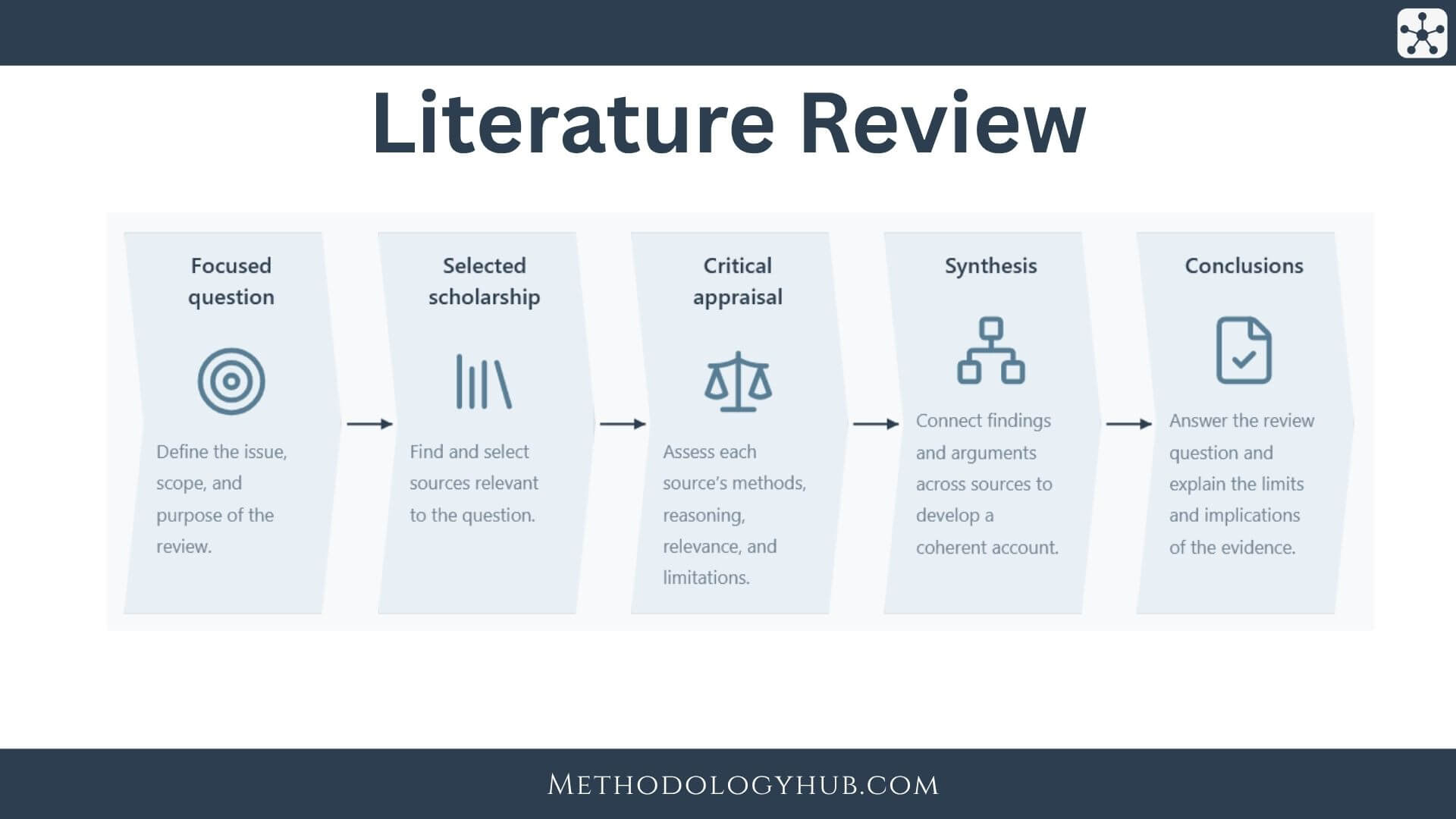
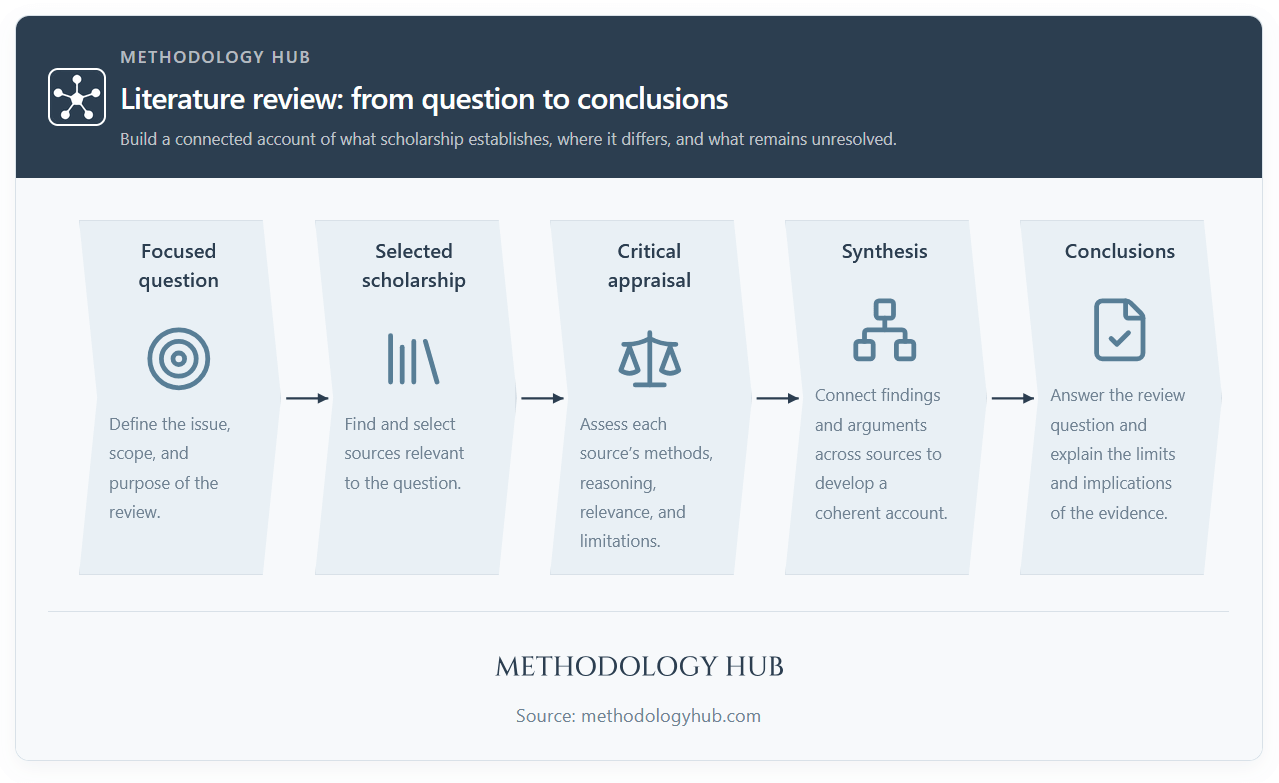
A literature review examines existing scholarship to develop a reasoned account of a topic. It brings relevant publications into conversation, showing where their findings agree, how their approaches differ, and what the evidence leaves unresolved. The task involves selecting and explaining sources, but its direction comes from the relationships between them. Readers should come away with an understanding of the field rather than a sequence of disconnected article descriptions.
During academic study, reviewing literature often precedes detailed decisions about research methods. Existing studies can reveal which concepts need clarification, which procedures have been useful, and which conclusions require further investigation. A review may also be the investigation itself, with published research providing the material for an original synthesis.
This article explains the main types of literature reviews, how to conduct and structure one, and how to synthesise and evaluate research.
What is a literature review?
Literature review definition
A literature review is an organised analysis of scholarly work relevant to a defined subject or question. Its material may include journal articles, academic books, conference papers, dissertations, and reports. What belongs in the review depends on its purpose and discipline. A history review may rely heavily on scholarly books, while a review of a recent scientific intervention may concentrate on research articles.
The word “literature” therefore extends beyond literary works. In the contour-map example, it would include research on map interpretation, spatial reasoning, geography education, and relevant teaching approaches. Selecting publications from these areas requires a focus: the reviewer needs to explain which part of map understanding connects them.
Where a literature review appears
A review can take several forms within academic work. The surrounding task affects how much detail is needed and how the discussion leads into later sections:
- A standalone assignment develops a focused discussion of existing scholarship.
- A dissertation or thesis chapter establishes the background and rationale for a larger investigation.
- A review article addresses its own question through the selection, appraisal, and synthesis of existing evidence.
A review article can make an original contribution by identifying a pattern or developing an interpretation across studies. This makes “literature review” and “research paper” overlapping terms, rather than opposing categories. The distinction concerns the basis of the inquiry: a review investigates existing scholarship, while other studies may generate new observations, participant accounts, or measurements.
Literature review vs. annotated bibliography
An annotated bibliography normally treats sources as separate entries, explaining the content and relevance of each. A literature review uses those sources within a connected discussion. Notes organised publication by publication can support the preparation, but the final structure should help readers follow an issue, debate, or development that runs across the material.
Purpose of a literature review
The purpose follows from what the reader needs to know about the existing scholarship. A review may clarify a debate, assess evidence for an explanation, trace the development of a concept, or establish the basis for a new study. These contributions often depend on one another: evaluating findings can reveal a conceptual problem that changes the next research question.
Establishing existing knowledge
For the map-reading review, the first question would be what researchers have meant by “understanding a map”. Recognising symbols, estimating elevation, and imagining terrain from contour lines involve different tasks. Examining their definitions and measures would help establish which conclusions concern the same phenomenon and which address separate aspects of it.
This comparison also explains how knowledge has been produced. A test score, an interview about a pupil’s reasoning, and observation during a lesson offer different forms of evidence. The review should examine what each contributes before combining them into a claim about learning.
Informing a research question
Reading across studies can sharpen a proposed research question. An initial interest in teaching maps might become an inquiry into how pupils interpret closely spaced contour lines. The review needs to show why that focus follows from the scholarship, including relevant findings, uncertainties, or disagreements.
Earlier research can also inform the choice of measures and procedures. A new investigation may adapt an established assessment, revisit a theoretical explanation, or examine whether a finding holds in another context. Repeating a study can be justified when it tests the reliability or reach of existing knowledge. The review helps distinguish a reasoned replication from repetition undertaken without a clear purpose.
Types of literature reviews
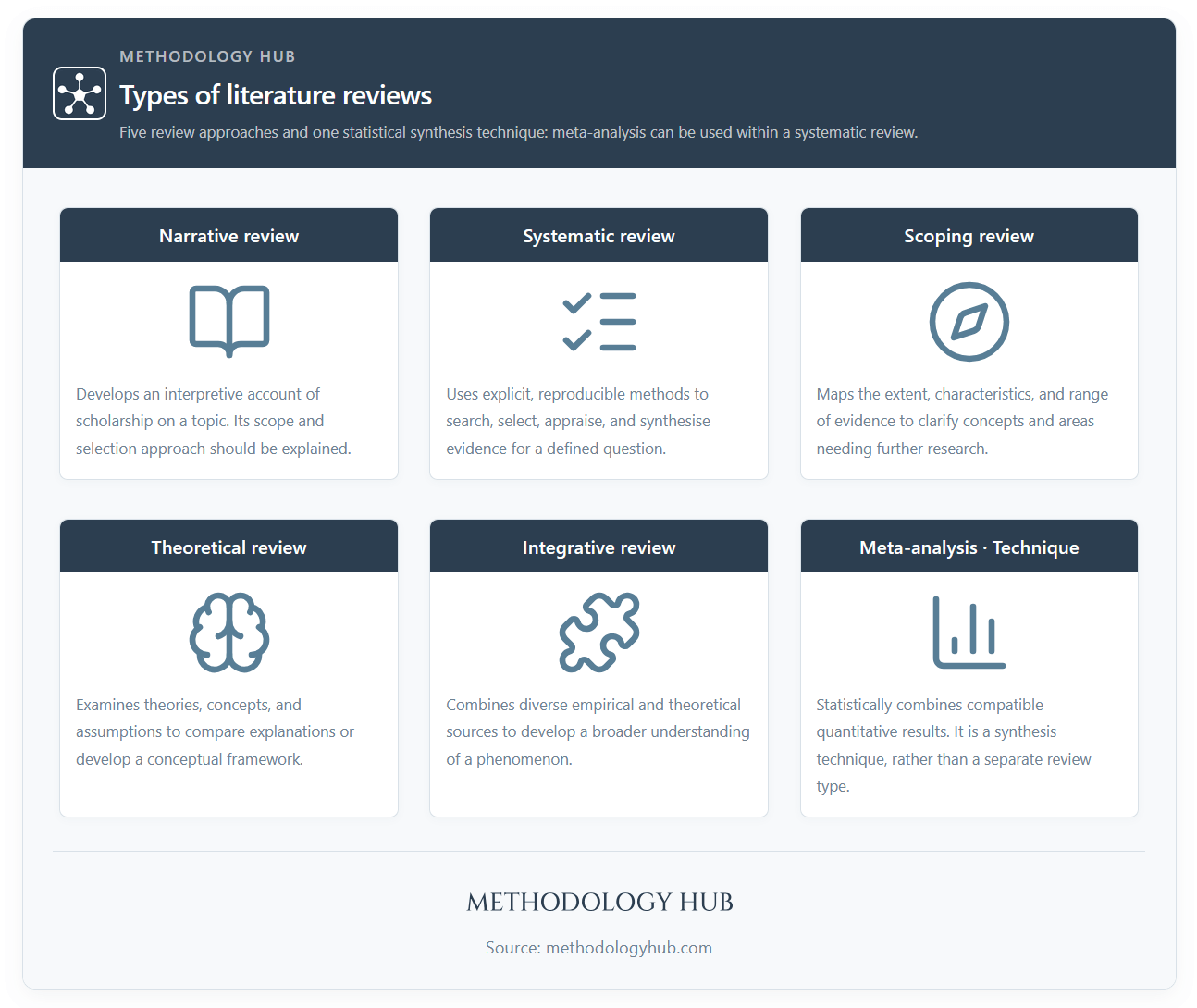
The review approach should suit the intended contribution. An overview of a theoretical debate requires different decisions from a review assessing the effects of a teaching intervention. The following approaches are common, although terminology varies across disciplines. Meta-analysis is included because it often accompanies a systematic review, while serving a distinct analytical function.
Narrative literature review
A narrative review develops an explanatory discussion of selected scholarship. It can examine a debate, trace an interpretation, or connect findings within a field. Selection and organisation require judgment, so readers need an explanation of the review’s scope and basis for including sources. A narrative approach permits a flexible discussion, but its claims still need support from the literature examined.
Systematic literature review
A systematic review addresses a defined question through planned, explicit procedures for searching, selecting, appraising, and synthesising evidence. A protocol sets out decisions such as eligibility criteria and analytical methods before the review is conducted. Screening and appraisal commonly involve more than one reviewer, with procedures for resolving disagreements.
The review reports how records were identified and which studies were retained. Reporting guidance such as PRISMA helps make these decisions visible; following a reporting checklist does not itself establish that the underlying methods were sound. The synthesis may be statistical, qualitative, or narrative, according to the question and evidence available.
Scoping literature review
A scoping review maps the extent and nature of evidence around a broader subject. For map interpretation, it might identify the populations, educational settings, concepts, and assessment methods represented in existing studies. It uses explicit search and selection procedures, but generally serves a different purpose from estimating an intervention’s effect.
Formal critical appraisal is not necessarily part of a scoping review; its inclusion depends on the review’s objectives and methodological guidance. Without an assessment of evidence quality, the review should be cautious about drawing conclusions on effectiveness. Mapping where research exists does not by itself establish how trustworthy its findings are.
Meta-analysis within a literature review
Meta-analysis uses statistical methods to combine quantitative results from separate studies. Before pooling results, reviewers assess whether the populations, interventions, measures, and designs are sufficiently comparable. Effect sizes may then contribute to a combined estimate with a confidence interval, while differences between studies, known as heterogeneity, require examination. If studies with certain results are more likely to be published, publication bias can distort the combined estimate. A systematic review can be appropriate even when its evidence cannot sensibly be pooled; a larger combined dataset cannot repair weaknesses in the included studies.
Theoretical literature review
A theoretical review examines concepts, assumptions, and explanatory frameworks. In geography education, it might investigate how different accounts of spatial reasoning explain the interpretation of contour maps. Its discussion would compare what each theory explains, the evidence used to support it, and the questions left open. The contribution could be a clarified concept or a revised framework, rather than an estimate of an educational effect.
Integrative literature review
An integrative review brings different kinds of evidence into a broader interpretation. It may combine quantitative studies with qualitative research and theoretical scholarship, using explicit procedures suited to each form of material. For map reading, assessment results could be considered alongside accounts of pupils’ reasoning. The reviewer needs to explain how these contributions fit together while preserving differences in what they can establish.
How to conduct a literature review
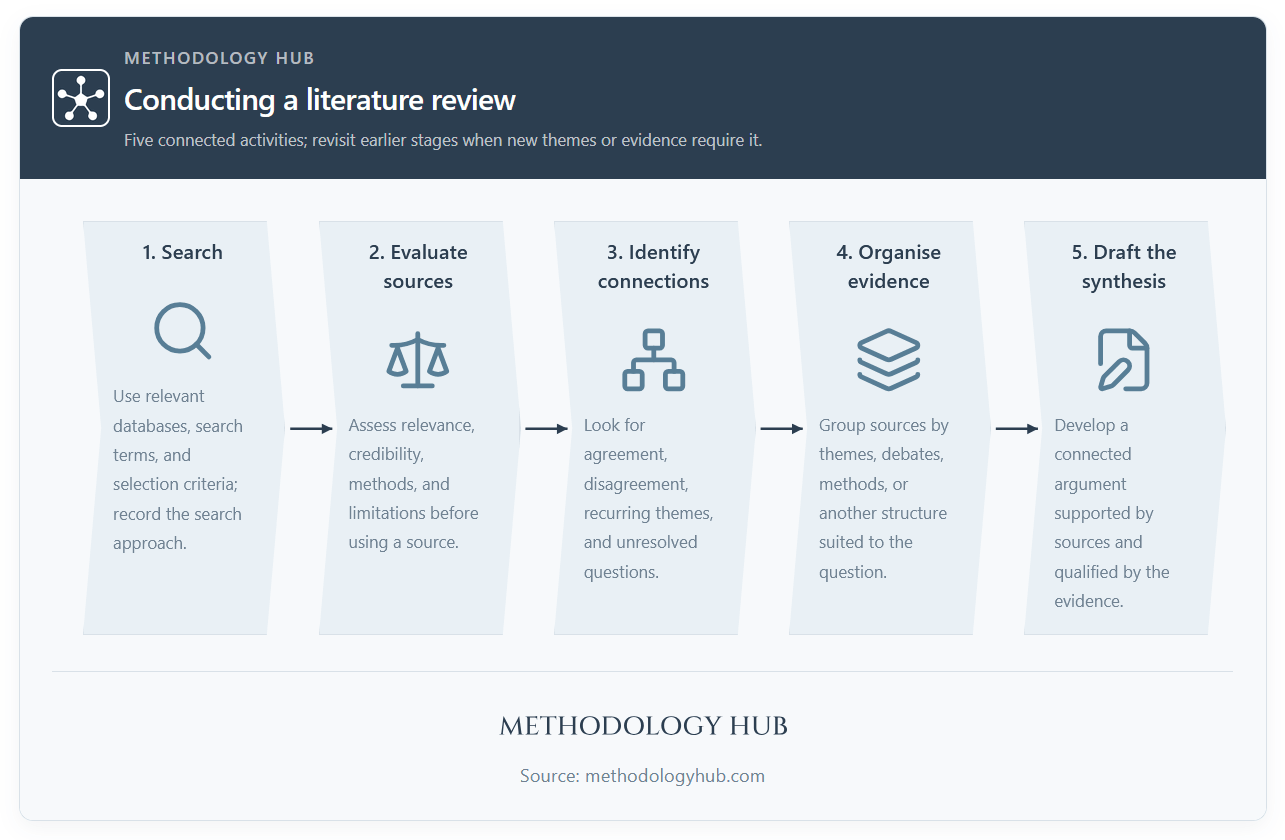
Conducting a review involves decisions about scope, searching, reading, and synthesis. These develop together: an unfamiliar term may require another search, while a comparison between studies may suggest a more useful outline. The following sequence provides a working approach. Formal systematic and scoping reviews require additional procedures specified in their chosen methodology.
Search for relevant literature
Begin by defining the part of the research topic the review will examine. For contour-map learning, decide whether the inquiry concerns a particular age group, educational setting, or aspect of interpretation. A workable scope might specify:
- The population or context, such as pupils in secondary-school geography lessons.
- The concept being examined, such as interpreting elevation and slope from contour lines.
- The kinds of evidence relevant to the question, including assessments, observations, or explanations of reasoning.
- Any justified limits on publication period, language, or document type.
Translate those decisions into search terms, including synonyms and related concepts. Where the database supports them, quotation marks can search phrases such as “contour map”. Boolean operators help combine the concepts: OR joins alternatives such as “map interpretation” and “map literacy”, while AND connects concept groups. Use NOT cautiously because excluding a term can remove relevant records along with irrelevant ones. Check the database’s search syntax before relying on these operators.
Search academic databases appropriate to the discipline and consult library catalogues for books. Subject headings can help locate records indexed under a concept different from the wording in your initial query. Follow references in relevant publications and examine later studies that cite them. Record search terms, dates, and limits so you can explain the coverage and update the search.
Select and evaluate research articles
Titles and abstracts help identify potentially relevant material, but selection and evaluation require attention to the full publication. Check the research question, design, sample, measures, analysis, and conclusion. Peer review is useful context, not a guarantee that every claim is well supported. Foundational theoretical work may remain relevant, while grey literature, such as unpublished theses and institutional reports, can contain otherwise overlooked evidence.
Separate relevance from quality. A rigorous study may address a different age group or task, while a closely relevant study may use a weak measure. Both judgments affect how the evidence is used. A comparison record makes these distinctions easier to retain as the number of sources grows.
Remove duplicate search records before screening and link multiple publications reporting the same study. For empirical evidence, appraisal also considers risk of bias: features of the design or reporting that could systematically distort the findings. These checks help prevent the apparent quantity of literature from being mistaken for the strength of independent evidence.
| Field | Useful notes | Role in the review |
|---|---|---|
| Question and concepts | The inquiry and definitions used by the author. | Establish whether sources address comparable issues. |
| Design and setting | The research approach, population, sample, and context. | Identify the conditions under which findings were produced. |
| Evidence and analysis | The data, measures, materials, and analytical procedures. | Assess what the investigation can establish. |
| Findings | The results or interpretations relevant to the review question. | Support synthesis across sources. |
| Limitations | Weaknesses, missing information, and constraints on interpretation. | Judge the reach and strength of the conclusions. |
| Reference details | Author, title, publication, year, and pages for notes or quotations. | Maintain accurate citations and traceable evidence. |
Identify connections across studies
Compare the records by issue rather than treating each publication as a separate topic. Two studies reporting different levels of map understanding may have assessed different tasks. One might require pupils to identify contour intervals, while another asks them to explain the shape of terrain. The difference in findings would need to be interpreted in relation to those measures.
Look for recurring concepts, changes in methods, consistent results, and unresolved disagreements. A discrepancy may reveal a substantive debate, but it can also arise from different samples or definitions. Keep the interpretation provisional until the relevant procedures and evidence have been examined.
Develop a working structure
Group sources around the discussion the review needs to develop. For the map-reading example, separate notes on symbol recognition from those on terrain interpretation, then examine how teaching approaches connect the two. A working outline makes omissions visible and helps decide whether another search is needed.
The organising principle should support the review’s purpose. Tracing the development of spatial-reasoning theory may call for a chronological discussion, while assessing the evidence behind learning claims may favour sections organised by task or method. Adjust the outline as the relationships between sources become clearer.
Draft and revise the review
Write from the issues identified in the comparison rather than copying the order of the reading notes. Cite sources where their findings, concepts, or interpretations are used. Keep exact quotations distinguishable from paraphrases, and check that every in-text citation corresponds to an accurate reference entry.
During revision, test the discussion against the sources again. Check whether qualifications have been preserved and whether a broad claim rests on enough relevant evidence. Update the search if the writing has exposed a missing perspective or if substantial time has passed since the initial search.
AI support for a literature review
AI assistance can suggest search terms or provisional ways to organise notes, but those suggestions need checking against the actual literature. Generated references may be inaccurate or nonexistent, and summaries may misrepresent a study’s methods or findings. Read the original publications before including a claim.
For systematic work, generative assistance cannot be treated as evidence that the search was comprehensive or that screening decisions were reliable. Keep human responsibility for selection, appraisal, and interpretation, and document permitted assistance as required by the academic task. Automated output should remain traceable to verified records and source passages.
Literature review structure
The structure gives the reader a route through the evidence. Most reviews need an introduction, a developed discussion, and a conclusion, although formal review articles also include sections reporting their methods and results. Within that overall arrangement, the organisation should reflect what the literature allows the reviewer to explain.
The introduction
Introduce the subject, the review’s purpose, and the boundaries of the discussion. In the map-reading example, clarify whether “map interpretation” concerns symbol recognition, contour-map reasoning, or a wider range of skills. Explain the educational context and indicate why the selected literature is relevant to that focus.
Readers also need to understand how the review will proceed. A short overview can name its organising principle and the main issues to be examined. Explain significant search or selection limits in an appropriate place, rather than presenting the resulting evidence base as if it included every publication on the subject.
Organising the main body
The main body develops the discussion across its chosen sections. Thematic organisation is useful when several studies address a recurring problem from different perspectives. A chronology can show how ideas or methods changed, but publication order alone is rarely sufficient reason to place sources together. The comparison below identifies possible organising principles.
| Approach | Organising principle | Suitable use |
|---|---|---|
| Thematic | Recurring issues, concepts, or findings. | Compare contributions to different aspects of map interpretation. |
| Chronological | Developments in scholarship over time. | Trace changes in explanations of spatial reasoning. |
| Methodological | Designs, measures, or analytical approaches. | Examine how assessments and interviews produce different evidence. |
| Theoretical | Models, assumptions, or conceptual frameworks. | Compare explanations of how pupils relate map symbols to terrain. |
These principles can be combined. A thematic section on interpreting elevation might trace a change in assessment methods, while another examines competing explanations. The structure should make those relationships easier to follow. It should not require the same study to be described in full every time it contributes to another section.
A provisional thematic outline for the main example could contain:
- Understanding map symbols and contour intervals.
- Relating contour patterns to the shape of terrain.
- Teaching approaches and the assessment of map interpretation.
The headings identify subjects for synthesis, not conclusions already established by the review. Each section would draw on the relevant sources to examine its issue. Where a study contributes to more than one theme, use only the detail needed for the point being developed and make its role clear.
The conclusion
The conclusion states what can reasonably be drawn from the combined discussion. It should identify the strongest supported understanding, significant qualifications, and any unresolved issue that follows from the review. New evidence belongs in the body, where readers can assess how it supports the argument.
For a dissertation chapter, the closing discussion can lead into the proposed study by showing how its question follows from the literature. A standalone review may instead end with a clarified debate or an assessment of the field. A separate “research gaps” section is useful only when it helps that discussion; gaps can also be developed within the relevant themes.
Writing a literature review
The writing develops the interpretation that emerged during reading and comparison. A paragraph usually begins with an issue or claim, introduces the relevant evidence, and explains how that evidence supports or qualifies the point. This gives citations a role within the discussion rather than allowing the sequence of authors to determine its direction.
Move from summary to synthesis
Summary establishes what a source contributes. Synthesis uses that contribution in relation to other sources, asking what their similarities and differences reveal. Both are needed, but the amount of summary should depend on the comparison. Readers need enough information about a study to understand its role without being given its entire abstract again.
Suppose one hypothetical study tests pupils’ recognition of map symbols and another examines their explanations of terrain from contour lines. Describing both designs provides background. Bringing them together reveals that “map understanding” has been investigated through different tasks, so their results cannot be treated as interchangeable.
A further step is to evaluate how the task design affects the conclusion. Recognising a correct symbol may establish something different from explaining an unfamiliar contour pattern. The table shows how the same imagined studies can be used at these different levels; the statements illustrate writing functions rather than report published findings.
| Writing function | Illustrative wording | Contribution to the discussion |
|---|---|---|
| Summary | One study assessed symbol recognition; another examined explanations of terrain from contour patterns. | Establishes what the separate studies investigated. |
| Synthesis | The studies operationalised map understanding through different tasks, separating recognition from terrain interpretation. | Identifies a relationship across the evidence. |
| Critical evaluation | Because the tasks assess different skills, comparing their scores directly would not establish which group had better overall map understanding. | Explains a limit on the conclusion the comparison can support. |
Evaluate findings through their evidence
Critical evaluation should identify a specific relationship between the evidence and the claim. If a conclusion concerns pupils in general, examine how the sample was selected and which educational settings were represented. If the argument depends on a test score, consider whether the assessment captures the skill being discussed.
Qualitative accounts need an appropriate evaluation too. The review can examine how participants were selected, how their explanations were recorded, and how the interpretation was developed. Numerical sample size alone is an inadequate basis for judging all forms of research. The criteria should fit the design and the claim.
Handle agreement and disagreement
When studies disagree, explain the relevant difference before deciding that one finding overturns another. Variations in definitions, tasks, instruction, or context may account for apparently conflicting results. Agreement also needs scrutiny: several publications may report the same underlying study, or repeat an interpretation without supplying independent evidence.
Avoid treating the number of supportive publications as a substitute for evaluation. For quantitative evidence, the size and uncertainty of estimates may be more informative than whether individual results passed a significance threshold. For interpretive scholarship, the strength of the argument depends on how convincingly it explains its sources and addresses alternatives.
Use citations to make claims traceable
Place citations where readers can identify which source supports each statement. Distinguish an author’s finding from your interpretation of its relationship with another study. Paraphrasing requires a fresh expression of the idea and an accurate reference; changing a few words does not remove the need to acknowledge the source.
Before completing a paragraph, check whether its final interpretation follows from the evidence introduced. If it makes a broader claim, add the missing support or narrow the wording. This review of the argument is more useful than adding a general sentence that merely says the topic is important.
Identifying a research gap in a literature review
A research gap is a specific limit in existing knowledge that the review can demonstrate. It may concern a question with insufficient evidence, findings that remain difficult to reconcile, or a concept that has not been examined adequately. The claim needs a basis in the literature searched and analysed, rather than an assumption that any unfamiliar setting has been overlooked.
Connect the gap to the evidence
In the contour-map example, imagine that the selected studies assess performance immediately after instruction, while providing little information about interpretation after a longer interval. This could support an inquiry into retained understanding if the issue is relevant and the search confirms the limitation. The gap concerns what the evidence allows researchers to conclude over time.
Another possibility is that assessments classify pupils’ answers without examining their reasoning. That would suggest a methodological limit, but it would need to be checked against studies using interviews or observations. A narrow search could create the appearance of a gap that disappears when different terminology or research approaches are included.
Write a qualified gap statement
A defensible formulation makes the limit explicit: “The studies included in this review provide limited evidence about pupils’ explanations of contour patterns beyond the immediate assessment period.” Such a statement can inform a research problem, while keeping the claim proportionate to the review’s actual coverage. In a real review, the statement would cite the studies supporting it.
Before carrying the gap into a proposal, check:
- Whether alternative search terms or publication formats could contain the missing evidence.
- Whether the limit affects an important interpretation rather than merely naming an unstudied location.
- Whether newer studies have addressed the issue since the main sources were published.
- Whether the proposed investigation could supply evidence relevant to that particular limit.
A review can also conclude that existing knowledge is sufficiently consistent for its purpose. It need not invent a gap to justify its existence. Clarifying the strength, scope, or meaning of the evidence can itself be a useful contribution, even when a new empirical investigation is not proposed.
Literature review examples
The following examples illustrate how a review’s focus changes across subjects. They are hypothetical passages and planning scenarios, not summaries of established findings. A completed review would connect its claims to the actual publications examined.
A thematic literature review in education
A review of map interpretation could organise its discussion around what different tasks reveal about understanding. An illustrative passage might read: “The distinction between recognising map features and explaining terrain gives the studies different analytical roles. Recognition tasks examine whether pupils identify a representation correctly, while explanation tasks examine the reasoning used to relate that representation to a landscape. Their findings should therefore be compared through the skills assessed, rather than treated as equivalent measures of map understanding.”
The paragraph has a focus that connects the sources. A real version would cite the studies for each task and discuss their results before drawing a conclusion about the wider evidence. The thematic structure creates a place for that comparison without requiring a separate section for every author.
A methodological literature review in environmental research
A review of urban trees and summer temperature could compare evidence from different measurement approaches. Satellite estimates of surface temperature and measurements of air temperature concern related but distinct quantities. The reviewer would examine which outcome each study used, the spatial scale, timing, weather conditions, and the basis for selecting the locations.
That organisation would support a discussion of how methods shape the conclusions available. An association between tree cover and temperature would also require consideration of other differences between neighbourhoods. The review should establish comparability before treating contrasting estimates as disagreement about the same effect.
A chronological literature review in history
A history review might trace changes in scholarly interpretations of migration narratives. Its chronology would concern the development of scholarship, including shifts in concepts, archives, or interpretive approaches. The date a historian publishes an analysis is different from the historical period examined in that analysis.
Sections could therefore follow changes in the field while bringing older events into each discussion where relevant. Within a period, the reviewer would compare arguments rather than list publications by year. Chronology becomes useful when it explains a development in interpretation, not simply because the sources have dates.
Conclusion
A literature review earns its conclusions through the relationship between its scope, selected sources, and analysis. Careful searching gives the discussion a foundation, while comparison and appraisal explain what the evidence supports. The structure then makes that reasoning available to the reader.
When revising, follow the central question through each section. Check whether the sources are used to develop an account of the topic and whether the final conclusions preserve the qualifications identified during evaluation. A completed review should offer a clear interpretation of the scholarship within boundaries the reader can recognise.
Cite this article
Whether you are preparing course materials, writing an academic paper, or sharing resources with students, we kindly ask that you acknowledge Methodology Hub as the source.
To make referencing easier, you can use the “Cite this page” tool below to automatically generate a citation in your preferred referencing style, including APA, MLA, Chicago, Harvard, and others. Simply select a citation style and click the generated reference to copy it.
When reproducing images, figures, or other materials from this page, please include an appropriate source credit and a link to the original page. Proper attribution helps others locate the original material and supports the continued development of freely accessible educational resources.