Narrative analysis examines how people organise experiences into stories and what those stories mean in context. In qualitative research, it connects the events described with their sequence, the narrator’s perspective and the circumstances of the telling.
Among qualitative research methods, narrative analysis is especially useful for studying identity and change over time. Its evidence can include interviews, diaries, oral histories and visual accounts.
This article explains narrative analysis, its approaches, data collection and analytical process.
What Is Narrative Analysis?
Narrative analysis is a family of methods for interpreting stories as connected accounts. The researcher examines how a narrator selects events, relates them to one another and gives them significance. These choices shape the explanation offered to a listener. Analysis considers both the experiences described and the narrative through which they become understandable.
Stories as Units of Analysis
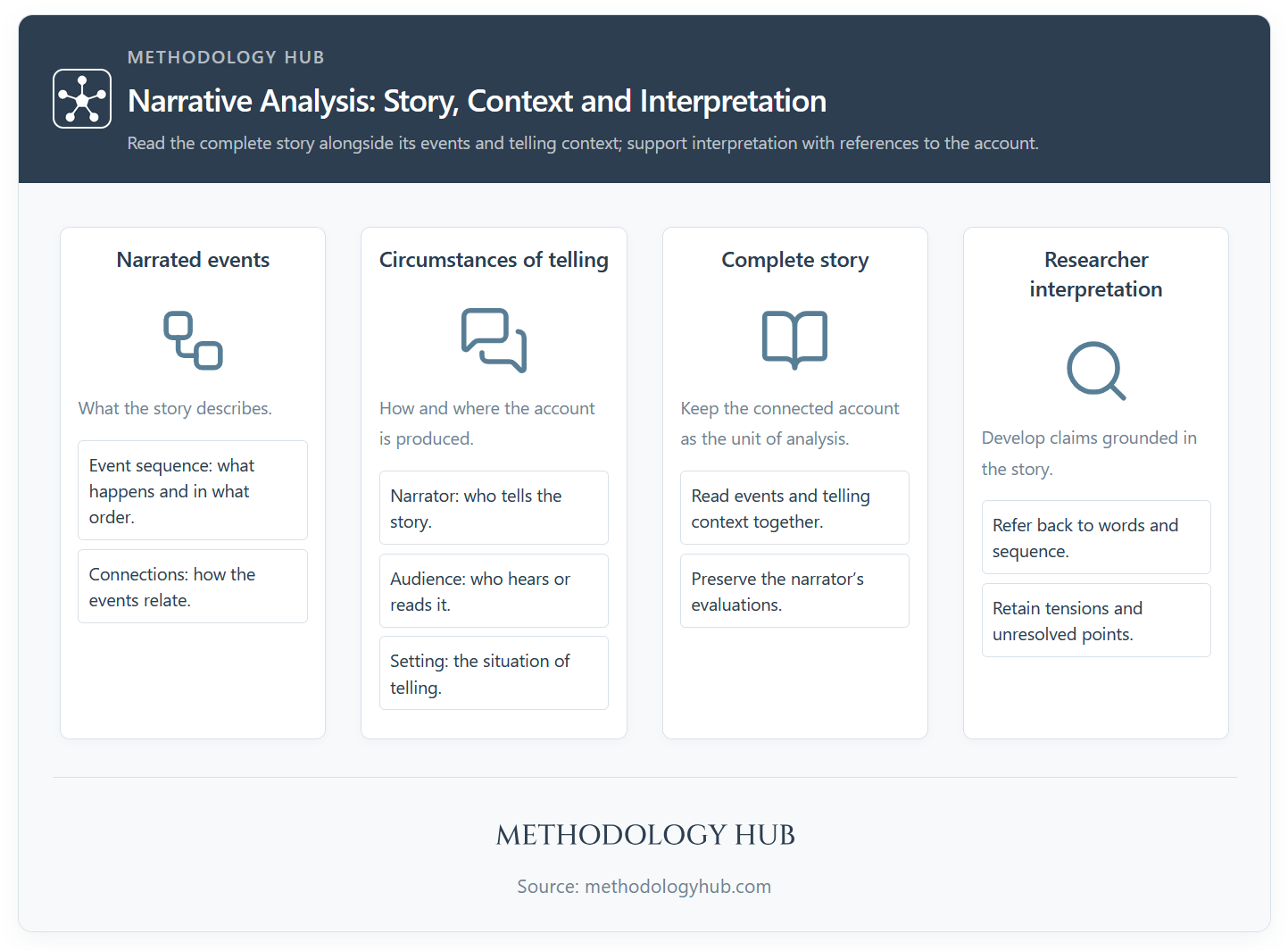
The unit of analysis can be a short episode, an extended interview account or a life history assembled from several sources. A topic-based narrative centres on a bounded experience; a biographical narrative follows a longer life trajectory. The study needs an explicit boundary around the story being examined, with enough surrounding material to support its interpretation.
Keeping a narrative intact means preserving the connections needed to interpret it. Researchers can still code sentences or compare extracts, provided those passages remain connected to the surrounding account. Later qualifications, explanations and shifts in perspective can change the meaning of an earlier statement. Extract selection must retain these relationships.
Narrative meaning also depends on what happens between events. A list of dates establishes chronology; a story may connect those dates through responsibility, regret or an explanation of change. The researcher investigates how that connection is made and what evidence supports the interpretation.
This organisation of events into a meaningful plot is often discussed as emplotment. Plot connects actions and consequences through a particular interpretation of experience. The analytical question concerns how that organisation makes an interpretation available to the listener, including which events receive emphasis and which remain peripheral.
Narrative Research and Narrative Inquiry
Narrative research is the broader study of storied experience. Narrative analysis names the interpretive work undertaken with narrative data, while narrative inquiry can describe an entire research methodology. The terms overlap, so a study should explain its usage rather than rely on the label alone.
In the tradition associated with D. Jean Clandinin and F. Michael Connelly, narrative inquiry attends to experience through temporality, sociality and place. Analysis connects past experience and anticipated futures with personal relationships, social conditions and physical settings. This orientation shapes the research relationship and data collection as well as the interpretation of narrative material.
When to Use Narrative Analysis
Narrative analysis suits questions about how people understand a sequence of experiences. Researchers often use it to study educational transitions, migration, professional development, family histories and experiences of illness. What links these topics is an interest in how people connect an earlier situation with their present understanding.
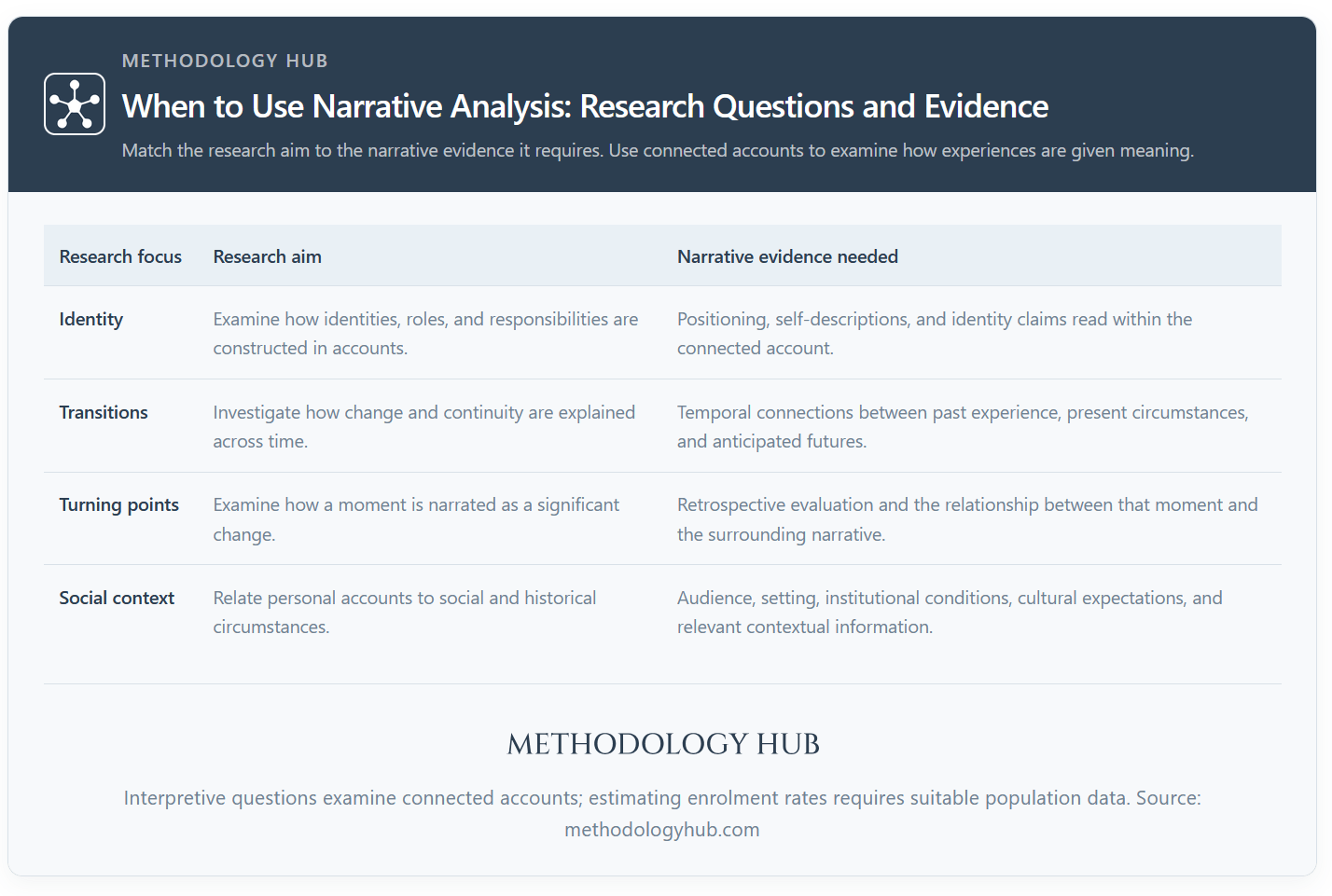
A useful research question specifies the narrative work to be investigated. Questions about how experiences are remembered, connected or explained support a narrative design. Questions about prevalence or prediction require other forms of evidence. Narrative findings can contribute to a wider study, provided their interpretive purpose remains clear.
- The research concerns how people construct identities through accounts of experience.
- The study examines transitions through the relationship between past, present and anticipated futures.
- The question requires attention to how narrators explain continuity, disruption or turning points.
- The analysis needs to connect personal accounts with their social and historical context.
Identity, Transitions and Turning Points
A story can position its narrator as persistent, excluded, responsible or uncertain. These identity claims develop through descriptions of actions and relationships. Examine who receives credit, who is assigned responsibility and how the narrator justifies those judgements. Identity can shift within an account as different relationships and audiences become relevant.
Turning points deserve similar attention. A narrator can condense gradual change into a decisive moment, assigning significance retrospectively. Compare the stated turning point with the wider sequence and the explanations surrounding it. A narrated moment of change provides evidence about interpretation; establishing its causal influence requires further support.
Scope and Practical Fit
Narrative studies often work intensively with a small number of cases because transcription and close reading take time. There is no universal sample size: the appropriate scope depends on the question, narrative richness and depth of comparison. One detailed case can support a case-specific interpretation, but it cannot establish how common that experience is in a population.
The method also needs material with a narrative dimension. A collection of one-word survey answers offers little evidence about event sequence or storytelling. Long interviews are not automatically better; a lengthy discussion of general opinions may contain fewer usable narratives than a brief account of a particular incident.
Collecting Narrative Data
Narrative data can be produced for a study or encountered in existing records. Their origin affects interpretation. An interview account answers a researcher in a particular setting; a diary entry may address an imagined future self; public testimony responds to the expectations of an institution. These audiences leave traces in the story.
Narrative Interviews
Narrative interviews give participants room to develop an account before the interviewer narrows the discussion. Begin with an open invitation that identifies the area of interest while allowing the participant to choose where the account starts. The chosen opening, initial emphasis and sequence provide evidence about how the narrator understands the experience.
Within qualitative interviews, follow-up questions can recover an event sequence or clarify the meaning of a phrase. Constant interruption risks replacing the participant’s narrative organisation with the interviewer’s preferred categories. Leave space for the initial telling, then return to passages that need more detail.
- Clarify gaps in the event sequence after the participant has developed the initial account.
- Ask participants to explain significant wording in relation to the experience being described.
- Follow up connections between episodes without supplying an explanation on the participant’s behalf.
Avoid assuming that every account should contain a breakthrough or a happy ending. Questions that presuppose recovery can push the participant towards an outcome the researcher expects. Neutral follow-up allows unresolved experiences, continued difficulty and changes in understanding to remain part of the account.
Diaries, Letters and Oral Histories
Personal journals, autobiographies, correspondence and oral histories can show how an experience is narrated at different distances from the events. Diary methods may capture uncertainty before the outcome is known. A later interview may organise the same period around an outcome that now appears inevitable.
Keep the date of the event separate from the date of writing or recording. Also record who produced the document, its intended audience and any editing. A published memoir and a private letter can concern the same event while serving different purposes. Neither should be treated as a transparent record of everything that occurred.
Recording and Transcription
Transcription decisions should follow the analysis. A thematic narrative study may prioritise wording and event sequence. An interactional study may also need interruptions, overlapping speech, emphasis and the interviewer’s responses. Video can preserve gesture and gaze when these features are relevant to the research question.
Use timestamps and speaker labels so interpretations can be checked against recordings. Preserve self-corrections when they alter agency, responsibility or the meaning of an event. Smoothing these revisions into polished sentences can remove useful evidence. During translation, note expressions whose meaning or narrative function cannot be carried directly into the other language.
Approaches to Narrative Analysis
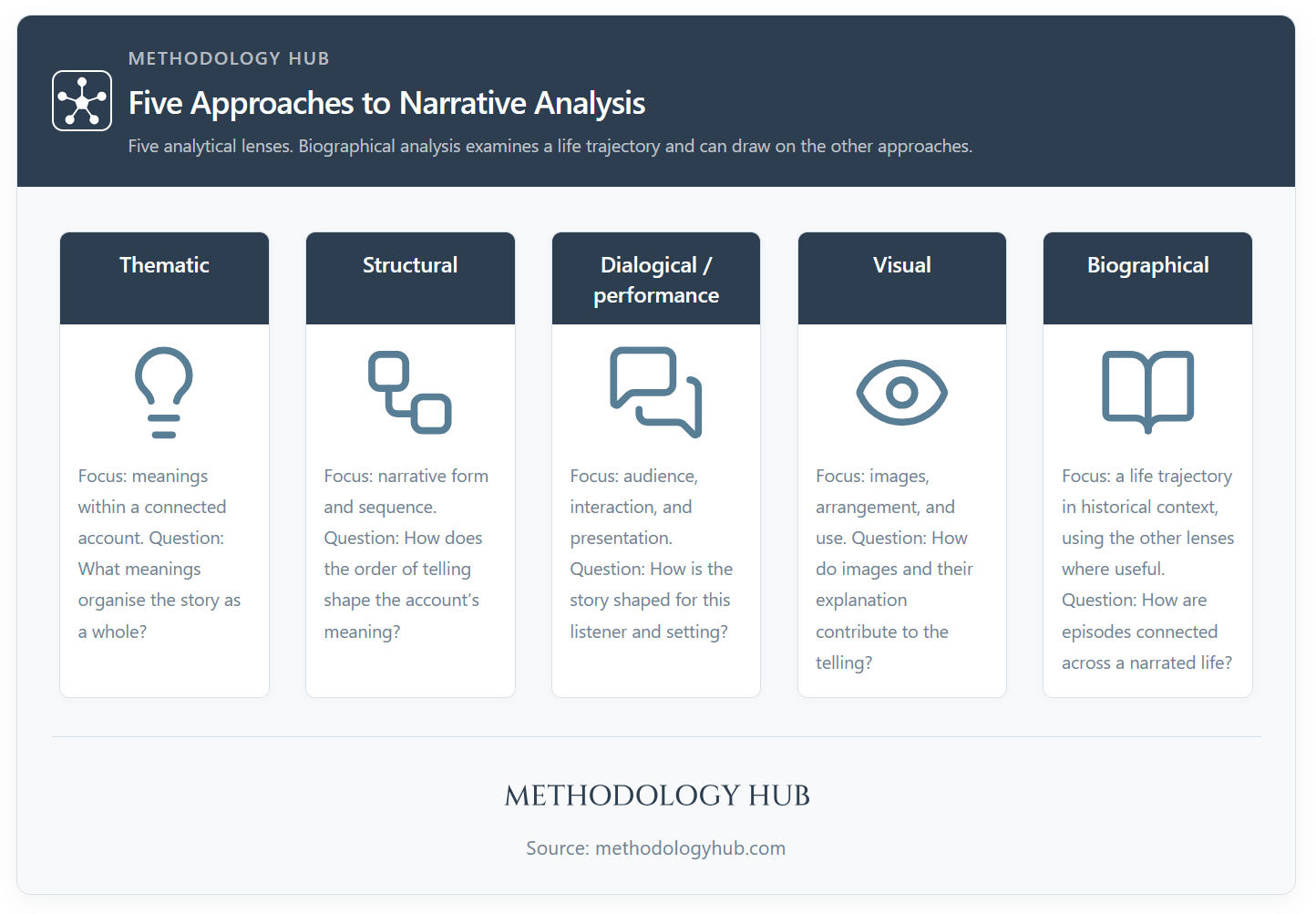
Approaches differ in the questions they ask of a story. Catherine Kohler Riessman’s methodological work distinguishes thematic, structural, dialogic/performance and visual forms of narrative analysis. These provide useful starting points; researchers can combine them when each contributes to a coherent analytical purpose.
Thematic Narrative Analysis
Thematic narrative analysis concentrates on the content and meanings of a story while retaining the case as an organising context. The researcher follows a meaning through the account, examining how it develops across episodes. Contradictions, qualifications and changes in emphasis are part of that interpretation, rather than material to remove when producing a consistent summary.
Comparison across cases is possible once each account has been interpreted in context. Shared topics do not necessarily carry shared meanings: their significance depends on their place in the narrative and the explanations surrounding them. Coding passages under the same topic can organise the material, but further analysis must establish what the comparison reveals.
Structural Narrative Analysis
Structural analysis examines how a story is assembled through language. The researcher considers its opening, the order of episodes, the distribution of detail and the way the account closes. These choices influence what the listener anticipates and how later information is understood. Analysis therefore preserves the sequence of telling alongside the events described.
William Labov’s work on oral narratives provides one influential structural framework. Other traditions examine rhythm, repetition and the organisation of speech into meaningful units. These approaches require a transcript detailed enough to support the claim being made; ordinary paragraph formatting can conceal features of spoken performance.
Dialogical and Performance Analysis
Dialogical analysis examines the relationship between storyteller and listener. The audience’s role, prior knowledge and responses help shape what is said and how it is explained. Attention turns towards what the telling accomplishes in that encounter: explaining a decision, resisting blame, requesting recognition or negotiating agreement.
Performance analysis can include reported speech, changes of voice, gesture and audience response. Here, performance refers to how the account is presented and received. It does not imply that the narrator is pretending. Examine how speech and bodily expression establish distance, authority or alignment, using recordings detailed enough to support those interpretations.
Positioning analysis connects the roles assigned to characters with the narrator’s relationship to the listener and broader cultural expectations. A master narrative provides a culturally familiar account against which personal stories can be understood. Counter-narratives contest those expectations. Both interpretations require evidence of the social conventions invoked or challenged within the account.
Conversation-based narrative analysis also examines brief, interrupted or collaboratively told episodes. Michael Bamberg and Alexandra Georgakopoulou’s work on small stories extends attention beyond polished life histories to these everyday tellings. The negotiation over whether to tell a story can be analytically relevant alongside the story’s content.
This focus overlaps with conversation analysis but does not make the methods interchangeable. Conversation analysis examines the sequential organisation of interaction, such as turn-taking and repair. A narrative study may draw on those observations to explain how a particular story and identity claim are jointly produced.
Visual Narrative Analysis
Visual narrative analysis examines how images contribute to an account. Image selection, sequencing and captions can establish connections that spoken descriptions leave unclear. Examine the relationship between individual images and the complete visual narrative, including how the arrangement directs attention and how accompanying words guide interpretation.
Interpret images with attention to their production and use. Visual content alone rarely establishes the participant’s intended meaning. Their explanation, the position of an image in the sequence and the circumstances of its production provide interpretive context. In digital storytelling, voiceover, editing and sound can also shape narrative meaning.
Biographical Narrative Analysis
Biographical analysis works across a life trajectory or a substantial period within it. It may combine interviews with documents and historical context to examine how a person narrates continuity and change. Thematic, structural and dialogical questions can all be applied within this design.
Distinguish the narrated life from an independently reconstructed chronology. A narrator may now understand an early decision through knowledge they acquired much later. Comparing that account with contemporary records can reveal retrospective reinterpretation without reducing the exercise to deciding which source is the single correct version.
Narrative Structure Analysis
Narrative structure analysis investigates the relationship between a story’s organisation and its meaning. Labov’s framework identifies six functions often discussed in the analysis of oral personal narratives. They are analytical categories, not six compulsory paragraphs that every speaker must produce.
| Narrative element | Function in the account | What to examine |
|---|---|---|
| Abstract | Signals the subject or point of the story | How the narrator announces the topic or its significance |
| Orientation | Establishes people, time, place and circumstances | Context supplied to make the account understandable |
| Complicating action | Develops the sequence of events | Actions, disruptions and temporal links between episodes |
| Evaluation | Communicates the narrator’s judgement or the point of telling | Judgements, emphasis and explanations of significance |
| Resolution | Describes the outcome of the narrated episode | How the outcome is presented and whether it settles the difficulty |
| Coda | Closes the telling or reconnects it with the present | Signals of closure or a return to the current situation |
Event Sequence and Narrative Flow
Chronological order and telling order are not always the same. A speaker can announce an outcome, return to an earlier episode, then describe the immediate circumstances. Preserve both sequences during analysis. Rearranging every account into calendar order can remove the delayed explanation or contrast through which the narrator makes a point.
Narrative flow concerns movement through the account: where it pauses, accelerates or returns to an event. Several months might pass in one sentence while a short exchange occupies a page. That uneven allocation of detail can guide further interpretation, although length alone does not establish an event’s emotional significance.
Evaluation and Narrative Connections
Evaluation may appear throughout a story. Judgements can interrupt the action, qualify a description or emerge through repeated contrasts between past and present understanding. Look for the language through which the narrator assigns responsibility or invites the listener to share a judgement. Its location helps explain which events receive particular significance.
These features also help establish tellability: what makes an episode worth recounting to a particular audience. Significance depends on the narrator’s concerns, the listener’s expectations and the circumstances of the encounter. Examine how the account establishes that relevance rather than treating dramatic content as a necessary feature of narrative.
Narrative connections can be temporal, causal or interpretive. Temporal succession establishes that one event followed another; an attributed cause explains why the narrator believes something happened. A narrative explanation makes an event intelligible from a particular standpoint. Claims about what actually produced an outcome may require evidence beyond the narrated account.
Open Endings and Alternative Structures
Some stories lack an abstract, return repeatedly to unresolved events or end without resolution. A coda may close the interview episode while the underlying difficulty continues. Apply structural categories where they clarify the account, and describe the form actually present where they do not.
Coherence also depends on cultural storytelling conventions and the interaction. An unfamiliar narrative form should not be treated as evidence of a confused speaker. Ask how the episodes connect within the account and whether the interviewer interrupted connections that might otherwise have developed.
How to Conduct Narrative Analysis
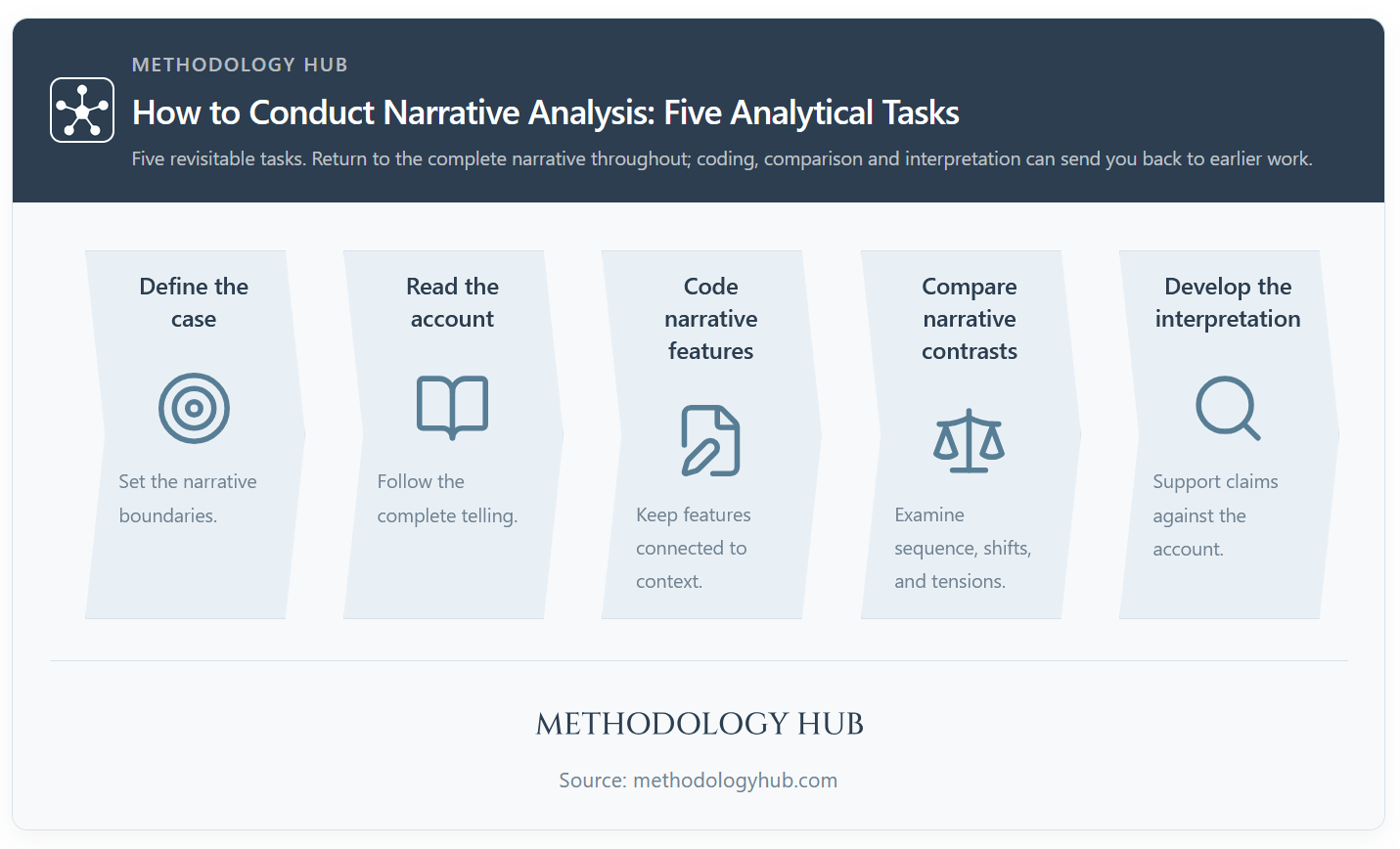
The analytical procedure should fit the study’s definition of narrative and its theoretical position. An experiential study may examine how a participant understands a transition. A constructionist study may investigate how the account produces a recognisable identity. Both require close engagement with the material, but they support different kinds of explanation.
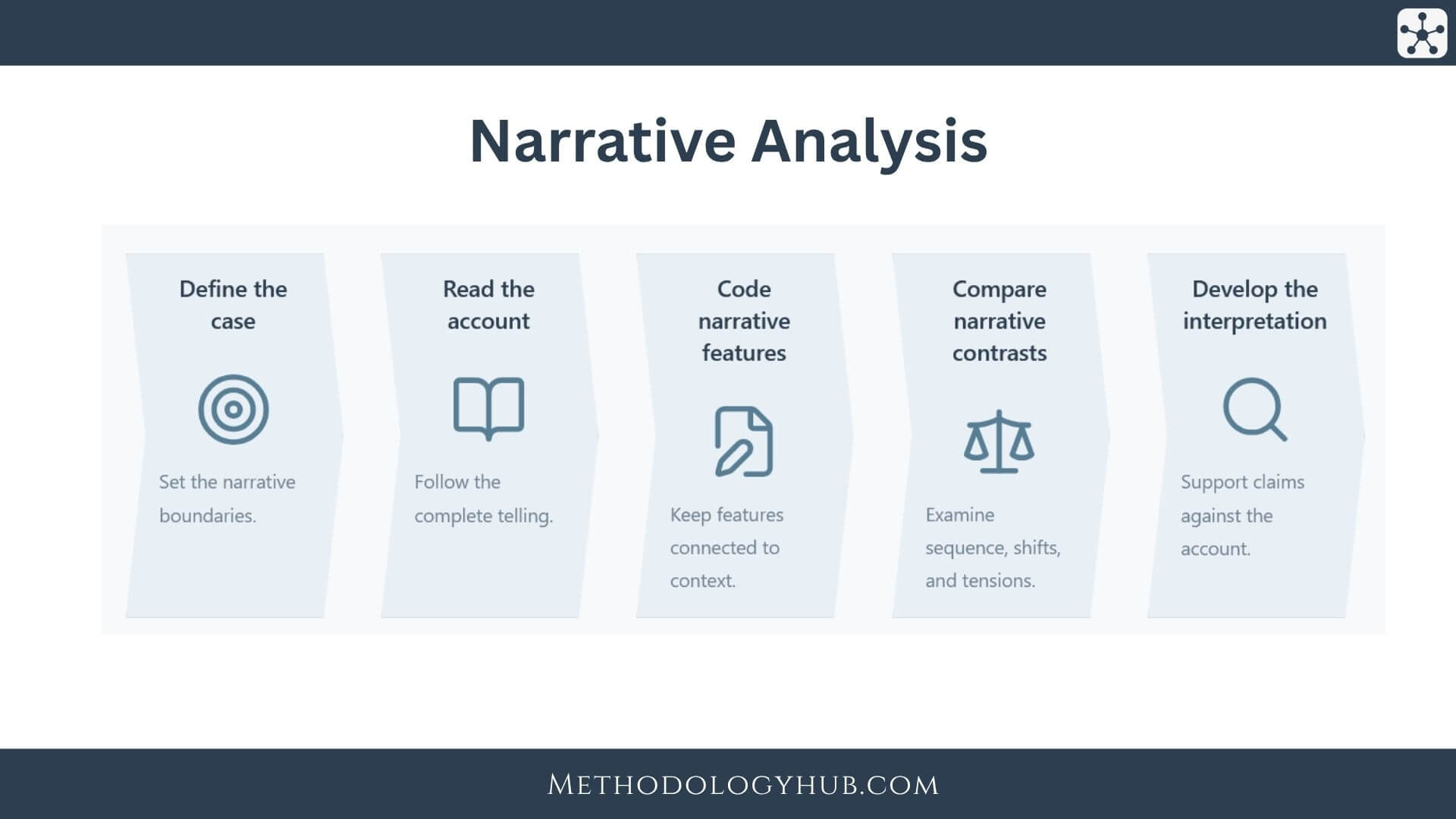
Define the Case and Narrative Boundaries
Decide whether the case is a person, a storytelling encounter, a particular episode or a collection of related documents. Then identify which material belongs to it. Narrative openings and closings can help, but a story may be distributed across an interview and revisited after an interruption.
Record the boundary decision. If a participant returns to an earlier incident near the end of the interview, excluding that passage may change the interpretation. A case record should preserve such links and identify any gaps in the available material.
Read the Whole Account
Read or listen before dividing the narrative into analytical categories. Prepare a short case summary that retains the setting, narrated events and unresolved questions. Separately note initial interpretations so that the participant’s account is not silently rewritten as the researcher’s conclusion.
A chronology can help locate discrepancies or uncertain dates. Where appropriate, archival data can provide institutional or historical context. Keep the original telling order alongside this reconstructed timeline; each addresses a different analytical question.
Code Narrative Features
Coding can mark turning points, identity claims, evaluations, metaphors or shifts in perspective. Use inductive codes for features noticed during reading, deductive codes drawn from a theoretical framework, or a justified combination. Attach each code to enough material for its narrative role to remain visible.
An analytical memo should explain the connection between an observation and a proposed reading. Record the wording or narrative feature involved, its position in the account and the reasoning behind the interpretation. Include plausible alternatives and identify what further material would help distinguish them. Memos preserve the development of the analysis as readings change.
Keep a practical record of the evidence behind each interpretation:
- Passage location and its place within the complete narrative.
- Narrative feature identified, including relevant wording or interaction.
- Interpretation proposed and the evidence supporting it.
- Alternative reading, contradictory passage or unresolved question.
Compare Narrative Contrasts
Begin with analysis within each case, then compare how cases organise similar experiences. A case-by-case matrix can preserve the opening situation, attributed turning point and ending of each account. This makes it possible to examine narrative contrasts without treating every mention of the same topic as equivalent.
Comparisons can also concern repeated tellings by one participant. Changes in emphasis, evaluation or attributed intention can show how experience is reinterpreted over time. Record differences in audience and interview conditions alongside changes in content. Variation between accounts does not by itself establish dishonesty or identify one telling as the definitive version.
Develop and Write the Interpretation
Build the findings around a clear analytical claim, then present enough narrative material for readers to assess it. A case portrait, a sequence of extracts or a comparison of narrative forms may be appropriate. Explain any reordering or reconstruction instead of presenting a polished researcher-written account as a verbatim participant story.
Where the study uses restorying, describe how source material was reorganised into a research account. Retain access to the original sequence and distinguish participant wording from analytical reconstruction. This transparency supports credibility; detailed case context helps readers assess transferability to other settings without implying statistical representativeness.
Reflexivity belongs within this work. Consider how the interviewer’s questions, professional background or expectations shaped the telling and its interpretation. Participant feedback can provide another situated reading, while discussion with colleagues can expose assumptions. Neither requires pretending that one final interpretation is the only possible account.
Narrative Analysis Example
A study of adults returning to college asks how students explain resuming education after an earlier withdrawal. The researcher uses narrative interviews and attends to both narrative content and the sequence of telling. The analytical interest concerns how returning is made understandable within an account of the person’s life.
Reading the Account
Illustrative interview extract: “The certificate is in a drawer. People ask about that, but I remember the Thursday I nearly stopped going. Three years earlier I’d left another course when my mother’s shifts changed. This time my sister said she’d collect the children. I told the tutor I had finally become more organised. Then the evening class moved, and I missed two weeks. My sister changed her own shifts after that. I finished, yes. I still leave straight after class when I visit. I don’t feel like one of the students who can hang around.”
The telling begins with the certificate but quickly shifts attention to a threatened departure. It then moves backwards to an earlier course before explaining the arrangements that made attendance possible. A chronological summary would put withdrawal first and completion last. Preserving the telling order keeps the narrator’s opening qualification visible.
| Feature in the extract | Analytical observation | Interpretation to examine |
|---|---|---|
| Certificate placed in a drawer | The expected success symbol is mentioned and then displaced | Completion does not fully organise the narrator's understanding of the experience |
| Claim of becoming organised | Personal responsibility is emphasised in the account given to the tutor | The narrator presents return as evidence of individual change |
| Sister changes her shifts | Continued attendance depends on another person's adjustment | Family arrangements complicate the explanation centred on individual organisation |
| Leaving immediately after class | Completion is followed by a present qualification about participation | Formal achievement and a sense of belonging remain distinct |
Interpreting the Tension
One possible reading concerns the uneasy relationship between self-reliance and practical dependence. The narrator tells the tutor a story of becoming organised, while the wider interview passage describes attendance sustained through a sister’s changing work schedule. An analysis could investigate how different explanations of responsibility coexist within the account.
The tutor’s response is unavailable in this extract. A dialogical interpretation would therefore need to be cautious about that encounter. The researcher can examine how the narrator reports the exchange now, but cannot establish how the tutor understood it without further evidence. Reported speech is part of the present narrative record.
The ending also resists a simple equation between completion and belonging. Leaving immediately after class could reflect childcare obligations, discomfort or several circumstances together. The extract explicitly distinguishes the narrator from students who can remain. Further interview material would help determine what that comparison means within the broader account.
Writing the Finding
A supported finding might argue that the narrator presents educational return through competing accounts of responsibility: personal organisation explains the decision to a tutor, while family coordination explains how attendance continued. The certificate provides an institutional outcome, but the closing comparison leaves participation unsettled.
This claim goes beyond repeating that childcare was difficult. It explains how the account connects practical arrangements with a presentation of self, while retaining the qualification at its ending. A fuller report would show whether the interpretation holds across the complete interview and how other cases develop similar or contrasting narratives.
Narrative Analysis vs. Thematic Analysis
Narrative analysis and thematic analysis can use the same interview material, but they usually organise the analytical question differently. A narrative study follows how an account connects experiences through time and telling. A thematic study commonly develops patterns of meaning across a dataset. Neither description determines every procedure used in a particular project.
| Comparison | Narrative analysis | Thematic analysis |
|---|---|---|
| Main focus | How a story connects experience, identity and context | Patterns of meaning relevant to the research question |
| Organisation | Often case-centred, with attention to narrative sequence | Often organised across cases through codes and themes |
| Treatment of time | Event order and telling order can be central evidence | Time can be examined when relevant to the thematic question |
| Use of coding | Codes remain connected to the narrative account | Codes contribute to developing and reviewing patterns |
| Typical findings | Interpreted cases, narrative forms or comparisons of stories | An analytical account structured around themes |
The distinction is not between preserving context and ignoring it. Careful thematic analysis also examines extracts in context, and narrative researchers can code smaller passages. What changes is the role those passages play in the final explanation.
A narrative finding usually explains relationships within an account: how its sequence, evaluations and ending support an interpretation. A thematic finding develops a pattern of meaning relevant to the research question across the selected material. The appropriate comparison therefore concerns the claim being made, the evidence it requires and the unit around which findings are organised.
Thematic narrative analysis occupies an overlapping area. It examines meanings within stories and may compare narrative cases while retaining their development and context. Simply attaching the word “narrative” to a set of topic headings does not explain how the stories were analysed.
A combined design can be useful when the question requires both forms of attention. Researchers can develop case interpretations before comparing patterns across the collection. Explain the contribution of each stage and preserve evidence of narrative sequence where it supports the findings. The report should make clear which analytical process produced each claim.
Choose the approach by considering what the report needs to explain. If the claim depends on how a narrator moves between past events and a present identity, narrative analysis gives that organisation a central role. If the aim concerns shared meanings across many accounts, a thematic approach may provide a better starting point.
Conclusion
Narrative analysis studies how accounts of experience are put together and made meaningful. Its findings depend on close attention to the relationship between events, the narrator’s interpretation and the setting of the telling.
A useful analysis can explain a shift in responsibility, an unexpected return to the past or an ending that qualifies the apparent outcome. Keep those details connected to the story they belong to. The resulting account should make a supported claim while leaving uncertainty visible where the evidence does not resolve it.
Cite this article
Whether you are preparing course materials, writing an academic paper, or sharing resources with students, we kindly ask that you acknowledge Methodology Hub as the source.
To make referencing easier, you can use the “Cite this page” tool below to automatically generate a citation in your preferred referencing style, including APA, MLA, Chicago, Harvard, and others. Simply select a citation style and click the generated reference to copy it.
When reproducing images, figures, or other materials from this page, please include an appropriate source credit and a link to the original page. Proper attribution helps others locate the original material and supports the continued development of freely accessible educational resources.